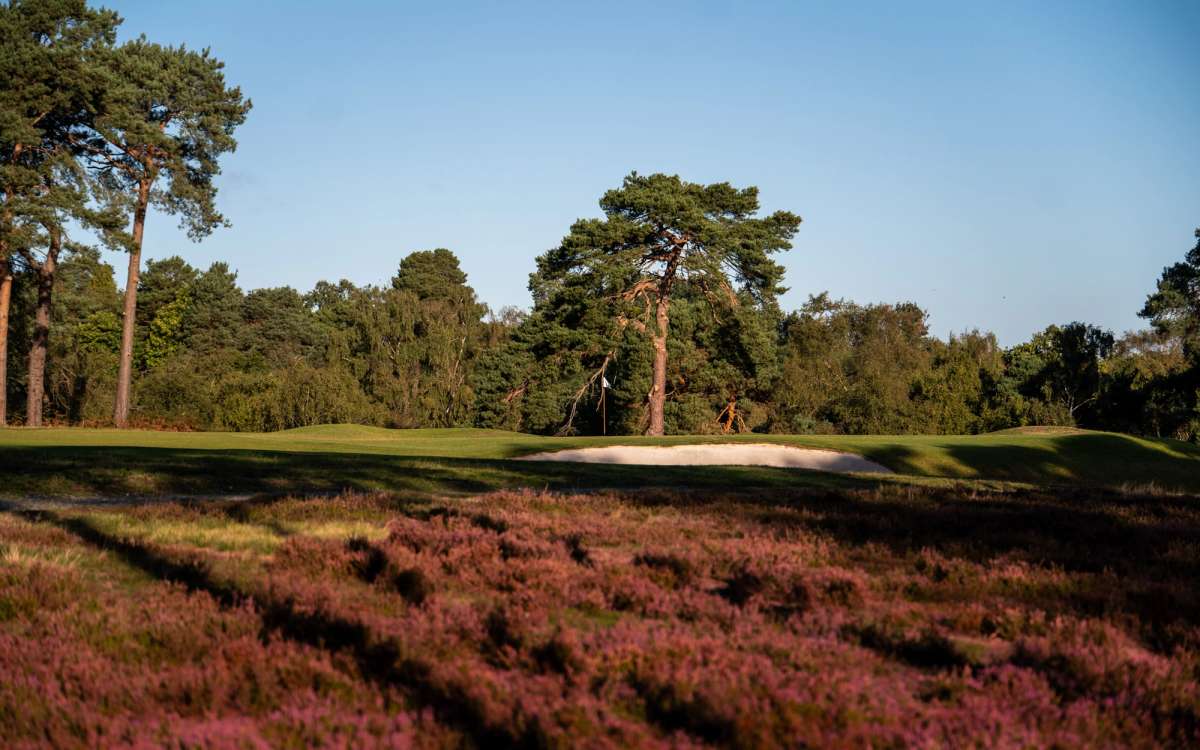
The Addington Golf Club is a rare Golden Age heathland layout in Croydon, south London, representing the only known collaboration between architects J.F. Abercromby and Harry Colt. Founded in 1913, the course stretches to over 6,300 yards across rugged, ravine-cut terrain, and has undergone an extensive restoration by Clayton, DeVries & Pont since 2020.
The Addington Golf Club
The Addington Golf Club is a rare Golden Age heathland layout in Croydon, south London, representing the only known collaboration between architects J.F. Abercromby and Harry Colt. Founded in 1913, the course stretches to over 6,300 yards across rugged, ravine-cut terrain, and has undergone an extensive restoration by Clayton, DeVries & Pont since 2020.
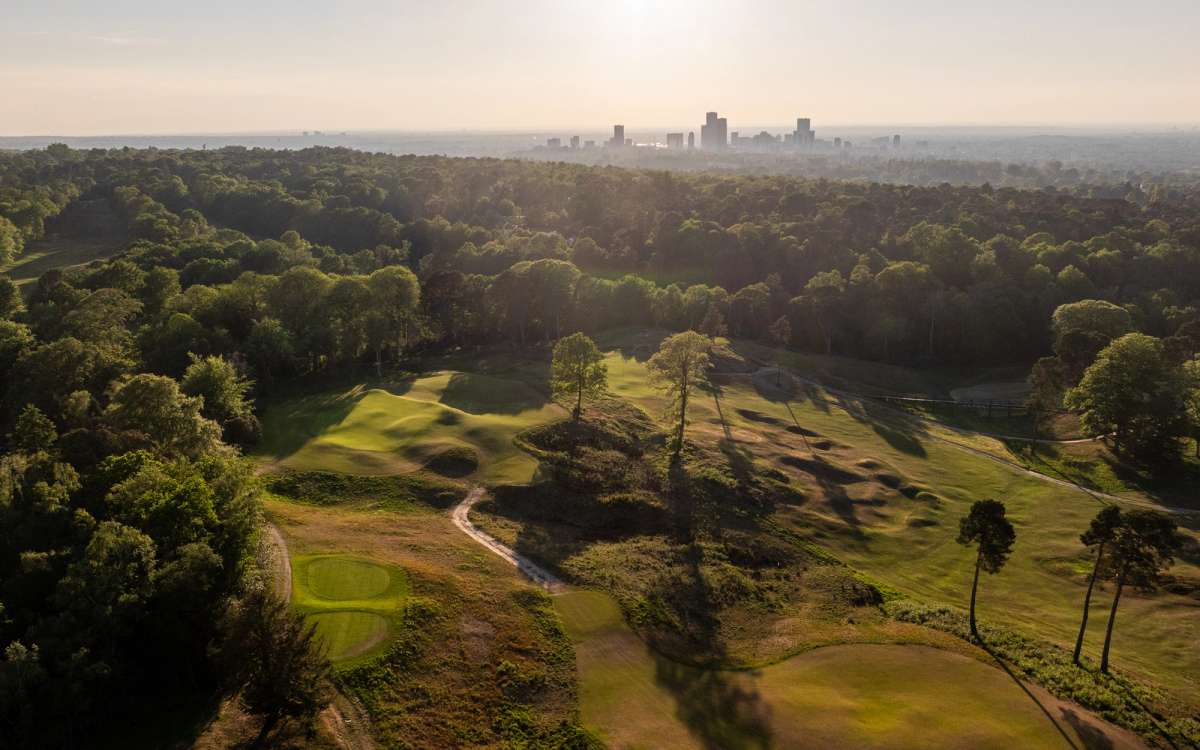
The Addington Golf Club sits on the highest ground in Croydon, just nine miles south of central London, where the Shard and Canary Wharf form the aiming line from hilltop tees. Founded in 1913, it is the only golf course in the world known to have been designed as a joint venture between J.F. Abercromby and Harry Colt, the two leading figures of early 20th-century British golf architecture. A rolling, ongoing restoration by Clayton, DeVries & Pont, commissioned in 2020, is bringing the original design back to a standard not seen since the club's inter-war heyday.
Why Play The Addington?
Experience one of Britain's most architecturally distinctive Golden Age layouts that sits inside the M25, and features par threes of the highest quality, including a hole described by Henry Longhurst as the finest one-shot hole in inland golf. No other course within striking distance of central London offers this combination of history, terrain and ongoing restoration ambition.
History of The Addington Golf Club
The origins of The Addington trace to July 1913, when the Addington Golf Syndicate Ltd was incorporated, with John Frederick Abercromby as the lead signatory. Abercromby had already built Worplesdon and Coombe Hill before turning his attention to The Addington, by then his most ambitious project. Understanding the scale of the undertaking, he enlisted Harry Colt as a consultant. Bernard Darwin visited the site during construction and noted that clearing the heavily wooded hillside required 500 labourers to remove 1,500 trees and 700 barrow loads of stones.
The club officially opened on 18th October 1919, with Abercromby remaining as chairman until he died in 1935. He was described by contemporaries as the course's sole, autocratic, and on the whole benevolent dictator, continually refining the design throughout his tenure.
The inter-war years represented The Addington's first golden period. The club became so popular that leading professionals, including James Braid, Percy Alliss and Abe Mitchell played an exhibition match to mark the New Course opening. The US Walker Cup team used The Addington as a practice venue before the 1933 match at Royal St George's. P.G. Wodehouse was a regular visitor, and his famously trap-prone relationship with the sixth-hole bunker led him to use the address "c/o the sixth bunker, Addington" for correspondence.
The Addington was privately owned for many years by Moira Fabes. She died in 2002, and in 2006 the course was acquired by Ron Noades, a self-made businessman and passionate golfer who also owned Wimbledon, Crystal Palace and Brentford football clubs. Ron Noades died in 2013, and his son Ryan subsequently became managing director. In 2020, Ryan engaged Clayton, DeVries & Pont (CDP) to begin a multi-year restoration programme aimed at returning the course to its 1913 character.
Course Layout & Playing Experience
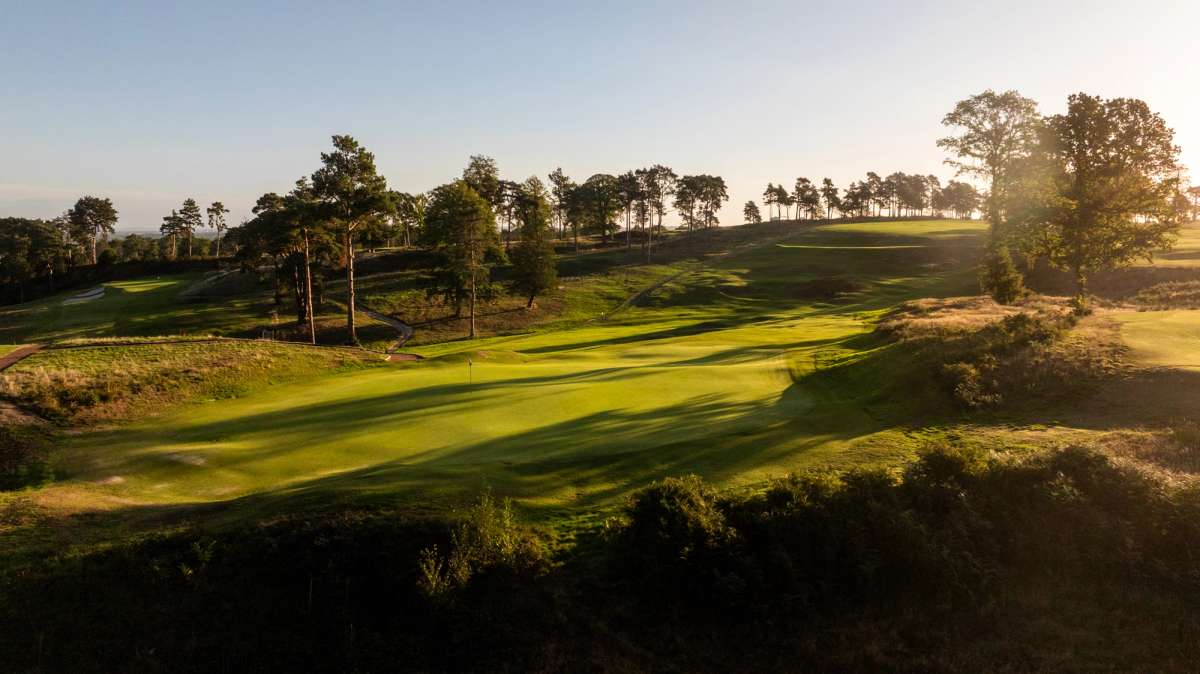
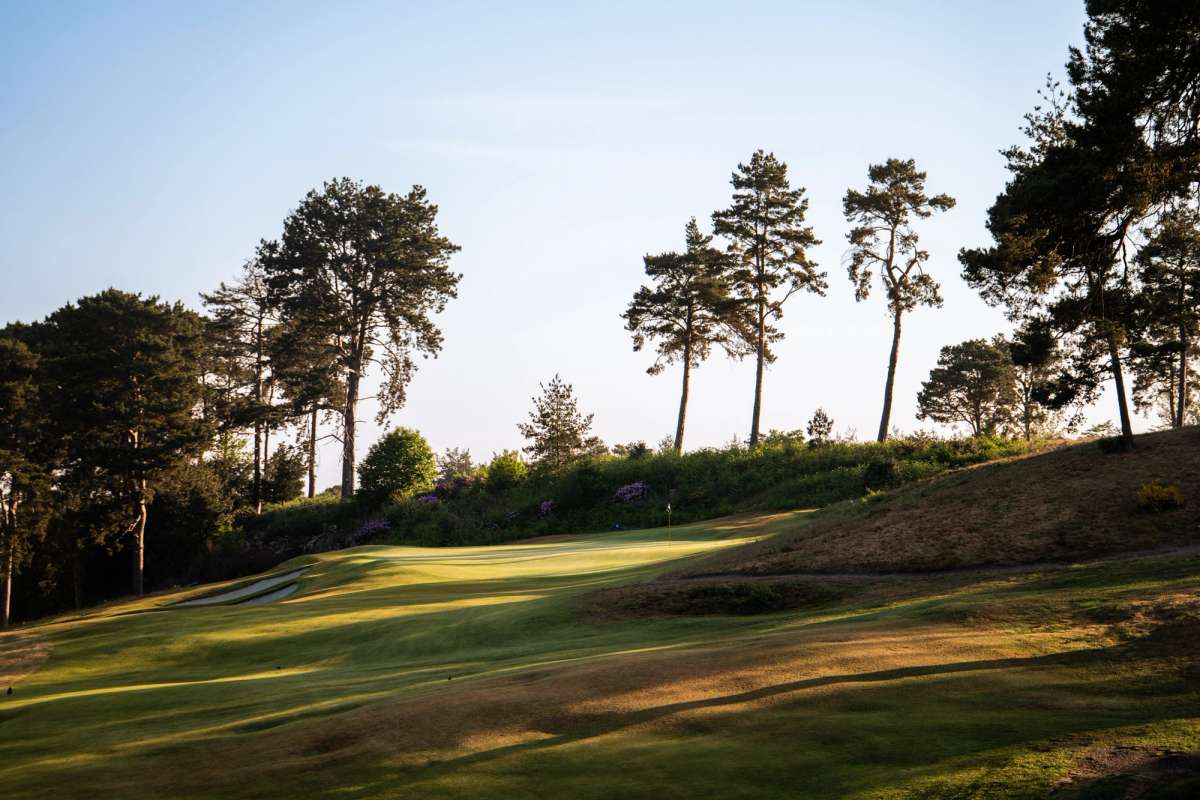
The Addington occupies a piece of ground unlike anything else in British golf. Originally gravel hills, the rugged property features several ravines throughout and, though it has become more wooded in nature over time, the terrain resists classification as heathland, moorland or parkland — it is, simply, what it is. The routing spans the high ground of the Croydon hills, producing a course that plays longer than its yardage and demands a full repertoire of shots across a par of 69.
Wooden bridges transport players across grassy ravines, opulently-sized sand-faced bunkers guard wide and demanding greens, and several holes require blind tee shots into terrain that reveals its character only on arrival. The views from hilltop tees at the 14th and 16th take in the full London skyline — with the Shard, Canary Wharf and the Gherkin visible on the horizon — a juxtaposition that is unique in British golf.
The CDP restoration, which commenced in earnest in 2020, has already transformed the course's visual character. Massive tree clearance has opened up playing corridors across the entire layout, with the effect most dramatic at the eighth, twelfth, famous thirteenth, and the sweeping downhill par-five sixteenth. Green complexes are being expanded to their original footprints, and a full bunker rebuilding programme is underway.
Notable Architectural Features
The par-three 13th is The Addington's defining hole and one of the most discussed one-shot holes in the history of British golf architecture. Playing to over 230 yards, it carries across broken, ravine-cut terrain to a green protected by one of Abercromby's most demanding putting complexes. Henry Longhurst described it as the greatest one-shot hole in inland golf, exceeded only by the fifth at Pine Valley.
The par-three seventh is one of the most significant restoration targets, where the green originally extended further back to create a spectacular double punchbowl.
In May 2024, a new par-three hole was opened using an original green site that had been taken out of play at least a century ago and was revealed by tree clearance. Recreated by Mike DeVries, the hole plays from near the tenth tees and is intended to form part of an alternative routing that Ryan Noades hopes will eventually run on alternate days. The tenth hole itself was also altered at this stage, with a new tee position transforming the mid-length par four into a 525-yard par five.
Travel & Planning
Regional Golf Context
The Addington sits within one of the finest concentrations of inland golf anywhere in the world. The Surrey–Berkshire heathland belt, stretching from the Croydon hills to the Berkshire sand lands, encompasses more top-ranked inland courses per square mile than any other region in Britain.
Within 30km (19 miles): Walton Heath Golf Club lies approximately 16km (10 miles) south-west, around 20 minutes by car, with both the Old and New courses ranked among Britain's finest heathland layouts. Royal Wimbledon Golf Club, a Harry Colt design, is approximately 13km (8 miles) west, around 15 minutes. Addington Palace Golf Club and Croham Hurst Golf Club are immediately adjacent, within 3km (2 miles).
30–60km (19–37 miles): St George's Hill Golf Club lies approximately 35km (22 miles) south-west, around 40 minutes. Wentworth Club and Sunningdale Golf Club are both within this range, approximately 40–50km (25–31 miles) west via the M25 or A3, around 45–55 minutes. Tandridge Golf Club is approximately 25km (16 miles) south, around 30 minutes. Swinley Forest Golf Club is approximately 50km (31 miles) west.
60km+ (37+ miles): The Berkshire Golf Club, Hankley Common and West Sussex Golf Club are all achievable on extended itineraries from a Croydon or central London base.
A base in central London or Croydon itself gives access to all Surrey and Berkshire heathland courses, with the flexibility to combine a morning round at The Addington with afternoon travel to the south-west corridor. Croydon hotels include Hilton and Premier Inn properties within a short taxi ride of the club.
Practical Planning
The Addington operates a visitor policy on weekdays, with weekend play available from midday. Advance booking is required. The club is moving progressively towards a more private membership model, so early contact with the pro shop is advisable to confirm visitor availability. Practice facilities include a driving range, a four-bay practice net, two short-game greens and a full-size putting green.
Want to know what other travelling golfers really think? Click the Reviews tab to discover the latest ratings and reviews.
Transport ✈️
London Gatwick Airport (LGW): Approximately 34km (21 miles), around 27 minutes by car via the M23 and A235. Car hire is available at the airport with direct motorway access.
London Heathrow Airport (LHR): Approximately 35km (22 miles) by road, around 45–50 minutes by car via the M25 and A22. Major car hire facilities on site.
By rail: East Croydon station is approximately 3km (2 miles) from the club, with fast trains from London Victoria taking around 15 minutes. From East Croydon, a taxi to the course takes approximately 10 minutes.
Ground transport: The course is accessed via Shirley Church Road (B253), off the A2022. From the M25, leave at Junction 6 and follow the A22 towards Croydon. Addington Village is clearly signposted from the Addington roundabout.
Private aviation: Biggin Hill Airport (London Biggin Hill) lies approximately 12km (7.5 miles) south-east, around 15 minutes by car, and handles private and charter aircraft.
Seasonal Timing
Spring (March–May):
The turf drains freely, and the course typically comes into excellent condition from late March onwards. Recent restoration work has increased natural light across the layout, benefiting both playing surface quality and overall presentation. Visitor demand begins to build from April, so advance booking is recommended.
Summer (June–August):
The course is in full condition, with firm, fast fairways that suit The Addington’s strategic design. Long daylight hours through July and August extend the playing window. Visitor demand is at its highest during this period, though green fee rates remain consistent with the broader peak season from May through October.
Autumn (September–October):
Often considered the finest time to play, with heather in bloom and rich autumn colour across the hillsides. Course conditions remain excellent through October thanks to the free-draining sandy subsoil, with ongoing restoration continuing to enhance playing quality year on year.
Winter (November–February):
The course performs exceptionally well through the winter months. Its elevation, gravel base, and extensive drainage system allow it to remain playable when many other courses struggle, and it is rarely closed except in cases of snow. Temporary greens have not been in use for several years. Winter visitor packages are typically available Monday to Thursday—contact the pro shop to confirm current arrangements.
The Addington: The Verdict
What makes The Addington unique is ultimately its collection of golf holes, set on a property that defies classification — rugged gravel hills dissected by ravines, unlike anything else in the British Isles. That it sits nine miles from central London, and that its design represents the only collaboration between the two principal schools of Golden Age British architecture, makes it one of the genuinely irreplaceable venues in English golf. The CDP restoration, now well advanced, has already produced a course that more closely resembles Abercromby and Colt's original intent than at any point in the past half-century. For travelling golfers assembling a London-based heathland itinerary, The Addington belongs in any serious conversation alongside the Surrey greats.
Parking
Golf equipment/accessories for purchase
Short game practice area
Golf Lessons Available
Group Clinics
Halfway House
Golf Club Rental
Restaurant / Grill
Locker Rooms with Showers
The latest ranking of the Top 100 Golf Courses in the World serves as the ultimate global golf bucket list. Most members of our World Top 100 Panel are seasoned golfers, each playing 20-30 of these courses annually while travelling extensively over decades to form their opinions on others. We recognise that opinions vary—even among our panel members. Rankings are subjective, and there are undoubtedly 50 or more courses in the UK and USA alone that could easily fit onto this list. Links Golf Pilgrimages The rankings
California, United States
New Jersey, United States
Northern Ireland, United Kingdom
New York, United States
New York, United States
England is perhaps the greatest golfing country in the world, with a plethora of world-class golf courses found both on the coast and inland. Thirteen of the world's top 100 golf courses are in this tiny country, and a total of 45 are included in the GB&I Top 100. We have an extensive list of contenders, but 50 are regularly audited and watched to see if they can crack the Top 100. Watch or Listen to the Podcast discussing the release: For the travelling golf enthusiast looking to play the world's finest courses, England has always been a treasure trove of architectural gems. With the release of the latest Top 100 England rankings, a fascinating transformation is underway that extends far beyond the mere shuffling of numbers. This paradigm shift represents a fundamental change in how courses are evaluated, restored, and presented to visitors, and savvy golf travellers should take note. The Geographic Revolution: Planning Your Golf Pilgrimage The most immediate practical change for travelling golfers is the shift from traditional county-level rankings to broader regional classifications. As the podcast hosts note, "most people couldn't find Wilshire on a map, even if you lived in England." The new system divides England into eight intuitive regions: East England East Midlands London and South East North East North West South West West Midlands Yorkshire This reorganisation isn't just administrative—it's transformative for trip planning. Instead of trying to decipher which obscurely named county contains your target courses, you can now focus on the regions you're visiting. Want to play around London? The "London and Southeast" grouping immediately clarifies your options. Architecture Trumps Reputation: The Fall of The Belfry Perhaps the most telling indication of the new ranking philosophy is the dramatic exclusion of The Belfry from England's Top 100. This isn't just any course—it's a historically significant venue that has long been considered among England's finest. Its removal signals an uncompromising commitment to architectural merit over reputation or conditioning. As the hosts bluntly put it: "We're about golf course architecture, right? It's not about how good your green keeping is." Courses struggling with drainage issues or prioritising manicured aesthetics over architectural integrity are being reassessed. For the travelling golfer, this means the rankings now better reflect courses that offer the most architecturally interesting playing experience rather than those with the most immaculate conditions. The Architectural Renaissance: Rising Stars The Addington's Dramatic Ascent No course exemplifies the new evaluation philosophy better than The Addington. This JF Abercromby design near London has rocketed up over 20 places thanks to an impressive restoration program that includes: Extensive tree removal opening up original vistas and strategic options Heather regeneration restoring the intended aesthetic and playability Routing improvements enhancing the flow and experience Creation of short game areas and alternative routing options What makes The Addington's transformation so remarkable is the passionate stewardship driving it. As the podcast emphasises, having someone "who has educated himself on the minutiae of every single aspect" makes all the difference. With renowned architect CDP consulting and master shaper Mike Devres involved, The Addington is poised to continue its ascent, potentially reaching the heights of courses like Sunningdale, Swinley Forest and St. George's Hill. For visitors, this means experiencing a course that combines historical architectural significance with modern restoration excellence—a rare combination. The Cult Favourites Rising England's ranking reshuffling has elevated several "cult favourites" that architecture aficionados have long championed. Courses like: Cleeve Hill Kington Yelverton These courses might lack the manicured polish of resort destinations but offer architectural integrity and playing interest that reward the discerning golfer. Their rise reflects a broader appreciation for "rough and ready" courses with authentic character rather than manufactured perfection. The Restoration Revolution: What Makes Good Courses Great Perhaps the most valuable insight for the travelling golfer is understanding what separates good courses from great ones in the modern ranking philosophy. Several key factors emerge: 1. Tree Management Done Right Tree removal has become a hallmark of quality restoration, but as the podcast warns, it must be done with expertise. A cautionary tale of a continental course that "actually looked worse after than before" due to improper tree removal underscores the importance of professional guidance. 2. Expanding Greens to Original Sizes One of the simplest yet most effective restoration techniques is returning greens to their original dimensions. Over time, maintenance practices naturally shrink greens, limiting pin positions and strategic options. The podcast notes that even at world-class venues like Sunningdale, Swinley Forest, and St. George's Hill, "they still struggle with the same thing." For visitors, courses that have reclaimed their original green expanses offer more interesting putting surfaces and approach shot challenges. 3. Heather Regeneration The revival of traditional heathland aesthetics and playing characteristics through heather regeneration has dramatically elevated courses like The Addington. Sutton Coldfield is highlighted as another success story, where removing "trees and scrub" has allowed the heathland to thrive once again. 4. Proper Mowing Lines Sometimes the simplest changes make the biggest difference. Proper mowing patterns that reflect the original design intent can transform a course's strategic interest without major reconstruction. The hosts emphasise this as "just good hygiene of a golf course" that any venue can implement. 5. Bunker Restoration While "renewing bunkers is not going to push it to the top of the ranking," thoughtful bunker restoration contributes significantly to a course's overall architectural integrity. Stoke Park is cited as a course that has benefited from this approach. Planning Your England Golf Pilgrimage For the golf traveller assembling an England itinerary, these insights suggest several approaches: Target the Rising Stars: Courses making big moves up the rankings often represent the best value and most exciting developments. The Addington and Wallasey should be high on your list. Don't Overlook Cult Favourites: Venues like Yelverton may lack mainstream recognition but offer architectural interest that exceeds their reputation. Look Beyond the Name: Historic reputation no longer guarantees a spot in the top rankings. Focus on courses that have embraced architectural restoration rather than those coasting on past glory. Regional Planning: Utilise the new regional classifications to build more efficient itineraries that maximise quality golf while minimising travel time. Watch for Restoration Projects: Courses undergoing significant restoration work often provide the most dynamic and interesting experiences as their original design intent is revealed. The New Standards of Excellence What's perhaps most exciting for travelling golfers is the podcast's suggestion that this movement could establish "the American standard to the UK of what it means to restore a golf course." With venues like The Addington and St. George's Hill potentially "setting the bar for restoration work," we're witnessing a golden age of British golf architecture rediscovery. For those planning their next golf pilgrimage to England, these developments promise richer, more authentic experiences that showcase the best of classic design principles. The rankings no longer simply tell you where to play—they reveal which courses are committed to presenting their architectural heritage in its purest form. Whether you're constructing an itinerary around London, exploring the rugged northwest coast, or venturing into the heathlands, understanding these architectural trends will transform your appreciation of England's golf treasures and ensure your next golf journey delivers memorable experiences that transcend the scorecard. Movers & Shakers in the England Ranking The following courses all moved down five or more spots in the latest ranking: St Mellion (Nicklaus), Wisley (Church & Garden), Lindrick, Sheringham, Woodhall Spa (Hotchkin), Woburn (Marquess), Woburn (Dukes), Little Aston, Royal Birkdale, New Zealand, Wentworth (East), Remedy Oak, The Grove, and the Isle of Purbeck. Alongside the courses that fell were those that saw the biggest rise: The Addington, Wallasey, Royal Worlington & Newmarket, Hayling, Huntercombe, Goswick, Blackmoor, Hadley Wood, Ashridge, Stoneham, Rye (Old), Seaton Carew (Micklem), and Cavendish. The standout is The Addington with an incredible 22-spot rise, followed by Wallasey with a 16-spot rise. Changing of the Guard It is probably the Top 10 in the country that will be the most contentious. Sunningdale Old and New are now ranked 2nd and 3rd. Royal Lytham, St Enodoc, and Ganton all rise above Royal Birkdale - no doubt for the first time. Woodhall Spa also stumbles out of the Top 10 after being overtaken by Royal Cinque Ports, West Sussex and Rye.

Review of the Month March 2019 – The Addington Talk about an inauspicious start – a fairly tatty uphill par 3. The sweeping second might have been a better option as an opener, but in truth none of the plain sailing opening 4 or 5 holes left much of an impression on us. The Addington gets off on the wrong foot. We’d played Cuddington earlier in the day, and so far that was the better course. It was April and course conditioning was also poor. There was also a fair bit of litter around the course, either wind blown in or left on site. If you’re going to be a low IQ parkland, you could at least be a pretty one, I muttered to myself. The Addington Golf Club photo by BB However, this all turned out to be a calm before the perfect storm. Or one of those romantic comedies where the nerdy/bullied heroine puts on a dash of makeup and isn’t quite so bad after all, or that moment when Jerry Lewis’s Nutty Professor drinks one of his own concoctions. Anyway, a great big pit next to the 6th green (quite understandable how anyone could take up residence there) with a walkway across to the 7th teeing area, signaled the change. From here on The Addington is thrilling, challenging, and idiosyncratic in equal measure. Mercurial even. The rest of the round blew by in a variety rich maelstrom of pleasure ‘twixt with pain, until, out of breath, you reach the calm waters of the 18th. This closer brings to mind again the mundane opening few holes. There are several highlights here and it is difficult to single one out. 12 & 13 was a great Par 5-3 combo, but so was 16 & 17. There were many challenging and exciting shots required. Some nice views of London too on the back 9, and in summer the course must see the odd purple patch. The Addington is pretty rough around the edges and has a slow start, but for a large part it is also brilliant golf and must be one of the better options within the M25. BB Review of the Month March 2019 selected by Editor-in-Chief, Keith Baxter and sponsored by TaylorMade – click to read more about The Addington.

A good halfway house can turn a great round of golf into a memorable one. It might be a cold beer on a Scottish links, a burger with a spectacular view or a hot drink to warm you up before the back nine. Whatever is on offer, the best halfway houses give golfers a chance to forget about the scorecard for a few minutes and enjoy the experience. We recently asked the Top100 Golf Courses community to share their favourite halfway houses, uncovering plenty of memorable stops around the world. We've picked five of their recommendations, alongside five more renowned halfway houses that are well worth knowing about. What is a Halfway House? A halfway house is a food and drink stop positioned around the turn of a golf course, usually between the ninth and 10th holes. Some are little more than a hut serving snacks and drinks, while others have become destinations in their own right, offering everything from full meals and cocktails to fires, views and plenty of local character. Five Halfway Houses Chosen by the Top100 Community Sunningdale Golf Club (England) There is a reason the halfway hut at Sunningdale has become one of the most famous refreshment stops in golf. The small Swiss-chalet-style building has been in place since 1903, sitting where the ninth holes of both the Old and New Courses meet their respective 10th holes. But the building itself isn't the main attraction. That would be the sausage sandwich. Sunningdale's legendary hut serves a simple sausage on buttered bread, with other food and refreshments available alongside it. The hut has become such an established part of the experience that the club's own tradition says everybody stops, but does so speedily. It's not fancy, and that's rather the point. After nine holes of heather-lined fairways, a hot sausage sandwich and a cup of tea can feel like exactly what golf ordered. Nairn Golf Club - The Bothy at Nairn (Scotland) The Bothy at Nairn has a history that goes well beyond golf. Built in 1877, the stone building and neighbouring icehouse formed part of the Easter Delnies Fishing Station, one of five salmon fisheries operating along the coast between Nairn and the mouth of the Findhorn. In a good season, the fishery could catch up to 5,000 salmon, with ice collected from local rivers and a specially made pond and stored in the icehouse to keep the catch fresh. The buildings have since been given a new lease of life, with the Bothy converted into a halfway house where golfers can stop for snacks and refreshments at the turn. On a cold day beside the Moray Firth, there's also a fireplace to warm up beside. The historic stone building, Highland setting and views across the course provide plenty of atmosphere. One of our community members put it rather simply: a dram of whisky and a fire are hard to beat. Hard to argue with that. Turnberry Ailsa (Scotland) Turnberry's halfway house is about as far removed from the traditional golf hut as you can get. The Ailsa's ninth hole now finishes beside the famous Turnberry Lighthouse, which doubles as a halfway house for golfers. The lighthouse itself dates back to 1873, while the golf course's dramatic ninth was redesigned as part of the Ailsa's major renovation. Inside, golfers can stop for food and drink before heading to the 10th, but the real attraction is outside. From the lighthouse, there are views across the Firth of Clyde towards the Isle of Arran and Ailsa Craig. It's a halfway stop that feels more like a destination than a quick pit stop. When your halfway house is a historic lighthouse overlooking one of Scotland's most spectacular stretches of coastline, you've got a pretty good excuse to take your time. Ardglass Golf Club (Northern Ireland) At Ardglass, the halfway-house experience is wonderfully straightforward: have a Guinness and enjoy the view. The course's old cottage halfway house at the back of the 7th green has become one of its most memorable features, with golfers able to stop for a pint before continuing their round. A recent visitor described it as a gorgeous cottage with Guinness, while another praised the combination of a Guinness, sausage roll and views over the Irish Sea. It fits Ardglass perfectly. The County Down links is already one of the most dramatic places to play golf in Northern Ireland, with the Irish Sea never far away. Add a pint of Guinness just before the turn and you've got a halfway house that feels distinctly of its surroundings. Sometimes you don't need to reinvent the wheel. Blair Atholl Golf Estate (South Africa) Blair Atholl might have been one of the less obvious names to appear among the community recommendations, but the descriptions made it impossible to leave out. The halfway stop sounds less like a quick break and more like an event. One golfer highlighted the chicken burger, a chef cooking a barbecue beneath the trees and a deck sitting beneath a stream. Another mentioned silver-service high tea. That's quite the halfway-house menu. It's also a good example of why the best stops aren't necessarily the most famous. A halfway house can become memorable because of the food, the setting or simply the feeling that you're being looked after rather than rushed back onto the course. Five More Renowned Halfway Houses St Andrews Links - The Old Course (Scotland) If we're talking about halfway houses, it makes sense to visit the place that has a claim to starting the tradition. In the 19th century, David "Old Da" Anderson sold ginger beer and other refreshments from a cart on the Old Course at St Andrews. It has been described as golf's first refreshment stand. The modern version sits behind the ninth green and keeps the tradition going, albeit with a rather more substantial menu. The pork and haggis sausage roll is a popular choice, while the club's own Tom Morris 1821 Lager provides a suitably Scottish accompaniment. It's difficult to think of a more fitting place for a halfway stop. The Old Course is steeped in golfing history, and even the break between nines has a story of its own. Pine Valley Golf Club (New Jersey, United States) Pine Valley's halfway house is memorable before you've even ordered anything. Rather than a conventional hut, it is built into the base of an old water tower, which golfers encounter around the eighth hole and again near the 12th tee. It's an appropriately unusual feature for one of the world's most unconventional golf courses. The tower doubles as a stop for drinks and snacks, giving golfers a chance to take a breather before continuing around Pine Valley. It even boasts an impressive collection of golf balls from around the world. There aren't many halfway houses that can claim to be built inside a water tower. Quivira Golf Club (Baja California Sur, Mexico) Quivira has taken the halfway-house concept and spread it across the entire round. The Jack Nicklaus-designed course has multiple all-inclusive comfort stations, each offering golfers food and drinks as they make their way around the Cabo San Lucas layout. The most spectacular is The Cliffs, perched almost 300 feet above the Pacific, where golfers can stop for a breakfast burrito and take in the views over the ocean. Then there's The Oasis, the main halfway house near the ninth green. Here, the emphasis is on the food, with freshly prepared Baja cuisine including tacos and tostadas, alongside a full tequila bar. A final stop, Cañada, sits near the 16th tee, while another comfort station beside the oceanfront practice facility offers snacks and cold drinks before golfers even reach the first tee. The food and refreshments are included in the green fee, making Quivira's comfort stations much more than somewhere to grab a quick drink. Tacos, tequila and spectacular Pacific Ocean views make the breaks almost as memorable as the golf. Whistling Rock Country Club (South Korea) At Whistling Rock, there isn't just one halfway house to look forward to. The South Korean club is made up of three nine-hole loops, each with its own themed tea house: Cocoon, Temple and Cloud. The three buildings are each distinctly different. One is a rounded structure between a lake and forest, another is a formal wood-and-glass building, while the Cloud tea house sits high among the trees. The result is a halfway-house experience that feels distinctly different depending on which nine you're playing, with each tea house adding another layer to the Whistling Rock experience. Royal Dornoch Golf Club (Scotland) Royal Dornoch's halfway house is proof that sometimes the best idea is a simple one. The stop sits behind the ninth green of the Championship Course, with views back across the links towards the Dornoch Firth. And then there's the traditional order: hot chocolate with Bailey's Irish Cream, a combination that makes considerably more sense when you're standing on a Scottish links in a North Sea wind. It's a small detail, but one that has become part of the Royal Dornoch experience and exactly the sort of halfway-house tradition golfers remember.