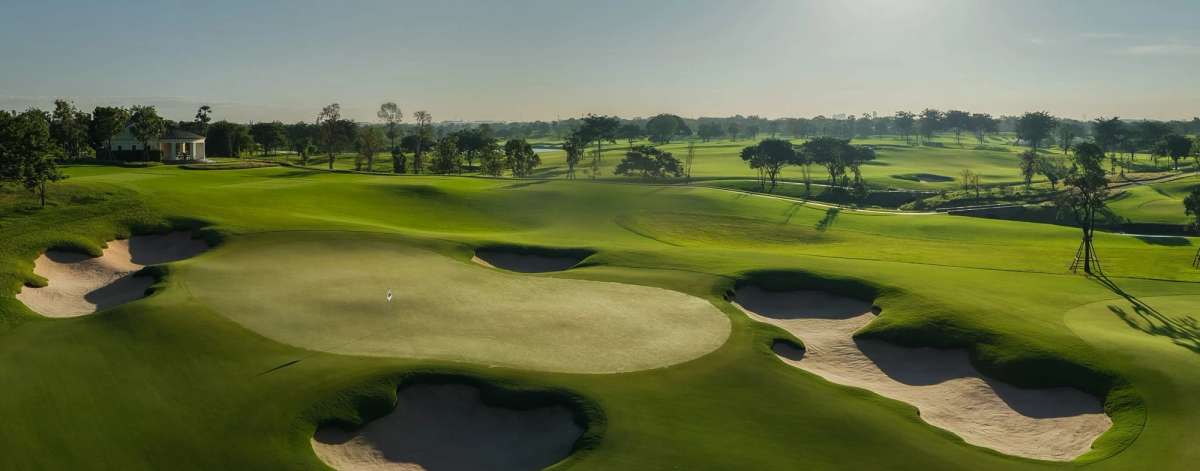
Formed in 2007 by thirty of Thailand’s wealthiest people, Ayodhya Links is one of the most exclusive golf clubs in Asia. Membership is by invitation so only the great and the good of Thai society mingle in the clubhouse...


Ayodhya Links
Formed in 2007 by thirty of Thailand’s wealthiest people, Ayodhya Links is one of the most exclusive golf clubs in Asia. Membership is by invitation so only the great and the good of Thai society mingle in the clubhouse...

6
I had the pleasure of taking a much too short trip North of Bangkok to visit Ayodhya Links recently. It’s located in a perfectly flat swamp area in Thailand, not a hill to be found. What they have managed to do with the land they built on is nothing short of a miracle. Ayodhya is a course full of water, in fact, water comes into play on nearly every hole. It’s an extremely challenging layout with World Class greens and surrounds. The course is full of subtlety and wonderful bunkering. I will say it’s a course that needs to be played several times to really get and try to understand all the strategy built into the holes. The green complexes are so outstanding that pin placement truly determines where you must place your drive to have a solid shot at par or better. The property is huge and the course is very walkable with the routing from green to tee being well thought out. Visually there is nothing spectacular about the property yet the brilliance of Ayodhya lies in the architecture and what’s been accomplished there. Hats off to Mr. Pitak for this great accomplishment.
Our host suggested he always wants the greens to run faster, however at 10 on the stimp I was more than satisfied, faster would certainly eliminate a lot of pin positions as they are full of internal contours. Approaches from the wrong area result in all but the most brilliant shots being left with delicate recovery shots and it’s quite easy to run up a big score around the greens.
Ayodhya Links is certainly the best course in Thailand and one of the gems in Asia. It’s been voted into the World Top 100 Courses, while that inclusion and resulting position could be challenged it’s certainly a course that should be a serious contender and a course I would love to play several more times.
David Davis
The latest ranking of the Top 100 Golf Courses in the World serves as the ultimate global golf bucket list. Most members of our World Top 100 Panel are seasoned golfers, each playing 20-30 of these courses annually while travelling extensively over decades to form their opinions on others. We recognise that opinions vary—even among our panel members. Rankings are subjective, and there are undoubtedly 50 or more courses in the UK and USA alone that could easily fit onto this list. Links Golf Pilgrimages The rankings
California, United States
New Jersey, United States
Northern Ireland, United Kingdom
New York, United States
New York, United States

Top 50 Golf Courses of Thailand 2017 We create three new regions and extend our coverage in the Kingdom of Thailand to a Top 50 Thailand’s golf brand remains as strong as ever, if events at the recent International Association of Golf Travel Operators awards ceremony in Mallorca are anything to go by. The Asia and Australasia Golf Destination of the Year 2017 was awarded to Chiang Mai Province in Northern Thailand and the Sustainable Golf Course of the Year 2017 award (with regard to Community Value) was allocated to Laguna Golf Phuket, on the Andaman island of the same name. We’ve gone some way towards recognising the wide geographical spread of Thai golf by dividing our coverage within the country into three distinct areas; north, south and central. Although the new national Top 50 is dominated by courses from Bangkok, Hua Hin and Pattaya in Central Thailand, we now maintain a Top 10 for both the Northern and Southern regions, allowing us to shine the spotlight a little bit wider than before onto a total of sixty different courses. And so, without further ado, we can reveal that our latest national rankings for Thailand are headed by the impressive Ayodhya Links in Bangkok, a Thomson & Perrett design that debuted almost exactly a decade ago now. Described by one reviewer as “nothing short of a miracle… extremely challenging… full of subtlety and wonderful bunkering,” it’s a very private facility that doesn’t see much traffic during the year. In the runner-up spot at number 2 – having climbed three places to number 3 when we updated the chart two years ago – we have Ron Garl’s mid-1990s layout at Alpine Golf Club. Situated to the north of the capital, not far from Ayodhya Links, this course was described by the author in James Spence’s book The Finest Golf Courses of Asia & Australasia as “an exquisite tropical gem, a good test and a thoroughly enjoyable experience.” Also moving up one position to number 3, the Old course at Siam Country Club is one of three courses operated by a prestigious club that’s located half an hour’s drive to the east of Pattaya. Originally opened for play in 1971 then renovated by Schmidt & Curley in 2007, the layout is home to the Honda LPGA Thailand ladies’ tournament and the 11th edition of this annual event will be held here next month. The course at Thai Country Club in Bangkok also makes a positive move up the new chart, rising three places to number 6. Twenty years in operation this year, the 18-hole layout was a brand new track designed by Dennis Griffiths when it hosted the Asian Honda Classic in 1997, an event won by newly-turned professional Tiger Woods, who ran away with the tournament when he claimed the title by a 10-stroke winning margin from his nearest rival. The 27-hole complex at Laem Chabang International Country Club outside Pattaya makes a significant move up the national listings, leaping four spots to number 7, and this is one of half a dozen Thai courses which were laid out by the Golden Bear’s design company in the early 1990s. The preferred 18-hole combination here consists of the B (Lake) and C (Valley) nines but the hillier A (Mountain) circuit at the back of the property is also not short of admirers. Further down the 2017 Thai standings, the highest new entry at number 20 comes from Rajpruek, a Michael J. Poellot design that sits close to Don Muang, Bangkok’s old international airport. Invited guests may have a little overhead interference from incoming and outgoing aircraft to contend with when playing here but they’ll tell you it’s a price worth paying to sample this beautiful private parkland track. Several recent developments impacted on our Thai ranking process, including Schmidt & Curley’s unveiling of a new 18-hole course – with spaceship-styled clubhouse – at Royal Bang Pa-In Golf Club (a new entry at number 26). An additional 9-hole layout (the West course) at Black Mountain Golf Club in Hua Hin also opened earlier this month whilst the Alpine Golf Resort in Chiang Mai has just been extended and upgraded to a 27-hole facility. Rank/ To view our Thailand Top 50 click the link. As ever, we’d be delighted to find out what you think of this revised Asian national chart. Why not get in touch with us via the “respond to this article” link at the top or bottom of this page if you have any strong opinions? We’re also keen to publish more reviews for our Thai courses so if you’ve played any of the country's top tracks then we’d be really pleased to have you post a few sentences to let us know what you thought about your playing experience. Jim McCann Editor Top 100 Golf Courses

Top 40 Golf Courses of Thailand 2015 Thailand does its best to maintain its reputation as the powerhouse of southeast Asian golf The Tourism Authority of Thailand’s assertion that the country is “increasingly becoming a top destination for travellers looking for great courses, great prices, and great service” is one that’s hard to disagree with. Indeed, as the global economy slowly emerges from a lengthy period of recession and the number of golfers booking golf holidays in The Kingdom of Thailand appears to be on the increase, the TAT statement is one that deserves our wholehearted endorsement. Over 200 golf courses are dotted around the country and more than a quarter of the layouts are located in and around the main centre of population in Bangkok, as might be expected. To the mountainous north of the country, in the Chiang Rai and Chiang Mai regions, you’ll find over a dozen top class courses, including Santiburi and Chiangmai Highlands, with most of the remaining Thai golf facilities arranged in three clusters to the south of the capital in Pattaya, Hua Hin and Phuket. We’ve presented the best courses in Thailand since 2009, expanding the coverage to thirty 18-hole layouts in 2012. Utilising local knowledge gleaned from regional correspondents, the number of ranked courses in Thailand has just been increased to forty and in the latest edition of the Thai chart, eleven courses move up, eleven drop down, four remain in the same position and another four fall from the ratings completely, allowing fourteen new entries to come in. For a nation that’s normally so accessible, many will find it ironic that our top three tracks in Thailand are all private facilities, where only members and invited guests can play. We make no distinction between private and public courses. If a course is amongst the best in its district/region/state/nation then it’s ranked, regardless of who can or can’t play it, it’s as simple as that. We don’t endorse elitism, we merely exhibit the best courses that exist around the world. Kimi, our Southern Asian correspondent, played the Thai No. 1 course at Ayodhya Links recently and was suitably impressed by what he found, saying, “this Thomson & Perrett design is a masterpiece for them. It is perfect in every aspect. Many holes are memorable and impressive. The owner is using a non-chemical method of golf course maintenance so it is an organic golf course. In order to maintain this great course, the owner keeps paying the multi-million dollar deficits every year as he loves his course and likes it very private”. Expect a full review from Kimi in the near future. Another two courses in the greater Bangkok area hog the limelight in our new listings. The Schmidt & Curley-designed Amata Spring course, former host venue of the Royal Trophy between 2006 and 2010, features a rather ingenious floating island green at its par three 17th hole and it retains the runner up spot in our new Thai table. This new millennium design has also managed to hold off the “botanical garden” layout at Alpine Golf Club, which climbs a couple of places to number three. The modern beach resort of Pattaya lies on the Gulf of Thailand, to the southeast of the capital, and it’s home to the number four course in Thailand, the Old at Siam Country Club, which was redesigned in 2007. Other highly rated golf facilities in this area include the 27-hole Jack Nicklaus complex at Laem Chabang International, along with the rather unconventional Des Muirhead layout at St Andrews 2000, an 18-hole course that plays to a par of 74, including par sixes at holes 4 and 13. Thailand’s original beach resort at Hua Hin, on the other side of the Gulf of Thailand from Pattaya, is situated a two and a half-hour drive from Bangkok and it somehow manages to retain much of its old fashioned charm, despite the many modern day tourist pressures exerted on it. Amongst the many good quality golf courses located in this region, the modern courses at Banyan (up five places to number five) and Black Mountain (down three spots to number seven) are undoubtedly the finest in the locality. The island of Phuket, lying just off the west coast of Thailand in the Andaman Sea, is internationally recognised as one of the most exotic travel destinations in southeast Asia. Fortunately for golfers, it has eight golf courses available for public play, the best of which are the fabulous Canyon and Lakes courses at Blue Canyon (number eight and twelve, respectively, in our national chart) and the remarkable Red Mountaincourse, which the Morrow Tikkanen design company introduced in 2004 (up six places to number six in our new listings). Major golf developments in Thailand last year included the construction of new 18-hole courses at Nikanti Golf Club in Bangkok and at Katathong Golf Club in Phang Nha. There was also the addition of another nine at Chiang Mai Highlands, creating an expanded 27-hole complex. And with substantial renovation work carried out at Laguna Phuket and Gassan Legacy, there’s no way anybody could say that Thailand was not trying to keep pace with a fast-changing golf world. To view our new Thailand Top 40 click the link. As ever, we welcome feedback so please let us know if you have any strong feelings about our new Thai listings. We never boast of publishing “definitive” lists but we do think that we produce the “most informed” rankings in the golf industry. If you’ve been fortunate enough to tee it up at any of the courses below, why not post a review and share your views with us? Dragon Hills, Evergreen Hills, Panorama and Royal Ratchaburi are the four courses that have dropped out of our latest Thai chart to make way for fourteen new entries. Jim McCann Editor Top 100 Golf Courses
The Long Lost Lido Found — Twice Most years feature one piece of golf course-related news that dominates the others. The opening of Bandon’s Sheep Ranch was quite the headline for 2020. A short way into 2021, and another Mike Keiser project is already the talk of the town: A recreation of the legendary Lido Golf Club, to be constructed near the Sand Valley Golf Resort in Central Wisconsin. The hubbub is justified by years of growing interest in golf course architecture, and particularly the philosophy of Charles Blair Macdonald. The stockbroker was dubbed “The Evangelist of Golf” by writer H.L. Whigham, and his template approach to course design — incorporating influence from the world’s most renowned holes, as seen at the National Golf Links of America — has been a central concept to the study of “The Golden Age” of golf course architecture. National Golf Links of America 4th hole - Redan The Lido was another Macdonald design, and one that fell into oblivion following the second World War. Such was the acclaim from players and experts during its time that it has become an object of fascination for modern architecture enthusiasts. That it would soon (2023) be available to the general public (or at least those staying at Sand Valley) inspired a wave of celebration. Amid the noise, you hardly would have guessed that another new Lido had opened in just the past year. Gil Hanse and Jim Wagner led the creation of a modern Lido at the Ballyshear Golf Links in Thailand. Ballyshear 12th green Two recreations of the same classic golf course, within the period of just a few years? How does one explain the sudden rush on Lido? Macdonald’s NGLA has always been a mainstay of architectural discussion and remains so to this day. Conversations on his acclaimed templates — including the Redan, Eden, Alps, and Long among others — almost always include the version from NGLA. A slew of originals at Lido, less prominent among Macdonald and Seth Raynor’s future designs, offer intrigue. NGLA 9th hole Long - image courtesy of Jon Cavalier @LinksGems Macdonald invited readers of Country Life and amateur architects to submit original designs for inclusion—with the entries judged by Bernard Darwin, Horace Hutchinson and Herbert Fowler. The winner was Alister MacKenzie, whose multi-fairwayed “Home” closed the routing. No. 15, named “Strategy,” was unofficially submitted by Tom Simpson (as he was an affiliate of Fowler, a judge). Raynor is believed to have adapted what would become known as “Raynor’s Prize Dogleg” from another submission, which became the No. 6 “Dog’s Leg” hole. Perhaps the club’s most iconic hole was the debut of the “ Channel,” a Littlestone-inspired par five that dared the bold to hit its island fairway on the way to an eagle opportunity. Littlestone Golf Club - 16th hole Channel - image courtesy of Littlestone Golf Club NGLA, however, was built for skilled amateurs and featured two U.S. Amateur champions among its membership. The Lido was longer and meaner, perhaps designed to test professionals and match Pine Valley’s notoriety as a man-eating test of golfing will. “Lido if you know it is like a boiled New England dinner, which if it doesn’t kill you young will make you a very husky citizen, set to digest anything that comes your way. So it is with Lido,” wrote Bernard Darwin for The Brooklyn Daily Eagle. “Once you’ve become inert to these ferocious carries and the all-engulfing rough, the iron has entered your soul and you are capable of tackling any golf course that the genius of Charlie Macdonald or Seth Raynor or Walter Travis can conceive.” Bret Lawrence, a golf historian, notes that the Country Life contest specifically calls for two-shot holes, suggesting Macdonald didn’t want another short hole. “He wanted two-shot holes, which are basically two full-shot holes,” Lawrence explains. “You could kind of get the sense from there that he wanted more of those as opposed to a drive and pitch kind of hole, which would make it shorter. He was looking for more strategy in the longer holes...because he wanted to test the professionals.” The originators, however, weren’t professionals, but wealthy New Yorkers who had previously tapped Macdonald to build clubs such as Piping Rock. With names like “Vanderbilt” on the ledger, no expense was spared, and earth was moved to such a degree as to put Whistling Straits to shame. Piping Rock Club 13th hole - image courtesy of Jon Cavalier @LinksGems “It almost seemed like they were trying to develop the area,” says Lawrence. “There was nothing out there at the time.” Those plans hit the skids with the onset of World War I and the original investors had lost interest by the Great War’s conclusion. The next buyer was William Reynolds, a former senator who began the area’s real estate boom and built a hotel, putting the retitled Lido Beach Golf Club on the map for the wider population. At its peak, the club featured more than 1,000 members. Unfortunately, that peak ended with Reynolds’s death; between his family and other investors, the “all-engulfing rough” soon received less care. Even at its critical peak, Macdonald was disappointed in the upkeep. “What he was unhappy about was — he mentioned this in Scotland’s Gift — that they didn’t keep up the golf course,” explains Anthony Pioppi, executive director of the Seth Raynor Society. “I think he expected the Lido to be treated the way National treated its golf course.” The U.S. Navy assumed control of the property during the next World War and it never returned. The legend, however, lived on, culminating with the new projects from Hanse and Tom Doak, who will be handling the Sand Valley installation. Those two projects will ultimately provide radically different Lido experiences, however. The Ballyshear Links is much less a carbon copy, due to the limits of the property Hanse and Wagner had to work with. The pair pitched the project to the owner of the Ban Rakat Club, understanding that they would need to tweak the original routing a smidge to make it fit, and their approach would be more in line with Macdonald’s approach at NGLA; creating interpretations of the historic holes versus clones. “Normally...we feel strongly that a golf course should be the product of its surrounds. But in the back of our minds, my partner Jim Wagner and I have often wondered what we would do with a completely flat site — what can you do to distinguish it?” Hanse said in a statement. “The most famous example of a manufactured golf course from The Golden Age was The Lido. Jim and I had always wanted to do a Macdonald/Raynor, angular grass-faced bunker design. We pitched the idea to the owner at Ballyshear and he loved it.” And that’s where Doak’s Lido will be different: The plan is an almost exact clone of the original Lido, built in Wisconsin rather than Long Island. Such a feat is possible because of technological advances. Peter Flory, a Chicago-based architecture enthusiast, has been building a 3D replica using the course design feature of The Golf Club computer game. That prompted a call from Doak, who had watched Flory’s progress via Golf Club Atlas. What began as a Flory’s passion project became the driving force for the course’s recreation. “I would not have agreed to take it on if I didn't think Peter's work gave us a chance to do it accurately,” Doak told Top 100 via email. Still, Hanse’s rendition didn’t require such digital wizardry, so the sudden Lido lean can’t all be attributed to modern tech. So why now? For Doak, Flory’s work represented a potential punctuation for a sentence that had begun long ago. The architect had previously created a tribute to Lido’s designer for Keiser, with the Old Macdonald course at Bandon Dunes. This track, like Macdonald himself, aimed not to replicate anything but rather adapt existing templates to the Oregon landscape. Apparently, even during 2005, Lido was on Keiser’s mind. Doak says the resort magnate expressed his interest in recreating the Lido while the pair discussed the third course at Bandon. Old Macdonald 4th hole - image courtesy of Bandon Dunes Bandon was blooming at that time, but Keiser’s resort ownership has only grown since then, operating nine 18-hole courses (and accompanying par three courses) between his three resorts. Doak suggests the root of both Keiser’s windfall and Lido’s rise is the relatively recent appreciation for golf course architecture. “There is 100-times more interest in golf architecture nowadays. Forty years ago, when I was a student, you were lucky to find a copy of Colt's or Macdonald's books through interlibrary loan,” he says. “Websites like Golf Club Atlas, podcasts like Andy Johnson's (The Fried Egg) and Derek Duncan's (Feed The Ball), and the golf magazines have all made golf architecture far more of a mainstream topic. They even talk about it on TV a little bit!” That still doesn’t explain “why Lido?” Why wasn’t someone like Keiser interested in restoring, for example, Ocean Links (Raynor’s nine-hole neighbor to Newport Country Club ) or the original El Caballero (Billy Bell’s masterpiece in the Los Angeles hills, prior to the club changing locations)? Simply put, the amount of information on these courses pales in comparison to Lido. “I think Lido is in a class by itself in that regard; it was much more well documented because of who designed it, because of the contest that helped make MacKenzie famous, et cetera,” Doak says, admitting even he knows relatively little about other lost tracks. “I'm a bit of a geek about this stuff, and I don't know one-tenth as much about the other courses you mentioned.” Information does exist, however, and there are certainly golf history buffs looking for it. Flory has begun creating a similar 3D model of Ocean Links, sharing his progress on Golf Club Atlas. A rendering of Sand Valley’s Lido by Peter Flory With that in mind, could the current Lido projects portend future projects focused on tributes to, and total recreations of, legendary golf courses? And if so, is that necessarily a good thing for the current state of course architecture? Pioppi is wary. “I do think that’s going to be a trend. I think because of this technology, people are going to be able to recreate holes. I mean, what’s to stop somebody from recreating the Old Course in Wisconsin? With this kind of technology, who knows?” he says. Still, he can accept such things if it means more eyes on golf course architecture. “For me, the bottom line is people are talking about architecture, which is good.” One “victim” of the Lido project is Doak’s “Sedge Valley” Swinley Forest concept, an original 6,100-yard course on the Sand Valley property. It will eventually happen...but not until the Lido wraps up. Doak doesn’t begrudge the Keisers for prioritizing the new project over his original design...but he does make a lighthearted jab at golf media’s (including Top 100) role in the narrative. “Unfortunately, this interview and all the others are demonstrating that the idea generates a lot of free publicity...more of it than my proposed third course at Sand Valley did,” he says. He states that Lido would be his only personal recreation. He compares the value of the project to his work restoring the Chicago Golf Club and others, preserving the legacy of architects he admires. “If I didn't think this particular course was worth restoring, I certainly wouldn't be doing it.” If we’re being accused for feeding the furor that results in the recreation of a legendary golf course, we’ll plead guilty! We’re looking forward to playing both new Lidos sooner rather than later. That said, we’re equally looking forward to celebrating what golf course architecture will be, and not just what it was.