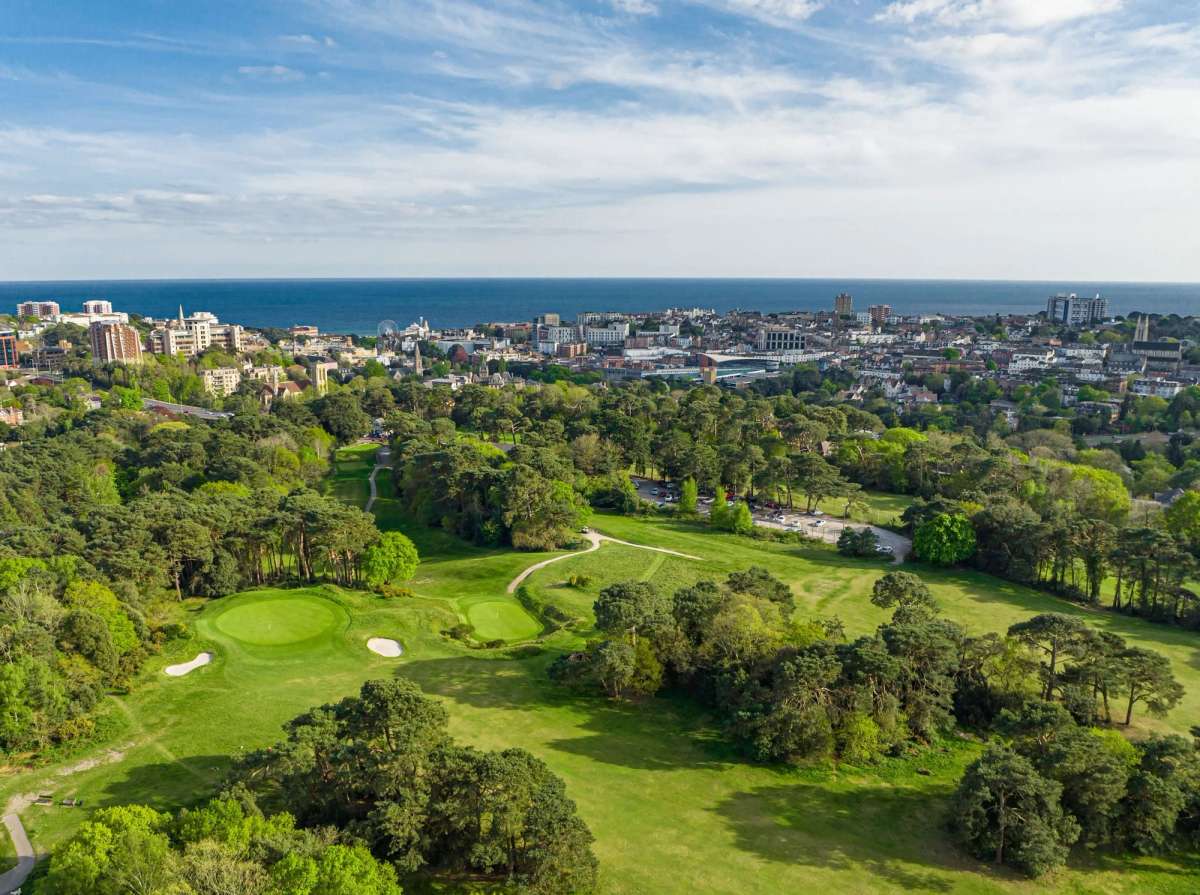
Broadstone Golf Club is laid out on glorious rolling terrain. The elevated homeward nine provides panoramic views of the Purbeck Hills and Poole Harbour.


Broadstone Golf Club
Broadstone Golf Club is laid out on glorious rolling terrain. The elevated homeward nine provides panoramic views of the Purbeck Hills and Poole Harbour.
Broadstone Golf Club is a par-70 heathland layout spanning 250 acres of rolling Dorset countryside, founded in 1898 by Ivor Bertie Guest, 1st Baron Wimborne, on his Canford Magna estate. Tom Dunn laid out the original course — then called the Broadstone Links at the Dorset Golf Club — before Harry Colt's landmark redesign between 1914 and 1922 removed all parkland holes and replaced them with pure heathland. The elevated inward nine delivers panoramic views across the Purbeck Hills and Poole Harbour, positioning Broadstone as one of the south of England's most architecturally significant inland golf courses.
Broadstone offers a rare opportunity to play a course shaped by Golden Age architects Tom Dunn, Herbert Fowler, and Harry Colt on terrain writer Bernard Darwin memorably described as designed by providence for golf.
The combination of severe elevation changes, four distinct par threes and a slope rating of 140 from the back tees makes this par 70 a more demanding proposition than its 5,777-metre (6,315-yard) length might suggest.
Lord Wimborne commissioned Tom Dunn to design the course in the summer of 1898, with the golf course officially opened on 16 November that year with a foursome featuring future Prime Minister A.J. Balfour partnered by five-time Open Champion J.H. Taylor against John Penn MP and Open Champion James Braid. Dunn, then the professional at nearby Meyrick Park in Bournemouth, was the most prolific Victorian-era golf course architect of his time.
Between 1905 and 1909, Herbert Fowler was retained to advise on Broadstone's bunkering. This represents one of the earliest documented examples of a golf course being altered by the architectural shift from the Victorian penal school to the Strategic school. The precise scope of Fowler's work remains the subject of historical debate, though his primary objective was to modify Dunn's penal bunkering philosophy.
Harry Colt was commissioned in 1914 to undertake a comprehensive redesign. His project — interrupted by the First World War — was completed by 1922. Colt's work involved routing new holes from the present 5th tee through to the 16th green across the heathland west of the disused Somerset and Dorset Railway line, eliminating all parkland holes from the layout. Writing in Golf Illustrated in 1916, Harold Hilton described the new Colt holes as 'bold' but 'eminently fair' and 'full of character'. The fifth and sixth holes, which remain today, were completed as the final stage of Colt's project in 1922.
Since the 1980s, more than three-quarters of the golf course land has been designated a Site of Special Scientific Interest (SSSI). The designation was upgraded to Special Area of Conservation in 2005 in recognition of the heathland habitat.
In 2012, Dutch architect Frank Pont was engaged to begin a multi-year restoration project focused on reinstating Colt's original bunker strategy and style. Pont's first-year work addressed the sixth and eighth holes — both Colt par threes — and the fifth hole, where tee, fairway and bunkering were altered to reflect Colt's original design.
Ongoing improvement work is led by Connor J Walsh and Gordon Irvine, encompassing bunkers, drainage, irrigation and tree clearance.
Broadstone measures 5,777 metres (6,315 yards) from the back tees with a course rating of 71.6 and slope rating of 140. The par-70 layout features two par fives, four par threes, and 12 par fours across 250 acres of undulating heathland. Fairways run separately through stands of heather, gorse, birch, pine and rhododendron, with individual holes separated by natural terrain rather than planting.
The opening three holes occupy parkland terrain shared with the closing two, providing a gentler introduction before the course transitions to pure heathland from the 5th tee. Top 100 Golf Courses notes that the elevated homeward nine delivers panoramic views of the Purbeck Hills and Poole Harbour. The course requires every club in the bag across eighteen holes, with accuracy off the tee more consequential than length given the proximity of heather to mown fairways.
The stretches from holes 4–8 and 10–16 contain some of the finest inland golf holes in England. The 7th, a 422-yard par four playing as Stroke Index 1, demands a tee shot onto a heavily right-to-left sloping fairway before a long carry to an elevated, sloping green. The 8th is the longest par three on the course at 203 yards, with three greenside bunkers requiring an extra club for most visitors.
The four par threes at the 6th, 8th, 11th and 15th holes constitute one of the most celebrated sets of short holes in English heathland golf. Frank Pennink, writing on Broadstone, described it as a first-class test without being unduly long — a characterisation that reflects the course's reliance on precision rather than power. Pont's Colt restoration work reinstated dramatic bunker profiles on holes 5, 6, 8 and 14 to match original Colt designs documented in early photographs.
The 13th, a 442-yard par four running along the top of the ridge, features a hollow known as 'Pugh's Grave' that must be avoided front-left of the green. The 14th sweeps downhill before climbing sharply to the right, creating one of the more visually dramatic par-four sequences in the south of England heathland golf.
Broadstone's greens complex conversion programme, moving from annual meadow grass (Poa annua) to Browntop Bent, has been overseen by agronomist Gordon Irvine, restoring the fast-running surfaces consistent with the course's heathland heritage.
Broadstone sits at the heart of what is arguably the finest concentration of heathland golf in southern England. Parkstone Golf Club lies approximately 8km (5 miles) to the south-east near Poole, a 15-minute drive that completes the celebrated Bournemouth 'big three' alongside Broadstone and Ferndown Golf Club (Old Course), situated approximately 8km (5 miles) to the north via the A348.
Isle of Purbeck Golf Club lies approximately 15km (9 miles) to the south, around 20–25 minutes via the A351 to Swanage, offering clifftop heathland play with distinctive coastal views across the Purbeck coastline.
Remedy Oak Golf Club, approximately 15km (9 miles) to the north-west near Verwood, provides a modern heathland alternative opened in 1993 and designed by Martin Hawtree.
A four-round itinerary combining Broadstone, Parkstone, Ferndown and Isle of Purbeck remains the benchmark south coast heathland golf holiday, with Poole or Bournemouth the logical accommodation base.
Broadstone is a private members' club requiring booking and a current handicap certificate. Visitors are welcome on weekdays; weekend availability is restricted.
The club provides a full-length driving range with matted and grass tees, a short game area and a putting green. Buggy hire is available subject to prior arrangement.
A valid handicap certificate from a recognised golf club is a prerequisite for visitor rounds.
Bournemouth Airport (BOH): approximately 14km (9 miles), around 20 minutes via the A338 and A349. The airport handles domestic routes and European connections with car rental on site.
Southampton Airport (SOU): approximately 60km (37 miles) to the east, around 45 minutes via the M27 and A31. Major car rental facilities with direct motorway access.
London Heathrow (LHR): approximately 160km (100 miles), under two hours via the M3 and A31.
Rail: Poole station is the nearest mainline station, approximately 3km (2 miles) to the south. Direct services run between Poole and London Waterloo in approximately 2 hours. Weymouth to London Waterloo services call at Poole on a frequent basis.
Ferry: Poole Harbour operates cross-Channel services from Cherbourg, France, making Broadstone a practical destination for visiting golfers travelling from continental Europe by ferry.
Road: Broadstone is accessible directly from the A349, with the A31, A35 and A350 all within close proximity. The postcode BH18 8DQ provides accurate SatNav routing to the club.
Spring (April–May): Optimal for heathland conditions. Rhododendrons provide colour across the course during May, and the bentgrass greens reach prime playing condition as moisture levels stabilise. Advance booking essential for weekend visits.
Summer (June–August): The driest period, which can place pressure on fairway surfaces during prolonged drought spells. Heather in full bloom creates the characteristic purple-gold palette typical of English heathland in July and August. Extended evening daylight allows early morning and late afternoon rounds.
Autumn (September–October): Shoulder season with reduced visitor pressure relative to summer. Heathland conditions tend to firm and fast in September, delivering quick-running surfaces consistent with the course's bentgrass conversion objectives.
Winter (November–March): The course remains open year-round, though temporary greens may be in use during periods of heavy rainfall. SSSI designation requires careful management of foot traffic on protected heathland areas during winter.
Broadstone's claim to genuine significance in British golf architecture rests on the quality of Colt's 1914–1922 work and the calibre of terrain he was given to work with. Bernard Darwin's 1910 assessment, that Broadstone holes have definite, individual characters that stay in the memory, remains an accurate description of the course's most distinctive quality.
The combination of Colt's original routing and the agronomic shift towards fast-running bentgrass greens positions Broadstone as a golf course progressively recovering the qualities that rank it among the finest heathland layouts in England.
For travelling golfers building a south coast heathland itinerary, Broadstone forms the natural centrepiece alongside Parkstone and Ferndown.
Club Fitting Services
Golf Lessons Available
Group Clinics
Golf Academy
Golf Cart Rental
Pull Cart Rental
Shoe/Club Cleaning Service
Parking
The latest ranking of the Top 100 Golf Courses in the World serves as the ultimate global golf bucket list. Most members of our World Top 100 Panel are seasoned golfers, each playing 20-30 of these courses annually while travelling extensively over decades to form their opinions on others. We recognise that opinions vary—even among our panel members. Rankings are subjective, and there are undoubtedly 50 or more courses in the UK and USA alone that could easily fit onto this list. Links Golf Pilgrimages The rankings
California, United States
New Jersey, United States
Northern Ireland, United Kingdom
New York, United States
New York, United States
Broadstone Golf Club, Broadstone, Dorset, England Click any of the large images to return to the main Broadstone course page Broadstone Golf Club - photo by Rod Wiltshire Broadstone Golf Club - 5th hole Broadstone Golf Club - 7th hole Broadstone Golf Club - 8th hole Broadstone Golf Club - 14th hole Broadstone Golf Club - 18th hole

Top 10 Golf Courses in Dorset 2015 Dorset Best in County rankings updated Dorset lies in the south west of England on the coastline with the English Channel and more than half of this rural county is designated as an area of outstanding natural beauty. A large proportion of its southern boundary forms the Jurassic Coast, a UNESCO World Heritage site that extends almost one hundred miles, where international field studies have looked at the wide variety of geological features occurring along its length. There’s some great golf to be found along this coast – as well as further inland – with some of the golf clubs established as far back as the 1890s, when the likes of Came Down, Isle of Purbeck and Sherborne were all founded. We’ve recently revised our rankings for this region and present now our newly updated Top 10 for Dorset. Broadstone holds onto the number 1 slot in the county, which is not entirely unexpected as it currently occupies a position in our Top 100 chart for Great Britain & Ireland. This lovely old heathland track has attracted a flurry of recent complimentary reviews, exemplified by: “the layout never fails to deliver a great round of golf in wonderful surroundings with superb views over the surrounding countryside”. At number 2 in the Dorset listings, the position it has occupied since we first established our county rankings in 2012, is Remedy Oak, a John Jacobs design that opened for play almost ten years ago. A designated regional qualifying course for the Open from 2013 to 2017, this top woodland track also features in our GB&I rankings. Such is its undoubted quality (especially since the club’s recent investment in USGA greens), we think it’s a modern classic in the making. Rising one place to number 3, we have the course at Parkstone, where James Braid modified the original Willie Park Jnr. layout back in the early 1930s. Not much has changed at this terrific track since then and the course is all the better for it too, with fairways routed across heathland and around lakes and pine trees, in a wonderfully natural setting. At number 7, climbing two spots in the chart, the course at Dudsbury Golf Club, Hotel & Spa is a tree-lined parkland layout where water comes into play at no fewer than fourteen of the holes. Designed by Donald Steel and opened in 1991, it offers a really tough test of golf when played from the 6,900-yard championship tees. The only new entry in the latest edition of the Dorset rankings arrives at number 10 and it’s Knighton Heath, which is situated a few miles north of Bournemouth, with fairways set our around a compact 90-acre parcel of land. Extending to a modest 6,065 yards from the back tees, this tree-lined track is tight in places so playing to handicap is never a foregone conclusion when teeing it up here. Sincere thanks to all the clubs and professional golfers who assisted with our re-ranking process for this region. To view details of all the courses in our Dorset Top 10 rankings click the link. If you’ve played extensively across the southwest region of England and would like to contribute to our next re-ranking exercise then please email Editor-in-Chief Keith Baxter at keith@top100golfcourses.com. Jim McCann Editor Top 100 Golf Courses

Alex Frolish has been a pilot for approaching 20 years and now travels to all corners of the globe in his role as a commercial airline pilot. His passion for flight is only equalled by his passion for golf and golf travel. Having picked up a golf club over 35 years ago when aged just 3 years old, Alex has played over 550 courses across every continent on planet earth furnished with a fairway. Over the next few months you’ll be able to follow Alex’s golfing travels as he brings you anecdotes of his life both in the air and on the course. One thing about being a travelling golfer and panellist who is also an airline pilot, is that you can guarantee nobody will have played the same last ten rounds that you have. This always makes for interesting clubhouse conversations, although keeping tabs on exactly where you’ve just been can be a little troublesome. I’ll be honest, life can be chaos at times. To illustrate that exact point, May might have been my most jam packed and varied month in some time, with thirteen rounds played in three countries at some of the best courses those countries have to offer. Summer rounds, winter rounds, links and parkland. My golfing diary is a myriad of contrasts. The month started on Top100 regional duty, at Bristol & Clifton Golf Club, the final course I had yet to play in my home county of Gloucestershire in England. It has to be said that Gloucestershire isn’t blessed with an abundance of architectural heritage, but it is in the Bristol area of the county that you find the most historic and well rounded golf clubs. One such club is Bristol & Clifton, located just a couple of miles from the famous Clifton suspension bridge, where the members and staff are fiercely proud of their golf course. I was impressed with this place (particularly the conditioning), and would highly recommend a visit if you are ever in the area. Photo credit: Bristol and Clifton Golf Club My next outing was formed in friendship rather than in the hunt for architectural splendour. Rocco and I first connected in 2018 and shared a round at Pittsburgh Field Club in Pennsylvania. It had been five years but we had stayed in touch and I had vowed I would get back out to share another round with him. This time we played at a local municipal, Pittsburgh National, a course I knew little about. It turns out that when you come to a golf course with no expectations, you are often pleasantly surprised, and this ex Country Club layout demonstrated an abundance of interest and value. A first time visit to a quartet of gems of English golf followed, played over two of the finest weather days of the year so far. I will remember Broadstone for its magnificent land and the way in which the course wraps itself around and across the varying undulations. Ferndown was possibly the most supremely conditioned course I have played in the U.K. in the last twelve months; the vista looking down the effervescent 1st fairway will be imprinted on my mind for some time. Woking’s understated historical majesty charmed me nearly as much as the brunch on the terrace after the round. And Worplesdon, just a few hundred yards from Woking, completed an epic 48 hours of golf in emphatic fashion. Photo credit: Ferndown Golf Club Next to the clifftops of Oregon, to play arguably the most wonderful par 3 course on the planet. Coore & Crenshaw were presented with some piece of land to route Bandon Preserve across, but they have done one hell of a good job in telling a story in just 13 par 3 holes. Surely the growth of the game should be focussed on creating more golf courses like this one; playable, enjoyable and accessible to all. Then on to Old Macdonald, to complete the Bandon set (for now). I played the tips in a steady breeze and played one of the rounds of my life to shoot a few under my handicap and a couple over the par of the course. Old Mac might get some stick in certain quarters, but I found it to be a solid blend of beauty and playability, two key ingredients for the enjoyment of a golf round for me, and it was a round I will remember for some time. The Duchess at Woburn was quite the contrast to play just a couple of days after Old Macdonald. This tree-lined parkland layout in the heart of the English countryside places a heavy premium on accuracy rather than options, and I found the contrast in styles a leap too far, following my best round in some time with my worst in living memory. That’s golf I suppose, and as my golfing years pass, I seem to be able to more easily accept these ups and downs! The game is always bigger than your score. Let that be no slight on the Duchess though, which is a beautifully peaceful place to play and to take in the relative solitude that the dense avenues of trees provide. The Jockey Club in Argentina is revered as one of South America’s most prized golf clubs. It boasts two (yes two) original Mackenzie golf courses, routed across surprisingly spacious grounds on the outskirts of Buenos Aires. We played the Red course, the more highly regarded of the two layouts, and we visited in early winter after a sustained period of wet weather, the course was in simply stunning condition. The land here was as flat as a snooker table when Mackenzie arrived, and this is one place in the world where the good Doctor had to work hard to generate undulations and interest that felt at the same time, in keeping with its surroundings. Of course, he managed it with aplomb and in doing so, left Argentina with one the best dual course layouts in world golf. As an aside, if you ever get the chance to play here, make sure you order the steak. However your round has gone, this plate of food (and accompanying glass of Malbec) will send you home one contented golfer. Photo credit: Patrick Koenig Finally, a whistle-stop stay in New Jersey found me visiting another world-renowned 36-hole golf club, Baltusrol. This golf club is the stuff of dreams for the average golfer, boasting two world-class golf courses with facilities to match, and it was awe-inspiring to walk the fairways of the Lower course just prior to the LPGA Championship. My lasting memory will be my drive into the 18th fairway which rolled to within a few inches of the plaque, celebrating Jack Nicklaus’s famous 1-iron in the 1967 US Open. Slightly overawed with the potential for replicating such a heroic piece of golfing history, my wayward 3 wood did no justice to the drive that had managed to follow so closely in greatness's footsteps. It didn’t matter though; to have had the chance to attempt it in the first place was the greatest of privileges. On to June, which looks no less packed with golf. It all begins with a pilgrimage to a part of Scotland I have wanted to visit for most of my golfing life. After that, there is plenty of potential for some last-minute madness, with trips planned to Spain, India and Singapore. In the meantime, the golfing season in the Northern Hemisphere is in full swing, so wherever you are and whatever you have planned, I wish you the straightest of drives, well-negotiated four- footers and happy rounds.