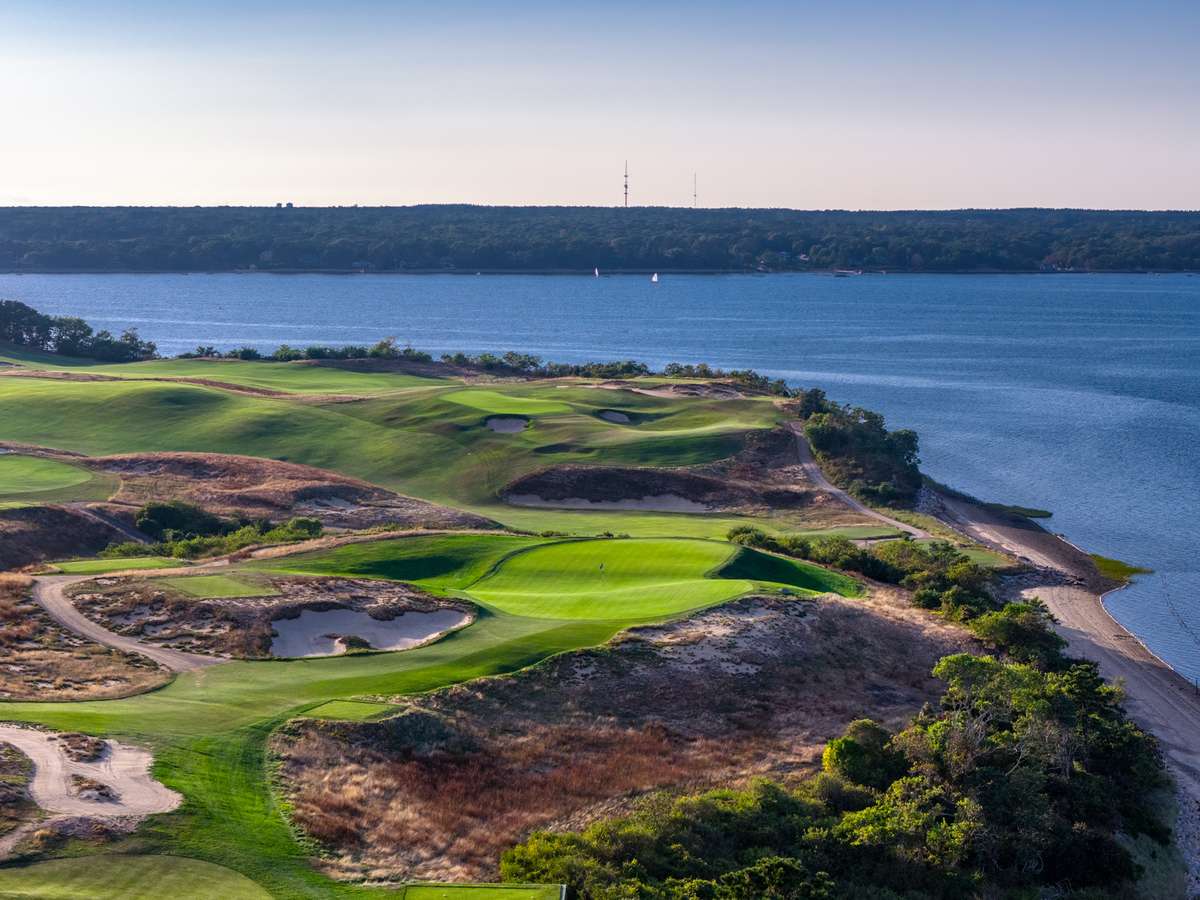
Cape Cod National Golf Club was designed by Brian Silva and opened for play in 1998. Already used as a US Open Qualifier and one of the premier layouts in Massachusetts.
Overall rating

5.0
Cape Cod National Golf Club
Cape Cod National Golf Club was designed by Brian Silva and opened for play in 1998. Already used as a US Open Qualifier and one of the premier layouts in Massachusetts.
The latest ranking of the Top 100 Golf Courses in the World serves as the ultimate global golf bucket list. Most members of our World Top 100 Panel are seasoned golfers, each playing 20-30 of these courses annually while travelling extensively over decades to form their opinions on others. We recognise that opinions vary—even among our panel members. Rankings are subjective, and there are undoubtedly 50 or more courses in the UK and USA alone that could easily fit onto this list. Links Golf Pilgrimages The rankings
California, United States
New Jersey, United States
Northern Ireland, United Kingdom
New York, United States
New York, United States
Review of the Month July 2018 – Myopia Hunt I was amazingly fortunate to play two of America’s gems within a twenty seven hour period. What a way to start a week, Myopia Hunt Club in South Hamilton, Massachusetts on Monday and The Country Club in Brookline, Massachusetts on Tuesday. The history of Myopia Hunt Club is a little bit fuzzy and depending upon who you talk to you may get a different historical vignette (especially if they are from The Country Club). Some believe that the club originated in baseball not golf, hunting or equestrian. In 1870, a group of men including four sons of Frederick Prince, who eventually became the mayor of Boston, formed a baseball team. The team was called the Myopia Nine. This was attributed to the four Prince brothers and another teammate who all wore glasses because they were nearsighted. Even though the group was nearsighted they did not lack vision. The Prince brothers and friends would often host competitions and events with their friends in Winchester at their summer cottage. Eventually, they formed the official Myopia Club with baseball, tennis, water sports, racing, hunting and steeplechase. In 1879 they built a clubhouse on a hill overlooking Mystic Lake in Winchester, Massachusetts. Fittingly, the building was dedicated on in May of 1879, with a baseball game. Of interest, in 1902, the site overlooking Mystic Lake ultimately became the Winchester Country Club. A fine club in its own regard, Winchester initially opened as a nine hole course and in 1916 it became 18 holes and was designed by the one and only Donald Ross. Frederick Prince introduced the sport of foxhunting to the Myopia club with the support of Hugh Allan, a Canadian. The hunts became quite popular. It quickly became apparent that the Winchester property was unsuitable for these types of hunts. A proposal was floated to move the hunts to either Ipswich or Hamilton. In the fall of 1881 the Myopians were able to reach an agreement with Mr. Gibney in Hamilton to rent his farm. However, several charter Myopia members wanted to move the club closer to Boston. This ultimately led to the founding of The Country Club in Brookline, Massachusetts. More on this later. In 1882, hunters outnumbered ballplayers and they were renamed the Myopia Foxhounds. At one point, the club passed a bylaw that for every golfer joining the club two equestrian members would be admitted as well. However, one viewed the club, be it hunting, golf or social, it flourished until 1891 when Gibney passed away. This created some uncertainty, but ultimately the club purchased the property from the estate for $20,000. This included the farmhouse, stables, barns and almost 150 acres! Amazingly, $20k in the 1890s would only be worth about $600k today. While this real estate transaction cannot compete with the purchase of Manhattan for $24 worth of trinkets, it still was a heck of a deal for the members. Once the deal closed the remodeling started, the farmhouse’s oldest rooms with the original fireplaces were converted into a library and most importantly a dining room with a bar. Thank goodness for priorities. Foxhunting still takes place today at Myopia August through November. They do not utilize live foxes as a live fox hunt can take up to six hours and is illegal in Massachusetts. Instead of a fox they use something called the drag, which is a laid scent over an 8-10 mile course. I did not know squat about foxhunting prior to this, but my favorite quote on the topic comes courtesy of Oscar Wilde, “The unspeakable chasing the uneatable” With a golf course that has the distinction of being the only course in America to have two of the top 100 signature holes in the United States, and a Master of the Hounds who mans the hounds for hunts three seasons of each year, and the oldest continually running polo field in the country, there is a lot to be seen and said about Myopia. In season, polo is still played on Sunday afternoons and is open to the public for a small fee. Myopia has hosted the U.S. Open four times 1898, 1901, 1905 and 1908. As the 1898 host, Myopia is one of only five courses that have hosted the U.S. Open in the nineteenth century. The first Open at Myopia in 1898 was the first US Open to be played over 72 holes. The previous three were only 36 holes. At the time, Myopia was only a nine hole course, hence the field had to play the same nine holes eight times. The winner was Fred Herd, a native of St. Andrews, Scotland, who shot a smooth 328! It was Fred’s only tour victory and he grossed a cool $150. However, Fred had a reputation as a hard core drinker. The USGA was concerned that Herd may hock the trophy to buy booze. Hence, they required him to make a deposit before he was allowed to have the championship trophy! How about them apples, John Daly?! As a side note, Fred Herd’s brother, Sandy, won the 1902 British Open. The 1901 US Open saw a record established that in all probability will never be broken. They say records are meant to be broken, and they are. I try to avoid absolutes, but, I feel pretty confident about this one. The 1901 champion was Willie Anderson who shot a 331 to claim the $200 prize money! Even that was not enough. He needed to defeat Alex Smith in a playoff, 85 to 86 to secure the victory. Patience is a virtue as Willie had to wait as the playoff was delayed until Monday because Myopia was reserved for member play on Sundays. Willie’s caddy was none other than Myopia’s club pro John Jones Willie Anderson was a tragic hero. He was born in North Berwick, (more on this later) Scotland and immigrated to the United States in 1896. He dominated US golfing circles for several years, being the first back-to-back winner, the first 3-time winner, and the first 4-time winner. He is still the only golfer to win the U.S. Open three straight years, 1903-1905 (1905 at Myopia); and he still shares, along with Bobby Jones, Ben Hogan and Jack Nicklaus the tournament record for wins with four. Sadly, he died at the age of 31 in Philadelphia, Pennsylvania. While the official cause of death was epilepsy, many people felt he drank himself to death. Other tasty tidbits from the 1901 US Open, coming in 21st place was another Scotsman named Donald Ross, yes that Donald Ross. Willie Anderson’s caddy, the Myopia club pro John Jones, finished twelfth. Yes, that is, correct, Jones caddied for Anderson AND PLAYED at the same time! I hope John didn’t give Anderson any bad reads or misclub him. Put that in your pipe and smoke it, Steve Williams. The second nine at Myopia was completed in time for the 1901 Open and Herbert Corey Leeds was the designer. Leeds had little to no prior golf course design experience. The last US Open championship at Myopia also went to a playoff. Ultimately, Fred McLeod prevailed over Willie Smith 77 to 83. Fred was the antithesis of the other Scottish US Open champions. While he was also from North Berwick, his father was involved in the temperance movement. McLeod immigrated to the US in 1903 and became the club pro at Rockford Country Club in Illinois. McLeod was a small man, 5’ 4” and when he won the Open he weighed less than 110 pounds. To put this in context, according to his biography Corey Pavin is 5’9” and weighs 155 pounds. I am not sure if there is any significance to this or not, but McLeod did live to 94, but I am not sure about the quality of those last few years…… Now to the course, while “only” 6500 yards, it is not for the faint of heart. Additionally, even the longest hitters must play from the red tees. The red tees are the tips. Unlike, most modern courses, Myopia has three sets of tees, yellow (ladies) 5500 yards, white, 6100 yards and red. The first hole is relatively benign. It is a short uphill 274 yard par 4 with a slight dogleg left. The second hole, while it is a relatively short par 5, 487 yards, the fairway is completely dissected twice. You must focus on the yardage and your distances or you may end up in the gunch. For those of you who are scoffing at the distance of the course, the third hole, a 253 yard par three is a real gut check. Not only is it long, it is well protected with 3 small greenside bunkers and one large one at about 200 yards off the tee. The fourth hole is a dog leg left with a soufflé green. While the green can be difficult, it is a feat to have the opportunity to three putt for a bogey. On the tee, one must be careful not to drive through the fairway as well as being too aggressive and failing to cut the corner. Either can be cataclysmic. Perhaps that is why it has consistently been rated one of the toughest 100 holes in the United States. The sixth hole is one of my personal favorites, a short par 4 that is only 260 yards. One must decide whether to try to carry the stream and the corresponding muck and mire and be about twenty yards short of the green or layup at 80 yards. That is not why it is one of my favorites, but rather this is the hole where golf aficionados will park their cars and sneak onto the course. Believe it or not, Myopia typically has less than 12,000 sanctioned rounds per year. The 9th hole is a brilliantly deceiving par three at 136 yards. Traditionalists would call it a postage stamp green, but I do not think it qualifies. This green is only nine yards wide and thirty yards long, hence I think an appropriate moniker would be a “bar code green”. The ninth is named Pond, where on the tee shot one must carry a pond to have a shot at par. I would be remiss if I failed to mention the seven bunkers that surround the green. Myopia is quite proud of its Scotlandesque deep bunkers (although they are but dimples compared to Bethpage Black). The ninth hole has also been cited as one of the toughest 100 holes in the country. As tough as the fourth and ninth hole are my money is on the twelfth as the toughest hole. It is the number one handicap hole and plays 446 yards off an elevated tee with a panoramic view. Do not get too comfortable, as it has a tight winding fairway surrounded by rough gone to fields and a wicked crowned green. After the daunting challenge of the twelfth hole, the thirteenth hole seems almost playful. It is a 349 yard slight dog left. Big hitters can hit it through the fairway. The approach shot is uphill and plays at least two and perhaps as much as three clubs more. The 16th hole is a downhill 192 yard par three that plays back toward the clubhouse. The pro shop is approximately 50 yards to the left of the green. One of my player partners had caddied at Myopia in the 1960’s. Caddies were paid $2 a bag at the time. He shared the following story with me. When he caddied there was no bunker to the left of the green. However, sometime in the 1970’s, a golfer hooked his tee shot (or sliced if they were left handed) and the ball hit the pro shop. The errant shot took a fortuitous bounce back towards the green, rolled onto the green and into the hole for a hole in one! I suspect that this particular member was not all that well liked because shortly thereafter a bunker was added between the green and the pro shop. When you play Myopia you will occasionally see or even end up on bridle paths (I know I did) crossing or paralleling various holes. One of the local rules is that you can take a free drop. This is just another attribute that contributes to the uniqueness of Myopia. By Colin Braithwaite, author of “A Good Walk Unspoiled” Review of the Month July 2018 selected by Editor-in-Chief, Keith Baxter – click to read more about Myopia Hunt.

The United States is home to some of the world's most celebrated golf courses, from spectacular coastal layouts to historic clubs that have hosted the game's biggest championships. But playing America's best golf is not always as straightforward as booking a tee time. Many of the country's highest-ranked courses are private clubs, while some resort venues require visitors to book accommodation before they can play. So where are America's top-ranked courses concentrated, and how many can the average golfer actually play? A state-by-state breakdown of the Top100 Golf Courses USA ranking reveals a striking divide. New York and California lead the way by course count, but of the 100 courses listed, just 16 meet our criteria for playing without knowing a member or staying at a resort. The remaining 84 have some form of access restriction, whether through private membership, accommodation requirements or other visitor policies. For golfers planning a trip to the United States, that distinction matters: a state might have an impressive collection of top-ranked courses, but that doesn't necessarily mean visitors can build a holiday around playing them. New York and California Lead the Rankings New York tops the state-by-state breakdown with 14 courses, narrowly ahead of California with 13. Massachusetts follows with seven, while Ohio and Wisconsin each have six. New Jersey and South Carolina account for five courses each. The figures highlight the strength of golf in the Northeast, alongside California's long-standing reputation as one of America's premier golfing destinations. New York is home to some of the country's most exclusive golf venues, including Shinnecock Hills Golf Club, National Golf Links of America and Fishers Island Club. However, it also has one of the world's most famous public courses. Located on Long Island, Bethpage Black has hosted multiple US Opens and the 2025 Ryder Cup. Its public status makes it an important exception in a ranking where access is often far from guaranteed. Demand is high and securing a tee time requires planning, but golfers do not need a private-club membership to play it. The other 13 New York courses in the ranking do not meet our public-access criteria. California presents a different mix of courses, from celebrated coastal layouts to championship venues further inland. Pebble Beach Golf Links is perhaps the best-known example, with its dramatic Pacific Ocean setting making it one of the most recognisable courses in golf. The state offers a wide range of golfing experiences, but green fees, booking conditions and accommodation requirements can influence whether a course is a realistic option for visiting golfers. Its size is another consideration, with distances between destinations potentially shaping how many courses golfers can fit into one trip. The States Where Top-Ranked Golf Is Hardest to Access Some of the states with the most courses in the ranking are also among the hardest for visiting golfers to explore. New York has 14 ranked courses, but 13 do not meet our criteria for playing without knowing a member or staying at a resort. California has 13 courses, with 11 falling outside those criteria, while none of Massachusetts' seven entries qualify. The contrast is striking. New York and California offer plenty of choice on paper, but their highest-ranked courses are often difficult to access independently. Massachusetts presents a similar challenge, with its rich golfing heritage reflected in a list dominated by venues that aren't straightforward for visitors to book. New Jersey faces a comparable issue. Its five courses include Pine Valley Golf Club, frequently ranked among the world's finest, but its reputation as a private club makes it a difficult destination for golfers without the right connections. These figures underline why course rankings alone don't tell the whole story. For visitors, the practical question isn't just how many highly ranked courses a state has, but how many they can realistically play. The Best States for Golf You Can Actually Play Of the 100 courses in Top100 Golf Courses' USA ranking, just 16 can be played by the public without knowing a member or staying at a resort. Wisconsin and Oregon lead the way, with four qualifying courses each, followed by South Carolina, Florida and California with two apiece. Oregon is an obvious choice for a multi-course golf trip. All four qualifying layouts are at Bandon Dunes Golf Resort on the Pacific coast: Bandon Dunes, Pacific Dunes, Bandon Trails and Old Macdonald. Having four highly ranked courses in one destination allows golfers to experience a variety of layouts without spending their holiday travelling between different parts of the state. The rugged coastal setting is a major part of the appeal. Wisconsin offers four qualifying courses across two destinations. Whistling Straits' Straits course is one of the state's best-known golfing venues, having hosted major championships on the shores of Lake Michigan. Further inland, Lawsonia Links offers a different style of golf, while Sand Valley and Sedge Valley give visitors two more courses to explore within the same resort destination. Together, they make Wisconsin a compelling choice for golfers looking to combine several highly ranked rounds in one trip. South Carolina has two qualifying courses, each offering a different experience. Kiawah Island's Ocean Course is known for its exposed coastal setting and championship pedigree, having hosted major events including the 2021 PGA Championship. Old Barnwell provides a contrasting inland experience, adding another option for golfers planning a trip around the state's top courses. Florida's two entries are Streamsong Red and TPC Sawgrass' Stadium Course. Streamsong Red is characterised by its expansive sandy terrain, while TPC Sawgrass is home to one of golf's most recognisable holes: the island-green 17th. The two courses offer very different experiences, from Streamsong's distinctive landscape to the chance to play one of the PGA Tour's most famous venues. California completes the group with Pebble Beach Golf Links and Pasatiempo. Pebble Beach is renowned for its Pacific coastline and history of major championships, while Pasatiempo, designed by Alister MacKenzie, offers a celebrated layout with a distinctive place in American golf history.
From Furyk to Bryson: Mungeam's defense of Olympia Fields When the PGA Tour returns to Olympia Fields Country Club this week for the BMW Championship, penultimate stage of the Fedex Cup Playoffs (Aug. 27-30), the most interested observer will be Mark A. Mungeam, the architect who spent nearly a quarter century renovating, then restoring, but always defending this historic Willie Park Jr. design from muscle-bound, technologically enhanced assaults on par. Mungeam, owner of Massachusetts-based Mungeam Golf Design, first reckoned with the competitive resilience of the North Course at Olympia Fields in 1992. That master-planning process led to his direction of renovations prior to the in U.S. Senior Open, in 1997, then more prior to the 2003 U.S. Open, won by Jim Furyk. Thereafter, when the club opted for a full-on restoration — after discovering key period photography — Mungeam directed that refurbishment, as well. His prep efforts continued prior to the 2015 U.S. Amateur Championship, at Olympia Fields, claimed by a young, svelte Bryson DeChambeau. In 2017, Danielle Kang won the KMPG Women’s PGA Championship there. But it is DeChambeau who has emerged post lockdown bigger and longer — the new embodiment of golf’s uncomfortable relationship with length. He and his PGA Tour colleagues would appear ever more indifferent to the scoring safeguards Mungeam created over the course of 20 years. Olympia Fields North course 3rd hole photo by Gary Kellner “You can’t take it personally — I certainly don’t,” said Mungeam, ASGCA, whose more recent tournament prep involved rehabilitating a pair of Donald Ross-designed, City of Boston classics — George Wright GC in Hyde Park and Franklin Park GC in Dorchester — for the 2019 Massachusetts Amateur. “I can remember adding a bunker on the left side of what plays during championships as the par-4 18th hole at Olympia Fields, what the members play as no. 9,” the architect says. “It was 310 yards from the tee in 1999. Back then, we thought of it as an aiming bunker! Today they’ll be flying it, or trying to. They were doing that in 2015, during the Amateur. “There is a randomness to the bunkering in places like Scotland that keeps those hazards relevant through changes in technology and length, but it’s not enough to deter professionals today. The fairway bunkers at 18 on the North Course are deep enough that they are plenty penal. But the rough, should they miss the fairway, is ever more punishing. It has to be. At Olympia Fields and elsewhere, it has become a risk/reward situation from the tee, the sort of dynamic we associate with severe U.S. Open-style conditions. Is that better? Well, it’s better than it could have been, had we done nothing.” Located just outside of Chicago, the North Course at Olympia Fields opened in 1923. Two years later, Walter Hagen won the PGA Championship there. In 1928, Johnny Farrell captured the U.S. Open title on the North Course, besting Bobby Jones in a playoff. The club would host another PGA in 1961. The Western Open — considered alongside golf’s major tournaments into the 1960s (the BMW Championship is its 21st century incarnation) — was played here five times. In preparation for the 1997 Senior Open (won by Graham Marsh), the club engaged Mungeam to effectively renovate the North Course for 21st century tournament use. The USGA needed a championship venue in Chicago, the nation’s second biggest population center and television market. This was the first of several distinct renovation phases, Mungeam says. “That second renovation in 1999 was complicated — we were preparing for a U.S. Open Championship in 2003, for goodness sake — but it was a renovation. We didn’t have any period photography or plans from Park Jr. detailed enough to allow for restoration. That all changed in 2013 when someone found a program from the 1928 Open, with pictures of every single hole! That document was a goldmine. It became the practical basis for our sympathetic restoration work prior to the 2015 Amateur — the basis for the course we’ll see this week. “Without those photos, we would not have those magnificent cross-bunkers on the 5th, 8th and 17th holes, for example. The old photos were also crucial to full expansion several green surfaces. And, of course, they helped guide some tree removal.” Mungeam’s interaction with the North Course during all these tournament engagements has run the gamut. In 2003, he became the first architect who prepared a U.S. Open site to ever work the same course as part of the grounds crew: Mungeam raked bunkers, filled divots and fluffed rough for then superintendent Dave Ward, starting at 4 a.m. — before watching championship play from the maintenance shed. “I had been working alongside that crew for nearly 10 years by then. They were my friends,” Mungeam explains. At the Amateur in 2015, the architect observed DeChambeau up close, walking the course from what then passed for a responsible distance. After 24 years, Mungeam’s association with the club ended in 2018. He will watch this week’s tournament from the sofa inside his 1850s farmhouse in central Massachusetts. “This winter I ran into the current Olympia Fields superintendent, Sam MacKenzie, and he confirmed that nothing much has changed since 2017,” Mungeam says, noting the layout still maxes out at 7,343 yards (Par-70), up from the 7,180 yards it played for the 2003 Open. “All the same, I’ll be interested to see where they maintain the fairway edges. We modified them — to narrow things down beyond those fairway bunkers. And I’ll be interested to see how long and thick they keep the rough in those areas, where there won’t be galleries trampling the rough down. “The only real deterrents to Bryson and the Bombers these days are the roughs and the wonderfully sloped Willie Park Jr. putting surfaces, which many of these guys haven’t see before (though Bryson has). In the end, the greens make this course what it is. I’m sure Sam will have them rolling pretty quick.” Jim Furyk, never a long hitter, shot a then-record 8-under par to win the 2003 U.S. Open. “If the BMW winner doesn’t double that,” the architect says, “I’ll consider it a moral victory.”
4.5
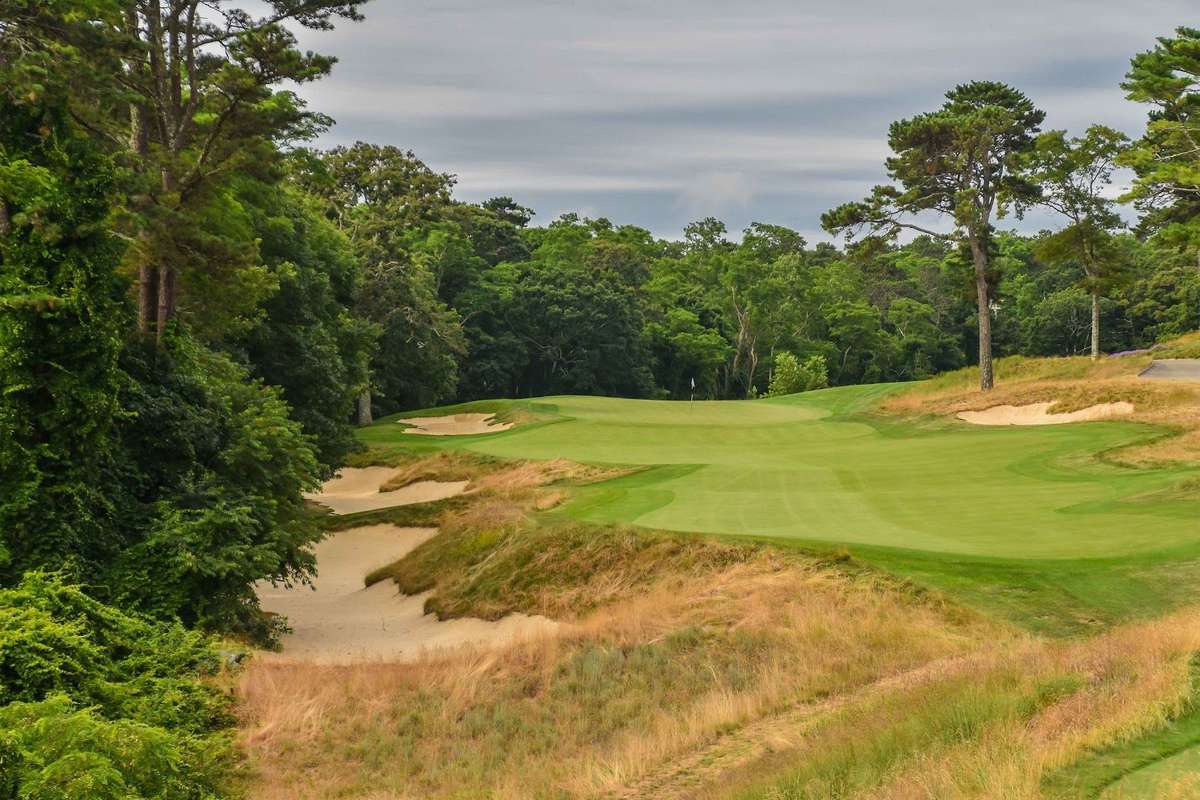
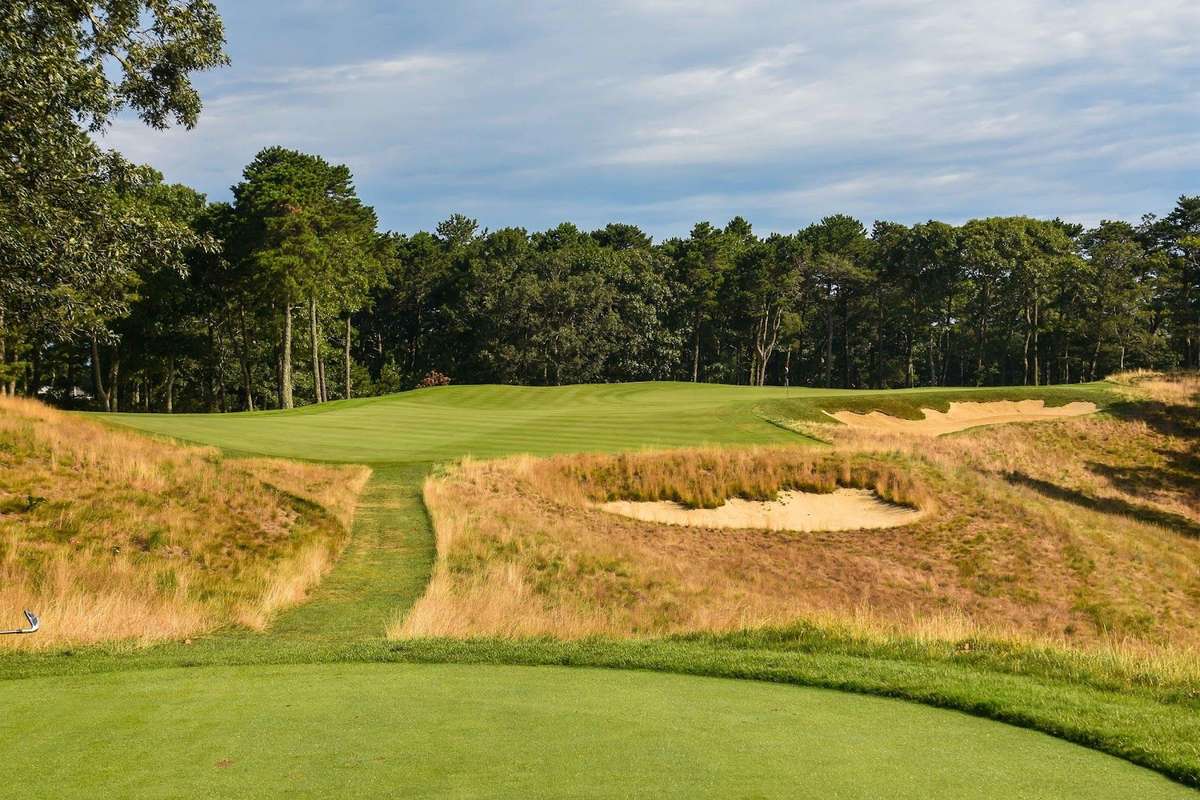
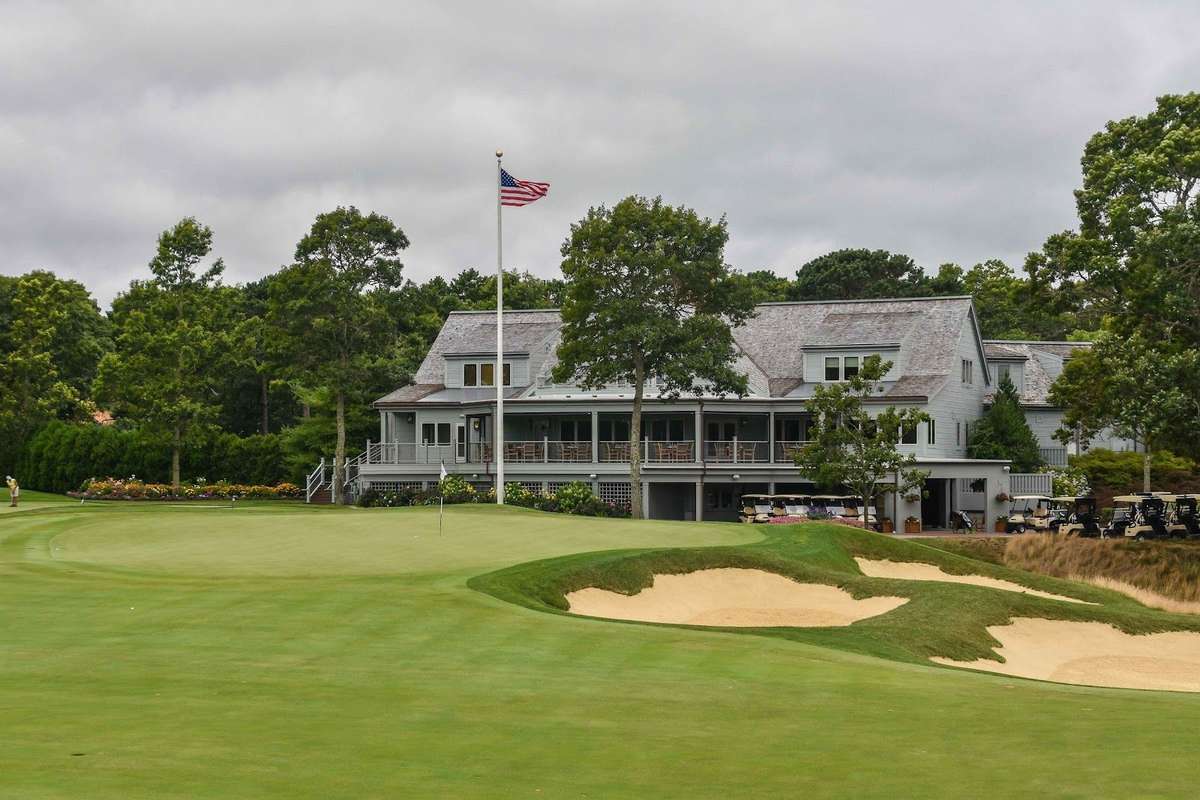
Cape Cod National is a design by Brian Silva. It is a good design across rolling topography that is a feature of nearly every golf hole. It must have been a real challenge to route the course thought this wooded, sometimes rocky, and always hilly/rolling terrain. Mr. Silva pulled it off beautifully through the use of twelve doglegs.
I was prepared to not like the course having gotten some input from very good players as to its pros and cons. After playing it, the course deserves praise as it has a lot of merits to it. I wonder if the course “suffers” from an image problem of being on Cape Cod but with no views of the coast. Certainly it sits in the shadow of Eastward Ho which is definitely a top 100 course in the USA and possibly a top 100 course in the world due to its excellent routing, seaside views, and wondrous holes beautifully built across its rolling/hilly terrain. It also sits in the shadow of Hyannisport which is pure fun offering views of the bay. I have not yet played Nantucket nor Sankaty Head but I imagine them to be as good as they are considered to be. Yet despite the amazing competition in a golf-rich state, Cape Cod National is considered to be one of the top twenty five golf courses in the state of Massachusetts. This is likely due to it being a course offering strategy and shot-making from the tee to holing out the putt.
Cape Cod National offers a good routing with uphill and downhill shots, easier holes and more difficult holes, well-placed bunkers and sometimes easier greens and sometimes confusing greens. The greens are usually surrounded by trouble, yet the trouble is usually fair. It is a course where one has to hold their concentration throughout the round due to the many doglegs which result in some blind tee shots as well as definite sides of the fairway being preferred. Due to the trees, change in terrain, high grass or the numerous bunkers, wayward shots are rarely received with good luck through a favorable bounce or ricochet. Yet, if one finds their ball and play smartly with the recovery shot, they will have a resonable chance to obtain a par.
The course is also well-balanced across the various pars – whether 3, 4 or 5. Unlike other courses where the par 3’s stand out or the par 5’s, there is no real standout hole or set of pars here. Nearly all of the holes are good and the few I did not like as much were due to land restrictions where I saw no other alternatives.
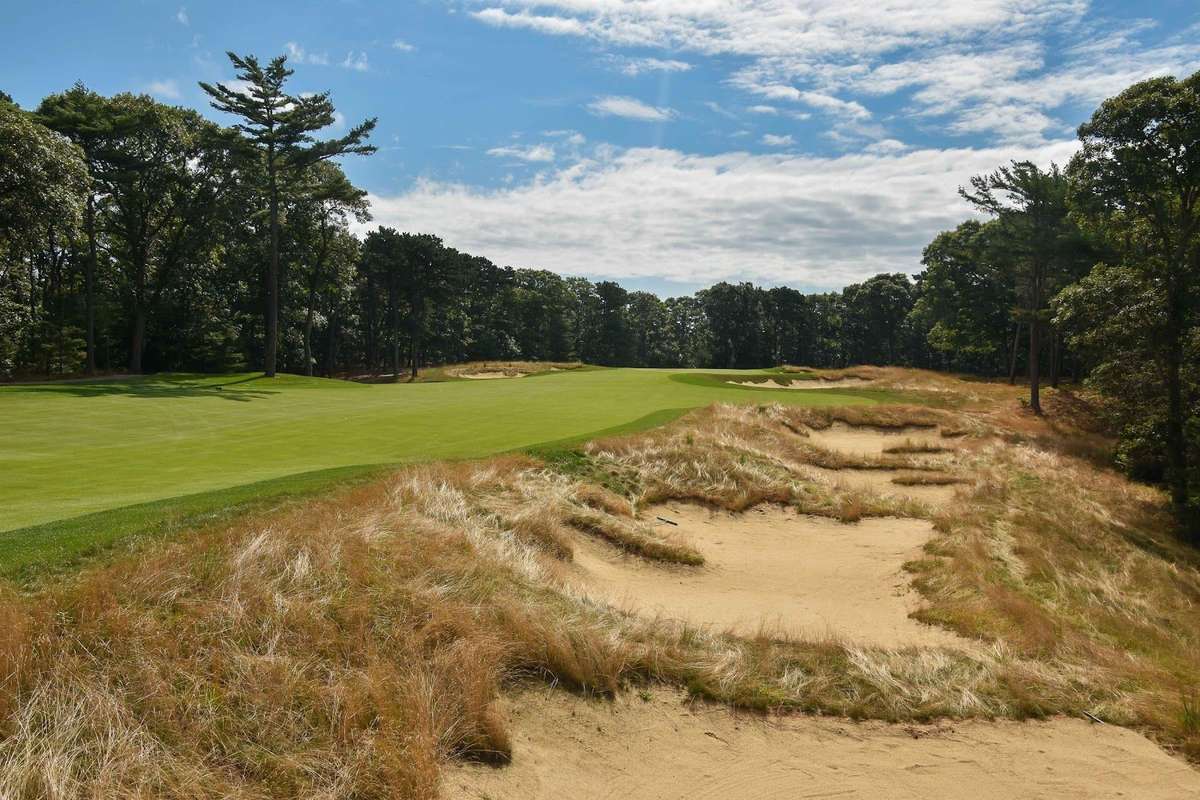
My only other “slight” criticism is that there seem to be an abundance of bunkers on the course, particularly often on the left side of the fairway. I counted nearly 90 bunkers, many of which are very long that in effect would be two-three bunkers on other courses. However, the bunkers are placed into land on the corner of doglegs and where there are slight rises, falls, or knobs which add visual drama.
Some might also say the course is too difficult for the average player. It is a course that one must know as the doglegs create definite preferred landing areas off the tee. The greens are confounding, but perhaps one will get to know them. The 90 bunkers are a constant thought as well as several holes involving ponds. The greens are the biggest defense of the course. No one in our group was able to successfully putt them on a consistent basis. We were unable to figure out either the correct line or the correct speed. Sometimes we could not figure out either at the same time.
The course plays to 6954 yards from the Blue tees, par 72, rated 74.0/135. From the White tees it is 6375 yards rated 71.2/131. There are two tees of lesser yardages. As we were non-members in a tournament, we played the White tees, which was more than enough for me given the somewhat soggy conditions. The course’s rating and slope appear to be correct.
1. Par 5 – 504/489. The first is a relatively tame opener with the biggest danger being a left side bunker 220-240 yards from the tee. Longer hitters can carry that bunker. Bigger hitters need to avoid the bunker on the right at 270-285 yards followed by a second one at 315-330 yards. There is a nice speed slot between the fairway bunkers. Average hitters should go right off the tee and then carry the two bunkers on the left. If one stays left there is another bunker on the left about 30 yards short of the green on a raised hill. The view of the green is blocked from the left. There is another bunker on the right front of a green that is narrow at the front, and then angles to the left with a slight back to front tilt. There are heavy trees on both sides of the hole but overall this represents a birdie or par opportunity.
2. Par 4 – 467/415. The second offers two deep bunkers on the left side, the first beginning at 180-213 yards followed by the second at 224-258 yards. The obvious play is to the left but the longer hitters will fly both of them. There is a third left bunker 90-65 yards from the green. The green’s bunkers are on the right to a green angled to the right with a false front. This hole is also heavily tree lined. This is a hole where par would feel good and a wayward shot will likely lead to a bogey or worse.
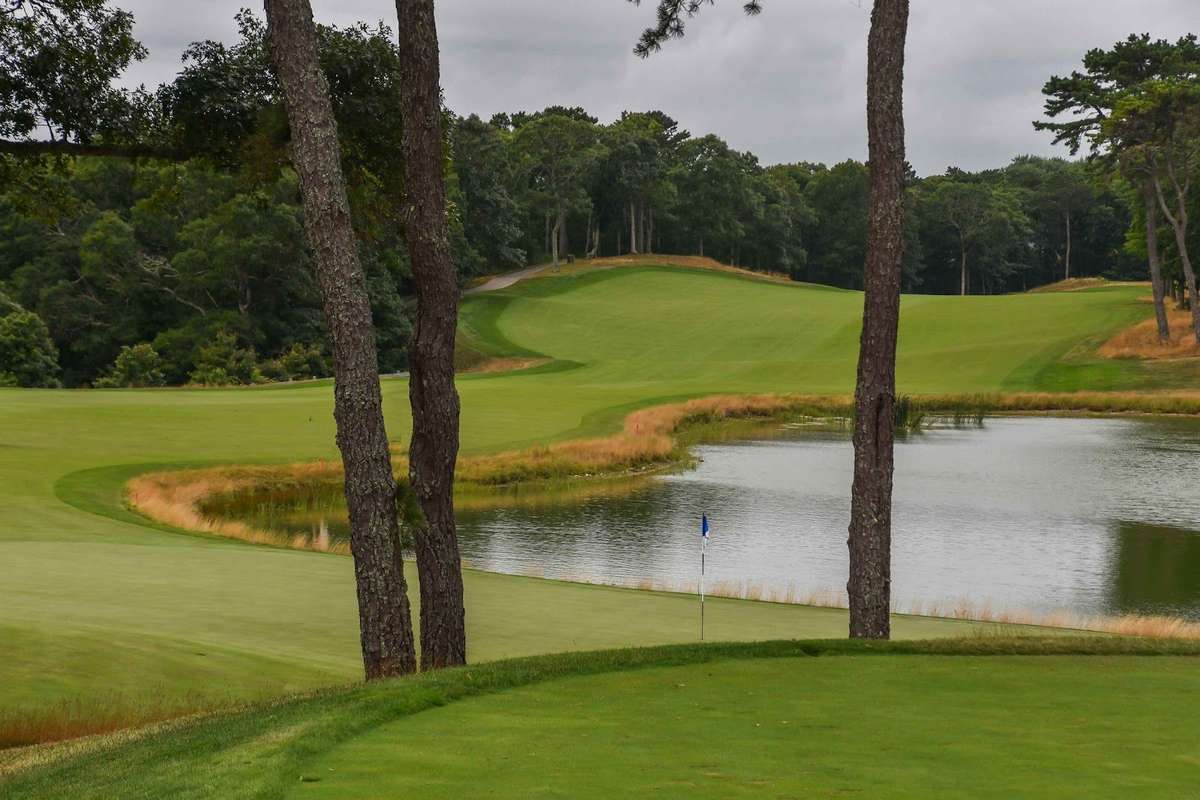
3. Par 5 – 566/521. The second par 5 comes early in the round with a long fairway bunker on the left at 255-277 yards. This bunker is 33 yards in length. The fairway drops towards a pond on the right which narrows the landing area considerably for the approach shot to an uphill green. There is another left bunker 80 yards from the green while a greenside bunker complex begins on the right between the pond and fairway/green about 60 yards short of the green. This makes the fairway very narrow for the second shot. The green has a substantial back to front tilt to it with a sustained rising slope in front of it. The hole is very punitive to the wayward shot and perhaps the fairway does not need the bunker right opposite the green, but overall I felt the hole to be good as one has an option to be aggressive or conservative on this hole.
4. Par 4 – 361/335. The first “short” par 4 again has fairway bunkers on the left set at 200-220 yards from the tee. This dogleg right also has an outer corner bunker at 225-250 yards from the tee. There are two more fairway bunkers on the right at 60-45 yards from the green which has a fronting central bunker. This has a two-tiered smaller green. The tee shot is uphill with the right side of the fairway offering a view of the green. Three of the four of us bogeyed the hole due to the difficulty of the approach shot and green.
5. Par 4 – 449/409. Playing parallel to the second in the opposite direction, none of us foursome parred this hole even after respectable tee shots. The first bunker is on the left at only 165-195 from the tee with a flanking right side bunker another 30 yards. There are two more bunkers on the right at 240-277 and 273-304 from the tee. The green has two bunkers on the right side. If one has a good tee shot, the second shot plays downhill to a larger green but with short grass chipping areas. It is my favorite hole on the front nine.
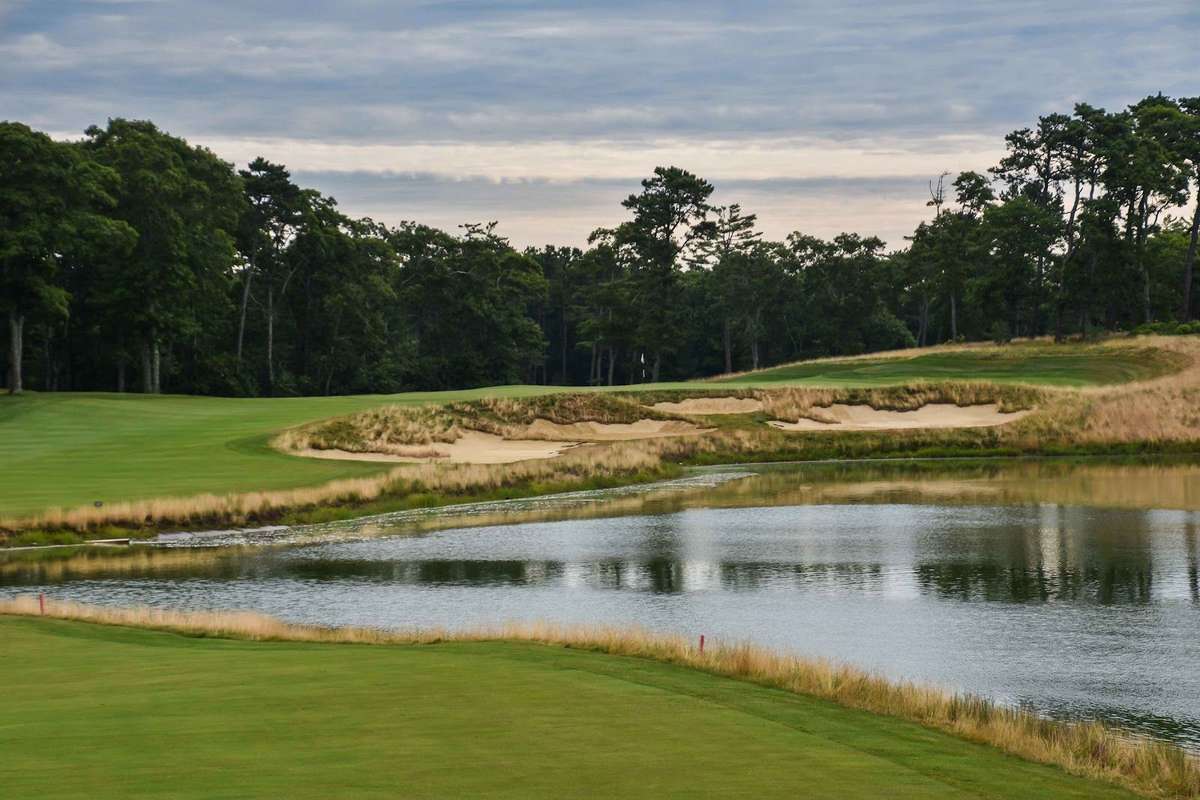
6. Par 3 – 203/178. This hole plays to a slightly elevated green with a green sloped like a redan. The long green is angled to the left with two long bunkers on the left placed between the green and pond. These bunkers are steep due to the raised green. The miss is either short or left. It is a visually attractive hole due to its setting.
7. Par 4 – 311/275. This is my least favorite hole on the front nine although my playing partners thought it to be fun. I generally like short par 4’s due to the risk/reward nature of the hole but this dogleg left feels too unbalanced to take the risk. It is not a great piece of land so I think Mr. Silva did his best here. The hole plays uphill with three bunkers left placed at 190-233 yards from the tee. Longer hitters can drive over these bunkers but the trees pinch in a bit too much from the left to make it worthwhile for this blind shot. There are two outer bunkers on this dogleg at 220-250 yards creating a narrow saddle opening to a saddle-shaped green. Behind the green is a substantial fall-off while a final bunker awaits on the right side. Maybe the hole has too many bunkers on the left and right or perhaps the severity of the dogleg is a bit much.
8. Par 3 – 186/159. This sharply angled left to right par 3 is a very nice hole with the slope of the green mirroring the shape. There is an unnecessary bunker about halfway to the hole and a deep long bunker fronting the green with a sliver of a bunker behind half of it. It is a pleasant golf hole but one where a high score can happen.
9. Par 4 – 401/342. The ninth is a fine hole with a cross bunker on the right at 230-260 yards off the tee. Farther up there are two bunkers at 260-310 yards from the tee on the left. The land slopes down to the green initially before flattening out. There is another cross bunker coming from the left about 50 yards shy of the green. Finally, there is a deep bunker right of the green. This hole has a tricky green.
10. Par 5 – 510/483. Playing over a small pond to a sharp dogleg right, one must stay left and preferably long off the tee to have a clear view for the second shot. The right side has trees that will obscure the line into the hole as the fairway bends. The right side is overly punitive as there is a long fairway bunker 220-245 off the tee that extends for nearly 30 yards. There is also a fairway bunker on the left at 285-310 off the tee that is not in play for most hitters. The second shot needs to avoid flanking bunkers about 85-55 yards from the green. The green is set back to the left with a final bunker on the right front. The hill side down the left side all the way to the green is filled with trees and presents a difficult recovery shot to another green that was a mystery to all four of us.
11. Par 4 – 471/432. I feel this is the most difficult hole on the course as it plays as a long dogleg left with the first bunker being on the right at 230-250 off the tee. There is a string of four bunkers right followed by another bunker right 50 yards short of the green. Finally, there are two bunkers left of the green and one on the right. The back of this green slopes away from you and the green is narrow for the length of the hole. A par here is well earned; I feel the hole is overly bunkered.
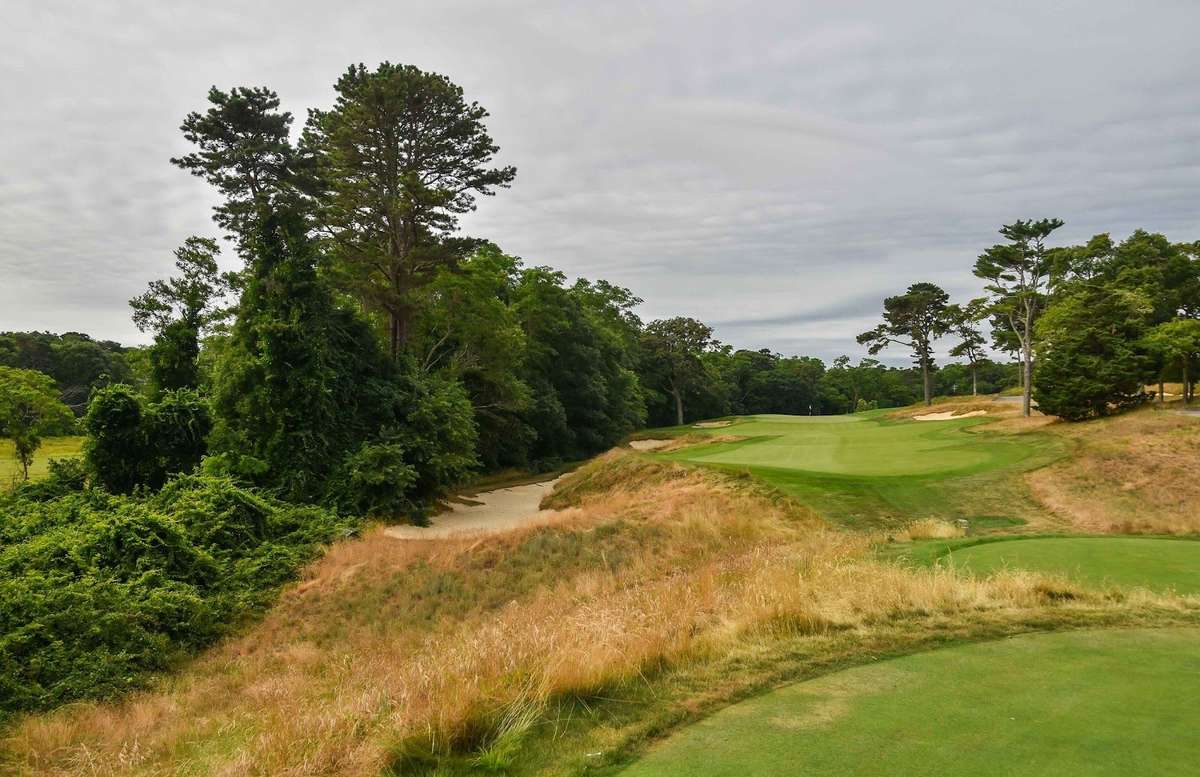
12. Par 4 – 391/364. From an elevated tee, this is a sharp dogleg left with a steep, grass-filled hill to the right and a fairway tilted to the left. A long bunker awaits at 260-280 off the tee on the inner corner of this dogleg. The second shot is played over wetlands to a circular green with a single bunker on the back corner. This is not a good hole but is limited by the land.
13. Par 3 – 239/209. This long hole has three bunkers down the left of which the first two are unnecessary. There is another bunker right about 20 yards short of the green. The left side has thick trees and lower ground while the right side has scattered trees and a hill that sits above the green. The green is sharply tilted back to front and to the left. It is a hard hole to make par although one has the chance to land short and play onto the green. The green is overly severe.
14. Par 4 – 344/313. This hole has a big hill from the right side to contemplate. Once again, there is an unnecessary bunker on the left before the beginning of the fairway which I think only adds to the cost of maintenance. There is a single bunker left side of the green. I like the hole due to the drama of both the tee shot and the second shot as the green is tucked into a corner angled to the left.
15. Par 5 – 527/501. Despite its length, this is a difficult hole. It begins with a bunker at 177-194 yards off the tee on the right that should not be in play for a generous fairway. But then the fairway shrinks to half the size due to a pond coming in from the left at 350 yards from the tee. The wind was in our faces making the hole play much longer and there was a bit of drizzle so I did not look at the yardage book and went into the long and deep bunker that begins about 30 yards short of the green on the right. This bunker is deep and hidden on lower ground. The green is angled to the left and sits mainly behind the pond, sloping towards it. Hitting long over the green will result in going down a hill. It is rated the number one index although I feel eleven is more difficult. However, one certainly can run up a very high score here.
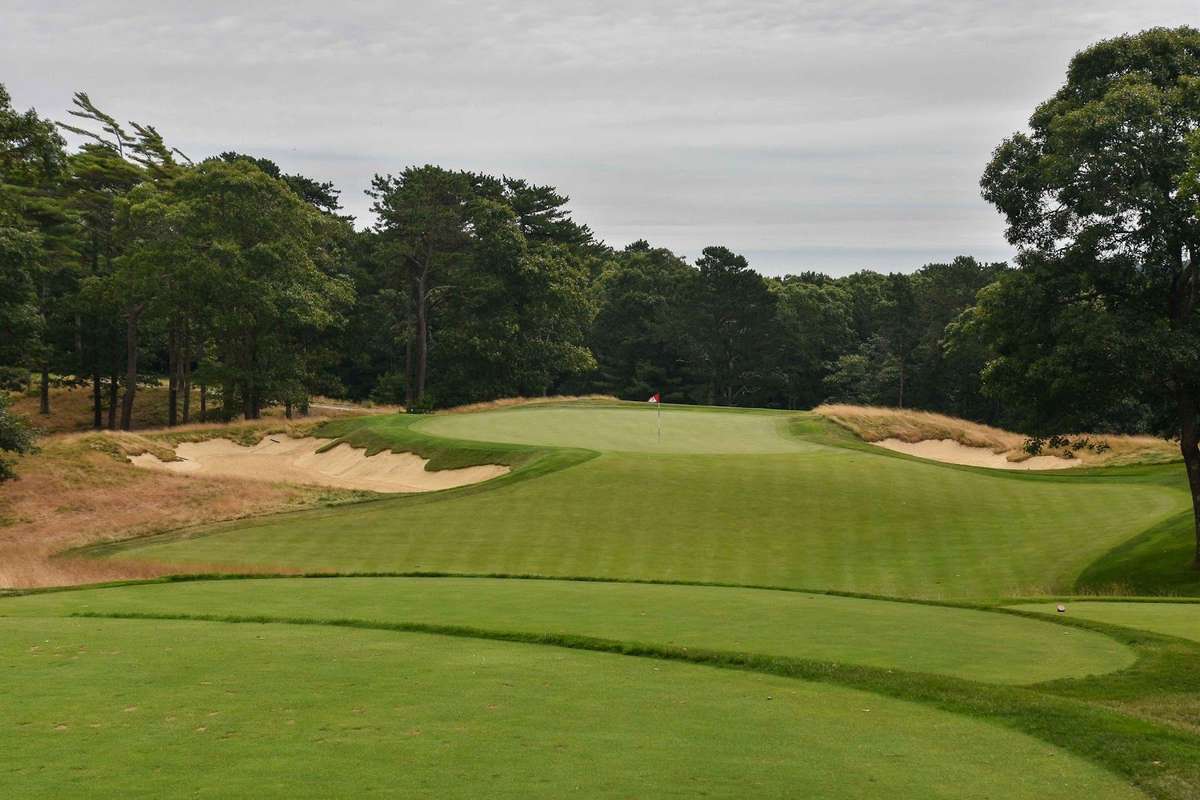
16. Par 3 – 151/127. The green is surrounded by bunkers on three sides, angled slightly to the left. It has a slant away from the front of the green. It is a nice short par 3.
17. Par 4 – 459/425. After the “breather” of the sixteenth, the seventeenth is a difficult hole playing uphill as a blind tee shot with a forced carry over a cross bunker and one on the right. Those carrying the crest of the hill will pick up another 50 yards or more on the downslope on the other side. There are four bunkers off to the left to a green placed uphill after the ravine well to the right resulting in another club. One can use the hill behind the long green to bring a ball back onto the putting surface as the green is sloped back to front with ripples in it. After the tee shot, this is a visually pleasing hole.
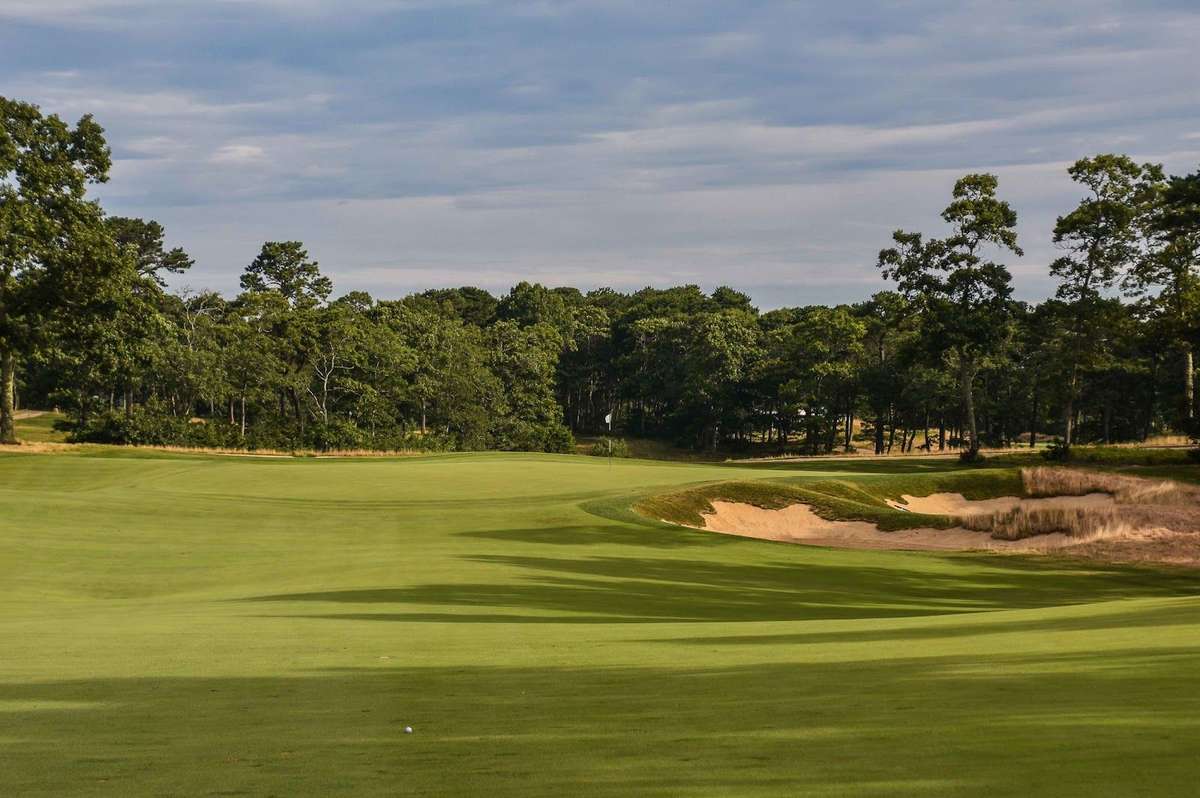
18. Par 4 – 424/377. The final hole is a dogleg left with a long outer bunker at 200-235 yards off the tee. This bunker is 35 yards long. There is another bunker 245-375 off the tee to the right. Two bunkers are also on the left at 270-323 off the tee. The greenside bunkers all sit to the right of the green on lower ground. There are four of them. The green tilts back to front. It is a nice finishing hole. As was typical during the round, none of us made our short putts for par.
Cape Cod National is a challenging golf course throughout the round. Perhaps there are two-three “breather” holes. One will likely score 3-5 shots higher here than the typical course due to the difficult greens and numerous doglegs. I think that would happen even if one moves up a tee from one’s regular yardage. The change in terrain on many of the holes are substantial and create extra drama. It is certainly a course worth playing and a testament to a clever layout.
Mark White