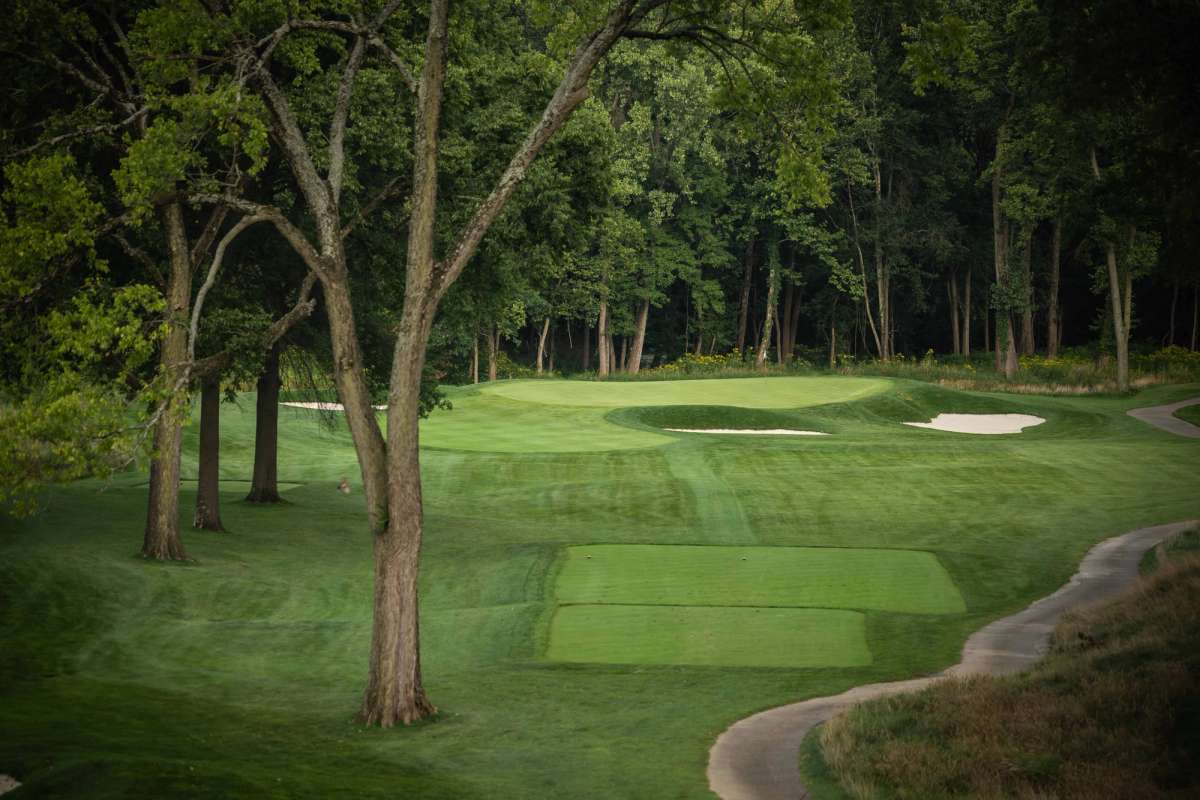
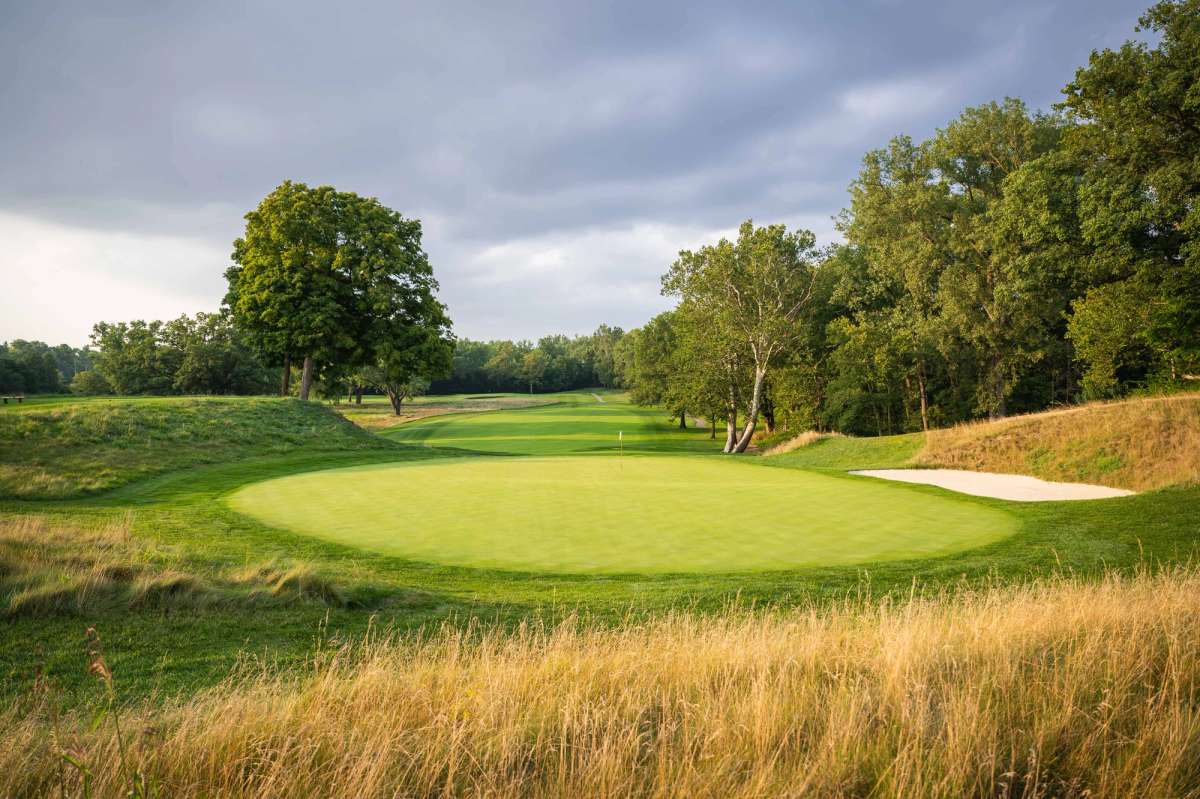
Kevin Hargrave completed a large-scale renovation of Columbus Country Club's Championship course in 2018. The architect replaced bunkers with versions more akin to the style of Donald Ross as well as adding new tees and removing more than 1,500 trees.
Columbus Country Club (Championship)
Kevin Hargrave completed a large-scale renovation of Columbus Country Club's Championship course in 2018. The architect replaced bunkers with versions more akin to the style of Donald Ross as well as adding new tees and removing more than 1,500 trees.

4.5
Columbus Country Club is a fascinating place. I would call it a "hidden gem" but I am not sure you can use that characterization for a club that hosted a major championship. You can tell CCC was one of the premier clubs in the city at one point in time. However, Columbus is a town that experienced most of its growth in suburban areas. With folks moving out of the city in the 90s/2000s and Columbus having tremendous golf/country clubs throughout the city, I think CCC lost some of its original prestige. Nevertheless, the golf course is tragically underrated. I had a chance to play after the renovation and I was blown away. The renovation shows off the amazing plot of land and it is one of the most peaceful walks in golf. Gentle rolling hills and some of the best "driving" holes I have ever played. It won't beat you up too badly but you can up with a big score given the challenging green complexes. I would easily put this place in my top 10 in Ohio.
Rodger Davis

The message of great, strategic golf course architecture is clear. The actual words used to describe those golf courses, however, are many. The Architecture Glossary column will examine more precise terms and concepts that one will find when exploring golf course architecture. Hopefully understanding these terms, and why certain architects employed them, will help you to better understand the golf courses you play…and maybe even improve your scores! Today’s term is ‘Puzzle Piece Bunkering’. Although many concepts within golf course architecture are shared across a wide variety of architects, they often become associated in particular with a single architect (few come to mind as quickly as Pete Dye when discussing an “island green” for example). The same applies to Dick Wilson and “puzzle piece bunkering.” Wilson is often associated with the penal era of golf, and some of the most challenging courses ever created. These routes often featured tight fairways, lofted greens and, of course, plentiful bunkering. Although it has become somewhat fashionable to lump all of these architects together into one oversimplified bin, the designers of this era each had definitive aesthetics. Wilson was perhaps the most stylistically distinguished of the group, thanks to his bold puzzle piece bunkering. The simple essence of this idea is bunkering that defy simple geometry, involving a number of irregular ins-and-outs. While his contemporary, Robert Trent Jones, helped to usher in the era of cape-and-bay bunkering — generally more curvilinear in shape — Wilson often showcased a style both jagged and geometric, like he had taken a jigsaw (pun intended) to the soil. To differing degrees, the shapes of the bunkers were compared to puzzle pieces. Consider the opening hole at Coldstream Country Club in Cincinnati, Ohio. Off the tee, there are three bunkers that feature inward pegs, giving the metaphorical impression that they could, indeed, be linked together with other “missing pieces.” Look ahead to the green, and a pair of longer bunkers are stylized in much the same way. An aerial of the opening hole at Coldstream shows how Keith Foster's restoration added Dick Wilson's character back to the club's bunkers. In terms of function, the turf inlets into the bunker behave very much like cape-and-bay bunkers, creating awkward lines out of the trap for those who end up near inserts. But the general presentation of the bunker is very much a question of aesthetics. Not familiar with Wilson’s signature style? Much of this can be traced to standards of upkeep. Colstream has recently undergone a restoration from Keith Foster, which involved reconstructing Wilson’s signature, rough edges into the bunker. This style requires dedicated maintenance to preserve its appearance, and — as a result — many of Wilson’s most celebrated designs have found their bunkering taking a more curvilinear shape over the decades. Another architect that has seen similar style degradation is Alister MacKenzie, who is noted for his “feathered” bunkering. In fact, it’s not too far to suggest that the Scot created a few puzzle pieces of his own. Consider Titirangi Golf Club, MacKenzie’s only design in New Zealand. The greenside bunkers alongside No. 4 take more distinctly “puzzle-piece” shapes, a style that Wilson would pursue at many of his most notable courses, including Pine Tree Golf Club. It’s unlikely that MacKenzie was Wilson’s prime influencer, of course. That title belongs to William Flynn, to whom Wilson was employed up until the Great Depression set in. Alister MacKenzie's approach to bunkering occasionally merits comparisons to Wilson's, particularly at Titirangi. (Photo Credit: Gary Lisbon) Through Flynn’s involvement at Merion Golf Club, Wilson became intimately familiar with the club’s East Course, and his boss’s work constructing its bunkers (Hugh Wilson completed the design and hired Flynn for construction). The shapes around this world-renowned course reflect where Wilson may have gotten his own shaping ideas. Particularly interesting are the four bunkers that sit between the fairways for holes Nos. 11 and 12; not only do these hazards take a shape we would expect from Wilson in later years, they also seem as if they would fit together — like puzzle pieces — to create a single, massive sand hazard. Although this is not what’s usually meant by “puzzle piece” bunkering, it does demonstrate a tendency that Flynn would take to other courses, such as Shinnecock Hills, and that Wilson would replicate his own courses. By clustering bunkers and nesting smaller sand hazards within the curves of larger ones, the architect can create an intimidating sight from the tee, as these hazards appear to be part of a much larger sand trap. Wilson, before opening his own design firm, worked creating camouflage for U.S. airfields during World War II. Who knows if his early years in golf course design paid dividends for the Allied forces? Wilson no doubt took some cues from William Flynn while working at Merion, among other clubs. Note the similarities in style, but also how this cluster of bunkers between Merion's No. 11 and 12 holes seems to fit together in puzzle form. The movements following Wilson have not necessarily maintained the “puzzle piece” style, however they have not thrown them by the wayside either. Joe Lee was Wilson’s most prominent student and, although his projects never gathered as much attention as Wilson’s, the latter’s style inevitably seeped to the former’s. Lee’s last original design, Musket Ridge, shows some tendencies toward puzzle piece bunkering at No. 6, although clearly influenced by the wiggling aesthetics popularized in that era by Jim Engh and Bob Cupp. The modern “minimalist” approach doesn’t quite leave room for such bunkers, however it’s not tough to imagine that a modern parkland course, relying on the frazzled fashion cues of Doak et al, could incorporate such a style. Great golf course architecture should present itself as a puzzle to be solved. Dick Wilson found a way to make his bunkers a puzzle to be seen as well.
US East North Central Division Best in State Rankings 2016 Another five States in our Midwest Region are re-ranked in the seventh of nine US divisional updates This concludes the Midwest Region of our Best in State re-ranking process for the USA, where we’ve spent the last few months assessing courses across nine regional divisions. This is the seventh in our series of reviews and it covers the five Midwest “Great Lakes” states of Michigan, Ohio, Illinois, Indiana and Wisconsin, which are home to almost fifty million people. We’re increasing the number of courses that we feature in the USA and this expansion will be exhibited across almost every state in the country. For instance, in this East North Central division, we’re adding ten new courses to each of the five states, resulting in new Top 50 charts for Illinois, Michigan and Ohio. Michigan The top three positions remain exactly the same as last time around, which means that Crystal Downs is still the number one course in the Wolverine State. A recent reviewer described it thus: ”one of the few courses I’ve played in the Top 100 where I was able to remember every single hole… Crystal Downs is unique and presents you with a tough challenge… not by being long but by placing a premium on strategy.” It’s just a pity the course’s remote location and deficient infrastructure has prevented it from hosting more national events like the US Senior Amateur that was held here in 1991. Climbing three places to number 4, the 9-hole “walking only” course at the Dunes Club makes an impressive move in the right direction near the top of the new state listings. Developed by Mike Keiser of Bandon Dunes fame, this lovely little woodland layout – which squeezed into our recent update of the US Top 100 at number 100 – nestles on the shores of Lake Michigan, where it’s been delighting a select number of golfers ever since it was first unveiled in 1992. Further down the chart, Barton Hills, a near 100-year old Donald Ross layout that Ron Pritchard spent time restoring in 2013, bounds up a spectacular sixteen places to number 16 and it’s immediately followed by Orchard Lake, our highest new entry at number 17, which is a 1920s Golden Age design from C.H. Alison that has also been the recipient of a new millennium restoration, this time by Keith Foster. It was too early for us to consider the sixth course at Gull Lake View Golf Club, Southwest Michigan's oldest and largest golf resort. The Gallically named Stoatin Brae course is slated to open shortly and it’s been routed over a former apple orchard, stripped of its trees and reseeded with native grasses by Tom Doak’s Renaissance Design company. No doubt we'll be hearing a lot more about it, along with The Loop at Forest Dunes in northern Michigan, a reversible 18-hole design from the same firm of architects that is due to open in a similar timeframe. Rank/ Click this link to see full details of our 2016 Michigan Best in State rankings Ohio There’s little movement at the head of the table in the Buckeye State, where the top five tracks are all nationally ranked, and the Jack Nicklaus and Desmond Muirhead co-design at Muirfield Village is still the state’s number one course. It’s more than forty years since the Golden Bear built this course outside his hometown of Columbus and he’s constructed hundreds down the years since then but this track still remains one of his most endearing. Pete Dye’s course at The Golf Club, one of the architect’s earliest designs when it appeared back in the late 1960s, drops one place to number three, swapping places with Camargo, which becomes the new number two in our revised listings. Seth Raynor’s Cincinatti masterpiece has had its bunkers overhauled in recent years by Tom Doak’s Renaissance Design team and this work has certainly gone a long way to reviving the fortunes of a fabulous old track. The most significant upward move in the new chart is made by Alex Campbell’s 1930s course at Moraine Country Club (the USPGA Championship was held here in 1945) which climbs fifteen places to number 9. There’s no doubt the course has massively benefited from a recent Keith Foster renovation, involving the widening of fairways and the reconstruction of new greens and bunkers. Click this link to see full details of our 2016 Ohio Best in State rankings Illinois Chicago retains its place at the top of the Prairie State chart. Currently ranked number 13 in the USA Top 100 and number 22 in our World Top 100, this historically important course is the oldest 18-hole layout in the country, having been established in 1894. Host to three US Opens and four US Amateur Championships in its formative years, the club is now scheduled to stage the inaugural US Women’s Senior Open in 2018. The No.1 course at Medinah Country Club streaks up the chart from position 39 to 13 and this prodigious leap is all due to the major redesign that was recently carried out by Tom Doak. Nine of the original holes were re-routed, in the words of the architect, “to get fairways away from the nearby Medinah Road and to break away from the back-and-forth nature of the original layout… new greens and bunkering have tightened up the test.” The highest Illinois newcomer arrives at number 23 and it’s the revered old course at Onwentsia Club, which hosted three major championships during its first two decades of operation – the US Open in 1896, the US Amateur in 1899 and the US Women’s Amateur in 1915. The layout has been lengthened, bunkers have been modified and a lake added since then but it’s still a track that appeals to golfers of a traditionalist persuasion. Click this link to see full details of our 2016 Illinois Best in State rankings Indiana The Hoosier State of Indiana still has the spectacular 18-hole Victoria National course as its number one, with this rather unique Tom Fazio design holding off a strong challenge from a number of other contenders. Laid out within an abandoned coal mine, the course offers an exacting test of golf where much of the strategic strategy is shaped by a variety of water hazards that now lie within its 400-acre confines. Pete Dye’s early 1960s layout at Crooked Stick and Steve Smyers’ late 1980s design at Wolf Run exchange positions, with the former course (which held the USPGA in 1991, the Solheim Cup in 2006 and the BMW Championship in 2012 – the BMW returns here again later this year) dropping down one place and the latter, a renowned tough track that’s set in thickly forested terrain outside Indianapolis, moving up one to the runner-up spot. Three courses each make notable five-place upward moves: Brickyard Crossing at number 7 (where four of its fairways are located inside the oval of the Indianapolis Motor Speedway track), Notre Dame’s Warren course at number 9 (which held the US Women’s Amateur Public Links Championship in 2010) and South Bend Country Club at number 12, an old George O’Neil design described by Tommy Armour as “the sweetheart golf course of the Midwest”. The highest Indianan new entry comes in at number 11 and it’s the Kampen course at the 36-hole Birck Boilermaker golf complex, a mid-1990s Pete Dye layout that has attracted a number of distinguished state and regional golf competitions in the two decades since it debuted. Click this link to see full details of our 2016 Indiana Best in State rankings Wisconsin The Badger State listings are headed by the Straits course at Whistling Straits. Site of three USPGA Championships in 2004, 2010 and 2015, this highly-regarded layout is all set to host the Ryder Cup in 2020. A recent reviewer is of the opinion that “Pete Dye’s work here was done spectacularly well… it’s quite playable for less talented golfers, often because Dye built wide fairways and huge greens… I place Whistling Straits alongside the world’s best ‘modern links’ courses: those at Bandon, Barnbougle, Kingsbarns and Streamsong.” Only three courses make upward moves in the new Wisconsin chart and the highest climber (up four places to number 11) is SentryWorld, an early 1980s Robert Trent Jones Jnr layout that was closed at the end of 2012 to undergo an extensive two-year renovation. The original architect was called back in to oversee the construction of new tees, bunkers and greens, the regrading and reseeding of fairways, the reconfiguration and rerouting of several holes, and the introduction of new par threes at the 3rd and 12th. Soaring into the revised listings as a new entry at number 11, Troy Burne is a late 1990s public access facility from Dr Michael Hurdzan and Dana Fry, built in consultation with Tom Lehman, which took almost three years to construct. Water hazards feature at almost half the holes, thanks to the presence of four man-made lakes and a babbling brook, with bentgrass fairways and greens routed around 225 acres of rolling countryside. Click this link to see full details of our 2016 Wisconsin Best in State rankings As ever, we like to ask for feedback when we conduct a re-ranking exercise so please let us know what you think about our five newly revised US Best in State charts. Hopefully, you agree with what’s been published but maybe you think we’ve not quite got everything right. Whatever your opinion is, please click the “Respond to this article” link at the top or at the bottom of this page to let us know your views. Jim McCann Editor Top 100 Golf Courses

A good halfway house can turn a great round of golf into a memorable one. It might be a cold beer on a Scottish links, a burger with a spectacular view or a hot drink to warm you up before the back nine. Whatever is on offer, the best halfway houses give golfers a chance to forget about the scorecard for a few minutes and enjoy the experience. We recently asked the Top100 Golf Courses community to share their favourite halfway houses, uncovering plenty of memorable stops around the world. We've picked five of their recommendations, alongside five more renowned halfway houses that are well worth knowing about. What is a Halfway House? A halfway house is a food and drink stop positioned around the turn of a golf course, usually between the ninth and 10th holes. Some are little more than a hut serving snacks and drinks, while others have become destinations in their own right, offering everything from full meals and cocktails to fires, views and plenty of local character. Five Halfway Houses Chosen by the Top100 Community Sunningdale Golf Club (England) There is a reason the halfway hut at Sunningdale has become one of the most famous refreshment stops in golf. The small Swiss-chalet-style building has been in place since 1903, sitting where the ninth holes of both the Old and New Courses meet their respective 10th holes. But the building itself isn't the main attraction. That would be the sausage sandwich. Sunningdale's legendary hut serves a simple sausage on buttered bread, with other food and refreshments available alongside it. The hut has become such an established part of the experience that the club's own tradition says everybody stops, but does so speedily. It's not fancy, and that's rather the point. After nine holes of heather-lined fairways, a hot sausage sandwich and a cup of tea can feel like exactly what golf ordered. Nairn Golf Club - The Bothy at Nairn (Scotland) The Bothy at Nairn has a history that goes well beyond golf. Built in 1877, the stone building and neighbouring icehouse formed part of the Easter Delnies Fishing Station, one of five salmon fisheries operating along the coast between Nairn and the mouth of the Findhorn. In a good season, the fishery could catch up to 5,000 salmon, with ice collected from local rivers and a specially made pond and stored in the icehouse to keep the catch fresh. The buildings have since been given a new lease of life, with the Bothy converted into a halfway house where golfers can stop for snacks and refreshments at the turn. On a cold day beside the Moray Firth, there's also a fireplace to warm up beside. The historic stone building, Highland setting and views across the course provide plenty of atmosphere. One of our community members put it rather simply: a dram of whisky and a fire are hard to beat. Hard to argue with that. Turnberry Ailsa (Scotland) Turnberry's halfway house is about as far removed from the traditional golf hut as you can get. The Ailsa's ninth hole now finishes beside the famous Turnberry Lighthouse, which doubles as a halfway house for golfers. The lighthouse itself dates back to 1873, while the golf course's dramatic ninth was redesigned as part of the Ailsa's major renovation. Inside, golfers can stop for food and drink before heading to the 10th, but the real attraction is outside. From the lighthouse, there are views across the Firth of Clyde towards the Isle of Arran and Ailsa Craig. It's a halfway stop that feels more like a destination than a quick pit stop. When your halfway house is a historic lighthouse overlooking one of Scotland's most spectacular stretches of coastline, you've got a pretty good excuse to take your time. Ardglass Golf Club (Northern Ireland) At Ardglass, the halfway-house experience is wonderfully straightforward: have a Guinness and enjoy the view. The course's old cottage halfway house at the back of the 7th green has become one of its most memorable features, with golfers able to stop for a pint before continuing their round. A recent visitor described it as a gorgeous cottage with Guinness, while another praised the combination of a Guinness, sausage roll and views over the Irish Sea. It fits Ardglass perfectly. The County Down links is already one of the most dramatic places to play golf in Northern Ireland, with the Irish Sea never far away. Add a pint of Guinness just before the turn and you've got a halfway house that feels distinctly of its surroundings. Sometimes you don't need to reinvent the wheel. Blair Atholl Golf Estate (South Africa) Blair Atholl might have been one of the less obvious names to appear among the community recommendations, but the descriptions made it impossible to leave out. The halfway stop sounds less like a quick break and more like an event. One golfer highlighted the chicken burger, a chef cooking a barbecue beneath the trees and a deck sitting beneath a stream. Another mentioned silver-service high tea. That's quite the halfway-house menu. It's also a good example of why the best stops aren't necessarily the most famous. A halfway house can become memorable because of the food, the setting or simply the feeling that you're being looked after rather than rushed back onto the course. Five More Renowned Halfway Houses St Andrews Links - The Old Course (Scotland) If we're talking about halfway houses, it makes sense to visit the place that has a claim to starting the tradition. In the 19th century, David "Old Da" Anderson sold ginger beer and other refreshments from a cart on the Old Course at St Andrews. It has been described as golf's first refreshment stand. The modern version sits behind the ninth green and keeps the tradition going, albeit with a rather more substantial menu. The pork and haggis sausage roll is a popular choice, while the club's own Tom Morris 1821 Lager provides a suitably Scottish accompaniment. It's difficult to think of a more fitting place for a halfway stop. The Old Course is steeped in golfing history, and even the break between nines has a story of its own. Pine Valley Golf Club (New Jersey, United States) Pine Valley's halfway house is memorable before you've even ordered anything. Rather than a conventional hut, it is built into the base of an old water tower, which golfers encounter around the eighth hole and again near the 12th tee. It's an appropriately unusual feature for one of the world's most unconventional golf courses. The tower doubles as a stop for drinks and snacks, giving golfers a chance to take a breather before continuing around Pine Valley. It even boasts an impressive collection of golf balls from around the world. There aren't many halfway houses that can claim to be built inside a water tower. Quivira Golf Club (Baja California Sur, Mexico) Quivira has taken the halfway-house concept and spread it across the entire round. The Jack Nicklaus-designed course has multiple all-inclusive comfort stations, each offering golfers food and drinks as they make their way around the Cabo San Lucas layout. The most spectacular is The Cliffs, perched almost 300 feet above the Pacific, where golfers can stop for a breakfast burrito and take in the views over the ocean. Then there's The Oasis, the main halfway house near the ninth green. Here, the emphasis is on the food, with freshly prepared Baja cuisine including tacos and tostadas, alongside a full tequila bar. A final stop, Cañada, sits near the 16th tee, while another comfort station beside the oceanfront practice facility offers snacks and cold drinks before golfers even reach the first tee. The food and refreshments are included in the green fee, making Quivira's comfort stations much more than somewhere to grab a quick drink. Tacos, tequila and spectacular Pacific Ocean views make the breaks almost as memorable as the golf. Whistling Rock Country Club (South Korea) At Whistling Rock, there isn't just one halfway house to look forward to. The South Korean club is made up of three nine-hole loops, each with its own themed tea house: Cocoon, Temple and Cloud. The three buildings are each distinctly different. One is a rounded structure between a lake and forest, another is a formal wood-and-glass building, while the Cloud tea house sits high among the trees. The result is a halfway-house experience that feels distinctly different depending on which nine you're playing, with each tea house adding another layer to the Whistling Rock experience. Royal Dornoch Golf Club (Scotland) Royal Dornoch's halfway house is proof that sometimes the best idea is a simple one. The stop sits behind the ninth green of the Championship Course, with views back across the links towards the Dornoch Firth. And then there's the traditional order: hot chocolate with Bailey's Irish Cream, a combination that makes considerably more sense when you're standing on a Scottish links in a North Sea wind. It's a small detail, but one that has become part of the Royal Dornoch experience and exactly the sort of halfway-house tradition golfers remember.
The latest ranking of the Top 100 Golf Courses in the World serves as the ultimate global golf bucket list. Most members of our World Top 100 Panel are seasoned golfers, each playing 20-30 of these courses annually while travelling extensively over decades to form their opinions on others. We recognise that opinions vary—even among our panel members. Rankings are subjective, and there are undoubtedly 50 or more courses in the UK and USA alone that could easily fit onto this list. Links Golf Pilgrimages The rankings
California, United States
New Jersey, United States
Northern Ireland, United Kingdom
New York, United States
New York, United States


