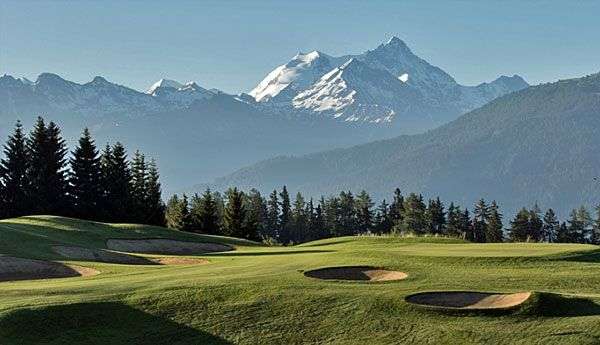
Perched at high altitude on a lush mountain plateau in the Alps, the Severiano Ballesteros course at Crans-sur-Sierre Golf Club has to be the most spectacularly scenic tournament venue in the world.


Crans-sur-Sierre (Severiano Ballesteros)
Perched at high altitude on a lush mountain plateau in the Alps, the Severiano Ballesteros course at Crans-sur-Sierre Golf Club has to be the most spectacularly scenic tournament venue in the world.
Perched at high altitude on a lush mountain plateau in the Alps, Crans-sur-Sierre has to be the most spectacularly scenic European Tour venue.
Golf was first played at Crans-Montana in the Swiss Alps way back in 1905, but at the outbreak of the First World War, the course was abandoned and it wasn’t resurrected until 1924 after the foundation of Crans-sur-Sierre Golf Club. A nine-hole course was soon laid out and then in 1928 Harry Nicholson extended the course to 18 holes.
Did you know that since 1972, Crans-sur-Sierre has annually staged a European Tour event? With 40+ tournaments hosted here at Crans-Montana, that’s way more than any other course on the Tour.
Slowly but surely Crans-sur-Sierre grew in popularity and in 1939, the European Masters was hosted at the club for the first time. WW2 interrupted proceedings but in 1948 the competition returned to the club and it has been held here ever since.
The club enlisted Jack Nicklaus to design an additional nine-hole course on the opposite side of the road to the main 18-hole track; in 1988 the Golden Bear's Signature layout opened for play.
Seve Ballesteros was drafted in to tighten up the main course in 1995 and he returned two years later to rebuild the greens after 70 years of wear and tear had taken toll. Clearly pleased with Seve’s transformation work, Crans-sur-Sierre renamed the course “Severiano Ballesteros” (it was previously known as Plan-Bramois).
With its high altitude and crystal clear air, expect to be flattered. The ball travels much further up here in the Alps and you can be forgiven for thinking that you might be able to out-drive Tiger. Crans-sur-Sierre is closed and under several feet of snow for half of the year but in the summer the playing conditions are perfect. Whatever you do, make sure you bring your camera, you'll be hard pressed to find better scenery anywhere else in Europe.
The latest ranking of the Top 100 Golf Courses in the World serves as the ultimate global golf bucket list. Most members of our World Top 100 Panel are seasoned golfers, each playing 20-30 of these courses annually while travelling extensively over decades to form their opinions on others. We recognise that opinions vary—even among our panel members. Rankings are subjective, and there are undoubtedly 50 or more courses in the UK and USA alone that could easily fit onto this list. Links Golf Pilgrimages The rankings
California, United States
New Jersey, United States
Northern Ireland, United Kingdom
New York, United States
New York, United States

Teeing it high in Switzerland Crans-sur-Sierre is golf with altitude 15th October 2014 When the invitation arrived on the Top 100 desk to sample the golf and culture of the Swiss Alps as part of a small media group, I jumped at the opportunity without hesitation. Switzerland may not be a top-of-the-list destination for many travelling golfers, but there is more than enough going on in the area to keep both golfer and non-golfer entertained. Our trip was based around the picturesque towns of Verbier and Crans Montana where you are more likely to see a well-known film star than anyone wearing a football shirt. Verbier is best known as one of Europe’s premier ski resorts and Crans Montana is renowned for the European Tour event that has been held at Crans-sur-Sierre Golf Club every year since 1972. I made the decision to hire rental clubs to cut down on luggage, as a three-hour train journey is necessary when travelling from Zurich, changing at Visp to Martigny in the Alps. I needn’t have worried as the trains are comfortably spacious and golf clubs wouldn’t have been an issue. After a splendid breakfast in the very comfortable Hotel La Cordée, located in the centre of Verbier, we took a gondola ride up the mountain from the Medran ski lift. From here we were able to enjoy the sculpture park and drink in the panoramic views over the snow-capped Mont Blanc massifs. The vista of the golf course below only whetted our appetite for our opening round later that afternoon. Verbier Golf Club is unlikely to appear in the Swiss best in country rankings, but it has more than enough character to keep you interested throughout. The unusual location just above the town, with the fairways clinging to the side of the valley, leaves a lasting impression, and although there are a number of blind shots and a few quirky holes, the course is great fun to play. The ski lifts that cut through the layout in numerous places serve as a constant reminder that for six months of the year snow covers everything. The course is laid out on cleverly designed terraces which run across the slopes, and our host Rico ably demonstrated that strategy and precision is required if you are to overcome the numerous streams and natural obstacles. Unusually the round begins with a ten-minute buggy ride to the top of the course from where you begin your slow descent. The course is certainly walkable; the only hard climb is to the 1st tee and then on the 15th and 16th holes where you play two short uphill par fours before heading back down to the clubhouse. There is also an 18-hole par three course nearby to cater for beginners. Dinner in the ultra-modern Arola Restaurant, at the exquisite and rather funky W Hotel, was the perfect way the end the day, sampling local wines and incredible tapas. No time was wasted the next morning as we headed to two small local Museums, part of the Musee de Bagnes, one of these being an old forge where cow bells were manufactured for many generations. The excellent Renoir Exhibition at the Pierre Gianadda Foundation in Martigny was next, where over a hundred works by the most famous portrait painter of all time had been assembled from galleries and private collections worldwide. Our next stop was Crans Montana, which is set in one of the most stunning Alpine locations. Perched on a plateau 1,500 metres above sea level, this a jaw-droppingly beautiful place. After checking in at the well-appointed Royal Hotel, we took a short walk through the picture postcard town to the famous Crans-sur-Sierre Golf Club. This is undoubtedly one of the more picturesque and most popular destinations on the European Tour, having hosted more events than any other course on the Tour. The layout has undergone several redesigns, including changes made by Seve Ballesteros in 1997 that led to the course being re-named in his honour. Recent modifications have created several lakes, rivers and tees, which have made a spectacular impact. The on-site facilities include an impressive academy and range built into a small hillside, which helps screen the building from the course, a putting green on the roof blending into the landscape seamlessly, and a pretty little halfway house where you will receive a welcoming smile from Corinne. The course boasts a number of classy holes, particularly the run between 12 and 14. On the par four 12th your approach must be played downhill to a sunken green guarded by a lake, the magnificent par three 13th is set in an attractive amphitheatre, again being closely protected by water, and the beautiful downhill par five 14th has a wonderful risk and reward dilemma to contend with. Currently ranked #4 in Switzerland, Crans-sur-Sierre has some of the most inspiring views in world golf; the vista of the peaks and valleys from the 7th tee is simply breathtaking. Cornelia Brukkner from Golf Women in Germany and myself were fortunate to be joined on the round by club teaching pro Eddie Gardino who was also an experienced European Tour and Ryder Cup caddie. Eddie, who twice appeared on the TV golf show “The Big Break”, speaks five languages and told many interesting tales from his years carrying the bags of some big name players. His most memorable moments came on the bag of Ángel Cabrera when he won the 2007 US Open, with Sergio Garcia at the 1999 Ryder Cup and with Miguel Ángel Jiménez at the 2002 Ryder Cup. At dinner, conversation focussed on an unforgettable day’s golf as we enjoyed traditional Swiss food and wine at La Bergerie de Cervin. The next morning we called in to the Pierre Arnaud Foundation, a modern new facility in Lens, to take a look at the surrealist art on show before our final round on the 9-hole Jack Nicklaus course at Crans-sur-Sierre. Although relatively short at 2,729 metres, this course is well worth playing as it boasts a number of raised tees and plateau greens. The fairways are tree-lined and mainly quite tight, so accuracy is vital if you are to score well. There’s plenty of variety in the design, the putting surfaces were excellent throughout, and both par threes are easy on the eye as well as challenging. There are a number of other courses nearby in the Valais region for those who want to play a few more. Both Riederalp GC and Matterhorn GC offer 9 holes in the mountains, while Sion, Sierre and Leuk are all 18-hole parkland style courses laid out on fairly level ground on the valley floor. This golf trip was certainly different to anything I’d previously experienced. It was not only thoroughly enjoyable, but also very memorable. Sincere thanks to Delia Inniger and Melanie at Valais Promotion for hosting such a great trip, and Switzerland Tourism for making the travel arrangements. Thanks also to the other hosts and guides we met at various locations for being so welcoming and informative. For more information on the Valais region visit www.valais.ch Brian Ward www.top100golfcourses.com
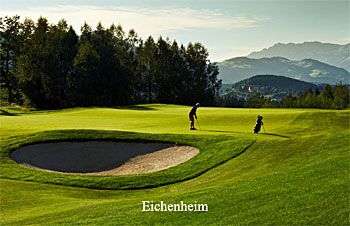
Top 100 Golf Courses revises its 2014 Alpine rankings Austria and Switzerland are the latest European countries to receive a Top 100 ranking review 19 January 2014 Top 100 Golf Courses has been ranking courses in the Alpine countries of Austria and Switzerland since 2008. Although best known in a sporting context for their world-class ski resorts, these two small, mountainous nations are home to a surprising number of engaging golf layouts. In Austria, Fontana has been ranked as the national No.1 since our classifications for that country began. A former Austrian Open venue, this wonderful course also occupies a place in our Continental European listings, where you’ll currently find it at number 49. Two years after Fontana opened, in 1998 to be precise, architect Jeff Howes expanded the original 9-hole layout at Adamstal to a full 18-hole course and this modern track has now matured into what we think is the second best golf facility in Austria, claiming a place in our European Top 100 at number 70. Three upward movers in the Austrian chart also deserve a mention: The Kyle Phillips-designed Eichenheim course in the state of Tirol is certainly a special place to play and, after registering a fall in our chart of two years ago, it now advances three places to number 5. Dachstein-Taurenin the Styrian region is a fine 1987 Bernhard Langer creation that climbs four spots to enter the national Top 10 for the first time at number 9. Donald Harradine’s Linz, located within the Tillysburg Estate in the Danube Valley, also rises a creditable four positions to number 10. Across the border in Switzerland, the top two courses – both of which emanated from the drawing board of American-based architects – have been locked in the same positions for the four editions of the course rankings that we’ve published. Domaine Imperial, which is one of a very small number of European creations attributed to Pete Dye (all of which have actually been constructed by Tim Liddy), remains at the top of the national chart and it’s also listed at a lofty number 30 in our Continental European rankings. Tucked in just behind Mr Dye’s course, Robert Trent Jones Snr’s 18 holes at Geneva were first revealed to the golfing public in 1972 and the layout was chosen a couple of decades later to host the women’s world amateur team championships. This course also makes our European chart, squeezing in at number 100. Several other courses make modest one position moves up the Swiss table: Crans-sur-Sierre, following a Ballesteros upgrade, is now a firm favourite with European Tour pros. Schonenberg, a 1960s Donald Harradine design, lies to the south east of Zurich. Ascona, where Messrs Colt, Alison, Cotton and Harradine have all had a hand in shaping it down the years. Zumikon, an old Zurich layout, which Thomas Himmel has upgraded in recent times. Top 100 Golf Courses has never claimed to present “definitive” golf course rankings. Instead, we think we produce the “most informed” listings, taking into account data and opinion from as wide a range of sources as possible. If you think we’ve missed an Alpine Gem then do let us know. And please send us a course review should you have been lucky enough to play any of our featured courses in Austria or Switzerland. Jim McCann Editor www.top100golfcourses.com Click the link to see our new Austrian Top 15 in detail Click the link to our new Swiss Top 10 in detail
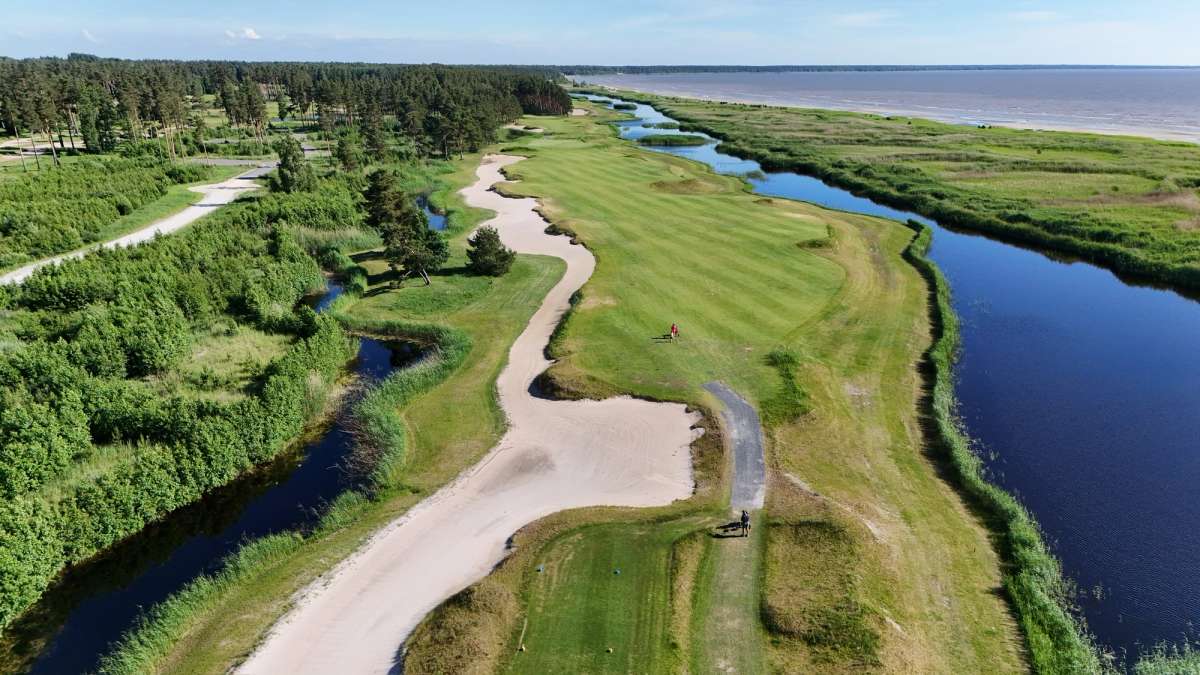
Europe's golf map stretches well beyond the famous names. Away from the links of Scotland and Ireland and the better-known resort destinations of Spain and Portugal, there are outstanding courses tucked into mountain valleys, Baltic coastlines and forests across the continent. From Switzerland to Estonia, these are courses that can be easy to overlook when planning a golf trip, despite offering the scenery, character and quality to make the journey worthwhile. We've picked 10 of Europe's biggest hidden gems, with every course coming from a different country. Andermatt Golf Course (Uri, Switzerland) Switzerland Ranking: 12th | Green Fees: From 130 CHF (€137) At around 1,400 metres above sea level, Andermatt Swiss Alps is surrounded by mountains, but the course itself is not quite the mountain layout you might expect. Designed by Kurt Rossknecht and opened in 2016, much of the 130-hectare course is relatively flat, with long rough lining the fairways and few trees giving it a links-like character. The third and fourth holes provide a dramatic change of pace, climbing through the rocky terrain at the end of the valley, while natural streams and water hazards feature elsewhere on the layout. The surroundings are impossible to ignore, with mountain ranges encircling the course and the sound of Alpine streams and grazing cows completing the experience. Pärnu Bay Golf Links (Pärnu Maakond, Estonia) Estonia Ranking: 1st | Continental Europe Ranking: 52nd | Green Fees: From €75 Estonia is hardly the first country that springs to mind when planning a European golf trip, which is precisely why Pärnu Bay Golf Links deserves a place on this list. Opened in 2015, the Lassi Pekka Tilander design occupies a narrow strip of sandy land where forest meets the Baltic Sea. Wide fairways, expansive waste areas and bold, multi-tiered greens give the course a links-like character, while the firm fescue surfaces reward a low, running game. Lead shaper Mick McShane, whose CV includes Kingsbarns, helped bring the design to life. Pärnu Bay may be off the beaten track, but it is one of the Baltics' standout layouts. Adamstal Golf Club - Championship Course (Niederösterreich, Austria) Austria Ranking: 1st | Continental Europe Ranking: 89th | Green Fees: €115 Tucked into a wooded valley southwest of Vienna, Adamstal feels a long way from the Austrian capital and even further from the usual European golf itinerary. Yet this spectacular mountain course has been Austria’s No. 1 on Top100’s national rankings and has hosted several editions of the Challenge Tour’s Euram Bank Open. Canadian architect Jeff Howes shaped the Championship course around the natural contours of the valley, with the 10th and 11th climbing into the mountains before dramatic elevated tees reveal the landscape below. The course even has a settle-the-bet 19th hole, a par three tucked into a pretty valley beside a mountain spring that has supplied Adamstal with drinking water for more than a century. Thracian Cliffs Golf & Beach Resort (Dobrich Province, Bulgaria) Bulgaria Ranking: 1st | Continental Europe Ranking: 43rd | Green Fees: €119 Perched on Bulgaria's northern Black Sea coast, Thracian Cliffs is one of Europe's most spectacular coastal golf courses. Gary Player’s signature design opened in 2011, with the holes carved along a narrow strip of land between high cliffs and the sea. The Black Sea is visible from every hole, while dramatic elevation changes add another dimension to the experience. The course hosted the 2013 World Match Play Championship, won by Graeme McDowell, and has featured prominently in Top100’s Continental Europe rankings. Alongside nearby BlackSeaRama and Lighthouse, Thracian Cliffs forms part of an unlikely but compelling golf destination on Bulgaria’s Black Sea coast. Zala Springs Golf Resort (Hungary) Hungary Ranking: 1st | Green Fees: 41,900 HUF (€114) Set among the rolling hills of western Hungary, Zala Springs combines a Robert Trent Jones Jr.-designed course with the thermal waters of nearby Hévíz. Opened in 2016, the 160-hectare layout winds through a landscape of lakes, natural rock formations and mature vegetation, with plenty of water coming into play. The 12th is among the standout holes, requiring an all-carry shot over an intimidating lake, while the ninth features a distinctive Biarritz green. Zala Springs is ranked Hungary’s No. 1 course by Top100 and offers something increasingly rare in modern golf: a high-quality course paired with a destination where golf is only part of the holiday. Kytäjä Golf – South East Course (Finland) Finland Ranking: 4th | Green Fees: From €90 Just 30 minutes north of Helsinki, Kytäjä's South East course offers a very different side of Finnish golf. Designed by Canadian architect Thomas McBroom and opened in 2003, it was his first Scandinavian project. The front nine winds through undulating woodland, before the back nine opens out across flatter terrain and towards the shores of Lake Kytäjä. Those lakeside holes provide some of the course’s most impressive views, with the surrounding Finnish landscape never far from sight. Kytäjä may be a relatively unfamiliar name to travelling golfers, but visitors are warmly received and there is plenty to discover. Karlštejn Golf Resort – A&B Course (Central Bohemian Region, Czechia) Czechia Ranking: 4th | Green Fees: From 1,900 CZK (€78) Golf in the grounds of a medieval castle is a pretty good way to spend a day in Czechia. Around 30 kilometres southwest of Prague, Karlštejn Golf Resort winds through a hilly, wooded landscape beneath the famous Karlštejn Castle, with limestone outcrops, ravines and a couple of lakes adding plenty of character. The 6,324-metre course was designed by Canadian architect Les Furber, who returned in 2006 to add a further nine holes. The original layout has also hosted a Ladies European Tour event, adding some serious pedigree to an otherwise wonderfully secluded setting. With Prague close by and the castle looming over the landscape, Karlštejn offers a memorable combination of golf and sightseeing. Golf Club Tále - Gray Bear Course (Slovakia) Slovakia Ranking: 3rd | Green Fees: From €75 Set in a mountain valley beneath the Low Tatras, Gray Bear was the first 18-hole championship course to open in Slovakia when it welcomed its first golfers in 2002. Designed by Americans Bob Walton and Skip Malek, the course occupies 160 acres of spruce forest within Tále National Park, weaving between open meadows and dense woodland. Streams, boulders, stone walls and specimen pines are incorporated throughout the layout, giving it a distinctly natural character. The 6th is the signature hole, with a stream crossing the fairway before the hole sweeps downhill towards a green surrounded on three sides by water. With the Low Tatras providing a dramatic backdrop throughout, Gray Bear is a memorable introduction to golf in Slovakia and an easy addition to a wider trip through the country. Golf Grad Otočec (Novo Mesto, Slovenia) Slovenia Ranking: 2nd | Green Fees: €80 Set among the heavily forested hills of Dolenjska, Grad Otočec winds through an undulating 185-acre property beside the River Krka. The course is a collaboration between Howard Swan and local architect Peter Škofic, with tight playing corridors creating an unusual sense of seclusion as the fairways twist through the woodland. The 3rd is a standout, with the par five turning towards a sunken, blind green, while the 12th stretches to 568 metres and demands three long, straight shots. Adding to the appeal, Otočec Castle sits nearby on an island in the river, giving visiting golfers the chance to stay in a genuine Slovenian castle after their round. Miklagard Golf (Viken, Norway) Norway Ranking: 2nd | Green Fees: From 850 NOK (€78) Just 10 minutes from Oslo Airport, Miklagard is remarkably convenient for a course of its stature. Robert Trent Jones Jr. designed it as Norway’s first championship course, with the layout purpose-built to host national and international tournaments. It is a big, bold test, with significant elevation changes, large bunkers and fast, contoured greens. A 2019 remodelling project added five new holes and reshaped the opening, while a hotel now occupies the former practice area. Its combination of accessibility, pedigree and championship credentials makes it an easy addition to a golf trip through Norway.