Opened for members play in May 2011 and known simply as “The Dutch”, this new Colin Montgomerie inland links-marketed golf course was at the heart of Holland’s bid to host the 2018 Ryder Cup.


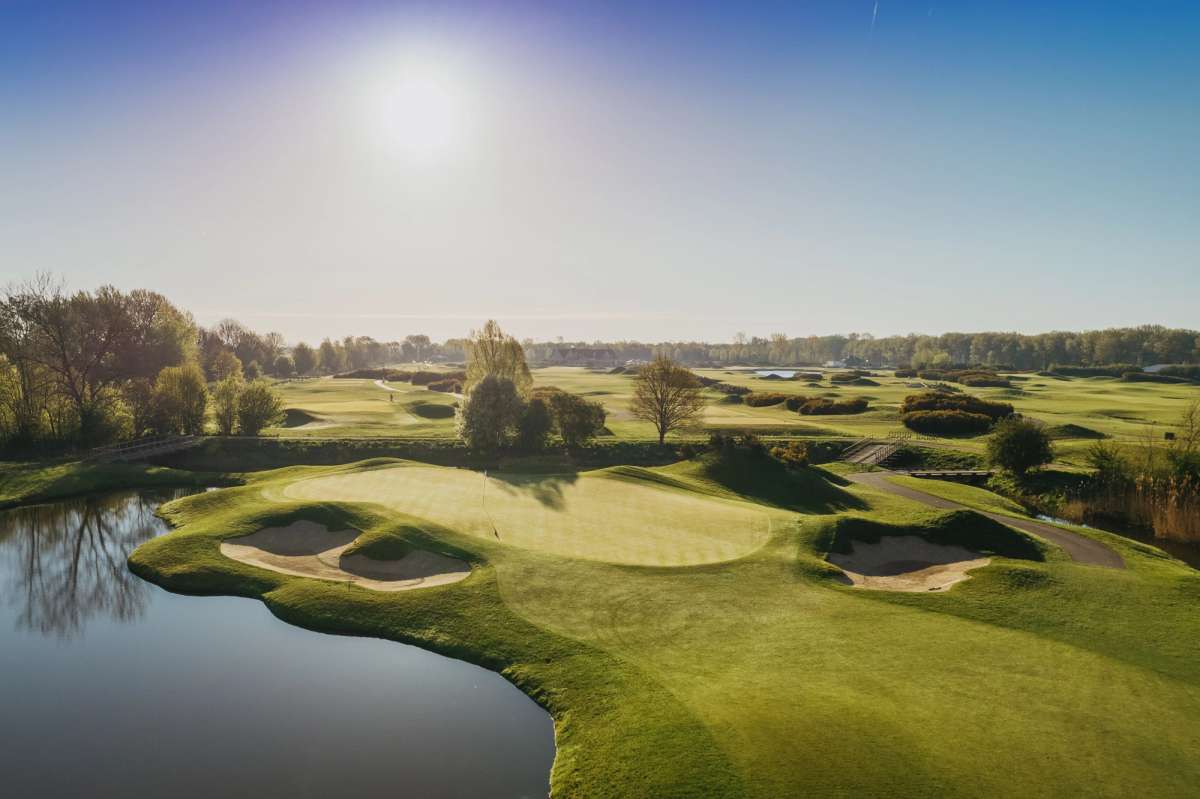


Opened for members play in May 2011 and known simply as “The Dutch”, this new Colin Montgomerie inland links-marketed golf course was at the heart of Holland’s bid to host the 2018 Ryder Cup.
In 1996, four good friends and golf professionals (who lived in The Netherlands), sat in front of a warm fire at Loch Lomond and formed a golf company called Made in Scotland that aspired to improve the game they loved in the Netherlands. This humble beginning would later lead to the expansion of their company along with the realization of their dream to create a world-class golf experience that would compete with the top golf courses in Continental Europe.
Made in Scotland worked together with Colin Montgomerie and Ross McMurray of European Golf Design (which is a joint venture between IMG and the European Tour) to create a course that would live up to the high standards necessary to host European Tour events. On the 14th of May 2011, The Dutch officially opened and was then put forward in the country’s bid to host the 2018 Ryder Cup. Unfortunately for the Netherlands, France won the Ryder Cup bid, but the infrastructure and facilities developed at The Dutch remain a lasting legacy and are pitched at a level capable of all the demands required to host any large-scale professional golf event.
The Dutch also represents a completely different kind of golf experience to anything that previously existed in the Netherlands. The level of service and the quality of facilities, from the practice areas to the meeting rooms and locker rooms are second to none. The club was formed as a place where business meets golf, where companies pamper clients and build relations in a very special environment. The Dutch is a rare treat for the lucky members and their invited guests.
Apparently styled in the fashion of an inland links, The Dutch features links-like bunkering, undulating green complexes and diverse, burn-like water hazards. The entire facility is set up for the hosting of European Tour events, at least the main Netherlands stop... the KLM Open was destined to be staged here at some point. The Dutch is really the only venue in the Netherlands that has the perfect facilities, space and infrastructure to easily and logistically host these events, which makes perfect sense given the club was a potential Ryder Cup venue and was designed as such.
In 2016 The Dutch was duly rewarded as host venue for the KLM Open, which historically has always been contested on a classic links or heathland course. Home favourite Joost Luiten won the event, becoming the first Dutchman to win his national Open twice. Frenchman Romain Wattel won the 2017 tournament and China’s Wu Ashun lifted the trophy in 2018. The KLM Open relocates from The Dutch to The International at Schiphol Airport in 2019 to commemorate the airline’s centenary and the 100th edition of the Dutch Open.
The Dutch is very private club, extremely private even for the standards of The Netherlands. Therefore, even if you are coming from overseas and call ahead or write in advance, you won’t get a game unless you know a member or have a corporate contact.
The latest ranking of the Top 100 Golf Courses in the World serves as the ultimate global golf bucket list. Most members of our World Top 100 Panel are seasoned golfers, each playing 20-30 of these courses annually while travelling extensively over decades to form their opinions on others. We recognise that opinions vary—even among our panel members. Rankings are subjective, and there are undoubtedly 50 or more courses in the UK and USA alone that could easily fit onto this list. Links Golf Pilgrimages The rankings
California, United States
New Jersey, United States
Northern Ireland, United Kingdom
New York, United States
New York, United States

A few more enticing golfing options in The Netherlands We left a few loose ends behind when we returned from The Netherlands last year. The article that followed our visit, The Netherlands – a golf destination of surprisingly high quality, covered most of the country’s top tracks but there were a few courses that we just didn’t have time to see at that particular time, including one of great antiquity and a couple of more modern tracks. We wanted to find out how the new Kyle Phillips course at Cromvoirt had turned out since we were over there and we needed to discover a little bit more about the only new entry in our Top 25 of The Netherlands rankings which were updated earlier this year. We’d also been alerted to a reversible 9-hole course that only opened this summer so another trip to the Kingdom of the Low Countries was the only way to satisfy our curiosity. Bernardus Bernardus, the new Kyle Phillips design at Cromvoirt in North Brabant, lies immediately to the east of the Dunes of Loon and Drunen National Park, one of the largest sand drift areas in western Europe. It’s no great surprise then to learn that the course occupies a sandy site, where fescue fairways are fringed by acres of transplanted heather to bolster the heathland appeal. The course had a soft opening in the summer when ten holes were brought into play and it’s only become fully operational in the last few weeks. There’s a little bit of shaping and tree planting still to be carried out but, to all intents and purposes, Bernardus is now up and running, featuring a wonderful 18-hole course that’s complemented by a fantastic clubhouse-restaurant ensemble and the best practice facilities in the country. Rosendaelsche Rosendaelsche Golfclub is one of the oldest clubs in The Netherlands, established in 1895 before moving to its present location thirteen years later. Today’s 18-hole layout was formed in 1977, after Frank Pennink added another nine holes to the original nine. Venue for the 1984 Dutch Open, Rosendaelsche is laid out across a glorious wooded heathland setting just off a busy road interchange to the north of Arnhem, with a fabulous new short game, practice area and driving range now in place. The Dutch The Dutch is one of the country’s new kids on the golfing block, located around 45 kilometres to the east of Rotterdam. The course was unveiled in 2011, but it’s already made its mark on the national golf scene by hosting the KLM Open for the last three years. Designed by Colin Montgomerie with Ross McMurray from European Golf Design, it’s one of twenty-eight worldwide destinations included in the European Tour Properties portfolio. Unfortunately, it’s one of the only truly private tracks that anybody on the Top 100 Team has played in The Netherlands so you’ll need to know a member or have a corporate contact to get a game here. Hoge Kleij An hour’s drive northwest from The Dutch, on the other side of Utrecht, the course at Golfclub De Hoge Kleij sits within a forested private estate on the outskirts of Amersfoort. Opened for play in the mid-1980s, it’s set out over a surprisingly undulating landscape, with around thirty metres of elevation change between the highest and lowest point on the course. Frank Pont has been busy here in recent years, advising on tree clearance, renovating greens and resequencing the holes. Heelsum The 27-hole facility at Golfclub Heelsum in Arnhem is a new millennium design by Hans Hertzberger which was a new entry in the latest edition of our Netherlands rankings back in January, debuting at number 17. Steve Marnoch has been working here for a number of years now, restoring a degenerated heathland habitat, re-bunkering the sand hazards with ragged edging, and improving the overall playing strategy of the original layout. Links Valley The Links Valley layout outside Ermelo in the Veluwe region of Gelderland only opened in May and it’s billed as Europe’s first reversible course. Designed by Frank Pont, the fairways are routed around 65 acres of the De Uller estate on a property that was once used as a quarry and then as a landfill site before it was capped with sand when it closed in 2006. Taking his inspiration from The Architectural Side of Golf by H. N. Wethered and Tom Simpson, Frank decided to put into practice a theory discussed in this 1920s book referring to the principle of a reversible course so shaper Conor Walsh was tasked with fashioning the playing corridors to play in either a largely clockwise direction (the South nine) or an anti-clockwise direction (the North course). The result is a fun track that stretches to just under three thousand metres, whichever way it’s played. The North has only one par five (at the 1st) and two par threes (the 3rd and 8th), while the South is a little more varied, configured with two par fives (#1 and #9) and three short holes (#2, #5 and #7). A very chic new clubhouse has just opened its doors for business and it’ll be interesting to see how things develop with this highly innovative endeavour. Jim McCann Editor Top 100 Golf Courses

From The Cradle to the grave Time is golf’s Achilles' heel. Often it takes too long to play eighteen holes, or at least it feels too long when you’re playing at snail’s pace behind groups of slower golfers. Waiting to play your shot time after time is no fun at all. I actually become murderous. I’ve never had much patience. When I first started playing golf some 30 years ago, I thought it was peculiar that some old-fashioned clubs insisted on two-ball or foursomes play only. I thought it was contrived to expect, or insist, on a round to be completed in less than three hours. These days it’s not unusual for male and female competitions (amateur and professional) to take five hours. You can add on a bit more time for medal play. I was invited to play in the Dutch Senior Masters at The Dutch near Rotterdam last autumn. The main event is a similar format to the Alfred Dunhill Links Championship where an amateur is paired with a pro and the best score counts in a two-day (Fri-Sat) team competition. Each professional’s individual score is counted on the Friday and Saturday and then the senior pros play their third and final round on Sunday without the amateurs in tow. The rules for the amateurs are simple – pick your ball up if you can’t beat the pro. Six hours after our Friday tee time, as the sun was beginning to set over Rotterdam, we putted out on the final green. The packed lunch and hot soup and sandwiches at the halfway hut were life saving. Thankfully I didn’t run out of cigarettes. My game largely deserted me for the two days, but in respect of the rules, and my pro partner’s well being, I duly picked up on many holes. I didn’t see any other amateurs picking up, probably they were either much better golfers than me or they had a much longer handicap. Maybe if golfers (pros and amateurs) spent less time thinking about the technical side of the game they’d play quicker and post a better score? If I’d played well in Holland, perhaps I’d feel differently about a six-hour round? Maybe, but I doubt it. So what can be done to avoid golf’s Achilles' heel, which I’ll call golf’s grave? First, let’s consider what is slow play. Is slow play when your group does not keep pace with the group in front? Or is it slow play if the group behind catches your group up? Maybe the group in front has lost a hole or more from the group in front of them, but will they let your group through? Should you ask to play through? If you and your partners are the only golfers on the course does it matter how long your round takes? Cart path only rules contribute significantly to slow play. Golfers leaving bags, trolleys or carts in the wrong place and not thinking ahead to where they’re going next wastes time. Standing around watching others in their group hit rather than walking ahead to their own ball and being ready to play when it’s their turn loses minutes. Worst of all, groups that do not care if they’re holding up the group behind – heaven forbid letting faster golfers play through. It all boils down to attitude, etiquette and awareness. But hold on a minute, isn’t there a rule for slow play? There is. But who abides by the rule, who cares and who enforces it? Slow play is supposedly governed under Rule 6; 6-7 Undue Delay; Slow Play – “The player must play without undue delay and in accordance with any pace of play guidelines…” Unfortunately, in my experience within amateur golf, most golf clubs don’t take a blind bit of notice of this rule, let alone enforce it. It’s those old fashioned golf clubs that insist on two-ball or foursomes play that take pace of play seriously. Most other golf clubs know who the slowcoaches are, but few do anything about it. My guess is that every golfer values playing at their own pace. I know I do. The problem is that we all tend to play the game differently. There are those that are forever thinking about where to leave their bags to enable a quick getaway. There are those that don’t want to spend much time looking for lost balls. There are golfers that don’t need to take a dozen practice swings. Some golfers walk faster than others. Some golfers don’t like to chat on the tee but would rather talk while walking between shots. It all comes down to “awareness”. Golfers should ask themselves “where am I relative to the group ahead and in relation to the club’s expectations on Pace of Play”. The problem/solution should be obvious. Fergal O’Leary, our US Consultant and self-confessed golf course addict, is a golfer who likes to get on with things. In the late 1980s, he’d go down to County Limerick with his cousins to play at Bruff Pitch & Putt. They’d walk around carrying a sand wedge and a putter, with tees and Commando golf balls stuffed in their pockets. Little did they realise that they were building a foundation for their short-game and shot-making ability. Fergal recently visited Pinehurst to play the new 9-hole par three course. The starter told Fergal to leave his golf bag with him as he pointed towards the first tee. Fergal had just celebrated his 35th birthday and once again he found himself walking to the first tee carrying a sand wedge and putter (he went old school and left the fancy cover in his bag). “There’s something really sentimental about carrying a couple of clubs in your hands as you navigate around this hugely fun 9-hole, 750-yard short course, created by the talented Gil Hanse”, said Fergal with a broad smile on his face. “There are no buggies or range finders to slow things down. The next tee is always within arm's reach of the previous green. As the name suggests (“The Cradle”), the course’s simplicity brings us back to the days when we had all of our lives ahead of us and when golf was a much less ‘technology’ dominated game. While Gil was challenged with adding his name to a golf course at such an iconic American venue, he brought back to me what I remembered as a young boy learning the game in Ireland: Hurry up! Use your eyes and mind to judge yardage Feel the distance, let the shot go and enjoy the experience Spend more time practicing the short-game The ‘Sandbelt-like’ scrubland visuals across the short course were really enjoyable, as are the impressive Hanse green-complexes which will mature beautifully. Despite being on a smaller plot of land, Hanse successfully laid out the course with changes in direction and even some gentle movement in elevation. At any point during the round you can see 20 to 40 golfers on the course moving quickly, picking up and placing down clubs on the grass and embracing the golf course that adds enormous value to the already impressive Pinehurst portfolio. It’s the best 40 minutes of your day – and replay rounds are free after you pay the initial (relatively modest for Pinehurst) green fee.” Unlike Fergal, you may not be heading to Pinehurst any time soon, but I wholeheartedly agree with his sentiments. So much so, in fact, that I joined a 9-hole golf club so I can escape from the office, play nine holes and be tethered back at the desk in about an hour and a half. The other reason I joined a 9-hole short course was to get my handicap down. I was arrogantly confident that I’d shave at least a shot off my handicap by playing a track that measures less than 2,300 yards from the tips. How wrong could I be? After playing more than fifty competitive rounds at Great Torrington Golf Club my handicap has actually gone up by one full shot. I’ve still not figured out why. My short game today is as good as it has ever been and my long game is no worse. I pray to the powers that be to stop lengthening courses for the professionals. Just let them all compete on sub 7,000-yard tracks… to hell with the scores. Who cares if the winner shoots 30-under par or better? I’d like to see a birdie fest at a course I too can play and enjoy from the same tees as the pros. I won’t shoot 10-under, but I might beat the pros on a couple of holes, as I achieved in Holland. It’s pointless trying to keep up with technology and sheer madness to lengthen courses just for the sake of accommodating a once-a-year pro tournament. Why not let the pros burn up the course if they can? Isn’t golf supposed to be fun? Matt Ward, one of our regular contributors, has a favourite motto: “You can print money but you can't print time. Once time is gone it’s gone.” He reckons we should make the most of every opportunity to play golf whenever possible. I wholeheartedly agree, but emphasise “play”. Playing is fun but waiting for others to play is like being stuck in a traffic jam. Nobody wants to admit to being slow. But if you are slow – and only you know that – just look in the mirror, step aside and let Speedy Gonzales through. If there isn’t a group behind, respect the policies around Slow Play anyway. Regardless of my musings, I doubt anything will happen anytime soon to address the issues surrounding slow play. But maybe someone will read this and accept that perhaps they are part of the problem – who knows I may be part of the problem too. They say patience is a virtue – maybe I should stop digging my grave. Keith Baxter Top 100 Golf Courses

There’s no “Going Dutch” at The Dutch Invited to play the most exclusive golfing facility in the Netherlands, our Benelux correspondent shares The Dutch experience November 2011 A day at The Dutch is really a unique experience, which up until now has not been equaled in the Netherlands. It all starts when you drive up to the manned entrance house and gate. Here you are immediately met by a gentleman with a smile on his face and clipboard in hand, something that rarely happens in Holland unless there is a police officer issuing a speeding ticket or a utilities company meter reader knocking on your door to penalize you for excessive use of lighting during the dark winters. This gentleman welcomes you and checks you off the guest list. As you drive down the approach to the beautiful clubhouse, the very best practice facilities in the Netherlands appear to your right and you sense a great day is in store. Two young men meet you and welcome you, asking you to leave your clubs in the car and just take your clothes into the clubhouse. They inform you that when you are ready your clubs will be waiting at the practice facility. This is a rather unique level of service in golf and reminiscent of some very special places… Whistling Straits, Bandon Dunes, Shoreacres and Loch Lomond spring to mind. As you make your way into the clubhouse it is evident that an enormous amount of attention has been paid to the fine details here at the Dutch. On top of that it’s clear that no expense has been spared with the furnishings from the quaint whisky and cigar room, equipped with private lockers for the members, to the cozy meeting rooms, Board Room and library. Various paintings, maps and old golf collectibles decorate the walls, many with the purpose of drawing as many parallels as possible between the Netherlands and Scotland – arguably the two homes of golf. Of all the features the clubhouse has to offer, the men’s dressing room is unquestionably the most memorable as it’s one of only a few in the world that has a fully equipped bar taking your orders and offering drinks upon entrance. With lounging chairs all around and flat screen TV’s in abundance, a trip to the men’s room takes on new meaning here at the Dutch. It provides the perfect setting to tempt your opponent into a few pre-round drinks to establish that ever so important competitive edge. The practice range is where I could easily spend my day. First of all, it’s one of the few in the Netherlands where you can practice from real turf instead of mats. The balls are stacked and waiting, both at the chipping and pitching range as well as the driving range. As always, a trip to the first tee is not complete without a stop at the putting green. At the Dutch, this is an absolute must and it will shock most golfers because the greens are incredibly fast and very undulating. In my opinion, The Dutch is the only course in the Netherlands with world-class green complexes and I was personally thrilled with them. I honestly didn’t think that any club in club in Holland would build greens as good as these – if anyone gets the chance to play this course, I’d highly recommend paying very close attention to their features. I think greens are an essential element that separates good and world-class courses. It’s also one reason why there are only a couple of courses in Continental Europe that ever make the World Top 100. Completely ready for the start of my round and having mainly focused on the facilities to this point, which are phenomenal in every sense of the word, it’s important to also look at things with a critical eye. In doing so I’d like to quote my favorite and most respected architect, Alister MacKenzie, upon seeing the property at Cypress Point, California: "It would be difficult to over-estimate the great possibilities of a golf course at Cypress Point. I am fully acquainted with the world's greatest golf courses and have no hesitation in saying that in the beauty of its surrounding, the magnificence of its sand dunes, its spectacular sea views, its glorious Cypress trees - there is no better opportunity of making [a golf course] which should be superior to any other.” You may wonder what’s the point of that quote being placed here? My point is simple. The greatest golf courses with few exceptions find themselves in the greatest locations, full of natural beauty with magnificent landscapes. While it’s clear to me that no expense was spared in creating the Dutch – and they performed miracles with what they had – in the end, what they started with was arguably one of THE worst locations to build a top course. Apparently, the site was so bad that European Golf Design (after surveying the property) left, refusing to build the course. The ground was simply a large, perfectly flat and rather square parcel of land that I would call swamp. On top of this, the location is two well-hit drivers away from a freeway, which makes the club easily accessible, but constant road noise is the flipside. Standing on the 1st tee, which is a short par 4, the main thing that caught my eye was the first green but, with the exception of the drive on the 2nd hole, which was a bit intimidating with water running down the right side, it was the only thing that left a significant impression on me until I reached the 8th hole. Commentators have previously stated that the Dutch really begins at the 8th. But to be fair, there is nothing wrong with the first seven holes. In fact, they are tremendous fun, they’re fair and playable for all levels of golfer but they are rather unspectacular, apart from the green complexes. However, the 8th hole is a perfect little par 3 and my favourite hole on the course, which plays 169 meters from the tips. Bunkers left, right, front and back heavily protect the raised green complex. The various run offs combine to make one of the most beautifully shaped, heavily undulating greens I’ve ever seen. The 9th hole is a strong par 4 at 425 meters and a tough driving hole with fairway bunkers to the right and left. The green is often out of play for the second shot, or at least leaves a very testing long iron over water that lies short of another very undulating green. Holes 10 and 11 pick up where the front nine ended in terms of challenge. 10 is a tough par 3 that normally plays into the prevailing wind. Water skirts along the right side all the way to the front of a slightly elevated green that is guarded by mounds of rough and bunkers to the left and right. 11 is a challenging and long par 4 that also plays into the prevailing wind. Long hitters will have to beware of the burn running through the fairway. The green is again slightly elevated and short approaches will feed right into the bunker protecting the right side of the green. This green is sloping left to right and front to back with tricky undulations throughout. The 12th hole is a short and tricky par 4 with a sharp dogleg left. A good drive will leave a short iron approach to a long, narrow, back to front sloping green protected by water on the left and bunkers on the right. Literally danger waits on every corner of this lovely little hole, which is the toughest hole on the scorecard. The 13th is a long par 5 that certainly challenges you from tee through to green. The drive is narrow with water on the right and bunkers left. The second shot must again take the burn into consideration. Lay up short of the burn and you are left with a long iron or wood to a highly elevated and undulated green. In fact, this green is the highest point on the course, which probably rises to the dizzy height of three meters below sea level! The 14th is another excellent par 3 with another undulated green surrounded by deep bunkers. The 15th is another very long and testing par 5 with water just short of the green and when this hole plays into the wind there will be absolutely no easy approach shots. Water again comes into play on the par 3 16th which at 158 meters (183m championship tees) is certainly no pushover as it’s all carry to the green over water and the further left you hit the longer the carry… as I found out the hard way. The par 4 17th is in my opinion one of the hardest holes with the most danger. Its index rating is set at 13, but it presents a tough drive with hazards everywhere. With an approach to a small, undulated, two-level green, water short left, bunkers both sides and no option of hitting long, it’s one of the best and toughest holes on the course. The home hole is a mammoth par 5 where the second shot and the approach shot are challenged with water on the right side and bunkers to the left. The green is very large and again very undulated, sloping in places towards the water to catch slightly errant shots. It was great to see that after a solid but unspectacular first 7 holes the Dutch really stepped up and produced a simply fantastic last 12 holes. Yes, I’m including the 19th, which is very special indeed and starts when you hit the men’s room where you are immediately treated to your first post match drinks, which can accompany you straight into the shower or sauna. A great way to round off a perfect day on the golf course! In the end I’m really impressed with the experience created by Made in Scotland at the Dutch. Despite the location they have done sublimely well with an amazingly unspectacular piece of ground. The outstanding green complexes are the highlight of the course and they set a new world-class standard for the Netherlands. These greens alone are more than enough to make me want to play the course over and over again in various weather conditions. Unfortunately, the vast majority of golfing Holland and myself will not be able to watch The Dutch mature over the coming years. That luxury is reserved for the members and their very fortunate guests. David Davis


