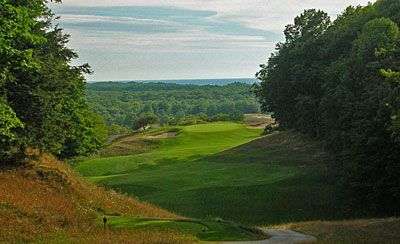
Featuring elevated tee positions on many of the holes, the 18-hole layout at EagleSticks Golf Club is routed across an undulating landscape where elevation changes occur with great regularity.

Featuring elevated tee positions on many of the holes, the 18-hole layout at EagleSticks Golf Club is routed across an undulating landscape where elevation changes occur with great regularity.
The Appalachian region of Ohio has received the least love from golf over the years, and Eaglesticks Golf Club represents an effort to bring affordable, quality play to citizens in a region often lacking. Part of the dearth of courses is the southeast portion of the state’s drastic topography, which is on display at Eaglesticks. Built on former farmland, one must sympathize with the livestock that were forced to pull equipment up and down these hills in eras past.
Michael Hurdzan and Dana Fry were able to squeeze a reasonable golf course within and on top of the slopes, however. Although many of the teeboxes will look down to fairways below, many players may want to consider leaving the driver in the bag: At just 6,500 yards from the tips, and ever-undulating land, finding the correct place to approach from is often preferable to finding the farthest distance from the tee.
The par five at No. 11 is perhaps the course’s signature hole, stretching nearly 600 yards, and divided by a creek about 250 yards out from the green. Ever resourceful, the club used remaining corn cribs from the property’s agricultural days to craft covered bridges across the span.
The latest ranking of the Top 100 Golf Courses in the World serves as the ultimate global golf bucket list. Most members of our World Top 100 Panel are seasoned golfers, each playing 20-30 of these courses annually while travelling extensively over decades to form their opinions on others. We recognise that opinions vary—even among our panel members. Rankings are subjective, and there are undoubtedly 50 or more courses in the UK and USA alone that could easily fit onto this list. Links Golf Pilgrimages The rankings
California, United States
New Jersey, United States
Northern Ireland, United Kingdom
New York, United States
New York, United States

The United States is home to some of the world's most celebrated golf courses, from spectacular coastal layouts to historic clubs that have hosted the game's biggest championships. But playing America's best golf is not always as straightforward as booking a tee time. Many of the country's highest-ranked courses are private clubs, while some resort venues require visitors to book accommodation before they can play. So where are America's top-ranked courses concentrated, and how many can the average golfer actually play? A state-by-state breakdown of the Top100 Golf Courses USA ranking reveals a striking divide. New York and California lead the way by course count, but of the 100 courses listed, just 16 meet our criteria for playing without knowing a member or staying at a resort. The remaining 84 have some form of access restriction, whether through private membership, accommodation requirements or other visitor policies. For golfers planning a trip to the United States, that distinction matters: a state might have an impressive collection of top-ranked courses, but that doesn't necessarily mean visitors can build a holiday around playing them. New York and California Lead the Rankings New York tops the state-by-state breakdown with 14 courses, narrowly ahead of California with 13. Massachusetts follows with seven, while Ohio and Wisconsin each have six. New Jersey and South Carolina account for five courses each. The figures highlight the strength of golf in the Northeast, alongside California's long-standing reputation as one of America's premier golfing destinations. New York is home to some of the country's most exclusive golf venues, including Shinnecock Hills Golf Club, National Golf Links of America and Fishers Island Club. However, it also has one of the world's most famous public courses. Located on Long Island, Bethpage Black has hosted multiple US Opens and the 2025 Ryder Cup. Its public status makes it an important exception in a ranking where access is often far from guaranteed. Demand is high and securing a tee time requires planning, but golfers do not need a private-club membership to play it. The other 13 New York courses in the ranking do not meet our public-access criteria. California presents a different mix of courses, from celebrated coastal layouts to championship venues further inland. Pebble Beach Golf Links is perhaps the best-known example, with its dramatic Pacific Ocean setting making it one of the most recognisable courses in golf. The state offers a wide range of golfing experiences, but green fees, booking conditions and accommodation requirements can influence whether a course is a realistic option for visiting golfers. Its size is another consideration, with distances between destinations potentially shaping how many courses golfers can fit into one trip. The States Where Top-Ranked Golf Is Hardest to Access Some of the states with the most courses in the ranking are also among the hardest for visiting golfers to explore. New York has 14 ranked courses, but 13 do not meet our criteria for playing without knowing a member or staying at a resort. California has 13 courses, with 11 falling outside those criteria, while none of Massachusetts' seven entries qualify. The contrast is striking. New York and California offer plenty of choice on paper, but their highest-ranked courses are often difficult to access independently. Massachusetts presents a similar challenge, with its rich golfing heritage reflected in a list dominated by venues that aren't straightforward for visitors to book. New Jersey faces a comparable issue. Its five courses include Pine Valley Golf Club, frequently ranked among the world's finest, but its reputation as a private club makes it a difficult destination for golfers without the right connections. These figures underline why course rankings alone don't tell the whole story. For visitors, the practical question isn't just how many highly ranked courses a state has, but how many they can realistically play. The Best States for Golf You Can Actually Play Of the 100 courses in Top100 Golf Courses' USA ranking, just 16 can be played by the public without knowing a member or staying at a resort. Wisconsin and Oregon lead the way, with four qualifying courses each, followed by South Carolina, Florida and California with two apiece. Oregon is an obvious choice for a multi-course golf trip. All four qualifying layouts are at Bandon Dunes Golf Resort on the Pacific coast: Bandon Dunes, Pacific Dunes, Bandon Trails and Old Macdonald. Having four highly ranked courses in one destination allows golfers to experience a variety of layouts without spending their holiday travelling between different parts of the state. The rugged coastal setting is a major part of the appeal. Wisconsin offers four qualifying courses across two destinations. Whistling Straits' Straits course is one of the state's best-known golfing venues, having hosted major championships on the shores of Lake Michigan. Further inland, Lawsonia Links offers a different style of golf, while Sand Valley and Sedge Valley give visitors two more courses to explore within the same resort destination. Together, they make Wisconsin a compelling choice for golfers looking to combine several highly ranked rounds in one trip. South Carolina has two qualifying courses, each offering a different experience. Kiawah Island's Ocean Course is known for its exposed coastal setting and championship pedigree, having hosted major events including the 2021 PGA Championship. Old Barnwell provides a contrasting inland experience, adding another option for golfers planning a trip around the state's top courses. Florida's two entries are Streamsong Red and TPC Sawgrass' Stadium Course. Streamsong Red is characterised by its expansive sandy terrain, while TPC Sawgrass is home to one of golf's most recognisable holes: the island-green 17th. The two courses offer very different experiences, from Streamsong's distinctive landscape to the chance to play one of the PGA Tour's most famous venues. California completes the group with Pebble Beach Golf Links and Pasatiempo. Pebble Beach is renowned for its Pacific coastline and history of major championships, while Pasatiempo, designed by Alister MacKenzie, offers a celebrated layout with a distinctive place in American golf history.

The message of great, strategic golf course architecture is clear. The actual words used to describe those golf courses, however, are many. The Architecture Glossary column will examine more precise terms and concepts that one will find when exploring golf course architecture. Hopefully understanding these terms, and why certain architects employed them, will help you to better understand the golf courses you play…and maybe even improve your scores! Today’s term is ‘Puzzle Piece Bunkering’. Although many concepts within golf course architecture are shared across a wide variety of architects, they often become associated in particular with a single architect (few come to mind as quickly as Pete Dye when discussing an “island green” for example). The same applies to Dick Wilson and “puzzle piece bunkering.” Wilson is often associated with the penal era of golf, and some of the most challenging courses ever created. These routes often featured tight fairways, lofted greens and, of course, plentiful bunkering. Although it has become somewhat fashionable to lump all of these architects together into one oversimplified bin, the designers of this era each had definitive aesthetics. Wilson was perhaps the most stylistically distinguished of the group, thanks to his bold puzzle piece bunkering. The simple essence of this idea is bunkering that defy simple geometry, involving a number of irregular ins-and-outs. While his contemporary, Robert Trent Jones, helped to usher in the era of cape-and-bay bunkering — generally more curvilinear in shape — Wilson often showcased a style both jagged and geometric, like he had taken a jigsaw (pun intended) to the soil. To differing degrees, the shapes of the bunkers were compared to puzzle pieces. Consider the opening hole at Coldstream Country Club in Cincinnati, Ohio. Off the tee, there are three bunkers that feature inward pegs, giving the metaphorical impression that they could, indeed, be linked together with other “missing pieces.” Look ahead to the green, and a pair of longer bunkers are stylized in much the same way. An aerial of the opening hole at Coldstream shows how Keith Foster's restoration added Dick Wilson's character back to the club's bunkers. In terms of function, the turf inlets into the bunker behave very much like cape-and-bay bunkers, creating awkward lines out of the trap for those who end up near inserts. But the general presentation of the bunker is very much a question of aesthetics. Not familiar with Wilson’s signature style? Much of this can be traced to standards of upkeep. Colstream has recently undergone a restoration from Keith Foster, which involved reconstructing Wilson’s signature, rough edges into the bunker. This style requires dedicated maintenance to preserve its appearance, and — as a result — many of Wilson’s most celebrated designs have found their bunkering taking a more curvilinear shape over the decades. Another architect that has seen similar style degradation is Alister MacKenzie, who is noted for his “feathered” bunkering. In fact, it’s not too far to suggest that the Scot created a few puzzle pieces of his own. Consider Titirangi Golf Club, MacKenzie’s only design in New Zealand. The greenside bunkers alongside No. 4 take more distinctly “puzzle-piece” shapes, a style that Wilson would pursue at many of his most notable courses, including Pine Tree Golf Club. It’s unlikely that MacKenzie was Wilson’s prime influencer, of course. That title belongs to William Flynn, to whom Wilson was employed up until the Great Depression set in. Alister MacKenzie's approach to bunkering occasionally merits comparisons to Wilson's, particularly at Titirangi. (Photo Credit: Gary Lisbon) Through Flynn’s involvement at Merion Golf Club, Wilson became intimately familiar with the club’s East Course, and his boss’s work constructing its bunkers (Hugh Wilson completed the design and hired Flynn for construction). The shapes around this world-renowned course reflect where Wilson may have gotten his own shaping ideas. Particularly interesting are the four bunkers that sit between the fairways for holes Nos. 11 and 12; not only do these hazards take a shape we would expect from Wilson in later years, they also seem as if they would fit together — like puzzle pieces — to create a single, massive sand hazard. Although this is not what’s usually meant by “puzzle piece” bunkering, it does demonstrate a tendency that Flynn would take to other courses, such as Shinnecock Hills, and that Wilson would replicate his own courses. By clustering bunkers and nesting smaller sand hazards within the curves of larger ones, the architect can create an intimidating sight from the tee, as these hazards appear to be part of a much larger sand trap. Wilson, before opening his own design firm, worked creating camouflage for U.S. airfields during World War II. Who knows if his early years in golf course design paid dividends for the Allied forces? Wilson no doubt took some cues from William Flynn while working at Merion, among other clubs. Note the similarities in style, but also how this cluster of bunkers between Merion's No. 11 and 12 holes seems to fit together in puzzle form. The movements following Wilson have not necessarily maintained the “puzzle piece” style, however they have not thrown them by the wayside either. Joe Lee was Wilson’s most prominent student and, although his projects never gathered as much attention as Wilson’s, the latter’s style inevitably seeped to the former’s. Lee’s last original design, Musket Ridge, shows some tendencies toward puzzle piece bunkering at No. 6, although clearly influenced by the wiggling aesthetics popularized in that era by Jim Engh and Bob Cupp. The modern “minimalist” approach doesn’t quite leave room for such bunkers, however it’s not tough to imagine that a modern parkland course, relying on the frazzled fashion cues of Doak et al, could incorporate such a style. Great golf course architecture should present itself as a puzzle to be solved. Dick Wilson found a way to make his bunkers a puzzle to be seen as well.
US East North Central Division Best in State Rankings 2016 Another five States in our Midwest Region are re-ranked in the seventh of nine US divisional updates This concludes the Midwest Region of our Best in State re-ranking process for the USA, where we’ve spent the last few months assessing courses across nine regional divisions. This is the seventh in our series of reviews and it covers the five Midwest “Great Lakes” states of Michigan, Ohio, Illinois, Indiana and Wisconsin, which are home to almost fifty million people. We’re increasing the number of courses that we feature in the USA and this expansion will be exhibited across almost every state in the country. For instance, in this East North Central division, we’re adding ten new courses to each of the five states, resulting in new Top 50 charts for Illinois, Michigan and Ohio. Michigan The top three positions remain exactly the same as last time around, which means that Crystal Downs is still the number one course in the Wolverine State. A recent reviewer described it thus: ”one of the few courses I’ve played in the Top 100 where I was able to remember every single hole… Crystal Downs is unique and presents you with a tough challenge… not by being long but by placing a premium on strategy.” It’s just a pity the course’s remote location and deficient infrastructure has prevented it from hosting more national events like the US Senior Amateur that was held here in 1991. Climbing three places to number 4, the 9-hole “walking only” course at the Dunes Club makes an impressive move in the right direction near the top of the new state listings. Developed by Mike Keiser of Bandon Dunes fame, this lovely little woodland layout – which squeezed into our recent update of the US Top 100 at number 100 – nestles on the shores of Lake Michigan, where it’s been delighting a select number of golfers ever since it was first unveiled in 1992. Further down the chart, Barton Hills, a near 100-year old Donald Ross layout that Ron Pritchard spent time restoring in 2013, bounds up a spectacular sixteen places to number 16 and it’s immediately followed by Orchard Lake, our highest new entry at number 17, which is a 1920s Golden Age design from C.H. Alison that has also been the recipient of a new millennium restoration, this time by Keith Foster. It was too early for us to consider the sixth course at Gull Lake View Golf Club, Southwest Michigan's oldest and largest golf resort. The Gallically named Stoatin Brae course is slated to open shortly and it’s been routed over a former apple orchard, stripped of its trees and reseeded with native grasses by Tom Doak’s Renaissance Design company. No doubt we'll be hearing a lot more about it, along with The Loop at Forest Dunes in northern Michigan, a reversible 18-hole design from the same firm of architects that is due to open in a similar timeframe. Rank/ Click this link to see full details of our 2016 Michigan Best in State rankings Ohio There’s little movement at the head of the table in the Buckeye State, where the top five tracks are all nationally ranked, and the Jack Nicklaus and Desmond Muirhead co-design at Muirfield Village is still the state’s number one course. It’s more than forty years since the Golden Bear built this course outside his hometown of Columbus and he’s constructed hundreds down the years since then but this track still remains one of his most endearing. Pete Dye’s course at The Golf Club, one of the architect’s earliest designs when it appeared back in the late 1960s, drops one place to number three, swapping places with Camargo, which becomes the new number two in our revised listings. Seth Raynor’s Cincinatti masterpiece has had its bunkers overhauled in recent years by Tom Doak’s Renaissance Design team and this work has certainly gone a long way to reviving the fortunes of a fabulous old track. The most significant upward move in the new chart is made by Alex Campbell’s 1930s course at Moraine Country Club (the USPGA Championship was held here in 1945) which climbs fifteen places to number 9. There’s no doubt the course has massively benefited from a recent Keith Foster renovation, involving the widening of fairways and the reconstruction of new greens and bunkers. Click this link to see full details of our 2016 Ohio Best in State rankings Illinois Chicago retains its place at the top of the Prairie State chart. Currently ranked number 13 in the USA Top 100 and number 22 in our World Top 100, this historically important course is the oldest 18-hole layout in the country, having been established in 1894. Host to three US Opens and four US Amateur Championships in its formative years, the club is now scheduled to stage the inaugural US Women’s Senior Open in 2018. The No.1 course at Medinah Country Club streaks up the chart from position 39 to 13 and this prodigious leap is all due to the major redesign that was recently carried out by Tom Doak. Nine of the original holes were re-routed, in the words of the architect, “to get fairways away from the nearby Medinah Road and to break away from the back-and-forth nature of the original layout… new greens and bunkering have tightened up the test.” The highest Illinois newcomer arrives at number 23 and it’s the revered old course at Onwentsia Club, which hosted three major championships during its first two decades of operation – the US Open in 1896, the US Amateur in 1899 and the US Women’s Amateur in 1915. The layout has been lengthened, bunkers have been modified and a lake added since then but it’s still a track that appeals to golfers of a traditionalist persuasion. Click this link to see full details of our 2016 Illinois Best in State rankings Indiana The Hoosier State of Indiana still has the spectacular 18-hole Victoria National course as its number one, with this rather unique Tom Fazio design holding off a strong challenge from a number of other contenders. Laid out within an abandoned coal mine, the course offers an exacting test of golf where much of the strategic strategy is shaped by a variety of water hazards that now lie within its 400-acre confines. Pete Dye’s early 1960s layout at Crooked Stick and Steve Smyers’ late 1980s design at Wolf Run exchange positions, with the former course (which held the USPGA in 1991, the Solheim Cup in 2006 and the BMW Championship in 2012 – the BMW returns here again later this year) dropping down one place and the latter, a renowned tough track that’s set in thickly forested terrain outside Indianapolis, moving up one to the runner-up spot. Three courses each make notable five-place upward moves: Brickyard Crossing at number 7 (where four of its fairways are located inside the oval of the Indianapolis Motor Speedway track), Notre Dame’s Warren course at number 9 (which held the US Women’s Amateur Public Links Championship in 2010) and South Bend Country Club at number 12, an old George O’Neil design described by Tommy Armour as “the sweetheart golf course of the Midwest”. The highest Indianan new entry comes in at number 11 and it’s the Kampen course at the 36-hole Birck Boilermaker golf complex, a mid-1990s Pete Dye layout that has attracted a number of distinguished state and regional golf competitions in the two decades since it debuted. Click this link to see full details of our 2016 Indiana Best in State rankings Wisconsin The Badger State listings are headed by the Straits course at Whistling Straits. Site of three USPGA Championships in 2004, 2010 and 2015, this highly-regarded layout is all set to host the Ryder Cup in 2020. A recent reviewer is of the opinion that “Pete Dye’s work here was done spectacularly well… it’s quite playable for less talented golfers, often because Dye built wide fairways and huge greens… I place Whistling Straits alongside the world’s best ‘modern links’ courses: those at Bandon, Barnbougle, Kingsbarns and Streamsong.” Only three courses make upward moves in the new Wisconsin chart and the highest climber (up four places to number 11) is SentryWorld, an early 1980s Robert Trent Jones Jnr layout that was closed at the end of 2012 to undergo an extensive two-year renovation. The original architect was called back in to oversee the construction of new tees, bunkers and greens, the regrading and reseeding of fairways, the reconfiguration and rerouting of several holes, and the introduction of new par threes at the 3rd and 12th. Soaring into the revised listings as a new entry at number 11, Troy Burne is a late 1990s public access facility from Dr Michael Hurdzan and Dana Fry, built in consultation with Tom Lehman, which took almost three years to construct. Water hazards feature at almost half the holes, thanks to the presence of four man-made lakes and a babbling brook, with bentgrass fairways and greens routed around 225 acres of rolling countryside. Click this link to see full details of our 2016 Wisconsin Best in State rankings As ever, we like to ask for feedback when we conduct a re-ranking exercise so please let us know what you think about our five newly revised US Best in State charts. Hopefully, you agree with what’s been published but maybe you think we’ve not quite got everything right. Whatever your opinion is, please click the “Respond to this article” link at the top or at the bottom of this page to let us know your views. Jim McCann Editor Top 100 Golf Courses


