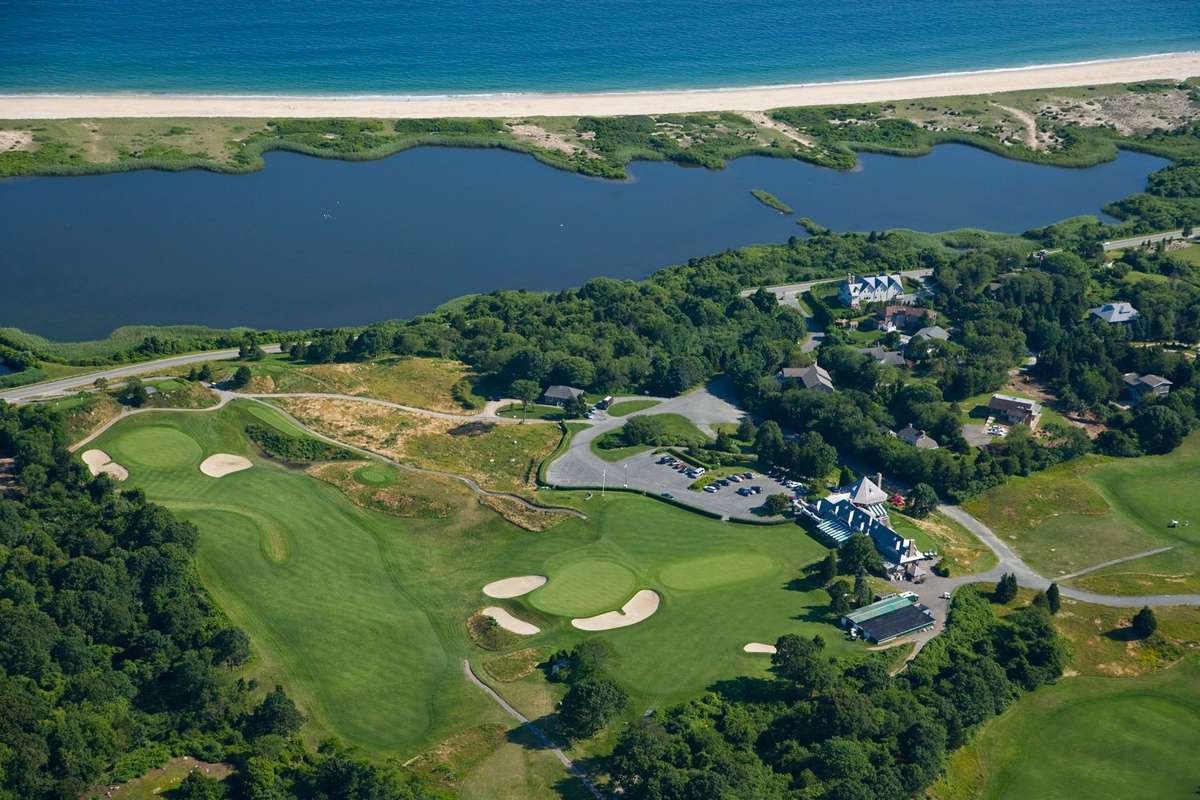
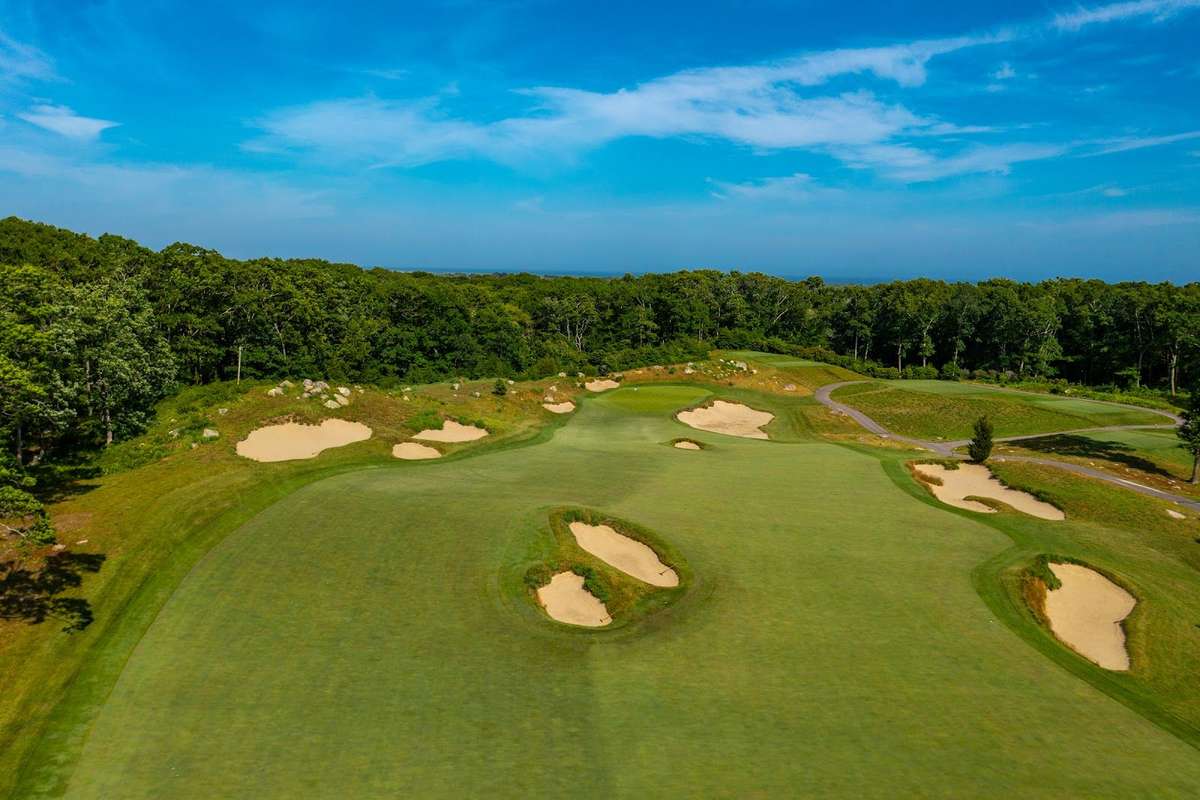
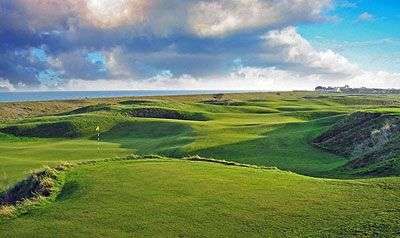
Fishers Island Club is set romantically on a narrow island that is a mere two miles wide and eight miles long.


Fishers Island Club is set romantically on a narrow island that is a mere two miles wide and eight miles long.

5.5
"Guests of guests may not bring guests" reads a facetious but friendly sign by the Fishers Island private beach club. For such an exclusive golf club, any guest--or guest of a guest--will feel welcome and experience a day unlike others.
Accessible only by boat, the visitor awaits their arrival to Fishers Island to the soothing sound of the Latimer Lighthouse bells, something they wont be able to ignore the whole day. As the boat approaches the unsuspecting dock near the 17th green, the lighthouse bell sounds begins to feel more like the spine-tingling intro to AC DC's "Hell's Bells," and the excitement grows inside you as the clubhouse in the distance slowly appears larger—where Dan will likely greet you by name.
If you've been lucky enough to receive an invitation to Fishers Island Golf Club, you're likely well-versed on the templated nature of its design by Seth Raynor, set on some extremely rare and exciting terrain.
The "Raynor's Start" opening hole is rather unexciting and fair, but perhaps the golfer deserves that right out of the gate, considering there’s isn’t a driving range you can walk to, so arrive ready to play.
The real fun begins on the 2nd tee to face the infamous Redan template. A tail wind advises you keep the ball flying low or you'll overshoot the green and find yourself with a nasty sand shot down the steep green slope, leaving par to nothing but a highly-skilled or simply lucky stroke.
And so the gauntlet continues with the most incredible stretch of sequential holes with the "Plateau", a truly amazing "Punch Bowl", and "Biarritz" templates along the water. Some golfers audaciously call these the best 3-hole stretch in all of golf, and others may argue that's 15,16, and 17 at Cypress. Such a conversation underpins how truly great these holes are. The Fishers Island "Punch Bowl" deserves recognition as one of the best single holes in all of golf.
While there may be many comparisons of Fishers Island to Cypress point, particularly considering Seth Raynor would have built CPC if not for his early passing, it should be safe to say that the right person built each of those. What’s certain is that Raynor built one of the most purely enjoyable tracks in American golf.
The 8th "Road Hole" is a bit of a disappointment compared to other template versions of it. The proverbial "St Andrews Hotel" hazard to the right of the fairway lacks the intimidation factor of the original hole, and the large front green side bunker lacks the true challenge of the original. Perhaps the specialest thing about the 8th hole is the subsequently available peanut butter and jelly with bacon sandwiches to refuel you before the turn.
Even if you strike a shot precisely enough to hold the 9th fairway, you're still going to encounter perhaps the most daunting approach shot of the day into the double plateau green with a probable strong cross wind to manipulate your ball further. Suddenly the Latimer Lighthouse "Hell's Bells" ring in your head again, this time with intimidation as you admire the hole's immensely beautiful setting. A miss of the green to the right or long is a death trap. By this point in your round, you're probably already used to pitching sand shots up to a green 10 feet above you.
The back nine continues the roller coaster round with the "Knoll" 10th green that favors the more creatively struck approach shots (usually played along the ground). Attempting the conventional shot through the air proves much more risky. The same can be said for the "Eden" 11th, which bears little resemblance to the original Eden at St Andrews, yet retains some of the intended playing elements.
Overall, playing a track with 15 of 18 holes on the ocean is a treat that's hard to beat. While, playing Fishers Island Club, one can't help but imagine which parts of the course contours were there before Raynor's hand influenced the soil. The greens complexes are world-class, though it is obvious they're manufactured to create maximum golfers' delight. It is hard not to imagine Fishers Island’s greens and hazards inspiring Pete Dye’s own earth-moving philosophy long before such dramatics became fashionable in golf course design.
The greens were remarkably consistent and smooth, yet surprisingly or even disappointingly benign in the level of challenging putts. The real challenge of the greens is reaching them unscathed, for the hazards are objects to be reckoned with. The safe approach to the green by laying up and sacrificing half a stroke may be smarter (and more fun) than missing your target.
The bunkers are well groomed with the island's natural sands. One may wish they had more varied and rugged appearances, a la Mackenzie, but one quickly realizes the bunkers' true intents are forcing strategic golf over eye candy.
The staff are friendly and make all guests—and guests of guests—feel like deserving members of the club.
No matter how well or poorly one plays at Fishers Island, they'll be eager for another experience here—for long after the ferry returns you to the mainland, the “Hell’s Bells” of Latimer echo in your mind.


peterlbowman
Round Information
Date Played
May 29, 2026
Standout Holes
#3, #4, #9
Rating Breakdown
Strategy
Green Complexes
Variety
Facilities & Amenities
D is for DOUBLE PLATEAU THE ORIGINAL The Double Plateau is one of the occasional templates that has no obvious “original,” but it could have been inspired by a number of plateaued greens Macdonald witnessed during his overseas research. The safe bet in such cases is to head to the National Golf Links of America, C.B. Macdonald’s distinguished template gallery. NGLA 11th hole - image courtesy of Jon Cavalier @LinksGems The Double Plateau template begins at the green, and works backwards. Greens displaying the ideal “Double Plateau” interpretations have three tiers: Two are the actual “plateaus,” raised higher than the third “ground-level” platform. It’s similar to the Biarritz in that landing on the wrong level will make two-putts a tough prospect. It is unlike the Biarritz in that all three levels are at different elevation, while the front and back levels are at the same height for a Biarritz. NGLA’s singularly-named “Plateau” at No.11 showcases a kidney-shaped Double Plateau rather than the more typical stumpy “L” shape—with plateaus at the front-left and back-right. The Double Plateau is rarely doglegged. Rather, the player must take pin position into consideration from the tee; its location alters whether the left or right side of the fairway makes for the best approach. As seen at NGLA, adjacent bunkers guard the plateaus to enforce this strategy. The most famous hazard on a Double Plateau, however, is the “Principal’s Nose,” located about 70 yards out from the green, which both interferes with the player’s sightline and their ground game. NGLA’s is a more psychedelic “Nose,” as it features three “nostrils” around a central hump. The hump is the more relevant element of a Principal’s Nose, preventing victims from taking a direct line to the green when escaping from the hazard. OTHER INTERPRETATIONS Those who prefer the more traditional, two-nostrilled Principal will admire Chicago Golf Club’s Double Plateau, which very accurately resembles a human snout. It’s another Macdonald classic, but featuring a more cubist nature, reminiscent of what protégé Seth Raynor would create in decades to come. This version also features a cross bunker off to the right. Although not an issue for modern drivers from the tee, it does pose a distraction from strategic consideration of the flag placement. Considering the number of plateaus the aforementioned Raynor added to his greens at Fishers Island, it is not surprising that there’s a Double Plateau in attendance. But which one? The obvious choice is No. 9, based on title alone: “Double Plateau.” The green is a mirror version of those seen at NGLA and Chicago, with the added benefit of the Atlantic Ocean as a backdrop. That said, it’s a touch short (365 yards) and the blind tee shot makes it impossible for the visiting player to fully identify the “perfect” placement off the tee. Fishers Island 18th hole - image courtesy of Jon Cavalier @LinksGems George Bahto instead makes an argument for No. 18 at Fishers in his book on Macdonald, The Evangelist of Golf. Some point out similarities to the Road Hole based on the green’s shape and strategic pot bunker, as well as its length (450-plus yards, playing as a Par 5 during strokeplay) and its playing angles. But this green actually checks all the boxes for a Double Plateau, and its visibility from the tee box allows players to play accordingly. When considered as a classic “Par 4.5” matchplay hole, No. 18 arguably fits more comfortably within the definition of “Double Plateau” than No. 9. On the other hand, Bahto advocates strongly for No. 14 at Raynor’s North Shore Country Club, which also features a blind tee shot over a (slightly smaller) ridge, before approaching an indisputable Double Plateau green. It features no Principal’s Nose, but neither do either of the aforementioned Fishers Island entries. Tom Doak is especially keen on his rendition of the Double Plateau, hosted at Bandon’s Old Macdonald course, describing it as “my favorite opening hole that we've ever built.” The choice from the tee box takes on an element of risk/reward, as bold drivers can attempt to carry a fairway bunker on the right to reach a lofted plateau, resulting in a more comfortable approach. The Principal’s Nose is very much in the green’s business, sitting right at the foot, rather than 50-or-so yards out. Old Macdonald 1st hole - image courtesy of Bandon Dunes MAYBE...MAYBE NOT The lack of an original, iconic hole leaves many angles for argument among aficionados, including these next few examples: We would propose that a true Par 5 cannot be a proper Double Plateau, in the template form. Although Fishers Island No. 18 is a “Par 5” by virtue of its scorecard, it is extremely short and more realistically a “stiff Par 4.” Macdonald’s design at St. Louis Country Club, on the other hand, features a 495-yard Par 5 named “Narrows,” which confusingly is an entirely separate template rendition. If the player looks to get home in two, then it most certainly plays as a true Double Plateau; after all, accuracy upon approach is paramount. But if the player opts to lay up, a short pitch takes considerable bite from the green, watering down its intent. Of course, if a Par 5 is of obvious three-shot length, then it could very much play into the Double Plateau’s purpose. Regardless of your (or our) take on the St. Louis iteration, No. 15 should be noted for its unique green setup: The first plateau is at the front, dropping off to the lower level, with the other plateau at the back-left. St Louis CC 2nd hole - image courtesy of John Sabino Remaining at St. Louis, we also suggest that a par three cannot be a genuine Double Plateau, in the template form. However, No. 2 at St. Louis Country Club started out in life as a short Par 4 and is actually named “Double Plateau.” This hole—now a brutal 225-yard uphill Par 3—may well have been more appropriately called “Biarritz.” The enormous green sports a three-foot swale cutting through its middle. It just goes to show how blurry the lines are in the world of template golf holes—especially at St. Louis Country Club. Charles Banks and Knoll Golf Club West in New Jersey come to the conversation with the course’s second hole. Here Banks employed his popular “thumbprint” technique to create a horseshoe-style green: The lower portion is front and center, while the raised “horseshoe” wraps from front-left up around the back and down to the front-right. The horseshoe does change altitude from left-to-right, but it differs from other Double Plateaus in that the plateaus are directly connected. The question is whether the two plateaus must be totally separated by the lower level?
A is for ALPS THE ORIGINAL Prestwick Golf Club—originator of several templates—claims “Alps” is “the oldest existing hole in championship golf.” It played as No. 2 during the first Open, and although course routing has changed (it’s now No. 17), the par four plays almost identically to its initial purpose. Prestwick 17th hole - Alps The opening drive is to a relatively narrow fairway for the links, but the true nature of the “Alps” becomes evident upon the approach shot. The namesake “mountains” block any view of the green, forcing the player to calculate an ideal distance to the flagstick (the position of which is displayed at the tee). The green is large and its Punchbowl form is forgiving; it shows mercy on blind players by funnelling reasonable approach shots toward the centre. Missing the outskirts of the green is not an option, however. Aside from the tall fescue surrounding, the green is fronted by the notorious railway-sleepered and sod-faced “Sahara” bunker (there was, presumably, no Swiss desert to name it after). The original comes from the drawing board of Old Tom Morris (considered by Darwin as "the most spectacular blind hole in all the world") but again C.B. Macdonald has come to define it. In his writings, he described Alps as featuring total blindness on the second shot—both the bunker and green totally obscured. The player then hits his shot over the Alps to a green that “lies in a hollow with the bunker in front and a high bank behind,” a “high shot with a long carry and very little run.” OTHER INTERPRETATIONS Macdonald notably made no notes about fairway requirements, and this is evident in his most acclaimed iteration, No. 3, the Alps at National Golf Links of America. Rather than playing dead ahead, the fairway moves diagonally from left-to-right; the farther left a player leaves their tee shot, the higher they must play to clear the hill. Although the fairway rises in altitude as it travels right, players must reckon with a long bunker along the right edge, to test the nerves. The rules of approach remain true: A deep and lengthy cross-bunker guards the apron surrounding an enormous, bowled green. National Golf Links of America 3rd hole - Alps As with all templates, especially one with as many constituent components as Alps, some flexibility has been accepted. Seth Raynor ran into a wall at Yeamans Hall, where membership outright told the Macdonald acolyte that they had no interest in blind shots. And so he did his best at No. 5 to (partially) block the approach view with a high-humped fairway bunker, and made up for the relative lack of blindness by adding more challenge to the green. Raynor would later refer to “Alps bunkering” to mean large, green-fronting cross-bunkers...no hill required. On the other hand, he cut out the cross-bunker requirement altogether for his famous Alps at Fishers Island. No stranger to manipulating earth, Raynor created a Punchbowl (when the island wouldn’t offer one) by raising a quarter-pipe ramp around the green. The trend away from blind shots has made Alps an increasingly rare guest in modern designs, however. Tom Doak and Jim Urbina's Old Macdonald—a tribute to C.B.—features a self-described Alps, but David McLay Kidd’s No. 10 at Bandon Dunes could pass muster if you accept the lack of cross-bunkering. MAYBE... MAYBE NOT The Raynor and Banks version at Lookout Mountain features an interesting—and controversial—Alps interpretation at its eleventh hole. The approach shot is most certainly blind, but it plays downhill and will allow a well-placed run-up. More thought-provoking is the supposed “Sahara” bunker, which lurks at the back right of the green, rather than the front. Considering Prestwick’s relative emphasis on accuracy of distance over accuracy of direction, this bunker’s role within the template is suspect, especially with the lack of a Punchbowl green. Some cite Lahinch’s short par five No. 4 Klondyke as an Alps, which is an overstatement. Although there is nothing preventing a par five from being an Alps, the Klondyke dune sits more than 150 yards (at its peak) from the hole, and features in front of a particularly wide stretch of fairway. This safe zone—versus a forced carry—derails the Alps comparisons. A more likely candidate would be the No. 13 “Nemesis” hole at Tobacco Road, where the third shot must clear two heavily-bunkered sand mounds to reach the green. Even then, the relative absence of depth to the green makes it a problematic “Alps” at best. Although Macdonald’s rules for the Alps don’t necessarily count out the idea of a par three, other blind-shot shorts—such as Maiden and Dell—typically fill that void.
P is for Punchbowl ORIGINAL Claiming an “original” Punchbowl green is probably a lost cause, as the earliest of designers didn’t necessarily look at the decision as a piece of golf strategy. It was, in reality, a piece of agronomic planning. The original links courses, winding among the dunes, feature many hollows in which to house greens. Rain provided the only irrigation, and therefore areas where it would collect provided the best opportunity to maintain these greens. The sandy soil drained well enough to prevent pooling (an issue American designers would need to work around during the Golden Age). Royal Cinque Ports - 3rd hole These hollows, which fed wayward shots back toward the putting surface, provided some strategic opportunity, however. Because the greens are relatively accepting, many designers coupled them with blind approaches, for play that is both mentally intimidating, and reasonable. One example is No. 3 at Deal's Royal Cinque Ports. The green on this 510-yard Par 5 is one of Henry Hunter’s three remaining original greensites and it’s certainly reachable, where the inviting Punchbowl adds to the allure of a long second shot. However, another pair of hollows pinch the fairway some 50 yards out from the green, almost guaranteeing a blind third for those who go astray looking for eagle. The green may collect approaches, but it makes no guarantees as to the ease of the putt. Within the Punchbowl are separate, compartmentalized collection areas. OTHER INTERPRETATIONS The relative formalization of the “Punchbowl” concept came (surprise) at C.B. Macdonald’s National Golf Links of America, where No. 16 bears the template green’s name. Macdonald also realized the benefit of coupling Punchbowls with blind shots, and continued the trend of combining the Alps template concept with Punchbowl greens (the original Alps at Prestwick features a Punchbowl green as well). Players will have a blind approach to the 16th green regardless of how well they hit from the tee, due to the fairway’s upward travel. The large fairway bunker along the right brings an element of Cape into play as well; those who avoid the bunker too far to the left may roll into a hollow similar to those at Cinque Ports, or NGLA’s own No. 5 (a Hog's Back hole). Playing from the right of the fairway may be blind, but at least there is a directional pole rising behind the green. Those in the left valley won’t be able to see this target either. Hopefully these players aren’t rattled, realizing that a pair of bunkers (a rare Macdonald forced carry) sit 50 yards short of the green. National Golf Links of America 16th hole - image courtesy of Jon Cavalier @LinksGems Seth Raynor carried the Alps-Punchbowl concept with him to Fishers Island, where it fits right in among the course’s other eye candy. The hole doglegs right along the coast; players can actually see the general area of the green from the tee, but not upon approach. The trick is that those who are closest to the green, hugging the corner of the dogleg, will have the most obscured view as well, only able to see the tip of the guiding flagpole over the crest of the slope. Although the Punchbowl’s ancestry lies in the natural hollows of Scotland, Raynor intentionally manufactured many of his own to suit the needs of a blind approach, and Fishers Island is no exception. He also designed outlet channels as part of his Punchbowls, allowing necessary drainage for excess rain. The spine that divides this green adds a further element of suspense, which will intrigue some players and infuriate others as they descend the slope to see whether their approach ended up flag-side. Fishers Island 4th hole - image courtesy of Jon Cavalier @LinksGems Punchbowls often serve as relative backstops as well, killing momentum on rapid descents into a green, such as at Macdonald’s St Louis Country Club, where many an approach has been saved from ramping into the creek behind No. 5’s green. Charles Banks, another Macdonald acolyte, applied similar logic for the first hole of Montclair’s Fourth nine. A reachable Par 5, a fairway chute dives into a deep Punchbowl at about 40 yards out. The green has two tiers, higher on the left—where a running shot would enter—and lower on the right. Ending up on the correct tier is recommended for those hoping to two-putt. Those attacking flags on the lower tier, however, must carry a sizable bunker at the top of the slope on the right side. Getting over likely means your ball will receive a friendly roll down to the putting surface. This bunker distracts from where the slope begins, however, and catches the ball of those who are fooled into leaving it short. The modern move toward naturalist design has brought the Punchbowl back to vogue. No. 5 at the Kingsley Club in Michigan demonstrates how, even as a one-shotter, the Punchbowl is hardly automatic. A ridge blocks the view for most of the green, and the apron seems to dip so severely back into the valley that paranoid players may take an extra club. However, there’s plenty of room to work with around the green, and a ground approach will be well received. Local knowledge advises that players observe the No. 5 flag position while coming off of the first green. It will come in handy later. Kingsley Club - 5th hole MAYBE...MAYBE NOT Some Punchbowls provide better strategy than others, such as when combined with other natural features to work with blind approach shots. That said, the concept of the Punchbowl green relies more upon the geography of the land and not other strategic elements of the hole, which is why it works well as either a Par 3, 4 or 5. Geography can often give the false impression of a Punchbowl, even when the green itself does not operate as one. For example, many artificial dunes were raised around the Trump Golf Links Ferry Point property, and Jack Nicklaus tucked many greens within them. Although the approach to No. 10 is gorgeous, the green and its surrounds do not function as a Punchbowl; your aim will need to be on-point if you expect to putt in regulation. Trump Ferry Point - 10th hole The Dell at Lahinch's Old course is a classic example of natural landforms creating the misperception of a Punchbowl. Playing over a large dune to a waiting green lives up to the blind shot often affiliated with a Punchbowl. But (spoiler alert): If you hit the back of that fronting dune, odds are your ball won’t kick forward to the putting surface. Most will stay within thick rough. Many a player has lamented Lahinch’s iconic Par 3 not playing like a true Punchbowl. Lahinch Old course - 5th hole "Dell" The same logic applies at “Nemesis,” a Par 5 at Tobacco Road that’s fronted by more than 10 feet of sand and natural growth. The fairway leading into the green becomes laughably thin, so most will be forced to lob over the ridge, even after laying up for a wise third shot. The two-tiered green brings the same suspense as a Punchbowl, but the geography of the site won’t mercifully bring a short/long pitch back into a putting position. You don’t get a name like “Nemesis” by demonstrating forgiveness.
The latest ranking of the Top 100 Golf Courses in the World serves as the ultimate global golf bucket list. Most members of our World Top 100 Panel are seasoned golfers, each playing 20-30 of these courses annually while travelling extensively over decades to form their opinions on others. We recognise that opinions vary—even among our panel members. Rankings are subjective, and there are undoubtedly 50 or more courses in the UK and USA alone that could easily fit onto this list. Links Golf Pilgrimages The rankings
California, United States
England, United Kingdom
New York, United States
Auckland, New Zealand
England, United Kingdom