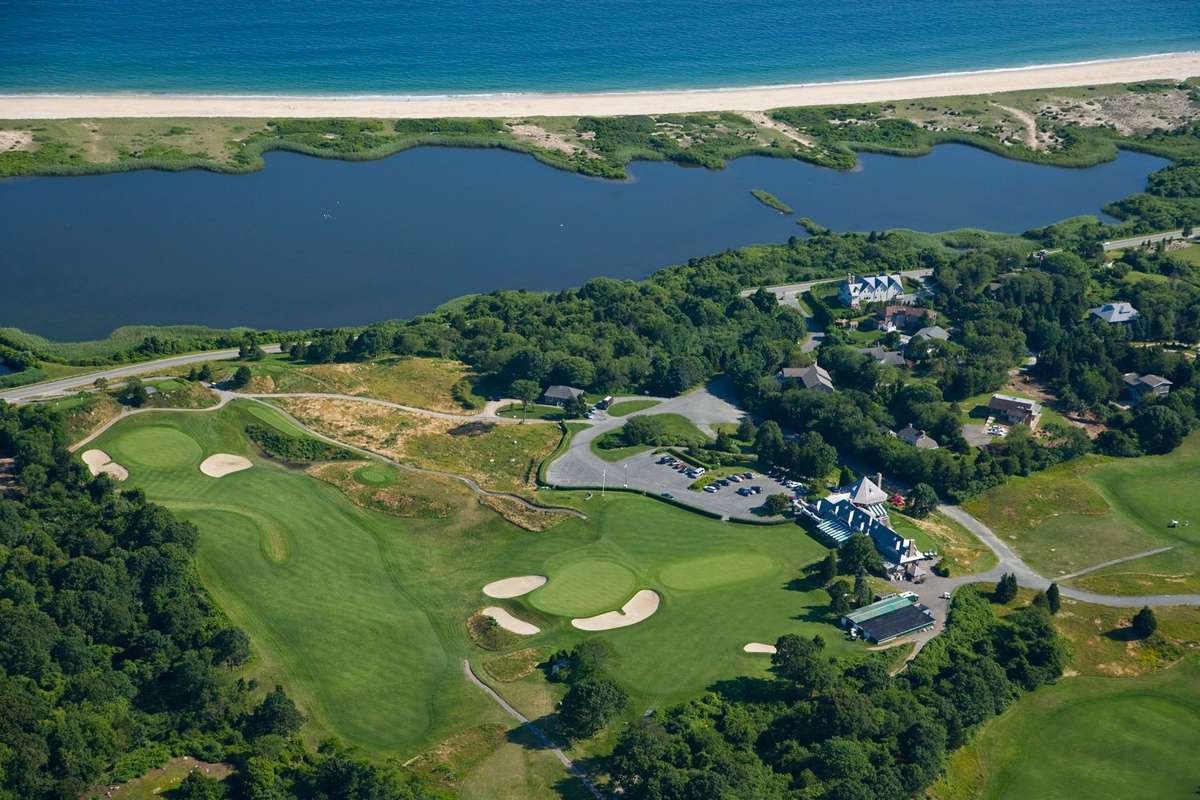
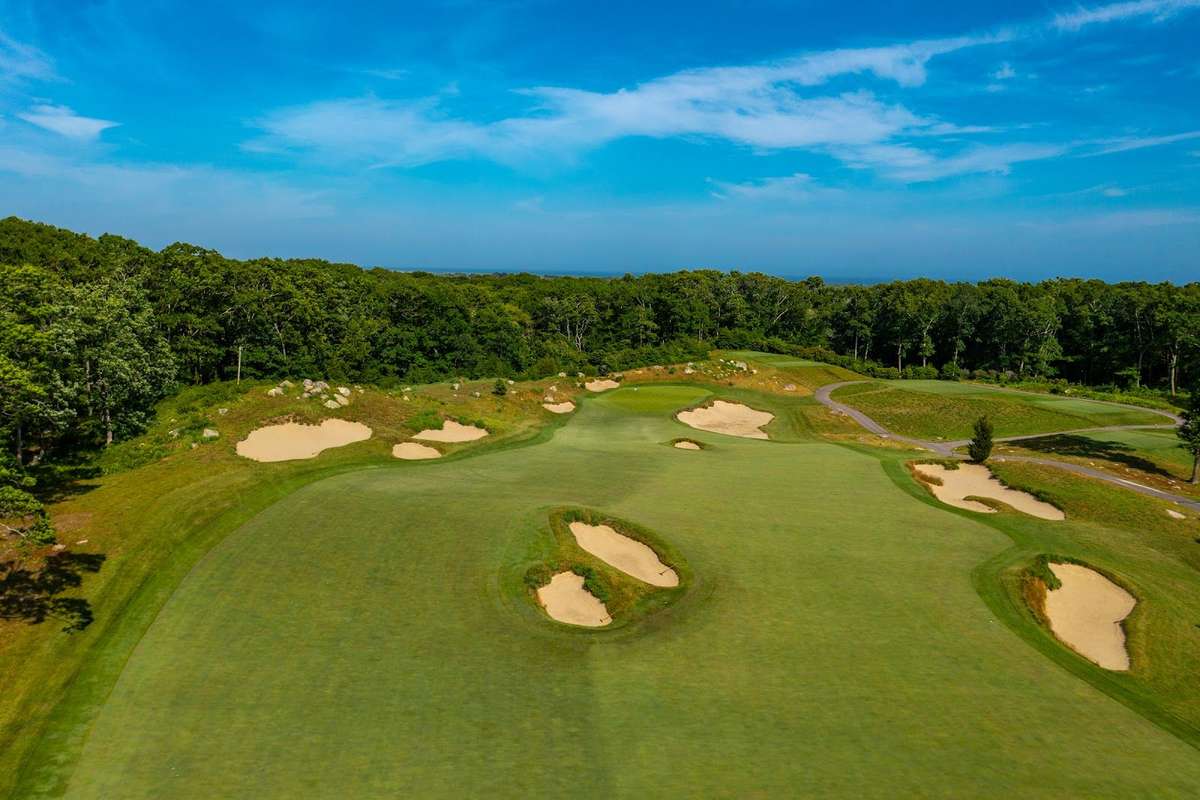
Fishers Island Club is set romantically on a narrow island that is a mere two miles wide and eight miles long.


Fishers Island Club is set romantically on a narrow island that is a mere two miles wide and eight miles long.
Fishers Island Club is set romantically on a narrow island that is a mere two miles wide and eight miles long. The island sits between the National Estuary of the Long Island Sound and a series of lakes and ponds. It’s a magnificent watershed where saltwater meets freshwater and it’s a diverse haven for plant and animal life. The course is rather heavenly too, offering the most beautiful and natural water views from virtually every hole.
The club was founded in 1927 and Seth Raynor laid out the golf course in a rather links-like style. With numerous stage-like plateaux greens that are protected by cavernous bunkers, the key to scoring well rests with accurate approach play. Gil Hanse has been advising the Fishers Island Club on course restoration since 1995.
Fishers Island Club measures 6,566 yards from the tips so length is not the issue, the essential element is to keep the ball in play. The rough is brutal and, as we have already mentioned, the bunkering is profound and often penal.
Fishers Island is not the easiest course on which to get a game – you’ll need to befriend a member – but stick with it because this is one of the finest and most enjoyable golf courses in the world.
The following article was written by golf architecture enthusiast Ed Getka and is an edited extract from Volume Four of Golf Architecture: A Worldwide Perspective. Reproduced with kind permission. To obtain a copy of the book, email Paul Daley at fswing@bigpond.net.au
Fishers Island is a landmark golf experience that begins with the ferry ride from Connecticut. As you sit there with your clubs beside you, your gaze is drawn toward the island with eager anticipation. For this is a rare privilege that few are fortunate to experience. Fishers Island Club prefers to remain out of the spotlight, yet but one cannot help but extol the virtues of its layout. When driving along, soon after arrival, you see the movement of the land: your sense of anticipation heightens.
Finally, you pull up on a rise to the understated clubhouse and take in your first look at the course – the first hole stretching down towards the green beckoning in the distance. Shoes are quickly changed in the small room just off the clubhouse entrance: you just can’t wait to get out on the course. For the newcomer, one may be wary that the course could possibly disappoint – but Fishers Island just steals your heart.
As you make your way around the property and glory in the course, the incessant wind, the views, and the golf that is required of you, it is hard to imagine a more delightful place for a game. It is no accident that the charms of this land are captivating.
The golf course was a result of a 1925 collaboration of Frederick Law Olmsted Jnr and Seth Raynor. Olmsted, following in his father’s footsteps, became a pre-eminent landscape architect, as well as making significant contributions to the development of the National Park Service. At Fishers Island, he did a remarkable job of integrating home sites and open spaces into the development that became Fishers Island Club.
Raynor was a disciple of Charles Blair Macdonald – one of the pioneers of golf course architecture in the USA – and a qualified surveyor with an engineering background when he assisted Macdonald in the creation of the National Golf Links of America. Learning the principles of golf design so well, in spite of never playing golf, Raynor went on to establish himself as a golf course architect. Fishers Island was his crowning achievement. Unfortunately, he never saw its completed form, as he died from exhaustion and pneumonia six months before opening day. At the time, Raynor was in the middle of 30 design projects, surely a scenario that would do little for one’s health.
Generally, you will find the course to be wonderfully firm and fast with your ball bounding along the fairways at speed. This will suit you just fine, of course, until an unnoticed contour takes your ball somewhere you didn’t intend. Such are the vagaries of links-style golf and they only add to your enjoyment of the day here. As you think back over your round, the predominant theme is the fun you’ve had had taking on the diverse challenges this course presents. Fishers Island is never far from my thoughts and when I daydream about golf it is here that I most often go.

The United States is home to some of the world's most celebrated golf courses, from spectacular coastal layouts to historic clubs that have hosted the game's biggest championships. But playing America's best golf is not always as straightforward as booking a tee time. Many of the country's highest-ranked courses are private clubs, while some resort venues require visitors to book accommodation before they can play. So where are America's top-ranked courses concentrated, and how many can the average golfer actually play? A state-by-state breakdown of the Top100 Golf Courses USA ranking reveals a striking divide. New York and California lead the way by course count, but of the 100 courses listed, just 16 meet our criteria for playing without knowing a member or staying at a resort. The remaining 84 have some form of access restriction, whether through private membership, accommodation requirements or other visitor policies. For golfers planning a trip to the United States, that distinction matters: a state might have an impressive collection of top-ranked courses, but that doesn't necessarily mean visitors can build a holiday around playing them. New York and California Lead the Rankings New York tops the state-by-state breakdown with 14 courses, narrowly ahead of California with 13. Massachusetts follows with seven, while Ohio and Wisconsin each have six. New Jersey and South Carolina account for five courses each. The figures highlight the strength of golf in the Northeast, alongside California's long-standing reputation as one of America's premier golfing destinations. New York is home to some of the country's most exclusive golf venues, including Shinnecock Hills Golf Club, National Golf Links of America and Fishers Island Club. However, it also has one of the world's most famous public courses. Located on Long Island, Bethpage Black has hosted multiple US Opens and the 2025 Ryder Cup. Its public status makes it an important exception in a ranking where access is often far from guaranteed. Demand is high and securing a tee time requires planning, but golfers do not need a private-club membership to play it. The other 13 New York courses in the ranking do not meet our public-access criteria. California presents a different mix of courses, from celebrated coastal layouts to championship venues further inland. Pebble Beach Golf Links is perhaps the best-known example, with its dramatic Pacific Ocean setting making it one of the most recognisable courses in golf. The state offers a wide range of golfing experiences, but green fees, booking conditions and accommodation requirements can influence whether a course is a realistic option for visiting golfers. Its size is another consideration, with distances between destinations potentially shaping how many courses golfers can fit into one trip. The States Where Top-Ranked Golf Is Hardest to Access Some of the states with the most courses in the ranking are also among the hardest for visiting golfers to explore. New York has 14 ranked courses, but 13 do not meet our criteria for playing without knowing a member or staying at a resort. California has 13 courses, with 11 falling outside those criteria, while none of Massachusetts' seven entries qualify. The contrast is striking. New York and California offer plenty of choice on paper, but their highest-ranked courses are often difficult to access independently. Massachusetts presents a similar challenge, with its rich golfing heritage reflected in a list dominated by venues that aren't straightforward for visitors to book. New Jersey faces a comparable issue. Its five courses include Pine Valley Golf Club, frequently ranked among the world's finest, but its reputation as a private club makes it a difficult destination for golfers without the right connections. These figures underline why course rankings alone don't tell the whole story. For visitors, the practical question isn't just how many highly ranked courses a state has, but how many they can realistically play. The Best States for Golf You Can Actually Play Of the 100 courses in Top100 Golf Courses' USA ranking, just 16 can be played by the public without knowing a member or staying at a resort. Wisconsin and Oregon lead the way, with four qualifying courses each, followed by South Carolina, Florida and California with two apiece. Oregon is an obvious choice for a multi-course golf trip. All four qualifying layouts are at Bandon Dunes Golf Resort on the Pacific coast: Bandon Dunes, Pacific Dunes, Bandon Trails and Old Macdonald. Having four highly ranked courses in one destination allows golfers to experience a variety of layouts without spending their holiday travelling between different parts of the state. The rugged coastal setting is a major part of the appeal. Wisconsin offers four qualifying courses across two destinations. Whistling Straits' Straits course is one of the state's best-known golfing venues, having hosted major championships on the shores of Lake Michigan. Further inland, Lawsonia Links offers a different style of golf, while Sand Valley and Sedge Valley give visitors two more courses to explore within the same resort destination. Together, they make Wisconsin a compelling choice for golfers looking to combine several highly ranked rounds in one trip. South Carolina has two qualifying courses, each offering a different experience. Kiawah Island's Ocean Course is known for its exposed coastal setting and championship pedigree, having hosted major events including the 2021 PGA Championship. Old Barnwell provides a contrasting inland experience, adding another option for golfers planning a trip around the state's top courses. Florida's two entries are Streamsong Red and TPC Sawgrass' Stadium Course. Streamsong Red is characterised by its expansive sandy terrain, while TPC Sawgrass is home to one of golf's most recognisable holes: the island-green 17th. The two courses offer very different experiences, from Streamsong's distinctive landscape to the chance to play one of the PGA Tour's most famous venues. California completes the group with Pebble Beach Golf Links and Pasatiempo. Pebble Beach is renowned for its Pacific coastline and history of major championships, while Pasatiempo, designed by Alister MacKenzie, offers a celebrated layout with a distinctive place in American golf history.
D is for DOUBLE PLATEAU THE ORIGINAL The Double Plateau is one of the occasional templates that has no obvious “original,” but it could have been inspired by a number of plateaued greens Macdonald witnessed during his overseas research. The safe bet in such cases is to head to the National Golf Links of America, C.B. Macdonald’s distinguished template gallery. NGLA 11th hole - image courtesy of Jon Cavalier @LinksGems The Double Plateau template begins at the green, and works backwards. Greens displaying the ideal “Double Plateau” interpretations have three tiers: Two are the actual “plateaus,” raised higher than the third “ground-level” platform. It’s similar to the Biarritz in that landing on the wrong level will make two-putts a tough prospect. It is unlike the Biarritz in that all three levels are at different elevation, while the front and back levels are at the same height for a Biarritz. NGLA’s singularly-named “Plateau” at No.11 showcases a kidney-shaped Double Plateau rather than the more typical stumpy “L” shape—with plateaus at the front-left and back-right. The Double Plateau is rarely doglegged. Rather, the player must take pin position into consideration from the tee; its location alters whether the left or right side of the fairway makes for the best approach. As seen at NGLA, adjacent bunkers guard the plateaus to enforce this strategy. The most famous hazard on a Double Plateau, however, is the “Principal’s Nose,” located about 70 yards out from the green, which both interferes with the player’s sightline and their ground game. NGLA’s is a more psychedelic “Nose,” as it features three “nostrils” around a central hump. The hump is the more relevant element of a Principal’s Nose, preventing victims from taking a direct line to the green when escaping from the hazard. OTHER INTERPRETATIONS Those who prefer the more traditional, two-nostrilled Principal will admire Chicago Golf Club’s Double Plateau, which very accurately resembles a human snout. It’s another Macdonald classic, but featuring a more cubist nature, reminiscent of what protégé Seth Raynor would create in decades to come. This version also features a cross bunker off to the right. Although not an issue for modern drivers from the tee, it does pose a distraction from strategic consideration of the flag placement. Considering the number of plateaus the aforementioned Raynor added to his greens at Fishers Island, it is not surprising that there’s a Double Plateau in attendance. But which one? The obvious choice is No. 9, based on title alone: “Double Plateau.” The green is a mirror version of those seen at NGLA and Chicago, with the added benefit of the Atlantic Ocean as a backdrop. That said, it’s a touch short (365 yards) and the blind tee shot makes it impossible for the visiting player to fully identify the “perfect” placement off the tee. Fishers Island 18th hole - image courtesy of Jon Cavalier @LinksGems George Bahto instead makes an argument for No. 18 at Fishers in his book on Macdonald, The Evangelist of Golf. Some point out similarities to the Road Hole based on the green’s shape and strategic pot bunker, as well as its length (450-plus yards, playing as a Par 5 during strokeplay) and its playing angles. But this green actually checks all the boxes for a Double Plateau, and its visibility from the tee box allows players to play accordingly. When considered as a classic “Par 4.5” matchplay hole, No. 18 arguably fits more comfortably within the definition of “Double Plateau” than No. 9. On the other hand, Bahto advocates strongly for No. 14 at Raynor’s North Shore Country Club, which also features a blind tee shot over a (slightly smaller) ridge, before approaching an indisputable Double Plateau green. It features no Principal’s Nose, but neither do either of the aforementioned Fishers Island entries. Tom Doak is especially keen on his rendition of the Double Plateau, hosted at Bandon’s Old Macdonald course, describing it as “my favorite opening hole that we've ever built.” The choice from the tee box takes on an element of risk/reward, as bold drivers can attempt to carry a fairway bunker on the right to reach a lofted plateau, resulting in a more comfortable approach. The Principal’s Nose is very much in the green’s business, sitting right at the foot, rather than 50-or-so yards out. Old Macdonald 1st hole - image courtesy of Bandon Dunes MAYBE...MAYBE NOT The lack of an original, iconic hole leaves many angles for argument among aficionados, including these next few examples: We would propose that a true Par 5 cannot be a proper Double Plateau, in the template form. Although Fishers Island No. 18 is a “Par 5” by virtue of its scorecard, it is extremely short and more realistically a “stiff Par 4.” Macdonald’s design at St. Louis Country Club, on the other hand, features a 495-yard Par 5 named “Narrows,” which confusingly is an entirely separate template rendition. If the player looks to get home in two, then it most certainly plays as a true Double Plateau; after all, accuracy upon approach is paramount. But if the player opts to lay up, a short pitch takes considerable bite from the green, watering down its intent. Of course, if a Par 5 is of obvious three-shot length, then it could very much play into the Double Plateau’s purpose. Regardless of your (or our) take on the St. Louis iteration, No. 15 should be noted for its unique green setup: The first plateau is at the front, dropping off to the lower level, with the other plateau at the back-left. St Louis CC 2nd hole - image courtesy of John Sabino Remaining at St. Louis, we also suggest that a par three cannot be a genuine Double Plateau, in the template form. However, No. 2 at St. Louis Country Club started out in life as a short Par 4 and is actually named “Double Plateau.” This hole—now a brutal 225-yard uphill Par 3—may well have been more appropriately called “Biarritz.” The enormous green sports a three-foot swale cutting through its middle. It just goes to show how blurry the lines are in the world of template golf holes—especially at St. Louis Country Club. Charles Banks and Knoll Golf Club West in New Jersey come to the conversation with the course’s second hole. Here Banks employed his popular “thumbprint” technique to create a horseshoe-style green: The lower portion is front and center, while the raised “horseshoe” wraps from front-left up around the back and down to the front-right. The horseshoe does change altitude from left-to-right, but it differs from other Double Plateaus in that the plateaus are directly connected. The question is whether the two plateaus must be totally separated by the lower level?
A is for ALPS THE ORIGINAL Prestwick Golf Club—originator of several templates—claims “Alps” is “the oldest existing hole in championship golf.” It played as No. 2 during the first Open, and although course routing has changed (it’s now No. 17), the par four plays almost identically to its initial purpose. Prestwick 17th hole - Alps The opening drive is to a relatively narrow fairway for the links, but the true nature of the “Alps” becomes evident upon the approach shot. The namesake “mountains” block any view of the green, forcing the player to calculate an ideal distance to the flagstick (the position of which is displayed at the tee). The green is large and its Punchbowl form is forgiving; it shows mercy on blind players by funnelling reasonable approach shots toward the centre. Missing the outskirts of the green is not an option, however. Aside from the tall fescue surrounding, the green is fronted by the notorious railway-sleepered and sod-faced “Sahara” bunker (there was, presumably, no Swiss desert to name it after). The original comes from the drawing board of Old Tom Morris (considered by Darwin as "the most spectacular blind hole in all the world") but again C.B. Macdonald has come to define it. In his writings, he described Alps as featuring total blindness on the second shot—both the bunker and green totally obscured. The player then hits his shot over the Alps to a green that “lies in a hollow with the bunker in front and a high bank behind,” a “high shot with a long carry and very little run.” OTHER INTERPRETATIONS Macdonald notably made no notes about fairway requirements, and this is evident in his most acclaimed iteration, No. 3, the Alps at National Golf Links of America. Rather than playing dead ahead, the fairway moves diagonally from left-to-right; the farther left a player leaves their tee shot, the higher they must play to clear the hill. Although the fairway rises in altitude as it travels right, players must reckon with a long bunker along the right edge, to test the nerves. The rules of approach remain true: A deep and lengthy cross-bunker guards the apron surrounding an enormous, bowled green. National Golf Links of America 3rd hole - Alps As with all templates, especially one with as many constituent components as Alps, some flexibility has been accepted. Seth Raynor ran into a wall at Yeamans Hall, where membership outright told the Macdonald acolyte that they had no interest in blind shots. And so he did his best at No. 5 to (partially) block the approach view with a high-humped fairway bunker, and made up for the relative lack of blindness by adding more challenge to the green. Raynor would later refer to “Alps bunkering” to mean large, green-fronting cross-bunkers...no hill required. On the other hand, he cut out the cross-bunker requirement altogether for his famous Alps at Fishers Island. No stranger to manipulating earth, Raynor created a Punchbowl (when the island wouldn’t offer one) by raising a quarter-pipe ramp around the green. The trend away from blind shots has made Alps an increasingly rare guest in modern designs, however. Tom Doak and Jim Urbina's Old Macdonald—a tribute to C.B.—features a self-described Alps, but David McLay Kidd’s No. 10 at Bandon Dunes could pass muster if you accept the lack of cross-bunkering. MAYBE... MAYBE NOT The Raynor and Banks version at Lookout Mountain features an interesting—and controversial—Alps interpretation at its eleventh hole. The approach shot is most certainly blind, but it plays downhill and will allow a well-placed run-up. More thought-provoking is the supposed “Sahara” bunker, which lurks at the back right of the green, rather than the front. Considering Prestwick’s relative emphasis on accuracy of distance over accuracy of direction, this bunker’s role within the template is suspect, especially with the lack of a Punchbowl green. Some cite Lahinch’s short par five No. 4 Klondyke as an Alps, which is an overstatement. Although there is nothing preventing a par five from being an Alps, the Klondyke dune sits more than 150 yards (at its peak) from the hole, and features in front of a particularly wide stretch of fairway. This safe zone—versus a forced carry—derails the Alps comparisons. A more likely candidate would be the No. 13 “Nemesis” hole at Tobacco Road, where the third shot must clear two heavily-bunkered sand mounds to reach the green. Even then, the relative absence of depth to the green makes it a problematic “Alps” at best. Although Macdonald’s rules for the Alps don’t necessarily count out the idea of a par three, other blind-shot shorts—such as Maiden and Dell—typically fill that void.
The latest ranking of the Top 100 Golf Courses in the World serves as the ultimate global golf bucket list. Most members of our World Top 100 Panel are seasoned golfers, each playing 20-30 of these courses annually while travelling extensively over decades to form their opinions on others. We recognise that opinions vary—even among our panel members. Rankings are subjective, and there are undoubtedly 50 or more courses in the UK and USA alone that could easily fit onto this list. Links Golf Pilgrimages The rankings
California, United States
England, United Kingdom
New York, United States
Auckland, New Zealand
England, United Kingdom