Mimosa Golf and Country Club could easily have been named Phoenix as it quite literally rose from the ashes that fell from Mount Pinatubo in 1991.

Mimosa Golf and Country Club could easily have been named Phoenix as it quite literally rose from the ashes that fell from Mount Pinatubo in 1991.
Mimosa Golf and Country Club could easily have been named Phoenix as it quite literally rose from the ashes that fell from Mount Pinatubo in 1991. The former US air base at Clark Field was severely damaged by fallout from the erupting volcano – causing its abandonment and subsequent return to the Philippine authorities – and it would take several years before the landscape returned to anything near normality.
The government decided to rejuvenate the local economy by developing the property as a Freeport Zone and resort area, commissioning the respected architectural firm of Nelson and Wright to shape the recreational aspect of the project with a 36-hole golf facility. Amazingly, only one year after work began on such a devastated site, 27 of the holes were ready for play.
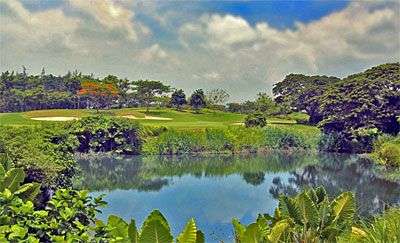
Routed around thousands of old mimosa rain trees that survived the volcanic blast, the 18-hole Mountain View course plays to a par of 72 with an overall length of 6,782 yards while the Acacia & Lakes layout measures up to 6,546-yards, also with a par of 72.
Architect Robin Nelson commented as follows:
"There was an existing 18-hole course on the site at the current Mimosa Golf Club, built by the American Military at Clark Airbase. When we got involved, the Americans had already left the Philippines. The June 1991 eruption of Mt Pinatubo had covered the course with thick lahar (volcanic ash), rendering the fairways and greens useless. A group of local golfers banded together to bulldoze the material off the playing areas and brought back to life some of the grass by means of water trucks and hoses.
The Americans left the base in November 1991 after the eruption earlier that year. We completed our work in 1994 with 27 holes and the final 9 was added shortly thereafter. The huge Rain Trees (or Mimosa Trees) formed many of the new fairways, but there were no entire fairways that can be considered part of the original course. The 18th on the Mountain Course is probably the closest resemblance to an original hole, but it was lengthened, recontoured and bunkers added.
The course was fun to design and build because we were actually starting from scratch with a number of magnificent trees and terrain. A number of older corridors were connected and/or expanded, and very few trees were removed. In addition, for a number of years, whenever a rain event would occur, a "secondary eruption" - a very small spewing of the volcano would occur which would lightly dust the course with fine ash and, once watered in, would serve as a nice topdressing!"
Filipino developer Filinvest acquired the property in 2016 and appointed Nelson & Haworth to formulate a master plan for renovating all thirty-six holes at the club. Four holes on the Lakeview course were rerouted to accommodate a new shopping centre but all the other fairways remained intact. A number of greenside bunkers on the Mountain View layout were removed to allow a running approach shot with the remaining sand hazards rebuilt using new bunker linings. Greens were also reconstructed and these new putting surfaces are now more heavily contoured than the smaller original greens.

10 quick facts- Rancho Palos - From Top100GolfCourses Rancho Palos Verdes Golf & Country Club in Davao City is an unparalleled golfing experience, providing both challenging gameplay and picturesque natural views. Here are ten interesting facts about this premier course: Andy Dye: Renowned architect Andy Dye designed this course, providing golfers with an exceptional golfing experience. Opened in 2001: Since its opening at the turn of the millennium, this 18-hole championship course has provided golfers with a formidable challenge. Challenging Layout: With over 7,000 yards to play and a par of 72, this course is famed for its challenging Tifdwarf Grass greens and Bermuda Grass fairways that present players with various challenges such as traditional dye pot bunkers, water hazards and subtle breaks. Beautiful and Harmonious with Nature: Set within a tropical rainforest, the course provides stunning views of Davao River and Mt Talomo as well as unique attractions such as crocodile lagoon and bird sanctuary. Elevation Changes: Golfers face over 250 feet of elevation changes that add an additional element of difficulty and anticipation to their game. Strategic Location: Situated 13 km away from Davao City centre in Barangay Mandug Buhangin, our club enjoys a strategic position that provides beautiful natural landscapes as a backdrop. Exclusive Amenities: The club boasts a host of facilities that include a full-service restaurant, golfer's lounge and bar, male and female locker rooms with showers, sauna, jacuzzi, massage room, pro shop, driving range and practice putting greens. Harmony with Nature: The design aims at coexistence with nature, featuring views of banana plantations along the Davao River and traversing tropical rainforest for four holes of play. Private Golf Club: Entrance into this club requires being accompanied by a member Rancho Palos Verdes Golf Course has earned national acclaim as an exceptional course, boasting superior design and facilities that set it apart as one of the Philippines' premier courses. Rancho Palos Verdes Golf & Country Club in Davao City provides golfers with an unforgettable experience that blends the excitement of their game with nature's tranquillity, making for a unique golfing destination. Why not register today to be the 1st to Receive World Rankings releases for 2024.
Top 30 Golf Courses of the Philippines 2017 We extend our Filipino rankings by 50% to produce a new Top 30 This is the fourth revision of a national ranking chart that we established with only a dozen courses eight years ago. Last time around, there was something of a surprise when we announced the course at The Country Club Philippines as our new number 1. Site of this year's Philippine Open and host venue of the men’s and women’s international golf tournament for the Southeast Asian games in 2005, The Country Club has now slipped one position to number 2, replaced at the summit by Sta. Elena Golf & Country Club, where the Makiling and Banahaw nines form the premier 18-hole layout at a fabulous 27-hole facility. This Robert Trent Jones Jnr-designed track headed three previous editions of our Filipino listings so, by recapturing the top spot, it could be said that the natural golfing order in the country has now been restored. Several courses make small upward moves in the new chart and are worthy of further scrutiny. The Masters course at Manila Southwoods (up 1 to number 4) was chosen to host a few prestigious events during the 1990s – including four Philippine Open tournaments and the men’s world amateur Eisenhower Trophy – so its pedigree as an uncompromisingly tough tournament track is certainly not in doubt. The Palmer course at the 36-hole Orchard Golf & Country Club (up two to number 5) was described by one recent reviewer as a layout that offers “plenty of risk-reward” even though “it isn’t overly punishing” whilst another reviewer described the Langer course at Riviera Golf Club (up three to number 6) as “one of the most challenging courses in the Philippines” which is “definitely not for beginners”. Our biggest climber is the East course at Wack Wack Golf & Country Club (up five to number 8), venue for the golfing World Cup tournament in 1977 when the home pairing of Ben Arda and Rudy Lavares were edged into second place by Spain’s Seve Ballesteros and Antonio Garrido. The course has also hosted more than half the Philippine Opens that have been staged since 1960 so it’s been a credible test for more than half a century now. The highest new entry in our standings is the South course at Canlubang Golf Club at number 14. The slightly shorter and more undulating track at a 36-hole facility designed by Robert Trent Jones Jnr in the late 1970s, the fairways of the South course are laid out within an expansive property that was once a coconut and sugar plantation. Rank/ To view our latest Philippines Top 30 in detail, click the link. We like to know what you think of our revised national charts so why not get in touch via the “respond to this article” link at the top or bottom of this page if you have any strong opinions about our new Filipino rankings? We’d also like to publish more reviews for these courses so if you’ve played any of them we’d be really happy to have you post a few lines to tell us about your playing experience. Jim McCann Editor Top 100 Golf Courses

Top 20 Golf Courses of The Philippines 2015 A new number one heads up our extended rankings for the Philippines Since 2009, when we first featured a Top 10 for The Philippines, the Makiling & Banashaw nines at St. Elena have formed the undisputed best 18-hole course in the country. Until now, that is, as this stellar layout has just been displaced at the top of the national rankings by the Tom Weiskopf-designed Country Club Philippines, which moves up four places to take over the number one position. A very private club, which the national golf teams use as a training facility, The Country Club is no stranger to big golf events, having hosting many local and regional competitions down the years. It also held the men’s and women’s international golf tournament at the Southeast Asian Games in 2005, with the Filipino team winning the gold medal and the Filipina team claiming silver. The highest new entry in our chart arrives at number 8 and it’s the wonderful new course at Anvaya Cove, which is situated on the west side of the Bataan peninsula, close to the Subic Bay Freeport Zone. Focal point of an ambitious residential development, the course is a Golfplan design that had Kevin Ramsey as its lead architect. Golfplan has been active in Southeast Asia for many years now but this is the company’s first project in the Philippines. The next newcomer to the Top 20 appears at number 11 and it’s the Andy Dye course at Eagle Ridge, one of four 18-hole courses at an impressive golf complex to make their mark on our listings. Andy, nephew of Pete Dye, is well known for pushing the design boundaries and this rather controversial 1998 creation is no exception. Dramatic and challenging in equal measure, it’s a course that divides opinion like no other in the country. At position 12, Pueblo de Oro is the next new entry in the Philippines listings. A Robert Trent Jones Jnr championship standard golf course that made its debut in the late 1990s, the layout is located in Mindaneo, the southernmost major island in the country, where it’s the main sporting attraction within the master planned Pueblo de Oro Township. A little further down the chart, the Isao Aoki and Greg Norman layouts at Eagle Ridge also break into our new Top 20 at number 17 and 20, respectively. Stablemates of the Nick Faldo and Andy Dye courses at Eagle Ridge, these tracks were the last two 18-hole layouts to be unveiled at an exciting golf and country club complex that offers its members a wide range of sporting activities. To view the complete detailed list of the Top 20 Golf Courses in The Philippines click the link. Jim McCann Editor Top 100 Golf Courses
The latest ranking of the Top 100 Golf Courses in the World serves as the ultimate global golf bucket list. Most members of our World Top 100 Panel are seasoned golfers, each playing 20-30 of these courses annually while travelling extensively over decades to form their opinions on others. We recognise that opinions vary—even among our panel members. Rankings are subjective, and there are undoubtedly 50 or more courses in the UK and USA alone that could easily fit onto this list. Links Golf Pilgrimages The rankings
California, United States
New Jersey, United States
Northern Ireland, United Kingdom
New York, United States
New York, United States


