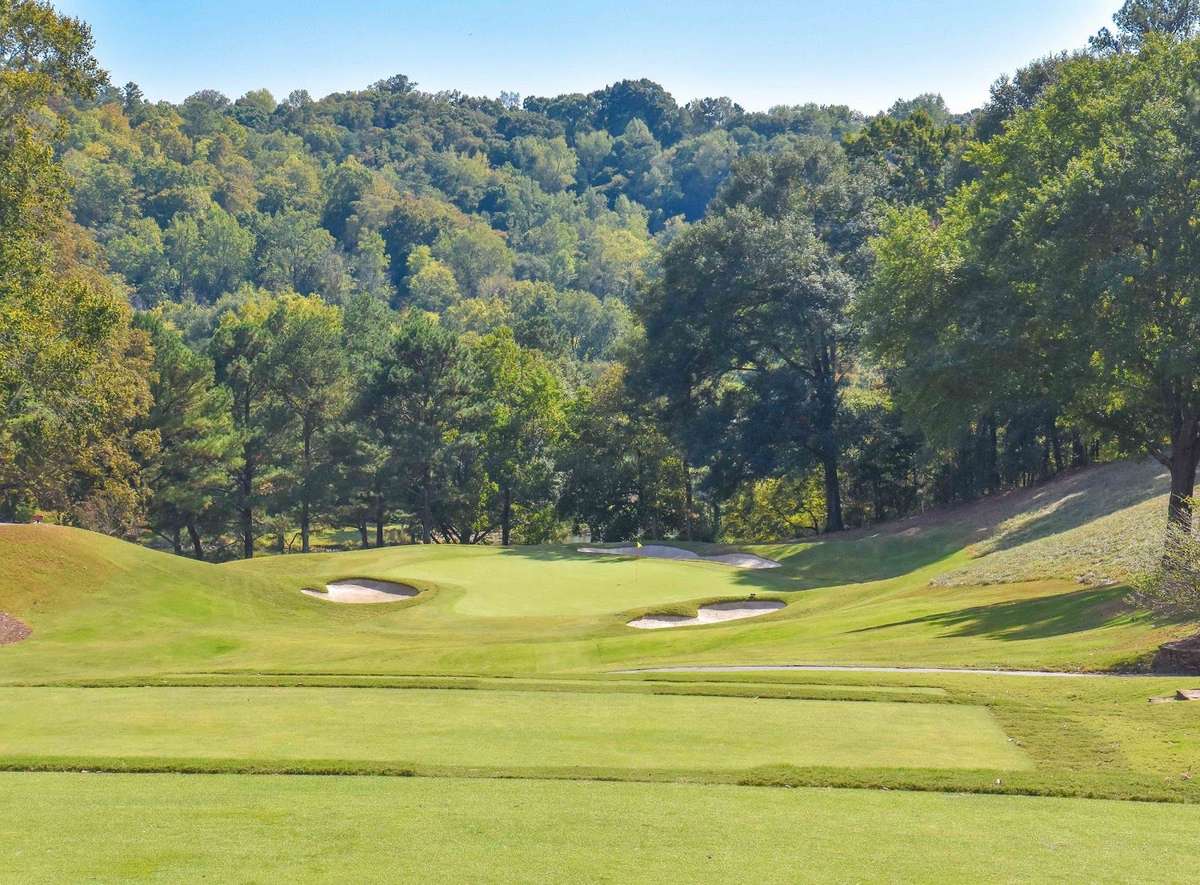
Peachtree Golf Club is located in Atlanta and it’s the course that the Joneses built. Bobby Jones was the inspiration and Robert was the architect.
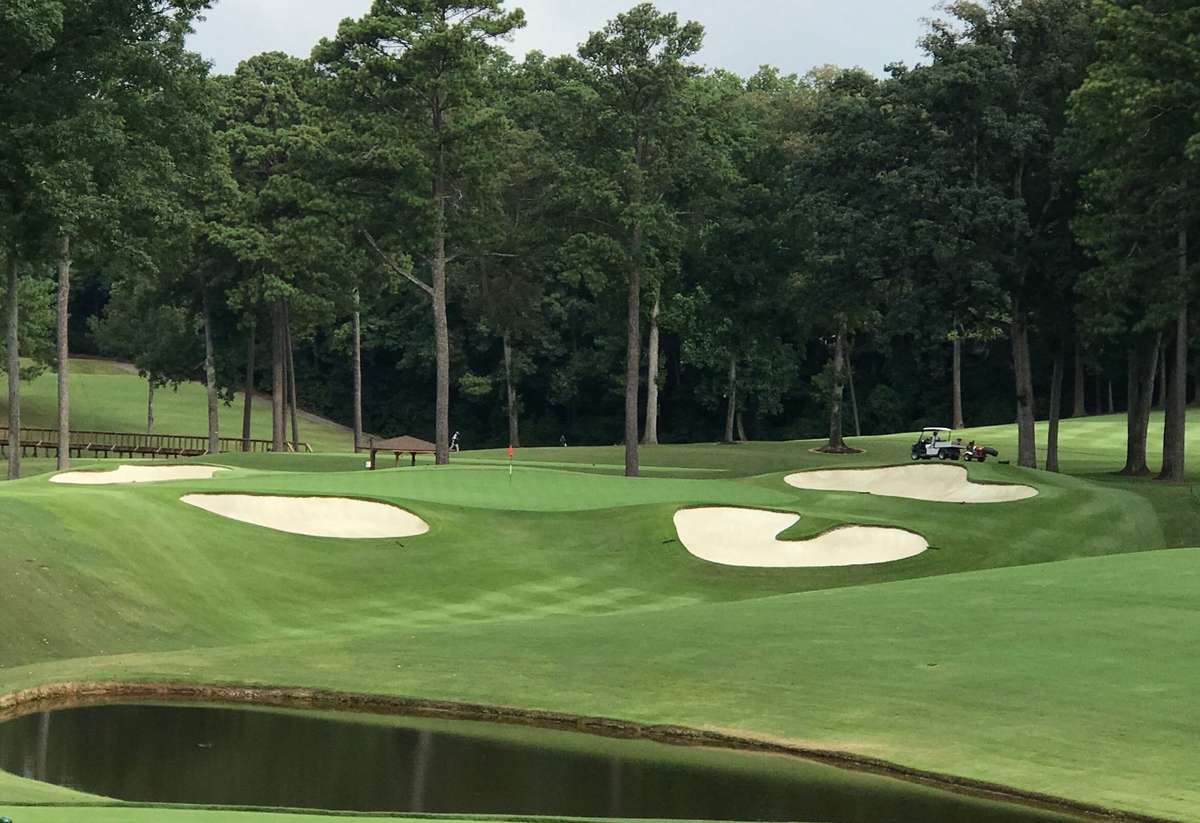


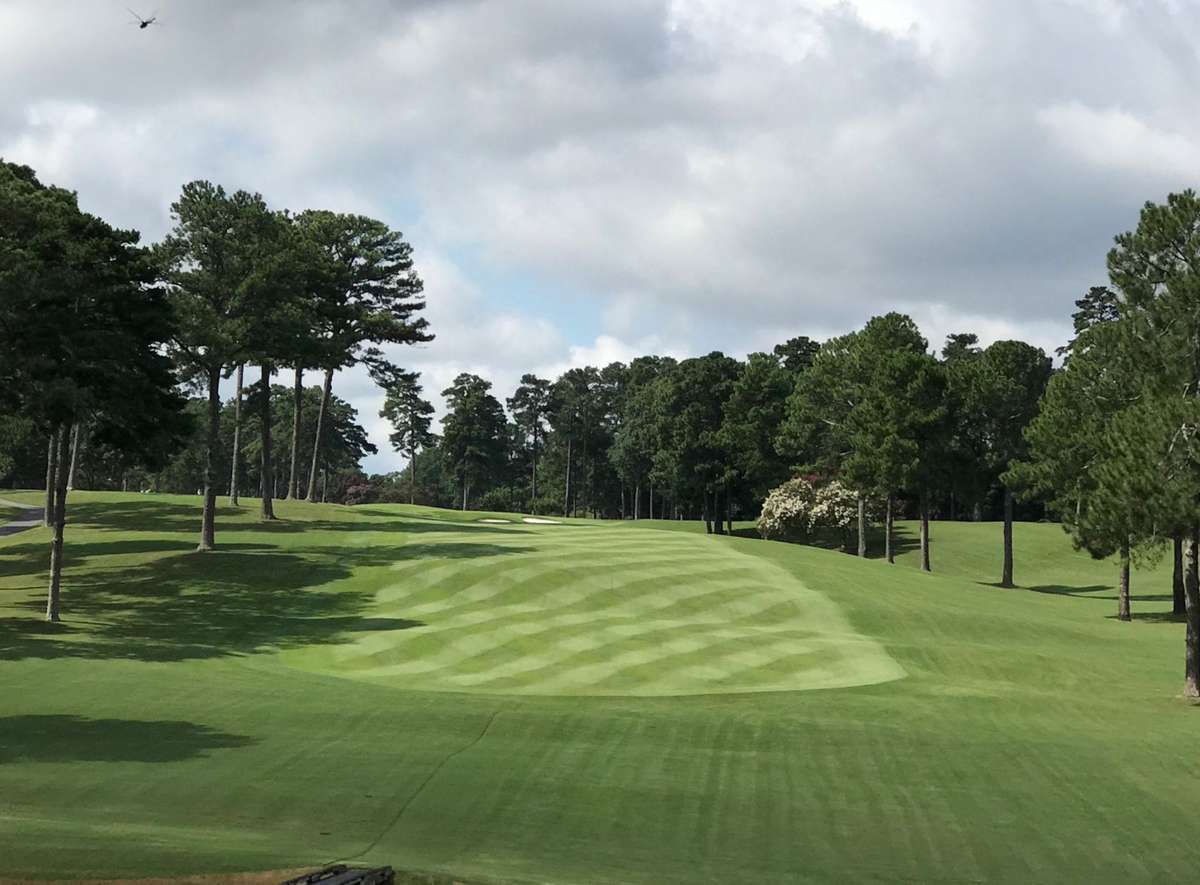
Peachtree Golf Club is located in Atlanta and it’s the course that the Joneses built. Bobby Jones was the inspiration and Robert was the architect.

5.5
Peachtree is about as perfect as an inland/parkland golf course can be found in the USA. As I played the course for the second time on March 26, 2021, I was struck by how strong the course was from the very first hole to its finish. There are perhaps only a couple of “average” holes on this course which are on the back nine. This is a credit to its designer, Robert Trent Jones. Peachtree was Mr. Jones’s first big design and he produced a masterful golf course. The front nine also benefited from input from Robert Tyre Jones (Bobby Jones) who hit shots on the holes. His illness struck him just after the front nine opened for play, so he did not play the back nine.
We played it on a very wet day, with the first tee time of the day. There was no sunshine during the round so the course did not get much assistance in drying out. We played the medal tees at 6659 yards but our host estimated the course was playing closer to 6900 yards, which is too long for me, although my two playing companions had the length to handle it. The Atlanta area had both tornados and thunderstorms the day before ending around 5AM, dropping several inches of rain. For example, we barely found my third shot on the second hole, a downhill par 5, which I was certain had cleared the stream short of the green. We could not see the ball until I nearly walked on it with about one quarter of it visible while the rest was embedded.
I knew I would not likely score well given the length unless I had my best day ever of chipping and putting. Therefore I concentrated on looking at the course, particularly the greens.
Peachtree has many positive qualities. There is the beauty of the setting. It has marvelous green complexes. The terrain is rolling and often hilly leading to unexpected surprises, variety and beauty. The wonderful routing perfectly moves one around the land offering a splendid mixture of doglegs and up and downhill shots. The greenside bunkering is very good. The course is tranquil despite one’s score. The par 3’s are particularly strong.
The one item that seemed inconsistent with the course itself comes in the form of a letter that is on display in the clubhouse written by Bobby Jones where he describes the course as not having as dramatic of change in land movement as at Augusta National. That did not make sense to me, having played both courses. Perhaps Mr. Jones was trying to find a way not to critique either course due to his affection for both. Maybe he desired not to be boastful to be fortunate to be associated with both clubs. I decided instead to think of Augusta National as having “smoother” changes in terrain other than on its fifth and sixth, while at Peachtree the land movement is more abrupt on more holes. For me the question became: “which course has the better land?” In the end I could not quite make up my mind. Peachtree and Augusta National sit on nearly perfect rolling/hilly land that add a tremendous amount to the strategy and variety of shots that one has to hit it order to play well.
Many people say that Peachtree is the closest course in the USA to Augusta National. After having played Bluejack National, which I do not consider to be close to Augusta National, I would agree with this statement. Both courses were built on the site of former nurseries. Both have excellent conditioning. Part of that comparison is due to the opening holes at both staring with pars of 4-5-4-3 with the second at both playing downhill and the fourth at both playing across a valley. Both finish on an uphill par 4. Another similarity is the landscape with the numerous stately pine trees, dogwoods, and azaleas. Both courses feature large greens, many of which are elevated. Both courses are on relatively large pieces of property with Peachtree being set on 250 acres. In this regard Peachtree is very much like Augusta National in the feeling of having a lot of room where the holes do not impede on another and allowing for ample, long views across the course. Both courses having rolling fairways although Peachtree seems to have more swales and undulations leading to fewer level lies and often a sidehill lie. Both routings are excellent with a good mixture of long and short holes regarding each par, and a good mixture of straight and dogleg holes. The doglegs move each way at both.
As mentioned, one senses solitude and calm when on the grounds at Peachtree despite it being close to a heavy development of houses, busy roads, condominiums, a church, and retail establishments. It is an oasis that is wedged in between all of the surroundings, with the club’s land occupying the shape of a piece of pie. There is a natural sound barrier to the course as much of it sits on lower ground and has a thick line of trees that define the boundaries of the property. I have driven on all of the busy roads surrounding the course, Peachtree Road, Johnson Ferry Road and entering the club from Ashford Dunwoody Road. Once one has parked their car it is almost as if you hear nothing but fellow players and birds. Yet the surrounding heavy development is a key differentiator to Augusta National. Augusta National has the funds to purchase the surrounding land to expand its footprint. That option is no longer available to Peachtree.
Another key difference to Augusta National is that water is used more strategically at Augusta National with its pinnacle being the thirteenth hole. Where there is water at Augusta National, it is always to be considered as it is very much a part of the defense of the course. At Peachtree sometimes the water is merely there for visual purposes, not always to be part of the defense of the course. It is the use of water that overall likely makes Augusta National the superior course in the minds of many.
A final difference is that Peachtree does not emphasize fairway bunkers, instead allowing the land and a heavier reliance on trees to dictate the strategy and defense of the course. I recall only four holes having a fairway bunker at Peachtree.
As for the green complexes themselves, one could make the argument that Peachtree’s are superior. There is more interior movement on the green’s surfaces at Peachtree, although overall less slope. The greenside bunkering is as deep, approximately the same number, and well positioned. Both courses excel in the greens that are raised as well as the fall-offs that surround most of the greens.
Despite those many similarities, Peachtree plays very differently and looks very different to Augusta National. I could argue that it is a better overall course but I could see the argument the other way. For me, Peachtree is still one of the top two courses in the state despite my high regard for Ohoopee Match Club.
From the Championship tees the course is very long at 7414 yards, par 72 rated 75.9/142. The course likely plays longer due to the uphill holes getting limited roll-out versus the roll-out from the downhill holes. In addition, many of the greens are elevated often leading to as much as an additional club into the green. The Peachtree tees are a combination tee between the Championship and Medal tees at 7033 yards, rated 74.6/139. They are not many who play either of these tees. The Medal tees, which we played are 6659 yard rated 72.6/135. There are two sets of lesser tees going all the way to 5196 yards.
1. Par 4 – 410/370. This is a fine starting hole with the dogleg right being made sharper by the two bunkers placed on the inward corner of the turn. Longer players will fly those bunkers from the back tee but have to navigate a somewhat narrow opening between thick trees on the right and trees and out-of-bounds on the left. The second shot plays to an elevated green with two deep fronting bunkers on the corners. There are fall-offs on all sides of the green. The green is very undulated with hollows and plateaus throughout. While large, it is a difficult green. This green complex is one of the better ones on the course. While some golf courses open with a gentle handshake, Peachtree does not. This opener is more difficult than Augusta National’s and likely one of the best opening holes one will ever play.
2. Par 5 – 584/527/511, Like Augusta National, this long hole eventually plays downhill although at Augusta National the longer hitters can now reach the downhill part from the tee. However, the doglegs go in a different direction with Peachtree’s having a sharp break to the right where the fairway descends dramatically. The longer hitters might try for the green in two if they can reach the sharp downhill but the green has water placed near the front with it continuing down the right side and heavy trees and out-of-bounds to the left. There is a small amount of fairway after the water to the left/front of the green that could prove too tempting for the longer players. From afar this narrow piece of land looks like an island. For players of normal length, one plays to a ridge before the land begins to fall away. For the second shot, the smart play is to carry the small stream with one’s second shot and play to the fairway placed to the right of a long pond that begins about 100 yards short of the green. As mentioned, this pond fronts the right side and continues up the length of it. There are no bunkers on the hole. The green has a back to front tilt with a huge, sizeable interior hump near the front. The second green at Peachtree has plenty of movement but Augusta National’s is much more severe and is a far larger green. This is one of the holes at Peachtree where the water is very much in play and part of one’s decision-making. Much like Augusta National, it is a beautiful view standing up high and looking downhill towards the green. For me, getting to the green is more difficult at Peachtree but Augusta National has the superior green surface and the contour behind its hole is very good.
3. Par 4 – 433/382. I found this to be a difficult hole despite its nine index. The hole slightly bends to the left and has a single bunker on its front left. A creek comes into play off the left side for one’s second shot. The fairway has a fair number of bumps and ripples as it climbs to an elevated green. We had a back right pin position which is one of the few seemingly level spots on the green which features a large mound near the middle. It is a fine hole but certainly not as strategic as Augusta National where its wedge shaped green and sharp fall-off at the front put more of a premium on accuracy.
4. Par 3 – 166/142. This is a beautiful hole from the tee, playing over lower ground where a pond is placed more for visual beauty than for defense. The real defense of the hole is the green which sits high above three fronting bunkers creating blind recovery shots from any of them. There is a central bunker at the rear adding to the defense of the hole. The green looks very thin from the tee but there is actually a bit of space here. It is longer certainly than deep. The ideal shot will clear the bunker by about two yards. It is a terrific hole and one that I think is superior to the fourth at Augusta National, although that one is more difficult due to its length.
5. Par 5 – 536/520. This hole has an early pond that is not in play. The hole plays about 30-40 yards longer than its length as it is uphill and has a very elevated green. The hole turns to the right with heavy trees down the left and scattered trees down the right. The key to this hole is at the green complex. Much like the first hole this is an outstanding green complex due to a central bunker fifteen yards short of the green and a deep bunker on either corner. The green is perhaps the most tilted back to front on the course and balls can easily be putted off the front where they will likely roll-out 30 yards. Going over the green leads to a nearly impossible shot to leave on the green given its tilt away from you. I felt this to be the fastest green on the course. It is a very good par 5.
6. Par 3 – 234/194. This long par 3 has early ponds not in play. The defense of the hole is the four surrounding bunkers with only the rear of the green without one. Between the front bunkers is a false front. The green is large and has a meaningful tilt to it likely making it one of the fastest greens on the course behind the fifth. It is a difficult hole, yet is the seventeen index.
7. Par 4 – 445/423. This dogleg right has a thick grouping of trees in play off the right side to discourage players from trying to shorten the hole. The hole plays both up and down to a slightly elevated green. The green complex is a good one, with a large, deep bunker on both corners and a small bunker on the left side. There is a substantial fall-off behind the elongated green. The green is split into sections with several interior spines and shelves. I played the hole very poorly but I loved the surface of the green. This is the number one index on the course and deserving of that rating.
8. Par 4 – 409/363. I liked this hole a lot as the hole seems to what to draw you down the right side but the smart play is to the middle of the fairway. The green is set off a bit to the right and also angled left to right. As such the two bunkers on the right become fronting bunkers that one must carry to hit the green. These bunkers are not as deep as some others, and one has a good chance of recovery from them although the green is tilted towards them.
9. Par 4 – 422/382. One of the few fairways with a bunker finishes the front nine, which finishes closer to the clubhouse than eighteen. The hole rises a bit to the green which sits in front a sort game practice area. There is another excellent green complex for the hole with a large bunker on the left beginning about fifteen yards short of the green edging into a second bunker behind. Many do not favor a back-to-back bunker near the green but I think it works very well here. There is a single bunker on the right front set a bit back from the green but looks closer than it is. The green is longer than wide with fall-offs on all sides and several hollows inside but also feels flattish. It is another strong hole.
10. Par 5 – 519/503. After stopping at the charming halfway house, you play from an elevated tee. For average length hitters, for their second shot they have to consider whether to lay up short of a stream or go over it to the left side of the fairway as the right side of the fairway has two bunkers beginning about 75 yards from the green. The green sits on the top of a hill/rise with a deep, large fronting bunker on the left side extending across to the middle front of the green. This is a very large green that when built was considered to be the largest green in the USA. It is a fun hole likely felt by longer players to be a potential eagle hole.
11. Par 3 – 220/180. This long par 3 has a bunker on both corners and plays fairly level. IOn most courses it would be considered a very good hole due to the green where just off the green there is good micro contouring.
12. Par 4 – 486/431. This hole is likely considered to be the best hole at Peachtree where a stream bisects the fairway making longer hitters likely to lay back of it. The tee shot plays through a chute of trees and as one strides down the fairway the hole reveals itself. The land drops sharply from the tee to the stream. The stream crosses at a slight diagonal. There is no reason to try to cut the corner of this dogleg right due to the stream angling away resulting in a longer shot to carry it as well as the right side has the thickest trees on the course. This is likely the second most visually appealing green on the course, nestled uphill surrounded by both trees on three sides as well as bunkers on three sides. The green tilts sharply left to right. If one does not catch the bunker on the right side their ball could roll off quite a ways, perhaps even into the trees or stream as the land falls quickly away to the right. It is as nearly perfect a golf hole as can be made. It is the number two index on the golf course.
13. Par 4 – 470/403/385. This straight hole offers one of the more realistic birdie chances, particularly from the Peachtree and Medal tees. The hole bends to the right yet the ideal tee shot is down the left side in order to avoid a grouping of trees. The green is one of the shallower ones on the course with two bunkers at the front. It feels very appropriate to have this as a “breather hole” after the brilliance of the twelfth hole. However, the championship tee makes this hole very difficult due to the uphill nature of the tee shot, followed by playing slightly downhill to the well protected green.
14. Par 3 – 183/167. This is another very pretty hole with water placed in front of this half circle shaped green with bunkers at the back corners. The green is narrow at the corners and has a good amount of interior movement. The green sits a bit diagonal from the tee from right to left. The hole plays slightly downhill requiring perhaps a club less. The green has a diagonal spine from the middle towards the right side and a swale on the left front. I left myself a long putt and found the pace difficult to judge resulting in a three putt so this is not an easy as it appears.
15. Par 4 – 448/411. There is ample width to this fairway with a stream to be crossed but basically out of reach for the tee shot and not in play for the second shot as it sits about 75 yards from the green. The stream sits in a bit of a gully so one goes up and down and up on this hole. There is a tree that pinches in from the left that blocks access to the green if down the left off the tee. The green has a partially wrap-around bunker on the left side which is large and a smaller one on the right. The green is large and one of the easier greens on the course.
16. Par 5 – 577/510. From an elevated tee you play down a broad fairway. For most players the key to the hole is the second shot which must cross a stream and a pond that cuts into the right side of the fairway for perhaps 25 yards. The green is quite elevated on higher ground with a central bunker 20 yards short of the green and another on the right front. From the central bunker one will have a semi-blind shot to a green with a false front and fall-offs on all sides. From the 510 tees this is a very playable golf hole but a strong hole from the championship tee.
17. Par 4 – 450/391. This is the second lowest handicap on the back nine. You play uphill across the small stream that also crossed the sixteenth. This hole is straight but the fairway has numerous undulations in it. The green is very well protected with five bunkers surrounding the front to back right. The green is elevated with a substantial fall-off at the back and its surface has several shelves and spines. This was one of my favorite holes on the course.
18. Par 4 – 422/394. The finishing hole plays longer than its length as you continue a climb to higher ground The elevation change is a steady rise from the tee to the green. This hole features a forced carry over a pond with two bunkers down the right side forcing one to the right. At the green there is a large bunker shaped like a first-place ribbon on the left front of the green which again has a false front and is elevated. The two-tiered green is very speedy with a back left shelf and a lot of other movement. I hit a good wedge and thought I had a chance to save par but was ultimately done in by my third three putt of the round. The finishing hole is a good ending to a strong course.
Peachtree is a gem. In going through the holes I realized the front nine is more consistent than the back nine, particularly where the par 5’s are both stronger than the two on the back nine. Yet the back nine has three fabulous holes in the twelfth, fourteenth and seventeenth. In my opening comments I compared it to Augusta National which also features a slightly easier, albeit more strategic back nine.
Peachtree is a fabulous course, likely the best course ever designed by Robert Trent Jones.
Mark White
The latest ranking of the Top 100 Golf Courses in the World serves as the ultimate global golf bucket list. Most members of our World Top 100 Panel are seasoned golfers, each playing 20-30 of these courses annually while travelling extensively over decades to form their opinions on others. We recognise that opinions vary—even among our panel members. Rankings are subjective, and there are undoubtedly 50 or more courses in the UK and USA alone that could easily fit onto this list. Links Golf Pilgrimages The rankings
North Island, New Zealand
Scotland, United Kingdom
Georgia, United States
Hyogo, Japan
Abu Dhabi, United Arab Emirates

The Hidden Experience of Playing Augusta National - Golf's Most Exclusive Course For travelling golf enthusiasts who dream of playing the world's top 100 golf courses, Augusta National Golf Club represents the ultimate bucket list destination. While millions watch The Masters tournament each April, few will ever experience what lies beyond the famous gates on Washington Road. This insider guide reveals the authentic Augusta National experience that television cameras never capture. Finding the Entrance: Augusta National's Understated First Impression Despite hosting golf's most prestigious tournament, Augusta National's entrance remains remarkably understated. Located on busy Washington Road in Augusta, Georgia, many first-time visitors drive past the discreet gates multiple times before finding their way. Unlike other famous golf courses with prominent signage, Augusta National relies on its reputation rather than obvious markers. The exclusive nature of the club becomes immediately apparent—guests must arrive with a member host, as no visitors are permitted without member accompaniment. Security measures include mechanical barriers and police officers who verify names before granting access to Magnolia Lane. Once inside, the legendary service begins. Mysteriously, every staff member addresses guests by name from the moment of arrival. "Mr. Lewis, it's lovely to have you," they'll say to first-time visitors who haven't yet introduced themselves, recalls Connor T. Lewis, who has been fortunate enough to play Augusta multiple times. This attentive hospitality creates an immediate sense of belonging that distinguishes Augusta National from other top-ranked golf destinations. The Historic Augusta National Clubhouse Experience The Augusta National clubhouse represents a fascinating piece of American architectural history. As the oldest poured concrete building in the United States (dating to the 1800s), it offers a surprising contrast to the grand southern mansions typical of prestigious golf clubs. Originally slated for demolition when the club was founded, financial constraints preserved what would become one of golf's most iconic structures. Inside, golf history surrounds you. The Trophy Room features oil paintings of founders Bobby Jones and Clifford Roberts in their green jackets, alongside President Eisenhower. Most impressive are Bobby Jones' actual clubs used to win the Grand Slam, displayed in the left corner—a must-see for golf history enthusiasts. The clubhouse ambience remains refreshingly understated despite its prestige. "You think that everything's gonna be super fancy? And it's very understated. It's very relaxed," observes Connor T. Lewis, reflecting on his first impressions of the club. This understated elegance extends to the on-site accommodations, where guests stay in cabins named after golf legends, complete with Augusta National-branded amenities and panoramic views of the famous first hole. A Secret Nighttime Tradition at Augusta National While playing Augusta National ranks among golf's greatest thrills, the most magical moments often occur after sunset. After dinner in the clubhouse, knowledgeable guests participate in a special tradition—a moonlit walk to Amen Corner. "If you told me for the rest of my life that I could only go to Augusta National, not to play, but just to take that walk, I would accept that with pure happiness," confesses Connor T. Lewis about the moonlit tradition he now shares with other guests whenever possible. Under full moonlight, the fairways glow with an ethereal blue hue as guests make their way toward golf's most famous three-hole stretch. What few know is that Augusta National illuminates the 12th and 13th holes at night with special lighting. These spotlights transform Golden Bell and Azalea into theatrical stages, creating one of golf's most sublime spectacles. Many visitors report feeling the presence of golf legends like Hogan, Snead, and Jones during these nocturnal pilgrimages—a spiritual dimension to Augusta that television audiences never witness. Playing Augusta National: What Masters Broadcasts Don't Show Television coverage flattens Augusta National's dramatic topography. In reality, walking the course involves elevation changes equivalent to climbing approximately 20 stories throughout 18 holes. By the 18th fairway, even fit players feel the burn in their legs—a physical challenge entirely invisible to viewers. The optical illusions throughout Augusta National demonstrate designer Alister MacKenzie's genius. Having worked in military camouflage during World War II, MacKenzie created greens that deceive the eye. Putts that appear to break dramatically left often move right, making Augusta's legendary caddies invaluable guides through this visual trickery. Even accomplished golfers face psychological challenges at Augusta. Connor T. Lewis, a single-digit handicapper, recounts snap-hooking his first three drives at Augusta despite normally being consistent off the tee. "I go to the second hole, par five, and snap-hook another drive. Now on two, there are a lot of options. Snap-hook is not one of them," he jokes about his nerve-wracking start. The intimidation factor of playing where Palmer, Nicklaus, and Woods made history can transform good swings into momentary disasters. Among the most challenging shots at Augusta National: The intimidating tee shot on the 18th hole (even from member tees) The deceptive par-3 12th where swirling winds confound club selection The approach to the 14th green with its severe undulations The Essential Augusta National Mindset: Enjoying Golf's Greatest Experience The most valuable advice from Augusta National veterans transcends technique: forget your score. "You miss the point of Augusta National if you're trying to shoot your best round or break 80," advises Lewis. "Just take the time to float on the clouds for a little bit." This wisdom extends to any top 100 golf course experience. The greatest tragedy would be visiting golf's cathedral and remembering only your frustration over missed putts. "You never know when it's your last," explains Lewis. "Lightning could hit you tomorrow, and that might be the last opportunity you get to walk those storied links." For golfers lucky enough to receive an invitation to Augusta National—or any prestigious course—the ultimate advice from Connor T. Lewis distills to: "Don't let your golf game get in the way of playing golf." Experience the World's Top Golf Courses with the Right Perspective Augusta National exists in two realities: the immaculate tournament venue millions see on television, and the spiritual experience few will ever know—where fairways glow under moonlight, where history whispers from century-old walls, and where playing becomes a pilgrimage. While most golfers won't receive an invitation to Augusta National, this perspective applies to all bucket-list golf courses. Whether playing St. Andrews, Pebble Beach, Pine Valley, or Royal County Down, the scorecard matters less than absorbing the experience. As you plan your next golf adventure to top-ranked courses, remember that scores fade but experiences endure. Float on those clouds while you can, for you never know when such an opportunity might come again.

Mastering the Menu: A Taste of The Masters The Masters Tournament is not only a showcase of golfing excellence but also a culinary tradition, with its concession stand fare becoming almost as iconic as the golf played on the greens of Augusta National. Among these, the Pimento Cheese Sandwich stands out as a fan favourite, a simple yet delicious testament to Southern comfort food. Here's a fun look at The Masters' famous concession food, including a recipe for you to recreate the iconic Pimento Cheese Sandwich at home. Pimento Cheese Sandwich The Pimento Cheese Sandwich is a staple of The Masters, beloved for its creamy, tangy flavour wrapped in soft white bread. Here’s how you can make it at home: Ingredients: 2 cups of shredded sharp cheddar cheese 1 cup of mayonnaise 1 (4 oz.) jar of pimentos, drained and finely chopped 1 teaspoon of Worcestershire sauce 1/2 teaspoon of finely grated onion 1/4 teaspoon of ground black pepper A pinch of salt Slices of white bread Instructions: Mix the Ingredients: In a large bowl, combine the shredded cheddar cheese, mayonnaise, chopped pimentos, Worcestershire sauce, grated onion, black pepper, and salt. Stir until all ingredients are well blended and the mixture is smooth. Chill: Cover the bowl and refrigerate the pimento cheese mixture for at least an hour to allow the flavours to meld together. Prepare the Sandwiches: Spread a generous amount of the pimento cheese mixture onto a slice of white bread, then top with another slice to form a sandwich. Serve: Cut the sandwiches into halves or quarters, plate, and serve. Enjoy a taste of The Masters at home! Egg Salad Sandwich Another crowd-pleaser at Augusta National is the Egg Salad Sandwich, known for its creamy texture and simple seasoning. Ingredients: 8 hard-boiled eggs, peeled and finely chopped. 1/2 cup of mayonnaise 1 tablespoon of yellow mustard Salt and pepper to taste Slices of white bread Instructions: Combine Eggs and Mayo: In a mixing bowl, gently mix the chopped hard-boiled eggs with mayonnaise and mustard. Season with salt and pepper to taste. Chill: Refrigerate the egg salad mixture to cool. Assemble the Sandwiches: Spread the egg salad on a slice of white bread, then cover with another slice. Serve: Cut into halves or quarters and serve chilled. Georgia Peach Ice Cream Sandwich For something sweet, the Georgia Peach Ice Cream Sandwich is a delightful treat that celebrates the state's famous fruit. Ingredients: Vanilla ice cream Fresh peach slices Sugar cookies or shortbread cookies Instructions: Prepare the Ice Cream: Soften the vanilla ice cream slightly and mix in finely chopped fresh peach slices. Assemble: Scoop the peach ice cream onto a sugar cookie, then top with another cookie to make a sandwich. Freeze: Place the ice cream sandwiches in the freezer until firm. Serve: Enjoy a cool, sweet taste of Georgia at home! Recreating these Masters' favourites allows fans to bring a piece of Augusta National into their homes, celebrating the tournament's culinary traditions alongside the golfing action. Whether it's the tangy zest of the Pimento Cheese Sandwich, the creamy goodness of the Egg Salad Sandwich, or the sweet delight of the Georgia Peach Ice Cream Sandwich, these recipes offer a taste of The Masters any time of year. Find out more about travel to Augusta National Golf Course Why not register today to be the 1st to Receive US Rankings releases for 2024. Lockhart Travel Club Concierge Services FAQ What is the Lockhart Travel Club? Lockhart Travel Club is dedicated to offering its members unique opportunities for world-class golf exploration and adventure. It connects members with like-minded individuals worldwide, aiming to fulfil their desire to play at the best golf courses globally. The club originated from Robert Lockhart's passion, a Scotsman who introduced golf to America in the late 19th century, and it continues to embody his spirit of golf travel (Lockhart Travel Club). Who are the members of the Lockhart Travel Club? Members are individuals from some of the world's greatest clubs, sharing a common passion for golf and adventure. The club welcomes golfers eager to travel, play, and check off their bucket list of courses. They are driven by the opportunity to see and play the best courses worldwide, taking advantage of the club's network. What kind of experiences does Lockhart Travel Club offer? In 2023, the club provided opportunities to play in various top-ranked courses and locations, including the Sand Hills of Nebraska and Colorado, the best of Japan and Korea, the English Heathlands, the classic courses of France, and the best of New Zealand’s North Island. The 2024 schedule promises unique experiences in 19 different countries, including Thailand & China, Brazil, South Africa, the Northeast USA, and Australia. How do I join Lockhart Travel Club? Interested individuals can inquire about membership by contacting the club directly via their official email. The club values connections among golf enthusiasts and strives to plan unique, unforgettable opportunities for its members throughout the year. For more detailed inquiries or to apply for membership, please refer directly to the Lockhart Travel Club's official website or contact their membership services. Lockhart Travel Club About Us: Learn more about the club Top 100 Golf Courses - Lockhart Travel Club: Explore member experiences and trips.

Golf courses near to the Augusta National Golf Club Augusta National Golf Club, home of the prestigious Masters Tournament, is a hallmark of golf's rich history and tradition. While this exclusive course in Augusta, Georgia, garners global attention, the surrounding area offers several other notable golf courses that present unique challenges and experiences for golf enthusiasts. Here's an in-depth look at some of the other golf courses near Augusta National, each offering its own unique flair and test for golfers of all skill levels. 1. Augusta Country Club Located just a stone's throw from Augusta National, Augusta Country Club is one of the oldest golf clubs in the United States, established in 1899. This private club offers a classic Donald Ross-designed course, which was later updated by Perry Maxwell. It provides a traditional and challenging experience with its narrow fairways and small, undulating greens. The course is known for its scenic beauty and strategic layout, demanding precise shot-making from players. 2. Forest Hills Golf Club Forest Hills Golf Club is a public golf course that dates back to 1926 and is part of Augusta University's history, serving as the home course for the Jaguars. The course was originally designed by Donald Ross and later renovated by Arnold Palmer in 2003. This blend of classic and modern design elements offers wide fairways and expansive greens, but its true test lies in the clever placement of bunkers and the subtle contours of the greens. Forest Hills provides an accessible yet challenging round for golfers of varying abilities. 3. The River Golf Club Situated in North Augusta, just across the Savannah River from Augusta, The River Golf Club offers a blend of natural beauty and challenging golf. Designed by internationally renowned golf course architect Jim Fazio, this semi-private course opened in 1998. It features MiniVerde Bermuda greens, numerous water hazards, and strategic bunkering, making it a test for precision and strategy. The course's layout along the riverbank provides stunning views and a serene golfing experience. 4. Jones Creek Golf Club Jones Creek Golf Club, nestled in the heart of Evans, Georgia, is another gem in the Augusta area. Designed by Rees Jones with later enhancements by Tom Fazio, the course offers a challenging yet fair test of golf. With its rolling hills, dense tree-lined fairways, and beautifully maintained greens, Jones Creek delivers a memorable golfing experience. The course is known for its elevation changes and the natural creeks that come into play on several holes, adding to the strategic challenge. 5. Mount Vintage Golf Club Mount Vintage Golf Club is a semi-private golf club located in North Augusta. The club features a 27-hole championship course designed by Tom Jackson, offering a mix of rolling terrain, beautiful natural landscapes, and challenging water features. The course layout is divided into three nines: the Chester, the Vintage, and the Independent, each with its own distinctive character and challenges. Mount Vintage is celebrated for its exceptional conditioning and the variety of shots it demands, making it a favorite among locals and visitors alike. 6. Bartram Trail Golf Club Named after the naturalist William Bartram, Bartram Trail Golf Club is a public facility located in Evans. This course stands out for its commitment to preserving the natural environment, offering a tranquil setting for a round of golf. The Rick Robbins-designed course features Bermuda fairways and Bentgrass greens, providing excellent playing conditions year-round. With five sets of tees, Bartram Trail is accessible to golfers of all skill levels, offering a strategic challenge with its unique blend of natural beauty and architectural design. Each of these courses near Augusta National offers a unique golfing experience, from classic designs that hark back to the golden age of golf architecture to modern layouts that challenge today's golfer. Whether you're a local resident or visiting for the Masters, taking the time to explore these courses can provide a broader appreciation of the rich golfing landscape that Augusta and its surrounding areas have to offer. Find out more about travel to Augusta National Golf Course Why not register today to be the 1st to Receive US Rankings releases for 2024. Lockhart Travel Club Concierge Services FAQ What is the Lockhart Travel Club? Lockhart Travel Club is dedicated to offering its members unique opportunities for world-class golf exploration and adventure. It connects members with like-minded individuals worldwide, aiming to fulfil their desire to play at the best golf courses globally. The club originated from Robert Lockhart's passion, a Scotsman who introduced golf to America in the late 19th century, and it continues to embody his spirit of golf travel (Lockhart Travel Club). Who are the members of the Lockhart Travel Club? Members are individuals from some of the world's greatest clubs, sharing a common passion for golf and adventure. The club welcomes golfers eager to travel, play, and check off their bucket list of courses. They are driven by the opportunity to see and play the best courses worldwide, taking advantage of the club's network. What kind of experiences does Lockhart Travel Club offer? In 2023, the club provided opportunities to play in various top-ranked courses and locations, including the Sand Hills of Nebraska and Colorado, the best of Japan and Korea, the English Heathlands, the classic courses of France, and the best of New Zealand’s North Island. The 2024 schedule promises unique experiences in 19 different countries, including Thailand & China, Brazil, South Africa, the Northeast USA, and Australia. How do I join Lockhart Travel Club? Interested individuals can inquire about membership by contacting the club directly via their official email. The club values connections among golf enthusiasts and strives to plan unique, unforgettable opportunities for its members throughout the year. For more detailed inquiries or to apply for membership, please refer directly to the Lockhart Travel Club's official website or contact their membership services. Lockhart Travel Club About Us: Learn more about the club Top 100 Golf Courses - Lockhart Travel Club: Explore member experiences and trips