Built on a relatively flat site close to the Neva River estuary, around thirty kilometres from Saint Petersburg city centre, the Peterhof Golf Club course is a Hills Forrest layout with six different ponds and lakes integrated into its design.

Russia
Built on a relatively flat site close to the Neva River estuary, around thirty kilometres from Saint Petersburg city centre, the Peterhof Golf Club course is a Hills Forrest layout with six different ponds and lakes integrated into its design.
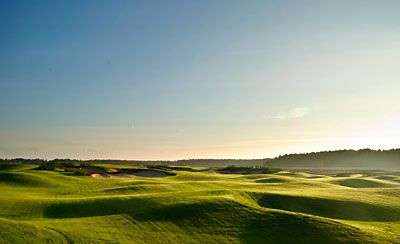
Situated close to the Neva River estuary on the outskirts of St Petersburg, the course at Peterhof Golf Club opened for play in 2017, with eighteen holes routed around half a dozen ponds and lakes. The layout extends to 6,067 metres from the back markers, playing to a par of 71 (35 on the front nine and 36 on the back nine).
We were a little confused when the club’s website stated “the golf course was designed by architect duo Greg Norman and Steve Forest” so we asked Steve if he really did co-design the layout alongside the Great White Shark. This is what he told us:
“Peterhof is in a terrific location – out the busy St. Petersburg highway past the Constantine Palace in Strelna and just 3 kilometres before the Peterhof Palace and its fabulous fountains – which is definitely on par with Versailles.
The original owner of the project was Protcion, our client for Forest Hills. Greg Norman was hired as the architect for the St. Petersburg site and his team produced a spacious layout, complete with a full-size practice range/academy.
Construction started just prior to the economic collapse in 2008-2010 but a couple of years later, a new group bought the property – although the practice range/academy land was not included – and wanted to add a residential component.
We were approached to come on board and we took on the task of fitting 18 holes, a practice range and a residential development on land that had previously only accommodated 18 holes of golf.
Somehow, we were able to fit it all in, working with the Norman-plan lakes that had already begun to be excavated. It’s a links-style course with only a few trees along the St. Petersburg highway. It seems to have a lively membership and is still going strong.”
Highlight holes include a tough par five opening hole (rated stroke index 2), where golfers need to avoid a lake to the right of the fairway on their way to a heavily sand-protected green. The 13th and 14th play over and across the same small lake, while the short par three 16th plays to a peninsula green that’s also flanked by four bunkers.
The latest ranking of the Top 100 Golf Courses in the World serves as the ultimate global golf bucket list. Most members of our World Top 100 Panel are seasoned golfers, each playing 20-30 of these courses annually while travelling extensively over decades to form their opinions on others. We recognise that opinions vary—even among our panel members. Rankings are subjective, and there are undoubtedly 50 or more courses in the UK and USA alone that could easily fit onto this list. Links Golf Pilgrimages The rankings
California, United States
New Jersey, United States
Northern Ireland, United Kingdom
New York, United States
New York, United States
PGA National Russia aims to become the No.1 Russian golf facility Designed by European Golf Design PGA National Russia will fully open in the summer of 2012 March 10 2011 Braemar Golf commence the pre opening phase of the PGA National Russia Braemar Golf are delighted to announce the commencement of the pre opening phase of their management agreement with Zavidovo Golf, LLC to develop the new high-end Golf Club ZAVIDOVO, PGA National. This follows on from a successful technical services phase and construction management contract that saw Braemar Golf manage the construction of the European Golf Designed golf course in conjunction with local contractors Geokam. Keith Haslam Braemar Golf’s Managing Director said “One of our company values is to create long term and mutually beneficial relationships with our clients and it is pleasing to continue our relationship with Zavidovo Golf in the run up to the opening of the golf course which is scheduled for July 2012. We believe golf is a sleeping giant in Russia and during the pre opening phase one of our key objectives is to grow interest in the game” The phase will see Braemar Golf responsible for the grow-in of the golf course, the recruitment of the management and operating team, pre opening marketing services, procurement of all of the operating equipment and establishing all of the operating systems and procedures. “We are delighted to continue our relationship with Braemar Golf and are keen to work closely with them to ensure PGA National Russia becomes the premier golf facility in Russia” added Alexander Yarunin, President of Golf Club Zavidovo, PGA National. PGA National Russia is the centre piece of a 1,300 ha master-planned community in Tver Region of Russia, on the shores of the Ivankovskoye reservoir adjoining the Volga River, 90 km away from Moscow. It is set to become one of the landmarks of Russian urban development, a modern place for a work, living, and leisure. The golf course has been designed by European Golf Design. The club will fully open in the Summer of 2012. Braemar Golf is an international golf services company head quartered at the home of golf in St Andrews, Scotland. They construct, support and manage high quality golf developments in Europe, the Middle East and North Africa. For more information contact – Michael Braidwood michaelbraidwood@braemargolf.co.uk Related web sites www.braemargolf.co.uk and www.zavidovo.com
Golf in Moscow begins to blossom 1st September 2008 It shouldn’t surprise anyone that the first Jack Nicklaus signature course to open in Russia – Tseleevo Golf Club on the outskirts of Moscow – is a private club commissioned by an individual whom Nicklaus describes simply as a “very wealthy man.” In the former Soviet Union, like other emerging markets, new wealth is sparking the creation of spectacular, high-end courses, either for resorts or private use. But bucking the international development trend, Russia, specifically Moscow, is pushing to build municipal courses, too. The city’s mayor also has turned to Nicklaus Design for a vision of his own: Establishing as many as 15 public facilities, which may vary from regulation courses to par 3s to driving ranges. “They want to do for golf in Russia what they did in tennis, and they have tennis players all over the world (who) are very successful,” Nicklaus says. “They’re gearing to their youth.” It’s a scenario that’s vitally important for increasing participation worldwide, but disturbingly lacking, according to Andrea Sartori, a partner with the Budapest office of KPMG who oversees the consulting firm’s golf advisory practice. KPMG conducts benchmark studies analyzing course building in Europe, the Middle East and Africa. It also hosts the Golf Business Forum, a major development conference, which itself is a testament to the current international building boom. Nearly 320 industry leaders from more than 40 countries attended the fifth annual conference, this year held in Ireland. Regarding new courses overseas, Sartori says: “Eight or nine out of 10 will be a golf resort and/or a golf community. We are almost seeing the end of the development of standalone golf facilities. Land is too expensive, construction costs are too high and the return very hardly justifies an investment into a golf course.” That’s a threat not only to the game but for short-sighted developers, too, Sartori says. Relying solely on tourism to fill a burgeoning supply of courses, he says, is a risky proposition. An “indigenous population of golfers” is a must. “After Ireland, Sweden is the country in Europe with the highest participation rate,” Sartori says. “This is the effort of the creation of junior programs, the creation of affordable golf courses and the intervention of the public sector.” The development activity in Russia was inevitable, says Paul Stringer, senior vice president of Nicklaus Design. He says the country’s natural resources, such as gas and oil, have created a new Russian upper class that has discovered elite golf facilities while traveling abroad, and now wants to introduce such amenities at home. “They have a keen interest in the game, and secondly, there’s a belief that they could prosper as developers because it hasn’t been done in their country,” Stringer says. According to a KPMG survey of course architects, the top markets for development in the next decade are China, Eastern Europe and Russia, United Arab Emirates and India. Russia already is a key market for Nicklaus Design, which is witnessing an international sales spike not seen since the Asian development boom that spanned from the late 1980s to early ’90s. Besides Tseleevo, the firm has three other course projects under contract in the area, including one in St. Petersburg near Catherine the Great’s summer palace. Nicklaus Design also is in discussion for two projects in Sochi, a sprawling resort city along the Black Sea. “Six years ago, approximately 75 to 80 percent of our business was domestic and the rest international,” Stringer says. “Now, it’s almost completely flipped.” By:Gene Yasuda of Golfweek


