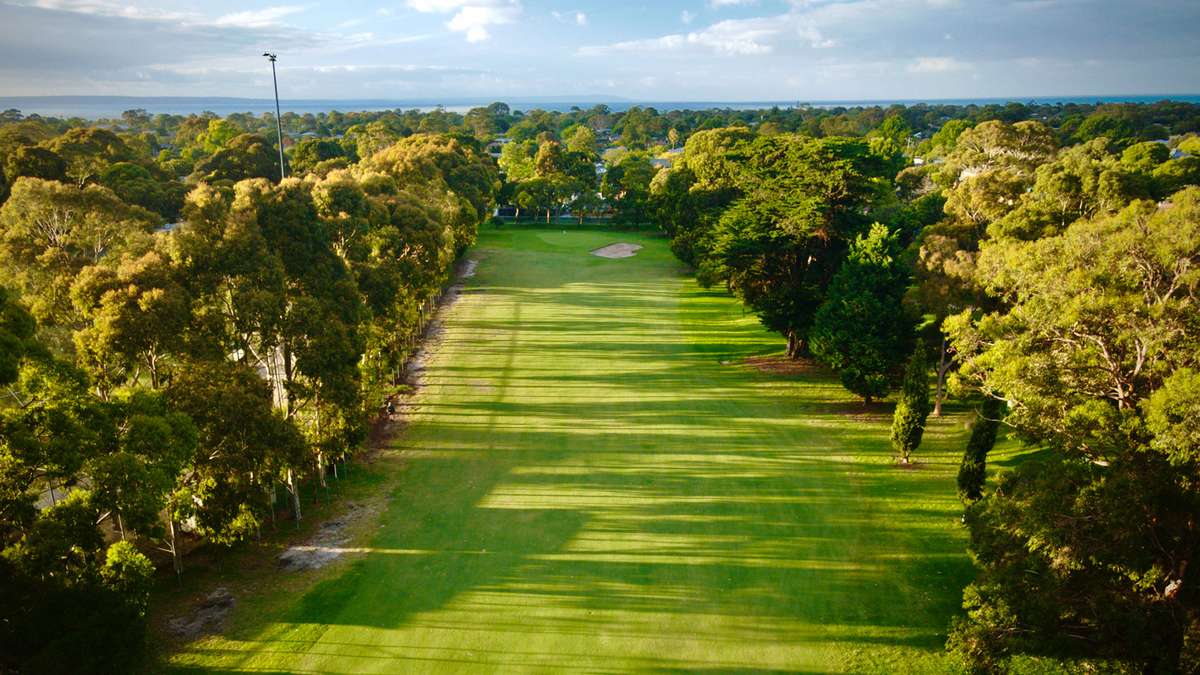
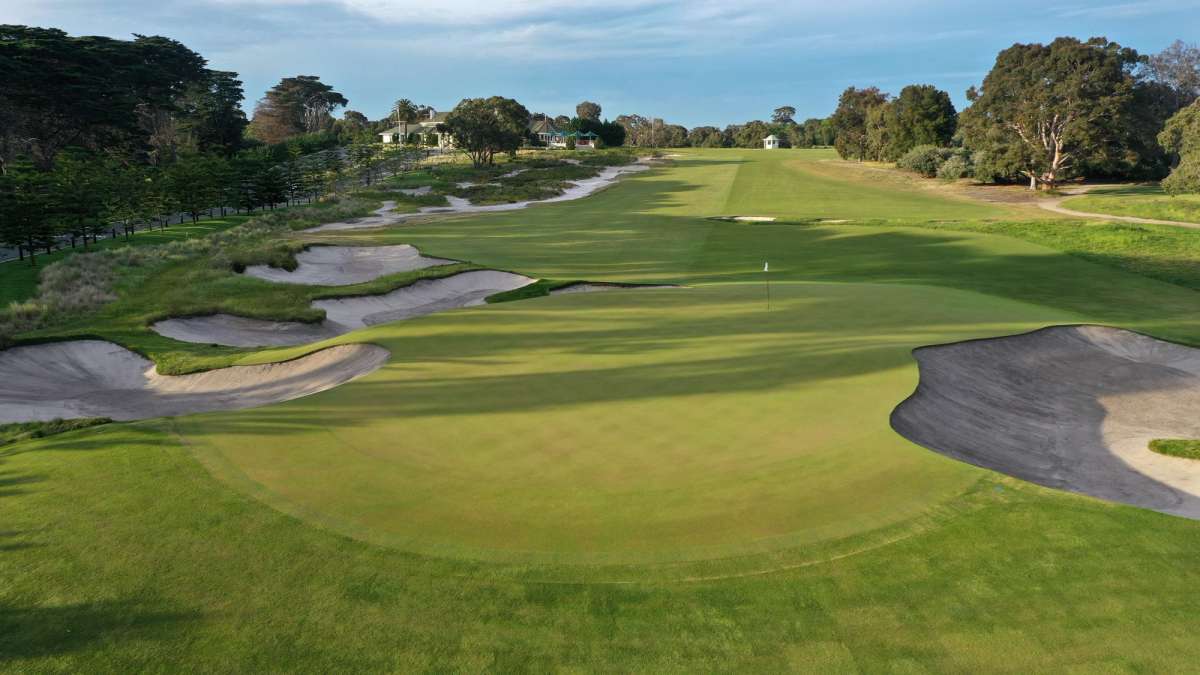
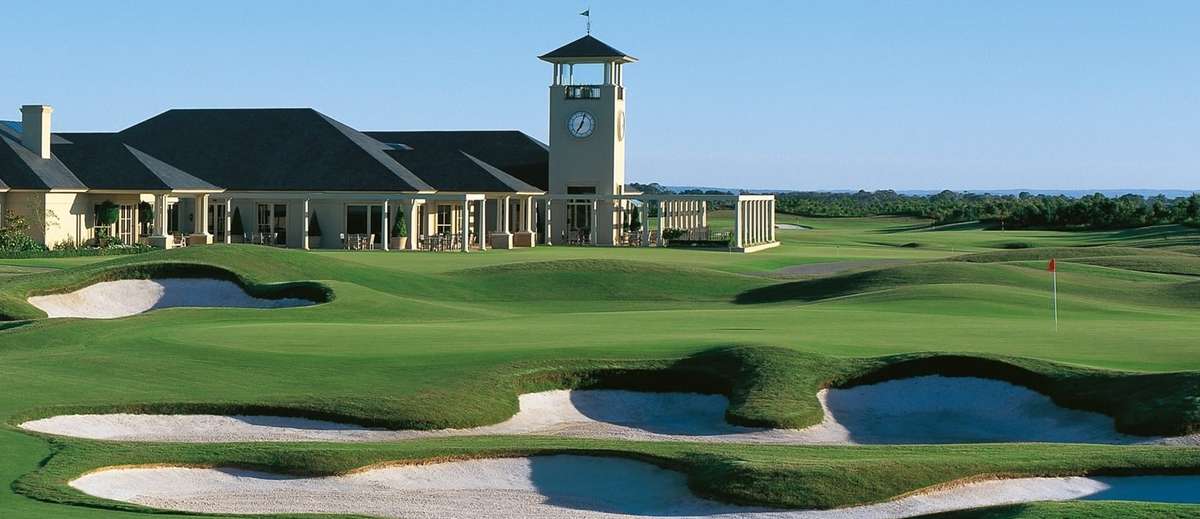
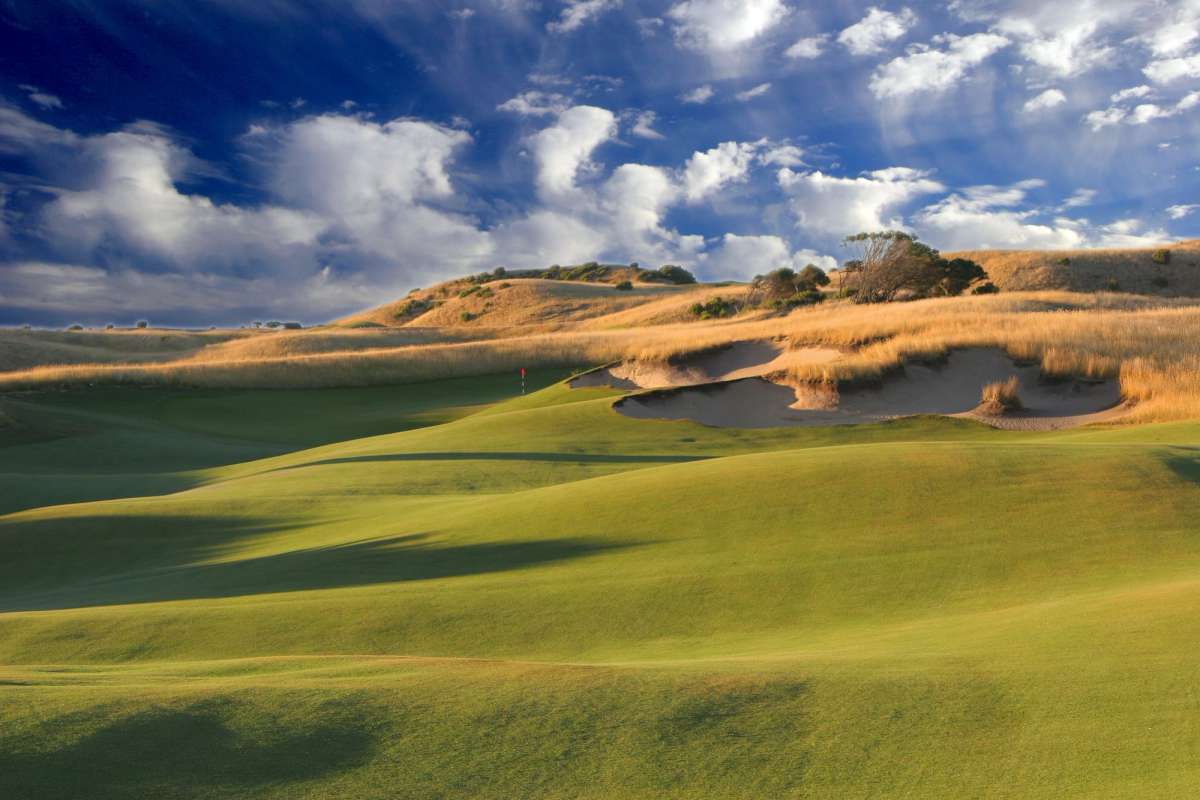
While it does not quite offer the grand theatre of the West, Royal Melbourne's East is still a fantastic golfing experience and holds its own versus all other courses in the Melbourne area.


While it does not quite offer the grand theatre of the West, Royal Melbourne's East is still a fantastic golfing experience and holds its own versus all other courses in the Melbourne area.
Royal Melbourne Golf Club (East)
“Golf came and went in Melbourne in the 1840s,” wrote Sir Peter Allen in The Sunley Book of Royal Golf; “the Club such as it was ending with a dinner at the Royal Oak Hotel in 1850. After that the discovery of gold in New South Wales and Victoria caused a huge boom and influx of people, followed by slump, which put aside most frivolous activities, so that organised golf was not revived in Melbourne until 1891.
The Melbourne Golf Club which was formed that year subsequently divided into two, one of which today is the Royal Melbourne Golf Club and the other the Metropolitan Golf Club.
The split was caused by disagreement among the members about moving from the original site occupied by the club at Caulfield. One group, led by J.M. Bruce, moved out to Sandringham, not far from the sea, taking with them the royal title which had been granted in 1895. The new course was opened in 1901. The other club remained onsite as the Caulfield Golf Club, but later in 1908 moved out to the sand-belt area and became known as the Metropolitan Club, which flourishes today.”
The following passage is a brief edited extract from The Finest Golf Courses of Asia and Australasia by James Spence. Reproduced with kind permission.
"Although six holes from the East course are incorporated with twelve from the West when Royal Melbourne is presented in its championship livery, when played in its entirety as the playing style of the East course is distinctly different. The bunkers are not so cavernous as to diminish the golfer. The fairways, though generous when compared to the Sandbelt average, are not as wide as on the West.
While it does not quite offer the grand theatre of the West, it is still a fantastic golfing experience and holds its own versus all other courses in the Melbourne area.
It is with the par threes I think where Alex Russell and Mick Morcom’s design most closely approximate their Svengali. All bar the short 13th make use of some natural drama. All involved some carry over the sandy heathland. As the greens are large enough to permit multiple pin permutations and you find yourself poised over your bag in between two or even three club decisions."
In April 2018, Paul Rudovsky, one of our most respected globe-trotting contributors, revisited the East course after being too long away:
"I first came to Melbourne in February 1977 and played Royal Melbourne’s West and East courses (as well as the Composite Course) on that trip. I have been back to Australia at least twice since and played RMGC’s West course at least three more times, but had not replayed the East. I clearly remembered holes 1-3 and 17-18, but to be honest not much about holes 4-15 (except remembering that it was almost as good as the West). So this time I decided that it was time to revisit the East and was very glad I did. It is an outstanding course and its only fault is that it sits in the shadow of RMGC’s West (which a good number of knowledgeable observers consider to be the finest in the world)."
Second Hundred Golf Courses of the World 2016 We preview the challengers for the 2018 Top 100 Golf Courses of the World and list this season’s second hundred Having recently published the latest 2016 edition of our Top 100 Golf Courses of the World, we thought we’d take a look at the layouts that missed inclusion this time round. We’ve focused this Second Hundred Golf Courses of the World article on forty highlighted challengers, but it’s feasible that any of the hundred courses listed at the end of this article could make the next World Top 100. It’s also viable that numerous other courses could also make the grade. If you think we’ve missed a layout from our current World Top 100 or from our Second Hundred (listed in full at the end of this story), please click the “Respond to this article” link at the top and bottom of the page and share your opinion. The forty “challengers” are profiled by country below. At the end of this article we list the entire second hundred in alphabetical order. Australia Moonah is one of the toughest golf courses in Australia and it’s the headliner at the remarkable National Golf Club at Cape Schanck on the Mornington Peninsula. This modern Greg Norman/Bob Harrison links is not only dramatic but also raw and elemental. Two other National courses are also notable (Ocean course and Old course), which is why RTJ2 commented that the National is “one of the great golf complexes anywhere in the world”. No true golfer could disagree. King Island is situated in the Bass Strait, to the northwest of the main island of Tasmania, and it lies about half way between Tasmania and the mainland state of Victoria. It’s here that respected author Darius Oliver is said to have convinced businessman Duncan Andrews to develop the Cape Wickham site and subsequently American architect Mike DeVries was hired to lay out this dramatic links, which opened in 2015. It’s too early to say whether or not this project will be sustainable due to the remote island location and the vicious Roaring Forties, which batter King Island. It might be a step too far for all but the most intrepid golfers. The East course at Royal Melbourne is undoubtedly the West’s understudy. According to James Spence, author of the Finest Golf Courses of Asia and Australasia: “While it does not quite offer the grand theatre of the West, it is still a fantastic golfing experience and holds its own versus all other courses in the Melbourne area.” The Alister MacKenzie-designed Royal Adelaide has featured in our world hundred on numerous occasions but has missed out recently. James Spence commented as follows: “Although the sea hasn’t bordered the course at The Royal Adelaide for some 10,000 years, it remains, like Royal Lytham & St Annes, more of a links course than an inland course. Royal Adelaide is a favourite golf course of many Australian golfers and it’s easy to see why.” Seven Australian Opens, five Australian PGAs and ten other professional tournaments have been hosted at The Metropolitan Golf Club. The World Golf Championships Match Play Championship was held here in 2001 and this Sandbelt classic is polished to within an inch of its life. Fergal O'Leary, our US Consultant, played here recently and commented: “Attention to detail and conditioning at “Metro” is second to none, I even heard that some of the green-side bunkers have their edges hand-cut with scissors!” Bermuda The Mid Ocean Club is set on the northeastern tip of Bermuda in weathly Tucker's Town. The “Father of Golf Architecture”, Charles Blair Macdonald, originally laid out the course in 1921 adjacent to the Atlantic and it has been on the cusp of the World Top 100 for each edition. It’s a unique layout that’s routed across glorious undulating ground, but the Atlantic Ocean doesn’t play a major part in the design, merely providing a beautiful backdrop to a number of holes, the majority of which are set back a little further inland amongst the stately pines, the pretty glades and the dramatic valleys. Canada Hamilton Golf & Country Club, or Ancaster as it is known locally, is located on land which once known as Grange Farm and it is set most beautifully in elegant, heavily wooded seclusion. There are three loops of nine holes here, called South, West and East and the championship layout comprises of the West (front nine) and South (back nine). Although Hamilton’s club history can be traced back to 1894, the West and South were designed as two nine-hole courses by Harry S. Colt and both loops formally opened for play in 1916. It didn’t take long for Cabot Links to make a startling impact on the Canadian Top 100 rankings, soaring almost to the top of this prestigious national chart within months of its opening. No pressure then on Bill Coore & Ben Crenshaw to deliver when their much awaited Cabot Cliffs layout debuted three years later. Situated half a mile away from Cabot Links, the Cliffs course occupies a more diverse landscape than its predecessor, sitting atop the bluffs that overlook the Gulf of St Lawrence, with fairways transitioning seamlessly between woodland, wetland and meadowland areas. Somewhat unusually, the layout is configured with three par threes, three par fours and three par fives on each of the nines. England The Herbert Fowler-designed East course at Saunton has been on the threshold of a World Top 100 ranking for many years. For one reason or another it has never managed to muscle its way onto the world list. This winter a number of new bunkers are being added by Mackenzie & Ebert and a couple of spectacular green run off areas are being created. The East course is undeniably a serious contender as is the Church course at St Enodoc, which pitches and rolls over glorious Cornish linksland. It even wraps around the church where the Poet Laureate, Sir John Betjeman, is buried. The poem “Seaside Golf” was inspired by a rare three Sir John carded at St Enodoc. Alwoodley came very close to knocking Ganton off the Yorkshire top spot when we recently revised our Best In County rankings. Many golfers think that the home course of Dr. Alister MacKenzie (his first architectural design) is one of his best layouts and it continues to progress upwards in our Britain & Ireland Top 100. A recent poster said: “Certainly a course which should be ranked higher and can rival the likes of the Hotchkin Course at Woodhall Spa.” Royal Cinque Ports is one of England’s unsung links. It doesn’t have the dune drama of its near neighbour at Sandwich, but the greens complexes at Deal are as good as any links course in Britain, while the brutal closing stretch will sort the men from the boys. France Les Bordes was the brainchild of Baron Marcel Bich (the man behind Bic pens) and his friend Yoshiaki Sakurai. Together they committed to paper (presumably by biro) the wooded masterpiece that is consistently ranked as one of Europe’s greatest courses. Designed by the late Texan, Robert von Hagge, on a day when he was at his most wickedly creative. Les Bordes opened for play in 1986 and it’s a supreme challenge. The likeable Jean Van de Velde holds the current course record of 71 (one under par), so don’t visit Les Bordes expecting to play to handicap. This monster layout stretches to 7,062 yards from the tips and it really is as difficult as its reputation suggests. According to the old Big Bopper song, “Chantilly Lace had a pretty face and a wiggle in her walk”. Golf de Chantilly is far more than a pretty face; the Vineuil is one of Europe’s most glorious courses that’s set amidst the forest of the Ile de France, approximately 30 miles to the north of Paris. The club was originally founded in 1909 and it has played host to numerous French Opens, including the 1913 French Open, which George Duncan won. Germany Falkenstein is an attractive course, which is routed in all directions of the compass. The wooded location provides a genteel oasis to play golf, away from the hustle and bustle of Hamburg’s city centre. While tree-lined courses often have dull highway-like holes, here only the 2nd and 11th are relatively straight and that is just the right amount of diversion on a course full of doglegs and interest. Every hole presents a unique challenge, the bunkering is vintage Colt (with some modern alterations) and the green complexes provide great entertainment without going overboard. Indonesia In the words of Greg Norman: “When I first saw the site, I was immediately taken by the dramatic location, the fascinating local culture and the rolling hills covered with rice paddies. I was determined to keep all these features while building a golf course that would challenge even the world’s best. I’m proud to have played a part in developing this world-class golf course.” But is Nirwana Bali that good? Let’s find out from Kimi Hoshiyama, our China and Southern Asia Correspondent: “Nirwana Bali Golf Club features wonderful views overlooking the Indian Ocean. There are many rice terraces positioned on roughs and creeks crossing fairways on some holes. The rugged cliffs with three holes running along the Indian Ocean, terraced rice paddies and coastal landscape, have all been preserved to provide spectacular natural hazards. When the prevailing strong sea winds blow, the course becomes more difficult. The par 5 hole 6, the par 3 hole 7, the par 4 hole 13 and the par 3 hole 14 are superb, these holes are not only beautiful but also the ocean comes into play.” Japan The East and the West are two outstanding golf courses at Kasumigaseki Country Club. East or West, which is best? We’re really not too sure, but the East is the one that the members generally favour, so we think it’s prudent to stick with those in the know and Fergal agrees: “The site for the 2020 Olympics golf course. The East course has had some recent bunker work done by Tom Fazio, but the bigger challenge that the course is facing is to decide whether to consolidate the current “dual green system” into a single set of greens for the Olympics… We played on the old greens which are small and not very deep – certainly a challenge for the best of players. I am not in favour of consolidating the greens and adding numerous water features to the course as it takes away from one of the historic reasons why this club is so special. Having played this course twice now, my desire was not to touch the wonderful Charles Alison design and just let the best players in the world earn their gold medal.” Mexico At the end of 2014, the Golden Bear completed work on Quivira, his sixth Los Cabos layout, which is located on a truly stunning property at the end of the Baja peninsula, overlooking the Pacific Ocean. Focal point of the 1,850-acre luxury resort, this fabulous 18-hole layout is reputed to have taken around eight years to construct at a cost of $40 million. According to Javier Pintos, our Argentinean Correspondent: “WOW! One thousand times WOW!! This is maybe the most spectacular piece of land on which I have played golf in my entire life. It has dunes, level changes, Ocean, carries across cliffs, mountains, desert, sun and views of the new Tiger Woods Course at Diamante (El Cardonal). I was lucky to play here two days after Jack Nicklaus played it in its inaugural event last December 2014.” Netherlands In the early days, the Kennemer Golf & Country Club played on a rudimentary nine-hole course and when it moved to its present location in 1927, the brilliant Harry Colt was commissioned to lay out the course amongst the towering sand dunes and the result is still really good, despite damage caused by the occupying army during the Second World War. In 1985, Frank Pennink was tasked with adding nine new holes (Pennink’s last design before this death). Each nine has a name and is also referred to as the A, B and C course, so things can get a bit confusing. The A course is also called Van Hengel (named after Steven van Hengel who was a member and an eminent figurehead in Dutch golf), the B course is called Pennink and the C nine is called Colt. The Dutch Open utilises holes from all three nines, so play all 27 and then decide for yourself which two of the three loops combine to make the best course. New Zealand Kauri Cliffs dropped off our 2016 world hundred list to the amazement of many. Will it be back? Quite possibly – seaside golf doesn’t get much better than this. It’s hard not to be seduced by the magnificent ocean vistas that grab your attention the entire way round. Is the course itself good enough for a world ranking? That’s a tough question but many golfers would reply with a resounding yes. One of the few true links courses in the Southern Hemisphere and host to a dozen New Zealand Opens, Paraparaumu Beach is a household name and has twice been listed in our World Top 100 (2006 and 2012). Fergal O’Leary was very impressed when he played Paraparam almost twelve months ago: “Everything about the club is humble and unpretentious and fits every element of a golfing gem. If you’re looking for a course which will examine how accurate you are from the tee, then you’ve met your match.” Scotland According to Colin Montgomerie, “wherever Loch Lomond is ranked, it ought to be higher”, it’s therefore a no-brainer that this beautiful Tom Weiskopf and Jay Morrish design from 1993 must appear on this second hundred list. “The best golf experience in Europe” is how one reviewer described this unique course set on the bonnie, bonnie banks. Prestwick has been described as quirky, eccentric, strangely odd and rather confusing. This golfing monument often divides opinion. However, there’s no denying that this time-honoured links genuinely deserves consideration for a world ranking position. After all, this is where the Open Championship began and nobody could ever accuse it of being a bore. Machrihanish is widely loved by golf course architecture aficionados and frankly what’s not to like at this remote golfing outpost on the tip of the Kintyre peninsula? Perhaps if the round concluded half as strongly as it started, Machrihanish would be a permanent feature in the world hundred. Gleneagles is one of Europe’s finest destinations with a wonderful hotel and a Ryder Cup course within its portfolio. Let’s not dwell on the PGA Centenary course, which will never be a contender for this stellar ranking list, but concentrate on the regally named courses for a moment. The Queen’s is the favourite of many mid handicap golfers and it’s as pretty as pretty can be, but it’s the King’s course that’s knocking on the door. Often lauded as James Braid’s finest design, the King’s is hard not to like; the setting is glorious and the course big and bold, but perhaps it’s a little too refined for some. South Africa Durban is part of Africa’s Zulu Kingdom and it’s a bewitching seaside playground in the province known as KwaZulu-Natal. Amidst the hustle and bustle of this cosmopolitan city lies the serenity and calm of Durban Country Club. The Country Club course has not appeared in our world hundred since 2008, despite many rating this 1922 Laurie Waters and George Waterman design as the best in the land. Set on the edge of the Indian Ocean, hidden behind a high ridge of sand dunes, the layout undulates beautifully through lush and intimidating tropical vegetation. Durban could easily reappear in the World Top 100 but many golfers reckon there’s a better course down at Fancourt. The Links course at Fancourt opened for play in November 2000 and it represents a unique and very tough South African golfing experience. The course was designed by Gary Player, but only after the Black Knight’s team had studied in great detail the characteristics of classic Scottish links courses. The Links does indeed resemble a traditional seaside links, but so far they have failed to replicate the changeable British weather. Fergal played here recently: “The sheer scale and size of the Links course is a sight to behold by itself. It’s an immensely enjoyable and impressive course to play. Without debate, it’s Gary’s best design in his global portfolio. Don’t be fooled by the name, this is not a Links golf course by definition, however the inherent pot-bunkers, blind drives and swashbuckling fairways immediately give the sense that you are beside the seashore.” South Korea Author, James Spence, kindly allowed us to reprint his account of Nine Bridges from the Finest Golf Courses of Asia and Australasia: "The course was designed by Golf Plan whose two principles are Ronald Fream and David Dale. As befits a golf design firm led by a horticulturalist, the visual presentation and aesthetics of the course are excellent. The public relations releases talk about how the designers have sought to create a Scottish Highlands course and, for once, this is not mere hyperbole. The manicuring and finishing is of an order of perfection you are not liable to find in Scotland so, in truth, it more resembles an American course in a Scottish atmosphere. And this part of Jeju Island does indeed resemble Perthshire. The two nines have been laid out on a very generous allocation of land that wanders through pine-clad rolling land in the lee of Mount Halla, at 6,000 feet South Korea’s tallest mountain.” Spain Spain may have lost the fight to host the 2022 Ryder Cup, but the Spanish Ryder Cup bid course at PGA Catalunya is at the pinnacle of Spanish golf. The Stadium course is the culmination of more than ten years of planning and design by the European Tour who wanted to build their own Players Championship course to rival the PGA Tour’s TPC at Sawgrass. It has to be said that it was a decade well spent. The PGA Stadium is so good that within months of opening, it hosted the 1999 Gene Sarazen World Open and the Spanish Open in 2000. The Spanish Open returned to the Stadium course in 2009 (won by Thomas Levet) and in 2014 when veteran Miguel Angel Jiménez extended his own record as the oldest winner in European Tour history, prevailing in a three-man play-off. Sweden According to many, the Stadium course at Bro Hof Slott is Sweden’s best course and even architect RTJ2 thinks so: “Everything is big at Bro Hof! The holes are longer, the greens are bigger, the course has more water and the bunkers are larger and well placed. Besides which, the wind is always part of the game. On the dogleg holes you not only have to hit the balls a long way, you also have to get them to stop. Mother Earth must have created this area for a golf course. All I had to do was to walk around this beautiful landscape and see where the holes would fit in. There was an enormous amount of land and a large wallet. If, in spite of everything, there wasn’t enough land, we could get more.” Therefore, big really is better – you’ve been told. Thailand Formed in 2007 by thirty of Thailand’s wealthiest people, Ayodhya Links is one of the most exclusive golf clubs in Asia. Membership to the club is by invitation, so only the great and the good of Thai society mingle in the clubhouse – and unless you’re closely acquainted with one of these invitees, don’t hold your breath on getting a game here anytime soon. The design company of Thomson and Perrett created the course and they've laid out a tough track where water lies in wait at each and every one of the eighteen holes on the scorecard. If you add rolling fairways, lightning fast greens and a variety of deep bunkers into the golfing mix then it’s easy to see why Ayodhya is regarded as a real test of golf. USA Old Town Club in North Carolina is an obvious World Top 100 contender. It rocketed into our latest 2016 US Top 100 (#49) following the Bill Coore and Ben Crenshaw 2011 restoration of this Perry Maxwell classic. Gozzer Ranch in Idaho is widely regarded as Tom Fazio’s best design, perhaps even better than Shadow Creek (North) and Wade Hampton (which occupies a place in our current world hundred). Pete Dye has two contenders knocking on the door: The Honors Course in Tennessee and Harbour Town in South Carolina (which was a collaboration with Jack Nicklaus). Bandon Trails (Coore & Crenshaw) must also be a candidate, along with the classics of Yeamans Hall (Seth Raynor), Winged Foot (East) by AW Tillinghast, which has recently been restored by Gil Hanse, Myopia Hunt (Herbert Corey Leeds) described by a reviewer; “Mypoia is to America what Prestwick is to Scotland,” and the Valley Club of Montecito by Alister MacKenzie (with a little help from Robert Hunter and, more recently, Tom Doak). The nine highlighted USA courses above only scratch the surface, as there are perhaps two-dozen or more American layouts that could conceivably make the World Top 100. The depth and quality in the States is second to no other country. If only more clubs could be accessed by regular golfers. Keith Baxter Editor-in-Chief Top 100 Golf Courses
Melbourne is located in the southeast corner of Australia. A major urban hub, it is the golf capital of Australia. Sydney has New South Wales, Brisbane has Royal Queensland, and Adelaide has Royal Adelaide but Melbourne is replete with world-class golf in abundance. It also has a depth that other Australian cities cannot match. Melbourne, The Sandbelt, and The Mornington Peninsula The term Sandbelt has become synonymous with Melbourne as a whole but it is a little more nuanced than that. Melbourne sits on the north side of Port Philip - a large bay that has the Mornington Peninsula on the east and Gellong on the west. The Sandbelt is found south and east of the Central Business District of the city. Strictly speaking, the famous 'Sandbelt Courses' are Commonwealth, Kingston Heath, Metropolitan, Peninsula-Kingswood, Royal Melbourne, Victoria and Yarra Yarra. In this synopsis, we will be looking at golf in the Sandbelt but also on the Mornington Peninsula as you would normally take in golf here in this area as a whole. World Top 100 Tier In the space of a few miles, Melbourne is host to perhaps the best collection of golf courses in a single neighbourhood. Royal Melbourne West leads the way. The Alister MacKenzie design is one of the all-time greats and would probably be even higher than 6th in the world if it wasn't located almost at the end of it... Photo Courtesy Gary Lisbon - Royal Melbourne Kingston Heath is up next. Kingston Heath is a proper heathland with a rare species of heather found only here. It is 1 of 1 and outshines the big London-based heathlands of Sunningdale Old, Sunningdale New, Swinley Forest and St George's Hill. It is the best heathland in the world despite not being in the home of heathland golf - it is that good. If you got an invite, you could play one or the other and no more and the trip down under would be worth it. Photo Courtesy Gary Lisbon Kingston Heath In Melbourne, the next two golf courses near the World Top 100 are Victoria and Royal Melbourne East. Victoria is an intricate routing and has recently completed fine work. Royal Melbourne East is sneaky good and adds six holes to the composite course, which may just be the best golf course in the world. Tom Doak is responsible for the East's current iteration based on Alex Russel's framework. The Newcomers The new kids on the block are Peninsula Kingswood North and South. After joining forces, two clubs became one, sold off some land and heavily invested in their two courses and clubhouse. The result is nothing less than spectacular. The North is making waves and some have it earmarked for World Top 100 consideration. The South is strategically sound but not as visually stunning. Every hole is good, but the North is more memorable with some cracking holes in incredible settings. Photo Courtesy Gary Lisbon - Peninsula Kingswood Old School Charm The old-world classics offer charm and class the flashiest new builds seem to lack. The three big names in the immediate area of note are Commonwealth, Yarra Yarra, and Metropolitan. Here, Tom Doak and Renaissance Golf Design have made their impact felt with Yarra Yarra and Commonwealth recently upgraded and refined. Metropolitan has also seen local firm Crafter & Mogford refine the more recent additions to make a cohesive whole. Photo Courtesy Gary Lisbon - Yarra Yarra Sample Itinerary Royal Melbourne West has to be on the top of anyone's wish list. Visitors are welcome on Mondays, Tuesdays, and Fridays. Kingston Heath allows visitors on those days and additionally on Thursday afternoons. Victoria is happy to hear from visitors but you can play any day if you stay on-site in their Dormie accommodation. Peninsula Kingswood operates on a similar system with visitors requiring prior application and approval before arriving on site. Metropolitan allows visitors most weekdays. Yarra Yarra and Commonwealth allow play seven days a week, especially if booked well in advance. Hence, in a single week, it would be possible to play the lot. With some careful planning. If you can get the anchors booked in, the rest should fall into place given enough time and notice. Be advised, that in Australia, you often need a letter of introduction and a handicap certificate for access at most clubs. As well, unaccompanied play as a visitor is not inexpensive. You can expect to play anywhere from $500 to north of $1000 AUD to play some of the courses listed above... Test Melbourne's Depth Within an hour or so, you have a plethora of great golf. The National Golf Club has three golf courses that anyone would enjoy. The Gunnamatta is Tom Doak's contribution, with Greg Norman's Moonah and Robert Trent Jones Jr's Old Course providing appealing additions or alternatives. Perhaps the best value of all, is St Andrews Beach. A collaboration between Tom Doak and Mike Clayton is superbly routed and one of the most pure golf experiences I've ever enjoyed. At $115 AUD or about £60, I'd happily play 36 here in a day. As it is a public pay-and-play, rounds can be lengthy as many aren't private golf club regulars who play ready golf, quickly - get out early. Photo Courtesy Gary Lisbon - St Andrews Beach Other options nearby like Cathedral Lodge, The Dunes Golf Links, Moonah Links, and Portsea are worth seeing if the others have been filled or the diaries don't sync. Getting to Melbourne The West Coast of North America is well serviced with direct flights to Melbourne from Vancouver, LA, and San Francisco. From the UK, there are no direct flights with most layovers at hubs in the Middle East and Asia. Getting Around You drive on the left side of the road or drive right-hand drive vehicles. Put another way, you drive on the opposite side down under than you do in America or the same as the UK. Car hire is easy and all the usual suspects are here. The airport is undergoing major renovations as of 2025, but it works well. Spend Time in Melbourne On golf destination holidays, its easy to cram in the golf and forget about the experience. However, few cities hit like Melbourne - food, drink and vibe are all worth soaking up. If you visit in January, the Australian Open (tennis) runs just about all month. It is an international city that is worth a day or two to see. Remember the Sunscreen I've not been caught out in four trips to Australia but the sun here and in New Zealand is next level. Wear UV 50+ sunscreen and a hat. Even the locals wear broad-rimmed or bucket hats instead of ball caps. In fact, it was observed many were now wearing protective arm sleeves as well. If the locals take it seriously, you should too!
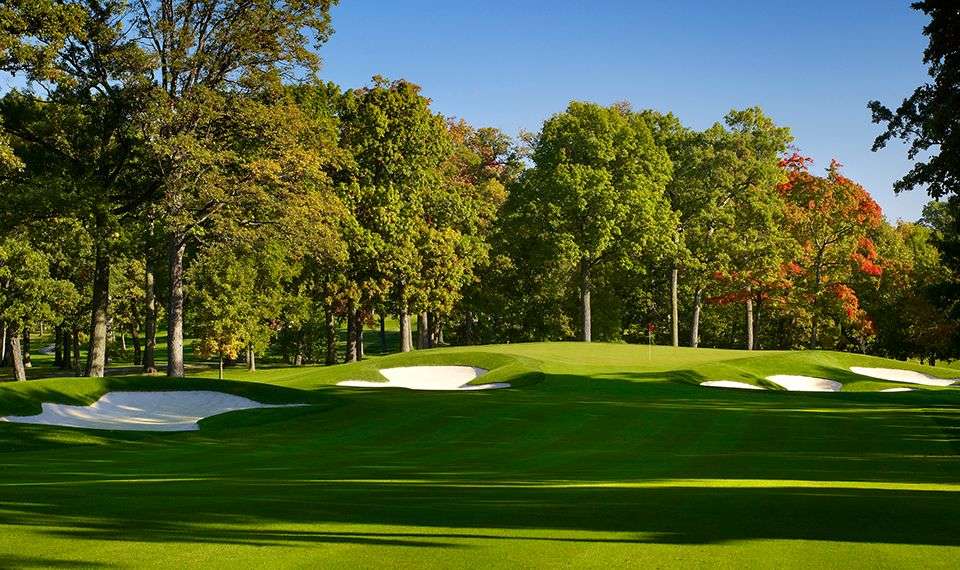
The message of great, strategic golf course architecture is clear. The actual words used to describe those golf courses, however, are many. The Architecture Glossary column will examine more precise terms and concepts that one will find when exploring golf course architecture. Hopefully understanding these terms, and why certain architects employed them, will help you to better understand the golf courses you play…and maybe even improve your scores! Today’s term is ‘Fringe Swale’. Take a look at renovation plans for any given golf course in the past decade and a number of trends appear. For one, trees disappear and fairways are widened into the area where trees once stood. Another is that the shaping of bunkers differs far from the curvilinear style that became popular during the second half of the 20th Century. Look at OCM Golf’s plans for Medinah Country Club’s No. 3 course and you’ll notice a third trend, albeit one that’s much more exaggerated here than elsewhere: Nearly every green seems to feature, if the color scheme on the master plan is consistent, short grass around the putting surfaces, rather than traditional second cut. Medinah Master Plan: A quick look at OCM Golf's master plan for Medinah Country Club's No. 3 course reveals a lot of short grass around the greens, a nod to the Australian firm's ancestral roots. (Photo Credit: OCM Golf) Some context: “OCM” is the acronym for the architectural agency of Geoff Ogilvy, Mike Cocking and Ashley Meade, a trio of Australians who brought their homeland’s significant influence to Medinah, most noticeable perhaps in this excess of shortgrass surrounding the greens. And there's a good reason for the approach. Those skeptical of the current “woke” movement in golf course architecture might bristle at such changes, lamenting the lack of penalty that comes with a lack of rough. This doesn’t accurately reflect the scoring tendencies between lower and higher handicap players, however. Looking at the numbers, the scores between a scratch golfer in greenside rough and a mid-handicapper vary widely; unless grown at an exhausting density, the better player will not struggle to control their spin and land a flop shot. The average player will do the opposite. Interestingly, if the greenside grass is cut at fairway height, the average player will perform significantly better than if he were in second cut, while the scoring ability of the scratch golfer actually decreases. Royal Melbourne East No. 10: An aerial over the tenth green on Royal Melbourne's East course shows the runoff that awaits inaccurate approaches. Not as bad as a bunker, perhaps, but a trick to get back into prime putting position. (Photo Credit: Royal Melbourne Golf Club) The rough-around-the-rosie approach to green-guarding occasionally reaches an unfortunate peak at professional events, where there is no buffer between green and ungodly rough. Nothing prompts a player’s ire like a ball that has been backstopped by a wall of rough, preventing a putt, yet the chip requires both a heavy hand (to cut through the stuff) and a light touch (to chip a ball that’s not actually sitting in that stuff). The justification for shortgrass around the green isn’t strictly for equalization purposes, of course. Course architecture enthusiasts drooled while watching players at the 2019 Presidents Cup utilize any number of shots and any number of angles to get up-and-down around the green. Pitch, chip, putt…the only limit was the player’s imagination. But back to Medinah: Not all of the shortgrass areas shown on Medinah’s master plan should be described in the same understanding. Some sit level with the putting surface. Others fall off the green and create collection areas for balls that flirt with the green’s edge, creating a mini-hazard of sorts that sits below the flag. Such shortgrass areas, beneath the putting surface, can be described as “fringe swale” (even if they are not a defined valley). One example at Medinah is No. 7. During the previous round of work at the club, Rees Jones had left the green defended at the front by bunkers on both sides, and otherwise surrounded by rough — a style of fortification popularized by his father, Robert Trent Jones, and mimicked by others for decades. Medinah No. 7: The bunkers will disappear when OCM puts the knife to Medinah No. 3's seventh hole, however new challenges will emerge. Those missing right will now face a tricky shot to get back at the flag, but the shortgrass will offer them the ability to choose the best option for finding their target...a flop? A bump-and-run? A putt? (Photo Credit: Medinah Country Club) OCM isn’t abandoning greenside bunkering wholesale (there are plenty of sand hazards in Melbourne, after all). Here they’ll feature a pair of bunkers at the left edge of the green, which will reward the bold who attack left pins directly. Those who play too conservatively will end up in a large swath of short grass that wraps all around the green, from 12 o’clock to 7. Although they’ve been spared thick rough, they’ll also need to think carefully about how they can get back at that flag without running over the green. Flags that sit on the right side of the green’s plateau won’t be an easy get either…those who try to get aggressive from a short-sided lie may easily roll right back down to where they started. The Melbourne Sandbelt might be most popular for this design factor, but it features elsewhere around the world. It is interesting to note, however, that it does seem particularly popular among the great “inland links” regions, such as the Carolina Sandhills (Pinehurst No. 2) or the London heathland. No. 1 at St. George’s Hill (Red) owes several factors for its consideration among the world’s great opening holes. One is the green, which is due in its current iteration more to the vision of Tim Lobb than original designer Harry Colt. At some point, Colt’s original had been replaced with an unusually flat putting surface, set in a bowl. Lobb brought the hole putting surface back into line with the club’s personality by adding a run-off area, resulting in a fidgety pitch (or putt) for those who miss the green in almost any direction. St. George's Hill No. 1: The tee shot at St. George's Hill sells itself to the spirit, but this hole has further improved following a green update from Tim Lobb, who added fringe swale fallaways around the putting surface, hidden behind the bowl. The change brings the hole more in line with the heath character seen elsewhere in Harry Colt's fine heathland portfolio. (Photo Credit: St. George's Hill Golf Club) This defense concept made its way to the United States, inspired by both Australian and English greats. Andy Staples sought to redesign Detroit’s Meadowbrook Country Club in a manner consistent with the mindset of its original designer Willie Park Jr., and so he visited Park’s Huntercombe Golf Club for inspiration. The result is a wild set of greens and, yes, fringe swales. No. 8 deserves highlight for its strategic consideration. Like many greens, the highest point is at the back of the putting surface, including a particularly daunting tier at the back left. As the green is fronted by water, cautious players may opt to air on the long side but, if they roll off the back, they’ll find that this tier provides a dramatic factor to be considered when solving the short game equation that the lie presents. Meadowbrook No. 8: Water is the obvious danger at Meadowbrook Country Club's eighth hole, but the shortgrass gathering area behind the green requires more problem-solving to get home in par. No shot is easy, but those that end up behind the back-left tier will have the most "fun." (Photo Credit: Meadowbrook Country Club / Andy Johnson) If one measures great golf course architecture in terms of the creativity it prompts, you’ll find few factors that accentuate this skill more than a fringe swale. If one measures great golf course architecture in how it tests the average golfer…you might not be a fan. If you measure it in how it tests the best players, however, you’re probably going to like what you see.
The latest ranking of the Top 100 Golf Courses in the World serves as the ultimate global golf bucket list. Most members of our World Top 100 Panel are seasoned golfers, each playing 20-30 of these courses annually while travelling extensively over decades to form their opinions on others. We recognise that opinions vary—even among our panel members. Rankings are subjective, and there are undoubtedly 50 or more courses in the UK and USA alone that could easily fit onto this list. Links Golf Pilgrimages The rankings
California, United States
New Jersey, United States
Northern Ireland, United Kingdom
New York, United States
New York, United States