Northern Ireland, United Kingdom
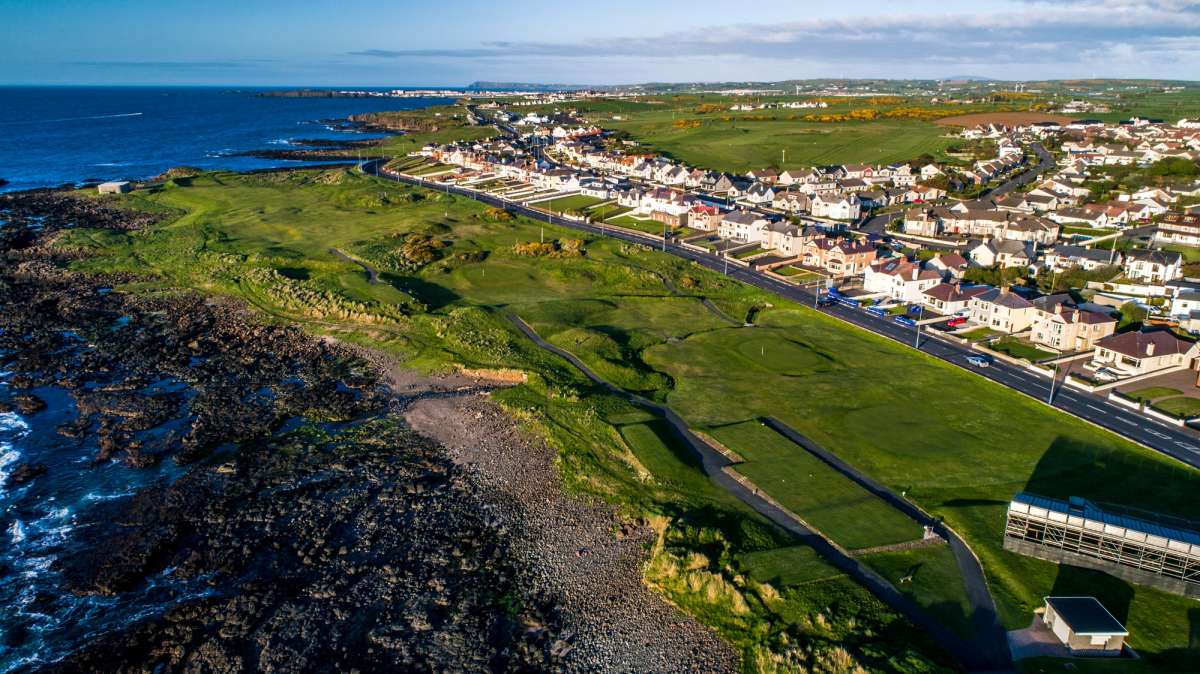
The Dunluce links at Royal Portrush Golf Club is named after the ruined Dunluce castle that overlooks the course. Seven years after the club's formation, the first professional golf tournament in Ireland, won by Sandy Herd in 1895, was staged here.


Royal Portrush Golf Club (Dunluce)
The Dunluce links at Royal Portrush Golf Club is named after the ruined Dunluce castle that overlooks the course. Seven years after the club's formation, the first professional golf tournament in Ireland, won by Sandy Herd in 1895, was staged here.
Royal Portrush has the honour of being the only club outside mainland Britain to host the Open Championship.
"Portrush stands on a rocky promontory that juts out into the Atlantic, and, if I may allude to such trivialities," wrote Bernard Darwin in, The Golf Courses of the British Isles, "the scenery of the coast is wonderfully striking. On the east are the White Rocks, tall limestone cliffs that lead to Dunluce Castle and the headlands of the Giant's Causeway. On the west are the hills of Inishowen, beyond which lie Portsalon and Buncrana and the links of Donegal."
Since its foundation in 1888, Royal Portrush Golf Club has undergone a transformation in more ways than one. It was originally a 9-hole course, known as the County Club. The following year it was extended to 18 holes. In 1892, its name changed to the Royal County Club, with the Duke of York as patron. In 1895, the Prince of Wales came along and the name finally changed to Royal Portrush. Why who knows?
However, the biggest transformation came along when Harry S Colt redesigned the course in 1932, including two holes in an area known as “The Triangle”. Just before the Second World War, when it became apparent that the clubhouse would have to be relocated, the professional at that time, a Mr P.G. Stevenson, designed the current 10th and 11th holes, allowing the old 1st and 18th in the Triangle to be released. It would take until 1946 though before club members moved to their present premises, the former Holyrood Hotel.
The Dunluce links is named after the ruined Dunluce castle that overlooks the course. It was the venue for the first professional golf tournament in Ireland, won by Sandy Herd in 1895. Until 2019, The Open Championship has been held outside of Scotland and England only once; that occasion was here at Royal Portrush in 1951 when Max Faulkner triumphed. Faulkner was the last British Open champion until Tony Jacklin lifted the claret jug in 1969 at Royal Lytham & St Annes. More recently, American Pete Oakley won the Senior British Open here in July 2004.
In 2014 it was confirmed that Royal Portrush would return to the Open Championship rotation in 2019. 2011 Open Champion, Darren Clarke, was thrilled to hear that his home club will stage the tournament. “It is wonderful for the area, for Northern Ireland and the whole of Ireland that one of the biggest sporting events in the world is coming here," he said. “It's just massive, with pictures of Royal Portrush being beamed around the world to people who haven't seen how beautiful it is.”
Royal Portrush is certainly beautiful and it has one of the most dramatic entrances to any golf course. As you wind your way towards the course along the coastal road, the crumpled, undulating links land suddenly appears in front of you, flags fluttering in the breeze. It's a classic seaside links, located in an evocative setting on the north Antrim coastline, blessed with magnificent ocean views. On a clear day (from the 3rd tee) you can see the Paps of Jura and the island of Islay.
The fairways nestle in natural valleys between towering sand dunes. The small greens blend perfectly into the landscape, one of Colt’s masterstrokes. The greens are generally protected by natural grassy hummocks rather than sand bunkers, further adding to the understatement.
The most spectacular parts of the course are down by the shore. The 5th hole (called “White Rocks”) is an absolute stunner. It’s a short, downhill par four with a left to right dogleg. The elevated tee provides a platform to soak up the vista. The green is perched on the very edge of the course some 50 feet above the seashore. The 16th, called “Calamity”, is a 210-yard par three; a deep chasm to the right of the green makes it a nervous tee shot.
The Dunluce is a seriously tough cookie and requires solid driving to hold together a decent score. It will intimidate many golfers; the rough is penal (and sprinkled with heather and briar). It has very few bunkers but frankly, it doesn’t need them. The course has enough natural hazards to wreck a card, not to mention the ever-present wind. However, at all costs avoid "Big Nellie" at the new 7th—it's one of the biggest bunkers in Ireland.
A trip to the Giant’s Causeway may provide some respite after a gruelling round, followed by a nip of whiskey at nearby Bushmills, the world’s oldest distillery. Failing that, you could head directly to the first tee of the Valley course. It may be the second course at Royal Portrush but it’s a little cracker.
In preparation for the return of the Open, architects Mackenzie & Ebert proposed a number of course changes to the course, the most significant of which was the replacement of holes 17 and 18 on the Dunluce with two new holes, located where the old 5th and 6th holes lay on the Valley course.
The new hole 7 is a par five, played over much of the former 6th on the Valley course, but in the opposite direction. The famous “Big Nellie” bunker from the old 17th on the Dunluce has been recreated in the dunes to the right of this new fairway. The new par four 8th is then played from close to the tee boxes on the old Valley hole number 5, back to a green perched in the dunes at a slightly higher elevation.
Although the four par threes remain untouched, except for mowing the green further out at the back of “Calamity Corner”, additional tees and bunkers at several holes have been added, as well as extending the greens at holes 5 and (the newly sequenced) 15.
Mackenzie and Ebert commented as follows:
"As part of the course review exercise, investigation of the evolution of golf at Portrush was undertaken to assess how the layout had changed over the years and especially since Harry Colt laid out his final design for the Dunluce Course in 1932. That highlighted a fundamental issue. When Harry Colt designed the Dunluce in 1932, the clubhouse was over 1,200 yards away from the present clubhouse in the town of Portrush. Two of his original holes - the key 1st & 18th holes – had been lost. They provided a link from the old clubhouse to the current 17th and 18th. The existing 8th and 9th holes did not exist. Although Harry Colt was consulted over the addition of the replacement 8th and 9th holes, they were the conception of the Club’s professional, P.G. Stevenson, and Colt was not involved with the detail of the holes. This shows that Harry Colt was open to adjustments to the course required by changing circumstances.
The Club found themselves at another juncture of its evolution with the opportunities presented by the possibility of The Open Championship coming to Royal Portrush again. The Championship has grown in scale tremendously since Max Faulkner lifted the Claret Jug when the event was held over the links in 1951. If The Open was to make a return, The R&A were clear from the outset of the negotiations that sufficient room had to be available in the right areas to allow all of the usual infrastructure to be put in place to support the Championship. Following an intensive study of all options, the inescapable conclusion was drawn that the existing 17th and 18th holes of the Dunluce Course would have to be made available for the majority of the tented village area.
Following a detailed study of the opportunities to replace the 17th and 18th holes, the conclusion was that two replacement holes for the Dunluce could be forged from the area of the old 5th and 6th holes of the Valley Course. This will provide a tremendous arena for two dramatic and iconic holes which should quickly achieve world fame. The knock on effect was that replacement holes were required for the Valley Course. In fact three new Valley holes have been formed with the last of them giving incredible views to the beach and the sea, something which the old course did not enjoy. The Valley element of the project also involved the restoration of one of the original holes at Portrush.
It will be fascinating to see how the world’s best players handle the reconfigured links in July 2019."
Fittingly is was Irishman Shane Lowry who dominated the final two days of the 148th Open championship to win his maiden major title by six shots from England's Tommy Fleetwood amid exuberant scenes at Royal Portrush. Tough weather conditions on Sunday saw every contender fall away, allowing Lowry to cruise home for a comfortable victory.

Northern Ireland punches well above its weight in world golf. This corner of the British Isles is home to two courses that regularly feature among the finest on the planet, a coastline that rivals anything Scotland or England can offer, and a depth of quality that surprises even seasoned links travellers. From the Mountains of Mourne to the Causeway Coast, the golf here is nothing short of extraordinary. The Top 100 Golf Courses Northern Ireland Ranking currently features 15 courses assessed by a dedicated panel of local experts. With 10 additional courses on the contenders list and plans to expand the ranking to 25, there has never been more reason to explore Northern Irish golf beyond the headline names. Alongside the standalone Northern Ireland ranking, courses from the region also feature in the Island of Ireland Ranking and the broader GB&I Top 100. The most recent 2025 update was a minor post-COVID refresh — a necessary recalibration after several disrupted seasons. The comprehensive 2026 GB&I ranking overhaul, currently underway, will reassess every course across Britain and Ireland under updated criteria, and the Northern Ireland results are expected later this spring. The Current Rankings: Northern Ireland's Top 15 The 2025 refresh kept the core order largely intact, while revised panellist guidance began to reshape the middle and lower reaches of the table. The shift towards rewarding exciting, strategic golf over pristine conditioning and resort polish is a theme that will accelerate further with the 2026 overhaul. 🏆 The Top 15 at a Glance The Unmoved Elite 🥇 Royal County Down (Championship) — The perennial number one contender. A World Top 100 fixture and, for many, the most beautiful golf course on earth. The outward nine beneath the Mountains of Mourne remains among the finest stretches of links golf anywhere. 🥈 Royal Portrush (Dunluce) — Host of The Open in 2019 and 2025, and the only Irish venue on the Championship rota. H.S. Colt's masterpiece continues to gain momentum in both the GB&I and World Rankings following Martin Ebert's hole revisions. 🥉 Portstewart (Strand) — Firmly established in the GB&I Top 100, the Strand retains third place. The front nine through towering Atlantic dunes has been called the finest nine holes in the British Isles. The Risers ⬆️ Royal Portrush (Valley) — Up following significant recent work to the opening three holes. Martin Ebert's redesign, including new par 3s, has elevated what Tom Doak once called "the most underrated golf course in Ireland." ⬆️ Castlerock (Mussenden) — The Causeway Coast's best-kept secret continues its steady climb. Martin Hawtree's renovation work has transformed the Ben Sayers original into a layout that more than holds its own alongside its celebrated neighbours. The Consistent Core Ardglass — A cult favourite with dramatic clifftop holes and the oldest clubhouse in the world (a 13th-century castle). Ken Kearney's routing changes and new holes are bedding in. Malone — Belfast's finest parkland holds its position. The 27-acre lake dominates the thrilling back nine, and recent upgrades continue to enhance an already impressive layout. Belvoir Park — Another Harry Colt design, this time a parkland gem tucked into Belvoir Forest just minutes from Belfast city centre. Old-world charm and mature tree-lined fairways define the experience. 🗺️ Best Golf Courses by County Northern Ireland's six counties each contribute something distinct to the golfing landscape. County Antrim dominates the upper reaches of the ranking with Royal Portrush (both Dunluce and Valley courses), Portstewart Strand, and Galgorm Castle. The Causeway Coast stretches from Portrush through Portstewart to Castlerock and represents one of the finest concentrations of links golf anywhere in the world. County Down claims the number one spot through Royal County Down's Championship links at Newcastle, along with Ardglass on the dramatic coastline. Belvoir Park adds Belfast-area parkland quality, while the Annesley links at Royal County Down offers an additional links experience following Mackenzie & Ebert's 2015 redesign. County Londonderry contributes both Castlerock courses — the Mussenden and the Bann — ensuring that the Causeway Coast's links pedigree extends well beyond Portrush and Portstewart. County Fermanagh is represented by Lough Erne's Faldo Course, the westernmost-ranked course and the only lakeside resort layout in the top 15. The setting on the Fermanagh Lakelands is unlike anything else in Northern Irish golf. 💡 What the Rankings Tell Us Links Golf Reigns Supreme The top six positions are all occupied by links courses, underlining Northern Ireland's coastal strength. This is a region where the best golf is found on natural terrain shaped by wind and sea rather than by earth-moving machinery. The Causeway Coast Triangle Royal Portrush, Portstewart, and Castlerock form one of the great links triangles in world golf. All three sit within a 15-minute drive of each other along the north Antrim and Londonderry coastline, making this stretch an essential destination for any serious links golfer. Parklands Under Pressure The updated ranking criteria have seen polished parkland and resort courses lose ground — a theme echoed across other Top 100 regional rankings. Courses that deliver exciting, strategic golf have gained at the expense of those offering primarily pristine conditioning and luxurious surroundings. Architectural Heritage Runs Deep Northern Ireland's golf courses read like a who's who of course design. Old Tom Morris, Harry Colt, Ben Sayers, and Willie Park Junior have all left their mark. A Decade of Growth: 2011–2025 The Northern Ireland ranking has evolved considerably since its inception, expanding from a Top 20 to a Top 30 before settling into its current focused format. 📅 2011 — The Inaugural Top 20 The first standalone Northern Ireland ranking established the pecking order that would prove remarkably stable for over a decade. Royal County Down and Royal Portrush occupied the top two positions, with Portstewart and Castlerock completing the Causeway Coast quartet in the upper reaches. The initial list showcased the region's links strength while also recognising quality parkland at Malone, Belvoir Park, and Royal Belfast. 📅 2012 — Expanded to Top 25 The ranking grew to 25 courses, reflecting increased panellist coverage and a desire to capture more of Northern Ireland's golfing depth. Ardglass cemented its position as a fan favourite, while the expansion allowed hidden gems from across the six counties to gain recognition. 📅 2014 — Consolidating the Top 30 A further expansion to 30 courses brought the ranking to its largest format. The additional positions allowed courses like Galgorm Castle, which was steadily building its reputation through tournament hosting, to break into the national chart. The depth of Northern Irish golf was becoming increasingly apparent. 📅 2018 — Pre-Open Anticipation With the 2019 Open Championship at Royal Portrush on the horizon, the 2018 update carried added significance. Martin Ebert's new 7th and 8th holes on the Dunluce course — carved from Valley Course land — generated considerable excitement. Portstewart Strand continued to climb following its successful hosting of the 2017 Irish Open, won by Jon Rahm. 📅 2020 — Post-Open Revision Following Shane Lowry's memorable Open victory at Portrush in 2019, the 2020 revision showed remarkable stability. Royal County Down held firm at number one, with only seven courses moving upward and each by just a single position. The Mussenden at Castlerock climbed to 5th following Martin Hawtree's renovation, while the 9-hole Bann course at Castlerock rose four places, earning praise as "the most exciting, fun and engaging 9-hole links course" from the then editor-in-chief. 📅 2022 — The Last Full Pre-COVID Update The 2022 revision confirmed the mature nature of the ranking — very little movement, the same number one, and only four new chart entrants. Edenmore Country Club made its debut at 24th, while City of Derry (Prehen) and Dunmurry re-entered the chart. The departures of Ballycastle, Gracehill, Roe Park, and Warrenpoint reflected tightening standards rather than any decline in those courses. 📅 2025 — Post-COVID Refresh The 2025 update was a minor revision rather than a full reassessment — a necessary refresh after several disrupted seasons. The ranking contracted from 30 to 15 courses, reflecting a tighter focus on quality, while panellist coverage was rebuilt. The headline stories were Royal Portrush Valley's climb to 4th and the downward pressure on polished parklands under revised guidance. Planning Your Northern Ireland Golf Trip Northern Ireland is a compact golf destination where world-class courses sit remarkably close together. The entire region can be covered from two or three well-chosen bases, making it ideal for golf trips of any length. The Causeway Coast is the essential starting point. Base yourself in Portrush or Portstewart, and you are within minutes of Royal Portrush (Dunluce and Valley), Portstewart Strand, and Castlerock (Mussenden and Bann). Five outstanding courses, all links, all within a 15-minute radius. Allow three to four days to do this stretch justice. The Belfast Area offers a different flavour. Malone, Belvoir Park, and Royal Belfast provide top-quality parkland golf, while Galgorm Castle sits just 30 minutes north-west. These courses make excellent additions to a Causeway Coast itinerary or a rewarding standalone trip for those who prefer parkland golf. County Down demands at least a day, ideally two. Royal County Down at Newcastle is a pilgrimage course — the Mountains of Mourne backdrop is unforgettable. Combine it with Ardglass, just along the coast, for a clifftop links experience that delivers some of the most dramatic holes in Irish golf. The Fermanagh Detour adds Lough Erne to the itinerary. It is roughly two hours from Belfast, but the lakeland setting is so distinctive that it rewards the journey, particularly for those seeking a complete picture of Northern Irish golf. The beauty of Northern Ireland as a golf destination lies in its contrasts — wild Causeway Coast links one day, refined Belfast parkland the next, dramatic clifftop golf the day after. Few regions anywhere offer such variety in such a concentrated area. Explore the complete Northern Ireland Golf Course Rankings on Top 100 Golf Courses. The 2026 GB&I ranking overhaul results for Northern Ireland are expected later this year.

Our initial Island of Ireland Ranking debuts with 25 spots. We've combined Northern Ireland and the Republic of Ireland into a single comprehensive ranking, we're also introducing regional lists for each of the four provinces: Leinster, Munster, Connacht, and Ulster. With a combined Republic and Northern Ireland ranking, the Island of Ireland is a legitimate contender with England and Wales for one of the best golfing destinations on the planet. Why a Combined Ireland Ranking? Previously, Northern Ireland and the Republic of Ireland had separate rankings. However, as our editor Jasper Miners explained on the latest Top 100 Clubhouse podcast: "There’s such outstanding golf across the whole island of Ireland, it made sense to create a unified ranking without politics getting in the way. We borrowed the idea from rugby’s provincial divisions—it's neutral, familiar, and lets us highlight the unique strengths of each region." Why the Rankings Have Changed This year, our ranking process evolved with updated evaluation criteria and fresh perspectives from several new panellists. The biggest impact? Traditional, authentic links courses have moved upward, reflecting a stronger emphasis on the core golfing experience rather than luxurious amenities. Jasper adds: "We've really focused on the golf itself. Courses that offer genuine links experiences—fun, strategic, and authentic—have moved up significantly, while lavish resorts, though still great places to visit, might have moved down a bit." Notable Movers in the Rankings Several courses have made noticeable jumps thanks to recent improvements and renewed recognition: Rosapenna’s Old Tom Morris: Gaining traction for its classic charm, enjoyable play, and thoughtful enhancements. Royal Dublin – Has benefited greatly from recent investments in course conditioning, including significant bunker renovations. Ballybunion (Cashen Course) – Continues to enhance its appeal with ongoing upgrades, and is making strides towards greater recognition. Small Budgets, Big Results Interestingly, budget size has not been the deciding factor in this year’s rankings. Instead, courses that deliver memorable, engaging golf—regardless of scale or financial backing—have gained ground: "Some of Ireland’s most enjoyable golf courses operate on surprisingly modest budgets," Jasper notes. "It’s about great design, charm, and strategic interest, not necessarily length or luxury." Final Thoughts from Top100’s Editor Jasper Miners sums it up best: "Rankings will always spark debate, but our aim remains clear—to showcase the best golfing experiences Ireland has to offer. If a course moved down, it doesn't mean it isn't great; it simply means others aligned better with our current criteria." Island of Ireland Ranking - 1 to 6 Royal County Down, Royal Portrush Dunluce, Ballybunion Old, Lahinch, Rosapenna St Patrick's, and Portmarnock complete the contributions from the island to the World Top 100 Rankings. Island of Ireland Ranking - 7 to 21 The best of the rest, almost half of the courses are found in the top 50 of the GB&I Top 100. Overwhelmingly links, Adare Manor breaks the mould as the top parkland entry. Island of Ireland Takeaways Near the bottom of the GB&I Top 100 lie Ballyliffin Old, Donegal, and Cork. All contenders for inclusion in that ranking, the Top 25 in the Island of Ireland Ranking, are almost as deep as any other GB&I Ranking. See also our news release and provincial rankings of Connacht, Munster, Ulster, and Leinster.

The first provincial rankings of Ireland are a unique way to see the golf courses outside of the traditional county rankings. Not intended to be controversial, it does allow one to consider the best golf courses consolidated in the Republic of Ireland and the country of Northern Ireland. Best Golf Courses of the Irish Provinces The province of Leinster lends 38 golf courses to the ranking with Portmarnock leading the charge in 1st place. The province of Ulster follows next, adding 28 courses - it is probably the strongest in top-end quality, with three of the four world Top 100 entries making up the Top 3. They are Royal County Down first, Royal Portrush Dunluce second, and Rosapenna St Patrick's third. Munster is the third province with 16 courses ranked and perhaps the most surprising, with some of the best links in the world contrasting with a premier parkland in Adare Manor. Connacht is the smallest contributor and has 8 courses with some of the island's most rugged yet playable links. An excellent set, it might not contain the highest highs but it also doesn't have some of the lower lows... Golf the Irish Province of Ulster It is the province of Ulster that is the most interesting as it includes counties in Northern Ireland and the Republic. The only real question is - did we get it right? Irish Provincial Golf in Summary Perhaps overdue, the time was right to try to see how the golf courses on the Island of Ireland stacked up - the GB&I ranking provided the basis and the derivatives were quite easy to establish once the two countries were updated too.
The latest ranking of the Top 100 Golf Courses in the World serves as the ultimate global golf bucket list. Most members of our World Top 100 Panel are seasoned golfers, each playing 20-30 of these courses annually while travelling extensively over decades to form their opinions on others. We recognise that opinions vary—even among our panel members. Rankings are subjective, and there are undoubtedly 50 or more courses in the UK and USA alone that could easily fit onto this list. Links Golf Pilgrimages The rankings
Scotland, United Kingdom
Pennsylvania, United States
Northern Ireland, United Kingdom
Scotland, United Kingdom
Nebraska, United States