Architect Marco Croze laid out the initial nine holes here in 1972 – one of several collaborative golf projects he completed with Commander John Harris around that time – and he returned twenty-two years later to add a second nine.


Architect Marco Croze laid out the initial nine holes here in 1972 – one of several collaborative golf projects he completed with Commander John Harris around that time – and he returned twenty-two years later to add a second nine.
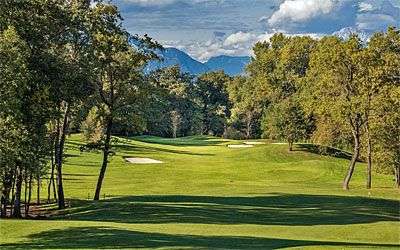
The small settlement of Fagagna sits between Udine and San Daniele del Friulu in the wooded foothills of the Carnic Alps and it’s an absolutely stunning location for the golf facility at Golf Club Udine which occupies a 180-acre property a mile north of the town centre.
Architect Marco Croze laid out the initial nine holes here in 1972 – one of several collaborative golf projects he completed with Commander John Harris around that time – and he returned twenty-two years later to add a second nine.
The course extends to 5,890 metres from the championship tees, configured with returning nines and, rather unusually, it features consecutive par fives at the 7th and 8th and back-to-back par threes at holes 11 and 12.
Notable holes include strong par fours at the right doglegged 6th and uphill 9th whilst, on the back nine, the par five 15th (rated stroke index 4) plays all of 489 metres downhill to a green that’s protected front left by a small pond.
Following a change of ownership in 2013, significant improvements were made to the course, resulting in it hosting the 2016 Italian Senior Open, the ninth time a European Senior Tour event had been played on Italian soil.
The latest ranking of the Top 100 Golf Courses in the World serves as the ultimate global golf bucket list. Most members of our World Top 100 Panel are seasoned golfers, each playing 20-30 of these courses annually while travelling extensively over decades to form their opinions on others. We recognise that opinions vary—even among our panel members. Rankings are subjective, and there are undoubtedly 50 or more courses in the UK and USA alone that could easily fit onto this list. Links Golf Pilgrimages The rankings
California, United States
New Jersey, United States
Northern Ireland, United Kingdom
New York, United States
New York, United States
Italy – Golf and More… We travel to the Friuli Venezia Giulia region of Italy to see what it can offer visiting golfers It’s six years until the 2022 Ryder Cup takes place, but awarding this prestigious golfing event to Rome’s Marco Simone Golf Club has triggered a flurry of promotional activity within Italy. In a concerted effort to show the world exactly what the country can offer visiting golfers, Italy Golf & More, was launched earlier this year and this enterprising project is a collaboration between eleven private sector partner regions, the Italian Golf Federation and the Ministry of Tourism, all of whom joined forces to publicise the nation as a forward-looking golf destination. Using the recent Italian Senior Open in Udine as the focal point for its latest promotion, the consortium commissioned The Azalea Group, the respected UK golf public relations and marketing company with an enviable list of international clients, to lead a small press pack of journalists on a tour of the autonomous Friuli Venezia Giulia region. Over the course of five days, the group was given the chance to spend some time in a couple of historic towns, sample a little of the excellent local cuisine, and squeeze in a few games of golf at a few of the best 18-hole courses in the district. Located in the northeast corner of Italy, where it borders Austria to the north and Slovenia to the east, Friuli Venezia Giulia occupies a diverse landscape of just under 8,000 square kilometres, stretching from the peaks of the Carnic and Julian Alps, through the foothills and plains of Friuli and the Karst, to the lagoons of Marano and Grado on the shoreline of the Adriatic Sea. It’s a district that can trace the origins of the Roman ruins at Aquileia back to 181 BC and it has seen Austrian, Slavic and Italian influences all vie for dominance at various times during the two millennia since then. The guarantee of a €7 million prize pot for the Italian Open for eleven years was a major financial inducement that helped win the Ryder Cup bid and another golfing commitment promised was the reintroduction of the Italian Senior Open to the European Senior Tour calendar. With businessman Gabriele Lualdi having invested heavily in the infrastructure at Golf Club Udine – including the construction of the Villaverde Hotel, spa and state-of-the-art medical centre next to the clubhouse – it seems only right to have the Senior Open revitalised here this year, rewarding a progressive club which has invested heavily in the future of golf in Italy. Originally laid out as a 9-hole design by John Harris and Marco Croze in 1972, the Udine course was later extended to a full 18-hole track by the same Italian architect. Following Mr Lualdi’s acquisition in 2013, the layout is undergoing a gradual renovation process, with holes upgraded in a rolling program by another designer, Fulvio Bani. Unfortunately, heavy rain led to the cancellation of the eagerly anticipated Senior Open pro-am, regrettably leading to a curtailment of journalistic participation in the event. Play in the tournament itself did get under way the following morning as scheduled, allowing the three-day event to proceed as planned, with Welshman Stephen Dodd eventually holding off a strong challenge from compatriot Phillip Price to win his first Senior title by one-shot in only his seventh Senior tournament. Sixty-three kilometres west of Golf Club Udine, Castel d’Aviano Golf Club lies between the charming little town of Pordenone and the Piancavallo ski centre. Set within a 55-hectare property inside the 16th-century Villa Policreti estate, the tree-lined fairways are laid out in two distinct 9-hole circuits, with holes 3 to 11 sitting in a separate, self-contained parcel of land. Water hazards come into play at three holes on the back nine, most notably at the 331-metre 17th, where a pond protects the front left side of the green. An hour’s drive northeast of Udine, via the A23 Alpe Adria highway, Golf Senza Confini Tarvisio is situated in the very top right hand extremity of the country as you look at a map of Italy. Originally designed by Giacomo Cabrini in 1992 then expanded a decade later by Graham Cooke, the course lies on the Priesnig plateau, some 750 metres above sea level, with the Austrian and Slovenian borders located less than 15 kilometers away. Mount Mangart looms in the background and Tarvisio Forest surrounds the course in what is simply a sensational location for playing golf. Although there wasn’t enough time in a packed itinerary to see either the d’Aviano or Tarvisio courses, an outing to Castello di Spessa more than made up for this. The 13th-century castle lies in the heart of the Collio Goriziano, one of the most prolific wine-producing regions in Italy, and this magnificent building has now been converted into a 15-bedroomed hotel. Ageing cellars beneath the castle house wine barrels on one level and bottles of red wine in a second, lower level which was once a military bunker built by the Italian army in 1939 and only rediscovered during restoration work. Its constant 14°C temperature is ideal for ageing both the Cru del Castello red wines and Grappa Riserva Conte Ludovico. Giacomo Cabrini designed the Castello di Spessa Golf & Country Club course that lies to the south west of the castle and the fairways are set out in an easy-walking, parkland setting. By far the most interesting sequence of holes during the round is played between the 4th and the 8th, which weave their way through vineyards that are sited on hillier ground. The 132-metre 5th, requiring a tee shot from an elevated position over rows of vines to a raised green on the other side of the vineyard, is easily the best hole on the card and one of the most unique par threes that you could ever imagine playing anywhere. After a sumptuous lunch in the Tavernetta al Castello, a gourmet restaurant and 10-bedroom hostelry converted from old farmers’ cottages, it was on to have a look around the border town of Gorizia. It’s here that Charles X of France died in 1836, when it was part of the Kingdom of Illyria, a crown land in the Austrian Empire. Gorizia Castle overlooks the old town, with Nova Gorica located on the other side of the border with Slovenia. This conurbation is sheltered by a mountain ridge to the north, protecting it from the cold Bora wind that affects other places in the locality, allowing residents to enjoy a year-round Mediterranean climate. Returning to Udine, the final night’s stay in the city was marked with dinner at Trattoria Ai Frati, a family-run restaurant serving regional specialties such as frico and polenta and tagliatelle with rabbit ragout and porcini mushrooms. Next morning, the exploration of the Friuli Venezia Giulia hinterland over, it was time to leave base camp at the comfortable Hotel Astoria in Udine and head for the coast, where Austro-Hungarian Emperors are reputed to have spent their summers in the spa town of Grado. The course is operated by the Tenura Primero resort and it was recently ranked in a golf magazine’s inaugural Top 100 Resorts in Continental Europe chart. Fairways are set out along the lagoon so there’s water in play at most of the holes, none more so than at the par five 11th, which plays to an island green. If you can finish a round here with the same ball you started with then you’re some player! After completing eighteen holes, another magnificent lunch ensued in nearby Ristorante Tarabusino before the group set off on the one-hour road journey to Trieste. In truth, after checking into the Gran Hotel Duchi D’Aosta there wasn’t really enough time before darkness fell to properly explore this wonderful city of around a quarter of a million inhabitants, apart from having a quick look around the narrow streets of the old city and taking a short walk around the Piazza Unita d’Italia. Sadly, the “Nice of the Adriatic” remains largely undiscovered by the group of journalists – though dinner at Roberto Marussi’s 50-year-old family Ristorante Al Bagatto will long be remembered – so a return visit may have to be taken some day to see more of the sights, perhaps as a disembarking passenger on a day trip from one of the large cruise liners that dock right in the heart of the city? Golf Club Trieste is the oldest golf club in the region, formed by members of the Allied forces that were based in the area after the end of World War II. The layout opened for play in 1955 and it extends today to 5,810 metres, playing to a par of 70. Laid out above the city at an altitude of 350 metres above sea level, the course affords golfers majestic views across the Gulf of Trieste to the Grado and Lignano lagoons. Feature holes include long par fours at the left doglegged 8th and the 17th, which is hampered by out of bounds down the left side. It’s a pity there was no opportunity to play the course on this occasion but that’s another good excuse for arranging a future trip to Trieste! The tour ended at Lignano Golf Club, situated between the Tagliamento River estuary and the Marano lagoon, where the Italian Ladies’ Open in 1993 and 1994 was hosted. The fairways of this course are routed around a gently undulating landscape close to the sandy beaches of the Adriatic shoreline. Four holes on the front nine (at 4 & 6 to 8) and three on the back nine (at 12 to 14) flirt with water hazards and there are a couple of large, sandy waste areas to negotiate at the 9th and the 15th. The best hole is also the most difficult: the 402-metre 13th, rated stroke index 1, requires a solid tee shot across an intimidating wetland area to reach the fairway before heading for the green. The 24-bedroomed Hotel Golf Inn Lignano is attached to the clubhouse at the golf club, presenting golfers with a range of tempting stay and play options, based on their choice of accommodation. Guests can also relax in the well-appointed, modern wellness facility, making use of the sauna, steam room, Turkish baths and tepidarium. With such a top-class leisure facility on the doorstep of the golf club, there’s really no good excuse for not indulging in a little golf-related pampering after a round at Lignano. Before returning to Venice for the flight back to the UK, the press trip was rounded off with a final lunch in the countryside near Gorgo di Latisana at the lovely little unassuming Ristorante Da Boschet, which specialises in seafood dishes. It was a wonderful way to round off a truly memorable excursion, eating local wild-caught fish and drinking some of the best wines produced in the area. In many ways, the last day encapsulated everything the Friuli Venezia Giulia region is capable of offering golfers – good golf and wellbeing for body and soul, the discovery of countryside secrets and cuisine of the highest order. This particular part of Italy might not be high on your list of potential golfing destinations – but it should be. Jim McCann Editor Top 100 Golf Courses

Top 50 Golf Courses of Italy 2018 Golf arrived in Italy via British golfers who founded Florence Golf Club in 1889 (though Nisbet’s Golf Year Book 1912 lists the year of its formation as 1899) and the pioneering club would go on to host the first Italian Amateur Championship in 1905, by which time other golf clubs had been established in Varese (1898), Rome (1903) and Lake Como (1905). Nowadays, more than two thirds of the 241 courses operating around the country are located in the eight regions that comprise Northern Italy. That might seem like a very healthy number of golf facilities nationally but, per head of population, Italy lags way behind the likes of Belgium and Portugal in its golf provision, even though, in fairness, both those nations have far fewer courses. Perhaps appointing Marco Simone Golf and Country Club as the venue for the Ryder Cup in 2022 will see an uplift in the numbers of Italians participating in golf. Currently, there are around 90,000 players registered with Federazione Italiana Golf – 23% of these are adult females and 10% are juniors – and hosting such a prestigious event will surely draw more people into the game. And so to the latest edition of our Top 50 for Italy, where the 18-hole layout at Circolo Golf Villa d’Este leaps three places into the number 1 position. Located in the tree-clad hillside above Lake Montorfano, the course is a Peter Gannon design dating back to 1926 that has hosted a dozen Italian Opens down the years, the most recent of which took place in 1972. It may be too short for the modern day professionals but Villa d’Este is still a timeless classic, as intimated by a recent reviewer who wrote: “from the moment you enter through the gate, you can see this is all high quality… with great views of the surrounding mountains… the clubhouse is nice (with) a lot of class… all in all a great experience and it comes with great Italian flair.” The most impressive upward move by our sixteen chart climbers is made by the oldest surviving golf course in Italy, belonging to Circolo del Golf Roma Acquasanta, which rises seven places to number 5 (it also debuted in our Continental Europe Top 100 at number 90 recently). Founded by diplomats from the British Embassy in 1903, the club started out with a 9-hole course but this was doubled in size to an 18-hole layout a decade later. It’s not known who actually designed the course but its routing indicates it was somebody of repute who was able to set out the outward half in an anticlockwise direction around the clockwise-orientated back nine – surely there must be some mention of an architect in the old club minutes (which were drafted in English up until 1930 when Alfedo di Carpegna became president) or perhaps it was laid out by members who knew what they were doing? Whatever the case may be, golf is played here in a very special atmosphere, where the tree-lined rolling parkland fairways are split by the wandering waters of the Almone River with the rather unique backdrop of the Via Appia Antica and the Claudius aqueduct ruins. The course will never again host an Italian Open (the last one was held here in 1980) as it can only be extended to just over 6000 metres, which is too short for the professionals, but that’s more the loss of the European Tour. Credit the club for preserving this Golden Age track as it must be tempting to have a high profile architect come in to renovate the layout – it’s fine just as it is, thank-you. Other courses making significant progress within the top half of the new table include both Kyle Phillips-designed 18-hole layouts at the Verdura Resort on the southwest coast of Sicily (the East course is up one place to number 8 and the West course rises three spots to number 11), the Rosso and Bianco nines at the 27-hole Gardagolf Country Club complex, set in 275 acres overlooking Lake Garda (up five to number 17), and the course at Argentario Golf Resort & Spa on the Monte Argentario promontory in Tuscany (up four to number 25), which was one of the first in Italy to be awarded an “Agricert” for its eco-compatible credentials when it was built in 2006. The only new entry in our updated Italian standings appears at number 21 and it’s the 18-hole Mountain course at Toscana Resort Castelfalfi, which Rainer Preissmann and Wilfried Moroder remodelled in 2011 when they redesigned ten holes from the previous course (designed by Pier Luigi Mancinelli in the early 1990s) and added eight new holes. They also brought the 9-hole Lakes course into play at an upmarket 27-hole resort which lies in the heart of Tuscany, a 90-minute drive southwest of Florence city centre. Castelfalfi has flown very low under our radar over the last few years but, now that it’s been brought to our attention, expect to hear more about it in the months that lie ahead. Rank/ To view further details of our newly updated Italian Top 50 rankings click the link. We’re always happy to hear what you think of our re-ranked national listings in Europe so please make use of the “respond to this article” link at the top or at the bottom of this page if you’d like to share your opinion of our newly revised Top 50 for Italy. Jim McCann Editor Top 100 Golf Courses

The course at Castiglion del Bosco is situated within the UNESCO world heritage site of Val d’Orcia in the Brunello di Montalcino winemaking region of Tuscany. Businessman Massimo Ferragamo acquired the 2,000-acre estate in 2003 then set about restoring the architectural and winemaking aspects of a property which includes castle ruins, a medieval church and historic village buildings. Old farmhouses and various premises were transformed into guest villas and suites and a new cellar was constructed to handle the revitalisation of the wine production. In 2011, Tom Weiskopf was engaged to design an 18-hole golf course close to the accommodation, with old farm buildings converted into a clubhouse. Golfers now travelling to Italy, where The Ryder Cup will be played next month, are being invited to a new, exclusive Tuscany golf experience at Rosewood Castiglion del Bosco, voted Travel+Leisure’s No. 1 Hotel in the World 2022. The five-star luxury hilltop resort offers 42 sophisticated suites and 11 luxury farmhouse villas, each of which features antique furnishings and local textiles. Castiglion del Bosco is also one of the world’s most beautiful wine estates, and membership of The Club brings exclusive privileges and access to the winery, including the option of a personal locker in the Members’ Private Wine Cellar. The organic-certified vineyards occupy 62 hectares, planted solely with the Sangiovese red wine grape variety responsible for the estate’s prestigious Brunello di Montalcino wines. In 2022, the Ferragamo family sold the estate to “an important international family office” with Rosewood retained to manage the luxury hotel. A year later, it was announced that Phil Smith (who worked on the original design with Tom Weiskopf) would oversee a major renovation project to install new drainage, reconstruct bunkers, upgrade irrigation, replace cart paths and build a new practice facility. The resort’s Tuscany Golf Experience special promotion includes a stay at Rosewood Castiglion del Bosco for two guests in a Suite; daily breakfast for two persons; two 18-hole rounds per stay (advanced reserved tee times 8-10am only, subject to availability); golf cart; rental equipment; practice range; dinner at Restaurant Campo del Drago (Michelin Star) or Osteria La Canonica. Click on this Castiglion del Bosco link to read our review of the golf course. As is often the case when we travel to a particular destination, we also like to have a look around the local region to see what other golf facilities are available to visitors. With that in mind, we dropped in to see another four courses located close to the city of Florence. Ugolino Ugolino is the oldest golf club in Italy, dating back to 1889, but the club moved in 1934 to a new site in the Chianti hills, half an hour’s drive south of Florence city centre. Designed by Peter Gannon and Cecil Blandford, the course is short, hilly and mostly tree lined, with fairways often plunging down from elevated tee positions then climbing up to small greens. The 40th edition of the Italian Open was played here in 1983, when Bernhard Langer beat Ken Brown and Seve Ballesteros in a playoff. Today, it offers an intimate golf experience – one to be savoured by golfers who don’t just want to blast away mindlessly off the tee – with holes draped across beautifully rolling terrain. Le Pavoniere An hour away from Ugolino, on the other side of Florence, is where you’ll find Le Pavoniere Golf & Country Club, located just outside the city of Prato. The landscape’s rather flat in this part of the region so a fair amount of soil was shifted to fashion the fairways, creating several interconnected lakes which add both strategic and aesthetic interest. The Arnold Palmer Design Company laid out the course in the mid-1980s, with water coming into play at half the holes on the scorecard. It’s definitely lush parkland golf that’s on offer here with wide, gently undulating playing corridors (separated by a variety of different types of maturing trees) which lead to large, sensibly contoured greens. Poggio dei Medici In the hills fifty kilometres northeast of Le Pavoniere lies the course at Poggio dei Medici, close to where the Mugello Circuit is used for car and motorbike racing. The course first opened for play thirty years ago, designed by Alvise Rossi Fioravanti and Baldovino Dassu, and it hosted five consecutive editions of the Ladies Italian Open, starting in 1999. It’s evident there’s been a lack of investment in the infrastructure and/or manpower for a while now but Marco Maiani, the Director of Golf, is confident the new owners who have recently taken over the property will be able to build on the bones of a well-constructed layout to revive the fortunes of this sleeping giant. Castelfalfi To the southwest of Florence, halfway towards the coastal town of Livorno, sits the 27-hole golf facility at Castelfalfi Golf Club. The original course was inaugurated in 1991 but after substantial remodelling by Wilfried Moroder and Rainer Pressman a decade ago, the 9-hole Lake and 18-hole Mountain courses emerged, with a new clubhouse positioned at the centre of the two new layouts. The Lake course is a tough track but the Mountain course is even more difficult, with a slope rating of 151 from the back tees. Don’t expect to play resort golf here as this is a real serious test of golf with holes winding through valleys, along ridges and plummeting down to heavily water-protected greens – be prepared to be severely challenged if you ever tee it up at Castelfalfi! Jim McCann Editor Top 100 Golf Courses


