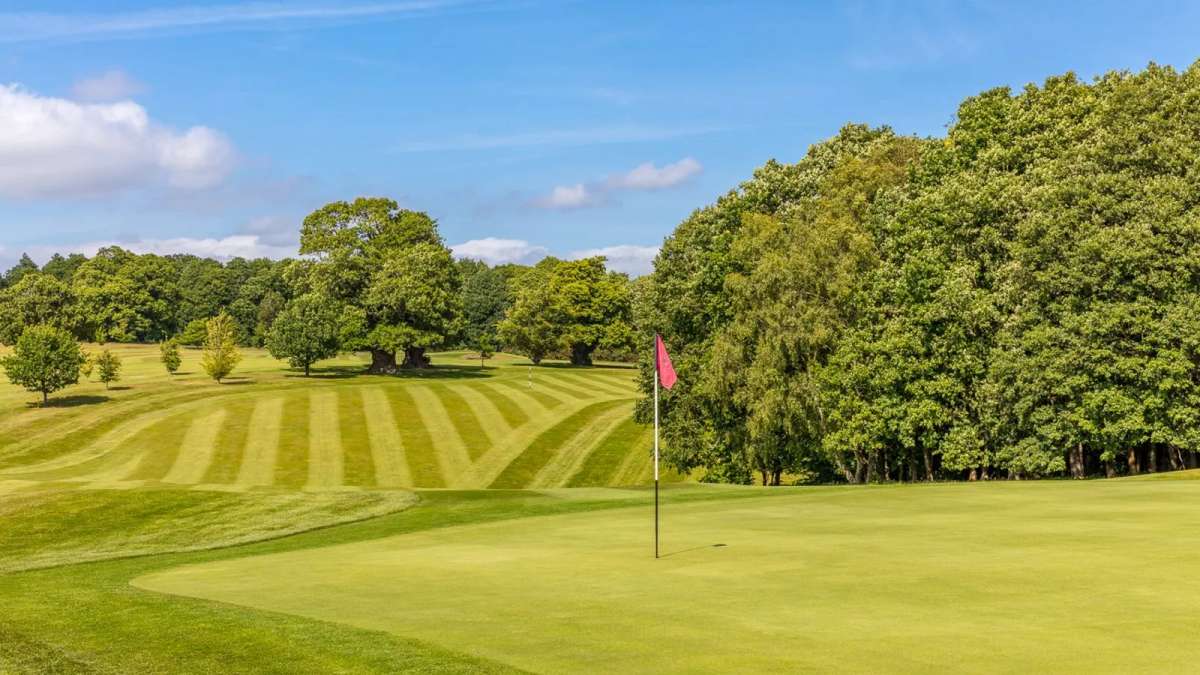
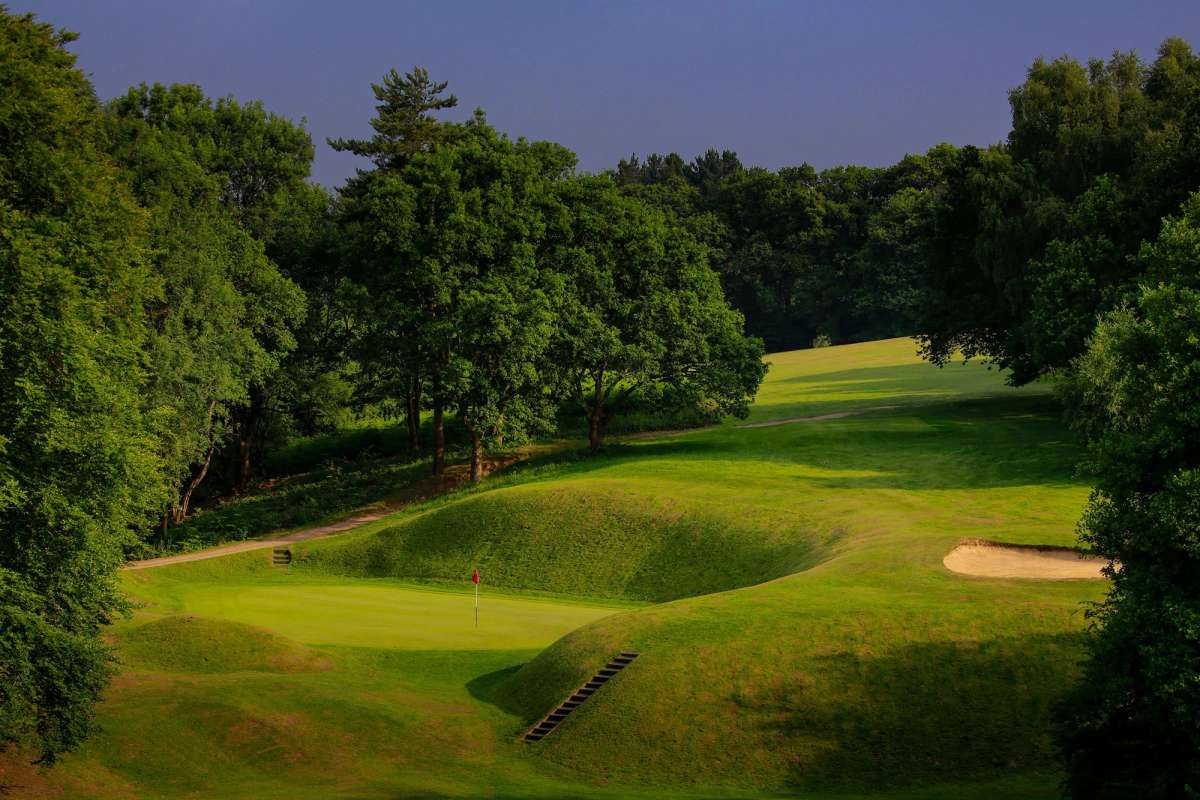
West Sussex Golf Club is one of our favourite inland courses. It is sheer delight to play golf on this charming sandy outcrop of heathland.


West Sussex Golf Club
West Sussex Golf Club is one of our favourite inland courses. It is sheer delight to play golf on this charming sandy outcrop of heathland.

6
You don't get many chances to play this course, so this was such a treat.
The weather had been dry for a long time. The course looked amazing, with a combination of green greens, straw-coloured fairways and large trees. The tees were lovely, the fairways were firm and dry, there was not much semi-rough. The rough wasn't deep as the trees or heather created the challenges. The greens were rolling well but would accept spin from a well struck shot.
You begin with the only par five on the course, so maybe a chance for a birdie start, provided you avoid the bunkers. The next three holes are par fours of varying length but all requiring straight tee shots. The 5th is a 150 yard par three with a large green. The 6th is a feature hole - a "dog leg par three"? The carry is 180 yards over an OOB water hazard or play right and chip onto the green. The 9th is a simple looking hole where you fancy a birdie putt however you need to avoid all the trouble to be able to play a shot to the green.
The back nine uses slopes on fairways a bit more, so on a dry day you could be almost aiming at the heather to hold the ball on the fairway. The 16th is a blind tee shot of trouble and then a shot to a raised green with a false front. The last two holes are stern par fours and as they go opposite directions there is a likelihood one of them will be into the wind.


Eddie Maylor
Round Information
Date Played
July 14, 2026
Standout Holes
#16, #6, #8
Rating Breakdown
Strategy
Green Complexes
Variety
Facilities & Amenities
Top 20 Golf Courses in Sussex 2015 Sussex Best in County rankings updated The historic county of Sussex is said to have its origins in the Kingdom of Sussex, where Ælle was the first king of the South Saxons in the late 5th century. Of course, the Romans flooded into Britain through this region 500 years before then and the Norman conquest of England began with the Battle of Hastings 500 years later in 1066 so the county has seen more than its fair share of trouble and strife over the course of the last two millennia. Nowadays, visitors to Sussex can still connect to the past through sightseeing trips to the 11th century Arundel Castle, 14th century Bodian Castle or Brighton’s 18th century Royal Pavilion but for sports-minded people who prefer to deal in the present, there are plenty of places to take in top class sporting action such as the horse racing at Goodwood, Fontwell Park and Plumpton or county cricket at Arundel, Horsham and Hove. For golfers who wish to play, rather than watch their chosen sport, there are more than sixty golf clubs spread around Sussex and we maintain Top 20 Best in County listings for these courses. We’ve just completed a period of consultation with golfing contacts in the region and have now revised our local county rankings, presenting the results below for your examination. The top three positions remain exactly as they were following our last update two years ago so the number 1 course in the county is still West Sussex, which Sir Guy Campbell and Major C.K. Hutchison laid out in 1930. Nothing much has changed with the layout of this heathland track in eighty-five years and the golfing world in general should be eternally grateful for that. Rye (Old) is at number 2 and, like West Sussex, it also sits comfortably within our Top 100 chart for Great Britain & Ireland. The first course designed by Harry Colt in 1894 when he was still a solicitor and only 25 years of age, it’s been described by a recent reviewer as “a knowingly understated, pure and simple golf club that presents you with a stiff challenge hole after hole”. The number 3 course in Sussex is the Old course at Royal Ashdown Forest, where the club achieved its royal prefix from Queen Victoria in 1893, five years after its formation. The fairways here are set out on rather hilly heathland terrain, with not a bunker in sight at any of the eighteen holes. It’s younger sibling, the West course, is a highly regarded companion at a wonderful 36-hole facility. Rising one place to number 4, Crowborough Beacon is an Alister MacKenzie re-design which is in much the same mould as Royal Ashdown Forest, its near neighbour. With springy heathland cum moorland fairways laid out across the southern slopes of the East Sussex High Weald, the course plays host to the Men’s Senior Home Internationals later this week. The two 18-hole layouts at East Sussex National also make positive upward moves. The West course climbs one place to number 6 and the East course nudges up two spots to number 7. Both tracks were designed by American Bob Cupp and constructed completely with bent grass, first opening for play in 1990. A full day at this 36-hole complex is recommended but visitors should expect a serious golfing examination when teeing it up here. The only other significant advance up the standings is made by Cooden Beach, which soars seven places to number 11. Located in Bexhill on Sea, this Herbert Fowler course dates back to 1912, when the master designer fashioned the layout with five par threes and five par fives. Two courses enter the Top 20 chart for the first time: Seaford debuts at number 10 and this club moved to its present site in 1907, twenty years after its formation, when J.H. Taylor set out a new course for the members. Cowdray Park also makes its first appearance at number 17 and this layout is set within the massive 16,500-acre Cowdray Estate in Midhurst, where golf has been played since 1904. We’re grateful to everybody in the county who helped with our re-ranking process for Sussex. To view details of all the courses in our Sussex Top 20 rankings click the link. If you have extensive experience of playing across the south region of England and would like to contribute to our next re-ranking exercise then please email Editor-in-Chief Keith Baxter at keith@top100golfcourses.com. Jim McCann Editor Top 100 Golf Courses

Top 100 Golf Courses of Britain & Ireland 2018 Having produced updated ranking lists for England, Northern Ireland, Republic of Ireland, Scotland and Wales over the last couple of months, we’ve now gone through the process of merging those national charts then siphoning off the top one hundred courses to create an all-embracing Top 100 table for the geographical location which is commonly known as the British Isles. Several UK-based members of the Top 100 Team have each played more than 75% of the new GB&I standings but spare a thought for our Midlands and North of England correspondent Brian Ward, who thought he’d recently completed the hundred, only to now discover there’s a Scottish new entry in this edition that he’s not yet played! For those interested in statistics, the chart contains 45 English courses, 30 Scottish courses, 18 from the Republic of Ireland, 4 from Wales and 3 from Northern Ireland. Overall, 39 courses move up, 34 go down, there are 23 non movers and 4 new entries. The four courses dropping out (Lough Erne, Druids Glen, Moortown and Sherwood Forest) join 34 others which have appeared in at least one of the seven previous editions before falling out of favour. At the top of the chart, the Championship course at Royal County Down in Northern Ireland retains the number 1 position, holding off four very strong Scottish contenders in positions 2 to 5. It’s been at the top of our chart since 2006 and, quite frankly, something really extraordinary will have to happen to see the course dislodged from the top spot. A reviewer described it like this earlier in the year: “the course once again never ceases to amaze me… RCD is a wonderful golf course not to be missed by those who truly love golf and the magical places and topography upon which it is played.” There’s not much movement within the Top 20. The “re-born” Ailsa at Trump Turnberry (# 5) swaps places with the Dunluce at Royal Portrush (# 6) – both of these Open venues have just undergone extensive renovations by Martin Ebert – and the New course at Sunningdale (#14) and West course at North Berwick (#15) each advance one position at the expense of the Championship course at Portmarnock (#16). Royal Lytham & St Annes (#18) and the Balgownie at Royal Aberdeen (#19) also switch positions. Two English courses make it into the Top 30 for the first time. The James Braid-designed Church course at St Enodoc in Cornwall climbs a creditable nine places to number 28 and the Sir Guy Campbell and Major C K Hutchison co-designed layout at West Sussex in Pulborough leaps up eleven spots to number 30. Don’t be at all surprised if these two 18-hole tracks also make a first appearance in our World Top 100 when it’s published next month. Opened in 2002 and recently remodelled by Martin Hawtree, the Trump International Golf Links at Doonbeg soars an incredible thirty five places to number 41 in our revised Top 100, which is actually the same position it held in the 2006 edition of our GB& I chart. Our correspondent Fergal O’Leary visited the course a couple of months ago and he had nothing but praise for what he found: “I wholeheartedly encourage everybody to visit Trump Doonbeg… the playing conditions, the fun and the beauty are all a sight to behold. Doonbeg is once again ready for the world to arrive.” A decade ago, the West course at Wentworth occupied a position just outside the Top 20 in these rankings but it took a mighty tumble when we last reappraised the chart two years ago, falling out of the Top 50. After publishing an article back in March entitled The rise and fall of the troubled Burma Road, we think a climb of eight positions in the new chart to number 46 indicates the latest round of renovation work (involving the costly installation of a sub-air system on new bent grass greens) has gone some way toward rekindling affections for this much maligned Harry Colt track. Also making an impressive leap in the listings (up fourteen to 50), the course at The Island in Donabate, near Dublin, has benefitted from a raft of course improvements in the last few years. Under the direction of course superintendent David Edmonston, the club has returned native links grasses to the playing surfaces, improved its rough management and removed unsightly areas of seabuckthorn to open out vistas over the Malahide estuary. Architect Martin Ebert has also advised on the redesign of a number of fairway bunkers, using a technique called “marram slabbing”. In the lower half of the new Top 100, the following five courses make substantial positive moves. Renaissance Club, where the Senior Scottish Open was held this year on the European Senior Tour, rises twelve places to number 55. This Tom Doak design entered the GB&I chart in 2014 at number 84 then advanced to number 67 in 2016 so it’s following a clear path of upward progression. The club doesn’t exactly seek out casual golfers but it does offer a “One Time Experience” which many consider worth the hefty green fee in order to sample the playing privileges for a day at this private members’ club. Many were concerned when The Machrie closed for extensive remodelling a while back. Essentially, those who had previously played this old Willie Campbell layout on the Isle of Islay were probably thinking this late 19th century layout would lose much of its old-fashioned charm with a modern makeover. Well, we visited just three months ago and were mightily relieved to discover that architect DJ Russell has not just replaced what was there before, he’s vastly improved the links layout with a sympathetic new routing, completely revitalising the old course. Once the new hotel is finished next year, Machrie (up seventeen to number 56) should become a really formidable 21st century links golf destination. Broadstone in Dorset progresses thirteen positions to number 73. First set out by Tom Dunn in 1898, the course has been modified at various times by the likes of Willie Park Jnr, Herbert Fowler and Harry Colt so there’s never been any doubt about its architectural integrity. Ed Battye, a regular Top 100 reviewer and founder of the Golf Empire website, had this to say about the course six months ago: “Broadstone is a wonderful golf course on a truly amazing property in an area of the country that is quickly establishing itself as a region for top class golf. Traversing some superb golfing terrain it is an idyllic place to play golf with a spaciousness that few other courses can boast.” The Queen's course at Gleneagles rockets a sensational 24 places up to number 74. We invited four Scottish members from the ranking panel of a leading golf magazine to assist with our biennial chart revision north of the border this year and it was largely their collective opinion that made us realise we’ve been undervaluing this lovely old track for some time now. As a recent reviewer said: “it’s possible, and most likely probably, that the Queen’s at Gleneagles is the best golf course under 6,000 yards. Not just in Scotland, but anywhere” – and we’re not going to argue against that assertion. The Strand course at Portstewart makes an impressive 17-place upward move to number 76. Numerous course improvements were implemented ahead of the 2017 Irish Open, won by Jon Rahm. New tees have been added and one of the most dramatic is on the 8th hole (“Portnahapple”), which is set on the highest point of the course, from where you can see the adjacent Riverside course and the flowing waters of the River Bann. The club has also installed its own “Big Nellie” bunker on the short par five 14th (“The Hill”), where the tee has been offset to create a sweeping dogleg and an extra 30 yards of length. The back nine cannot compete with the drama of the stellar front nine, but these changes have markedly improved this impressive links course. There are four new entries in our Britain and Ireland Top 100. The first of these is Portmarnock Hotel & Golf Links (new at number 90), located less than half an hour’s drive to the north of Dublin City centre on the ancestral family estate of the Jameson whiskey family. A mid-1990s co-design from Bernhard Langer and Stan Eby, the course and attached hotel were acquired by new owners in 2014 and a significant level of investment has been made to upgrade the visitor experience both on and off the course here. Links Superintendent Fintan Brennan has overseen the revetting of bunkers, the introduction of turf paths, the implementation of a rough management programme and the return of putting surfaces to fescue dominated grasses. Two places behind, at number 92, the Old course at Moray in Lossiemouth makes its debut in the GB&I hundred. The Moray Firth area is fast becoming something of a golfing hotspot, what with the championship courses at Royal Dornoch, Castle Stuart and The Nairn all within easy reach of Inverness airport. The 36-hole golf club at Moray lies just a little further away from this triumvirate, between the RAF Lossiemouth base and the Covesea Skerries Lighthouse, so it’s often overlooked by visiting golfers, which is a big mistake. Truth be told, the unpretentious Old and New courses at Moray offer as good a day’s play out on the links as you might find anywhere in Scotland. New at number 99, the course at West Lancashire dates back to 1873, when the club was founded. A number of prominent architects have made revisions to the layout over the last 144 years, including Ken Cotton and Fred Hawtree in the early 1960s, but it’s the club’s recent appointment of Course Manager Stuart Hogg that has elevated the layout to its new found position among the elite of Britain and Ireland. Stuart’s a firm advocate of the firm and fast game and his staff have carried out lots of little projects around the course to emphasise its link credentials, from reintroducing natural swales around greensites to refurbishing many of the revetted bunkers. The final new entry arrives at number 100 and it’s Liphook, which is currently the number 1 course in Hampshire and the number 45 in England. Strictly speaking, it’s actually a re-entry into these rankings as it featured in our inaugural chart back in 2004 at #96 before making another brief appearance at #94 in 2010. First opened for play as an 18-hole layout in 1923, the course was designed by Arthur Croome, a partner in the architectural firm of Fowler, Abercromby, Simpson and Croome. It’s a charming heathland layout that’s much appreciated by golfing connoisseurs who don’t mind travelling the extra mile to savour the delights of such a delightful, understated course. We welcome feedback when we produce new rankings so please feel free to share your opinion of our new Top 100 for Britain & Ireland. Is there a top track that we’ve overlooked or is there a layout included that really has no business being there? Maybe a certain course is resting on its laurels or there’s one that should be higher in the standings? Whatever your view, click the “Respond to this article” link at the bottom of the page to let us know what you’re thinking. Rank/ To view the complete detailed list of the 2018 Britain & Ireland Top 100 click the link. Jim McCann Editor Top 100 Golf Courses

A good halfway house can turn a great round of golf into a memorable one. It might be a cold beer on a Scottish links, a burger with a spectacular view or a hot drink to warm you up before the back nine. Whatever is on offer, the best halfway houses give golfers a chance to forget about the scorecard for a few minutes and enjoy the experience. We recently asked the Top100 Golf Courses community to share their favourite halfway houses, uncovering plenty of memorable stops around the world. We've picked five of their recommendations, alongside five more renowned halfway houses that are well worth knowing about. What is a Halfway House? A halfway house is a food and drink stop positioned around the turn of a golf course, usually between the ninth and 10th holes. Some are little more than a hut serving snacks and drinks, while others have become destinations in their own right, offering everything from full meals and cocktails to fires, views and plenty of local character. Five Halfway Houses Chosen by the Top100 Community Sunningdale Golf Club (England) There is a reason the halfway hut at Sunningdale has become one of the most famous refreshment stops in golf. The small Swiss-chalet-style building has been in place since 1903, sitting where the ninth holes of both the Old and New Courses meet their respective 10th holes. But the building itself isn't the main attraction. That would be the sausage sandwich. Sunningdale's legendary hut serves a simple sausage on buttered bread, with other food and refreshments available alongside it. The hut has become such an established part of the experience that the club's own tradition says everybody stops, but does so speedily. It's not fancy, and that's rather the point. After nine holes of heather-lined fairways, a hot sausage sandwich and a cup of tea can feel like exactly what golf ordered. Nairn Golf Club - The Bothy at Nairn (Scotland) The Bothy at Nairn has a history that goes well beyond golf. Built in 1877, the stone building and neighbouring icehouse formed part of the Easter Delnies Fishing Station, one of five salmon fisheries operating along the coast between Nairn and the mouth of the Findhorn. In a good season, the fishery could catch up to 5,000 salmon, with ice collected from local rivers and a specially made pond and stored in the icehouse to keep the catch fresh. The buildings have since been given a new lease of life, with the Bothy converted into a halfway house where golfers can stop for snacks and refreshments at the turn. On a cold day beside the Moray Firth, there's also a fireplace to warm up beside. The historic stone building, Highland setting and views across the course provide plenty of atmosphere. One of our community members put it rather simply: a dram of whisky and a fire are hard to beat. Hard to argue with that. Turnberry Ailsa (Scotland) Turnberry's halfway house is about as far removed from the traditional golf hut as you can get. The Ailsa's ninth hole now finishes beside the famous Turnberry Lighthouse, which doubles as a halfway house for golfers. The lighthouse itself dates back to 1873, while the golf course's dramatic ninth was redesigned as part of the Ailsa's major renovation. Inside, golfers can stop for food and drink before heading to the 10th, but the real attraction is outside. From the lighthouse, there are views across the Firth of Clyde towards the Isle of Arran and Ailsa Craig. It's a halfway stop that feels more like a destination than a quick pit stop. When your halfway house is a historic lighthouse overlooking one of Scotland's most spectacular stretches of coastline, you've got a pretty good excuse to take your time. Ardglass Golf Club (Northern Ireland) At Ardglass, the halfway-house experience is wonderfully straightforward: have a Guinness and enjoy the view. The course's old cottage halfway house at the back of the 7th green has become one of its most memorable features, with golfers able to stop for a pint before continuing their round. A recent visitor described it as a gorgeous cottage with Guinness, while another praised the combination of a Guinness, sausage roll and views over the Irish Sea. It fits Ardglass perfectly. The County Down links is already one of the most dramatic places to play golf in Northern Ireland, with the Irish Sea never far away. Add a pint of Guinness just before the turn and you've got a halfway house that feels distinctly of its surroundings. Sometimes you don't need to reinvent the wheel. Blair Atholl Golf Estate (South Africa) Blair Atholl might have been one of the less obvious names to appear among the community recommendations, but the descriptions made it impossible to leave out. The halfway stop sounds less like a quick break and more like an event. One golfer highlighted the chicken burger, a chef cooking a barbecue beneath the trees and a deck sitting beneath a stream. Another mentioned silver-service high tea. That's quite the halfway-house menu. It's also a good example of why the best stops aren't necessarily the most famous. A halfway house can become memorable because of the food, the setting or simply the feeling that you're being looked after rather than rushed back onto the course. Five More Renowned Halfway Houses St Andrews Links - The Old Course (Scotland) If we're talking about halfway houses, it makes sense to visit the place that has a claim to starting the tradition. In the 19th century, David "Old Da" Anderson sold ginger beer and other refreshments from a cart on the Old Course at St Andrews. It has been described as golf's first refreshment stand. The modern version sits behind the ninth green and keeps the tradition going, albeit with a rather more substantial menu. The pork and haggis sausage roll is a popular choice, while the club's own Tom Morris 1821 Lager provides a suitably Scottish accompaniment. It's difficult to think of a more fitting place for a halfway stop. The Old Course is steeped in golfing history, and even the break between nines has a story of its own. Pine Valley Golf Club (New Jersey, United States) Pine Valley's halfway house is memorable before you've even ordered anything. Rather than a conventional hut, it is built into the base of an old water tower, which golfers encounter around the eighth hole and again near the 12th tee. It's an appropriately unusual feature for one of the world's most unconventional golf courses. The tower doubles as a stop for drinks and snacks, giving golfers a chance to take a breather before continuing around Pine Valley. It even boasts an impressive collection of golf balls from around the world. There aren't many halfway houses that can claim to be built inside a water tower. Quivira Golf Club (Baja California Sur, Mexico) Quivira has taken the halfway-house concept and spread it across the entire round. The Jack Nicklaus-designed course has multiple all-inclusive comfort stations, each offering golfers food and drinks as they make their way around the Cabo San Lucas layout. The most spectacular is The Cliffs, perched almost 300 feet above the Pacific, where golfers can stop for a breakfast burrito and take in the views over the ocean. Then there's The Oasis, the main halfway house near the ninth green. Here, the emphasis is on the food, with freshly prepared Baja cuisine including tacos and tostadas, alongside a full tequila bar. A final stop, Cañada, sits near the 16th tee, while another comfort station beside the oceanfront practice facility offers snacks and cold drinks before golfers even reach the first tee. The food and refreshments are included in the green fee, making Quivira's comfort stations much more than somewhere to grab a quick drink. Tacos, tequila and spectacular Pacific Ocean views make the breaks almost as memorable as the golf. Whistling Rock Country Club (South Korea) At Whistling Rock, there isn't just one halfway house to look forward to. The South Korean club is made up of three nine-hole loops, each with its own themed tea house: Cocoon, Temple and Cloud. The three buildings are each distinctly different. One is a rounded structure between a lake and forest, another is a formal wood-and-glass building, while the Cloud tea house sits high among the trees. The result is a halfway-house experience that feels distinctly different depending on which nine you're playing, with each tea house adding another layer to the Whistling Rock experience. Royal Dornoch Golf Club (Scotland) Royal Dornoch's halfway house is proof that sometimes the best idea is a simple one. The stop sits behind the ninth green of the Championship Course, with views back across the links towards the Dornoch Firth. And then there's the traditional order: hot chocolate with Bailey's Irish Cream, a combination that makes considerably more sense when you're standing on a Scottish links in a North Sea wind. It's a small detail, but one that has become part of the Royal Dornoch experience and exactly the sort of halfway-house tradition golfers remember.
The latest ranking of the Top 100 Golf Courses in the World serves as the ultimate global golf bucket list. Most members of our World Top 100 Panel are seasoned golfers, each playing 20-30 of these courses annually while travelling extensively over decades to form their opinions on others. We recognise that opinions vary—even among our panel members. Rankings are subjective, and there are undoubtedly 50 or more courses in the UK and USA alone that could easily fit onto this list. Links Golf Pilgrimages The rankings
California, United States
New Jersey, United States
Northern Ireland, United Kingdom
New York, United States
New York, United States