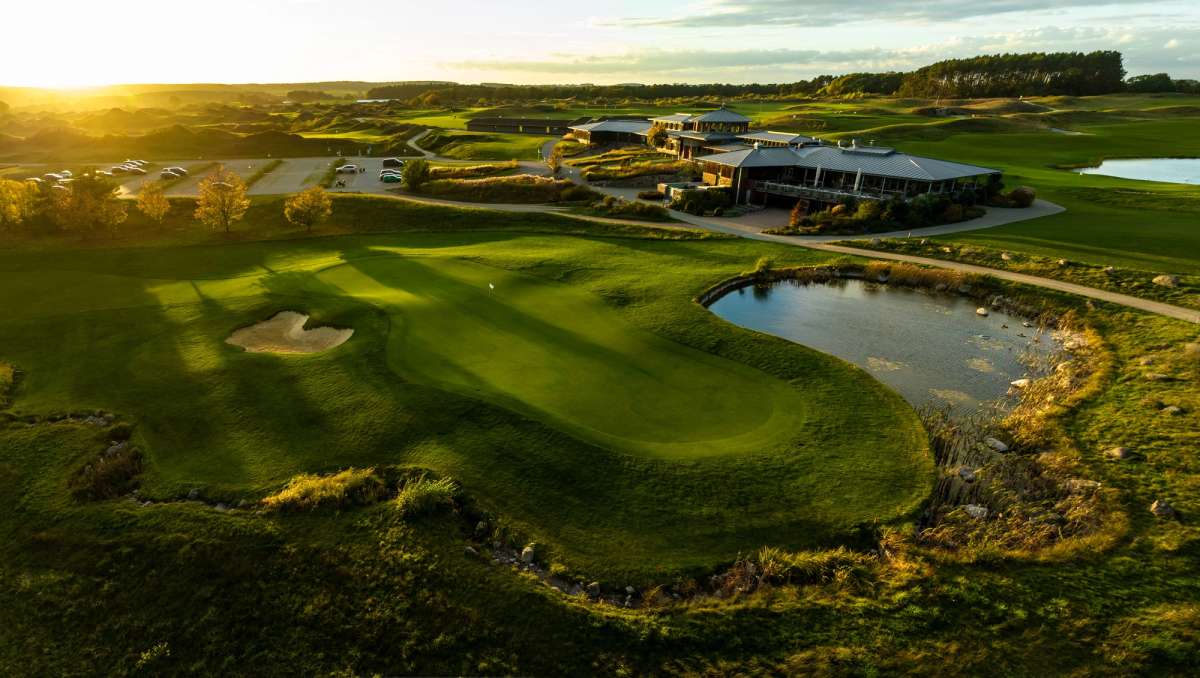
The Canadian architect David Krause certainly moved the earth to create the Winston Links course, which is set in a sandy landscape, and is described as an inland links.


The Canadian architect David Krause certainly moved the earth to create the Winston Links course, which is set in a sandy landscape, and is described as an inland links.

5
Good and beautiful inland links course which offered a good challenge from the back tee and almost all greens had tough run-off areas punishing poor and too aggressive approaches, while par 5 holes provided good risk and reward opportunities with good drive. 7th hole, quite long par 3 was exciting playing uphill into a front-right pin position, penalizing a short and right approach (latter which happened to me) and ending up with a very tricky uphill chip from the run-off area to a pin which did not allow hitting the ball beyond the flag or left or leaving it short. The 8th hole followed with a blind drive (from back-tee) over a mound, and while the fairway was quite generous, the drive was very intimidating.
Par 5, 5th, 12th and 17th holes provided good opportunity to attack the green with a good drive, while the 6th hole stretching 530m required a more strategic playbook. While the par 5 holes were modest in length, par 3 5th, 7th, and 11th all played 175m-190m. Good driving is required from the tee, while driver is not necessary but good drives provide for easier approach into the greens and bad drives missing the fairways are punished, as is poor approach shots which tend to find run-off areas leaving tricky chips from below the surface level.
In addition to the very good golf course, the clubhouse provides good facilities, locker rooms, and restaurant, as well as a good range, putting greens and chipping and approach areas.
Daniel Partia
Round Information
Date Played
July 17, 2026
Standout Holes
#7, #8, #16
Rating Breakdown
Strategy
Green Complexes
Variety
Facilities & Amenities
The latest ranking of the Top 100 Golf Courses in the World serves as the ultimate global golf bucket list. Most members of our World Top 100 Panel are seasoned golfers, each playing 20-30 of these courses annually while travelling extensively over decades to form their opinions on others. We recognise that opinions vary—even among our panel members. Rankings are subjective, and there are undoubtedly 50 or more courses in the UK and USA alone that could easily fit onto this list. Links Golf Pilgrimages The rankings
California, United States
New Jersey, United States
Northern Ireland, United Kingdom
New York, United States
New York, United States

Top 100 Golf Courses doubles up in Germany It has been a quiet year for German golf. Another Ryder Cup aspirant surfaced (little-heralded Gut Wissmanshof), which hardly qualifies as news, considering the fuddy-duddy campaigning of previous years. As always the German Golf Federation claims that the game is still growing and a handful of new courses have actually opened. Perhaps 2018 will be a bit more eventful? Certainly the pending rules changes have inflammatory potential. Plus, we're starting off the year with our own little routine of shaking up the status quo. Even though our German Top 50 chart is showing no signs of losing steam, we've decided to take a brave leap into the unknown and created a second fifty. Data is hard to come by for those often relatively dark horses, but we've got to start somewhere and so here it is, our very first instalment of a German Top 100. Hopefully the added visibility will lead to an influx of reviews and rating data, not to speak of spirited discussions. However, for the time being the focus should remain on the Top 50. The most spectacular move was that of the 27-hole complex on the island of Föhr, which leap-frogged a whopping twenty-two competitors to break into the Top 5. The long-term redesign effort at Golf Club Föhr led by Christian Althaus will soon enter its second decade and what has been produced so far is nothing short of stunning. Equally impressive is the sometimes overlooked Winston Open, which rises by eighteen spots. While it probably won't topple its sister course, the #4 ranked Winston Links, it does sit at a well-deserved #13 now. Other big winners include Schloss Klingenburg (#38 to #18) and Hubbelrath East (#5 to #3), which enjoyed a favourable visit by Tom Doak recently. Among the downward trending courses are a number of former leaders, who put too many eggs in the exclusivity basket and design-wise chose to tread in the footsteps of foreign archetypes. Stalwarts like Sporting Club Berlin, Gut Lärchenhof, Seddiner See, Frankfurter, St. Leon-Rot and Stuttgarter Solitude have been sliding down the table for a number of years. Köln at least is holding on to the Top Ten, first reports about their ongoing bunker renovation have been encouraging. Entering the Top 50 for the first time are Tegernseer Bad Wiessee (#27) with its FC Bayern angle, the mountain course of Oberstaufen-Steibis (#29) and “the links in the woods” at Hofgut Georgenthal (#34). Debuting at #40 is Augsburg-Burgwalden, Bernhard Langer's home course, where he started his career as a caddie and at #43 you'll find the oddball track at Golf Club Varmert. The last, but most likely not the least of the new entries in the top half of the table is Hamburg Walddörfer at #46, fresh off a Christoph Städler renovation. As always, if you don't agree with our rankings (and even if you do!), we would be most obliged if you contributed a review with your side of the story. You can also tell us off via email and expect a meaningful response, but none of our combined wisdom will then benefit the rest of our readers, so share your thoughts by clicking the "Respond to this article" link at the top and bottom of this page. As it stands, we do not want our rankings to end all discussions, but rather to facilitate them. Rank/ To view the complete detailed list of the Top 100 Golf Courses of Germany click the link. Ulrich Mayring German Correspondent www.top100golfcourses.com
Top 50 Golf Courses of Germany 2016 Halfway there? Top 100 Golf Courses hits a half-century in Germany While previously the focus was on cleaning up our slightly “historical” Top 30, we now found the time (and the courses) to expand. Despite a stagnating golf market and yet another failed Ryder Cup bid, the Germans still play the game. And they do so on more than 700 courses, many of which are quite good and relatively unknown. Our new entries speak to that, the highest being a very diverse trio entering the rankings at #21, #22 and #23: first there's Altenhof in the classic English parkland style, then Sonnenalp Oberallgäu, a spectacular mountain course by Kurt Rossknecht and finally Bad Münstereifel, the archetypical hidden gem designed by Nature. Not far behind those, two seaside courses make waves: Föhr at #27 and the Ostsee golf resort Wittenbeck at #29, both from Christoph Städler's stable of architecture. There is some movement at the top of the table as well. Most notably the tremendous East course at Hubbelrath continues its upward trend by leapfrogging 11 competitors to land at #5. The Düsseldorf behemoth also crashed into our Continental European Top 100 at position #57. No other course rises in double digits, but two come close: Seddiner See Süd (up 9 to #14) and Taunus-Weilrod (up 9 to #17). The controversial Winston Links, which stormed up the rankings in the last couple of years, seems to have reached its pinnacle at #3 – hard to believe it could upset the real links course at Budersand or even Colt's masterpiece at Hamburg. Not everyone was fortunate, of course, none less so than Beuerberg, which loses 17 spots and finds itself at #26. It can't just be ignored that the courses south of Munich generally struggle with heavy soil. Former kingpin St. Leon-Rot also lost some of its USP thanks to the assortment of quality courses appearing in the last decade. The two layouts St Leon (now #19) and Rot (now #25) combine for a loss of 21 spots, Solheim Cup notwithstanding. Naturally, the expansion to 50 courses allows us to feature a cluster of lesser-known tracks, some of which, like Schloss Klingenburg, Regensburg and Weimarer Land (Goethe) have considerable upward potential. The general trend in Germany appears to be towards a cheaper golf experience, which is rather difficult to achieve in a densely populated country, where real estate is always at a premium. Traditional clubs defend their business model, of course, and in the midst of all these shake-ups the German Golf Association took it on the chin, when for the first time in its 100+ year history the incumbent president was voted out of office. There are even proposals on the table to require unaffiliated golfers to join a club. Interesting times are certainly ahead, so why not go out and play some of those Top 50 courses, while you still can? And if you don't agree with our assessment (or if you do!) you can always make yourself heard by contributing a review. We believe that those are often more helpful to other readers than a purely numerical chart. We do not want our rankings to end all discussions, but rather to facilitate them. Ulrich Mayring German Correspondent ulim@top100golfcourses.co.uk Top 100 Golf Courses To view the complete detailed list of the Top 50 Golf Courses of Germany 2016 click the link.
Great German golf resorts So far in this series of resort articles we’ve profiled only one German golf facility – albeit it was the largest in Europe at the Quellness & Golf Resort Bad Griesbach, which has an incredible 129 holes in play – so we thought it was time to take a look at some of the other top golf establishments in a nation ranked #6 in the world by the R&A for the number of courses (811) that are open to golfers. We’ll start in the north of the country near the Danish border then gradually meander our way almost two thousand kilometres southwards through several German states to end up in Bavaria, close to the border with Austria. Some of the resorts rank highly in our German national chart, others are listed in our regional listings – all of them offer stay and play options that are as good as you’ll find anywhere on the continent. Budersand First stop on our resort roundup is Golf Club Budersand Sylt, located on the North Frisian island of Sylt, the most northerly German island in the North Sea, which connects to the mainland by the Hindenburg Dam, a railway causeway that links the long sandy stretch of land to the rest of the country. First opened for business fifteen years ago, the course is set out in what was formerly an old military base, with holes routed as two returning nines across dune-strewn linksland, bringing pot bunkers, meandering burns and creative contouring into focus. The club’s 5-star hotel offers 77 rooms and suites which are characterized by the thoughtful use of fine natural materials and each of the five guest room categories comes with its own balcony or suite roof terrace. Room furnishings are high quality, from Perlino Bianco marble in the bathroom to walls adorned with works of art. The restaurant serves “Nordic Fusion" cuisine – featuring ingredients from selected producers in Northern Germany and Scandinavia – and the spa comprises a large pool, saunas, steam bath and several treatment rooms. Gut Apeldör Halfway between Sylt and Hamburg lies the 27-hole golf facility at Golf Club Gut Apeldör in the Dithmarschen district of Schleswig-Holstein. David Krause laid out the “Big Apple” and “Big 9” courses in the mid-1990s and holes on both layouts are set out on a sandy heathland landscape with free-draining soil properties. Water and sand hazards come into play at many holes, most memorably at the par four 18th, with a long beach bunker positioned between the home green and a lake on the right. The Golfhotel Gut Apeldör has 42 guest rooms available for visitors, divided into four different categories (standard, business, comfort, junior suites) and varying in size from 27 to 80 square metres. The Gutshof Restaurant is open for breakfast, lunch and evening dinners, serving fresh, high-quality regional food. The attached wellness centre within the converted silo tower of the Old Barn is where to seek out a sauna or a massage – or maybe just a place to chill out in the designated relaxation room. Gut Kaden A 90-minute drive from Gut Apeldör brings us to another 27-hole complex to the north of Hamburg, Gut Kaden Golf und Land Club, where Frank Pennink designed the original 18-hole layout in the early 1980s. Deutsche Bank became title sponsors of the European Players Championship in 1995 and the event was held here nine times until its demise in 2007, with tournament winners on the “B” and “C” nines at Gut Kaden including the likes of Bernhard Langer, Lee Westwood (twice) and Padraig Harrington. The hotel offers 39 spacious guest rooms (each one decorated with an eye to detail) for single or double occupancy and if 30 square metres of space is too small then there’s also a suite for those who might require a bit more room. The restaurant in the Gut Kaden manor house also boasts a large outdoor terrace as a meeting place for both golfers and hotel guests. The fitness area contains a range of cardio equipment, in addition to a sauna, massage room and other treatment rooms. WINSTONgolf Another 2-hour drive east of Gut Kaden sits the 45-hole facility at WINSTONgolf in the northeast German state of Mecklenburg-Vorpommern. Built on the site of an old sand quarry, the Open course was the first layout unveiled here around twenty years ago, designed by Holger Rengstorf, followed a decade later by the David Krause-designed Links layout. You’ll be hard pressed to discover a more diverse 36 holes at one location – and including the 9-hole kranich course gives a full day of golf that’s hard to forget. The Gut Vorbeck manor house hotel is situated on the 13th hole of the Links course, directly on the river Warnow. The building was constructed in 1912 on the ruins of a previous enterprise which burned down, though the original vaulted cellar has been preserved. The manor house was completely renovated in 2010 and converted into 19 stylishly furnished guest rooms and a suite. The Kranichhaus restaurant serves everything from crispy salads to fresh fish and fine fillets. On the spacious estate grounds there is a canoe station and a riding stable for those who want more than golf. Fleesensee We continue east from WINSTONgolf into the heart of the spectacular Mecklenburg Lake District and the 72-hole Golf Fleesensee resort. The Schloss course is the longest and toughest of the three 18-hole layouts here, designed by Stan Eby for European Golf Design in the late 1990s. With well-bunkered holes routed in an out-and-back fashion, the Schloss course extends to a little over 6,400 metres from the back markers and ponds come into play close to the green on several occasions at this rather demanding track. There are three main accommodation options at Fleesensee, starting with the 177-bedroom Schloss hotel which has rooms varying in size between 27 and 73 square metres. Restaurant Blüchers (once the castle chapel) presents cuisine of the highest quality and the spa and wellness area are wonderful facilities providing exclusive treatments and soothing massages. In addition to the hotel, the child-friendly Beech Resort is a great family-orientated hostelry and there are also apartments in the Maremüritz Yachthafen Resort. Hardenberg Three hundred and thirty-five kilometres southwest of Fleesensee in Lower Saxony is where you’ll find the 36-hole facility at Golf Resort Hardenberg. The Göttingen course was first to arrive here in 1971 when Donald Harradine set out the original 9-holer (later expanded to eighteen holes in 1987) then the David Krause-designed Niedersachsen 18-hole course came along in 2004. The Göttingen brings water into play from time to time while the Niedersachsen goes one better with an island green complex shaped like a boar’s head on the par three 11th, replicating the distinctive image on the Hardenberg family crest. The 5-star Hardenberg BurgHotel nestles close to the ancient Hardenberg castle ruin (some 8 kilometres south from the golf courses) on the outskirts of Nörten-Hardenberg, with 38 guest rooms and 4 suites available. The Novalis restaurant serves regional northern German and classic French cuisine and the wellness centre houses a state-of-the-art gymnasium, three different types of sauna and a couple of whirlpools. Alternatively, the 4-star Hotel FREIgeist Northeim is located 5 kilometres in the opposite direction from the resort outside Northeim, with 62 double rooms which are suitablefor 1-2 adults with children and/or a dog – and family rooms can be booked with connecting doors. Weimarer Land We continue 200 kilometres southeast into the Thüringen state (“the green heart of Germany”) and the Weimarer Land Spa & Golf Resort. Here, you’ll discover a 45-hole facility designed by Christoph Städler with two 18-hole layouts (the Goethe and Feininger) and a recently developed short track named the Königin Luise 9-hole course. Interestingly, the Bobby Jones Champion Course is an 18-hole composite layout which is configured as holes 1-5 and 15-18 of the Goethe course then holes 10-18 of the Feininger course. The on-site hotel consists of 94 elegant guest rooms which range from 27-square metre double rooms to 97-square metre suites (with 1 bedroom and spacious living room area over two floors). The Lindenspa contains several pools, a blossom bath, steam bath and sauna, while the wellness centre provides a selection of body treatments and massages. The Augusta restaurant is named after the legendary Masters venue in Georgia and it opens for breakfast from 06:30 to 11:00 then for dinner in the evening between 18:00 and 21:30. Jakobsberg Our next golfing port of call lies 350 kilometres west of Weimarer Land at the Jakobsberg Hotel & Golfresort, overlooking the Rhine Valley to the south of Koblenz. The property was purchased in 1960 by Dr. Hans Riegel – founder of confectionery maker Haribo – who later brought in architect Wolfgang Jarsombek during the 1990s to develop the hunting grounds and transform them into the 18-hole golf course that’s in play today. The resort has been a training base for the German PGA for many years now. Romantik Hotel Klostergut Jakobsberg was built in 1157 as a monastery by Emperor Barbarossa and today it towers high above the Upper Middle Rhine Valley UNESCO World Heritage Site with 39 guest rooms in total (most come with a balcony or terrace) and a well-appointed spa and gymnasium. Local and regional cuisine is served in the Waidblick restaurant and there are 7 conference rooms for up to 200 people. The estate’s vineyard is managed by a local winemaker who tends to the vines, produces the wine and bottles it. Waldsee We continue 425 kilometres south now, past Heidelberg and Stuttgart into central Baden-Württemberg and the Princely Golf Resort Bad Waldsee. This 45-hole golf complex nestles close to the small spa town of Bad Waldsee, with two very different 18-hole layouts: the Old course is a Donald Harradine design dating back to 1969 and the longer, tougher New course is a Thomas Himmel and Carlo Knauss co-design which appeared in 1998. Both tracks as complemented by a delightful 9-hole par three course measuring less than a thousand metres. Forty guest rooms at the resort each have a balcony and they come with all the usual amenities such as television, telephone, minibar and high-speed internet connection. Overnight stays include use of the fully-equipped fitness room, sauna and whirlpool. A range of chargeable massage therapies are also available. The Restaurant in the Courtyard lays on regional and seasonal specialties, with a full buffet breakfast on offer every morning. Snacks, light meals and drinks are served in The Outlook T-19 café-restaurant. Sonnenalp The final leg of our German resort excursion takes us another hour’s drive southeast from Bad Waldsee to Sonthofen, the most southerly town in the country, and the nearby Golf Resort Sonnenalp-Oberallgäu. The older Sonnenalp layout is another Donald Harradine track which originally opened for play in 1975, while the Oberallgäu course is a Kurt Rossknecht early new millennium production – if mountain golf is what you’re looking for then look no further than here (out with the winter months of course)! Accommodation at the 5-star hotel comprises 218 guest rooms and suites, along with 7 Alpine chalets. Nearly all rooms have a south-facing balcony or terrace with a view of the Allgäu Alps. Catering is taken care of at four restaurants, including the award-winning Silberdistel gourmet restaurant. The wellness area features a separate natural spa section, heated outdoor pools, saunas and relaxation rooms. A gymnasium with modern Technogym equipment is also on hand for those who feel the need to work out. Many thanks to Stefan von Stengel for permission to use his images above for Budersand, Gut Apeldör and WINSTONgolf. If you have any comment to make on the above article then please use the “WRITE A RESPONSE” link at the bottom of this page. Jim McCann Editor Top 100 Golf Courses