
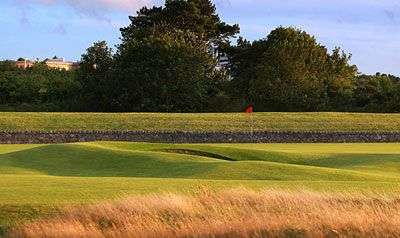
A Biarritz hole is one of golf's most theatrical par 3s: a long carry to a massive, elongated green bisected by a dramatic swale or depression that divides the putting surface into two distinct plateaux. Named after the French seaside resort where the original hole once stood, the Biarritz has challenged golfers and sparked architectural debate for over a century.
Most template holes replicated by C.B. Macdonald—the father of American golf course architecture, who pioneered copying famous holes and adapting them to new sites—and his disciples draw inspiration from originals in the British Isles, the homeland of golf. The Biarritz is a rare exception, most commonly traced back to the south-west coast of France, in the region of the same name. There, Tom and Willie Dunn Jr. crafted one of the most famous and infamous par 3s in history.
The "Chasm" hole (the current name for the template is derived from its original host club, not the original hole name) at Golf de Biarritz Le Phare featured a heroic carry over the titular chasm, approximately 160 yards, to a massive putting surface. The third hole's target area featured two large flat zones—one at the front and one towards the rear—divided by a drastic swale running between them, and guarded at the sides by bunkering. It is believed that only the rear platform was ever pinned—totalling between 210 and 240 yards—making the hole essentially a test of a player's ability to hit both long and straight (this was certainly a driver during the Dunn brothers' time in the 1880s).
The rest of the putting surface's dimensions are largely conjecture, as the original lasted only four years before construction of a hotel moved the teebox and took the bay out of play. The original green and hole would eventually be eliminated and, later, decimated during World War II. Furthering the mystery is the unlikelihood that Macdonald could have found himself in France during its brief existence.
All of these factors—or lack thereof—add up to occasionally contentious conversation amongst golf architecture enthusiasts about what constitutes an authentic Biarritz.
Whilst interpretations vary, most architecture historians agree a Biarritz should include:
Macdonald's template showcase, the National Golf Links of America, doesn't feature the model. Instead, Long Island's Piping Rock Club hosts the designer's first Biarritz. In the absence of official documents, the Biarritz swale has traditionally been understood to fit within a range of 1 to 1.5 metres in depth, which describes Piping Rock's variant well.
Lacking a bay, Macdonald added a large bunker in front of the first plane. It's important to note that this landing area is not green, but fairway, running down into the swale, which features a similar cut. The effect is a rather micro-version of the Valley of Sin at St Andrews, forcing a tricky up-and-down recovery for shots short off the tee. These specifications inspire the most vocal arguments about whether the front could—or should—be pinned, and whether that act violates Macdonald's intentions.
It appears one person who didn't see an issue pinning the front was Seth Raynor, Macdonald's nearest disciple. His Course at Yale hosts perhaps the most famous rendition of the Biarritz, and perhaps the most dramatic as well. Players must carry nearly 200 yards of water to where the green immediately begins, through a swale, to the back plateau. To compound your problems, the green tilts aggressively both front-to-back and right-to-left.
Whilst a more "dignified" template, such as the Redan, might flaunt its subtle tweaks from the original, the Biarritz seemingly encouraged imitators to push the envelope ever further.
Charles Banks created one of the longest versions at Forsgate Country Club in New Jersey, stretching to 235 yards. Not taking his nickname "Steamshovel" lightly, the designer also added Raynor-style thumbprints—shallow depressions—to both of the green's flat surfaces. The most controversial element, however? His swale can be pinned.
Getting back to Macdonald, The Creek gets a nod for its distinct rendition. Missing the green isn't enviable for any Biarritz, but The Creek's takes it to a new level via its Biarritz/Island hybrid. It's a big target, but tee shots are easily pushed by aggressive winds into the Long Island Sound inlet.
The naturalist tendency of the 21st century has made this template a less-likely choice for new courses, but a few true Biarritzes have emerged. One of the more straightforward versions is the 16th at Streamsong's Red Course in Florida, featuring a 70-yard green that plays between the property's dunes.
Tom Doak included a Biarritz-based hole at Bandon Dunes' Old Macdonald, but the Oregon resort's naturalist aesthetic raises some doubts amongst purists. The green does take a pill shape and features a swale through the middle. On either side of the swale, however, Doak enacts rolling features more in keeping with his Pacific Dunes design than the relatively plain planes of traditional Biarritz. And, at 180 yards, it is short even by Dunn's old-fashioned standards.
The most famous examples of the Biarritz don't leave much room for subtlety. Accordingly, some of the more debatable examples are guilty of underdoing rather than overdoing.
There is no doubt that a Biarritz green can accomplish its purpose as part of a long par 4 or short par 5, but two of the more notable examples raise questions about whether the template can survive a change in par. For example, A.W. Tillinghast included one at Somerset Hills Country Club in New Jersey. Perhaps because of the 13th hole's two-shot nature, his swale is much shallower than the holes referenced above. This alters the approach, but is it watered down enough to strip the "Biarritz" title? The architecture community remains divided.
The "Gate" hole at North Berwick Golf Club in Scotland does more than inspire questions about the nature of the Biarritz; it inspires questions as to the template's origin story. The approach shot on this par 4 is much shorter than a typical Biarritz, but the green is much more severe. Similar to the course's iconic Redan, the green tilts down from front-right to back-left, and is divided by a gully reaching Yale-level depths.
If the concept alone weren't enough to stir the pot, some suggest that Gate may be the true inspiration behind the Biarritz. North Berwick was founded in 1832, and Macdonald had decisively visited, unlike the Chasm hole. Two facts take some wind out of this theory, however: first, most historians agree that Gate was added in the 1930s, and it's suspected that Bernard Darwin didn't mention the green during his 1920s visit. Second, Macdonald named the template "Biarritz," not "Berwick."
Despite the mystery surrounding its origins and the ongoing debate about what constitutes an authentic example, the Biarritz remains one of golf architecture's most compelling templates. At its best, it presents a thrilling all-or-nothing shot that separates the bold from the cautious—a test of both distance and precision that has captivated golfers for well over a century. Whether you believe the front plateau should be pinned or consider North Berwick the true inspiration, Biarritz's dramatic swale continues to spark conversation and challenge players at some of the world's finest courses.
Originally written by R Book.
Edited by J Miners.
R is for Road ORIGINAL Even the most casual tour follower is familiar with the original Road Hole, the penultimate challenge at The Old Course, which often serves as the deciding test during competitions, such as when Seve Ballesteros parred the hole to Tom Watson’s bogey during the 1984 Open. The hole begins with some quirk, almost unthinkable in today’s naturalistic age: The player must drive directly over the hotel (formerly railway sheds) at the corner of the dogleg. This artificial blind shot influences the hole’s peak drama, which occurs upon approach. Those who trust their line across the roof will have the “best” angle to the narrow front-right to back-left green (which is still a very demanding shot, even with an ideal angle). Those who play safe to the left of the fairway have very little chance of rolling a long approach past the notorious pot bunker that guards the front of the green. Even poor shots from the ideal angle will potentially funnel down into its maw. Although the name of the hole stems from the street named Old Station Road, which runs immediately behind the green, the term “Road Bunker” traditionally refers to the deadly pot. St Andrews Old Course 17th hole - courtesy St Andrews Links Trust An interesting note from the hole’s history is its transition from par 5 to par 4. This occurred during the lifetime of the hole’s original architect, Allan Robertson. A distinguished competitor, Robertson never once carded a birdie at Road after it became a par 4. The ultimate lesson is that regardless of par, whether a short 5 or a long 4, a Road hole must offer some incentive for trying to reach the green, and punishment for those who stumble in that task. Ben Crenshaw believes that “the reason the Road is the hardest par 4 in the world is because it is really a par 5.” OTHER INTERPRETATIONS C. B. Macdonald naturally brought the Road concept to the United States, and his first stab came at Piping Rock. The 8th green is considerably larger than that of its predecessor, and front pins are much more attainable for players who don’t have an ideal approach angle, as this Road bunker leaves the front two-thirds of the green more open, with the front protruding forward out of the bunker’s reach. Macdonald pulls one trick from his bag by making the front a more intimidating target. Similar to his Narrows or Double Plateau templates, a fairway bunker short of the green blocks the player from seeing how much room they have to land and run up, creating a new source of tension for approach into this Road hole. The late George Bahto knew more about templates than anyone and his assertion (documented beautifully in The Evangelist of Golf) that No. 8 at Piping Rock is one of the finest Road examples is irrefutable. Piping Rock 8th hole - George Bahto collection Macdonald’s admiration for No. 17 at St. Andrews is best displayed in the title of his Road hole (No. 7) at the National Golf Links of America. Although the Old course gave us classic templates such as the Eden, Macdonald chose to name NGLA’s Road “St. Andrews.” This variant on the hole is a short par 5 (but, at 478 yards, it could work as a long par 4 for longer hitters). Although he doesn’t seek to emulate the blind tee shot at The Home of Golf, he does place a large waste area along the right corner of the dogleg; those who can carry the cape get the best look at the green for a potential eagle attempt. Those who choose to take the safe route get an easier passage to the green than at St. Andrews, with wide fairway landing areas. Although the original Road can make even pitches tough from the front, Macdonald did not crown his green to guide poor chips into the namesake bunker. This, and many Road holes to come, feature bunkers at the back of the green, in place of the title “road.” NGLA 7th hole - image courtesy of Jon Cavalier @LinksGems Many takes on the Road, particularly from Seth Raynor and Charles Banks, did not require a dogleg carry from the tee. Their most effective variants, such as the one at Long Island’s North Shore Country Club, still requires a test of skill (or power) from the tee. The best approach into this green will come from the plateau on the right of the fairway, while shots that fail to peak may roll leftward toward a sizable fairway bunker. The original Road is tough to green in its own right, but the North Shore version slopes from front to back, which makes stopping the ball at the correct spot on this deep green a nuisance. Tom Doak has proven especially keen on the Road concept among modern designers, and his version at Cape Kidnappers (No. 14 called “Pimple”) may be the most daring. The back tees come in at 348 yards, but those willing to tee it forward can make this a drivable variant of Road. The green is near identical to Road specifications, and its front is directly in line with the tees. That shot first requires carrying a chasm separating the tees from the fairway, as well as the pair of bunkers short of the green on the right side. Reaching the green demands a laser-guided shot, as any sort of fade will roll right down into the chasm. As with the debate between “Long Par 4” and “Short Par 5,” a drivable 4 lives up to the exciting matchplay requirements of a Road. Cape Kidnappers 14th hole - courtesy John Sabino MAYBE...MAYBE NOT Although Old Station Road runs alongside the original Road Hole, the holes most frequently mistaken for “Road” only include that element of the original. One such example is the closer at Royal Worlington & Newmarket, which is a reasonably misleading case. On one hand, the player must choose an appropriate line from the tee during this dogleg right, while avoiding the field on the right (in line with a true Road). The similarities end after that. No “Road” bunker exists, and Golf Links Road itself bisects the fairway about 40 yards short of the green. Although this could make for daring strategy from the tee (carry the dogleg 260 yards and bounce up to the green?), it is not a Road hole. Royal Worlington & Newmarket 9th hole - courtesy RW&N GC Although some Road holes prove themselves worthy without a dogleg, some are lacking. We’ll be as bold as to suggest that Macdonald’s No. 4 at St. Louis Country Club doesn’t meet his own demanding standards. We’re not bothered by the “Reverse Road” nature of the green, which opens at the front-left and travels back-right around the Road bunker, but we would argue there is not enough difficulty along the left fairway to punish those who fail in seeking out the best angle of approach. If these bunkers were to jut out more into the fairway and sit closer to each other, potentially creating a landing area where players must carry the first and stop short of the last, this would be an ideal solution. But the spirit of the original Road lies in it being one of the most intimidating holes in professional golf. St Louis CC 4th hole - image courtesy of Jon Cavalier @LinksGems The No. 2 hole at Lost Dunes in Michigan displays Doak again putting unique spin on classic concepts. As with Macdonald’s “St. Andrews,” Doak’s dogleg right involves carrying a large bunker complex at the corner to find the ideal angle into the green. There is no Road bunker, however. Rather, two large native mounds rise to block view of the back two-thirds of the green for those who are not in prime approach position. It’s possible that these hazards do too much to deter an attempt at the green, however. Although it is never wise to attack the Road Hole from the left, the option remains open. And, in the case of Ballesteros, glory awaits those who can pull off the heroic shot. Would Seve have taken the shot if he could not even see the green? Doak’s Lost Dunes innovation is an intriguing one, but perhaps goes a touch too far to be a true Road. Lost Dunes 2nd hole - courtesy Lost Dunes Golf Club

E is for EDEN THE ORIGINAL The “Eden” is one of several templates finding its origins at the Home of Golf itself, the Old course at St. Andrews. It’s a decent hike from the Royal and Ancient, as No. 11 “High In”—the original Eden—is the farthest hole from the clubhouse. St Andrews Old course 11th hole - image courtesy of Kevin Murray We derive the template’s name from the River Eden, which becomes an estuary while meeting the North Sea just behind the iconic short hole. Many golfers will consider the green a relative “Garden of Eden” after the challenges that must be overcome to enter. There are very few casual shots, even for those who get home in one, however. The trouble ends with the green itself, severely slanted from back to front. At 175 yards, the challenge is accuracy with one’s middle irons. Hitting past the pin brings the distinct possibility of putting off the green... or worse. Traditional Edens feature four distinct hazards, usually bunkers, all named for posterity. The first is the “Cockleshell” or “Shelly” bunker. This is placed well forward of the green, and should only be found by a poor tee shot. The “Hill” bunker sits greenside-left, and is of significant depth. Getting up-and-down onto the slanting green is hardly guaranteed. Perhaps the most significant bunker is also the smallest: The “Strath” (taking its name from a legendary golf gambler of lore) is a pot bunker sitting right in front of the green. The greatest humiliation is putting from the back of the green into the bunker, pitching out, and repeating the process. Finally, the “Eden” is not a bunker at all in the Old course’s case, but rather a valley behind the green going down to the river. Hitting up and trying to hold the green on the way down... this too is a damnable shot. OTHER INTERPRETATIONS The Eden is often cited as second only to the Redan in terms of conceptual strength, so of course C.B. Macdonald included one at the National Golf Links of America. On one hand, Macdonald realized the cruelty of the original Eden, so he made the slopes considerably more gracious here. On the other hand, he also greatly expanded the size of the green to make up for this generosity, leaving more lengthy (if gentler) putts. Some have complained that a layer of rough prevents some quick putts from reaching the Old course’s Strath. Those gluttons for punishment will be rewarded here: all short grass from the green into the pit. The “Eden” hazard becomes a bunker at NGLA, a moat-like trench that runs from front-right and around the back of the entire green. It’s also worth noting that Macdonald’s most prominent Eden plays across a pond, although not long enough to rattle any but the most anxious golfers. This trend would continue down the line to Macdonald’s followers, Seth Raynor and Charles Banks, who also included ponds or other forced carries from the tee at their own Edens. Neither Raynor nor Banks ever had the opportunity to visit St. Andrews, which may explain the variance in designs. One such case is at the Camargo Golf Club, where the green plays much like a Redan. The Hill Bunker is signature Raynor, nearly 30 feet deep. There are also renditions of the Strath and Eden bunkers, but no Shelly in play. Camargo Club 5th hole - image courtesy of John Sabino Tom Doak took a similar stance at Old Macdonald—Bandon’s tribute to the Father of American Golf Architecture—at least in terms of abandoning the Shelly bunker. The gap Doak allows between the Hill and Strath bunkers is significant, seemingly leaving the room open for a ground attack. This approach requires significant prayer as well: All the undulation along the fairway means luck is almost as important as skill if you plan to putt in regulation. One bad bounce, and a bunker beckons. Old Macdonald 2nd hole - image courtesy of Bandon Dunes Shinnecock Hills features a clever alternate take on the Eden, and indeed emerged during Macdonald’s renovation of the course during 1901. The deceptive nature of the template comes from the green’s unconventional tilt to the left in relation to the tee, unlike the conventional head-on nature of most Edens. The three consecutive bunkers to the left are more than just “three consecutive bunkers,” however. A well-struck shot should not find the first—the Shelly. The second, at the foot of the green, stands to collect poor putts—a Strath. The third is the Hill, direct left of the green. The larger Eden bunker sits at the back right. Shinnecock Hills 17th hole - image courtesy of the USGA MAYBE...MAYBE NOT All of Raynor’s holes merit citation due to his closeness with Macdonald, but we must question the “Eden” status of his entry at Fishers Island. We’ve established that no hole requires all four prescribed Eden hazards, as even the original Eden did not feature a back bunker, and many Edens forgo the Shelly. We feel, however, there is an obligation to feature a Strath. The hole at Fishers Island is a tad short for the traditional Eden, but the green does slant to match the description. It only features two of the established bunkers, a Hill that forms a sand moat around the entire left side, and an Eden that forms a similar trap around the right. This hole may be too long to be a true “Short” template, but it’s one thumbprint from being synonymous with the infinity-views of Sleepy Hollow’s famed No. 16. Fishers Island 11th hole - image courtesy of David Davis As discussed, Raynor and Banks took some liberal interpretations of the concept, one case being Banks’s No. 17 at Knoll Golf Club West. The Eden Bunker serves both its purpose and Hill’s, as it wraps from front-left all the way around the bunker to the opposite side. The trouble in nailing down the “Eden” concept lies in the other three bunkers. The alleged “Hill” is now at the front of the green. One would need to be playing like Gary Woodland from the back of the green—i.e. chipping—to end up in the so-called “Strath.” Although Eden is among the most revered templates, it’s worth noting several cases where Edens have not appeared. One is Harry Colt’s Eden course at St. Andrews itself. Although the course neighbors the Old course, features several holes along the Eden, and was built during the same period as Macdonald’s spirited promotion of templates, the Eden course itself does not feature the river’s namesake hole. Surely the Eden course at Fanling in Hong Kong is named for the river at St. Andrews, however no Eden hole exists. Notably, it does have a “Narrows” (as well as other charming hole titles such as “Devil’s Elbow” and “The Pimple”).

D is for DOUBLE PLATEAU THE ORIGINAL The Double Plateau is one of the occasional templates that has no obvious “original,” but it could have been inspired by a number of plateaued greens Macdonald witnessed during his overseas research. The safe bet in such cases is to head to the National Golf Links of America, C.B. Macdonald’s distinguished template gallery. NGLA 11th hole - image courtesy of Jon Cavalier @LinksGems The Double Plateau template begins at the green, and works backwards. Greens displaying the ideal “Double Plateau” interpretations have three tiers: Two are the actual “plateaus,” raised higher than the third “ground-level” platform. It’s similar to the Biarritz in that landing on the wrong level will make two-putts a tough prospect. It is unlike the Biarritz in that all three levels are at different elevation, while the front and back levels are at the same height for a Biarritz. NGLA’s singularly-named “Plateau” at No.11 showcases a kidney-shaped Double Plateau rather than the more typical stumpy “L” shape—with plateaus at the front-left and back-right. The Double Plateau is rarely doglegged. Rather, the player must take pin position into consideration from the tee; its location alters whether the left or right side of the fairway makes for the best approach. As seen at NGLA, adjacent bunkers guard the plateaus to enforce this strategy. The most famous hazard on a Double Plateau, however, is the “Principal’s Nose,” located about 70 yards out from the green, which both interferes with the player’s sightline and their ground game. NGLA’s is a more psychedelic “Nose,” as it features three “nostrils” around a central hump. The hump is the more relevant element of a Principal’s Nose, preventing victims from taking a direct line to the green when escaping from the hazard. OTHER INTERPRETATIONS Those who prefer the more traditional, two-nostrilled Principal will admire Chicago Golf Club’s Double Plateau, which very accurately resembles a human snout. It’s another Macdonald classic, but featuring a more cubist nature, reminiscent of what protégé Seth Raynor would create in decades to come. This version also features a cross bunker off to the right. Although not an issue for modern drivers from the tee, it does pose a distraction from strategic consideration of the flag placement. Considering the number of plateaus the aforementioned Raynor added to his greens at Fishers Island, it is not surprising that there’s a Double Plateau in attendance. But which one? The obvious choice is No. 9, based on title alone: “Double Plateau.” The green is a mirror version of those seen at NGLA and Chicago, with the added benefit of the Atlantic Ocean as a backdrop. That said, it’s a touch short (365 yards) and the blind tee shot makes it impossible for the visiting player to fully identify the “perfect” placement off the tee. Fishers Island 18th hole - image courtesy of Jon Cavalier @LinksGems George Bahto instead makes an argument for No. 18 at Fishers in his book on Macdonald, The Evangelist of Golf. Some point out similarities to the Road Hole based on the green’s shape and strategic pot bunker, as well as its length (450-plus yards, playing as a Par 5 during strokeplay) and its playing angles. But this green actually checks all the boxes for a Double Plateau, and its visibility from the tee box allows players to play accordingly. When considered as a classic “Par 4.5” matchplay hole, No. 18 arguably fits more comfortably within the definition of “Double Plateau” than No. 9. On the other hand, Bahto advocates strongly for No. 14 at Raynor’s North Shore Country Club, which also features a blind tee shot over a (slightly smaller) ridge, before approaching an indisputable Double Plateau green. It features no Principal’s Nose, but neither do either of the aforementioned Fishers Island entries. Tom Doak is especially keen on his rendition of the Double Plateau, hosted at Bandon’s Old Macdonald course, describing it as “my favorite opening hole that we've ever built.” The choice from the tee box takes on an element of risk/reward, as bold drivers can attempt to carry a fairway bunker on the right to reach a lofted plateau, resulting in a more comfortable approach. The Principal’s Nose is very much in the green’s business, sitting right at the foot, rather than 50-or-so yards out. Old Macdonald 1st hole - image courtesy of Bandon Dunes MAYBE...MAYBE NOT The lack of an original, iconic hole leaves many angles for argument among aficionados, including these next few examples: We would propose that a true Par 5 cannot be a proper Double Plateau, in the template form. Although Fishers Island No. 18 is a “Par 5” by virtue of its scorecard, it is extremely short and more realistically a “stiff Par 4.” Macdonald’s design at St. Louis Country Club, on the other hand, features a 495-yard Par 5 named “Narrows,” which confusingly is an entirely separate template rendition. If the player looks to get home in two, then it most certainly plays as a true Double Plateau; after all, accuracy upon approach is paramount. But if the player opts to lay up, a short pitch takes considerable bite from the green, watering down its intent. Of course, if a Par 5 is of obvious three-shot length, then it could very much play into the Double Plateau’s purpose. Regardless of your (or our) take on the St. Louis iteration, No. 15 should be noted for its unique green setup: The first plateau is at the front, dropping off to the lower level, with the other plateau at the back-left. St Louis CC 2nd hole - image courtesy of John Sabino Remaining at St. Louis, we also suggest that a par three cannot be a genuine Double Plateau, in the template form. However, No. 2 at St. Louis Country Club started out in life as a short Par 4 and is actually named “Double Plateau.” This hole—now a brutal 225-yard uphill Par 3—may well have been more appropriately called “Biarritz.” The enormous green sports a three-foot swale cutting through its middle. It just goes to show how blurry the lines are in the world of template golf holes—especially at St. Louis Country Club. Charles Banks and Knoll Golf Club West in New Jersey come to the conversation with the course’s second hole. Here Banks employed his popular “thumbprint” technique to create a horseshoe-style green: The lower portion is front and center, while the raised “horseshoe” wraps from front-left up around the back and down to the front-right. The horseshoe does change altitude from left-to-right, but it differs from other Double Plateaus in that the plateaus are directly connected. The question is whether the two plateaus must be totally separated by the lower level?


