
Bethpage Black’s 15th hole – “Mount Olympus”
by M. James Ward
When concluding play at the short par-3 14th at Bethpage State Park's Black Course you descend downhill for a short walk across Round Swamp Road. Upon crossing the road you enter via a gate opening back onto course property and then you see what lies ahead.

Bethpage Black 15th tee - photo courtesy of the PGA of America
Although there are no official names for the holes at the Black, the 15th should be rightly named "Mount Olympus." The hole turns slightly left in the drive zone with the final 180 yards moving uphill. The green is literally perched on a high precipice, 50 feet above the fairway and you believe when you finally reach the green you will be in the company of Zeus. There are two distinct tiers on the putting surface and the green slopes diagonally from rear left to front right. Although the hole can stretch to 478 yards for the PGA Championship, for the two US Opens, held in 2002 and 2009, the tee boxes were set at 459 yards.

Bethpage Black 15th fairway - photo courtesy of the PGA of America
The most crucial element starts with the tee shot. Failure to find the fairway likely means no real opportunity to reach the green in the regulation stroke. For those hitting the green the key is being near enough to the pin avoiding massive breaking putts. Should one miss the green – either short, left or worse long – the penalties can be exacting.
Starting with the 2002 US Open, the fairway cut on the left side was extended further out, therefore putting players on notice to respect the penalty for missing on that side. How tough is the hole? After the first round of this year's PGA Championship the stroke average was 4.577 – with just four birdies made and Tiger Woods had one of them.
In major championship golf you rarely see severely uphill holes. The 18th at Augusta National is one that comes quickly to mind. However, the abruptness for the final 75-100 yards at the 15th at the Black is truly steep. Gauging club selection and marrying it properly with the appropriate trajectory is an absolute must.
Bethpage's Black Course will return to the competitive scene in 2021 when hosting The Northern Trust event on the PGA TOUR – the opening event for the FedEx Cup Playoffs. And more importantly, Bethpage will host the 2024 Ryder Cup Matches. Count on the 15th hole playing a major role in that encounter between the American and European teams.

USGA opts for coastal locations - heartland hostings on hold By M. James Ward The selection of future US Open sites provides a fascinating behind the scenes understanding of how the United States Golf Association (USGA) seeks to position its most important event. Recommendations are made to the full Executive Committee by senior staff who then ultimately make the final call on which sites are eventually selected. Interestingly, it was a staff recommendation -- from former USGA Executive Director Frank Hannigan -- that got the ball rolling when Shinnecock Hills was considered for re-entry in 1986 as a US Open venue. The issue was whether a seasonal club could host the event with the USGA playing the role in getting all the details in motion -- especially on the volunteer side -- something other active membership bases had been keen to do for all the years prior. In recent years the USGA has opted to include a combination of different sites. In 2013, the Open returned to Merion Golf Club, just outside of Philadelphia, for the first time since 1981. The charming club on the Main Line had to undergo significant modifications given the limited acreage on-site. For example, total ticket sales were capped at 18,000 daily because of the limited space. In addition, the practice area was held on the adjoining West Course -- which required all players to be shuttled back to the East Course. The net result? The desire to include Merion provided clear logistical hurdles that may keep the club on the sidelines for quite some time if ever hosting the event again. Adding to the mixture of host sites has been the introduction of new sites. This includes the likes of Bethpage's Black Course in 2002 and 2009, as well as Torrey Pines South in 2008. Courses that have opened in recent years were also included -- Chambers Bay in 2015 and Erin Hills in 2017. As of now, only Torrey is scheduled for a return in 2021. Two of the major championships have a completely different set of circumstances. The Masters is always played at Augusta National Golf Club and therefore is always played at the same course. The Open Championship does rotate to different venues but those locations must be a links course and the circumstances for hosting leave a very limited number of options with anywhere from 8-10 courses being in the mix. The PGA Championship is the direct competition with the USGA. For much of the PGA's history the selection of sites was a hodgepodge of second tier layouts with only a few of note being selected. That changed dramatically under the leadership of Jim Awtrey when he became a part of the leadership team in 1986. It was Awtrey who went full bore in raising the profile of the 4th major and the primary emphasis was on getting quality clubs being pursued rigorously. Television exposure expanded from 6.5 hours in 1986 to 64.5 hours in 2005 while TV rights fees grew 600-percent during that same period. Total revenue also saw great gains moving from $12.5 million to $200 million with 381 percent increase in total sponsorship dollars and 286 percent increase in total licensing dollars. In sum -- the USGA was no longer in the catbird seat regarding course selections and now faced a revved up competitor looking for equal consideration. That tug-of-war continues to this day. In years past, it was possible for a club to hold both events near enough on the calendar. Oakmont held the US Open in 1973 and 1983 --- sandwiched in-between in 1978 was the PGA Championship. No PGA Championship has returned to the famed Pittsburgh layout since then. The same holds true for Oakland Hills (South). The Detroit-area club hosted the US Open in 1985. In 2004 and 2008 the club hosted the Ryder Cup and PGA Championship respectively -- as well as two US Amateurs in 2002 and 2016. To date, no 7th US Open is scheduled. The PGA of America has been quite active in securing host sites that formerly were tied very closely to the USGA. The most prominent being Oak Hill, Baltusrol and Hazeltine National respectively. Oak Hill, the Rochester, NY club, last hosted a US Open in 1989. In the years to follow -- the famed East Course staged the 1995 Ryder Cup and the 2003 and 2013 PGA Championships. In 2023, the club will again host the PGA. A US Amateur was played there in 1998 but no US Open is planned or likely to happen for the foreseeable future. The same has happened with Baltusrol. The New Jersey-based club eschewed any professional event by being firmly in the USGA camp. After the 1993 US Open the club was unable to secure support for a 8th US Open following a 13-year cycle in hosting the USGA's main event in 1954, 1967, 1980 and 1993. The PGA Championship was played there in 2005 and during the PGA Championship's centennial in 2016. Whether the club is able to secure another US Open is entirely problematic. Hazeltine in the Minneapolis area has hosted numerous USGA events -- the most noted being the 1970 and 1991 US Opens. But, despite the desire of the club to get a 3rd US Open the USGA has opted for other locations. Given that reality, Hazeltine hosted the PGA Championship in 2002 and 2009 as well as the Ryder Cup in 2016. Another Ryder Cup is scheduled for 2028. The recent focus for the USGA has been in restoring the position of a number of classic designed layouts to the forefront. In 2016 Oakmont hosted the US Open and will do so again in 2025. After the debacle in not watering greens during the 2004 championship it appeared Shinnecock Hills might not return to the grand stage. Time has a tendency to heal wounds and the Long Island club is front and center this week with its 5th Open and will do so again for a 6th time in 2026. From this year through the 2027 event at Pebble Beach the US Open will be staged primarily in either east or west coast time zones. The west coast locations provide the USGA with prime time viewing of the event as the final tee times can be scheduled for 3-4 pm local pacific time allowing for prime time viewing in the eastern USA. The 2019 event at Pebble Beach marks the 100th anniversary of the club and the Open returns to California in two-year intervals with Torrey the site in 2021 and a new opportunity with Los Angeles CC in 2023. Covering the remaining slots are several eastern locations with Winged Foot in 2020, The Country Club in 2022 and Pinehurst in 2024. The central and mountain time zones in America will not be able to host a US Open until at least 2028 at the earliest. But, that has not meant that clubs in those two areas have stood still. Inverness, located in Toledo, OH, and a four-time venue for the US Open, went through an extensive restoration project that jettisoned the ill-suited contributions made by George and Tom Fazio when the club was about to host the 1979 US Open. Those changes were never really accepted and the club showed total resolve in admitting the obvious and in bringing on board a relatively unknown architect named Andrew Green based out of Baltimore, MD. The Donald Ross layout has returned with much needed vigor and the overall "look" of Inverness is clearly aligned to its original premise. The layout can stretch to over 7,500 yards and it will be interesting to see if the USGA takes note. After hosting the 1979 Open, Inverness also was courted by the PGA and eventually hosted two events -- in 1986 and 1993 -- where Aussie Greg Norman lost both times in epic finishes by Bob Tway and Paul Azinger respectively. Courses such as Cherry Hills in the Denver area and Southern Hills in the Tulsa area have hosted previous US Opens but are unlikely to get nods for future events. In the case of Southern Hills the club opted to work with the PGA and will host two of its events -- including the PGA Championship -- both prior to 2030. Interestingly, when Herb Kohler opened his mega golf facility just north of Sheboygan, Wisconsin -- initially with Blackwolf Run and then Whistling Straits -- he was intent in having a future US Open come to Whistling Straits. That opportunity never came but it did not prevent Kohler from working with the PGA of America and eventually hosting three PGA Championships as well as being the site for the 2020 Ryder Cup Matches. In Kohler's mind -- that's a trade he will take gladly. With the exception of Bethpage in 2024 the Ryder Cup has been the domain of America's heartland since 2004 and will be in that part of America through 2028. One major factor that will certainly change the landscape is the PGA Championship being contested in May starting in 2019. The switch happened in concert with the PGA TOUR seeking to abbreviate its congested FedEx Cup Playoffs so no overlap with the start of the National Football League's season would occur. This meant The Players Championship, formerly played in May returning to its original placement in March. The new time frame means the PGA of America will be looking for possible host sites that may have been at a disadvantage when the traditional August time frame was used. Locations such as Southern Hills would be a much better fit in May than in the cauldron of oppressive heat with an August placement. It is very possible that large States which have had no real role in major championship golf such as Texas will become viable candidates. With the PGA making a clear beachfront in America's heartland -- the USGA has made a clear movement in relying on locations in the eastern and pacific time zones. Classic design architecture has clearly returned to the forefront and the core four facilities -- Oakmont, Shinnecock Hills, Pebble Beach and Pinehurst #2 -- are firmly entrenched as the lead layouts for the folks from Far Hills, NJ. The PGA of America has quickly escalated the stakes for what courses will be in play. The ensuing battleground skirmishes will make for an interesting roadmap on which courses opt to go in one direction or the other. The street of major championship golf is clearly a "one way" oriented street - either with the USGA or PGA of America. Two-way traffic is hardly likely.

You don't need a four-figure budget, a private-club connection or an invitation from a member to play a course in the World Top 100. Top100 has collated the 10 cheapest visitor-accessible courses on our current World Top 100 Ranking, based on standard green fees. From a world-class links in Tasmania to a U.S. Open and Ryder Cup venue in New York, these courses offer the chance to play some of the best golf on the planet without the eye-watering green fees attached to many of their World Top 100 counterparts. 1. St Andrews Beach Golf Course (Victoria, Australia) World Ranking: 89th | Australia ranking: 6th | Green fee: A$139 (£74) Tom Doak’s first Australian mainland design, St Andrews Beach opened in 2004 on the Mornington Peninsula and has since become one of the country’s best-value, ranked courses. The public-access layout occupies 175 hectares of former grazing land, with wide fairways, rolling terrain and sandy natural contours that give several holes a links-like feel. Measuring just over 6,000 metres from the back tees, it is playable for a broad range of golfers, though the subtle greens ensure there is still plenty to think about. In a region known for outstanding golf, St Andrews Beach stands out not only for its quality but also for its accessibility, offering everyday golfers the chance to experience a Tom Doak design without the premium price tag often attached to courses of this calibre. 2. Bethpage Black (New York, USA) World Ranking: 58th | USA ranking: 28th | Green fee: From US$140 (£106) Bethpage Black has the rare distinction of being a World Top 100 course, a major championship venue and a public golf course. Located within Bethpage State Park on Long Island, the A.W. Tillinghast design opened in 1936 and has since hosted two U.S. Opens and the 2025 Ryder Cup. The Black is renowned for its difficulty, with narrow fairways, deep rough, large sculpted bunkers and elevated greens making accuracy essential. It is a demanding test, but one that remains remarkably accessible to everyday golfers. That combination of championship pedigree and public access is what makes Bethpage Black so unusual. Few golfers get the chance to play a course of this stature without needing a private-club connection or resort stay. 3. Paraparaumu Beach Golf Club (Wellington, New Zealand) World Ranking: 91st | New Zealand ranking: 2nd | Green fee: NZ$275 (£118) Set on the Kapiti Coast, north of New Zealand's capital city Wellington, Paraparaumu Beach has been one of the country’s most celebrated golf courses since Alex Russell designed it in 1949. The links has hosted 12 New Zealand Opens and has long been regarded as one of the country’s finest layouts. It is a relatively short course by modern championship standards, but the coastal wind, firm fairways, deep bunkers and undulating greens provide plenty of challenge. The split-fairway 17th is a particular highlight, forcing golfers to choose between two very different routes to the green. For international golfers, Paraparaumu offers the chance to experience a genuine piece of New Zealand golfing history without needing access to a private resort. 4. Fairmont Jasper Park Lodge Golf Course (Alberta, Canada) World Ranking: 73rd | Canada ranking: 2nd | Green fee: C$280 (£149) Set among the Canadian Rockies in Jasper National Park, Fairmont Jasper Park Lodge is one of Stanley Thompson’s most celebrated designs. Opened in 1925, the course winds through the valley beside Lake Beauvert, with snow-capped peaks providing a backdrop to almost every hole. The course combines wide fairways, elevated tees and strategically placed bunkers with the natural contours of the landscape. Thompson’s design rewards thoughtful play rather than simply demanding power, making it a course that can be enjoyed by golfers of different abilities. The result is a rare combination of classic golf and Canadian wilderness, with the surrounding mountains and forest making the journey between shots almost as memorable as the golf itself. 5. Barnbougle - The Dunes Course (Tasmania, Australia) World Ranking: 25th | Australia ranking: 3rd | Green fee: A$285 (£151) Barnbougle Dunes is about as close as Australia gets to a traditional seaside links. Set on Tasmania’s northeast coast, the course was designed by Tom Doak and Australian Mike Clayton and opened in 2004, establishing Barnbougle as one of the country’s premier golf destinations. The layout runs through towering coastal dunes, with wide fairways, natural contours and greens that follow the movement of the land. The wind is an ever-present factor, while the strategic design rewards golfers who think their way around the course rather than simply relying on power. For golfers seeking a genuine links experience outside the British Isles, Barnbougle Dunes is about as compelling as it gets, combining world-class golf with the rugged coastline of Tasmania. 6. Cape Wickham Golf Links (Tasmania, Australia) World Ranking: 47th | Australia ranking: 4th | Green fee: A$315 (£167) Cape Wickham occupies a spectacular stretch of coastline on King Island, sitting in Bass Strait between Tasmania and mainland Australia. Designed by American architect Mike DeVries, the links opened in 2015 and quickly established itself as one of the country's standout modern courses. The course makes the most of its remote coastal setting, with the opening five holes winding around Cape Farewell before the layout moves through sand hills and limestone outcrops. Several holes hug the shoreline, while the closing stretch heads towards the imposing Cape Wickham Lighthouse. The 18th provides a fitting finale, with the fairway doglegging around a sandy bay before reaching the home green, making Cape Wickham a memorable links experience from start to finish. 7. St Enodoc Golf Club - Church Course (Cornwall, England) World Ranking: 49th | England ranking: 4th | Green fee: £175 Set among towering dunes overlooking the Camel Estuary in Cornwall, St Enodoc’s Church Course is one of James Braid’s most distinctive designs. Founded in 1891, the course was transformed by Braid in the early 20th century and remains a spectacularly natural links. It is a relatively short par 69 at 6,010 metres, but its undulating fairways, dramatic elevation changes and formidable dunes create a test that demands imagination. The famous 6th is the standout, with the enormous Himalaya dune obscuring the green and making club selection particularly difficult. The course also has an unusual piece of history, with the 13th hole running alongside the churchyard where poet laureate John Betjeman is buried. 8. South Cape Owners Club (Gyeongsangnam-do, South Korea) World Ranking: 63rd | South Korea ranking: 2nd | Green fee: From KRW 350,000 (£195) Set on Namhae Island off the southeast coast of South Korea, South Cape Owners Club is a dramatic Kyle Phillips design where the ocean is visible from all 18 holes. The course opened in 2013 as part of a luxury resort development and has quickly established itself among Asia's most striking modern layouts. The course is framed by granite outcrops, coastal cliffs and rolling terrain, with bluegrass fairways contrasting against fine fescue rough. The standout stretch comes from the 11th onwards, culminating in two spectacular waterside par threes at the 14th and 16th. For golfers willing to make the journey to Namhae Island, South Cape offers a rare combination of world-class golf, dramatic coastal scenery and a luxury resort experience. 9. Utrecht De Pan Golf Club (Utrecht, Netherlands) World Ranking: 56th | Netherlands ranking: 1st | Green fee: From €235 (£198) Dating back to 1894, Utrecht De Pan is the second-oldest golf club in the Netherlands, with Harry Colt designing the current course in 1929. Set in secluded woodland near Utrecht, the layout is a classic heathland course, winding through pine, birch, oak and chestnut trees. De Pan has hosted the Dutch Open three times and is built around strategic rather than power golf. Several of its most memorable holes play over valleys of heather and sand, while the sixth and seventh demand particularly thoughtful tee shots and approaches. Recent restoration work by Frank Pont has helped return the course towards Colt’s original design, making De Pan a fascinating example of Golden Age heathland golf in the Netherlands. 10. Cruden Bay Golf Club - Championship Course (Aberdeenshire, Scotland) World Ranking: 70th | Scotland ranking: 10th | Green fee: From £205 Cruden Bay is one of Scotland’s most distinctive links, winding through towering dunes on the Aberdeenshire coast with the North Sea providing a constant backdrop. The course opened in 1899 after being laid out by Old Tom Morris and Archie Simpson, before Tom Simpson and Herbert Fowler remodelled it in 1926. Cruden Bay makes spectacular use of its natural terrain, with elevated tees, blind drives, punchbowl greens and fairways that rise and fall between the dunes. The 193-yard 4th, played from an elevated tee across a deep hollow, is one of several standout holes. There is plenty of character, too, from driveable par fours and back-to-back par threes to the feeling that every hole reveals something different. It is exactly the sort of course that rewards golfers willing to embrace its quirks. Green fees are based on standard 18-hole visitor rates, using international visitor rates where applicable. All prices are peak-season rates and do not take twilight, off-season or promotional rates into account. Prices are correct at the time of writing and are subject to change.
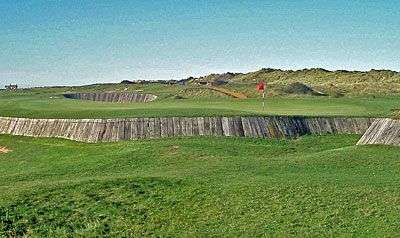
S is for Short ORIGINAL The concept for the “Short” can be traced back to Royal West Norfolk’s No. 4 at Brancaster. Although there are many Par 3 holes of minimal yardage, it would be architect Horace Hutchinson’s advice that had the most profound impact on C.B. Macdonald’s development of the template (more on that later). The shortest hole on the course (129 yards) with one of the largest greens, No. 4 is certainly the easiest green-in-regulation, but far from the easiest two-putt. Royal West Norfolk Golf Club 4th hole The putting surface sits upon a ledge among the dunes, which led Hutchinson and Holcombe Ingleby to prop it up with a long stretch of railroad ties. While eye-catching, the wall also alerts the player where not to miss: Those who come up short, left or right will face a difficult up-and-down from a thick cut well below the green. The only safe miss is to go far and right, where there’s a relatively flat area connected with the No. 14 green. This valley likely inspired the tendency to surround Shorts with hazards. There are also a few bunkers at the foot of the rail-tie wall with little strategic relevance aside from further punishing the short; one might hope Mackenzie & Ebert see fit to remove them during the current work at the club. OTHER INTERPRETATIONS As with most templates, Macdonald more definitively laid out the “Short” when he returned to the United States. And again, his most famous example sits at the National Golf Links of America. He understood immediately that the purpose of such a short drive to such a large green placed emphasis on accurate short-iron play. Using some (aforementioned) advice from Hutchinson, he amplified the importance of the first shot. The Brit suggested that Macdonald drop a series of pebbles on a green sketch, and add mounding accordingly. This resulted in NGLA’s infamous central hump, which makes any two putt from the wrong side of the green feel like a birdie. This green also set Macdonald’s precedent for “wide” rather than “long” (Brancaster’s was rather circular). NGLA 6th hole - image courtesy of Jon Cavalier @LinksGems Those surprised to see the relatively “rough” bunker aesthetic at NGLA will no doubt find the Short at Chicago Golf Club more familiar. Another wide green, this one is wrapped by two long “moat”-style bunkers, set below the green, as seen at many MacRaynor designs. Rather than build up, as he did with the mound at NGLA, Macdonald built down. Both the left and the right side of the putting surface feature distinct “thumbprints,” which make even three-putts admirable for a poorly-placed tee shot. Both Seth Raynor and Charles Banks would use this putting “hazard” on greens throughout their career, but especially for Shorts. This version also features a forced carry over an irrigation pond from the tee, which only serves to spook guests already nervous about playing at such an exclusive club. Chicago Golf Club 10th hole - image courtesy of Chicago Golf Club Raynor and his thumbprint come into play in perhaps the most recognizable rendition of the Short, No. 16 at Sleepy Hollow Country Club. The pronounced dip sits right in the center of the square green, which is fully surrounded by sand. Although this shape adds to its photogenic nature, most pay more attention to the beautiful Hudson River Valley in the background. It’s more than just scenery, however: The falling-off behind the putting surface creates an “infinity” effect, making it tougher to gauge where the landing area ends. This makes rear pin placements particularly frightening. Sleepy Hollow Country Club 16th hole - image courtesy of Sleepy Hollow Country Club Banks made his landing area ambiguous with No. 2 at Long Island’s North Hempstead, but at the front in this case. The uphill tee shot leaves large portions at this green’s front ill-defined. Pins at the left of this wide green are easier to attack, both because the landing area is lower and more visible, and because there is a brief fairway apron (don’t put too much stock in it however, as it works better as a false front than a runway). Pins to the right sit on a higher plateau, and also must carry a large bunker fronting the green. Trusting one’s distance and playing to the center is key. Short templates have made a resurgence, both because of their strategic brilliance and the relative ease of fitting a 135-yard hole into a route. Just one example is No. 15 at Gil Hanse’s Streamsong Black, which plays 133 yards to a wide green surrounded by the course’s noted waste areas. Typically, a Short has one of the largest, toughest greens on its host course. Black has many large, undulating greens, so the putting surface at No. 15 is in good company. MAYBE…MAYBE NOT There are many, many courses that feature one—if not more—holes that fit the ideal length for a Short. It takes much more to earn that title, however. Consider Bandon Preserve, the resort’s 13-hole short course. At least six of those holes fall within acceptable distance for a Short, but Bill Coore and Ben Crenshaw didn’t supply greens that lived up to the billing (not that they were trying to). One exception is No. 10, which features a green sizable enough for Macdonald’s purposes. There is a large bunker that rises to obscure the front of the green, which provides a unique (and reasonable) take on the concept. Bandon Preserve 10th hole - image courtesy of Bandon Dunes Another interesting look at the idea of a short (not “Short”) template comes from A.W. Tillinghast, who had a relatively limited collection of repeated concepts. His “Tiny Tim” idea shares a distance with true Shorts, and also the idea that the green is wrapped in danger. As seen with No. 14 at Bedford Springs, the difference lies in the green itself, which is rather small. True, this requires even more targeting from the tee than Macdonald’s versions, but C.B. also preferred to test the putting ability of his players. Tillinghast’s version, less forgiving, is more similar to Royal Troon’s “Postage Stamp.” Perhaps no template has as much potential for ruination than the Short, because of its required distance. Unfortunately, many clubs have viewed the short nature of the tee shot as a weakness during the advance of golf technology. They mistake distance as the only relevant metric in modern golf, and continue to add new teeboxes. The once-Short at Raynor’s Nassau Country Club now stretches more than 200 yards from its back tees, all but wiping out the template’s intent.

