
Architect Rick Baril of von Hagge, Smelek and Baril answers our El Encin questions
Who was the client?
The Community of Madrid. It’s a long-term concession, presently managed by Desprosa. Thirty six holes were to be designed with the Madrid Open in mind as a spectator-style golf course. There was even early mention of this course being Spain’s venue proposal for the 2018 Ryder Cup. was in fact submitted and rejected by the European Tour in favour of Tres Cantos and a ‘to be designed golf course’ by European Golf Design.
The design competition for the El Encin golf project was intense and the proposal requirements demanding as they also included a financial component which likely and ultimately limited the number of viable contenders. We teamed with Desprosa, who also own Golf Olivar de la Hinojosa.
All proposals were submitted in August 2006 and a month later our team was selected to design and develop the project. Detailed design work and construction documents were prepared the following year. 2008 was spent working on construction entitlements. Construction started on the 18-hole South course in early 2009 and continued until October 2010. Originally, there was a requirement to build the 18-hole North course immediately following the completion of the South Course. The design work is completed but, to date, there has been no discussion about building the second 18 holes.
What was the thought process behind the large number of small bunkers on #2 and #9?
The short answer: options.
Hole #2 and #9 are the most obvious, due to the significant number of bunkers on these holes. But holes 1, 6, 10 and 14 offer a similar challenge, with fewer obstacles. The use of smaller bunkers offers more “indistinct or indeterminate” options on line of play. Hole #2 perhaps stands out different from the others as there are two distinct angles to approach the green. Based on the location of the pin, the golfer will be better favouring the right or left side of the hole. Still, on either side of the fairway, there are small bunkers to encourage a thoughtful strategic approach while playing the hole.
Why only dig irrigation lakes on the back nine?
El Encin is located in an arid region so irrigation is a must. El Encin uses treated water for the irrigation as it’s the only reliable and significant source of water available. Storage of treated water requires a reservoir with an impermeable liner – which is quite costly. In order to be budget-conscious, water requirements were studied carefully to keep the reservoir size to a minimum. In fact, there is a third lake, behind the 14th green which serves as a “working lake”.
The volume of water – and water level - fluctuates in this lake. One of its important tasks is to ensure the two lakes on the golf course remain full so it accepts water from the source and it transfers water to the golf course lakes (which are connected via a subsurface pipe) to maintain the water level.
We decided to use the two lakes for strategy on the back nine, where we felt they could provide the most drama – and, a memorable finish to the golf course. As you know, water holes can be dramatic.
Why have two different styles of bunkering (mainly "cookie-cutter" on the back nine) across the property?
The answer to this question is partially addressed in the above answer to “What was the thought process…” – the answer to the question is likely a subject for a larger discussion about bunkers; bunker shapes, scale, bunker purpose, position, etc. Still, the two different styles of bunker present two different questions for golfers:
1) The small round bunkers are not too psychologically daunting. After all, they are not so big, and should be easy to play around. They are placed to make the player think, not only about the line of play but the distance to hit the ball. Where these bunkers are used, the player is being asked to make choices, based on degrees of risk. Playing near these bunkers can be advantageous. But, there is also a measure of risk. On the holes with more small bunkers, there more options, more answers to the question, more ways to play the hole.
2) The larger freeform bunkers are more daunting – practically and psychologically. The strategy on the golf holes with these bunkers is more obvious. Instead of an abundance of strategic options the player is being asked to make a more binary choice; either take a risk (challenge a daunting bunker) or play safe.
Hopefully, the two bunker styles mean the player is required to apply different strategic approaches. The player is required to “shift gears” in the strategy applied to playing these disparate holes. Failing to do this, will cause scoring problems.
Can you say anything about the putting surfaces?
The greens were the most difficult part of the project. We wanted large undulating greens, with “target zones” within the greens. The golf course manager owns a golf course near Madrid airport and I visited it to gain an understanding of their maintenance standards.
From this visit, and some other discussions, I felt we could make interesting putting greens, which they would not need to maintain and a very low cutting height. We felt this would also provide them a measure of safety in this arid climate. In fact, we recommended they do not exceed a stimp of 10 on the greens.
I was on site for weeks at a time, working with the shaper and we worked hard to shape putting green areas, without defining the actual putting green. The idea was to shape the area and then decide the limit of the putting surface. This may seem a rudimentary point. But, in typical golf course construction, the shaper uses the drawing to “shape” the putting green and surrounds.
In this process, the shaper (as he is following the plans) works to define the putting green. What happens is the shaper provides definition to the green – like a frame. Even working with a good shaper, the greens take on a “staged” appearance. What I worked hard to accomplish, was to shape the entire green area, without defining the limit of the putting green. After the area was shaped, I marked the limit of the putting greens. Hopefully, this helped the putting surfaces to be better integrated with the surrounding forms.
This all went quite well. Unfortunately, after the shaper’s work was done, the greens were handed to the local crew, who were not diligent in saving the shapes we had created. One problem – we installed a polyethylene moisture barrier around the putting surfaces. This barrier was not very flexible and resulted in some very poor tie-ins on the perimeter of the greens.
The other significant problem was the contractor did not respect the elevations on the greens. On green #2, I spent six hours removing sand from the green with a sand-pro. The sand, which was supposed to be installed to a depth of 30cm was 80cm deep! We had similar problems on every green which was frustrating.
One final word: it should be remembered, in the context of this golf course, that everything is fabricated. The site was flat and barren, in fact, we developed a drainage channel thorough the site, to help evacuate storm water. There is a significant motorway on one side and a railway on the other side of this elongated property. Perhaps the only interesting natural attribute are the mountains to the southeast of the property, which are considered long views off-site.
Click the link to return to the main El Encin page.
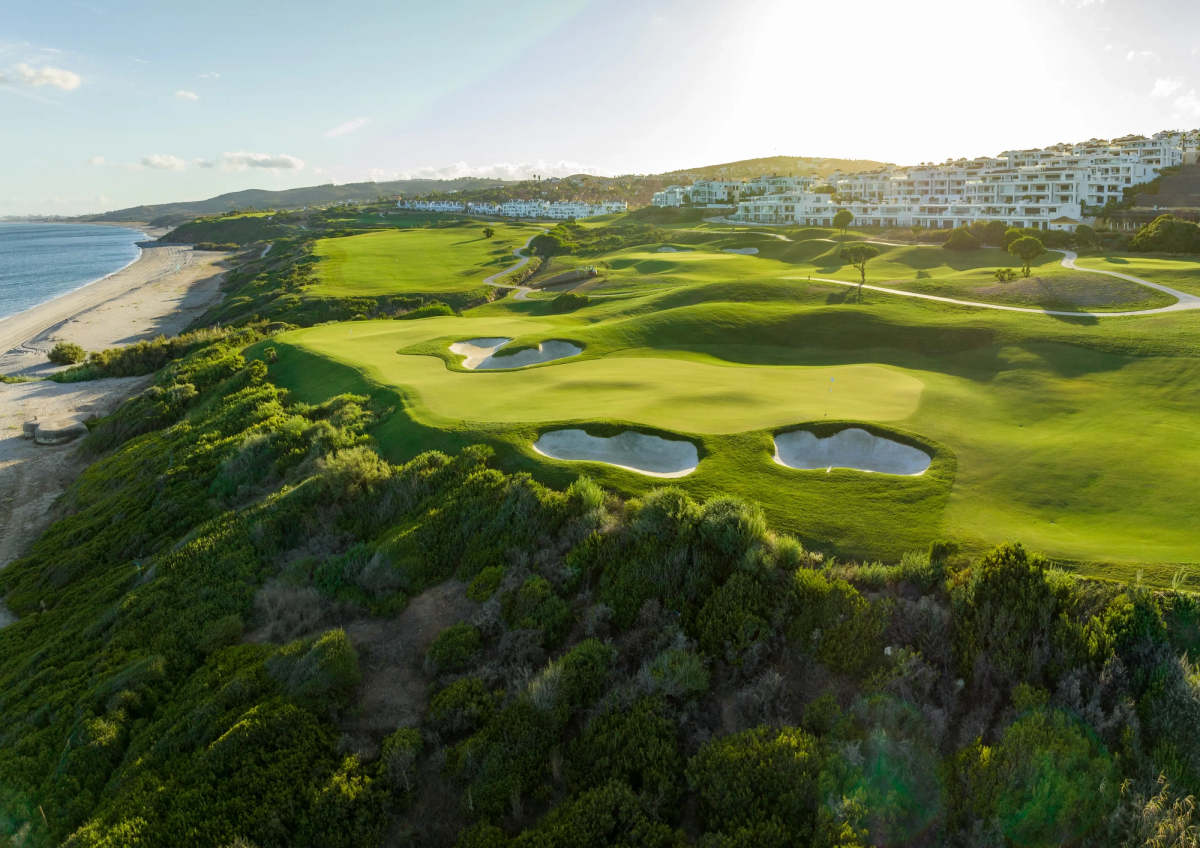
This week we welcome golf course architect Kurtis Bowman to the Top 100 Clubhouse. Kurtis talks to us about his new design at La Hacienda in Spain; he also details the reasons for his sabbatical from golf, and his subsequent return to the industry. Previous Episode - Don't Miss Out! The previous episode features Javier Reviriego. Javier is currently the CEO at Real Club Valderrama, one of the world's Top 100 courses. He has a highly impressive CV having previously been head pro at Real Club de Golf Sotogrande, and general manager at both Fuerteventura, and Finca Cortesin, which hosted the Solheim Cup this year. We talk about his career journey, the importance of running a sustainable golf course, and the decision to host LIV golf at Valderrama. What Are The Top 100 Clubhouse Podcasts About? Top 100 Clubhouse is the ultimate podcast for golf enthusiasts! Join us as we delve deep into the minds of fascinating individuals from every corner of the golfing world. From players to course designers, caddies to golf historians, we'll leave no stone unturned in our quest to share unique insights and experiences with the Top100 Community. Together we'll explore the stunning courses and breathtaking landscapes, enjoying the unforgettable stories that bring the game of golf to life. How Do I Listen To The Latest Top 100 Clubhouse Podcast? You can download and listen on the following links. Listen now, wherever you download your podcast! Apple Podcasts Spotify Google Podcast Podtail We Need Your Feedback? The Next Podcast Interview? Top 100 members can share their views on who should join the next Top 100 Clubhouse podcast show? If you have an idea who you would like to hear, why not drop our Top 100 Clubhouse host James Henderson an email on james@top100golfcourses.com Happy Listening!
Finca Cortesin – 18 new greens and a new green initiative It’s more than ten years ago since my first visit to Finca Cortesin as I was there just after the course first opened for play in 2006. My initial impressions were strong then and I knew that it would become a serious player, not just in Spanish golf, but as a big hitter in Continental Europe. Around that time, there were some remarkable new high-end courses opening across Europe and Finca Cortesin was certainly one of them. After looking back at the historical ranking positions, it’s clear that Finca Cortesin continues to improve and is loved by all who play there as the player reviews on the Top 100 Golf Courses website tell us. The course attained a #25 position in Spain back in 2008, rising to #19 in 2010 then #10 in 2012. Currently, it’s ranked as the 5th best course in the country which shows steady, continuous improvement every time we’ve updated our national listings. My recent visit – arranged by our good friends at The Azalea Group – was to see the course after the latest round of upgrades, constituting the biggest tranche of work carried out to date. During 2017, all eighteen greens (and the practice putting green) were relayed with Ultra Dwarf Bermuda grass which was grown at a Caceres nursery in the centre of Spain. Amazingly, despite all the disturbance to normal operations, the course re-opened only after only one month of disruption and much credit for that must go to Ignacio Soto, the resort’s head greenkeeper who supervised the project and tested the different possible grass varieties for more than two years in advance of the renovation. Some world class venues – including Sawgrass, Quail Hollow and East Lake Golf Club – have been hugely successful converting to Ultra Dwarf Bermuda grass greens and industry expert Ken Mangum believes the new investment will help propel the five-star golfing experience at Finca Cortesin to another level. Mangum, ex-director of golf courses and grounds at Atlanta Athletic Golf Club and head consultant on the project after being recommended by Soto, said: “Many great courses around the world have used the Ultra Dwarf greens system for several years. Overall, they are more environmentally-friendly, cost effective and sustainable. “Ultra Dwarf Bermuda grass provides a more consistent daily playing surface. The greens remain fast and firm with the changes in weather and moisture, (whereas) Bentgrass becomes soft and slow with humidity, irrigation and rainfall. “The new greens will offer more great days of play, especially during warmer times of the year. Less pitchmarks will be visible. The dark green colour and surface uniformity will provide good speed and firmness throughout the season.” As I mentioned already, I’ve been coming here for more than ten years and I’ve certainly noticed improvements every time as the course has matured. The trees, bushes and shrubs all around the course have grown to a point now where many holes are isolated from others and are framed in a magical way. My favourites holes include the great 3rd and 4th – a risk/reward par five then a potentially driveable par four from an elevated tee – and, on the back nine, the 15th and the 18th. The par four 15th requires a big carry off the tee then a 90 degree left turn uphill to the green and the par five home hole (with the great Casares Mountains as a backdrop that appears to have been Photoshopped into real life) is all about position from the tee to set up the approach to the green. For those who have yet to visit Finca Cortesin, then do put the course on your ‘must play’ list; you will definitely not be disappointed as this course is the newest member of the European Tour Properties network and was also home to the Volvo World Matchplay event in 2009, 2011 and 2012. My recent visit was made extra special as I stayed onsite at the luxury Hotel Cortesin, a truly exceptional 5-star experience with service and standards of the highest quality. Without a doubt, it’s one of the very best golf resorts that I’ve been luckily enough to stay at during my Top 100 travels. The location is perfect too – between Marbella and Sotogrande on the Costa del Sol – and it’s served very well from the airports at Malaga and a little nearer in Gibraltar. Finca Cortesin’s relatively brief history has been a success story with a course and resort that steps up a level with every returning visit. Andy Newmarch Top 100 Golf Courses

We review three Costa del Sol designs by Robert Trent Jones Snr and a trio by Javier Arana One of a select number of golf media outlets invited to the annual conference of the European Institute of Golf Course Architects in Spain last week, Top 100 Golf Courses took the opportunity to review half a dozen golf courses before and after the main business was conducted at the H10 Andalucía Plaza Hotel, Puerto Banus. Official visits were arranged to play two Robert Trent Jones Snr courses at Real Sotogrande and Real Las Brisas, both of which feature prominently in our Spanish Top 100 chart, and we decided to add another of the old master’s more recent designs at Los Naranjos to our itinerary. To compare the works of this world-renowned designer against other local options, we sampled three tracks from the portfolio of the much-respected architect Javier Arana. Unlike Trent Jones, with hundreds of courses to his name, Arana was involved in only thirty-two Spanish projects during a 30-year design career. Real Sotogrande was first up on the EIGCA playlist, with the architects and industry partners playing a round on the course before the formal business of their yearly get together got underway two days later. Originally laid out by Trent Jones Snr in 1964, the course was totally rebuilt over the past two years by Roger Rulewich and design partner Dave Fluery, with sub air systems installed in all the greens. The following day, the course at Real Las Brisas was next to come under the scrutiny of the conference delegates. Opened in 1968, this Trent Jones layout has also just undergone an extensive makeover from another of the architect’s former lead designers, Kyle Phillips. Like Sotogrande, this course was also upgraded in two stages, allowing one nine to remain open for play whilst work was carried out. As the course at Los Naranjos is situated only a kilometre east of Las Brisas, we thought it worth having a look around it while we were close by. This RTJ course functioned under the same management as its near neighbour after debuting in 1977 but that arrangement lasted only a short time before a decision was made to build a separate clubhouse and go it alone in a very competitive Marbella golf market. The theme of a very informative EIGCA conference was “Spanish Lessons – Golf in Southern Spain” with speakers giving insightful presentations on several Iberian-related topics, including an overview of the Spanish golf industry provided by golfindustria.es, details of the renovations at Sotogrande and Las Brisas, the development of the Valderrama and Zagaleta courses, water management and turfgrass selection for southern Europe. Later, at the President’s Dinner, Ross McMurray of European Golf Design became the 10th President of the EIGCA, pledging to continue the legacy of his predecessor, Tom Mackenzie of Mackenzie & Ebert, by actively promoting the professionalism of members through the implementation of a structured Continuing Professional Development programme, which allows architects to update their skills and knowledge and remain professionally competent. All the formal business completed, it was now time to call in on a trio of Javier Arana creations before heading for home. The first of these was Aloha, located two kilometres west of Las Brisas, where Arana set out his last 18-hole course before he died in 1975. Venue for last year’s Andalucía Costa del Sol Open de España event on the Ladies European Tour, this course is currently undergoing major irrigation work on the back nine holes. Guadalmina (Sur) lies closer to the coast, indeed two of the greens almost touch the beach where the Guadalmina River enters the Mediterranean Sea. Originally constructed as a 9-holer in 1959, the course had an additional nine holes appended to it by Arana a few years later. Global Golf has since conducted a new millennium remodel of the layout, recontouring greens and adding new bunkers. The final port of call on our short Arana tour took us to Rio Real, another of the courses that have operated in the Marbella area for more than half a century. Occupying a very compact 105-acre site, most of this delightful course’s fairways are laid out along the narrow valley of the Real River, but there are several holes intelligently routed across higher ground on the east side of the river. Two of the three Robert Trent Jones Snr designs above are ranked within the Top 100 of our Continental Europe chart, which tells its own story regarding their quality. Such golfing excellence comes at a price, of course – millions of euros have been spent on course improvements at these 50-year old golfing paragons – so expect to pay a significant green fee for the privilege of playing them. On the other hand, even though the three Arana courses aren’t imbued with the same golfing cachet as their more illustrious counterparts, they each possess an exquisite charm that’s hard to define but tangible, nonetheless. Whilst the top rated RTJ tracks are built to test the best, the Arana layouts are more suited to the average player’s game, scaled to fit players who are looking for a more intimate game of golf. If you’d like to get in touch with us about our recent Spanish excursion to the Costa del Sol then please do so via the “Respond to this article” link at the top or bottom of this page. We’re delighted to receive feedback whenever we publish short articles like this so if there’s something you’d like to comment on then by all means feel free to contact us. Jim McCann Editor Top 100 Golf Courses

