Ernie Els to design three Cape Verdean courses
Cape Verde is poised to become one of golf's hottest destinations
Cape Verde is poised to become one of golf's hottest destinations after the PGA agreed to brand an Ernie Els-designed course on the islands. The former Portuguese colony, which lies off the coast of west Africa, will join the PGA's expanding worldwide portfolio after the Association cemented a deal with Cape Verde Development, who are behind two planned multi-million pound resorts in the country.
The new investment, which will also see two-five star resorts established, will also bring golf, which has been played on Cape Verde for over 100 years, into the 21st century with the three Els-designed courses plus two training academies forming a major part of the high-class development, which is scheduled to open in 2010.
Two courses, including the branded PGA National Course, plus a training academy will be located at the luxurious Calheta Bay development on the island of Sal. The third Els course plus the PGA National Academy will be situated at the equally prestigious Baia das Gatas resort on the island of Sao Vincente, which will be the first of the developments to open.
PGA director of property & development, Robert Maxfield, believes the partnership with Cape Verde Development will put the islands firmly on the golfing map. "Golf has been associated with Cape Verde for more than 100 years but this is a new chapter in the country's golfing history and it is great that the PGA is at the heart of this developing golf nation.
"The PGA, in partnership with Cape Verde Development, will be developing the PGA National Course and the PGA National Academy, with the emphasis on creating world class facilities. Hopefully it will encourage locals and new arrivals to Cape Verde to experience the game of golf.
"Given the stature of the complexes Cape Verde should certainly become one of the places to play golf."
The archipelago's branded facilities will join a high-class elite already part of the PGA stable, including the world-famous Gleneagles and The Belfry, host to an unprecedented four Ryder Cups and the headquarters of the PGA. It will also join illustrious PGA branded partnerships that already exist in Ireland, Scotland, Spain, Cyprus, Turkey and as far a-field as India and China.
The golf facilities will be managed by PGA Golf Management, whose clients include the prestigious St Andrews Links Golf Academy and the award-winning Bayhood No 9 golf course in China.
The PGA, the world's first professional golfers' association was founded in 1901 by legends JH Taylor, James Braid and Harry Vardon. The PGA has 7,500 qualified members, including 1,500 working overseas in more than 70 countries.
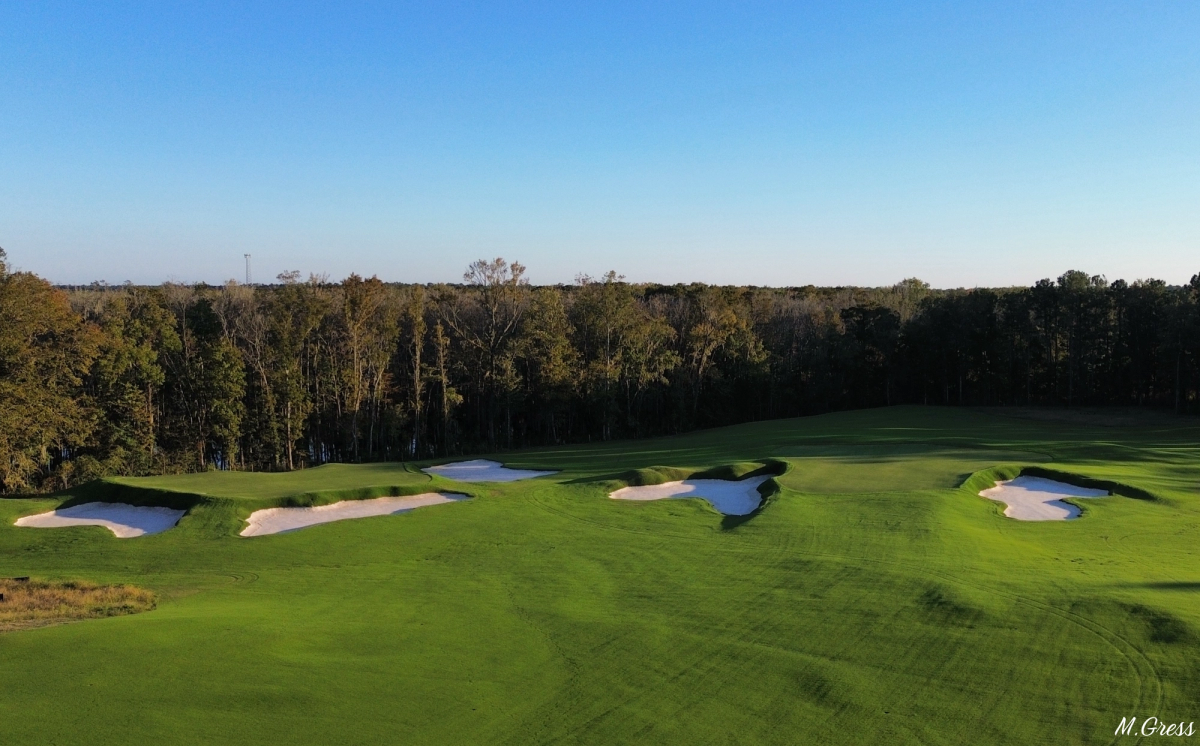
Old Sawmill Golf Club — Tyler Rae's First Solo Design The new golf course building revolution in South Carolina continues to sprint along. Amidst the high-profile new offerings of Old Barnwell, The Tree Farm, and Anson Point, the maiden solo effort from architect Tyler Rae flies a little under the radar at Old Sawmill Golf Club. Tyler Rae is a graduate of the University of Kentucky and has extensive work experience with notable architects Ron Pritchard, Keith Foster, Coore and Crenshaw, Tom Doak, and Bruce Hepner, amongst others. His experience in the field of restorations of Ross, Raynor, Flynn, and Tillinghast has enabled him to access a vast array of styles upon which he can draw for this first solo project. Old Sawmill is located about 30 miles northwest of Charleston, near the town of Ridgeville, and about two hours from the rising mecca of South Carolina golf, Aiken. The course is built on former farmland, and the business model is once again an exclusive private club with high-end initiation fees and predominantly national memberships that have thrived in the post-COVID golf boom era. The Old Sawmill site, previously farmland, is in no way laden with striking natural features or topography, which is in no way a disclaimer for what Tyler Rae has created, quite the opposite. It is more of an homage to what he has been able to lay out for the golfer. The final product reflects an old-school Golden Age layout and presents a finished landscape somewhat reminiscent of the Chicago Golf Club. First impressions upon arrival are underwhelming, and it’s hard to see how this land can create an interesting course. That feeling is soon changed as the course progresses. Tyler Rae has obviously absorbed all of the fabulous experiences from his restoration projects of that Golden Age period, because whilst playing Old Sawmill, one is constantly reminded of the likes of Ross, Raynor, and even Pete Dye as your eyes feast on the product laid out before you. The delightfully intimate routing is so reminiscent of Donald Ross, as the holes turn and meander in every direction to all four corners of the property. The sparse landscape of native grasses and the spectacular green sites that one will play later creates an atmosphere of anticipation. It is a very walkable experience, with any elevation changes masterfully utilised to perfection in the routing. Ample fairway playing lanes — but often with Dye-like visual illusions — create a wonderfully inviting playing experience. The pièce de résistance of the course, however, are the green complexes and beautiful bunkering, both in the fairways and greenside. In fact, the bunkering is quite stunning: wonderful contouring, but without being overdone in any shape or form. It is often accompanied by steep grass-faced bunkers and elevated greens that combine to create exciting visual approaches. Selecting favourite holes is not easy. The stretch from holes 2–8 is all you can handle, and is really the least of the course as far as the scorecard is concerned. The 2nd is a stunning Raynor-like par three, playing from 150–200 yards to a rectangular green with gorgeous step bunkers to the right, followed by a series of three tough par fours ranging from 370–495 yards — all wonderful holes. The par-five 8th is very cool, said to be the first hole created on the course and based upon a hole Tyler designed as a teenager. A huge mountain of a mound guards the right side approach to the green and creates the most wonderful strategic hazard to be negotiated — simply brilliant design. On the back nine, a creek runs through the property and is strategically used by Rae, starting as a hazard to be crossed in front of the spectacular 11th green. It comes into play again on the 12th hole Punchbowl. The 13th is a drivable Cape par four that combines the visual language of Dye with the aforementioned Cape template — again, quite brilliant. A wonderfully designed golf course. Massive kudos to Tyler Rae on his first solo design. On the evidence of Old Sawmill, his name is going to be mentioned extensively in the future. Contributed Words - Michael Wharton Palmer Edited - Jasper Miners
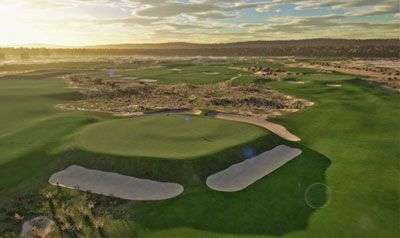
The Long Lost Lido Found — Twice Most years feature one piece of golf course-related news that dominates the others. The opening of Bandon’s Sheep Ranch was quite the headline for 2020. A short way into 2021, and another Mike Keiser project is already the talk of the town: A recreation of the legendary Lido Golf Club, to be constructed near the Sand Valley Golf Resort in Central Wisconsin. The hubbub is justified by years of growing interest in golf course architecture, and particularly the philosophy of Charles Blair Macdonald. The stockbroker was dubbed “The Evangelist of Golf” by writer H.L. Whigham, and his template approach to course design — incorporating influence from the world’s most renowned holes, as seen at the National Golf Links of America — has been a central concept to the study of “The Golden Age” of golf course architecture. National Golf Links of America 4th hole - Redan The Lido was another Macdonald design, and one that fell into oblivion following the second World War. Such was the acclaim from players and experts during its time that it has become an object of fascination for modern architecture enthusiasts. That it would soon (2023) be available to the general public (or at least those staying at Sand Valley) inspired a wave of celebration. Amid the noise, you hardly would have guessed that another new Lido had opened in just the past year. Gil Hanse and Jim Wagner led the creation of a modern Lido at the Ballyshear Golf Links in Thailand. Ballyshear 12th green Two recreations of the same classic golf course, within the period of just a few years? How does one explain the sudden rush on Lido? Macdonald’s NGLA has always been a mainstay of architectural discussion and remains so to this day. Conversations on his acclaimed templates — including the Redan, Eden, Alps, and Long among others — almost always include the version from NGLA. A slew of originals at Lido, less prominent among Macdonald and Seth Raynor’s future designs, offer intrigue. NGLA 9th hole Long - image courtesy of Jon Cavalier @LinksGems Macdonald invited readers of Country Life and amateur architects to submit original designs for inclusion—with the entries judged by Bernard Darwin, Horace Hutchinson and Herbert Fowler. The winner was Alister MacKenzie, whose multi-fairwayed “Home” closed the routing. No. 15, named “Strategy,” was unofficially submitted by Tom Simpson (as he was an affiliate of Fowler, a judge). Raynor is believed to have adapted what would become known as “Raynor’s Prize Dogleg” from another submission, which became the No. 6 “Dog’s Leg” hole. Perhaps the club’s most iconic hole was the debut of the “ Channel,” a Littlestone-inspired par five that dared the bold to hit its island fairway on the way to an eagle opportunity. Littlestone Golf Club - 16th hole Channel - image courtesy of Littlestone Golf Club NGLA, however, was built for skilled amateurs and featured two U.S. Amateur champions among its membership. The Lido was longer and meaner, perhaps designed to test professionals and match Pine Valley’s notoriety as a man-eating test of golfing will. “Lido if you know it is like a boiled New England dinner, which if it doesn’t kill you young will make you a very husky citizen, set to digest anything that comes your way. So it is with Lido,” wrote Bernard Darwin for The Brooklyn Daily Eagle. “Once you’ve become inert to these ferocious carries and the all-engulfing rough, the iron has entered your soul and you are capable of tackling any golf course that the genius of Charlie Macdonald or Seth Raynor or Walter Travis can conceive.” Bret Lawrence, a golf historian, notes that the Country Life contest specifically calls for two-shot holes, suggesting Macdonald didn’t want another short hole. “He wanted two-shot holes, which are basically two full-shot holes,” Lawrence explains. “You could kind of get the sense from there that he wanted more of those as opposed to a drive and pitch kind of hole, which would make it shorter. He was looking for more strategy in the longer holes...because he wanted to test the professionals.” The originators, however, weren’t professionals, but wealthy New Yorkers who had previously tapped Macdonald to build clubs such as Piping Rock. With names like “Vanderbilt” on the ledger, no expense was spared, and earth was moved to such a degree as to put Whistling Straits to shame. Piping Rock Club 13th hole - image courtesy of Jon Cavalier @LinksGems “It almost seemed like they were trying to develop the area,” says Lawrence. “There was nothing out there at the time.” Those plans hit the skids with the onset of World War I and the original investors had lost interest by the Great War’s conclusion. The next buyer was William Reynolds, a former senator who began the area’s real estate boom and built a hotel, putting the retitled Lido Beach Golf Club on the map for the wider population. At its peak, the club featured more than 1,000 members. Unfortunately, that peak ended with Reynolds’s death; between his family and other investors, the “all-engulfing rough” soon received less care. Even at its critical peak, Macdonald was disappointed in the upkeep. “What he was unhappy about was — he mentioned this in Scotland’s Gift — that they didn’t keep up the golf course,” explains Anthony Pioppi, executive director of the Seth Raynor Society. “I think he expected the Lido to be treated the way National treated its golf course.” The U.S. Navy assumed control of the property during the next World War and it never returned. The legend, however, lived on, culminating with the new projects from Hanse and Tom Doak, who will be handling the Sand Valley installation. Those two projects will ultimately provide radically different Lido experiences, however. The Ballyshear Links is much less a carbon copy, due to the limits of the property Hanse and Wagner had to work with. The pair pitched the project to the owner of the Ban Rakat Club, understanding that they would need to tweak the original routing a smidge to make it fit, and their approach would be more in line with Macdonald’s approach at NGLA; creating interpretations of the historic holes versus clones. “Normally...we feel strongly that a golf course should be the product of its surrounds. But in the back of our minds, my partner Jim Wagner and I have often wondered what we would do with a completely flat site — what can you do to distinguish it?” Hanse said in a statement. “The most famous example of a manufactured golf course from The Golden Age was The Lido. Jim and I had always wanted to do a Macdonald/Raynor, angular grass-faced bunker design. We pitched the idea to the owner at Ballyshear and he loved it.” And that’s where Doak’s Lido will be different: The plan is an almost exact clone of the original Lido, built in Wisconsin rather than Long Island. Such a feat is possible because of technological advances. Peter Flory, a Chicago-based architecture enthusiast, has been building a 3D replica using the course design feature of The Golf Club computer game. That prompted a call from Doak, who had watched Flory’s progress via Golf Club Atlas. What began as a Flory’s passion project became the driving force for the course’s recreation. “I would not have agreed to take it on if I didn't think Peter's work gave us a chance to do it accurately,” Doak told Top 100 via email. Still, Hanse’s rendition didn’t require such digital wizardry, so the sudden Lido lean can’t all be attributed to modern tech. So why now? For Doak, Flory’s work represented a potential punctuation for a sentence that had begun long ago. The architect had previously created a tribute to Lido’s designer for Keiser, with the Old Macdonald course at Bandon Dunes. This track, like Macdonald himself, aimed not to replicate anything but rather adapt existing templates to the Oregon landscape. Apparently, even during 2005, Lido was on Keiser’s mind. Doak says the resort magnate expressed his interest in recreating the Lido while the pair discussed the third course at Bandon. Old Macdonald 4th hole - image courtesy of Bandon Dunes Bandon was blooming at that time, but Keiser’s resort ownership has only grown since then, operating nine 18-hole courses (and accompanying par three courses) between his three resorts. Doak suggests the root of both Keiser’s windfall and Lido’s rise is the relatively recent appreciation for golf course architecture. “There is 100-times more interest in golf architecture nowadays. Forty years ago, when I was a student, you were lucky to find a copy of Colt's or Macdonald's books through interlibrary loan,” he says. “Websites like Golf Club Atlas, podcasts like Andy Johnson's (The Fried Egg) and Derek Duncan's (Feed The Ball), and the golf magazines have all made golf architecture far more of a mainstream topic. They even talk about it on TV a little bit!” That still doesn’t explain “why Lido?” Why wasn’t someone like Keiser interested in restoring, for example, Ocean Links (Raynor’s nine-hole neighbor to Newport Country Club ) or the original El Caballero (Billy Bell’s masterpiece in the Los Angeles hills, prior to the club changing locations)? Simply put, the amount of information on these courses pales in comparison to Lido. “I think Lido is in a class by itself in that regard; it was much more well documented because of who designed it, because of the contest that helped make MacKenzie famous, et cetera,” Doak says, admitting even he knows relatively little about other lost tracks. “I'm a bit of a geek about this stuff, and I don't know one-tenth as much about the other courses you mentioned.” Information does exist, however, and there are certainly golf history buffs looking for it. Flory has begun creating a similar 3D model of Ocean Links, sharing his progress on Golf Club Atlas. A rendering of Sand Valley’s Lido by Peter Flory With that in mind, could the current Lido projects portend future projects focused on tributes to, and total recreations of, legendary golf courses? And if so, is that necessarily a good thing for the current state of course architecture? Pioppi is wary. “I do think that’s going to be a trend. I think because of this technology, people are going to be able to recreate holes. I mean, what’s to stop somebody from recreating the Old Course in Wisconsin? With this kind of technology, who knows?” he says. Still, he can accept such things if it means more eyes on golf course architecture. “For me, the bottom line is people are talking about architecture, which is good.” One “victim” of the Lido project is Doak’s “Sedge Valley” Swinley Forest concept, an original 6,100-yard course on the Sand Valley property. It will eventually happen...but not until the Lido wraps up. Doak doesn’t begrudge the Keisers for prioritizing the new project over his original design...but he does make a lighthearted jab at golf media’s (including Top 100) role in the narrative. “Unfortunately, this interview and all the others are demonstrating that the idea generates a lot of free publicity...more of it than my proposed third course at Sand Valley did,” he says. He states that Lido would be his only personal recreation. He compares the value of the project to his work restoring the Chicago Golf Club and others, preserving the legacy of architects he admires. “If I didn't think this particular course was worth restoring, I certainly wouldn't be doing it.” If we’re being accused for feeding the furor that results in the recreation of a legendary golf course, we’ll plead guilty! We’re looking forward to playing both new Lidos sooner rather than later. That said, we’re equally looking forward to celebrating what golf course architecture will be, and not just what it was.
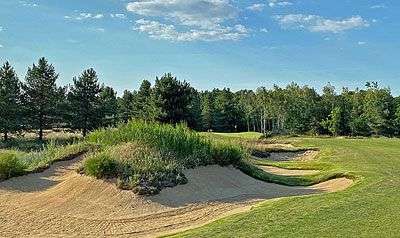
The New Gil Hanse-designed course at Les Bordes We’re big fans of Robert von Hagge’s mid-1980s course at Les Bordes, so we were really intrigued to hear last year that the club was constructing another 18-hole layout to complement the original course. When we then discovered this new track was to be designed by Gil Hanse, one of the world’s leading golf course architects, we had to find out more about this project before it opens in 2021. Les Bordes Old course 8th hole But first, a little background about the place. The Les Bordes Estate was taken over by an affiliate of RoundShield Partners in 2018. Since then, a fully private golf club with an international membership has been established. Six Senses Hotels also recently announced the intended opening of a luxury hotel in 2022 that will be completely separate from the golf club. The vast majority of the members belong to other top ranked clubs around the world, with only around a quarter of them residing in France. Despite a harsh economic climate, there’s a waiting list for membership and access is only available as either a member or a member’s guest. A number of other non-golf amenities – such as an equestrian centre, swimming lake with white sand beach, fishing lake, cycling, tennis and archery – were recently completed on-site. And as the estate extends to over 1400 acres, there’s plenty of space to accommodate all these other activities without interfering with the golf. But the focus is very much on providing a world-class, 36-hole facility for passionate golfers. The New course lies to the west of the club’s existing layout, where there had previously been 27 holes, with the new project happening after a conversation between the architect and mutual friends of the new owners about developing a second course on the estate. Once Gil Hanse and other members of his design team visited the site, they knew right away they could create something really special here. Les Bordes New course 13th hole “We visited the site and fell in love with the entire property,” said Hanse last year. “It will be very different stylistically to the original, which I think is a positive, as members will have two very different golfing experiences. The routing allows for a very walkable design, with some tee boxes an extension of the fairway cut around the previous green. Les Bordes New course 2nd hole The 10th, 11th and closing holes occupy the same large area of fairway, the latter playing to a green set against a lake edge. Regarding the course that was previously laid out on the same site, the playing corridors were very narrow so those that are used in the new design have been significantly widened.” Les Bordes New course 9th hole Extending to 7,301 yards from the back markers, the New course is configured as two returning nines, featuring four par threes that measure between 131 yards (at the 7th) and 230 yards (on the 14th). Holes to look out for include short par fours at the 9th and 15th, along with the right doglegging par five 6th and the par five 18th, played to a home green protected on the left by water. Les Bordes New course 15th hole We corresponded recently with Jack Laws, the Director of Golf at Les Bordes Golf Club, and he said the intention was always to have two very different courses: the Old remaining more target golf-orientated with the ball played through the air and the New emphasizing the ground game and being able to shape and control the ball along the playing surfaces. Les Bordes New course 7th hole He told us: “Gil Hanse lived with us on the estate for 4/5 months whilst construction was under way. He’d be up at 06.00, have a croissant and coffee in the clubhouse then start his day on the dozer at 07.00. He’d be shaping all day until darkness fell, six days a week. He was incredibly hands on and his team were just as thorough. The course is fundamentally a heathland-style layout built on sand, with large waste areas like those on Pine Valley, where Gil is a member. It’s a very unique style, particularly for Europe, with outstanding, truly exceptional architecture. Featuring large bunkers, subtle elevation changes and amazing green complexes, the course plays firm and fast so it’s actually shorter than the 7,400-yard overall length due to the playing conditions.” Les Bordes New course 2nd hole Much of the architect’s inspiration for the new course came from the style and strategy of Tom Simpson’s work at Morfontaine, Chantilly and Fontainebleau. Hanse and his team visited those clubs in Paris and they realized there was an opportunity to replicate elements of the bold and dramatic features found there on a site which, by comparison, is low-profile in nature. Care was taken to clear the location, making subtle transitions from the fairways into the natural vegetation and the trees to preserve as much of the natural environment as possible and hopefully impart a sense of harmony and balance with the surrounding landscape, giving it an almost immediate sense of place and belonging in the Loire Valley. Les Bordes New course 2nd hole As professional events are unlikely to be held here, width and the ability to play from different angles and at various lengths allows players of all abilities to comfortably make their way around the course. The older course may be more manufactured and penal, with lots of water in play, but the New is a little more nuanced and understated. Our panelist BB visited Les Bordes last month and this was his verdict on what he saw of the New course which was still growing in: “I played the old course and walked five holes of the new Hanse design with Jack Laws. I also walked a fair chunk of the new Wild Piglet course. The overwhelming takeaway is the contrast with the original course and the New feels more natural than the original, more ‘unearthed’ than created. The holes flow over a landscape that appears more undulating than the old course. I didn’t see any back and forth issues in the routing, with subsequent holes just heading off in a different direction. Tees seemed pretty close to the previous greens, so it would be quite a nice walking course. There was a small amount of heather on site, which they are propagating to spread to other areas, as well as broom, which I believe is endemic there. The construction/shaping has been well done – there were landforms I suggested that were natural (that weren’t) and vice-versa. Driving corridors felt generous and I could see at least two ways to play each hole that I saw. I’d say there were some bold/distinctive hazards: either a large fronting bunker, a cross bunker on the driving line, or some kind of ridge incorporated into the strategy. There was also a slightly random element to some hazards, which I quite liked. The bunkering was very natural and some fairways traps looking exactly like natural sandy blowouts on the wild heathlands where I live. The greens were built up and looked like fun, with run offs and short grass everywhere. It was a challenge to not keep comparing it to Gil Hanse’s design at Castle Stuart – the holes I saw had that same look and feel, just transported to an inland site. It had a flamboyant feel to it which got the pulse racing – more Tom Simpson than Harry Colt in style, based on my experience of Belgian and Dutch courses – but maybe this is just typical of the architect. To me it called out ‘fun’ more than ‘test’.” We mustn’t forget the 10-hole Wild Piglet short course which has also been built. Jack Laws told us Gil Hanse thinks it’s every bit as good as The Cradle which he built a while back at Pinehurst – and that short course is regarded by many as the best in the world. Les Bordes Wild Piglet course 8th hole Much like the New course at Les Bordes, it has interesting green complexes and bunkering, with holes ranging from 131 to 198 yards. Permit delays on the main layout allowed the construction team to spend an additional couple of weeks refining the Wild Piglet layout to make it even more elaborate and entertaining, which now shows in the level of detail on every hole. “So we have a bunker in the centre of one of the greens, a few of the putting surfaces have three or more tiers and there are some other crazy designs thought up by Gil and his team,” said Jack. “It will be a lot of fun post lunch in the afternoon, or a great place to start for beginners and juniors. Les Bordes Wild Piglet course 10th hole I love Gil’s message on the Wild Piglet scorecard – his take on the ‘Golf should be a pleasure not a penance' Donald Ross quote – which is ‘Golf should be fun, it shouldn’t suck’. Finally, our superintendent, Lee Strutt, is working tirelessly to implement Gil and our chairman’s vision; a recent addition to the team, Lee has been of overwhelming value in lifting the project to the next stage of evolution and has a clear view of what it takes to deliver a truly world-class golfing experience for our members." We’ll bring you first hand reports of both the New and the Wild Piglet layouts when we re-visit Les Bordes next year.

