K is for KNOLL
THE ORIGINAL
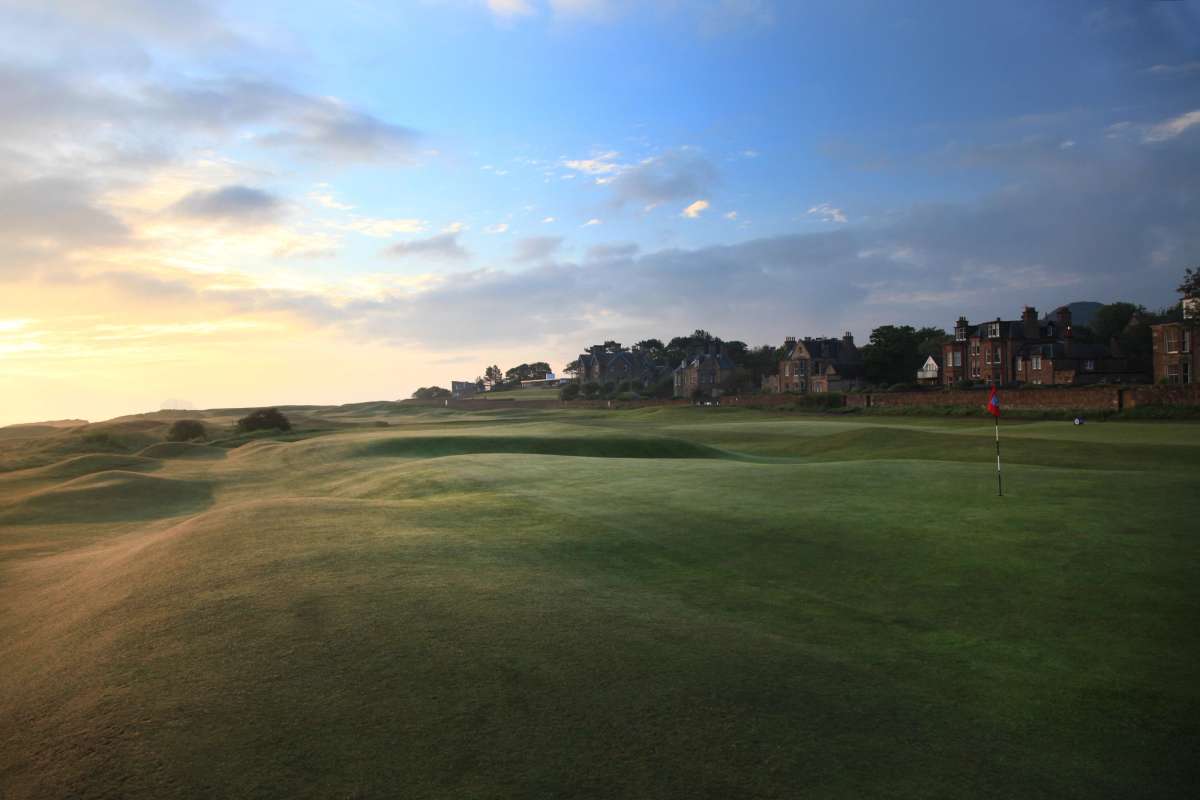
Royal North Devon is not the only notable “Westward Ho” in Britain. Although Scotscraig Golf Club doesn’t seem as excitable about its signature hole (unlike at Devon, there’s no “!”), it can lay claim to the origin of the “Knoll” template.
James Braid found success by taking a knoll—defined by Webster’s as “a small, round hill”—and placing a green atop. And, at its bare bones, this is the essence of a “Knoll”... a green requiring a lofted approach, where missing in any direction means finding a slope covered in second-cut... or worse. In Scotscraig’s case, the worst-case scenario is a large pot bunker at the front-right. Not only are you battling from this beast to get out of the sand, you must add additional power to get up to the green. But of course not all up-and-downs are created equal, even from the second cut. The plateaued nature of the green, with a higher level at the back and a lower level at the fore, means staying below the flag is the ideal putting scenario. Good luck getting home in two from top-to-bottom, especially if you need a chip to do it. Although not “crowned,” the edges of the green do fall away.

Scotscraig Golf Club 4th hole - image courtesy of Scotscraig Golf Club
This par four is not especially long, topping out at 366 yards, but getting on in regulation at No. 4 requires avoiding a trio of fairway bunkers, before adding at least one extra club of loft. Gauging the correct club for approach can be challenging; although more heathland than links in nature, Scotscraig is only 15 miles from St. Andrews. There is enough wind to muddle your mind.
OTHER INTERPRETATIONS
C.B. Macdonald and his associates created several versions of the Knoll. Although the rendition at Lido has (for the time being) been lost to time, Piping Rock’s No. 13 is a recognizable twist on the Scotscraig version, and it’s also the course’s signature hole. A new challenge comes right off the tee, as players will be hitting blind over a fairway crest. Although the landing area is plenty wide, the downhill nature of the shot means anyone hitting farther than 275 yards will roll off the fairway and possibly end up in Piping Rock’s rendition of Scotscraig’s hillside bunker, which is centered and not off-right. And then, of course, the raised green. This is nearly identical to its forebearer, featuring upper-back and lower-front platforms. Seth Raynor handled construction, and his fingerprints are immediately recognizable at the back of the green. The slope falls steeply for 20 feet (nearly twice the altitude as the front of the green) into a bunker surrounding the hill’s rear. It is a poor idea to miss long at Scotscraig. It is Book-of-Job-scale tragedy to miss long at Piping Rock (remember, the green atop that 20-foot climb slants away from you).

Piping Rock Club 13th hole - image courtesy of Jon Cavalier @LinksGems
It’s worthwhile to give Stanley Thompson, the Canadian great, a chance to shine. His fourth "Heich O’Fash" at Cape Breton Highlands Links was once a tempting target for big hitters, as the original back tees were a mere 275 yards to the green. Obviously the elevated nature of the green required utmost perfection from ambitious drivers, and four bunkers—one front-left of the green and a trio front-right—make the ground approach a hazardous one. Unfortunately, the original tee has since been moved for safety purposes, lengthening the hole to 325 yards. The good news is that it still plays as a traditional Knoll.
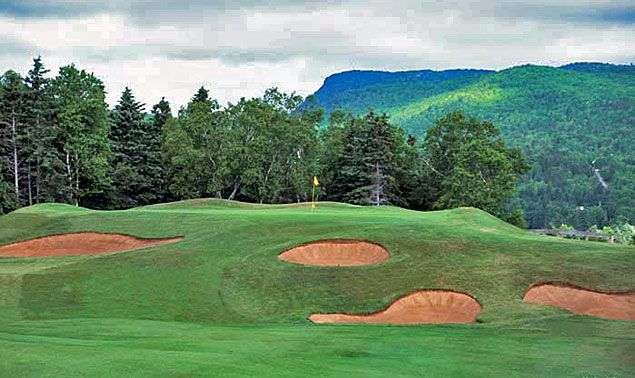
Highlands Links 4th hole
The Knoll’s concept sets itself up very well for Par 3 play, and several great examples exist around the world. The headliner is “Het Girdle” the 5th at Gleneagles King’s course, where Braid one-upped his original, both in terms of challenge and aesthetics. Rather than one bunker, Braid placed three deep bunkers into the front of the hill. A fourth bunker out front serves a “Shelly” purpose for those truly spooked at the tee. The trick is not to be fooled into missing long. Although the second-cut will probably slow down a hot downhill chip before it rolls into a front bunker, players shouldn’t test the odds. Left and right are the places to miss...but they aren’t much better than the don’t-miss places. Coming away with a par without also achieving GIR is unlikely.

Gleneagles King's course 5th hole
One concept traditionally attached to Donald Ross is the “Volcano” idea, which is essentially a “Knoll” Par 3. Sometimes the Scot would use one of his signature crowned greens for particular challenge, but the “Pulpit” hole at the Country Club of Buffalo is more traditional. The course sits atop an old quarry, and Ross dealt with a large rock formation by covering it with soil and adding a green. Playing 186 yards, No. 6 features a bunker at the right, as with Scotscraig, as well as an apron of fairway. Although this last element sounds friendly, it also encourages tee shots just a touch short to roll back down the steep grade, potentially to the bottom of the hill. Those who go too far will find an even less gracious up-and-down waiting. The lumpy limestone base creates a curious mess of bumps and humps at the back, a virtual Plinko board for overlong shots. Where you end up is anyone’s guess.
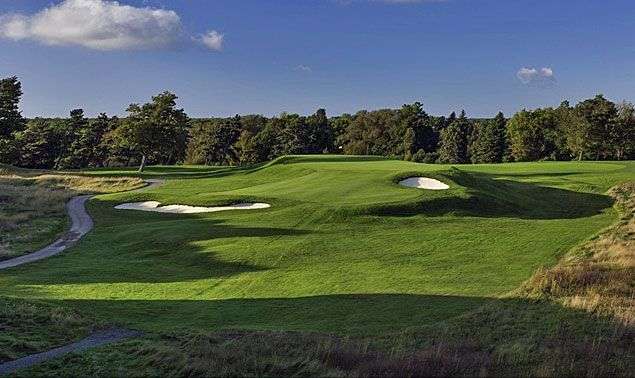
Country Club of Buffalo 6th hole - image courtesy of the CC of Buffalo
MAYBE… MAYBE NOT
Defining a “Knoll” is simple. Defining what is not a “Knoll” is less so. We understand that the green must be on a hill, which slopes away in all directions. But in the “Golden Age” of golf course architecture, raised greens of this ilk were common. Where does one draw the line? We’re opting to draw the line in terms of height. Does the amount of elevation from fairway-to-green live up to the challenge set by Braid at Scotscraig?
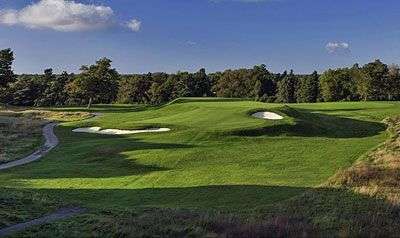
Consider the “Knoll” No. 14 at Yale. This one takes some special explanation because it is not named after the “Knoll” template at all. The title hill is actually set on the left side of the fairway, providing any number of odd lies and sporadic bounces from the tee. That said, Charles Banks acknowledged Scotscraig’s “Westward Ho” was indeed the inspiration for the hole. The green is raised and slopes down from all sides, but we would contend its eventual height doesn’t quite pack the punch of Macdonald’s effort at Piping Rock.

Yale golf course 14th hole - image courtesy of John Sabino
Sleepy Hollow Country Club receives a similar rebuff, although it should be noted that its current “Knoll” hole No. 9 (“Katrina’s Glen”) was not a contribution from Macdonald, Raynor or Tillinghast. Rather, Gil Hanse recommended upon his renovation that the club be restored to a 100% Macdonald vision. Thus Hanse replaced Tillinghast’s contributions and built a hole on the south end of the property that was relatively similar to Yale’s “Knoll,” albeit with a wobbling green more in line with his own at Streamsong Black.

Sleepy Hollow Country Club 9th hole - image courtesy of Gil Hanse
And, finally, to continue Tillinghast’s bad luck, we’re also going to rule out his contribution at Baltimore Country Club, both in terms of the green’s height and also due to a curiosity off of the tee. Players must cross a fairway crest to reach the presumed landing area. “Presumed” because, at 235 yards from the back tee and 220 yards from the green, it’s not so bad a thought for a skilled player to lay up to the top of the crest and play downhill to the green, rather than make an uphill approach from down in the “presumed” area. Needless to say, a downhill approach takes “Knoll” off the table.
A Biarritz hole is one of golf's most theatrical par 3s: a long carry to a massive, elongated green bisected by a dramatic swale or depression that divides the putting surface into two distinct plateaux. Named after the French seaside resort where the original hole once stood, the Biarritz has challenged golfers and sparked architectural debate for over a century. Most template holes replicated by C.B. Macdonald—the father of American golf course architecture, who pioneered copying famous holes and adapting them to new sites—and his disciples draw inspiration from originals in the British Isles, the homeland of golf. The Biarritz is a rare exception, most commonly traced back to the south-west coast of France, in the region of the same name. There, Tom and Willie Dunn Jr. crafted one of the most famous and infamous par 3s in history. The Original: A Hole Lost to History The "Chasm" hole (the current name for the template is derived from its original host club, not the original hole name) at Golf de Biarritz Le Phare featured a heroic carry over the titular chasm, approximately 160 yards, to a massive putting surface. The third hole's target area featured two large flat zones—one at the front and one towards the rear—divided by a drastic swale running between them, and guarded at the sides by bunkering. It is believed that only the rear platform was ever pinned—totalling between 210 and 240 yards—making the hole essentially a test of a player's ability to hit both long and straight (this was certainly a driver during the Dunn brothers' time in the 1880s). The rest of the putting surface's dimensions are largely conjecture, as the original lasted only four years before construction of a hotel moved the teebox and took the bay out of play. The original green and hole would eventually be eliminated and, later, decimated during World War II. Furthering the mystery is the unlikelihood that Macdonald could have found himself in France during its brief existence. All of these factors—or lack thereof—add up to occasionally contentious conversation amongst golf architecture enthusiasts about what constitutes an authentic Biarritz. Defining Features of a True Biarritz Whilst interpretations vary, most architecture historians agree a Biarritz should include: Length: 180-240 yards (though modern versions may stretch further) The swale: A deep depression dividing the green Two plateaux: Distinct front and rear landing areas, traditionally both cut to green height. Purists claim only the rear was pinned. Massive scale: Greens typically 60-80 yards, or more, deep Strategic question: Can (or should) the front plateau be pinned? Classic Biarritz Examples Macdonald's template showcase, the National Golf Links of America, doesn't feature the model. Instead, Long Island's Piping Rock Club hosts the designer's first Biarritz. In the absence of official documents, the Biarritz swale has traditionally been understood to fit within a range of 1 to 1.5 metres in depth, which describes Piping Rock's variant well. Lacking a bay, Macdonald added a large bunker in front of the first plane. It's important to note that this landing area is not green, but fairway, running down into the swale, which features a similar cut. The effect is a rather micro-version of the Valley of Sin at St Andrews, forcing a tricky up-and-down recovery for shots short off the tee. These specifications inspire the most vocal arguments about whether the front could—or should—be pinned, and whether that act violates Macdonald's intentions. It appears one person who didn't see an issue pinning the front was Seth Raynor, Macdonald's nearest disciple. His Course at Yale hosts perhaps the most famous rendition of the Biarritz, and perhaps the most dramatic as well. Players must carry nearly 200 yards of water to where the green immediately begins, through a swale, to the back plateau. To compound your problems, the green tilts aggressively both front-to-back and right-to-left. Whilst a more "dignified" template, such as the Redan, might flaunt its subtle tweaks from the original, the Biarritz seemingly encouraged imitators to push the envelope ever further. Charles Banks created one of the longest versions at Forsgate Country Club in New Jersey, stretching to 235 yards. Not taking his nickname "Steamshovel" lightly, the designer also added Raynor-style thumbprints—shallow depressions—to both of the green's flat surfaces. The most controversial element, however? His swale can be pinned. Getting back to Macdonald, The Creek gets a nod for its distinct rendition. Missing the green isn't enviable for any Biarritz, but The Creek's takes it to a new level via its Biarritz/Island hybrid. It's a big target, but tee shots are easily pushed by aggressive winds into the Long Island Sound inlet. Modern Interpretations The naturalist tendency of the 21st century has made this template a less-likely choice for new courses, but a few true Biarritzes have emerged. One of the more straightforward versions is the 16th at Streamsong's Red Course in Florida, featuring a 70-yard green that plays between the property's dunes. Tom Doak included a Biarritz-based hole at Bandon Dunes' Old Macdonald, but the Oregon resort's naturalist aesthetic raises some doubts amongst purists. The green does take a pill shape and features a swale through the middle. On either side of the swale, however, Doak enacts rolling features more in keeping with his Pacific Dunes design than the relatively plain planes of traditional Biarritz. And, at 180 yards, it is short even by Dunn's old-fashioned standards. Contested Variations: Where Does the Template End? The most famous examples of the Biarritz don't leave much room for subtlety. Accordingly, some of the more debatable examples are guilty of underdoing rather than overdoing. There is no doubt that a Biarritz green can accomplish its purpose as part of a long par 4 or short par 5, but two of the more notable examples raise questions about whether the template can survive a change in par. For example, A.W. Tillinghast included one at Somerset Hills Country Club in New Jersey. Perhaps because of the 13th hole's two-shot nature, his swale is much shallower than the holes referenced above. This alters the approach, but is it watered down enough to strip the "Biarritz" title? The architecture community remains divided. The "Gate" hole at North Berwick Golf Club in Scotland does more than inspire questions about the nature of the Biarritz; it inspires questions as to the template's origin story. The approach shot on this par 4 is much shorter than a typical Biarritz, but the green is much more severe. Similar to the course's iconic Redan, the green tilts down from front-right to back-left, and is divided by a gully reaching Yale-level depths. If the concept alone weren't enough to stir the pot, some suggest that Gate may be the true inspiration behind the Biarritz. North Berwick was founded in 1832, and Macdonald had decisively visited, unlike the Chasm hole. Two facts take some wind out of this theory, however: first, most historians agree that Gate was added in the 1930s, and it's suspected that Bernard Darwin didn't mention the green during his 1920s visit. Second, Macdonald named the template "Biarritz," not "Berwick." The Bottom Line Despite the mystery surrounding its origins and the ongoing debate about what constitutes an authentic example, the Biarritz remains one of golf architecture's most compelling templates. At its best, it presents a thrilling all-or-nothing shot that separates the bold from the cautious—a test of both distance and precision that has captivated golfers for well over a century. Whether you believe the front plateau should be pinned or consider North Berwick the true inspiration, Biarritz's dramatic swale continues to spark conversation and challenge players at some of the world's finest courses. Originally written by R Book. Edited by J Miners.

The Long Lost Lido Found — Twice Most years feature one piece of golf course-related news that dominates the others. The opening of Bandon’s Sheep Ranch was quite the headline for 2020. A short way into 2021, and another Mike Keiser project is already the talk of the town: A recreation of the legendary Lido Golf Club, to be constructed near the Sand Valley Golf Resort in Central Wisconsin. The hubbub is justified by years of growing interest in golf course architecture, and particularly the philosophy of Charles Blair Macdonald. The stockbroker was dubbed “The Evangelist of Golf” by writer H.L. Whigham, and his template approach to course design — incorporating influence from the world’s most renowned holes, as seen at the National Golf Links of America — has been a central concept to the study of “The Golden Age” of golf course architecture. National Golf Links of America 4th hole - Redan The Lido was another Macdonald design, and one that fell into oblivion following the second World War. Such was the acclaim from players and experts during its time that it has become an object of fascination for modern architecture enthusiasts. That it would soon (2023) be available to the general public (or at least those staying at Sand Valley) inspired a wave of celebration. Amid the noise, you hardly would have guessed that another new Lido had opened in just the past year. Gil Hanse and Jim Wagner led the creation of a modern Lido at the Ballyshear Golf Links in Thailand. Ballyshear 12th green Two recreations of the same classic golf course, within the period of just a few years? How does one explain the sudden rush on Lido? Macdonald’s NGLA has always been a mainstay of architectural discussion and remains so to this day. Conversations on his acclaimed templates — including the Redan, Eden, Alps, and Long among others — almost always include the version from NGLA. A slew of originals at Lido, less prominent among Macdonald and Seth Raynor’s future designs, offer intrigue. NGLA 9th hole Long - image courtesy of Jon Cavalier @LinksGems Macdonald invited readers of Country Life and amateur architects to submit original designs for inclusion—with the entries judged by Bernard Darwin, Horace Hutchinson and Herbert Fowler. The winner was Alister MacKenzie, whose multi-fairwayed “Home” closed the routing. No. 15, named “Strategy,” was unofficially submitted by Tom Simpson (as he was an affiliate of Fowler, a judge). Raynor is believed to have adapted what would become known as “Raynor’s Prize Dogleg” from another submission, which became the No. 6 “Dog’s Leg” hole. Perhaps the club’s most iconic hole was the debut of the “ Channel,” a Littlestone-inspired par five that dared the bold to hit its island fairway on the way to an eagle opportunity. Littlestone Golf Club - 16th hole Channel - image courtesy of Littlestone Golf Club NGLA, however, was built for skilled amateurs and featured two U.S. Amateur champions among its membership. The Lido was longer and meaner, perhaps designed to test professionals and match Pine Valley’s notoriety as a man-eating test of golfing will. “Lido if you know it is like a boiled New England dinner, which if it doesn’t kill you young will make you a very husky citizen, set to digest anything that comes your way. So it is with Lido,” wrote Bernard Darwin for The Brooklyn Daily Eagle. “Once you’ve become inert to these ferocious carries and the all-engulfing rough, the iron has entered your soul and you are capable of tackling any golf course that the genius of Charlie Macdonald or Seth Raynor or Walter Travis can conceive.” Bret Lawrence, a golf historian, notes that the Country Life contest specifically calls for two-shot holes, suggesting Macdonald didn’t want another short hole. “He wanted two-shot holes, which are basically two full-shot holes,” Lawrence explains. “You could kind of get the sense from there that he wanted more of those as opposed to a drive and pitch kind of hole, which would make it shorter. He was looking for more strategy in the longer holes...because he wanted to test the professionals.” The originators, however, weren’t professionals, but wealthy New Yorkers who had previously tapped Macdonald to build clubs such as Piping Rock. With names like “Vanderbilt” on the ledger, no expense was spared, and earth was moved to such a degree as to put Whistling Straits to shame. Piping Rock Club 13th hole - image courtesy of Jon Cavalier @LinksGems “It almost seemed like they were trying to develop the area,” says Lawrence. “There was nothing out there at the time.” Those plans hit the skids with the onset of World War I and the original investors had lost interest by the Great War’s conclusion. The next buyer was William Reynolds, a former senator who began the area’s real estate boom and built a hotel, putting the retitled Lido Beach Golf Club on the map for the wider population. At its peak, the club featured more than 1,000 members. Unfortunately, that peak ended with Reynolds’s death; between his family and other investors, the “all-engulfing rough” soon received less care. Even at its critical peak, Macdonald was disappointed in the upkeep. “What he was unhappy about was — he mentioned this in Scotland’s Gift — that they didn’t keep up the golf course,” explains Anthony Pioppi, executive director of the Seth Raynor Society. “I think he expected the Lido to be treated the way National treated its golf course.” The U.S. Navy assumed control of the property during the next World War and it never returned. The legend, however, lived on, culminating with the new projects from Hanse and Tom Doak, who will be handling the Sand Valley installation. Those two projects will ultimately provide radically different Lido experiences, however. The Ballyshear Links is much less a carbon copy, due to the limits of the property Hanse and Wagner had to work with. The pair pitched the project to the owner of the Ban Rakat Club, understanding that they would need to tweak the original routing a smidge to make it fit, and their approach would be more in line with Macdonald’s approach at NGLA; creating interpretations of the historic holes versus clones. “Normally...we feel strongly that a golf course should be the product of its surrounds. But in the back of our minds, my partner Jim Wagner and I have often wondered what we would do with a completely flat site — what can you do to distinguish it?” Hanse said in a statement. “The most famous example of a manufactured golf course from The Golden Age was The Lido. Jim and I had always wanted to do a Macdonald/Raynor, angular grass-faced bunker design. We pitched the idea to the owner at Ballyshear and he loved it.” And that’s where Doak’s Lido will be different: The plan is an almost exact clone of the original Lido, built in Wisconsin rather than Long Island. Such a feat is possible because of technological advances. Peter Flory, a Chicago-based architecture enthusiast, has been building a 3D replica using the course design feature of The Golf Club computer game. That prompted a call from Doak, who had watched Flory’s progress via Golf Club Atlas. What began as a Flory’s passion project became the driving force for the course’s recreation. “I would not have agreed to take it on if I didn't think Peter's work gave us a chance to do it accurately,” Doak told Top 100 via email. Still, Hanse’s rendition didn’t require such digital wizardry, so the sudden Lido lean can’t all be attributed to modern tech. So why now? For Doak, Flory’s work represented a potential punctuation for a sentence that had begun long ago. The architect had previously created a tribute to Lido’s designer for Keiser, with the Old Macdonald course at Bandon Dunes. This track, like Macdonald himself, aimed not to replicate anything but rather adapt existing templates to the Oregon landscape. Apparently, even during 2005, Lido was on Keiser’s mind. Doak says the resort magnate expressed his interest in recreating the Lido while the pair discussed the third course at Bandon. Old Macdonald 4th hole - image courtesy of Bandon Dunes Bandon was blooming at that time, but Keiser’s resort ownership has only grown since then, operating nine 18-hole courses (and accompanying par three courses) between his three resorts. Doak suggests the root of both Keiser’s windfall and Lido’s rise is the relatively recent appreciation for golf course architecture. “There is 100-times more interest in golf architecture nowadays. Forty years ago, when I was a student, you were lucky to find a copy of Colt's or Macdonald's books through interlibrary loan,” he says. “Websites like Golf Club Atlas, podcasts like Andy Johnson's (The Fried Egg) and Derek Duncan's (Feed The Ball), and the golf magazines have all made golf architecture far more of a mainstream topic. They even talk about it on TV a little bit!” That still doesn’t explain “why Lido?” Why wasn’t someone like Keiser interested in restoring, for example, Ocean Links (Raynor’s nine-hole neighbor to Newport Country Club ) or the original El Caballero (Billy Bell’s masterpiece in the Los Angeles hills, prior to the club changing locations)? Simply put, the amount of information on these courses pales in comparison to Lido. “I think Lido is in a class by itself in that regard; it was much more well documented because of who designed it, because of the contest that helped make MacKenzie famous, et cetera,” Doak says, admitting even he knows relatively little about other lost tracks. “I'm a bit of a geek about this stuff, and I don't know one-tenth as much about the other courses you mentioned.” Information does exist, however, and there are certainly golf history buffs looking for it. Flory has begun creating a similar 3D model of Ocean Links, sharing his progress on Golf Club Atlas. A rendering of Sand Valley’s Lido by Peter Flory With that in mind, could the current Lido projects portend future projects focused on tributes to, and total recreations of, legendary golf courses? And if so, is that necessarily a good thing for the current state of course architecture? Pioppi is wary. “I do think that’s going to be a trend. I think because of this technology, people are going to be able to recreate holes. I mean, what’s to stop somebody from recreating the Old Course in Wisconsin? With this kind of technology, who knows?” he says. Still, he can accept such things if it means more eyes on golf course architecture. “For me, the bottom line is people are talking about architecture, which is good.” One “victim” of the Lido project is Doak’s “Sedge Valley” Swinley Forest concept, an original 6,100-yard course on the Sand Valley property. It will eventually happen...but not until the Lido wraps up. Doak doesn’t begrudge the Keisers for prioritizing the new project over his original design...but he does make a lighthearted jab at golf media’s (including Top 100) role in the narrative. “Unfortunately, this interview and all the others are demonstrating that the idea generates a lot of free publicity...more of it than my proposed third course at Sand Valley did,” he says. He states that Lido would be his only personal recreation. He compares the value of the project to his work restoring the Chicago Golf Club and others, preserving the legacy of architects he admires. “If I didn't think this particular course was worth restoring, I certainly wouldn't be doing it.” If we’re being accused for feeding the furor that results in the recreation of a legendary golf course, we’ll plead guilty! We’re looking forward to playing both new Lidos sooner rather than later. That said, we’re equally looking forward to celebrating what golf course architecture will be, and not just what it was.

Gil Hanse's recreation of the lost, legendary Lido to open in August 2021 Gil Hanse has already made waves designing courses abroad, making his South American debut with the host layout for the Rio 2016 Olympic Games. He wasn’t necessarily looking to compete with that when making his Asian debut, however the concept was bound to create headlines: A recreation of the lost, legendary Lido Club. Now that long-discussed course, the Ballyshear Links just outside of Bangkok, has an opening date: August, 2021. The course will be hosted at the Ban Rakat Club — a highly-exclusive establishment, reportedly with only 400 members —which is chaired by Takeyasu Aiyama. Aiyama is also the chairman at Yokohama Golf Club. Bill Coore and Ben Crenshaw had done renovations at that club, and Aiyama was looking for inspiration for the property to become Ban Rakat. Interestingly, Coore recommended Hanse. Hanse and Wagner arrived at the property in Thailand and did not necessarily find anything evocative in the terrain. In fact, it was almost pancake flat. That opened another door, however, allowing Hanse and Wagner to apply their “caveman” personas and move more dirt than usual to create a bolder concept. Few concepts could be as bold as recreating the iconic Long Island club. Charles Blair Macdonald and Seth Raynor were known for their template-based approach to golf course design, which resulted in some of the world’s greatest golf courses, including the National Golf Links of America, Fishers Island, Chicago Golf Club and more. Although legend helps create hype, some hypothesize Lido may have been superior to all of them. Ballyshear 12th green Macdonald and Raynor were not at all “minimalists,” and Hanse and Wagner saw fit to emulate that historic pair’s approach with this piece of land. “Normally...we feel strongly that a golf course should be the product of its surrounds. But in the back of our minds, my partner Jim Wagner and I have often wondered what we would do with a completely flat site — what can you do to distinguish it?” Hanse said. “The most famous example of a manufactured golf course from The Golden Age was The Lido. Jim and I had always wanted to do a MacDonald/Raynor, angular grass-faced bunker design. We pitched the idea to the owner at Ballyshear and he loved it.” Ballyshear 14th tee The name “Ballyshear” is derived from the name of Macdonald’s own estate on Long Island. As with almost all of Macdonald and Raynor’s designs, template holes based on Macdonald’s travels in the UK were the basis for Lido’s design. If you’ve been keeping up with Top 100’s template architecture series, you’ve already learned about a few holes at Lido. The most famous hole at the course was the “ Channel,” based on Littlestone’s No. 16 hole. At the Lido version, players had the option to significantly shorten a long par five by first making a bold drive from the tee over the title “channel” to a rightward fairway, followed by another long, quality approach. It is near the ultimate in risk/reward, requiring two near perfect shots or else penalty will ensue. Ballyshear 17th hole Another example you’ve seen on this site is “ Narrows.” Although there is some debate whether the opener at Lido qualified, Macdonald did make a comparison between the two holes, with their respective fairway bunkering pinching the fairway. Other history was made at Lido as well. Although Alister MacKenzie no doubt would have found some success eventually as an architect, Lido represented his “breakthrough” moment. Country Life magazine held a contest for design submissions, which MacKenzie won with an entry that has come to be known as the “Lido” template. Macdonald and Raynor were so impressed by this multi-fairway par four that it ended up being used as the closing hole. The Lido also marked the debut of the minor template known as “Raynor’s Prize Dogleg,” a long par four requiring a long, precise tee shot to get home in two to an undulating green. Although named for the famous architect, it was actually an adaptation of another entry into the Country Life contest. Not that anyone reading this post will have played the original Lido, but if the golf historian gets the chance to play at Ballyshear, they will notice the routing is almost a perfect replica. “Almost,” as the property required the second and sixth holes to be switched to make the concept work. A small detail, probably not to be mourned by architecture enthusiasts. Ballyshear 18th tee For what it’s worth, Hanse is most keen on the final pair of holes, based on the “ Long” template and of course MacKenzie’s contribution, respectively. “At Ballyshear, I think the 17th and 18th, with their shared waste bunker between them, came out extremely well,” he said. “The scale of those two holes at Lido was impressive and we were able to capture that at Ballyshear.” Ballyshear will be the first Lido recreation to market, but rumors abound that Mike Keiser is looking to build a similar project near his Sand Valley Resort (albeit a private course in this case) in Wisconsin, with Tom Doak at the helm. Keep your eyes on Top100GolfCourses.com for updates on both projects.

