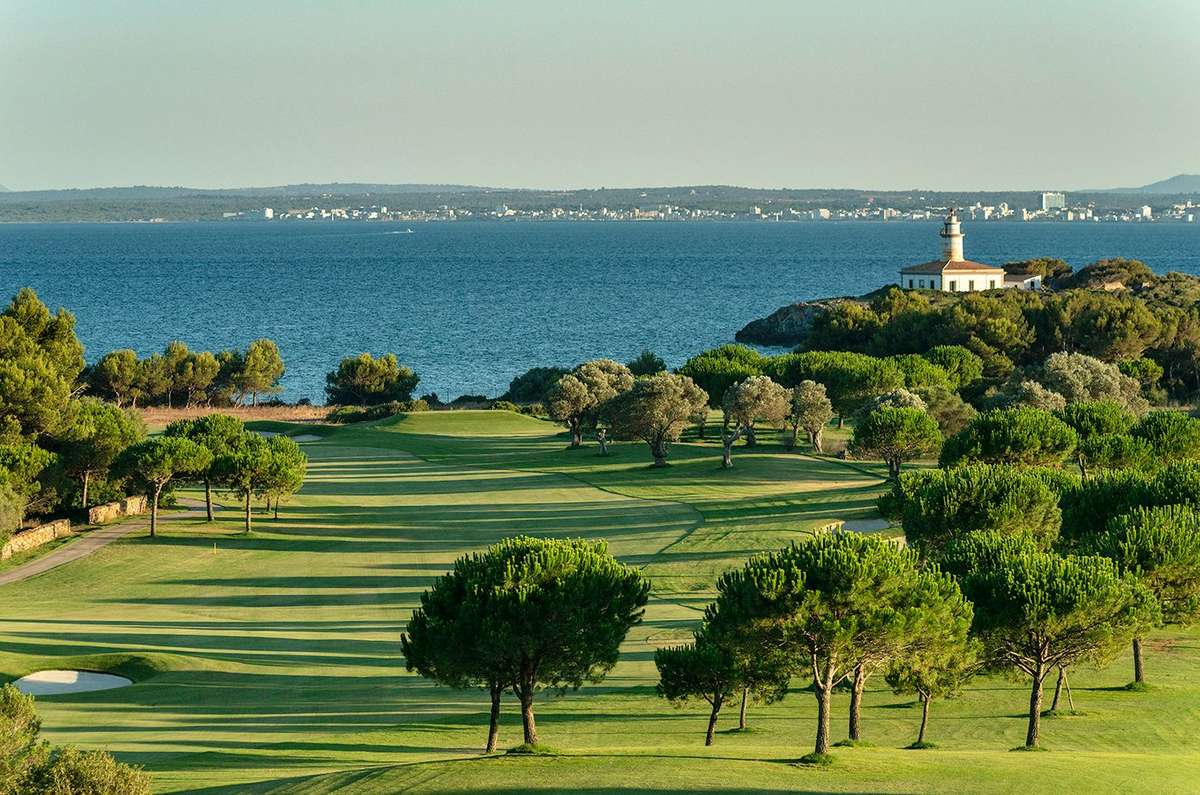
Marvellous Mallorca – where good golf abounds
Last month, we looked at golfing options across the Canary Islands so we’re now turning our attention a little closer to mainland Spain and the island of Mallorca in the Ballearic Islands.
One of the clubs we visited near Palma last month published an in-house magazine article which reckoned almost 9 out of 10 rounds on the island are played by visiting golfers (44% Germans, 17.5% Spanish, 14% British, 10% Nordic) and this obviously generates a substantial financial benefit to the local economy.
Without the usual large numbers of incoming tourists over the last two years due to covid travel restrictions, it’s a minor miracle that all the clubs have survived.
Manfred Mallon, managing director of SIEMA Golf & Print, states in the excellent little pocket book Mallorca Golf Guide 2022: “Almost 90% of the golf courses in Mallorca are economically managed and depend on golf tourists and green fees. And a golf course doesn’t have many opportunities to save money… the maintenance and management measures have to continue.
I got a personal impression of the condition of the golf courses at the beginning of this year and I am positively surprised in what good condition the courses are in. If travel conditions permit, come to Mallorca as usual and play your favourite courses.”
Most golf facilities are situated in either the northeast or southwest of the island, near the main city of Palma de Mallorca. When we last published a Mallorca article six years ago – entitled Golf in the Spanish Balearic Islands – we stayed near the capital so this time we branched out to the northeast, allowing easier access to the cluster of five golf courses in that part of the island.
CARROSSA HOTEL SPA VILLAS

Part of the Hamacher Hotels & Resorts group with four holiday residences in Austria and Mallorca, the 5-star Carrossa Hotel Spa Villas sits just outside the small village of Artà, making it the perfect golfing base for visitors playing any of the five golf courses that operate in the local area.
There are 75 air-conditioned rooms and suites located in either the 300-year-old historic manor house or in several new single-storey luxury accommodation blocks. The spa boasts an indoor and outdoor swimming pool and there’s a wide range of treatments to complement the saunas and steam bath.
Bistro Badia is open all day, offering tapas, sandwiches and salads during the afternoon then anything from steak to fresh seafood in the evening. The Carrossa Restaurant presents fine dining options from 7pm in the evening, with meals served as a 4-course option or à la carte. The wine cellar also stocks the best local and international vintages.
A couple of attractive packages aimed at golfers include full use of the spa facilities, along with buffet breakfast and multi-course gourmet half-board. The 4-night Golf Package permits play at two nearby courses whilst the 7-night Premium Golf Package allows guests to tee it up at four courses (one of which is Alcanada).
ALCANADA

Club de Golf Alcanada nestles to the north of Carrossa, a 45-minute drive to the other side of Port d'Alcúdia, and not only is it the best golf course on Mallorca, it’s also highly ranked in both our Spanish and Continental European Top 100 listings. Designed by Robert Trent Jones Junior, this is a championship layout that’s scheduled to host the season-ending Rolex Challenge Tour Grand Final in November this year. It takes a bit longer to get here than it does to reach the other four northeast courses but it’s well worth going the extra few kilometres to play this magnificent Mediterranean beauty.
PULA

Located a mere 13 kilometres from Carrossa, the modern-day course at the Pula Resort is quite a bit different to the one unveiled in the mid-1990s. According to Esencia Pula Golf 25 años which was published in 2020, José María Olazábal’s parting shot to owner Romeo Sala after a tournament in 1998 was “do you see this face? Look at it long and hard because it’ll be the last time you’ll see it around here. The course is (expletives deleted)!” Olly was eventually taken to task and between 2004 and 2006 he assisted in transforming the layout into a far more challenging affair so it was only fitting he should win his last professional event here at the Mallorca Classic during the renovation work in 2005.
SON SERVERA

Less than three kilometres away as the crow flies, lies the Club de Golf Son Servera, where Rafa Nadal holds a membership. It’s the second oldest course on the island and the only one owned by its members so there’s an entirely different feel to this place. Commander John Harris laid out the original 9-hole course in the late 1960s and another nine holes were added just a decade ago by Francisco López Segalés. Five of these new holes (from the 3rd to the 7th) are marketed as “The Pine Trap” and they constitute quite a challenge, with stroke index ratings of 12, 7, 1, 5 and 3.
CANYAMEL

The 18-hole layout at Canyamel Golf sits four kilometres to the north of Son Servera but there’s no direct road connection between the clubs so it takes 15 minutes by car (about the same time from Carrossa) to get here. The course is a late-1980s José Gancedo design, culminating in a par three closing hole that’s played to a three-tiered green benched into a hillside in front of the clubhouse. Configured as two returning nines, the course plays to a par of 73 with three par fives between the 13th and 17th holes.
CAPDEPERA

Capdepera Golf is situated a little further inland from Canyamel, with the course dating back to the late 1980s, when Dan Maples designed the layout. Maples is better known for his work in the Carolinas (his grandfather Frank was the long-time superintendent at Pinehurst and a construction engineer for Donald Ross) so it’s anybody’s guess how Dan was ever appointed to set out eighteen holes in the northeast corner of Mallorca! The first twelve holes below the clubhouse are set out in a valley that was once an almond plantation then the last six holes were hewn from a wooded hillside on higher ground, with the signature par three 15th offering panoramic views all the way to the coast.
Of course, it would be a shame to come all the way to Mallorca and not play any of the highly rated tracks around Palma so you’ll be doing yourself a big favour by arranging a game on at least one of the following three courses.
SON MUNTANER

Golf Son Muntaner is the flagship 18-hole course at the 63-hole Arabella Golf Mallorca resort and the layout at this European Tour Destination was designed by Kurt Rosskecht, opening its doors to visitors in 2001. The course was reseeded six years ago, using Bermuda Celebration on every fairway and Agrostis V8 on all the greens. A couple of new holes were also introduced at that time, indicating the willingness of Arabella to continually develop and improve its golf product.
T GOLF

The course at T Golf Calvia hosted the season-ending Rolex Challenge Tour Grand Final in 2020 and 2021 so there’s no questioning its championship-hosting capabilities. Originally opened in the late 1970s as Golf de Poniente, it’s one of the oldest layouts on the island but a substantial investment from new owner Heiner Tamsen since 2015 has taken the course to a whole new level. In recent days, T Golf acquired the Nicklaus-designed facility at Puntiro (which will now be known as T Golf Palma), making it an even bigger player now on the island.
SON GUAL

Son Gual Golf has enjoyed unparalleled success in the Spanish rankings since the course first appeared on the Mallorcan golf scene, occupying Top 10 positions in the national chart for three editions between 2014 and 2020. It took great vision by the owners to take a predominantly flat, largely featureless property and turn it into the top-spec track that it undoubtedly is – albeit with the expert assistance of architect Thomas Himmel and a very creative construction crew.
As Son Gual is positioned less than a 15-minute drive from the airport, it’s an ideal place to either start or finish a golf trip to the island.
Jim McCann
Editor
Top 100 Golf Courses

The Rain in Spain falls mainly at the wrong time Introduction Few of us expect our course back home to be at its best every day of the year. For example, we are a bit more tolerant of imperfect conditions in early spring when we get out on the course for the first time to kick-start the golfing season. Likewise, we do not expect the greens to be at their firmest during the heaviest of autumn rains. Yet, many of us show much less understanding for imperfections once we head to warmer climes on a golf trip. This is quite evident when reading golf course reviews online. Is this because the weather is so much better or are we not aware that the course maintenance issues are different? On Mallorca, one of four main Balearic Islands, three factors conspire to make autumn a trying time for greenkeepers, accounting for variable course conditions due to: a) mandatory irrigation with wastewater during the hot summer, b) occasional deluges and c) the transition between summer and winter grasses. Irrigation with wastewater Many parts of Mallorca consist of limestone substrata. Readers from London know this equates to hard tap water and crusty limescale in the kettle. Therefore, much of the island softens its drinking water with extracted salts going down the waste pipe. Furthermore, the many tourists enjoying Mallorca’s beaches in the summer put a lot of stress on the island’s limited freshwater resources as very little rain falls during the hot summer season. It may not come as a surprise to learn that golf courses on Mallorca are only permitted to use recycled wastewater for irrigation during the summer. Due to the water softening process, this wastewater is unfortunately high in salt, almost to the point of being toxic to grass. Not watering at all is not an option during a hot summer with temperatures way above 30oC (86°F). Ignoring the rules, by sinking an illegal well or borehole to extract freshwater, is not an option either and significant fines have had to be paid recently by some prominent courses. Therefore, course managers are doing all they can to treat this wastewater to make it friendlier to the grass. Despite these efforts, autumn is often spent recovering summer damage, whereas your greenkeeper back home has a similarly busy time in spring. Apart from repairing unsightly bare patches on fairways and greens, these efforts often also involve a lot of extra watering at night to flush out accumulated salt deposits and restore the chemical balance in the soil. Therefore, you might be playing a very wet course if you start early in the morning, even if no rain has been recorded for quite some time. The rain in Spain… Mallorca has a dry Mediterranean climate, but when it does rain, it tends to come in bursts, sometimes in very high quantities. Fortunately, this seldom happens over the whole island at the same time or for any extended length of time. The tourism industry in general does not mind, as it makes it easier to rent hotel bedrooms and sunloungers. Golf courses, however, have a more challenging time, as few courses anywhere have a drainage system that can cope with a 50 mm (2-inch) deluge in a few hours. Superintendents are often good at recovering the courses after these rainy assaults. But if you arrive a day or two after a very major downpour they might not have been able to cut fairways and there may still be standing water in some bunkers, despite the sunny weather you might now be enjoying. However, most courses drain well and very few have to shut completely for more than the odd day during a year. Another consequence of the irregular rainfall pattern is the plethora of ponds doubling as water hazards on most Mallorcan courses. Greenkeeping without the ability to store water is not a realistic proposition. Overseeding Mallorca falls into what is knows as the “transition zone” where neither warm nor cool season grasses grow successfully throughout the year. No strain of grass has yet been developed that will cope with hot summers and cool winters while withstanding golf carts and year-round traffic and still looking looking permanently happy and healthy. Therefore many courses alternate between a heat-resistant (warm season) grass that thrives in summer (often Bermuda) and a cool season strain that grows in winter (often ryegrass). This is achieved by verti-cutting the turf, topdressing and overseeding with the desired grass and, of course, watering a bit more and cutting a bit less than usual until the new grass has taken hold Course managers do their best by moving tees and restricting buggy traffic to paths only, but the fact of the matter is that you will be playing on a partially substandard surface for a short period and may be unlucky if you’re visiting during that time. Value-for-money Apart from conditioning, the main point of criticism levelled at golf courses on Mallorca concerns value for money. However much we like to focus primarily on design qualities, many of us make a conscious or subconscious value-for-money comparison when playing a new course… “How does this course compare with others where I’ve paid a €100 greenfee?” When considering value-for-money do remember that compared to most clubs in Northern Europe and the British Isles, Mallorcan courses have to spend much more on water, both in terms of capital investment (ponds, treatment plants etc) and in terms of ongoing water rates and maintenance costs. Also, golf courses on Mallorca are commercial operations, which are open 365 days a year with greenfees as their main source of income. Most facilities further north are member-owned clubs, some of which set a low green fee to attract marginal revenue from additional guest play. This point is further underscored by the fact that peak season green fees for 18 holes vary from €60 to about €150, whereas the gap between the least and most expensive green fees tend to be much bigger further north. Conclusion The purpose of this article is not to warn you from visiting Mallorca as a golfing destination – quite the contrary – but to help you understand why course conditions vary, even in the autumn high season. In reality, Mallorca is a great place to go golfing in spring and autumn, especially if you want to combine your golf with other things like hiking, cycling, wine tasting or more traditional sun, sea and sand holiday pursuits. Some of the points raised in this article are likely to be equally valid for other destinations. Who knows, with climate change advancing these issues might soon have some relevance for the golf club you belong to back home? This article was written by one of our regular contributors (who does not wish to be credited) after consulting with a number of course managers on the island of Mallorca.

Golf in the Spanish Balearic Islands The Mallorca Press Cup showcases some of the island’s best courses At the moment, we feature a dozen courses from the Balearic Islands, which represents only 10% of the Spanish layouts in our regional and national charts. It may be only a small fraction of the overall number of Iberian tracks that we promote but it’s an important cluster, attracting an ever-growing number of golfers who visit the islands every year. The Mallorca Press Cup, sponsored by Arabella Golf, Starwood Hotels and Air Europa, is intended to showcase some of the best golf facilities in Mallorca so Top 100 Golf Courses was delighted to receive an invitation this year to participate in the 7th edition of the event. Based in the wonderful Castillo Hotel Son Vida, one of three prestigious hotels in the Arabella Golf portfolio, golf writers from the UK, Sweden, Germany, Spain and the Netherlands made up the majority of the thirty-two journalists and top junior players taking part in this year’s tournament, with competitors from Belgium, France and Italy also appearing for the first time. Before the 2-day event got under way, we thought it might be a good idea to have a proper look around the Arabella Golf Resort as it boasts three impressive 18-hole layouts and a 9-hole pitch and putt course. As only one of Arabella’s courses was being used for the competition, it made sense to arrive a day early to check out the other two. And so, we joined up with respected French golf writer Roland Machenaud on the eve of the tournament to play Arabella’s Son Vida and Son Quint courses. We knew in advance that Son Vida was the oldest layout on the island, set out fifty years ago by Fred Hawtree – what we didn’t know was that it had hosted a couple of European Tour events back in the early 1990s, won by Seve Ballesteros and Barry Lane. A fabulous new clubhouse is currently being built in a magnificent position, high above Son Vida’s 18th green, and this is scheduled to open in Spring of next year. Bernat Llobera, the Arabella Director of Golf, assures us the fabulous action photos of Seve that currently adorn the locker room walls in the old clubhouse will be reinstalled in the new building, preserving some treasured items of Spanish golfing history. The tight, roller-coaster playing corridors of Son Vida were something of a throw back in time as it’s hard to imagine any modern day course ever being designed nowadays to co-exist in such close proximity to the substantial residential properties that back onto many of the fairways on the opening twelve holes. By way of contrast, the newer Son Quint course was not nearly as confined, even though its fairways occupy a more compact site. The short par four 8th is one of the quirkiest holes you will ever play, squeezed into the south west corner of the property, where a blind approach shot can be played to the green over a high-walled tennis court at the foot of an adjoining property! On the back nine, the 195-metre 12th is as tough a par three as you will find anywhere. One of only three short holes on the card, it requires a forced carry across water from the tee to find the green – and for those who attempt to bail out to the left, there’s a cavernous bunker just waiting to gobble up golf balls. After 36-holes of golf, it was time to return to the Castillo Hotel Son Vida to meet up with the other newly arrived Mallorca Press Cup competitors. Before a buffet dinner in the hotel’s El Castell restaurant, Pilar Carbonell, the manager of the Mallorcan tourist authority, was introduced to the assembled group and he expressed the hope that everybody would enjoy their short stay before “leaving as ambassadors for the island”. And so, next day, it was on to the Son Muntaner course, which is marketed as the number 1 layout at Arabella Golf. There’s no doubt it’s a cut above the other two courses, though it’s in something of a transitional state right now because land that had previously been set aside for another hotel is now being used in the design of two new holes. Even more radically, the course will close from March to October next year when it will be totally overseeded with Bermuda Celebration, a type of grass which is currently being introduced on a number of other top-end courses on mainland Spain. Such a progressive move is indicative of Arabella’s intention to keep one step ahead of the others in Mallorca’s fiercely competitive golf market. When play was done for the day – and with Italy, France and Netherlands occupying positions 1, 2 and 3 in the competition – it was time for a tapas dinner in the Bodega del Green restaurant in the Sheraton Mallorca, one of the other two hotels operated by Arabella Golf, before transferring back to the Castillo Hotel Son Vida. And so to the final day of the short visit, where the golf action moved on to Golf Maioris, on the other side of the Bay of Palma, which is owned by Air Europa, one of the sponsors. A little less polished than the other three Arabella layouts, Maioris has more the feeling of a golf members’ club (as opposed to a modern resort) which was a very pleasant surprise. Apart from a couple of dubiously designed holes, this linksy layout was a real treat to play and a fitting track to conclude the trip. Having returned to base and with dinner concluded, Golf Director Bernat Llobera presented the Mallorca Press Cup prizes. He revealed that the 4-man team from the Netherlands had overtaken their French counterparts to claim the runner-up position but the winners, by just one point, were Team Italy, who lifted the trophy at their very first attempt. However, once the cheering had died down, it was unanimously agreed that Mallorca Golf was actually the real winner. As part of our biennial re-ranking exercise for our Spanish Top 100, we took the opportunity to consult with a number of local golfers about the current Balearic golf scene. The most prominent of these correspondents was Elmar Schreiber from mallorcagolf.info, a website that performs something of a golfing quality control function on the island, visiting every course on a regular basis to basically check that standards are being maintained. We’re grateful for the feedback that we obtained from Elmar and from the others that we conferred with. We’ve still to finalise our new Top 10 for the Balearic Islands, never mind our Top 100 for Spain, but it’s hard to see either Son Gual or Alcanada, both of which the Top 100 team visited a couple of years ago, being seriously challenged at the top of the regional standings. Our poll of local journalists did indicate strong support for the courses at Canyamal and Son Serva in the north east of the island so we’ll make a point of checking those two out when we next visit the island. Golfers are certainly not lacking in choice when visiting Mallorca, with more than twenty places to play, half of which we publicise in our Balearic Islands chart. If you think there’s one that shouldn’t be there or alternatively, if there’s a favourite of yours that we’ve missed, then please let us know by clicking the “Respond to this article” link above and below. If you’ve played any of the featured courses then please post a review or reply to any of the reviews already posted. Sincere thanks to Christine Crespo, Director of Corporate Communications for Starwood Hotels Mallorca, for the ultra-smooth running of the Mallorca Press Cup. Her attention to detail was fantastic as she effortlessly looked after the transportation, accommodation and other logistical needs of more than thirty very demanding visitors. Gracias y nos vemos de nuevo en algún momento. Jim McCann Editor Top 100 Golf Courses

Spain’s golf courses continue to set the standard for Continental European golf, with the 2026 rankings showcasing unprecedented stability at the summit alongside remarkable movement in Madrid's most prestigious clubs. Real Club Valderrama retains its crown for another year, whilst Real Puerta de Hierro's Arriba course surges into the Top 5, and Real Moraleja 2 sees a dramatic rise. The latest Top 100 Golf Courses of Spain rankings reflect deeper panellist coverage across all regions, from Andalusia's resort-lined coastlines to the Basque Country's clifftop layouts. With 27 new entries joining the rankings and significant repositioning throughout, these updated listings provide essential guidance for golfers planning trips to Europe's premier year-round golf destination. Spain's 345 courses serve more than 269,000 registered golfers and attract millions of international visitors annually, generating substantial tourism revenue whilst maintaining world-class playing conditions across diverse landscapes. Check out the Complete Spain Ranking now! See the ranking for the Balearic Islands See the ranking for the Canary Islands See the ranking for Madrid and Central Spain See the ranking for North East Spain See the ranking for Northern Spain, including Basque See the ranking for South East Spain See the ranking for Southern Spain - Costa del Sol 2026 Rankings: The Established Century The 2026 rankings maintain the traditional Top 100 format whilst introducing 27 fresh perspectives that reshape the lower half of the table. Spain's golf infrastructure supports this depth, with courses ranging from Robert Trent Jones Sr.'s 1960s masterpieces to cutting-edge modern designs incorporating the latest agronomy and environmental practices. Beyond the ranked 100, dozens of additional playable courses offer compelling golf experiences across the mainland, Balearic Islands, and Canary Islands. Several courses showing promise for future rankings include developments in Valencia, updates to established Mallorcan venues, and renovations to classic Madrid layouts that could elevate their standing in subsequent editions. 2026 Top 100 At A Glance The Unchanged Summit • Real Club Valderrama - The 1997 Ryder Cup venue remains Spain's #1, maintaining its position through meticulous course conditioning and Robert Trent Jones Sr.'s strategic design mastery • Real Club de Golf Sotogrande - Jones's first European design from the early 1960s holds firm in the runner-up position • El Saler - Javier Arana's Valencia masterpiece inside Albufera Nature Park celebrates over 55 years of excellence in 3rd • Camiral Resort Stadium - The European Tour's flagship course, originally PGA Catalunya, anchors the Top 4 for another edition Madrid's Renaissance • Real Puerta de Hierro Arriba surges into the Top 5 • Real Moraleja 2 achieves historic leap into the Top 40 • Real Moraleja 1 climbs substantially into the Top 40 • LaFinca Madrid debuts in the upper half • Moraleja 4 advances into the Top 15 Andalusian Stability and Movement • La Zagaleta Old rockets into the Top 30 • Real Pineda surges into the Top 50 • Los Naranjos Golf Club climbs into the Top 50 • Aloha Golf Club maintains Top 25 status with minimal movement Catalonian Excellence • Real El Prat Pink rises into the Top 10 • Infinitum Hills advances into the Top 25 • Emporda Forest maintains a strong position in the Top 30 • Fontanals enters the rankings in the mid-table Basque and Northern Quality • Real Sociedad de Golf de Neguri climbs into the Top 10 - Javier Arana's clifftop masterpiece near Bilbao • Real Pedreña advances into the Top 15 - Harry Colt design, where Seve Ballesteros learned his craft • Real La Coruña rises into the Top 30 • Larrabea makes debut in Top 40 • Real La Toja enters in the Top 60 South East Developments • La Finca Algorfa surges into the Top 40 • Las Colinas Golf & Country Club advances into the Top 20 • Real La Manga Club South climbs into the Top 20 • Escorpión leaps into the Top 60 New Entries • Infinitum Lakes (31st) • LaFinca Madrid (36th) • Larrabea (40th) • Buenavista (59th) • Real La Toja (60th) • Desert Springs - Indiana (63rd) • Fontanals (64th) • Costa Adeje (66th) • Real Club de Golf La Cerdaña Verde (67th) • Montanya (70th) • Real Club de Golf La Peñaza (78th) • La Dehesa (79th) • Real Guadalhorce (81st) • Sherry Golf Jerez (82nd) • Isla Canela Links (84th) • Norba Cáceres (88th) • Las Pinaillas (89th) • Sant Cugat (90th) • Real Zarauz (92nd) • New Sierra (95th) • Saldaña (96th) • San Sebastián (97th) • Isla Valdecañas (98th) • Costa Brava Verde (99th) • Izki Urturi (100th) Check out the Ranking now! Best Golf Courses by Region Southern Spain (Andalusia): 38 Courses (38%) Andalusia maintains its position as Spain's golf heartland, with more than a third of the Top 100 concentrated along the Costa del Sol and Costa de la Luz. Real Club Valderrama leads the southern contingent, followed by Sotogrande, Las Brisas, La Reserva Club, and Finca Cortesin in the Top 15. The region's dominance reflects decades of golf tourism infrastructure, reliable year-round playing conditions, and architectural contributions from Robert Trent Jones Sr., Pepe Gancedo, and modern designers. South East Spain (Valencia & Murcia): 22 Courses (22%) The Mediterranean coastline from Valencia through Murcia delivers impressive depth, with El Saler leading at 3rd nationally. The region showcases Javier Arana's links-influenced masterpiece alongside Jack Nicklaus's extensive Murcia portfolio, including Alhama, El Valle, and Saurines. Las Colinas and Real La Manga South represent the region strongly in the Top 20, whilst recent improvements at La Finca Algorfa and Escorpión demonstrate the area's evolution. North East Spain (Catalonia): 19 Courses (19%) Catalonia concentrates quality rather than quantity, with Camiral Stadium at 4th and Real El Prat's Pink course at 8th providing world-class golf near Barcelona. The Costa Brava delivers gems like Emporda Forest and the newly-entered Fontanals, whilst inland venues such as Montanya and La Peñaza expand the region's options. The cooler northern climate ensures superb conditioning even during peak summer months. Madrid & Central Spain: 19 Courses (19%) The capital region demonstrates remarkable growth in the 2025 rankings, with Real Puerta de Hierro's two courses both cracking the Top 10. The Real Moraleja complex's extraordinary rise—with three courses now in the Top 40—reflects both improved course conditioning and expanded panellist coverage. Club de Campo Villa de Madrid's Negro course at 11th and LaFinca Madrid's debut at 36th round out Madrid's strengthening golf credentials. Northern Spain (Basque Country & Galicia): 11 Courses (11%) The rugged northern coastline produces characterful layouts that reward creativity over power. Real Sociedad de Golf de Neguri at 6th represents Javier Arana's finest clifftop work, whilst Real Pedreña's association with Seve Ballesteros adds historical resonance to Harry Colt's design. Real La Coruña and the newly entered Larrabea and La Toja expand northern options for discerning golfers. Balearic Islands: 8 Courses (8%) Mallorca dominates the island representation with Club de Golf Alcanada at 21st and Son Gual at 26th leading the way. The departure of several Mallorcan venues from the rankings suggests heightened competitive standards, though those remaining demonstrate genuine Top 100 quality. Canary Islands: 10 Courses (10%) The Atlantic archipelago offers year-round golf in volcanic landscapes. Abama on Tenerife at 41st and Tecina on La Gomera at 57th provide resort golf with dramatic elevation changes. New entries Buenavista (59th) and Costa Adeje (66th) expand Tenerife's options. Check out the Ranking now! What the Rankings Tell Us Key Takeaways from 2026 Summit Stability • Top 4 unchanged for the second consecutive edition demonstrates enduring quality • Valderrama's continued dominance reflects ongoing investment and the 1997 Ryder Cup legacy • Sotogrande, El Saler, and Camiral Stadium prove mature designs age gracefully Madrid's Renaissance • Real Puerta de Hierro Arriba's Top 5 entry validates one of Spain's oldest layouts • Real Moraleja complex achieves three courses in Top 40 - unprecedented clustering • LaFinca Madrid debut demonstrates capital region's strengthening golf credentials Architectural Legacy Recognition • Robert Trent Jones Sr. portfolio (Valderrama, Sotogrande, Las Brisas) dominates Andalusia • Javier Arana's genius honoured with El Saler (3rd) and Neguri (6th) in Top 10 • Harry Colt's Pedreña (12th) maintains historical significance as Seve's home course • European Tour's Camiral Stadium design proves championship pedigrees endure • Modern architects like Pepe Gancedo ("Picasso of Golf") gain recognition Regional Dynamics • Andalusia maintains 38% share - Costa del Sol remains Spain's golf heartland • South East Spain (22%) demonstrates Valencia/Murcia depth with a strong Nicklaus portfolio • Catalonia (19%) concentrates quality over quantity near Barcelona • Madrid/Central (19%) achieves parity with Catalonia through dramatic climbs • Northern Spain punches above its weight with Arana and Colt masterpieces • 27 new entries reflect expanded panellist coverage across all regions Resort Course Validation • La Finca Algorfa and Escorpión prove modern resort layouts compete with private clubs • Improved conditioning and strategic management elevate previously overlooked venues • Year-round playing conditions increasingly valued by international panellists Check out the Ranking now! A Decade of Evolution: 2014-2023 Spain's Rankings Journey 2014-2016: The PGA Catalunya Era During this period, the Stadium course at PGA Catalunya (now Camiral Stadium) dominated Spanish golf rankings, holding the #1 position through multiple cycles. The European Tour's flagship course rivalled the PGA Tour's TPC Sawgrass in tournament pedigree, having hosted the Spanish Open on multiple occasions. Real Club Valderrama was granted Royal status in 2014, adding prestige to its already considerable championship credentials from hosting the 1997 Ryder Cup and annual Volvo Masters events. The mid-2010s saw Spain's golf industry navigating post-financial crisis recovery, with some resort courses struggling whilst established private clubs maintained standards. The rankings reflected this bifurcation, with traditional venues holding strong positions whilst newer resort tracks sought to establish reputations. Anfi Tauro's entry into the rankings at this time signalled growing recognition of Canary Islands golf beyond purely resort-style offerings. 2018: Dramatic Movements and New Perspectives The 2018 rankings marked a turning point, with significant repositioning across the entire table. PGA Catalunya Stadium retained the #1 spot, but emerging challengers demonstrated Spain's deepening quality. Anfi Tauro surged dramatically into the Top 20, Las Colinas made a substantial leap upward, and Rio Real achieved a remarkable climb. These movements reflected both course improvements and expanded panellist coverage providing fresh perspectives. La Finca in Algorfa entered the rankings for the first time, with reviewers praising Pepe Gancedo's design as worthy of the "Picasso of Golf" moniker. The Golf Quara group's properties began receiving recognition, with La Finca joining sister courses Las Ramblas and Villamartin in the Top 100. This period emphasised that Spain's golf scene extended well beyond traditional Andalusian strongholds into Valencia, Murcia, and the Costa Blanca. 2020: Valderrama Ascends The 2020 rankings witnessed Real Club Valderrama's rise to #1 after remaining at #4 since 2012. This ascension reflected both the course's timeless quality and renewed appreciation for its strategic demands. A reviewer noted it as "a step away from heaven... from the moment you arrive, you feel as if you are in a golfing paradise," capturing the venue's ability to blend championship pedigree with aesthetic beauty. El Saler climbed to #2. The links-influenced Valencia layout benefited from celebrating 50 years of operation in 2018, with reviewers rediscovering Javier Arana's genius for blending inland and seaside holes. Nine new entries joined the rankings in 2020, including Costa Teguise in Lanzarote, Lopesan Meloneras in Gran Canaria, and Real Club de Golf de La Coruña at #35. These additions demonstrated expanded geographical coverage across Spain's Atlantic islands and northern coastline. 2023: Panel Expansion and Radical Transformation 2023 saw an enlarged panel providing diverse perspectives across all Spanish regions. Valderrama retained its #1 position, having risen there in 2020, whilst the Top 10 remained relatively stable. However, the lower half underwent radical transformation, with 25 courses departing and 24 new entries or re-entries fundamentally reshaping the table's composition. La Hacienda Links made a dramatic climb following its cliff-top Links course's rediscovery by panellists. San Roque Old leapt substantially after completing a total makeover, including bunker refurbishment, bent grass greens, Bermuda fairways, and new practice facilities. Real Sociedad de Golf de Neguri rose into the Top 15, approaching a first Top 10 appearance. Harry Colt-designed Real Pedreña advanced into the Top 15, reinforcing northern Spain's architectural contributions. The 2023 rankings emphasised that Spain's golf scene remained dynamic, with course conditioning, architectural pedigree, and overall experience differentiating elite venues from the merely good. 2026: Spain’s Coming of Age Ranking The 2026 Top 100 Golf Courses of Spain rankings reflect a mature, diverse golf market offering world-class experiences across multiple regions and architectural styles. From Valderrama's strategic brilliance to El Saler's links-influenced routing and Madrid's private club excellence, Spain delivers golf worth travelling for across all skill levels and playing preferences. Check out the Complete Spain Ranking now! See the ranking for the Balearic Islands See the rankings for the Canary Islands See the rankings for Madrid and Central Spain See the ranking for North East Spain See the ranking for Northern Spain See the ranking for South East Spain See the ranking for Southern Spain - Costa del Sol

