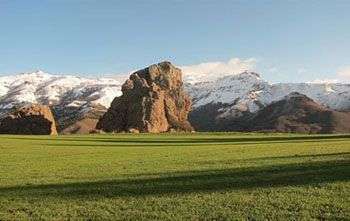
Golf by the mountains in Gaucho’s Land
By Javier Pintos on Patagonia's golf courses
Golf was first played in Argentina in the Buenos Aires City surroundings when the first courses were laid near the new railway stations built in the early 20th century. Not long after the first courses were created, the sport started to grow across the country. During the 1930s many more courses were opened in Buenos Aires including both layouts created by Dr. Alister MacKenzie and now the sport has become even bigger in Argentina after Angel Cabrera’s two Major championship victories (2007 US Open and 2009 Masters Tournament).
Before 1990, Golf in Patagonia was not that big, with just one 9-hole course by the Hotel Llao Llao near Bariloche laid out between the forest with the last two holes adjacent to lake Nahuel Huapi. In the 1990s Arelauquen Country Club (with the help of European Tour and PGA Champions Tour Winner Vicente Fernandez) opened a very nice course by Lake Gutierrez, with majestic views of the snowcapped mountains and the Cerro Catedral Ski Center where golf can be played almost all year round. During the early 2000s Llao Llao completed the 18 holes which were opened with a Junior Tournament where current European Tour player Estanislao “Tano” Goya fired an opening round of 63 (28-35, -7) to win the Tournament with 133 strokes.
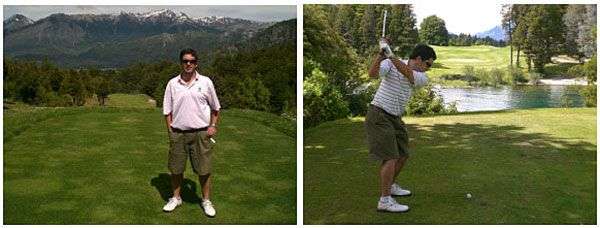
Left 15th at Arelauquen and Right 18th at Llao Llao, both par 3s
I have been able to play both courses in the past and they are totally different from each other: Llao Llao is friendlier and playable in the most spectacularly scenic spot in Patagonia while Arelauquen is a more demanding course, longer and tougher. The setting is really nice as well, but nothing to do with Llao. Both courses make a great combination with some fly fishing and sightseeing for maybe a four-day stay in Bariloche.
It was around this time when an undiscovered golf destination was starting to rise. San Martin de los Andes, located 170kms away from Bariloche, was chosen by Jack Nicklaus to build Chapelco Golf Club which opened in 2006 located 15kms away from the downtown.
I was lucky to first play Chapelco in 2008 in a team competition. “La Copa Molitor” is a Ryder Cup format competition and I played Chapelco for five consecutive days and it was love at first sight. The course has a great setting with a beautiful landscape, especially in spring when gorse turns yellow and the course becomes very challenging and demanding. Jack Nicklaus has used his best creative effort to build this fantastic venue, which will for sure be always in South America’s Top 5 courses.
I went back in 2010 for two rounds and 2015 for two more rounds and the love grows deeper every time I get to that first tee. It is not close to Bariloche, but it's easy to combine with the other two courses to create a great golf holiday.
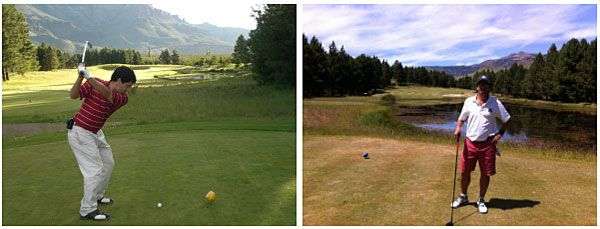
11th and 12th at Chapelco (me in 2008 and 2015 respectively)
Just across from Chapelco, a new upcoming project is under construction with a Signature Greg Norman Course: El Desafío Mountain Resort. The course has 9 holes open to play (the front 9) and is expected to complete the 18 early in 2017. This course is located a couple of hundred meters higher than Chapelco with great views of the course, the polo fields and the Andes Range including the majestic Lanin Volcano that stands just in the limit between Argentina and Chile.
El Desafío was designed to become one of the best courses in Argentina. Greg Norman was given free rein to choose the best land from more than 1,000 hectares to build a masterpiece. The course takes up a massive 90 hectares (222 acres) for a 7,100-yard par 72 track. Interestingly, it includes five par three and five par five holes, so it plays somewhat longer than a normal 7,100-yard course and it is a more fun routing.
Greg Norman designed a very wide course with plenty of strategic options within the wide fairways, with as many as four target options from the tees. Placing the ball on the right side of the fairway is important for the scratch player in order to score, but higher handicap players can use other parts of the fairway easily. The course has practically no out of bounds with the exception of the par 4 second.
Tees, fairways and rough are pure fescue grass allowing firm and fast conditions and plenty of bounce and roll for some very long drives. Combined with shortly mowed green complexes, El Desafío plays similarly to a links course allowing for the ground game bump and run. Large greens and naturally rugged bunkers complement the huge natural scale of the site.
The par 4, 450-yard opening hole starts with a blind tee shot over a wide ravine to a generous fairway that does not present much difficulty, but favors a straight shot for best angle to the flag. As you get to your ball the green opens up below. To the right, several bunkers protect the green and provide some safety from a ravine. A large bail out area to the left allows for balls to trickle down to the green.
The par 4, 365-yard 2nd hole appears intimidating from the tee with a very deep canyon in front and the fairway several feet below the tee. It is also amazingly beautiful with the snowcapped Andes in the background. The long hitter can play to the left to a split fairway with the 3rd hole and away from trouble, leaving a small pitch to a well-protected green.
The 3rd is a brutal par 4 of 457 yards playing uphill from the tees. If the drive is not long enough, the second shot will be blind to a green with all sorts of trouble to the left. We anticipate this to be the toughest hole on the golf course.
The 4th hole is another par 4 measuring 466 yards from the tips, but considerably shorter from the remaining tees. The pro tees are narrow and require a strong drive. But the hole plays quite a lot shorter than its yardage as it is all downhill. This hole required little or no shaping. The green is protected by a large bunker on the left and a steep slope on the right.
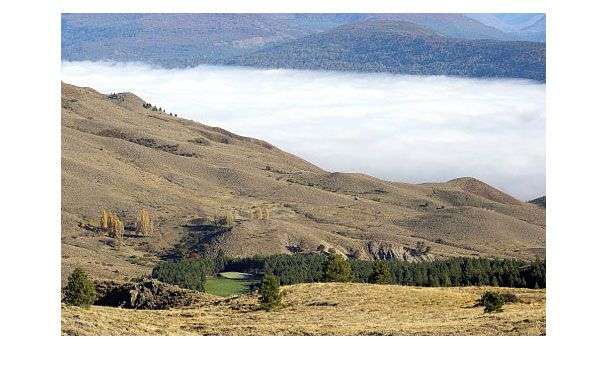
4th hole from one of the highest points on the back 9
The 5th hole is the first par 5, measuring 555 yards. A dogleg left, the tee shot is wide open to the right side of the hole, and shots right of center will tend to roll down to the middle of the fairway. The player wanting to reach in two shots might want to risk cutting the left corner by carrying the very deep bunkers, but the consequence of being left or short will cost you at least one shot.
The first par 3 arrives at the 262-yard (!) downhill 6th hole. For the pro golfers it is a challenging shot to a green that slopes away and slightly from right to left with no bail out areas on either side and narrow long bunkers on the left side. However, the hole plays much shorter than the yardage indicates. For the least aggressive players, a shorter shot to the fairway will funnel balls towards the green. It is possible to play a 6-iron from the 230 yards tees and reach the green.
The shortest par 4 on the card is number seven, measuring only 340 yards and it's one of the most beautiful. Multiple target areas from the tee include going for the green. However, anything long or left of the green is in deep trouble. The safest drive line short left leaves you with a strong uphill shot over deep bunkers to a narrow right to left sloping infinity green. A more aggressive drive over the fairway bunker on the right will bounce towards the green and leave you with a short chip shot.
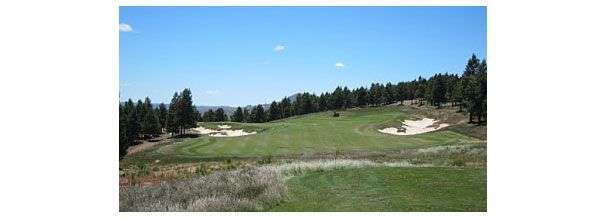
7th from the tee - a great reachable par 4
The par 5 8th hole heads back up the mountain and measures 540 yards with a prevailing head wind. A straight long drive will leave you with a decision between going for a smaller upper section of the fairway with a perfect level line to the flag, or going for a lower wider section of the fairway that leaves an uphill approach protected by bunkers to a left to right green. The views from the tees are simply gorgeous.
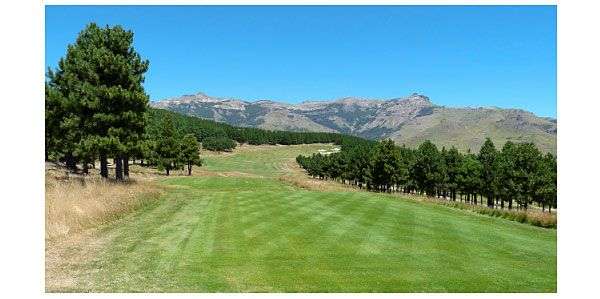
8th hole from the tee on a sunny January day
The 167-yard par 3 ninth hole showcases the rugged beauty of Patagonia and is exposed to the wind, making it a challenge. The infinity green is built against a giant rock with views of Chapelco Golf below.
I played the course on December 31st on a very cold summer day, where in the higher parts of the course we had some snow during play, but it was an amazing experience and I feel this course will be a real blast for first time visiting golfers. The course will be open for the new season starting in November. To play, contact WeGolf Argentina in advance.
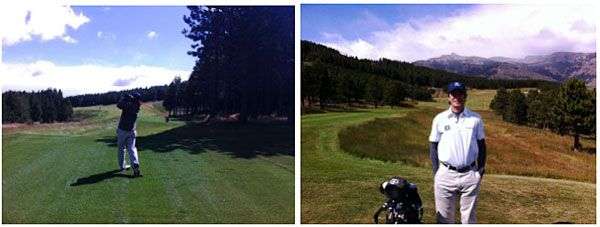
5th tee (left) when a “Tero” bird dangerously crosses my line - 8th tee (right) with my Wegolf/Top 100 shirt ready to play one of the best par 5s in South America
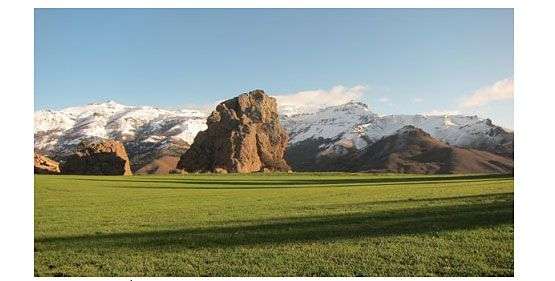
9th green in January 2015 just weeks before opening for play
Undoubtedly a great golf destination inside Argentina is emerging. Together with fly fishing and delicious gastronomy, the land of the Gaucho is fast becoming one of the best tourist experiences on the planet. Llao Llao and Arelauquen have been the foundation stones, Chapelco Golf Resort arrived giving the destination a higher status and now El Desafío Mountain Resort will complete the equation to make our beloved Patagonia a must-play destination.
To see our current list of Argentina's Top 20 golf courses, click the link.
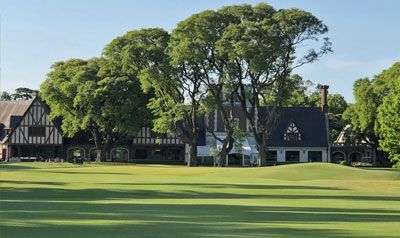
One really famous Argentinean golf hole is the 15th at Olivos Golf Club, which is included in the book 1001 Golf Holes you must play before you die. Javier Pintos (our Argentina Correspondent) isn’t sure if it’s the best hole in the country but it’s certainly the most famous. As a fun exercise, he has created “My Best 18 golf holes in Argentina” to fashion an imaginary golf course with his favourite holes. My best 18 golf holes in Argentina Hole 1 – SAN ANDRES GOLF CLUB – Par 4 420 yards A great opener, tree-lined on both sides and with a very tricky green described by Tom Doak as the best putting surface in Argentina. It’s a two-tiered platform, with the chance of a very tough short pin and the back left position demands one of the most precise shots in the country. Hole 2 – BUENOS AIRES GOLF CLUB – Par 5 515 yards A 90-degree dogleg caused by a lake which was easily carried in the 2000 EMC World Cup when it played as a par four hole. The second shot uphill offers a challenge with bunkers on the left and a canyon with trees on the right where recovery is tough. It has a big sloping green with plenty of good pin positions but it still offers a good chance for a birdie to get your round going. Hole 3 – CAÑUELAS GOLF CLUB – Par 3 155 yards This hole features an island green, similar to the famous 17th at TPC Sawgrass, where the tee is a little bit raised from the green level which has two platforms and is bigger than the famous Florida version. It usually plays into the wind in a wide open place so correct club selection is the difference between an easy par or disaster. Hole 4 – CHAPELCO GOLF CLUB – Par 4 420 yards This hole is furthest from the Clubhouse, in the middle of a Valley which is usually the breeziest part of the course. Into the wind, club choice can be driver and long iron, without the wind the mound that splits the fairway can be carried to leave only a wedge to a small sloped green. Hole 5 – GOLF CLUB ARGENTINO – Par 4 360 yards One of the great short par fours in Argentina, where length off the tee is important but isn’t mandatory. The fairway is pretty open until 150 yards from the green with a cross-bunker on the left and big oak tree on the right at 100 yards to a very small green which breaks from front-to-back, making it very tough to hold an approach shot. Hole 6 – MAR DEL PLATA GOLF CLUB (Playa Grande) – Par 4 360 yards This is the best par four in the country. A slight dogleg left with a small forest on the right and sand mounds on the left, with two pine trees that really come into play off the tee on a left to right sloping fairway. Wind is always a factor and it can play from a short lob wedge to a 7 iron into the wind. The green slopes from back-to-front and anything over the pin will require the fastest putt in Argentina. Hole 7 – EL DESAFÍO MOUNTAIN RESORT – Par 4 330 yards Another great example of where a short par four can be great. It’s driveable from every tee except the black for amateur players and the clever shot is to aim to the right side and let the terrain make the ball break back to the front part of the green for an easy chip or a putt. Don’t miss left where bunkers and dense fescue rough can be a nightmare. Laying up is easy but it will leave a very difficult approach shot so this one calls for brave hearts. Hole 8 – El POTRERILLO DE LARRETA COUNTRY CLUB – Par 5 550 yards A great golf hole, with a stream that runs along the right of the fairway then crosses in front of the green before continuing on the left side. Usually a 3-shotter, there’s danger for the tee shot on the left side with rocks and trees. Laying up isn’t hard but the small, water-protected green also has a bunker on the right side, making it one of the most challenging short shots you’ll face. Hole 9 – HURLINGHAM CLUB – Par 3 176 yards One of the nicest half-way houses you will see in Argentina stands before the 9th tee. After a hot-dog and either a soup in winter or something fresh in summer, you will face this very challenging par three with a bunker on the right side and an undulating green that slips away to the back and left. Hole 10 – JOCKEY CLUB RED COURSE – Par 5 500 yards “The hole without a par” as it is regarded, this fantastic MacKenzie green has really everything to be a nightmare. It is a short par five where even pros after a 300-yard tee shot can easily make a 7. It has a big bunker on the right side and almost half the green is up the hill where short balls will definitely roll back to the front of it. And the back part rolls away to the end so you need to be extremely precise with the approach shot. It’s my favourite hole on this course. Hole 11 – ESTANCIA LA PAZ – Par 5 531 yards This amazing golf hole starts the stretch with the river on the right side. A fairway that rolls downhill where a good tee shot will give you the chance of going for it but you have to carry almost up to the green’s edge as the ball could roll back like that famous 15th hole at one of the Majors… a hole that is not only great but very nice! Hole 12 – NORDELTA GOLF CLUB – Par 3 200 yards This hole faces the biggest lake on the property and it’s one of the first that was finished during construction. It plays to a two-tiered green with a bunker on the right side and some room to miss on the left. Into the wind you can consider it a short par four and lay up… just joking, but a great golf hole! Hole 13 – MARTINDALE COUNTRY CLUB – Par 4 430 yards Although not a big fan of this course, I really like the challenge of the second shot to a two-platform green where the high part is on the right over the bunker and the left is the lower portion. It’s pretty wide off the tee, but if missing on the right then the approach remains extremely demanding. Hole 14 - PILARÁ GOLF CLUB – Par 5 540 yards It plays as a true links hole, slightly downhill with small bunkers spread for the tee shot which, if you carry, there is a chance of getting home in two shots. A very small green is protected by a big bunker on the right and a smaller (and deeper) one on the left. A layup will provide an easy approach and a chance for a birdie. If you go over the green, marsh and water will destroy your chances of making this a good birdie chance. Hole 15 - OLIVOS GOLF CLUB – Par 4/5 480 yards Described as one of the 1001 holes to be played before dying, this fantastic par five (par four for professional events) is a strong dogleg right with the second shot going downhill with a small lake on the right. The green has three protecting bunkers (right, left and long). You have to love it, if played during fall the oak trees frame it in amazing colours. Hole 16 - SAN ISIDRO GOLF CLUB – Par 3 190 yards This might not be a popular choice. There are a couple of holes on the course I could have selected (7th, 8th, 14th, 15th) but I need a par three to balance the imaginary venue and this one provides challenge and beauty surrounded by 60+ year-old trees and a tough shot over a front/right bunker with only a small space left for a running shot. Hole 17 - MAR DEL PLATA GOLF CLUB (Playa Grande) – Par 4 420 yards The most iconic green on the course – the only one that doesn’t totally break towards the ocean – for a hole that will always provide a strong test. The tee shot is not easy but there is room in this left-to-right sloping fairway. Everything short of the green will roll backwards to the front right and will leave a tough chip over the bunker. It’s one of the toughest greens to read. Hole 18 - JOCKEY CLUB RED COURSE – Par 4 340 yards There could have been many other choices like 18th at Pilará, Nordelta, Mar del Plata, Buenos Aries Golf Club, San Andres and others, but finish facing that amazing clubhouse and try to beat the Valley of Sin on a severely sloped green. It’s just a great finish to my imaginary favourite course in Argentina. 19th Hole – The Terrace at MAR DEL PLATA GOLF CLUB After the round, just take an imaginary flight to the terrace at Playa Grande facing the course, the port, the ocean and the sunset and enjoy a nice “picada” with a cold beer and be glad to be a golfer, there is no place in South America for an after-round drink like this one. This is just my choice, using my imagination, listing the holes I enjoy more with some criteria on quality, golf design and challenge. It’s a very nice par 74 which I will play always in my mind as my favourite round in Argentina. Javier Pintos We.Golf
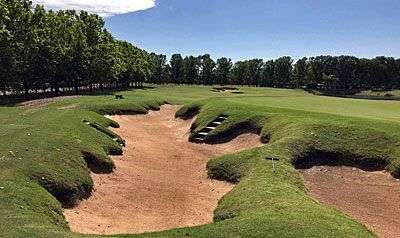
Introduction to Ellerstina Golf by Matthew Dusenberry I was referred to a potential client in Pilar, Argentina that owns and operates a large polo estate named Ellerstina. Ellerstina was formed by the Pieres family in Argentina and wealthy Australian Kerry Packer. The Pieres family are famous in Polo internationally and the three sons are all top ranked players in the world. There is also a sister property to Ellerstina in Australia named Ellerston. The Australian property is also a large polo estate with a private/personal 18-hole golf course designed by Greg Norman in the 1990s and commissioned by Kerry Packer. His son, James Packer, now owns and operates Ellerston and is a partner in Ellerstina with the Pieres family. The Pieres family and James Packer are avid golfers and sought a private/personal golf experience on their Argentina estate. They designated two of their nine polo fields as property for a private golf course. The two polo fields along with a grazing paddock occupy approximately 32 acres – clearly not enough for a typical regulation golf course. The owners and their friends would play the golf personally. There are no retail or commercial considerations by the client. It is purely for their own personal fun and enjoyment. When I was introduced to the project, there was another preliminary design being considered by the Pieres family from a local Argentine architect. It was a nine-hole course comprised of mostly par 3’s and several “replica” holes. I was asked to evaluate their current plan and present any alternatives that might work for their property. My focus was on providing an alternative concept that I had in mind for many years and just needed to find the right property and client. Site Characteristics The property is nearly flat, which is a characteristic of the Buenos Aires delta region and of existing polo fields. It is surrounded by a double alee of mature London Plane trees on the North, East, and South. One of the four main stables and polo clubhouses is directly west of the site. The site parameters are linear and geometric which clearly set the four strong boundaries creating a defined “room” or “corridor” effect on the golf course area. These boundaries provided just enough vertical definition on a very flat site to provide a much needed and desirable sense of enclosure. Design Concept / Inspiration I had in mind a strong concept for the project before we gave our initial design concept presentation to the client, but we started by taking a look at other private/personal estate golf course concepts and evaluating their pros and cons. I looked at traditional 18-hole layouts, 9 holes layouts, 3-hole layouts, par 3 courses, etc. They had the same characteristic “traditional” golf concept. The holes were structured and put in front of players by the architect. The owners were then limited to playing these structured holes. I put myself in the owner’s position and asked “why would I want to be limited to the same structured golf holes day after day?” As the owner, if revenue was not a consideration, I would want to create my own golf experience within an open golf framework and draw from design characteristics of my favorite golf courses. For this property, the Old Course at St. Andrews came to mind consistently. That provided the platform and inspiration to create a unique design concept for Ellerstina. Unique Design Concept – Open Format Golf Experience Variety and fun are keys to any great course design. These attributes keep players interested and wanting to come back out to play the course again and again. This design concept provides the greatest amount of variety and fun by allowing players to create their own golf experience and it is only limited by imagination. The concept for the course is to provide an “open format” golf experience rather than a single structured 18-hole golf course that is played day after day. The “open format” is the ultimate in private golf. You can play nearly any direction to any green/hole location. Golfers have an almost infinite variety of holes to play in any manner they see fit. Players are not shackled to the traditional 18 hole golf course. It is our intention that this is a match play experience and less about keeping score for 18 holes. However, when a structured 18 holes of golf with a par and course rating are desired… that format is also available. Of course there are many options for the structured 18-hole course layout as well. These options keep play fun and interesting. The “open format” golf course allows the best of both worlds, fun open format golf and structured 18 hole stroke play. Ellerstina utilizes the concept and principles outlined above on a smaller scale. The course occupies only 32 acres of property. Which is more efficient and lower cost for the client in both construction and maintenance. Execution of the Concept The ‘Map of Ellerstina’ below illustrates the as-built layout and features. You can also get a quick overview of the property and feel for the experience by watching the video via the following link: https://www.instagram.com/p/BQQVNo6Fyt0/?hl=en&taken-by=ellerstina Ground Contour / Fairway The first challenge was to create interesting ground contours and features for the golf course on a flat site. However, this limitation does allow for open sight lines in all directions with few obstructions. So the intent was to create low profile hollows and rolls that result in ground contours similar to seaside links golf but still allows for 360-degree views and play. Almost the entire property is mown as fairway. This has two desirable results. First, it keeps the golf course truly open format, and second it allows players to find their own way from the teeing area to the selected hole location. This open format concept provides maximum width. Width allows for added strategy and fun. Turf Conditions / Agronomy The turf conditions are firm and fast which also encourages creative shot-making. Argentina does not have affordable access to the latest slow-release fertilizers and turfgrass chemicals. This allows the golf course to be maintained at a lower cost with fewer inputs. The normal maintenance crew at Ellerstina is three. One manager (non-professional) and two labor. The entire project is then overseen/consulted by an American educated Argentine agronomist. This agronomist will oversee 10-20 golf courses – an efficient and cost effective approach. The turfgrass for the golf course is harvested from the other polo fields on the property. It is believed to be a variation of 328 Bermuda. The greens are an A1/A4 bentgrass mix. Polo field conditions at Ellerstina are managed to a high standard which makes for an easier transition to maintain a golf course. For example, polo grounds turf is maintained at just over ½” – similar to normal golf course fairway mowing heights. The polo fields are also regularly top-dressed with sand for better footing by the horses. These maintenance practices are easily translated and beneficial to the golf experience. The grown-in was completed in summer 2015 with the client and agronomist reporting excellent playing conditions going into this summer (November – March). Greens & Tees The layout has nine total greens with seven greens “double” in size around the perimeter. The property limits and shape indicated this layout and suggested nine greens as the best solution. This was not intentional or formulaic, rather, the layout indicated nine green sites. This concept would work adequately with fewer greens or more greens if the property size and shape allowed. The intention for the green locations were two fold. First, pushing the majority of the greens to the perimeter and corners allowed for maximum distance for par 4 and par 5 holes. Second, by including two greens in the interior of the property we ensured that players could maneuver from green to green playing a “short course” if desired. These interior greens also added playing options for some of the longer holes. The interior greens are lower in profile to avoid significant obstruction of views to the corner greens. As noted, the corner greens are generally double in size with two pin locations at all times. The approaches are a mix of open areas and guarded bunker fronts. The open format of the fairways allow for players to find some very different lines of play and extreme angles into the pin placements. I felt strongly that the contours of the greens should be bold and encourage a variety of approach shots and short game options. The green contours are a fun mix of bold movement and quieter more pinnable areas. The large green sizes assist in making this concept feasible. There is a fine line between variety and enjoyment/playability in design of bold putting surfaces. Since the same players will experience these greens day after day, the variety and challenge is even more important. Again, the Old Course gave inspiration to many of the putting surfaces. As seen on the map, the greens along the edges are generally set back from the surrounding tree line. This was necessary to avoid shade issues on the greens but this also allowed for some flatter tee pads to be placed in the surrounds “behind” the greens. These tee surrounds are placed at an elevation just below the profile of the green to avoid a flat line behind each green. Of course there are no formal teeing grounds. Players can tee up at any flatter area mown as fairway and select the next hole to play. Hazard Placement The primary hazard utilized are bunkers. Placement is a very difficult task when considering that there are many lines of play on the golf course. The corner greens are a bit more straightforward. We know play will approach the green from two maybe three sides of the green. We can then consider placement, sight lines, approach grades, etc. These are more predictable. The hazard placement in the fairway areas are more difficult. The goal was to keep the bunkers relevant by placing many in the “center” of the golf course requiring players to navigate their way around and over them. The next significant challenge was visibility. The grading was performed in a manner to try and make the hazards visible from several directions, but ultimately it was conceded that some hazards would be blind from certain angles. We felt it was acceptable due to the private nature of the course and the repeat play. The players would create a memory bank from their experiences and learn hazard locations and areas to be avoided. There was also restraint on the number of bunker hazards. We felt it was far more fun to give players room to play and navigate the property. Ground contours were utilized as an alternative to sand bunkers. They were shaped to provide a variety of stances and lies for the players. The more open concept fits better with the challenging design of the approaches and greens. Structured Card of the Course The course map illustrates the nearly limitless number of holes. Certainly there are many par 3 holes, many par 4 holes, and par 5 holes from 500 yards up to 600 yards are possible when playing corner to corner (north/south). The client asked us early in the design process to create a “card of the course” for a suggested 18-hole routing. Initially I was against providing this structured card of the course option. I felt it was contrary to the open format concept. However, after discussions with the client I realized that providing the structured course option as a supplement to the open format had even more appeal. It provides the best of both worlds. The ultimate fun match play golf course with the option to have several stroke play golf courses if desired. Matthew Dusenberry – Principal Dusenberry Golf Course Design, LLC Course photos courtesy of David Davis. Read more about Ellerstina Golf

Central & South American Golf Course Rankings 2012 Top 100 Golf Courses extends its Central & South America rankings 21st January 2012 It has been a challenging process for us to journey through Central & South America, identifying the best golf courses across twenty-one countries. But we’ve done just that. Some countries, such as the Falkland Islands, French Guiana, Guyana and Suriname have only one or two golf courses, and their current golfing facilities are rather too rudimentary to mention in any detail. However, there is some stunning golf to be played in numerous other countries across the continent and subcontinent. Argentina is at the historical heart of golf in Central & South American and it’s where golf reputedly began in 1890, when an intrepid Scotsman was flung into jail after customs officials in Buenos Aires thought his golf clubs were secret weapons. Little did they know that seven decades later an Argentinean would win more than 250 golf tournaments worldwide. Roberto de Vincenzo is the Argentine golfing equivalent of football’s Diego Maradona and de Vincenzo’s career was crowned in 1967 when he lifted the Claret Jug at Hoylake. Two years later, Ángel Cabrera was born and “The Duck” progressed from caddying at Córdoba Country Club to becoming a two-time Major champion, winning the US Open in 2007 and the Masters two years later. There are around 250 golf clubs registered in Argentina and there are many Argentinean golf courses worthy of close inspection. I won’t steal any thunder from Javier Pintos, who runs a successful golf travel company called “Let’s Golf Argentina”, because Javier has agreed to write an article for us on his country’s golf courses. I’ll just thank Javier wholeheartedly at this point for helping us assemble our Argentinean golf course rankings. Caye Chapel is Belize’s only golf course and it’s set on a private 2.5-mile Caribbean island just off the Belize mainland. Originally developed by Kentucky industrialist Larry Addington, the entire island of Caye Chapel is currently for sale. If you have $75 million dollars under your mattress and fancy your own private 265-acre island retreat, complete with airstrip, deep-water marina, eight beachfront villas and eleven marina view cabanas, then Caye Chapel and its championship golf course and clubhouse could be yours. If you do buy it, please forward an invite to the island warming party to the address below! We currently feature only one golf course in the following countries: Bolivia (La Paz), Ecuador (Quito), Honduras (Black Pearl at Pristine Bay), Nicaragua (Hacienda Iguana) and Peru (Los Incas). We feature two courses in Chile: (Las Brisas de Santo Domingo) and (Leones), two in El Salvador: (Salvadoreno) and (Veraneras), two in Panama: (Coronado) and (Cielo Paraiso) and two in Paraguay (Yacht & Golf Club Paraguay) and (Carlos Franco). The premier courses in Colombia are located around the capital, Bogotá, and the best is Club El Rincón de Cajicá – to give the club its full title. The Country Club of Bogotá and San Andrés Golf Club are two other Colombian golfing facilities that are from the top drawer. Costa Rica has become quite a golfing hotspot in recent years and we have five golf courses listed, headed by the Arnold Palmer designed Peninsula Papagayo course at the Four Seasons Resort, which opened in 2004. Designed by George Fazio and constructed by his nephew Tom Fazio in the early 1970s, Cariari Country Club was the first 18-hole course to be built in Costa Rica and it’s our Costa Rican No.2. Hacienda Pinilla was fashioned by American, Mike Young, and our No.3 course weaves its way out through tropical woodland and heads down to the Pacific Ocean on the way home. Guatemala is another Central American country that punches way above its weight. The Fuego Maya course at La Reunion Antigua Golf Resort is a Pete and Perry Dye design from 2009 which enjoys a stunning setting in a verdant valley that lies between two towering volcanoes. The Mayan Golf Club on the other hand was established in 1918 as the Pamplona Golf Association and is recognised as the oldest golfing society in Central America. We feature three of the eleven golf clubs affiliated to Uruguay’s Golf Association and the best of these was laid out in 2000 at the Four Seasons Resort Carmelo by two Robert Van Hagge protégés, Kelly Moran and Randy Thompson, from the American Golf Course Design Company. Last but not least in our whistle-stop tour is Brazil, South America’s largest and most populous country. There are more than 100 golf courses in Brazil and we feature fifteen of the best. Our No.1 Brazilian golf course was laid out by American architect Dan Blankenship, a former associate of Pete and Perry Dye, on Brazil’s Discovery Coast. Terravista opened for play in 2004 and from day one the golf course has received glowing accolades. “Terravista Golf Course has proven to be the most enjoyable project of my career,” said Dan Blankenship with pride. “Working in an area with incredible ocean views from seaside cliffs, native Brazilian rain forest, contours almost ideal for a golf course, and knowing that Brazil was discovered at this exact location 500 years ago, was a wonderful experience. My construction team and I felt honored to be part of this amazing project and also felt a huge responsibility to deliver not just a golf course but a championship course that will stand the test of time in the ever growing game of golf.” We genuinely welcome feedback… in fact we actively encourage it. So please tell us what you think about our latest voyage through the golf courses of Central and South America. We won’t ever claim to be “definitive” but we are the most “informed” golf course rankings in the business. If you’ve played any of our featured Central and South American courses, we’d be delighted to know what you think, so why not contribute and post a course review or two? Click here to visit Central and South America on the Top 100 website, or simply click on Central and South America on the left to navigate through the continent. Keith Baxter Editor-in-Chief www.top100golfcourses.com

