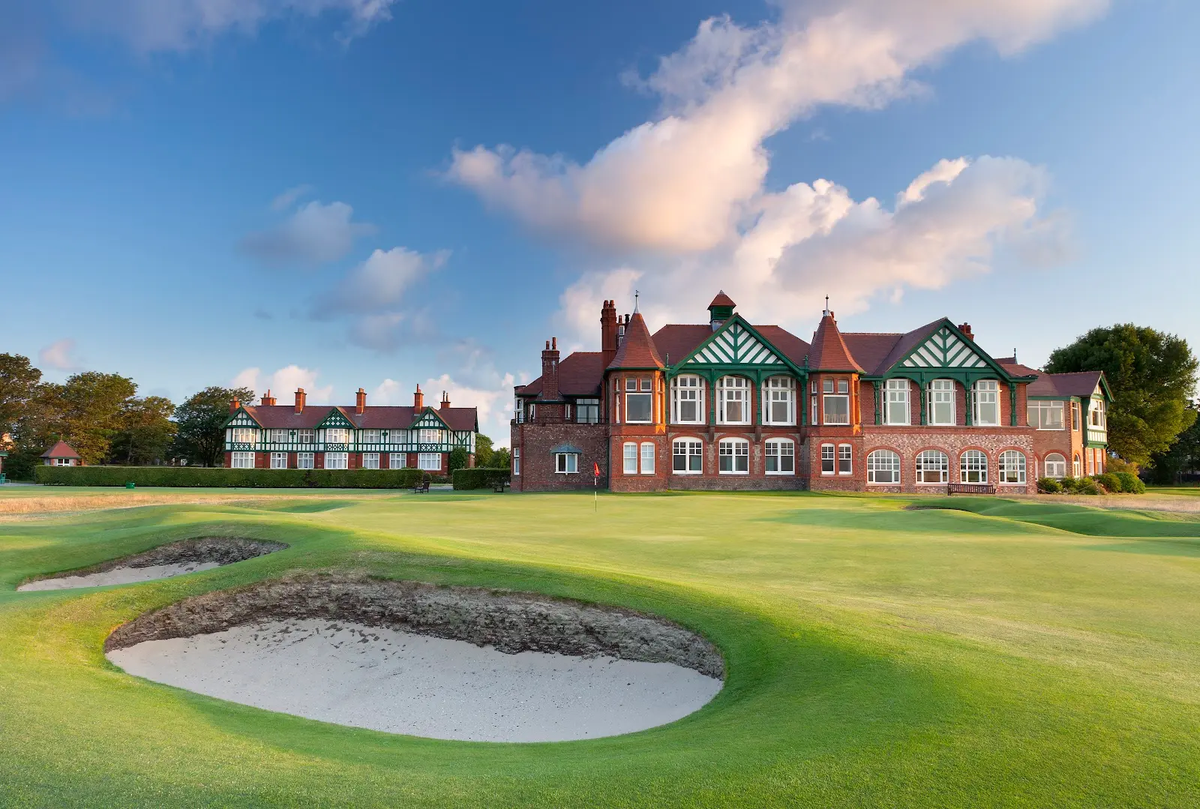
The purpose of the Review of The Month feature is twofold. Top100GolfCourses has always aimed to salute and encourage those who are putting admirable effort into reviewing the world’s great golf courses. Moving forward, we are also looking to learn from these experts! We’ll be chatting with the month’s star authors and discussing topics such as golf in their area, what they like to see in a strong course review, and of course dig a little deeper into their own winning review.
August 2023’s Review of The Month comes from Bill “BB” Branch, whose signature, offhand irreverence can’t hide his pleasure at dodging Royal Lytham & St Annes revetted bunkers, reminiscing on his wild youth whilst providing keen analysis of this World Top 100 course.
You can read all of Bill’s winning review below, and find other takes on Royal Lytham & St. Annes here.
Royal Lytham is a links set back from the sea. Depending on your point of reference, it may lack stunning vistas & impressive dunes. Also dependent on mood, it is an oasis from, or a prisoner to, the urban environment. It actually reminded me a little of Royal Worlington & Newmarket (without the absurd greens and characters torn from a page of a PG Wodehouse novel). Perhaps not a true links then, but nevertheless something unique on the sliding scale of fantastic variety offered up by English Golf.
The Sacred Nine disguises their average land with eccentric greens. Lytham decided that Bunkering would be their memorable feature. Mission accomplished, for their are rumored to be 2,167 of them here on the front nine alone. They are plentiful, ominous, cavernous, & beautiful. The tactic of the day is to carefully choose where you place your tee shot as you plot your way around the land mines. Any false step is likely to invite disaster, so you tread carefully and don’t get too far ahead of yourself.
The demand is more for accuracy than imagination, so it’s not particularly strategic golf. But it isn’t penal golf either and I found avoiding the Sandy traps an enjoyable challenge akin to teenage memories of evading capture whilst sneaking into the house and tip-toeing unsteadily up the stairs after a night on the cider. Adam Scott might have won an Open if only his youth was a little more misspent.
In addition to the bunkering, the green complexes help elevate the course far above the quality of the land itself. They are “Open Championship quality”, compensating for the variety in options occasionally absent on the tee-green journey. The putting surfaces themselves themselves are reasonably flat and devoid of significant undulation, with fairly subtle breaks.
You may have heard of half-par holes, but at Royal Lytham you also get half-width holes. One or two on the outward stretch feel like a fairway was sliced in half running tee to green, with trees then planted along the incision. At times the turf didn’t feel so sandy in these areas. You become very aware that there is less room on the right side, so I found myself aiming left like I was playing the Old Course.
The routing improves significantly after the early holes & the way the intensity & quality builds is exceptional, with finishing holes becoming more difficult & interesting than those that have preceded them. At the turn the land does get interesting with 8-10 a strong stretch, and despite a lull on the 11th - no doubt exacerbated as they’d sold out of the signature culinary delight at the halfway house - the course has a famously rousing finish.
I don’t need stunning vistas & dune-scapes to enjoy my golf, but I would prefer a bit more room on the early holes & increased internal contouring on greens. Royal Lytham is therefore a solid 5-baller for me due to its unique engaging challenge & quality holes. I suspect it may sneak another half-ball when I go back and unearth more of the course’s architectural subtleties. That and a sausage roll.
Golf’s Royal Clubs Architect Scott Macpherson's book on the clubs honoured by the British Royal Family 1833-2013 22nd December 2014 Architect and author Scott Macpherson, a New Zealander now living and working in Scotland, had his first golf book St Andrews: The Evolution of the Old Course published in 2007. To mark the Diamond Jubilee of her Majesty Queen Elizabeth II in 2012, the R&A commissioned Scott to write another book about the golf clubs that have acquired their royal title from the British monarchy. The result is a lavishly photographed book crammed full of facts and figures about these special clubs, supported by course related items such as maps, scorecards and full design credit details. It took four years of research, with the author visiting 57 of the 66 Royal clubs still in existence, to produce a wonderful account of just how close the links are between the game of golf and the British Royal family. Not that there’s always been such a harmonious relationship between the sport and the ruling sovereign, right enough. In Scotland, where the game first began, King James II outlawed ‘golfe’ by an Act of Parliament in 1457 – only to have King James IV take up the game forty-five years later after he’d signed the Treaty of Glasgow with Henry VII of England! A number of the clubs listed have had members of the Royal family act as Club Captain or Club President and most of the clubs have had a Royal Patron, though patronage has never automatically given clubs the right to use the royal title and several prominent clubs have fallen foul of that fact down the years. The process of obtaining royal status has evolved over time and applications nowadays would be expected to include a history of the club, details of its administration and membership, recent reports and accounts and information on any other royal or government associations. The standard of the club’s course has not always been a determining factor on whether royal title could be given though Home Office guidelines in the 1919 did state that “the status of the course is a most important factor, and the decision would perhaps depend largely on whether or not the club’s course is a championship one or in the championship class”. Nine-hole layouts like the one at Royal Worlington and Newmarket would probably have failed that particular test if it had been in operation when the club was added to the royal portfolio in 1895. Royal Perth Golfing Society was the first to be given the royal prefix in 1833 and it remains one of only four royal clubs - along with the R&A, Royal Montrose and Royal Epping Forest - to play on a public course. Royal Cromer is the only club to receive its royal designation before it actually opened, with its status announced on Christmas Day in 1887, eight days before the club officially debuted on 2 January 1888. By way of contrast, it took Royal Lytham & St Annes five attempts before its royal title was finally conferred in 1926. Some may be surprised to learn that, in more recent times, the reigning British monarch allowed Marianske Lazne Golf Club in the Czech Republic to use the royal title in March of 2003 and she repeated this investiture a decade later in April of 2013 when Homburger Golf Club in Germany was also given permission to use the royal title. It’s an interesting matter of golfing speculation now to try and figure out which of the many other esteemed golf clubs in Europe (and beyond) are currently lining up their application… If you’ve read and enjoyed John de St. Jorre’s Legendary Golf Clubs of Scotland, England, Wales and Ireland, where seven of the twelve clubs featured have the Royal prefix, then you’ll love this book. It’s only available to purchase through the R&A at the moment (contact Catherine McGirk on +44 (0)1334 460153, email catherinemcgirk@randa.org) but it may become more widely available in due course. The ISBN to look out for is 978-0-9926240-2-6. Highly recommended as a worthy addition to any golf book library. Jim McCann Editor Top 100 Golf Courses of the World
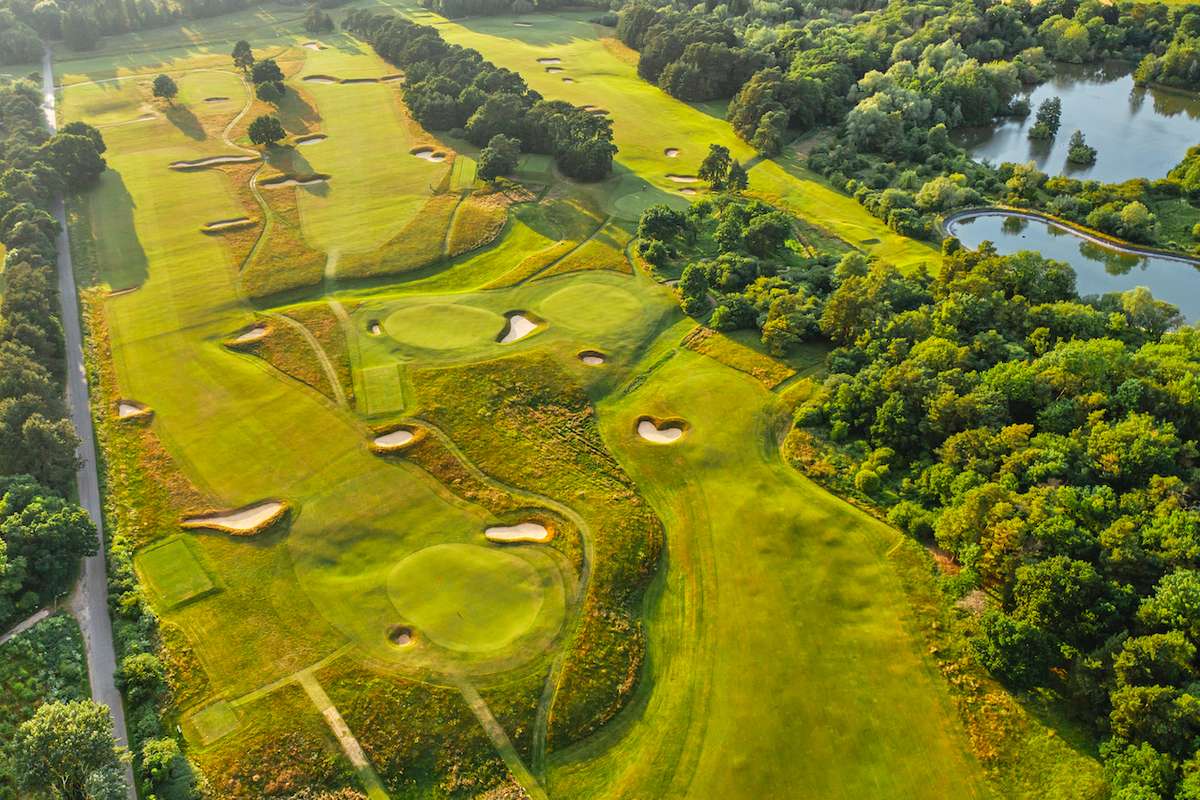
The city of Cambridge sits close enough to the Gog Magog Hills to claim two outstanding parkland layouts on its doorstep, and within a short drive you will find Royal Worlington and Newmarket Golf Club — ranked #87 in England and widely regarded as the finest nine-hole course in the world. For the business traveller staying in the city centre or the leisure golfer planning a long weekend, this compact corner of East Anglia delivers far more quality per mile than its flat fenland reputation suggests. Top 3 Golf Courses in Cambridge Best Golf Course in Cambridge — Royal Worlington and Newmarket Golf Club #1 in Suffolk | #87 in England | #3 in East England Access: Contact Club Prior to Visit Best Time to Visit: April to October Distance from City Centre: 40 km (25 miles) — approximately 40 minutes via the A14 and A11 Tom Dunn laid out these nine holes on sandy Suffolk soil in 1893, and Harry Colt refined them a generation later. Bernard Darwin, who chose two holes here among the 18 greatest inland holes in Britain, dubbed the layout the Sacred Nine — a name that has stuck for good reason. The home course of Cambridge University Golf Club since its founding, Royal Worlington plays faster and firmer than almost any inland course in England, with green complexes that demand imagination and precision in equal measure. Note that this course sits beyond the standard 30-minute drive from Cambridge city centre, but its national ranking and unique standing in golf history make the extra distance worthwhile. #2 Golf Course in Cambridge — The Gog Magog Golf Club (Old) #1 in Cambridgeshire Access: Contact Club Prior to Visit Best Time to Visit: April to October Distance from City Centre: 8 km (5 miles) — approximately 15 minutes Established in 1901 on the chalk escarpment of the Gog Magog Hills, this centurion layout rises south from the city across terrain that surprised Bernard Darwin when he first played it: undulating, fast-draining downland in one of England's flattest counties. Willie Park Junior, John Abercromby and Martin Hawtree have each shaped the course over more than a hundred years, and the result is 6,398 yards of accuracy-first parkland where rare perennial flax blooms blue in the rough each summer. The par-three 13th, played over a depression to a green with a spinney lurking left, is as good a one-shotter as the region produces. Host of the Lagonda Trophy since 1975, the Old course counts Lee Westwood, Luke Donald and Andy Sullivan among its past winners. #3 Golf Course in Cambridge — The Gog Magog Golf Club (Wandlebury) #2 in Cambridgeshire Access: Contact Club Prior to Visit Best Time to Visit: April to October Distance from City Centre: 8 km (5 miles) — approximately 15 minutes Sharing the same hilltop address as the Old course, the Wandlebury opened in 1997 after Martin Hawtree combined eleven new holes across freshly acquired downland with seven from an earlier nine-hole layout. At 6,735 yards it plays longer than its sibling and carries its own credentials: the R&A selected it for Open Championship Regional Qualifying between 2007 and 2011. The join between old and new holes is softening with time, and some members prefer the Wandlebury's flow to the Old. Stone Age flint tools discovered on the 4th fairway during construction — following a mandatory archaeological survey — add another dimension to a course that already has one of the finest settings in East Anglia. Can't Play the Top 3? Try These Instead The Links Golf Club, Newmarket #4 in Cambridgeshire Access: Visitors Welcome Best Time to Visit: April to October Distance from City Centre: 22 km (14 miles) — approximately 25 minutes Set out in 1902 on the southeast perimeter of Newmarket racecourse. Colonel S.V. Hotchkin — the architect behind Woodhall Spa's Hotchkin course — redesigned the layout in the 1930s and his work remains largely unchanged today. A training track known as the Gallops surrounds the course and at the 7th and 15th, the tee shot must clear the white racecourse rails before reaching the fairway. The bunkers are numerous and classically placed, with a full fairway-width specimen guarding the approach at the left-doglegging 16th that is as old-fashioned and effective as any hazard on the course. Royston Golf Club #28 in Hertfordshire Access: Visitors Welcome Best Time to Visit: April to October Distance from City Centre: 22 km (14 miles) — approximately 20 minutes Laid out by Harry Vardon on chalk heathland straddling the Cambridgeshire and Hertfordshire border, Royston is one of the most unusual courses within reach of Cambridge — hilly, exposed and entirely unlike the flat fenland landscape that surrounds it. At 5,910 yards and par 70, the course offers no refuge in length, but the fast-draining chalk base keeps conditions firm and true year-round, and the rough in summer plays as demanding as heather. Nick Faldo won the junior championship here. The first formal golf course was recorded on this ground in 1869, making Royston one of the oldest clubs in England, and the layout has changed little since Andrew Kirkaldy became the club's first professional in 1893. More Golf Courses Near Cambridge Beyond the top five, Cambridge sits within an hour of several other ranked courses worth exploring. In Cambridgeshire itself, Ely City Golf Club — a Henry Cotton design opened in 1973 by Lee Trevino — lies 24 km (15 miles) north of the city, while St Ives (Hunts) Golf Club, Cambridge Country Club (Bourn) and Cambridge Meridian Golf Club each provide solid parkland golf within 30 km to the north and west. Cross into Suffolk and the county's heathland gems open up: the nationally ranked Ipswich Golf Club (Purdis Heath) and Aldeburgh Golf Club (Championship) are further east but reward the drive for golfers building an East Anglian itinerary. For a full ranked and reviewed list of courses across the region, visit top100golfcourses.com. Frequently Asked Questions What is the best golf course in Cambridge? Royal Worlington and Newmarket Golf Club is the highest-ranked course within reach of Cambridge, sitting at #87 in England. Known as the Sacred Nine, this nine-hole Suffolk layout is widely considered the finest nine-hole course in the world and has been the home course of Cambridge University Golf Club since 1893. For golfers wanting the best course within 15 minutes of the city centre, The Gog Magog Golf Club (Old) is ranked #1 in Cambridgeshire and has hosted the Lagonda Trophy since 1975. Is golf in Cambridge open to visitors? The Gog Magog Golf Club requires visitors to contact the club in advance to arrange a tee time. Royal Worlington and Newmarket Golf Club also operates on an advance-booking basis, with visitors required to have an official handicap certificate. The Links Golf Club in Newmarket and Royston Golf Club both welcome visitors and allow direct booking. When is the best time to play golf in Cambridge? April to October offers the most reliable conditions, with longer daylight hours and firmer, faster surfaces as the season progresses. The chalk and sand-based courses — Royal Worlington, the Gog Magog layouts and Royston — drain exceptionally well and remain playable through most of the winter, making Cambridge a viable golf destination outside the peak season. Getting There Cambridge station sits on the Great Northern main line, with direct services to London Kings Cross taking from 49 minutes. The station is approximately 2 km (1 mile) from the city centre. Nearest airport: London Stansted Airport (STN), 48 km (30 miles) south of Cambridge city centre, approximately 35 minutes by road to the Gog Magog Golf Club. For international connections: London Heathrow Airport (LHR), 110 km (68 miles) southwest of Cambridge city centre, approximately 80 minutes by road under normal traffic conditions. Best Time to Play Golf in Cambridge The golf season in Cambridge runs comfortably from April through October, with May, June and September representing the sweet spot of firm ground, reliable weather and manageable course pressure. The chalk and sand-based courses — Royal Worlington, the Gog Magog layouts and Royston — drain exceptionally well and remain playable through most of the winter, making Cambridge a more viable year-round golf destination than much of East England. Summer brings long evenings and the blue flax rough in flower on the Gog Magog hills. Autumn sharpens the light and empties the courses. Spring offers the best green fees for early-season visitors willing to take a chance on the weather. Plan Your Cambridge Golf Trip For full rankings, course reviews and visitor information, visit top100golfcourses.com. Use the site to compare courses across Cambridgeshire, Suffolk and Hertfordshire, read panellist reviews and build your East Anglian golf itinerary from one of the most comprehensive golf course databases in the world.
Greatest Open Championship players in the modern era by M. James Ward Assessing golfers from across different time lines is no easy task. But the fun in doing so makes for interesting discussions. Case in point. This coming week's 147th Open Championship at Carnoustie. Golf's oldest major is perpetually played on a links course. The intersection of unpredictability is often a given. The vagaries of the host course, the uncertain weather and the sheer luck of the bounce of ball are all elements golfers need to face and overcome in order to hoist the Claret Jug as "Champion Golfer of the Year". The Open has been contested since 1860 and the game of golf has clearly evolved greatly from the earliest of times. Who have been the best links players at The Open in the post World War II time frame? A number of factors clearly must be weighed. Victories are no doubt important. But being a sustaining force in a series of championships over the course of time and against the best of competition are all parts needing to be weighed carefully and ultimately decided upon. #5 – BOBBY LOCKE (South Africa) / 1946-1957 The name Bobby Locke starts the roll call as a golfer who made his mark following the conclusion of World War II. Cited as the best putter of all time, the South African was an early standout in his home country. For 20 consecutive years Locke never lost a 72-hole tournament in South Africa. In a 16-match exhibition held at different courses in South Africa in 1946 against American sensation Sam Snead, Locke was victorious by the margin of 12-2-2. Locke's most notable triumphs came in only one major -- The Open Championship but the impact he provided was considerable. His first win came in 1949 at Royal St. George's -- where he routed Ireland's Harry Bradshaw by 12 strokes in a 36-hole playoff. In 1950 he defended his title with a win at Royal Troon and in 1952 beat his main adversary at the time – Peter Thomson – by one stroke at Royal Lytham & St. Annes. His final win would come at The Old Course at St. Andrews in 1957 but controversy took place at the final hole when Locke failed to correctly replace his marked ball on the final green. Needing only two putts from five feet to win, the R&A elected to allow the final outcome to stand when possible disqualification could have happened. One can only surmise what would happen if a similar situation were to occur in today's global social media world. During the period between 1946 and 1957, Locke won The Open four times, with seven top fives. In that period there were two years when he did not compete and only once during that time frame did he miss the cut. Locke relished the opportunity to meet key challenges and at The Open he showed a remarkable resolve to raise his game to the highest level. But beyond the likes of Thomson, were the wins coming against inferior competition? #4 – NICK FALDO (England) / 1982-1996 Although he is now a golf television commentator with CBS-Sports, Nick Faldo at his best was an extraordinary player. After retooling his game with David Leadbetter, the Englishman proved to be a formidable presence in The Open. His first win came with 18 consecutive pars in the final round to overcome American Paul Azinger at Muirfield. Three years later Faldo torched the Old Course with a 270 four round total. The highlight coming in the 3rd round when paired with Greg Norman. Faldo obliterated Norman with a 67 to the Aussie's 76. Two years after that win Faldo once again triumphed at Muirfield. Trailing by two strokes to American John Cook with just four to play. Cook did stumble but what is often forgotten is how Faldo played the final four holes in two-under-par to snatch his 3rd and final Claret Jug. During the 1982-1996 period beyond the three wins Faldo also placed 2nd once in 1993 behind Norman, had eight top five's and 11 top tens with no missed cuts. While Faldo was not as flamboyant as Spain's Seve Ballesteros, the main differential is the overall consistency that the Englishman demonstrated over a considerable period of time. #3 – JACK NICKLAUS (USA) / 1963-1980 There’s a very hard call to make between 3rd and 2nd. The Golden Bear demonstrated superior consistency against the deepest of fields throughout the measured time frame. True, Nicklaus only won three Claret Jugs, but consider that he finished second seven times and only finished out of the top ten once during those 18 years. This includes 15 top five placements with no missed cuts. In short, the Bear was always on the prowl. Among those Nicklaus bested who were clearly in their prime during that time frame included Arnold Palmer, Gary Player, Lee Trevino, Tom Watson, Tony Jacklin, Johnny Miller and Tom Weiskopf, to name just a few. One additional victory would have pushed Nicklaus to the runner-up position. Alas, golf's greatest player has to settle for the bronze medal. #2 – PETER THOMSON (AUSTRALIA) / 1951-1971 The recent passing of Peter Thomson on June 20 made many give pause to the extraordinary contributions this gifted man provided on so many levels. From 1951 to 1971 the Thomson golf file at The Open is utterly impressive. The Aussie claimed the title five times, with three in succession between 1954-56. His final triumph came in 1965 when Palmer, Nicklaus and Player were all competing in their prime. During that time frame Thomson made every cut and was only out of the top ten three times. In the period between 1952-58 he either won or came in second. The downside to Thomson’s accomplishments was that the fields were not exactly top tier and often contained mediocre depth. There is no way to say for certain if American stars such as Sam Snead and Ben Hogan had competed in those years that they would have been as successful given their advancing ages. The American contingent was comfortable in remaining on its side of the pond until a golfer named Arnold Palmer reinvigorated the event with his presence in 1960 at St Andrews. Nonetheless, Thomson's Open record speaks for itself and cannot be easily dismissed. #1 – TOM WATSON (USA) / 1975-1989 Tom Watson claims the top spot for one specific reason. At age 59 the man from Kansas City, MO nearly claimed a record tying 6th Open Championship. A victory at Turnberry would have meant a repeat win on the Ailsa Course – 32 years after his epic "Duel in the Sun" mano-a-mano with Jack Nicklaus. Even though Watson would fall to Stewart Cink in a playoff, his near triumph still resonates to this day. Consider that the oldest man to have a major is Julius Boros at age 48 when winning the 1968 PGA Championship. No senior golfer has come remotely close to doing what Watson did and given the nature of today's professional game featuring younger and younger stars the likelihood of something of that sort ever happening again is remote. During the time frame of 1975-1989 Watson had seven top five and eight top ten finishes. But what separates Watson is the top tier competition he beat time after time in lifting five Claret Jugs. One other thing to keep in mind – foul weather did not impact Watson's capacity to relish the challenge. Even losing the 1984 Open to Seve Ballesteros at The Old Course at St Andrews made for great theater. Watson wishes he had one mulligan to play when deciding to play a high risk 2-iron to The Road Hole during the final round. Initially, Watson did not relish links golf when first exposed to it, but his sheer grit and determination made him the champion golfer he became. If only that 8-iron approach to the 18th at Turnberry in 2009 had not bounced over the green. No matter. Watson earns the top spot. Honourable mentions… Tiger Woods (USA) / 1998 to 2013 Three wins, six top fives, nine top tens along with just one missed cut are the statistics. But consider the highlights – winning by 12 shots in 2000 at The Old Course at St Andrews and in the course of 72 holes never playing a shot from the numerous bunkers that dot the famed landscape. Fast-forward to 2007 when Woods defended his title at Hoylake and in this event used his driver just once. His gifted long and middle iron play was beyond peer. The Woods who won three Claret Jugs by the age of 30 could have achieved far more if numerous surgeries and personal issues did not compromise his skills. Can Tiger still add to his resume? Carnoustie could certainly be an epic storyline should Woods rekindle some of his past magic. Seve Ballesteros (SPAIN) / 1976 to 1988 The superbly talented Spaniard who left this world too soon at age 54 was a maestro on the links. His skills at escaping from one pitfall after another displayed a gift few have ever seen in golf's long history. In 1976 Ballesteros nearly claimed the championship at 19 and tied for second with Jack Nicklaus behind eventual winner Johnny Miller. Three years later he would capture the first of three Open wins at Royal Lytham & St. Annes, made famous by his ability to play from an adjoining car park. In 1984 the Spaniard upended Tom Watson down the stretch to win a classic battle at The Old Course at St Andrews. His fist pumping exclamation with a final birdie at the closing hole is a golf moment seared in the memory banks. Ballesteros would win his final Open in 1988 with a sterling final round 65 in overcoming a stiff challenge from Nick Price – again winning at Lytham. Links golf, at its heart, is being able to invent shots when others confine their thinking to ordinary efforts. Ballesteros conjured shots that made him golf's Houdini.
