
Review of the Month February 2021 – Vilamoura (Victoria)

In a way, I think it’s tricky to fairly review a course you played on holiday. Everything seems better on holiday. You’re in Portugal. The weather is perfect. You’re with your best mates. You’ve got 4 bottles of ice-cold Super Bock in the buggy cooler. Your work phone is 2,000 miles away. Life is about as good as it can get for any golfer who isn’t a Tour pro or the owner of a diamond mine.
But I digress. Here are the most objective thoughts I can muster about this course.
It’s taken as gospel that the best track in Vilamoura is the Old. An elegant, mature course that gracefully winds its way through the umbrella pines over dramatically undulating terrain. The Victoria meanwhile is an open, largely flat, bulldozer scarred behemoth that’s lacking any scenic beauty, clearly designed to be a spectator course for European Tour events.

But the thing is, I actually think the latter is more enjoyable.
Yes, the front 9 is a bit ordinary in its architecture (the 4th and 7th standing out in my mind as exceptions) and I find the bunker on number 8 at best a gimmick, at worst an eyesore. But from the approach to the 10th green onwards, it’s rollocking good fun.
Water is an ever-present threat on the back 9 but there is plenty of fairway to hit if you can keep your nerve. 11 is risk/reward off the tee as the fairway is pinched narrow by the lake at around the 240-yard (sorry we’re on the continent – 220-metre) mark, but successfully threading the needle offers up a much more simple second shot. The 12th is a monstrous par 5 that demands two carries over the lake. 13 is a beautiful par 3. 14 is a really fun par 4 with a stream dividing the fairway into two halves – a brave (and successful) tee shot gets rewarded with a simple approach. 15 is a drivable par 4 for the longer hitters. 16 is a tough, long par 3, though the green is much bigger than it looks. 17 is a spectacular par 5 that winds its way through babbling brooks, mini waterfalls and more dramatic lakes. Finally, 18 is one of the toughest holes on the course. A long par 4 with water threatening down the left of the fairway and bunkers guarding the safer right-hand side. The green is handsomely guarded by more water framed by classy looking stonework.

In the end, perhaps this isn’t an objective review. Golf is the experience you have and it’s difficult to compartmentalise the different elements of that experience. Is the Victoria course a great layout worthy of the 5 ball rating I’m giving it? Its world ranking on this site would suggest not. Who am I to argue with the collective wisdom of those more experienced and articulate than I am? I’m just a guy who had the time of his life playing the Victoria course. And in the end, isn’t that all that matters?
Review of the Month February 2021 selected by Editor-in-Chief, Keith Baxter, and sponsored by TaylorMade – click to read more about Vilamoura (Victoria). Photos courtesy of Dom Pedro Golf.

Review of the Month November 2018 – Oitavos Dunes Played Oitavos today at the end of a week-long golfing trip to the greater Lisbon area. Oitavos aspires to be something it frankly is not. The above statement includes the caveat that I played it in early November 2018 (for whatever that’s worth!). Don’t get me wrong, Oitavos represents a nice gentle stretch of Portuguese seaside golf at its best, tumbling through coastal sand, pine and native scrubland. All positive. If you can keep the ball out of the trees and scrubland you are left with sufficient room to generous fairways, which coupled with some really interesting raised green sites cut into the side of the ample sandscape. Here’s the rub, in fact here’s two rubs. This place purports to be a natural links course. It's not. No run on fairways, hit and stick on the greens, best played through the air and crater plug marks on the fairways. It looks somewhat like a links, but plays more parkland than it should. I suspect this club also has delusions of grandeur. Suggesting that because Monte Rei (ranked 1 in Portugal on this very website) wasn’t ranked in the 2017 Golf Magazine World Top 100 (and they were) that means they are the best course in Portugal. By Shane Review of the Month November 2018 selected by Editor-in-Chief, Keith Baxter – click to read more about Oitavos Dunes.
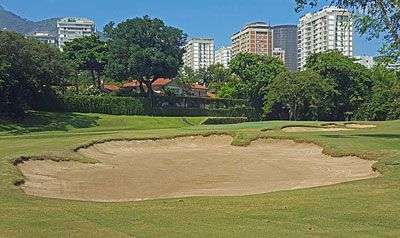
Review of the Month January 2021 – Gávea As humans, we like to categorise things and attach labels to them. Golf is much the same, whether it be the type of shot you hit, the ball you play or the course you walk. Having wrestled with it for some time, I have found categorising Gávea Golf Club in Rio De Janeiro particularly difficult. It is by the sea but I wouldn’t say it was a links design. It is tree lined and perfectly manicured but I wouldn’t say it was a parkland course. It is measures short in terms of yardage but long in difficulty. Gávea is as unique, vibrant and diverse as the streets and jungle covered mountains that encircle it. First and foremost, the club is steeped in history and is one of the oldest and most prestigious golf clubs in Brazil. Originally laid out by a group of British golfers in the early 1920’s, it was later re-designed by Stanley Thompson (one of four of his projects in Brazil) in the 1930’s and it is then that it really took the shape of the course we see today. Gil Hanse then further modified the course (particularly the greens) in more recent times. You could be forgiven for imagining yourself on the set of Jurassic Park while standing on the first tee and looking to your left. Jungle swathes cover large portions of the mountainous landscape and the air is alive with the sounds of wildlife. Take a look to the right though and you will see and hear the sights and sounds of one of the most bustling cities on earth. The contrast of the two backdrops is as mind blowing as it is dramatic. The layout wanders up and down the side of the iconic craggy barrier of mountains that pin most of the metropolis of Rio de Janeiro to the Eastern coastline of Brazil. From the top of Pedra da Gávea, hang gliders take off and soar above the course sharing the sky with the Frigate birds before eventually descending on to the beach beyond the holes on the back nine. Looking at the course from the clubhouse (and I’m sure from those hang gliders also), it makes you wonder just how anyone ever imagined a golf course could be built on such ground. Equally, one could be persuaded that the course has been here for thousands of years as it merges so beautifully with its surroundings. I felt the course played in three distinct phases. The initial nine holes wrap around the clubhouse and take you from sea level up to the highest parts of the property (with some of the most enchanting views of any golf course I have seen in the world). The two par 3’s (No’s.6 and 8) in the middle of the front nine are particularly dramatic, No.6 for its extraordinary sheer green perched on the top of a precipitous outcrop and No.8 for the huge vertical drop between tee and green. After No.9, you then cross the highway to play the coastal holes which are much flatter (but no less interesting) and surround a large lake. The final four holes come back across the road and tuck themselves at the foot of the hills. No.17 is particularly dramatic with a near 100ft drop awaiting any shots missing the green by no more than a couple of metres left. Pound for pound, I would say Gávea is one of the toughest courses I’ve played for such a short yardage (just over 6,000 yards from the back tees). Hitting short clubs off the tee, although initially providing a greater margin for error, only serves to crank up the pressure on what are already tight and punitive approaches. It really is a course where you have to play to your strengths. Once on the green, you will rarely find a flat putt and unless your proximity to the hole is consistently good, you will find yourself having more 3 putts than 1 putts. Brazil is a wonderful place and Rio is as hectic as it gets but Gávea Golf Club is an oasis within the madness. Golf course design to me is a form of art and although provided with an excellent set of ingredients, Thompson has once again displayed a level of imagination and craft here that is truly remarkable. Alex Frolish Review of the Month January 2021 selected by Editor-in-Chief, Keith Baxter, and sponsored by TaylorMade – click to read more about Gávea. Photos courtesy of Brian Ward.

Review of the Month December 2020 – Bulls Bay The Lowcountry. When one considers this geographic descriptor bestowed on the coastal plains of South Carolina, a towering and broad-shouldered hill that climbs 75 feet above sea level is not the first thing to pop into mind. But Bulls Bay Golf Club, whose stately clubhouse and several teeing grounds sit just that high above their surrounds, is not a course that aligns with rational expectations. With a few notable exceptions, South Carolina golf requires an aerial approach. Bump and runs, overly aggressive tee shots skidding through fairways, and approach shots that must be aimed according to undulations in the greens, not pin placements – these are things you might find on Texas hardpan, the dolomite bedrock of the upper Midwest, or the distant shores of Scotland’s wind-battered linksland. But there they are, fully on display at Bulls Bay, complete with golden autumn hues more reminiscent of Shinnecock Hills on Long Island than Long Cove on Hilton Head. Mike Strantz’s masterpiece (yes, it’s better than Tobacco Road… though slightly less dramatic) is perhaps the most creative 18 holes within spitting distance of the South Carolina coastline. To be sure, there are “better” courses in the state (Palmetto, Ocean Course, among others), but you’d be hard pressed to find one that requires more imagination and produces more enjoyment than Bulls Bay. Despite stretching 7,200+ yards from the tips, Bulls Bay is exceptionally playable from its more reasonable teeing grounds. Its spacious and undulating fairways allow balls to release, especially on several holes where hillocks and sloping collars guide and funnel running shots to the putting surface. The greens range in size and character. Under the direction of Alan Black, each putting surface maintains consistent speed and challenges a player to consider breaks from every angle, even when you’ve got a wedge in your hand, not a putter. Bulls Bay isn’t perfect. There are some quirks that many a modern golfer will find infuriating or unfair: blind approaches, visual deception and plenty of unknowable hazards for players visiting for the first time or two. And for the more traditional architecture nut, the number of forced carries over water may seem excessive, particularly on a couple par 3s that present narrow landing strips perpendicular to the angle of the tee ball (for a low-ball hitter, the only thing more difficult getting over the water is being able to stop your ball before it barrels over the green or into some bunker). But the variety of golf shots required – or better stated, the variety of golf shots available to the imaginative golfer – make Bulls Bay a course that never plays the same way. The beauty of the grounds also benefits from diversity. The routing bends through marshland, thin forests and dramatic elevation changes, presenting magnificent and expansive views of ruggedly shaped waste areas and a number of bending bodies of water. In short, Bulls Bay is one of golf’s best-kept secrets. Though its renown has grown in recent years, the vision of founder/owner Joe Rice and the late Mike Strantz, has been given a much-deserved facelift by Alan Black and his grounds crew, and the result is truly something to behold. Nick Schreiber Review of the Month December 2020 selected by Editor-in-Chief, Keith Baxter, and sponsored by TaylorMade – click to read more about Bulls Bay. Photos courtesy of Nick Schreiber.

