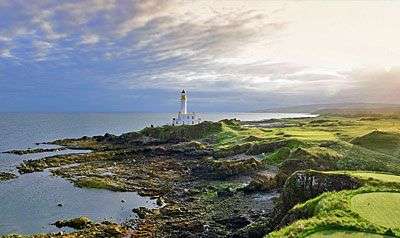
Review of the Month March 2018 - Trump Turnberry (Ailsa)
Four Englishmen tried their luck with the Scottish weather and took advantage of an offer to play the new Ailsa course in March. I had played the old version a few times and considered, along with many others, the stretch from holes 4 to 11 as one of the very best I have ever played. Would the new version live up to the old?
Fortune smiled on us and, despite snow drifts that day in parts of England we were treated to blue skies and crystal-clear views and temperatures above freezing for the first time in days.
We were given mats to play off which felt a little disappointing at first having paid so much money, but several factors prevented this detracting from our enjoyment. Some of the time we simply moved our balls to the semi-rough (better than most club's fairways) and played from there – no problem. Also, the mats were of high quality and enabled perfectly decent golf shots to be played (not like the thin pieces of carpet I'd be given at other places. This all meant that the fairways looked spectacular and divot-free (unlike the soggy courses we'd left behind in Yorkshire).
I should also point out that we played off the proper tees – we were offered the choice of white or yellow - and played on all proper greens so definitely received the full Turnberry experience.
On to the course itself, were the changes a good idea? The simple answer is a resounding 'yes'. The best really can be made better. Although there are changes to most of the holes, it is probably most apparent on the famous 4-11 stretch. Once down by the sea on the 4th tee, with Ailsa Craig overlooking your tee shot, you really get a sense you're in golfing heaven. The par 3 tee shot is all carry (as indeed are all the par 3s). The green has been relocated closer to the sea and any degree of wind (we had around 10mph from the East) will cast doubts on the golfer's strategy and only a well-executed shot will hit the green.
The next par 3 (6th) has been shortened but the new green is no less easy to hit being on top of a dune ridge. Again, anything other than finding the green and bogeys or worse will likely ensue. Holes 7 and 8 maintain the high standard, threading their way through dune valleys.
It used to be that one strolled from the back of the 8th to the Open championship tee of the then Par 4 9th and marvelled at the carry the professionals must make over the rocky inlet with the sea crashing below. The amateur golfer then walked to a slightly inland teeing area to play a fairly straightforward par 4 without too much danger. Even for the Pros in modern times, this hole has been relatively easy unless there was a rare strong off-shore wind and so even for the Open the drama of the hole had diminished.
Not so anymore. With the re-siting of the green close to the lighthouse, the Open tee is once again daunting as a 248-yard par 3 over the sea. However, unlike the previous version, us mere mortals also have a chasm to cross. Our group resorted to fairway woods into the breeze to carry the ocean below and our good shots were rewarded with a great sense of achievement. This seems to me the closest I will get to playing the 16th at Cypress Point.
The 10th hole was previously one of my favourite holes in all golf, hugging the sweeping coastline as a very tough par 4, littered with bunkers and slopes. It still retains its place as one of the greats. The breath-taking views remain, possibly enhanced by the use of numerous (I think there are 7!) elevated tees all framed by the famous lighthouse behind. The green has been pushed further into the corner of the coastline allowing the hole to become a par 5 which at least gives the amateur golfer a better chance of better of a par if they are not distracted by the glorious scenery.
Finally, we say goodbye to the sea along the 11th but this also has been redesigned to be more of an all-or-nothing par 3 where nothing but the green will do. Another stunning improvement.
The remaining holes are still of a high standard (the 14th green is now almost back at the lighthouse) but it remains the coastline holes which will capture the imagination of every golfer that visits Turnberry.
Needless to say the hospitality, facilities and attention are all of the high standard expected at a top tier golfing resort but it is the course itself that will live long in the memory. RdD
By Richard
Review of the Month March 2018 selected by Editor-in-Chief, Keith Baxter – click to read more about Trump Turnberry (Ailsa).
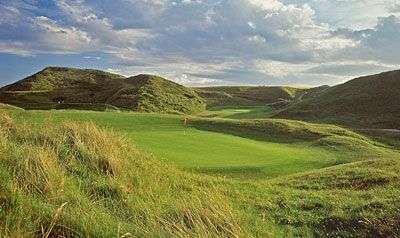
Review of the Month June 2017 – Cruden Bay Where to start with glorious Cruden Bay? You’ve probably heard it all before; the blind shots, the spectacular views, the bathtub green and the often-quirky layout, the clichés are all true. The opening hole of the Championship Course heads out to the left of the clubhouse and through the town. You’re given the opportunity to open your shoulders on the pretty but routine opener before facing the 2nd where the green sits atop of a giant mound that competes with the 2nd at Royal Dornoch in terms of difficulty to hold your ball on the short stuff when the surfaces are hard and dry. The short but meandering 3rd is actually more difficult than it looks from the yardage as bumps and borrows of every description sit in front of a green that lies below the level of the fairway. The course then really comes to life on the long par three 4th that is played alongside Port Errol and parallel to the river that heads out to sea. This hole in combination with the 5th, 6th and 7th are where the course shows most of its teeth as you make your way through and across the rising dunes and over water hazards. The approach shot to the 7th between the humps in those dunes must make this one of the most unique golf holes I’ve had the honour of playing. After the driveable par four into an amphitheatre green (I’d love to see a tour event played here and the surrounding land covered in spectators), you’re faced with a climb to the 9th tee. This is quite a climb and not for the faint-hearted, but take your time and bring your camera as the view from the top was recently voted as the best in Scottish golf by UK golfers who were polled via Visit Scotland’s website. All I can say is drink it in folks, it doesn’t come much more enjoyable than this. Which is the better view: Across the front 9 and back to Slains Castle, or down to the 14th and the sandy beach behind? That viewing position alone is almost worth a 6-ball rating on its own merit. The hole itself also now lives up to the view. From what I understand, this used to be quite an ordinary hole, but has recently been changed and is now a dogleg along the cliff with the green perched over the edge providing more spectacular views, this time of the back 9 and the white horses rolling from the sea and onto the beach… All in all, Cruden Bay is a real contender for the most photogenic course in Scottish golf and the course absolutely lives up to those photos. If you’ve not played here yet, you’re absolutely missing a treat, it’s a wonderful day’s golf that goes beyond just the 18 holes of the Championship Course. I’d therefore like to doff my hat and offer my congratulations Cruden Bay, my favourite golf experience to date. By Tom Review of the Month June 2017 selected by Editor-in-Chief, Keith Baxter – click here to read the full review Photos courtesy of Tom

The Confidential Guide revealed Tom Doak’s updated “Confidential Guide” book: a Scottish perspective The updated version of Tom Doak’s cult golf book “The Confidential Guide to Golf Courses” will be released in five volumes, the first of which has just been published. For those who don’t know, earlier editions of The Confidential Guide – where Doak reviews and marks courses on a scale of 0 to 10 – change hands for substantial amounts of money amongst acolytes of the minimalist designer. Along with Ran Morrissett (founder of the Golf Club Atlas website), Darius Oliver (writer and publisher of the Planet Golf books) and Masa Nishijima (long-time international consultant at Top 100 Golf Courses and author of Analysis of a Golf Course), Doak now aims to rate and critique more than 2,000 golf courses around the world, the first 289 of which, in Great Britain and Ireland, appear in Volume 1. There’s quite a bit to digest in this particular volume, so we thought it might be worth having an initial look at the book from a more specific Caledonian perspective, leaving an examination of the other countries for future articles. The original Confidential Guide first appeared in 1988, when 53 of the layouts assessed by Tom Doak were located in Scotland. The new revised edition of the book almost doubles the number of courses that lie to the north of the border with England, adding all the top courses that have opened for business in the last quarter of a century, with three glaring exceptions. Most prominent of these is Spey Valley in Aviemore, an exuberant Dave Thomas-designed layout that sits comfortably in the top half of our Scottish Top 100 chart. The exclusion of the other two courses is even more puzzling because the Fidraand Dirleton courses at Archerfield Links – currently number 32 and 39 in our Tartan Top 100 – are located immediately adjacent to Tom Doak’s only Scottish design at Renaissance Club in East Lothian, which is ranked above both its near neighbours at number 27 in Scotland. Cynics might speculate the absence of both Archerfield courses from the book is understandable due to commercial rivalry – we’d like to believe it was simply an oversight. Actually, there are a number of other noteworthy courses that are also missing, three of them on the west coast at Glasgow (Gailes), Kilmarnock (Barassie) and Irvine (all of which have been used in the past as Final Open Qualifying venues) and the expansive parkland layout of Downfield in Dundee. The reason given in the book for leaving out Downfield (a former Scottish Open venue) was that it couldn’t be found after driving around for half an hour in search of it. A rather lame excuse surely? In fairness, to counterbalance any controversy over leaving out (inadvertently or otherwise) those leading Scottish courses, the book does make reference to a raft of lesser layouts, such as Braid Hills, Peebles and Strathpeffer Spa. Also, dare I mention it, there’s even appraisals of other little-known courses, such as Braemar, Cullen and Dunaverty. Furthermore, several wee 9-holers – Carradale, Killin and Rosehearty amongst them – are also considered, so full credit to the authors for this depth of coverage. As it’s perfectly entitled to, the new volume reappraises the “Doak scale” ratings that were originally given to more than a dozen Tartan tracks, with most of these layouts marked up one point from 3 to 4, 4 to 5 or 5 to 6. Nevertheless, eyebrows will be raised at three courses – Lundin, St Andrews (Jubilee) and Dunbar – which have jumped up 2 points from a 3 (“about the level of the average golf course in the world”) to a 5 (“well above the average golf course, but probably about the average among courses covered by this book”). If those ranking alterations are surprising, the three point jump of Shiskinefrom a humdrum Doak scale-2 (“a mediocre golf course with little or no architectural interest”) to a more than respectable 5 (where although “it’s certainly not everybody’s cup of tea… Shiskine is not to be missed”) might well have some people wondering if Arran was under a blanket of fog when the course was first visited. Eighteen of the courses in the book have been selected for special attention, forming what’s been termed “The Gourmet’s Choice,” and five of these favourite tracks – all links layouts – are located north of Hadrian’s Wall: St Andrew’s (Old), Prestwick, North Berwick (West), Royal Dornoch (Championship) and, rather surprisingly, Askernish. These courses are described as “places that stir our souls, and will reward the visitor with something out of the ordinary”. Simply put, the authors think that they’re “courses we would take a good friend to play”. An eclectic 18-hole course for GB & I has also been assembled in the new Confidential Guide, with eight of the holes fashioned from Scottish links courses. The more predictable of these – No. 1 (“Battery”) at Machrihanish (Championship), No. 8 (“Postage Stamp”) on Royal Troon (Old), No.14 (“Foxy”) at Royal Dornoch (Championship) and No. 17 (“Alps”) on Prestwick – are joined by the par four 2nd on St Andrews (Old), the par five 6th at Carnoustie (Championship), the par three 13th at Muirfield and the par three 15th at North Berwick (West). Individual holes on a number of courses attract criticism from the authors – the “uncomfortably American” 18th at Skibo Castle – Carnegie Club and the “ridiculous uphill par-3” 3rd at Gullane No.2 are two that spring to mind – but the most damning narrative is reserved for all 18 holes on the St Andrews (Castle) course, controversially awarded a score of 0 (“a course so contrived and unnatural that it may poison your mind”), where the considered opinion is that “trying to one-up Kingsbarns turned out to be a formula for excess”. Unnecessarily harsh words indeed for a modern layout that currently resides at number 22 in our national rankings for Scotland, only one position behind its illustrious stablemate St Andrews (New). Then again, it’s very fashionable amongst many in the golfing architectural fraternity these days to lambast just about anything the St Andrews Links Trust does. Despite the gap of "local" European knowledge, the authors have, overall, performed a reasonable job from a Scottish golf course perspective. Ralph Thompson and the other golfing islanders on South Uist will no doubt be delighted to have their Askernish course lauded so loudly in the book. However, I'm doubtful that architects David J. Russell and David McLay Kidd will be overwhelmed. Jim McCann Editor Top 100 Golf Courses of the World

For generations, 18 holes has been the accepted standard for a round of golf. But with people becoming increasingly time-poor, a growing number of clubs are questioning whether it still needs to be the default. After running into financial difficulties in 2019, Eastwood Golf Club - a moorland course on the outskirts of Glasgow in Scotland's central belt - was forced to appoint an administrator and shut its doors after 126 years in operation. Enter Glasgow-based property developer Colin Whitelaw, who took over the land at the end of 2019, three months before the Covid-19 pandemic forced a change in his plans. “Instead of thinking it was a land deal, I had to really think about whether I was going to continue maintaining the golf course,” Whitelaw told Top100 Golf Courses. “That was the big issue, and wondering whether there was value in that. We decided there would be.” As a member of Prestwick Golf Club, where the first nine Open Championships were played over the layout, and a long-time player at Shiskine Golf Club on the Isle of Arran, Whitelaw was familiar with the concept of a shorter format. “We’ve played Shiskine for 35 years or something and just loved the whole idea of going out and playing for two-and-a-quarter hours…. It’s just a lovely number.” Whitelaw said he reflected on the fact that there were a handful of 18-hole members-only clubs in and around the south side of Glasgow that he would have to compete with if he kept the original layout of Eastwood Golf Club. “Why would we establish another 18-hole members-only course that had already failed?” he said. The idea for a 12-hole course was developed in 2021, with Eastwood Twelve opening its gates in June 2025. ‘It’s been a rollercoaster’: Building Eastwood Twelve Eastwood's existing parcel of land contained a collection of holes that Whitelaw believed could work in the shorter format. The resulting course has five par threes and seven par fours, including two par fours of more than 400 yards. “It’s actually a very good test of golf, and we established a set of three tees so we could have something for the higher handicappers, but a real challenge for the low handicappers,” Whitelaw said. Just over a year after opening, Eastwood Twelve has amassed more than 320 members. Roughly half of its rounds are being played by visitors. Whitelaw said there was plenty of demand after opening, with curious visitors coming from afar to test the new layout, and that the club’s only hiccup this year was the “appalling” weather during spring, which he estimated had lost them 10% of their turnover. “It’s been a rollercoaster… but it’s all going in the right direction,” he said. The club has also taken a different approach to marketing. Whitelaw credits his daughter Samantha, the club's general manager, with building its presence on social media platforms Instagram and TikTok. “The power of Instagram and TikTok has driven our business, without a doubt. If you look at our figures in terms of followers, it’s quite amazing for a wee company. That’s been a big eye-opener for me.” The result has been a club that draws both members and visitors, rather than relying solely on traditional membership. ‘That’s a brilliant number’: The Two-And-A-Quarter Golf Round Whitelaw said a lot of people want to get out and hit a ball, but many think that 18 holes is too many and 9 isn’t enough. “When people come off the golf course… particularly the ones that have not been before, the first thing they say is, ‘12 holes, that’s a brilliant number’. “To get dressed up, to get your kit out and go out for an hour-and-a-half is just not quite enough, but to go out for 12 holes, two-and-a-quarter hours, is a much better prospect.” As for the demographic of golfers attracted by Eastwood Twelve, Whitelaw said the vast majority were time-precious people aged 30 to 50 who would play before, after or during the working day for a few hours. “We have a lot of business owners who can nick away, but we don’t actually have a lot of older people.” Whitelaw said the club has worked hard to improve the quality of the course, including through investment in five robotic mowers. “The quality of the cut and everything… The fairways are fantastic because of that.” ‘A market for it’: Is 12-Hole Golf the Future? Whitelaw says there were fewer than 10 12-hole courses around the world when he first began looking seriously at the concept. He now puts the number at 33, including around eight in the UK. Asked if 12-hole courses would become more prevalent in golf’s future, he said “definitely”. “People are more time-precious. I think the modern man is not allowed to disappear on a Saturday morning at 8am and come home at 5pm, that’s a big factor. There’s just so much more going on in life… there’s so much to do. “I think the demands on people nowadays are more inclusive, I think families are more inclusive. People want to still play golf, but they recognise they can’t escape for seven hours.” Talking about the state of Scotland’s golfing market, which has approximately 550 to 600 courses, Whitelaw said there are too many for the playing population, meaning “a lot of courses are on the margin”. “Scotland is overshopped, that’s the problem, there’s so much choice. “There’s this problem, and you can see it happening, that the poorer facilities go and chase the market down, and they spiral out of control and get into this situation where you get £10 Tuesdays. It’s just nonsense, and there’s no future in that, but I’m not sure what you do about that because they survive, just.” He suggested that developing a new 12-hole course would be too expensive given the potential returns, but there was a real market for transforming an existing course. “I think there’s definitely a market for it. “I think quality is the key to the element, it’s not the quantity, actually. If you’ve got a quality product, people will come up and pay for it.” He referenced the quality of Cabot Highlands in the heart of the Scottish Highlands, and how people would happily travel to experience it. “That whole Moray-Firth neck from Royal Dornoch right to Nairn is just becoming so exciting, and people are really happy to go up there and travel to play these links courses, it’s fantastic.” Whitelaw said if he were to open another 12-hole course, he would try to do it with a links layout, “because you get better all-year-round play”. “But as I say, we inherited this situation, and it’s a moorland course, but it plays more like a parkland course frankly.” As for Eastwood Twelve, a full seven-day membership is currently priced at £795, which Whitelaw says will increase once the club has built a solid membership base. “It’s less than two-thirds of what the equivalent courses are nearby… We’re very competitive at the moment, but obviously hoping longer term that will nudge its way up.”
