
Review of the Month November 2017 - Streamsong (Black)
When Streamsong opened 36 holes featuring Tom Doak's Blue layout and Ben Crenshaw and Bill Coore's Red course there was little to question the design quality, which is far beyond the pedestrian level found at many Florida courses.

A third course was planned to join the twosome early on. Given the standard of existing golf, the bar to meet what was already done would be a tough chore for just about any architect. In a brilliant move, the ownership opted to bring on board likely the only person capable in not only equaling what had already been done but also surpassing it.
Gil Hanse is arguably the most sought after architect in all of golf design today. His blast-off has been nothing less than rocket-like in its ascendancy. Hanse's successes are especially noteworthy for the range of his efforts – both in the restoration and in creating new efforts. It was Hanse who won the design job for creating the 18-hole layout for the '16 Olympic Summer Games in Rio de Janeiro. Hanse resurrected a tired Doral Blue layout for Donald Trump in Florida. He also played a major role in bringing to the forefront all of the qualities George Thomas originally created for LACC's North Course, which will host the '23 US Open after many years in declining such involvement.
Hanse has worked his magic with other restoration efforts involving the likes of Winged Foot, Aronimink, Oakland Hills, Southern Hills, Plainfield, to name just a few. On the new course scene his design at Rustic Canyon leapfrogged a number of LA-area daily fee courses that were clearly overmatched by this affordable public gem. The same can be said when Hanse partnered with Mark Parsinen at Castle Stuart in Scotland. Other notable layouts include Mossy Oak in Mississippi and Boston Golf Club in Massachusetts, among several others. In short, Hanse took on the Streamsong project and all eyes would be watching to see if he could again step to the forefront and continue his incredible momentum.
The answer is yes he has…
Streamsong clearly provides a golf product that moves completely away from the low level results seen at so many other courses in Florida. There's no doubt the resort is sequestered away from the ongoing festivities of nearby Tampa and Orlando respectively and for some a visit of a few days will suffice. The resort has seen fit to add a number of top tier amenities to keep guests from developing any wanderlust.
In simple terms, if you consider yourself a core golfer and you head to Florida -- Streamsong should be front and center on one's agenda. Hanse stepped into a difficult situation given the momentum already in place, but, as he has done with other efforts, the net result is an imaginative layout that distinguishes itself very, very well.
By M. James Ward
Review of the Month November 2017 selected by Editor-in-Chief, Keith Baxter – click to read more about Streamsong (Black).

US South Atlantic Division Best in State Rankings 2018 Our Best in State biennial re-ranking exercise for the United States of America reaches the halfway stage with this news release for the eight South Atlantic states of Delaware, Florida, Georgia, Maryland, North Carolina, South Carolina, Virginia and West Virginia. In this revision, we’ve expanded four of those state charts so there are now four hundred and five different courses featured across this geographical region, almost double the number listed in our inaugural 2012 state listings three editions ago. In the last few months, we’ve processed the Pacific, Mountain, East South Central and West South Central Divisions and, before the summer is over, we’ll have updated the standings for states in West and East North Central, the Mid-Atlantic and New England Divisions. But first to matters in hand and The South Atlantic region which has seventeen courses currently occupying positions in our US Top 100, making it one of the nation’s strongest golfing territories. We start in Delaware, the second smallest state in the USA with a population of around one million. Delaware Located an hour’s drive north of Dover, the state capital, lies the small town of Greenville in New Castle County, where the Bidermann course displaces Wilmington's South course as the number 1 golfing layout in our First State rankings. Redesigned by Dick Wilson in the mid-1960s, the Bidermann course sees less than ten thousand rounds played on it during the year, hence there’s no need to allocate tee times for a membership numbering fewer than three hundred. The only new entry in the state chart arrives at number 14 and it’s a mid-1980s design from Algie M. Pulley at Cripple Creek Golf and Country Club near Bethany Beach which has recently had its fairways and approach areas successfully converted to Latitude 36 bermuda grass. The club has also increased the size of its short game practice area, allowing more players to hone their chipping and putting skills. Rank/ Click this link to see full details of our 2018 Delaware Best in State courses. Florida The Sunshine State is a golfing powerhouse, with the top half dozen tracks in Florida also ranked nationally. The state Top 100 is headed by the Donald Ross-designed course at Seminole in Juno Beach, where two of our well-travelled correspondents paid a visit last year. Javier Pintos, our Argentina correspondent, called it both “special” and “charming” with David Davis, our International Correspondent declaring it “one of the best routed and most interesting courses in the world”. The two older, more established tracks at Streamsong, the Red and the Blue, ease up one place in the new table to number 3 and number 4 but it’s the Gil Hanse-designed Black course (the first of nine new entries at number 6) that’s causing a stir since it opened last year. Our US Consultant Fergal O’Leary has played the course, calling it a “gigantic piece of golf minimalism of enormous scale (where) fairways, waste areas and greens are amongst the biggest I’ve seen… the sheer scale of the property is a lot to comprehend”. Two other tracks make impressive upward moves in the upper echelons of the new state listings and they’re situated right next door to each other in Hobe Sound. Tom Fazio’s 18-hole design at McArthur Golf Club enters the Top 10 for the first time with a seven-place rise to number 9 and Bobby Weed’s recent renovation of the Medalist Golf Club course leads to a Top 20 debut after a climb of six places to number 18. Michael Jordan is currently building a new course near Hobe Sound called Grove XXIII, paying homage to the number 23 he wore for most of his basketball career. Tom Doak was considered for the project, but the NBA legend selected Bobby Weed who will stay on site to supervise the design process which is due to complete in 2019. We expect Grove XXIII to feature prominently in our 2020 Florida rankings. Click this link to see full details of our 2018 Florida Best in State courses. Georgia Still the number one track in the Peach State standings, Augusta National Golf Club is regarded by many as an elusive golfing shrine, the one place – apart from the Old course at St Andrews – they would most like to play, given the chance, which is a lot easier said than done because invitations are very few and far between. Some might say its lavish conditioning represents much of what’s wrong with golf in the modern era but we’re sure such critics will be glued to their television for four days when the Masters tournament comes around every April. On the southeast perimeter of the course, across the other side of Rae’s Creek, lies Augusta Country Club (up five to number 8) which was formed in 1897, way before its more famous near neighbour was ever thought about. Once a 36-hole facility, the club now operates an 18-hole layout (formerly called the Hill) that was redesigned by Donald Ross in 1927. Brian Silva carried out a remarkable restoration here early in the new millennium and this work is only now being fully appreciated. The Crabapple course at Capital City Club (at number 17) is the highest of ten new Georgian entries as we extend the state chart to a Top 50. A Tom Fazio design from 2002, the course sits on a property some twenty-two miles north of the club’s other 18-hole Brookhaven course, located next to Atlanta National Golf Club in Milton. The Crabapple made a big impact the year after opening when it hosted the 2003 WGC-American Express Championship which Tiger Woods won by two strokes from three other players. We are keeping a watchful eye on Gil Hanse's new layout at Ohoopee Match Club, which is due to open later this year on land formerly used for growing onions – it's sure to make a bold statement in our 2020 rankings. According to Hanse, who was interviewed by Golf Course Architecture; “the course is going to be a ton of fun to play, and owner Michael Walrath founded the club to foster the experience of match play. We have tried to design a course that will feature a lot of half par holes and some expansive hazards. The sandy site is conducive to that and we are excited about what we have cooked up.” Click this link to see full details of our 2018 Georgia Best in State courses. Maryland The top three places in the Old Line State listings remain the same as last time so the East course at Baltimore Country Club is still the state number 1. Laid out by A. W. Tillinghast in 1926, the course – known locally as Five Farms – has hosted many prestigious amateur and professional events, including the 1928 PGA Championship, the 1932 US Amateur, the 1965 Walker Cup and the 1988 US Women’s Open. Keith Foster completed a well-received restoration of the course in 2015, reviving much of the original design intent. The first of three new entries appears at number 15 and it’s The Links at Perry Cabin near St Michael’s in Talbot County. The course was originally built by Andy Dye in the 1960s but it fell on hard times and closed in 2015. The rebuilt layout is another Dye family production and this time it’s a collaboration between P.B. Dye and his parents Pete and Alice Dye, featuring a brilliant Biarritz green on the par three 7th and an iconic island green on the par three 17th. Click this link to see full details of our 2018 Maryland Best in State courses. North Carolina The fabled No.2 course at the Pinehurst Resort in Moore County sits atop our chart for the Tar Heel State, which we’ve now increased in size to a Top 75. Designed by Donald Ross in 1907, the layout was tweaked on an almost continual basis by the old master right up until he died in 1948, and Bill Coore and Ben Crenshaw’s recent renovation has breathed new life into an old golfing masterpiece that certainly looked at its very best during both the US Open and US Women’s Open in 2014. Regular contributor M. James Ward had this to say about the course last year: “Pinehurst #2 is one of those few ‘must’ plays for the architectural cognoscenti. If one can secure permission, it pays to walk the course prior to any round and really see the manner in which the ‘small details’ all add up… #2 is number one in my book for any design student to view first hand. If the opportunity allows to play enough rounds the discerning elements will only add to your enjoyment in playing this iconic layout.” Another couple of Donald Ross tracks enter the Top 10: Roaring Gap Club thunders up the listings from number 12 to number 6 and Mid Pines Club advances nine places to number 8. Our aforementioned raters Fergal O’Leary and David Davis visited Roaring Gap independently not so long ago and they mentioned there was “plenty of charm about this massively underrated course” located on “a great and interesting property” whilst another of our top reviewers, Richard Smith, played Mid Pines Club just a few weeks ago, when he said: “In Contrast to modern designs, which seek to intimidate the golfer while actually allowing for quite a bit of room for most shots, designer Donald Ross accomplished the opposite here. Relatively benign and open holes actually require very precise placement to play the hole properly.” The highest new entry at number 23 is the Elk River Club in Avery County, positioned at an altitude of 3,500 feet above sea level in the Blue Ridge Mountains between the ski resorts of Sugar Mountain and Beech Mountain. Despite the fabulous mountain scenery that surrounds the layout, the fairways actually occupy quite flat terrain and the course had the distinction in 1984 of being the first Jack Nicklaus Signature Course to open in North Carolina. Click this link to see full details of our 2018 North Carolina Best in State courses. South Carolina The Palmetto State has had another handful of courses added to its ranking chart so we now highlight the Top 80 layouts in South Carolina. The Ocean course at the Kiawah Island Golf Resort retains its status as the number 1 course in the state and many consider it to be one of Pete Dye’s best designs. Opened just in time to host the 29th edition of Ryder Cup matches in 1991, the Ocean course is one of five 18-hole layouts within a fabulous resort that offers ninety holes of championship golf in a stunning location overlooking the Atlantic Ocean. Three courses make noteworthy progress inside the new table’s Top 10 positions. At number 4 (up three places) there’s the Robert Trent Jones Snr-designed layout at The Dunes Golf & Beach Club in Myrtle Beach, site of the US Women’s Open in 1962, which has been providing a stiff test for golfers since it first opened in 1948. Hard on its heels at number 5 (up six spots) comes the much-revered (and much-revised) layout at Palmetto Golf Club in Aiken, where many top architects – Gil Hanse the latest – have had a hand restoring the course back to its 1895 origins. And at number 7 (up six places), the course at Chechessee Creek Club near Okatie is a Coore & Crenshaw design – described by one reviewer as “a tour through nature” – that’s adopted a rather low profile since it debuted in 2000. The highest newcomer on the South Carolina chart emerges at a very commendable number 12 and it’s the result of a philanthropic project developed between the small settlements of Ridgeland and Grays in Jasper County by a couple of high-end private golf club owners in The Carolinas. The course at Congaree Golf Club is a Tom Fazio layout set within a vast site that was once nothing other than a rice plantation and the architect has routed the fairways around an old plantation house, stables and courtyard, affording a painstakingly preserved 19th century ambiance equivalent to, as one recent reviewer wrote, being “invited behind the curtains to witness a land where time has no meaning”. Click this link to see full details of our 2018 South Carolina Best in State courses. Virginia We’ve added another ten courses to the Old Dominion chart to form a state Top 50 which is still led by the Kinloch Golf Club in Goochland County at number 1. Designed by architect Lester George in conjunction with Vinnie Giles, the US Amateur champion in 1972 (who also won the British equivalent three years later), the course exhibits something of a split personality as the front nine is routed through forested terrain with the back nine laid out around an enormous 70-acre lake. The most significant leap up the listings is made by the newly upgraded 18-hole layout in Albemarle County called Full Cry at Keswick Hall, soaring eighteen places to number 7. The original course dates back to 1949 though Arnold Palmer upgraded this layout in the early 1990s. When the property changed hands in 2012, Pete Dye was called in to redesign the course and he’s added more than a thousand yards to the length while simultaneously changing the par on more than half the holes. The new entry to make the biggest impression in this chart is Boonsboro Country Club in Lynchburg (new at number 14) where Willie Park Jnr arrived in 1922 to set out a course for the club which Fred Findlay eventually completed seven years later. Modifications have been made since then, of course, most appreciably in 1964 when holes were re-sequenced due to the construction of a swimming pool and in 1981 when Rees Jones carried out some work. Donald Ross and William Flynn's historic legacies at Washington Golf & Country Club in Arlington are currently being renovated as is Mike Stranz's layout at Royal New Kent. It remains to be seen where these rejuvenated courses will land in our 2020 rankings. Click this link to see full details of our 2018 Virginia Best in State courses. West Virginia The courses in the top five positons in the Mountain State chart remain as they were before this latest reappraisal took place which means the 18-hole layout at the Pete Dye Golf Club in Bridgeport remains in the number 1 slot. Situated in the hill country of Harrison County, the course is laid out on the site of an old coal mine so there are various reminders of the property’s former use dotted around the layout. Opened in 1994, it actually took all of sixteen years to get the project off the drawing board and into play! The only West Virginian new entry is the Woodhaven course at Glade Springs in Raleigh County, replacing the Greenbriar course at the Greenbriar Resort which is currently closed for reconstruction by Phil Mickelson’s design firm. The Tom Clark-designed Woodhaven is the toughest of the three 18-hole layouts at a fabulous 54-hole resort in Daniels, due to the undulating, forested nature of the terrain that the course is set out on. Click this link to see full details of our 2018 West Virginia Best in State courses. We’re always happy to receive feedback when we update our US Best in State charts so feel free to let us know what you think of these eight listings. Is there perhaps a course that shouldn’t have made the cut or maybe there’s another which is due a position in one of the state tables? Whatever you’re thinking, please click the “Respond to this article” link at the top or at the bottom of this page to share your thoughts with us. Jim McCann Editor Top 100 Golf Courses

Is Streamsong Florida’s premier golf resort? By Richard Smith, Knoxville, Tennessee Having decided to take full advantage of my wife’s newfound enthusiasm for golf we decided to take a trip to the acclaimed Streamsong resort. Streamsong is located in central Florida, to the Southeast of Tampa and the Southwest of Orlando. The resort is accessible from either airport by about an hour or an hour and a half drive. Streamsong is built on the site of an old phosphorus mine and is truly in the middle of nowhere, so if you plan to stay for any period of time you’ll have to stay at the hotel, which is on site. However, as I will describe later, the hotel itself is magnificent and a wonderful place to stay. We arrived on a Friday afternoon and we were able to fly from our home in Knoxville, Tennessee directly to Punta Gorda Florida. After we got our rental car it was an easy 1-hour 15-minute drive up to the resort. The hotel is a curved modern design with rooms that face either forward towards the east or back towards the west overlooking a lagoon. The rooms were fantastic, very large and roomy with a king-size bed and nice comfortable sectional couch and two large flat screen TV’s. The bathroom was also spacious with an elegant walk in shower and plenty of counter space. All in all one of the nicest hotel rooms I’ve experienced at a golf resort, really only rivaled by the lodge at Pebble Beach. There are two courses at Streamsong and they are designed by two of the hottest current names in golf course design. Tom Doak and his team at Rensaissance Golf designed the Blue Course while the renowned team of Bill Coore and Ben Crenshaw built the Red Course. The courses share a common clubhouse and run over much of the same land, crisscrossing in places much like the Old and New Courses at Walton Heath. Straight up I will say that both courses are outstanding and a joy to play. Each has its subtleties that different golfers will appreciate but it would be hard for me to pick a favorite. Walking is the order of the day at Streamsong, although carts are allowed in the summer and at certain time periods during the day. We went in November and the weather was perfect, running from 50 degrees F at night to over 70 degrees F during the day. The courses are easy to walk, although the Blue has some surprising elevation changes, especially for Florida. My wife and I took a caddy out for our first two rounds on the Blue and Red courses, and then I played the Red again on our last day and carried my bag without any problems. I love walking and it’s wonderful to see courses designed to be walked like the classic courses of old instead of having extended slogs between holes like the plethora of poorly designed courses that popped up in the 80s and 90s, especially in the USA. Now to the courses. Streamsong (Blue) Our first round was on the Blue course. I am a fan of Tom Doak’s courses and this design didn’t disappoint me at all. The routing flows naturally like many beautiful links and heathland courses of the United Kingdom. In general the fairways are very generous but the holes become more and more difficult the closer you get to the green. The 1st hole is a fairly benign par four, but the second shot demands a precise approach due to the steep right-to-left slope on the green. I loved the dogleg par four 4th hole, where the approach shot is to an elevated green over a huge steep bunker to the right – but there’s plenty of room to carry this bunker and hit the green. The hole reminds me of the fantastic 17th hole at North Berwick West Links, one of my favorite golf courses in the world. Five is a short par three with a benign flat area to the left of the green but brutal bunkers and a sharp run off to the right. The long green offers a huge variety of pin placements and strategic options. However, at the par three 7th you really know you are somewhere special. The tee is set high atop a spectacular dune and the tee shot crosses over water and sand to a fiendishly sloped green. My laser range finder with slope measured the downhill as playing at -12 yards, which is something I thought I would never see on a Florida course. The turn shacks at Streamsong are already famous, with the Blue course being known for their tacos. Three small tacos with pork, beef or fish can be enjoyed for $7 which isn’t too bad a deal – I chose the beef and it was fantastic. The back nine continues with gentle rolling contours and wonderful sloped greens. Doak’s greens are difficult but always fair, there’s certainly more slope to his Blue greens than those on the Red but the severity always seems proportional to the challenge. There are a number of great holes on the back. The short par four 13th is driveable for many golfers, but the massive bunker to the left awaits a wayward shot, and the green is narrow with steep runoffs, demanding precise play – very appropriate for such a short hole. I also enjoyed the par five 14th, which played uphill after a challenging tee shot over an angled hazard that absolutely dared you to bite off as much as you could chew. The finish is very strong with the last three holes (from the back tees) being a 237-yard par three, a 590-yard par five and a 478-yard par four. I enjoyed the Blue course a great deal. Everything was right in front of you and good shots were rewarded while poor golf was challenged or penalized. My wife enjoyed the course as well – there are no forced or impossible carries for the female golfer and each hole usually had an opening that allowed a shot to run on. The greens were difficult for her, but she adapted as the round went on. I do think the course is a little long for most women, measuring 5,531 yards from the up tees. I think many female golfers are more comfortable at 5,000 yards or less. I love courses like Royal North Devon in the UK, which has forward ladies tees measuring around 4,500 yards. Setting up advanced tees can encourage younger golfers, beginners and females and I think it would lead to more play from these groups. Streamsong (Red) On our second day we played the Red course. There is a certain familiarity with the Blue course, but this course is unique and offers its own challenges. For starters, the first hole on the Blue is a relatively benign short par four, but the opener on the Red is a tough uphill par four that plays even to a length of 447 yards from the Silver tees (which has a total yardage of 6,094). The hole runs gently uphill and is guarded by bunkers left and right. Something about the hole reminded me of the great first at the Island Golf Club just outside of Dublin. Things continue to get interesting as the round progresses. The second doesn’t look that intimidating on the card, measuring 508 yards from the Black, or second longest set of tees, but it was playing directly into the wind which made the drive over water rather difficult. The water is angled in such a way that it is very difficult to choose and commit to the correct line. This is a beautiful hole. The short par four 4th is another great hole. A bunker dominates the middle of the fairway forcing the player to choose the path to the green. The green is very narrow from front to back, and is bisected by a huge bunker in the middle with steep back-to-front run offs on either side of the bunker. I played this hole twice, had 50 yards left for my second shot, and made bogey both days with is a testament both to brilliant design and my less than stellar play from 100 yards in. I enjoyed so many of these holes. The greens all were built in such a way that a huge number of pin placements were available, and the hole could play completely different depending on the tee and pin placement. The par five 7th has a huge mounded bunker that sits halfway up the green to the right. With a front pin the bunker has to be avoided, with a back pin the bunker has to be carried. This is simply great design. The turn shack on the Red is between 8 and 9, and Bar B Q is the theme here. I went with a bison sausage that was out of this world, again for $7 USA, and it was worth every cent. The back nine on the Red course is really tough. 10 and 11 are good par fours that generally play downwind. However at 12 the course turns into the wind and 12 is a brutally long par four that plays 500 yards from the back tees. Nothing gets really easier as the rest of the back nine through 17 runs into the prevailing wind. 16 is a par three that shares the plateau with the 7th on the Blue. While similar to its sister hole, 16 has it’s own challenges. The green is severely sloped with a hug dip in the middle. Once again this reminded of North Berwick, although it’s the split green at 16 on that course that seems similar. The green is enormous, running over 70 yards from front to back. I hit 6 iron the first day to an up pin and 3 hybrid the second to a back pin. 18 is a relatively benign par five that usually plays downwind giving you a chance to finish your round on a positive note. The Red course demands more precise driving than the Blue and the greens are less severe, but there are still significant slopes that influence your shot and club selection. After I had played both courses I chose to play the Red on my second time around, but as I viewed many of the holes on the Blue course during my second round I found myself wishing I could have played that course again as well. Both courses are magnificent. My wife enjoyed the Red course, probably more than the Blue. Although longer from all the standard men’s tees, the course played about 5,000 yards from the up tees. The driving lines were tighter than the Blue, but there was still plenty of room for her to play. And, as on the Blue, there was almost always a safe, open option to the green to allow her to play up onto the putting surface without having a forced carry over a bunker or water hazard. These are great design features that use the natural land to create beautiful free flowing golf courses that are challenging and fun to play. Streamsong has another course that is not yet ready for play. The Black course is designed by Gil Hanse, and has already been built. It will be about a year before the grass has grown in – it looks like Nov. 2017 is the anticipated opening date. The course sits about a mile away from the Red and Blue, which share a common clubhouse and driving range, but much of the Black course is visible from the opening holes of the Red course, Everyone at Streamsong is excited about the Black and the feeling I get is that it will be a little more dramatic and less natural than the Blue and Red. I think the course will probably fit in well and having a third course will make the resort more desirable as a get away destination for longer than a weekend. The golf at Streamsong is fantastic and only looks to get better with the addition of the Black course. The hotel is beautiful and a wonderful place to stay. The resort has been open less than five years, and there is still some work to do on the service end before the resort can truly claim world-class status. On the food side Sottoterra is an excellent high end Northern Italian option. The other two restaurants, P2O5 and Restaurant fifty-nine, are only average at best and really need to be upgraded in regards to both service and food quality. Overall resort service was only average. Just an example we had to wait over 30 minutes for a one-mile shuttle ride from the clubhouse to the hotel after dinner one night, and it took three requests from different employees to finally get a ride back. That doesn’t happen at top resorts such as Pinehurst, Kohler and The Homestead. I’m sure the management will get things sorted out, and the problems we had would not keep me from returning. In fact I’m planning to return next year after the opening of the Black course and staying for an even longer period of time. Streamsong is a great resort that should continue to improve and become a destination for golfers of all skill levels and interests. Richard Smith
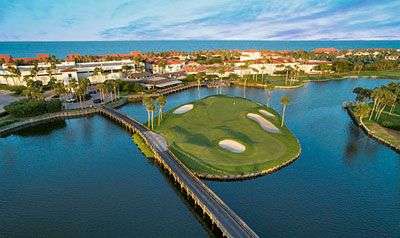
I is for ISLAND THE ORIGINAL A green surrounded by water is not a new concept. In fact, even the denizens of the Golden Age of golf course architecture occasionally surrounded the putting area with liquid hazard. The truest grasp on the concept of the “Island” template begins with No. 9 at Ponte Vedra (what is now known as the Ocean Course at Ponte Vedra Inn & Club). Herbert Strong completed the Ponte Vedra Club in 1928, and it was apparent he intended to test the mettle of the game’s best with dramatic greens and demanding hero shots... much like a nearby course to-be-named-soon. Like that other course, Ponte Vedra featured a Par 3 green set upon an island in a lagoon, 145 yards from the tee. The hole was originally No. 18, and upon walking off, Bobby Jones commented that Ponte Vedra “[is] a course to challenge professionals.” Ponte Vedra Ocean course 9th hole - photo courtesy of Ponte Vedra Inn & Club This original island held far more than a green; three pot bunkers (more were added later) fitted along the back of the putting surface, and a larger one sat front-right. There was even an apron of fairway...but too much spin could easily bring a short shot back down into the water. It seems like a generous target today, but after the shell-shock of playing one of America’s then-toughest courses, it may have intimidated even the best. OTHER INTERPRETATIONS We have already alluded to another Florida course that would become the standard for the “Island” template, the infamous No. 17 on the Stadium course at TPC Sawgrass. Pete Dye had a pit to fill, and legend claims his wife and frequent contributor, Alice Dye, suggested just placing a green in the middle of the future lake. No doubt the pair took inspiration from Strong’s work at the nearby coastal course. The Stadium course was created with the intention of hosting The Players Championship, and players immediately set upon its design for its over-the-top greens. TPC Sawgrass Stadium course 17th hole - photo courtesy of TPC Sawgrass No. 17, however, was not a challenge because of its size or slopes. It plays at 137 yards, a simple wedge for most players. At 78 feet in length, the green is much smaller than Ponte Vedra’s version, but hardly a tiny target. The challenge is solely of the nerves, knowing the lake will take all misses. Based on its 7% double-bogey percentage at The Players, this factor impacts pros almost as much as everyday players. It is perhaps the most pure rendition of “target golf.” The island is not quite a black-or-white equation, however. As with many penal holes, there is an element of matchplay risk/reward: Playing to the center of the green is always safe, and attacking the pin is—more often than not—dangerous. A strong backbone goes a long way in saving par, but strong conviction goes a long way in winning the hole. Granted, the “Island” concept is still rather binary for the mid-handicapper, which alienates some critics. Not helping the template’s cause is its appeal for the tourist crowd, a group that instantly appreciates the visual appeal of an island, versus the more subtle strategic pleasures of, say, a Double Plateau. In some cases, this leads to kitschy entries, à la the fruit-shaped No. 17 green at Apple Tree Golf Course. Although the Coeur D’Alene Resort built some tourist appeal (and excess round lengths) into its Island Par 3, via the necessary boat taxi to the green, it also created an interesting element for potential multi-day tournaments. The No. 14 green floats, and can be maneuvered to land for maintenance purposes, which suggests they could also alter its placement in the lake to change the hole’s identity from day-to-day. It’s essentially the putting surface version of runway tees. Coeur D'Alene 14th hole - photo courtesy of Coeur D'Alene Resort One hole that often gets overlooked in the “Island” conversation is The Creek Club’s 11th hole. The only real expectation of the modern “Island” template is a relatively short length, to emphasize nerve and accuracy over power. Geographically, however, the only real requirement of an “Island,” is that the green be surrounded almost entirely by water. Seth Raynor’s No. 11 is indisputably a Biarritz (200 yards and a signature swale), but there’s no reason why it can’t be an “Island” as well. Any template Par 3 could theoretically be adapted to “Island” form. The Creek 11th hole - photo courtesy of The Creek We’re honestly not trying to force MacRaynor into every conversation on templates! MAYBE... MAYBE NOT We stated earlier that many island greens debuted prior to Ponte Vedra’s (including the aforementioned Creek Club). Baltusrol’s Old Course featured one as early as 1910 (it was in play for the 1915 U.S. Open) and A.W. Tillinghast created an island green at Aronimink's No. 13 when he was the first to tweak Donald Ross's original design. The difference between Baltusrol and Aronimink’s entries from that era is that they are not Par 3s. It’s a “simple” distinction, but one that drastically alters the mindset during play. In these cases, the player must eventually cross the water, but they have an option of when to do it. Feeling bold? Go for two. Not so sure, or your tee shot was poor? Lay up. It is a viable risk/reward strategy, allowing players to choose how much distance is included with their forced carry. An “Island” Par 3 is a more predetermined test… ”do or die.” Every player is given the same basic task, even during matchplay. The options that a player may flex on a Par 5 with an island green, or even a Par 4, make the formula different. Famous short Par 5s with island greens—such as No. 17 at Cherry Hills or No. 15 at TPC Scottsdale’s Stadium course—make for exciting play, but they do not fit within our definition of the “Island” as a template. Cherry Hills 17th hole - photo courtesy of Cherry Hills Country Club Interestingly, Tillinghast may have also created the first Par 3 surrounded by water. His “Moat” hole at Galen Hall is a beast: 190 yards to a raised green, which is surrounded by the aforementioned moat, dug by Tillinghast for the purpose. We would argue, however, that despite its Par 3 status, the 15th hole doesn’t quite live up to the “Island” standard, even with the watery surrounds. Because the moat is so thin (compared to a lake), the option exists to lay up short of the moat, and play for par with a short pitch over the hazard. This makes it a shorter version of the Par 4s and 5s we described in the previous paragraph, versus a true “Island” hole in the Strong / Dye sense. Galen Hall 15th hole - photo courtesy of Galen Hall Golf Club David McLay Kidd gave the Ponte Vedra version a spin at Sand Valley’s Mammoth Dunes No. 8, in that there is additional short grass around the green for players to land upon... the catch being that the green itself is about half the size of Mammoth’s other elephantine putting surfaces. The major difference between this and the Strong / Dye version is, of course, the water being replaced with sand. This will surely make for a tough recovery, but it does not result in an automatic loss of a stroke, which dramatically alters the psyches of those teeing off. McLay Kidd intended Mammoth to be the more playable than the Sand Valley course, so we’re sure he won’t mind if that means sacrificing true “Island” status. Mammoth Dunes 8th hole - photo courtesy of Sand Valley

