Review of the Month September 2018 – Navatanee
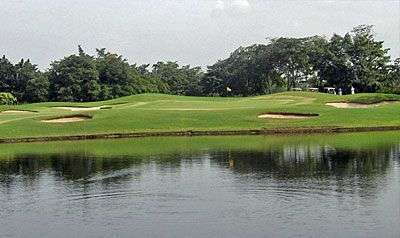
Oops I did it again; I got sucked into playing an overly expensive Asian golf course that rates fairly highly within the country. In the case of this course, Navatanee, likely based on two factors: it stills clings to the World Cup 1975 tag and the fact that it's an expensive and mostly private club.
However, it's a flat, parkland or even resort style layout that quickly became repetitive – if it wasn't for the photos and notes I took during the round I'd scarcely be able to recall a single hole 24 hours later. Additionally, it was very wet underfoot and most balls plugged on the fairways and surrounds. Whilst it had rained the night before, the addition of sprinklers had kept everything far too wet and really, this course is in tropical Asia where rain is pretty much a constant. If the conditioning can't cope with a small amount of rain I'd hate to think what it was like after a real downpour.
Really surprised that this course is rated anywhere near the top 10 to 15 in Thailand: as a club, sure it has a nice clubhouse and lots of staff (more staff working on the course than golfers playing midweek) and it looked tidy enough, but if I really consider the key points of the course design, conditioning and aesthetics, it was pretty average. Another word comes to mind: confected. A course confected from flat floodplain.
There must be better and better value golf in Bangkok and I think this course would be more accurately rated 3.5 balls.
By Scarlett
Review of the Month September 2018 selected by Editor-in-Chief, Keith Baxter – click to read more about Navatanee.

Review of the Month December 2020 – Bulls Bay The Lowcountry. When one considers this geographic descriptor bestowed on the coastal plains of South Carolina, a towering and broad-shouldered hill that climbs 75 feet above sea level is not the first thing to pop into mind. But Bulls Bay Golf Club, whose stately clubhouse and several teeing grounds sit just that high above their surrounds, is not a course that aligns with rational expectations. With a few notable exceptions, South Carolina golf requires an aerial approach. Bump and runs, overly aggressive tee shots skidding through fairways, and approach shots that must be aimed according to undulations in the greens, not pin placements – these are things you might find on Texas hardpan, the dolomite bedrock of the upper Midwest, or the distant shores of Scotland’s wind-battered linksland. But there they are, fully on display at Bulls Bay, complete with golden autumn hues more reminiscent of Shinnecock Hills on Long Island than Long Cove on Hilton Head. Mike Strantz’s masterpiece (yes, it’s better than Tobacco Road… though slightly less dramatic) is perhaps the most creative 18 holes within spitting distance of the South Carolina coastline. To be sure, there are “better” courses in the state (Palmetto, Ocean Course, among others), but you’d be hard pressed to find one that requires more imagination and produces more enjoyment than Bulls Bay. Despite stretching 7,200+ yards from the tips, Bulls Bay is exceptionally playable from its more reasonable teeing grounds. Its spacious and undulating fairways allow balls to release, especially on several holes where hillocks and sloping collars guide and funnel running shots to the putting surface. The greens range in size and character. Under the direction of Alan Black, each putting surface maintains consistent speed and challenges a player to consider breaks from every angle, even when you’ve got a wedge in your hand, not a putter. Bulls Bay isn’t perfect. There are some quirks that many a modern golfer will find infuriating or unfair: blind approaches, visual deception and plenty of unknowable hazards for players visiting for the first time or two. And for the more traditional architecture nut, the number of forced carries over water may seem excessive, particularly on a couple par 3s that present narrow landing strips perpendicular to the angle of the tee ball (for a low-ball hitter, the only thing more difficult getting over the water is being able to stop your ball before it barrels over the green or into some bunker). But the variety of golf shots required – or better stated, the variety of golf shots available to the imaginative golfer – make Bulls Bay a course that never plays the same way. The beauty of the grounds also benefits from diversity. The routing bends through marshland, thin forests and dramatic elevation changes, presenting magnificent and expansive views of ruggedly shaped waste areas and a number of bending bodies of water. In short, Bulls Bay is one of golf’s best-kept secrets. Though its renown has grown in recent years, the vision of founder/owner Joe Rice and the late Mike Strantz, has been given a much-deserved facelift by Alan Black and his grounds crew, and the result is truly something to behold. Nick Schreiber Review of the Month December 2020 selected by Editor-in-Chief, Keith Baxter, and sponsored by TaylorMade – click to read more about Bulls Bay. Photos courtesy of Nick Schreiber.

Gil Hanse's recreation of the lost, legendary Lido to open in August 2021 Gil Hanse has already made waves designing courses abroad, making his South American debut with the host layout for the Rio 2016 Olympic Games. He wasn’t necessarily looking to compete with that when making his Asian debut, however the concept was bound to create headlines: A recreation of the lost, legendary Lido Club. Now that long-discussed course, the Ballyshear Links just outside of Bangkok, has an opening date: August, 2021. The course will be hosted at the Ban Rakat Club — a highly-exclusive establishment, reportedly with only 400 members —which is chaired by Takeyasu Aiyama. Aiyama is also the chairman at Yokohama Golf Club. Bill Coore and Ben Crenshaw had done renovations at that club, and Aiyama was looking for inspiration for the property to become Ban Rakat. Interestingly, Coore recommended Hanse. Hanse and Wagner arrived at the property in Thailand and did not necessarily find anything evocative in the terrain. In fact, it was almost pancake flat. That opened another door, however, allowing Hanse and Wagner to apply their “caveman” personas and move more dirt than usual to create a bolder concept. Few concepts could be as bold as recreating the iconic Long Island club. Charles Blair Macdonald and Seth Raynor were known for their template-based approach to golf course design, which resulted in some of the world’s greatest golf courses, including the National Golf Links of America, Fishers Island, Chicago Golf Club and more. Although legend helps create hype, some hypothesize Lido may have been superior to all of them. Ballyshear 12th green Macdonald and Raynor were not at all “minimalists,” and Hanse and Wagner saw fit to emulate that historic pair’s approach with this piece of land. “Normally...we feel strongly that a golf course should be the product of its surrounds. But in the back of our minds, my partner Jim Wagner and I have often wondered what we would do with a completely flat site — what can you do to distinguish it?” Hanse said. “The most famous example of a manufactured golf course from The Golden Age was The Lido. Jim and I had always wanted to do a MacDonald/Raynor, angular grass-faced bunker design. We pitched the idea to the owner at Ballyshear and he loved it.” Ballyshear 14th tee The name “Ballyshear” is derived from the name of Macdonald’s own estate on Long Island. As with almost all of Macdonald and Raynor’s designs, template holes based on Macdonald’s travels in the UK were the basis for Lido’s design. If you’ve been keeping up with Top 100’s template architecture series, you’ve already learned about a few holes at Lido. The most famous hole at the course was the “ Channel,” based on Littlestone’s No. 16 hole. At the Lido version, players had the option to significantly shorten a long par five by first making a bold drive from the tee over the title “channel” to a rightward fairway, followed by another long, quality approach. It is near the ultimate in risk/reward, requiring two near perfect shots or else penalty will ensue. Ballyshear 17th hole Another example you’ve seen on this site is “ Narrows.” Although there is some debate whether the opener at Lido qualified, Macdonald did make a comparison between the two holes, with their respective fairway bunkering pinching the fairway. Other history was made at Lido as well. Although Alister MacKenzie no doubt would have found some success eventually as an architect, Lido represented his “breakthrough” moment. Country Life magazine held a contest for design submissions, which MacKenzie won with an entry that has come to be known as the “Lido” template. Macdonald and Raynor were so impressed by this multi-fairway par four that it ended up being used as the closing hole. The Lido also marked the debut of the minor template known as “Raynor’s Prize Dogleg,” a long par four requiring a long, precise tee shot to get home in two to an undulating green. Although named for the famous architect, it was actually an adaptation of another entry into the Country Life contest. Not that anyone reading this post will have played the original Lido, but if the golf historian gets the chance to play at Ballyshear, they will notice the routing is almost a perfect replica. “Almost,” as the property required the second and sixth holes to be switched to make the concept work. A small detail, probably not to be mourned by architecture enthusiasts. Ballyshear 18th tee For what it’s worth, Hanse is most keen on the final pair of holes, based on the “ Long” template and of course MacKenzie’s contribution, respectively. “At Ballyshear, I think the 17th and 18th, with their shared waste bunker between them, came out extremely well,” he said. “The scale of those two holes at Lido was impressive and we were able to capture that at Ballyshear.” Ballyshear will be the first Lido recreation to market, but rumors abound that Mike Keiser is looking to build a similar project near his Sand Valley Resort (albeit a private course in this case) in Wisconsin, with Tom Doak at the helm. Keep your eyes on Top100GolfCourses.com for updates on both projects.
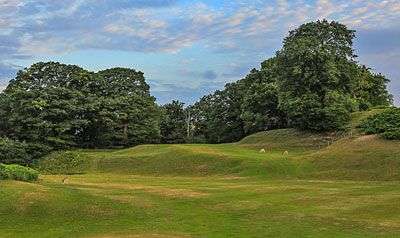
Review of the Month June 2020 – Knole Park Knole Park has been heralded as Kent's finest inland course and this is a great description of the course. It is a very enjoyable moorland complete with many lovely holes and some deer (one of which nearly ate my Mars bar on the 3rd tee). Knole Park is not amazingly presented and this is due to the deer. However, this does not detract from the overall experience. 1 - a par three of 192/186/186/181 that plays slightly uphill over a small cluster of bunkers. A fairly sedate opener in all honesty. 2 - a par four of 342/343/335/292 uphill to a green carved out of a small hillside. A decent hole but nothing too special. 3 - a beautiful par four of 403/393/380/340 with a large downhill drive. The hole climbs uphill after that to a very narrow green. Definitely one of the more picturesque holes on the course. 4 - a lovely par four of 421/418/410/406 from an elevated tee down to a curving fairway in a beautiful valley. A very picturesque hole but has a slightly awkward approach angle if you are a short hitter. 5 - an uphill par three of 194/180/161/122 that demands you take at least two extra clubs. Not an incredible hole to be honest. 6 - a very good par four of 409/399/372/375 to a fairway in a small valley before playing uphill to a raised green. A great hole that has a very open nature and is affected by the wind. 7 - a par five of 483/480/475/417 playing uphill along the boundaries of Knole house. Nothing too special, but a good birdie chance. 8 - a glorious par three of 184/175/163/161 playing downhill over multiple bunkers and water on the left. A beautiful hole that lies near the scene from the Penny Lane video. 9 - a tough par five of 534/503/472/354 uphill with trees on the left side of the fairway. Another fairly average par five. 10 - a good par three of 171/164/158/125 downhill with renovated bunkering at the front of the green. Me and my dad played the hole in one under gross combined which is quite an achievement since I play off 34 as a junior! 11 - a good par four of 438/427/408/408 which is slightly downhill from the tee. It bends very sharply to the right. The greensite is nice and this is a good hole. 12 - a long par three of 202/198/192/150 with panoramic views over the grounds and moors. It is actually a very nice par three with a sloping green. 13 - a short par four of 342/325/277/276 playing slightly uphill to a green in the shadow of a tall oak tree. A good birdie chance, but not much else to be honest. 14 - a fantastic par four of 499/447/429/435 downhill to a green with the bracken in the background. Apparently Peter Alliss loved the hole. I agree - it was my favourite hole on the course. 15 - a long par five of 546/485/471/461 playing from an elevated tee to a fairway deep in the valley before climbing back uphill. Either this or 17 is the best of the par fives. 16 - a tough uphill par three of 198/188/180/171 that has trouble all up the right. The simple solution is to just aim left of the green. The views from the green are among the best on the course. 17 - a good par five of 521/503/494/492 downhill towards the clubhouse. The green is a bit below the fairway and makes it easier to reach the green in two shots. A nice hole. 18 - a great finishing hole of 401/391/344/312 down the hill with O.O.B on the right. In front of the green is a small pond. A nice, but not taxing, finisher. Knole Park deserves to be in the Top 100 in England. An excellent course with many great holes. C. Davies Review of the Month June 2020 selected by Editor-in-Chief, Keith Baxter, and sponsored by TaylorMade – click to read more about Knole Park. Photos courtesy of Knole Park Golf Club.
