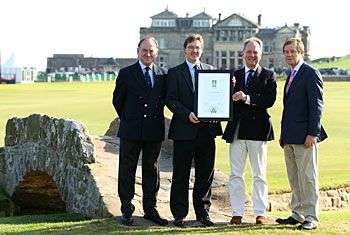
St Andrews Links achieves prestigious GEO Certified™ ecolabel
St Andrews Links has become the first Open Championship venue to achieve the prestigious GEO Certified ecolabel in recognition of its sustainability commitment and achievements.
St Andrews Links Trust, which manages the seven courses at the Home of Golf including the Old Course and The Castle Course, has operated a sustainability programme for many years and this approach was described by Mike Wood, the accredited verifier, as being “close to defining an ideal model for sustainable management.”
A special plaque was presented to Euan Loudon, Chief Executive of St Andrews Links Trust, by Jonathan Smith, Chief Executive of the Golf Environment Organisation, with George O’Grady, the Chief Executive of The European Tour, and Peter Dawson, the Chief Executive of The R&A, in attendance.
The Golf Environment Organisation (GEO) is an international non-profit organisation, supported by stakeholders across the golf community to help build awareness and understanding, provide practical programmes and reward achievements with the GEO Certified ecolabel.
In the GEO verification report the assessor praised the Trust’s commitment to social responsibility and community engagement as well as the eco-friendly manner in which the clubhouses, retail outlets and other facilities are operated. They said that not only was the Trust nurturing a 600 year heritage as the birthplace of the game, it was a “standard bearer for 21st Century good practice in golf management.”
A number of sustainability measures at the Links were highlighted by the assessor, including:
• The high quality of the golf courses’ playing surfaces which are maintained with minimal fertiliser, chemical and irrigation inputs.
• The restoration of the distinctive dune landscape between the New and Jubilee courses, recreating a natural habitat area.
• Managing the courses in such a way as to contribute to the management of the neighbouring SSSI at the Eden Estuary.
• The comprehensive range of energy efficiency measures in operation in the clubhouses and facilities.
• The re-use of organic materials and other recycling activities.
• Working in close partnership and co-operation with the local community.
• The transformation of intensively managed mixed farmland, into a new golf course (The Castle Course) with an extensive matrix of grassland habitats.
Euan Loudon said, “We take our duty to manage St Andrews Links sustainably as a golfing resource for future generations extremely seriously. Over the years we have won awards for the measures we have implemented and developed but this is certainly the most rigorous certification process we have gone through. We are delighted to achieve the GEO Certified ecolabel and we are focused on continuing to introduce new sustainable methods and practices across the breadth of operations at the Links in the years ahead.”
George O’Grady said, “We congratulate St Andrews Links Trust on their commitment and achievement. This is the kind of leadership that The European Tour are encouraging across all our venues as part of our own commitment to sustainability in golf, which was further reinforced by last year’s comprehensive Ryder Cup Green Drive. As founding partners of GEO, we are delighted to see their customised guidance, programmes and ecolabel gaining this kind of momentum.”
GEO has been dedicated to supporting and promoting sustainability in golf since 2006. In the space of two years, more than 250 golf clubs in 34 countries have started the GEO OnCourse programme to achieve the GEO Certified ecolabel. St Andrews Links becomes the 50th golf facility to achieve the distinction.
Jonathan Smith said, “For centuries the Home of Golf has been synonymous with low input, community integrated and ecologically rich golf. This stewardship of the historic Links of St Andrews, and more recently The Castle Course, has occurred through good decision-making that blends financial, golfing and common good interests relating to local people and the environment. We are delighted that our OnCourse programme has helped the staff of such an iconic golfing destination to broaden and deepen their actions enabling them to combine traditional values with a clear appreciation of modern day corporate and environmental responsibility.”
Dr Christian Deuringer, Head of Global Brand Management, Allianz SE, the global partner of St Andrews Links, said, “We congratulate St Andrews Links Trust on having achieved the GEO Certified ecolabel. As a leading global Insurance and Asset Management company, sustainability is part of the Allianz DNA and we have therefore decided together with the Trust, that a significant part of our partnership contribution goes to maintaining the courses and preserving the historic coastline. We are therefore especially pleased that St Andrews Links Trust’s superior efforts are rewarded and highlighted as examples for other venues around the world.”
Working closely with local advisors, consultants and the Scottish Golf Environment Group, the Links Trust has received widespread recognition for its environmental work in recent years. In 2003, it won the Scottish final of the British and International Golf Greenkeepers Association’s environmental competition. The following year it received the Scottish Golf Environment Group’s Environmental Excellence Award. In 2009, the Trust received the Golf Course Environment Award from the Sports Turf Research Institute for protecting the ecology of the Links landscape. The Castle Course Clubhouse was also recognised by St Andrews Preservation Trust for its outstanding design which complements the clifftop landscape.
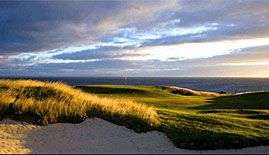
The Castle Course - Article courtesy of St Andrews Links Trust St Andrews Links Trust is creating a seventh 18-hole course to join its portfolio of six courses. It will be a public course, open all year round and is hoped to be ready for play in 2008. David McLay Kidd is designing the course. It is overseen by Project Manager Peter Mason and Links Trust General Manager Alan McGregor. A history of the site The site of the Castle Course is one that has been intimately connected with St Andrews for many hundreds of years. Earliest records indicate that the land was part of a hunting ground for Pictish kings who adopted St Andrew as their patron saint in the mid eighth century. At that time the district was called Muckross, from muic meaning a boar and ross, a promontory. From around 1100 AD the land was called the Cursus Apri, or Boar’s Chase. A boar still features as part of the town crest of St Andrews and a nearby village is called Boarhills. St Andrews town is linked to the site of the golf course by a stretch of coast called Kinkell Braes, which is designated a Site of Special Scientific Interest. (Kinkell comes from ceann coille, or head of the wood. Brae is a Scottish word for a hillside or steep slope.) The Braes is an area of wildflowers which has long been a favourite haunt of St Andreans walking along the clifftops and taking in spectacular views of the town and of St Andrews Bay. The Braes are not included in the golf course land, but mark its northern boundary. Public access to all the clifftop area has of course been maintained. The site of the course is made up of land purchased from Kinkell Farm and Brownhills Farm. The focal point of the course will be the headland named Kinkell Ness, or Kinkell Point, which is where the double green that serves holes 9 and 18 is situated and where the clubhouse will be built. On this headland there was once a fortification known as Kinkell Castle, which included a dovecot. Below the castle, there was a Kinkell Harbour. St Andrews Bay has long been notorious for shipwrecks and the small natural harbour was a welcome sight to many a sailor in distress. Closer to the shore, down on The Braes, there is a Kinkell Cave. This is thought to have been used by a hermit and may also have played a part in the smuggling trade of bygone times. Below the western edge of the course is Maiden Rock, a large isolated formation on the pebble-strewn shore, while the most prominent feature of the rest of the foreshore is an unusual sea-stack called the Rock and Spindle. In former times it was called Spindle Rock, a name which refers to a circular volvanic feature at its base which resembles a spindle, a device that played a part in the weaving industry which was a mainstay of the local economy up to the nineteenth century. The central part of the golf course was surveyed in 1837 when it was part of an area known as Spinkston. Other details on the map include names such as Kinkellfield, West Kinkell, Lower Briery Hill, Lower Twentys, Upper Rigs, Longlands, Collier Shod, Middle Shod and Craigendaff – this was also spelt Craigduff in the mid-nineteenth century. When the land at Kinkell was farmed in the middle part of the last century it was split up into a number of fields, all of which bore a name. The area where the clubhouse is to be situated was known as Castle Park. The others along the cliff top were called Cove and Craigduff. Further inland, there was Highland, east and west, and Spindle. Two of the southern fields were named Quarry Park and Milestone, with Centre Park making up the rest of the middle section. This information was kindly supplied to us by Henry Wilson who worked on the land in the 1940s. The requirement for a seventh public course at St Andrews was first recognised in 1998 and much of the early planning took place as the Millennium unfolded and passed. The right land was eventually found and purchased in 2002 and then the detailed planning was able to take place – including the selection of David McLay Kidd as the course architect. This period coincided with the four year study period at the University of St Andrews of Prince William, the heir to the throne.
In this episode of 'The Clubhouse' James is joined by a Scottish golf architecture legend; David McLay Kidd. The Glasgow-born Kidd founded DMK Golf Design in 2000, and ultimately went on to design incredible (but sometimes divisive) courses such as Bandon Dunes, St. Andrews (Castle) & Gamble Sands in Washington State. In this interview James talks to him about his life in golf, and how he approaches/thinks about course design. Previous Episode - Don't Miss Out! In the previous episode, we welcome golf journalist Matt Ward to the Clubhouse. Matt is the top reviewer on top100golfcourses.com, he's played over 2000 golf courses, and written 831 reviews! As a journalist, Matt has attended 100 majors and 12 Ryder Cup's, and has interviewed countless high profile golfers. In this wide-ranging interview Matt discusses his prestigious career and sheds light on what makes a top golf course. What Are The Top 100 Clubhouse Podcasts About? Top 100 Clubhouse is the ultimate podcast for golf enthusiasts! Join us as we delve deep into the minds of fascinating individuals from every corner of the golfing world. From players to course designers, caddies to golf historians, we'll leave no stone unturned in our quest to share unique insights and experiences with the Top100 Community. Together we'll explore the stunning courses and breathtaking landscapes, enjoying the unforgettable stories that bring the game of golf to life. How Do I Listen To The Latest Top 100 Clubhouse Podcast? You can download and listen on the following links. Listen now, wherever you download your podcast! Apple Podcasts Spotify Google Podcast Podtail We Need Your Feedback? The Next Podcast Interview? Top 100 members can share their views on who should join the next Top 100 Clubhouse podcast show? If you have an idea who you would like to hear, why not drop our Top 100 Clubhouse host James Henderson an email on james@top100golfcourses.com Happy Listening!
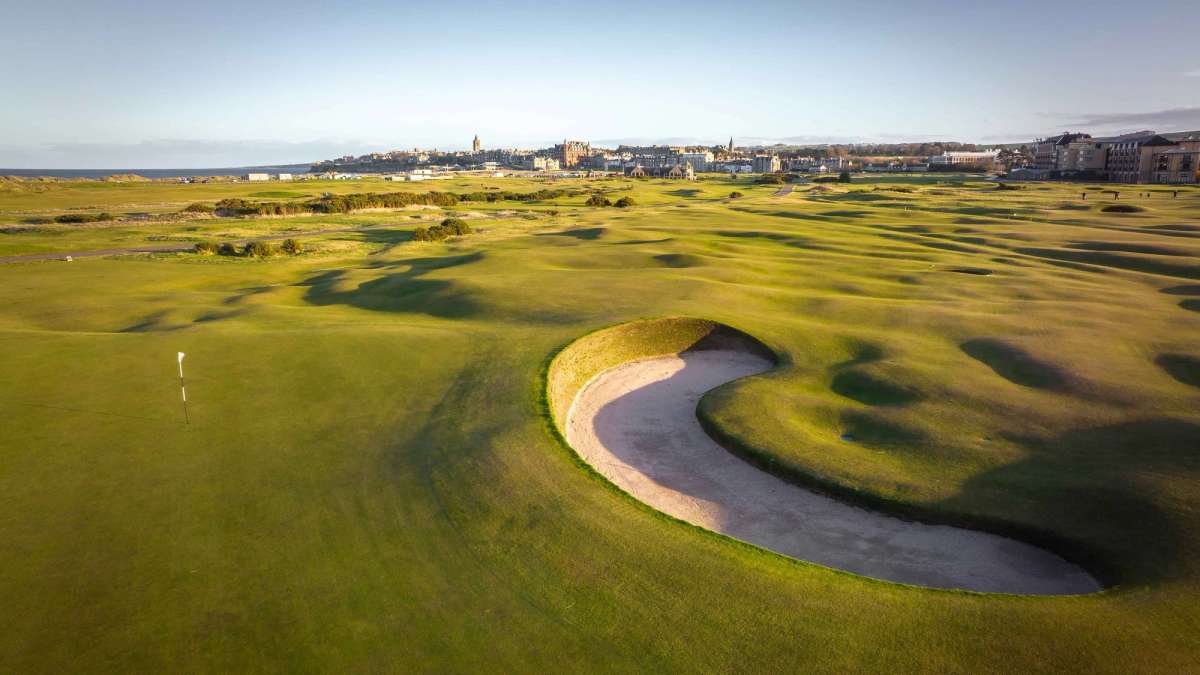
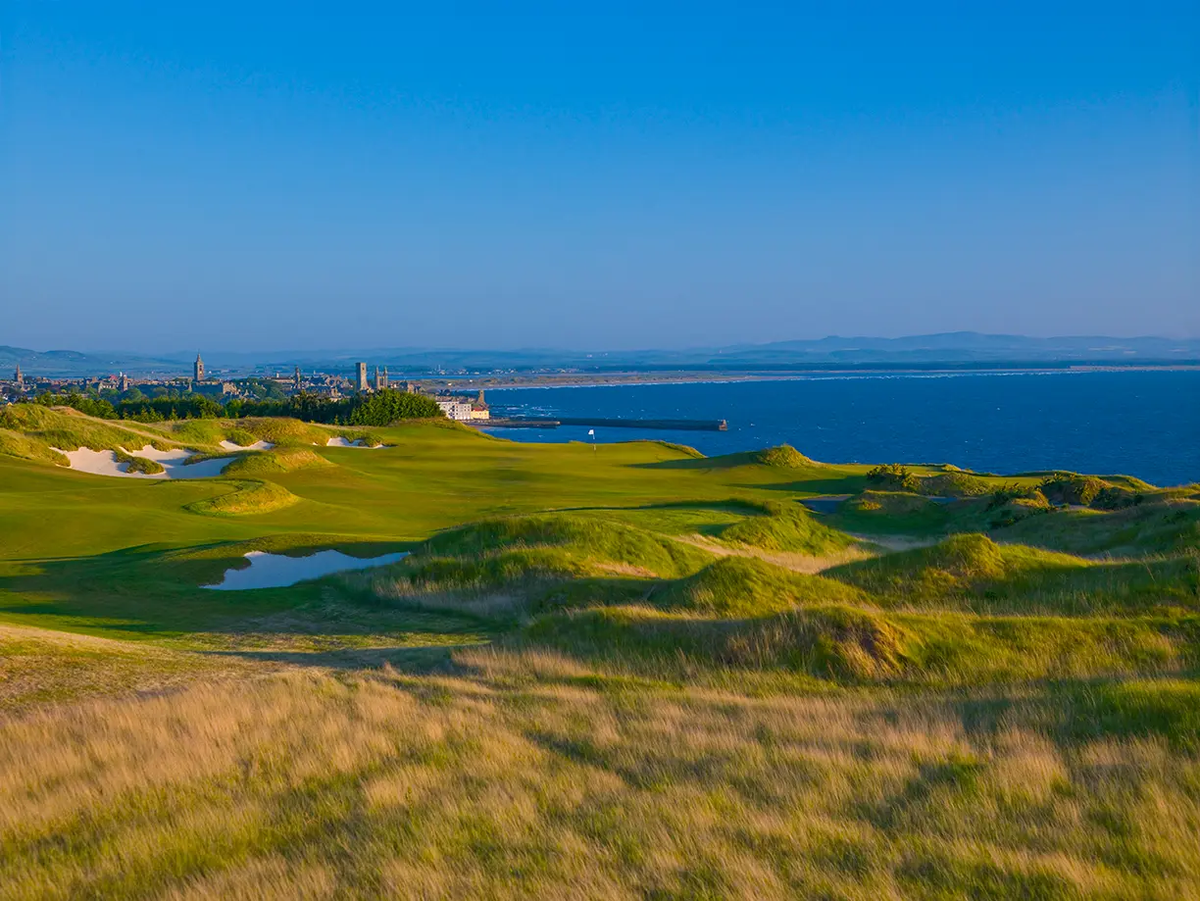
No golf destination carries quite the same weight as the Kingdom of Fife. This peninsula jutting into the North Sea between the Firth of Forth and the Firth of Tay is where the game was born, where its rules are written, and where golfers have been making pilgrimages for six centuries. It is Scotland's most densely packed region for quality golf. The Old Course at St Andrews sits at the very summit of the world rankings, but Fife's strength goes far beyond one famous address. Kingsbarns ranks among the finest modern links on the planet; Dumbarnie has shot to prominence since opening in 2020; the Castle Course, New Course, and Jubilee provide championship-level variety without leaving the St Andrews links complex. Venture further south into the East Neuk and you find Elie, Crail, Lundin Links, and Leven – courses that serious golfers return to again and again. Venturing inland to Ladybank and Scotscraig rewards those willing to look beyond the coast. A week in Fife barely scratches the surface. A fortnight leaves you wanting more. This guide covers everything needed to plan a trip that does justice to Scotland's most extraordinary golf region. Fife Golf: Why It Should Top Your Travel List 🌟 Unmatched Golf Density Fife leads Scotland's regional breakdown with the most courses in the Top 100, ahead of East Lothian and Ayrshire. Within a 40km (25-mile) radius of St Andrews, golfers can access more world-class links than on any comparable stretch of coastline anywhere. The concentration is genuinely remarkable… drive 20 minutes east from St Andrews, and you are playing Kingsbarns; 30 minutes west and you are at the East Neuk classics; an hour north and Scotscraig awaits. The quality also spans every price point and every course style. The range means golfers on any budget can build a serious itinerary. A Golf Trip Unlike Any Other Home of Golf heritage – it is the home of golf and where the R&A still governs the global game from Championship pedigree – the Old Course alone has hosted 29 Opens; Kingsbarns co-hosts the Dunhill Links each autumn Modern excellence – Dumbarnie (2020) and the Castle Course (2008) prove Fife's ability to produce world-class new designs Diversity of terrain – links, heathland, parkland, and clifftop golf all within an hour's drive Infrastructure – St Andrews supports international golfers with world-class hotels, caddies, equipment rental, and year-round play Fife's Finest Golf Courses ⛳ The Top Eight – Essential Fife Golf 1. The Old Course at St Andrews The Old Course at St Andrews – The most famous golf course in the world sits at the very heart of the town, its fairways woven into the fabric of St Andrews itself. The course divides opinion among architects and purists – the blind shots, shared fairways, and vast double greens are either baffling or revelatory depending on the round – but no golfer leaves unmoved. A guaranteed tee time requires booking many months in advance through an authorised operator. The daily ballot offers a more affordable route but demands flexibility; the ballot draws 48 hours ahead, and results are announced after 5 pm. Caddies are strongly recommended to complete the experience. 2. Kingsbarns Golf Links Kingsbarns Golf Links – Opened in 2000, Kyle Phillips's design transformed flat farmland 11km (7 miles) southeast of St Andrews into one of the most celebrated links in existence. The North Sea is visible from every part of the course, and six holes play directly along the shoreline. The par-5 12th, sweeping around the bay, and the par-3 15th, demanding a carry over a rocky inlet, are among the most photographed holes in Scottish golf. Kingsbarns co-hosts the Dunhill Links Championship with the Old Course and Carnoustie each autumn. The club's caddie operation is excellent, and the post-round hospitality matches the best in Scotland. 3. Dumbarnie Links Dumbarnie Links – Clive Clark's 2020 creation on the 5,000-acre Balcarres Estate has made one of the most dramatic entrances in recent Scottish golf history. Set on the Fife coast overlooking the Firth of Forth, with 14 of 18 holes offering sea views, Dumbarnie stretches to 7,600 yards from the tips and can be set up with up to three drivable par-4s depending on conditions. The 10th, defending itself with a large water feature, is the hardest hole on the course; the 17th, a short par-4 climbing over a stone wall and wetland, captures the Scottish links spirit perfectly. Dumbarnie hosted the Women's Scottish Open in 2021 and has quickly established itself as one of Scotland's finest pay-and-play venues. 4. St Andrews Castle Course St Andrews Links (Castle Course) – The newest addition to the St Andrews Links Trust portfolio was designed by David McLay Kidd and opened in 2008. Laid out on a clifftop above the town with over 1.6km (a mile) of waterfront. The Castle Course divides opinion within the St Andrews family as it lacks the 'natural' links character of its famous siblings, but the clifftop setting delivers drama that few courses anywhere can match. The closing three holes of each nine are strung along the coastline, and the wind at this exposed elevation makes the Castle Course play more difficult than its yardage suggests. Closed from November to February. 5. St Andrews New Course St Andrews Links (New Course) – Created in 1895 by Old Tom Morris and Benjamin Hall Blythe to relieve pressure on the Old Course, the New Course is considered by many locals to be the finest test in St Andrews. Tighter and more defined than its famous neighbour, the New rewards precision over creativity and has hosted national championships for over a century. It is outstanding value for a course of this quality and heritage. 6. Golf House Club, Elie Golf House Club, Elie – James Braid was born and raised at Elie, and while it was Old Tom Morris who laid out the current 18 holes in 1895, Braid made his revisions in 1921, and the course has remained largely untouched since. Elie is famously quirky. For example, the starter uses a submarine periscope salvaged from HMS Excalibur to check that the opening hole is clear before sending groups on their way. Five-time Open champion Peter Thomson called it the most enjoyable course he knew, and the layout of 16 par-4s and two par-3s, with fiery greens and constant Firth of Forth views, makes the claim easy to understand. Visitor access is limited in the summer due to member priority, so early booking is essential. 7. St Andrews Jubilee Course St Andrews Links (Jubilee Course) – Often described as the most challenging of the St Andrews courses, the Jubilee was built in 1897 and sits between the New Course and the sea. The Jubilee is considered excellent preparation for anyone hoping to play the Old Course. 8. Crail Balcomie Links Crail (Balcomie Links) – Golf has been played at Crail since 1786, making it one of the oldest clubs in the world. Old Tom Morris designed the current Balcomie Links layout in the late 1890s, with the course positioned right on the craggy East Neuk coastline. With stone walls, railway sleeper bunker faces, and natural hollows as hazards, Crail has an authenticity that newer courses spend fortunes trying to recreate. Crail is 15km (9 miles) from St Andrews and serves as an ideal companion round to Kingsbarns, just minutes away. Worth Every Minute: Fife's B-Side Courses 🎯 The Supporting Cast That Steals the Show One of Fife's great secrets is how well its mid-tier courses compare to headline acts elsewhere in Scotland. The following seven are ranked 9–14 in Fife's Top 100 regional listing, and each one earns its place in any serious Fife itinerary. 9. Crail Craighead Links Crail (Craighead Links) – Gil Hanse's 1998 design at Crail occupies higher ground than its older sibling, Balcomie, and offers more dramatic elevation changes and sweeping views in multiple directions. Craighead's tall fescue rough is among the most demanding in Fife, and the green complexes require careful thought. Playing both Crail courses in a single day is entirely achievable and gives a fascinating contrast in approach and character. 10. Lundin Golf Club Lundin Links – Lundin's unusual origins. The club shared a course with Leven Golf Club until 1909, when James Braid was brought in to create a separate layout, giving the course a character unlike any other in Fife. The front nine is classic links; the back nine crosses an old railway line into a different style entirely. Lundin hosted Open Final Qualifying when the Championship was at St Andrews for many years, which says everything about the quality of the test. Six holes play adjacent to the beach, and the 18th, at 450 yards, is one of the toughest finishers in the Kingdom. 11. Leven Links Leven Links – Sharing the same stretch of coastline as Lundin, Leven is the more traditional of the two and offers one of the most honest links tests in Fife at a price that feels increasingly rare for a course of this calibre. The par-3s can be particularly devilish, and the two closing holes are as strong as any in the East Neuk. The golf club dates to 1820, making Leven one of the older clubs in Scotland. 12. Ladybank Golf Club Ladybank Golf Club – Ladybank is Fife's only heathland course is a pine-lined inland gem that offers a completely different experience from the coastal links dominating the rest of the Kingdom's roster. Old Tom Morris designed the original layout, and the course has hosted Open qualifying and top amateur events, including the Scottish PGA Championship. The contrast with a day on the links is deeply refreshing, and the course's compact, strategic nature rewards intelligent play over raw power. 13. Scotscraig Golf Club Scotscraig Golf Club – Founded in 1817, Scotscraig is among the 20 oldest golf clubs in the world and sits in the north of Fife near Tayport. The hybrid course, partly heathland, partly links, sits close to the sea without actually playing along it. James Braid redesigned the layout in 1923, and his accuracy-focused design rewards careful course management over aggression. Scotscraig hosts Open qualifying when the Championship is at St Andrews and held the Scottish PGA Championship in 2023. 14. St Andrews Eden Course St Andrews Links (Eden Course) – The Eden sits within the St Andrews Links complex, tucked between the estuary of the River Eden and the more celebrated courses. Redesigned by Harry Colt in 1913, it is a genuine links test at an accessible price point and makes an excellent warm-up round for groups visiting St Andrews for the first time. Where to Stay: The Fairmont St Andrews 🏨 The Golf Resort of Choice for Fife For golfers seeking a single base that combines world-class accommodation with on-site golf, the Fairmont St Andrews stands apart from every other option in the Kingdom. The five-star resort occupies a dramatic clifftop position 3km (2 miles) from the Old Course, with views across St Andrews Bay that set the mood from the moment of arrival. The Fairmont's 209 rooms and suites range from golf-view standard rooms to sprawling spa suites, and the hotel's Esperante restaurant has earned consistent recognition for its Scottish menu. The leisure facilities, including an indoor pool and spa, provide welcome recovery between rounds on days when Fife's weather has taken its toll. For golfers not staying at the Fairmont, St Andrews town centre offers a substantial choice. The Rusacks Marine Hotel occupies one of the most coveted positions in Scottish golf, overlooking the 18th hole of the Old Course from just beyond the boundary. Its recent renovation has brought it back to the standard the location demands. The Old Course Hotel, directly adjacent to the 17th Road Hole of the Old Course, remains the most famous golf hotel address in Scotland and serves as the unofficial meeting point for serious golfers visiting St Andrews. In the East Neuk, the small fishing towns of Anstruther, Pittenweem, and Crail offer characterful B&B and self-catering accommodation that puts golfers within minutes of Elie, the two Crail courses, Lundin, and Leven. For golfers making Elie or Lundin Links the centrepiece of a visit rather than St Andrews, basing in the East Neuk avoids the traffic and crowds of the town while keeping the top courses within easy reach. Getting There and Getting Around 🚗✈️ Reaching Fife Edinburgh Airport is the primary international gateway, with direct flights from London (1 hour), most major European cities, and transatlantic services from New York, Boston, and Toronto. The drive from Edinburgh to St Andrews takes approximately 75 minutes via the Forth Road Bridge and the M90. Dundee Airport serves regional UK routes and sits 35km (22 miles) from St Andrews. Trains from Edinburgh to Leuchars station (the stop for St Andrews) take approximately 1 hour; the connecting bus into town adds 15 minutes. For golfers planning multiple East Neuk courses, a rental car is essentially mandatory. All the key courses are within 45 minutes of St Andrews by car. Getting Around Fife A hire car is the practical choice for any golfer playing more than two or three courses. The road network in Fife is straightforward and largely free of congestion outside St Andrews town centre. Distances are compact: Kingsbarns is 11km (7 miles) southeast; Elie is 24km (15 miles) south; Lundin Links is 30km (19 miles) southwest; Ladybank is 32km (20 miles) west; Scotscraig is 26km (16 miles) north. Most golfers based in St Andrews can reach any course in Fife within 45 minutes. Clubs, Equipment, and Caddies Caddies are strongly recommended on the Old Course. The local knowledge on the Old Course is genuinely invaluable and transforms an enjoyable round into a memorable one. Weather and When to Visit Golf in Fife is a year-round proposition, though the experience varies significantly by season. May to September offers the longest days, the best weather reliability, and peak green fees. Late April and early October provide excellent conditions at shoulder-season pricing, with fewer crowds and the same course quality. Winter play (November to March) is possible on most courses, with green fees dropping substantially. The Dunhill Links Championship in early October is a significant draw for Fife at that time of year, with the Old Course, Kingsbarns, and Carnoustie all hosting the pro-am. The Open Championship at St Andrews – next scheduled for 2030 following the 150th edition in 2022 – creates enormous demand for the entire year in question and the year before. Booking Golf in Fife 📅 Securing Tee Times at the Top Courses The Old Course requires the most planning. Guaranteed commercial tee times through authorised operators sell out many months in advance – for peak season, 12 months ahead is not excessive. The daily ballot is drawn 48 hours before play and offers a more affordable route but demands flexibility and a willingness to adjust the day's schedule. Entering the annual private ballot in late August for the following year is the most popular approach. Kingsbarns releases tee times well in advance, and the booking process is straightforward through the club's website. Dumbarnie's visitor tee times are bookable directly via email or phone and the club is responsive to inquiries – booking 2–3 months ahead for peak summer is prudent. The East Neuk courses of Elie, Crail, Lundin, and Leven generally have more availability and bookable time slots within a 4–6 week window in summer. Elie is the notable exception: member priority severely limits visitor access at weekends in high season, and weekday play is strongly advisable for non-members. Ladybank and Scotscraig are the most accessible of Fife's top courses and can often be booked within days during the summer. The St Andrews Links Trust courses (New, Jubilee, Eden, Castle) are bookable through the Links Trust website or via authorised operators. Package deals combining two Links courses on consecutive days are offered and provide meaningful savings over individual bookings. Beyond the Fairways 🏰 When the Clubs Are Put Away St Andrews is a complete destination beyond golf. The University of St Andrews, founded in 1413 and the oldest in Scotland, gives the town an intellectual energy that distinguishes it from most golf destinations. The ruins of St Andrews Cathedral – once the largest in Scotland before the Reformation – and the adjacent St Andrews Castle are worth a morning's exploration. The British Golf Museum, adjacent to the R&A Clubhouse, is the finest golf heritage museum in the world and an essential context for any serious golfer visiting the Kingdom. The East Neuk villages – Anstruther, Pittenweem, St Monans, and Crail – reward exploration on any day away from golf. The Pittenweem Arts Festival each August transforms the village into a gallery town; the working fishing harbour at Anstruther is active year-round; Crail's harbour, with its distinctive red pantile rooftops, is among the most photographed spots in Fife. Scotland's Secret Bunker near Anstruther, a Cold War nuclear command centre preserved underground, provides a genuinely surprising afternoon for the curious. Walking the Fife Coastal Path, which stretches 117km (73 miles) from the Forth Road Bridge to the Tay Bridge, is increasingly popular with non-golfing partners. The section from Largo to St Andrews is particularly rewarding and passes several of the region's best courses. The village of Falkland, home to Falkland Palace, a Renaissance royal hunting lodge that served as a retreat for Mary Queen of Scots, is worth the 30-minute drive inland for a complete change of pace. Insider Local Knowledge 💡 What the Guidebooks Miss The Old Course is closed every Sunday – a fact that surprises first-time visitors Ballot tee times on the Old Course are actually cheaper than commercial guaranteed times Elie's periscope starter system is worth arriving early for The Craigtoun Course (formerly Duke's) is now a St Andrews Links Trust property and offers a heathland experience completely unlike the links courses Lundin Links and Leven Links share the same stretch of coastline and are most rewarding played together; the contrast between Braid's hybrid Lundin design and Leven's traditional links format is instructive and thoroughly enjoyable Ladybank is easily overlooked but consistently surprises visitors who expect a 'lesser' inland course Pack waterproofs regardless of the forecast; Fife weather changes rapidly, and even the best forecasting is unreliable on the coast Golf in The Kingdom of Fife Awaits 🏴 Fife rewards planning but forgives those who arrive without much of it. The sheer density of outstanding golf means that a trip here produces memories that last a lifetime. The Kingdom of Golf earned its name long before marketing departments existed, and the courses that fill this guide prove it still deserves the title. Book the Old Course as early as possible, be flexible with everything else, and trust that Fife will deliver. It always does.

