
The Wisconsin “Pearl” Golf Trip
By Richard Smith, Knoxville, Tennessee
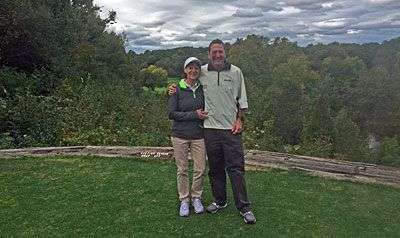
For our 30th wedding anniversary I convinced my lovely wife Ruth to accompany me on a golf trip to the Kohler Resort in Wisconsin and then on to Erin Hills Golf Course, site of the 2017 U.S. Open championship. Ruth has begun to take a liking to golf even though she is a relative beginner. I was looking forward to playing some exciting golf and sharing some new experiences with her.
We were able to get an early morning flight into Milwaukee then we rented a car and drove to Kohler in just under an hour. We played the Irish course first on the day we arrived. There was some bad weather on the way so we moved our tee time up an hour which turned out to be a smart decision.
Bob was our caddy and he, like the other caddies we had during this trip, was an excellent guide around the course. We played as a twosome and basically had the course to ourselves. We played in 3 hours and 15 minutes, just finishing as a bad storm came in and the lightning siren was going off.
Although the Straits course is the most famous layout at Kohler, the Irish course is a well designed, challenging course which is a lot of fun to play. There are a good variety of tee options and if you play the course from the appropriate set of markers you’ll have a very enjoyable day.
The Irish course is just inland from the Straits course so that the Lake Michigan shoreline is not in play. The course has a gentle rolling feel. There is an abundance of sand and water hazards but the course always seems to offer a safe option both off the tee and on the approach. The greens are well contoured and have a huge variety of pin placement options. Many of the holes have openings to the front of the greens allowing run up shots if the ground is firm enough.
There’s a great variety of short and long par fours and par threes. I thought the long dogleg left par four 4th was a very strong hole, but very well designed. An opening to the left of the green allowed an opening for a shot to roll in and the green actually fed to the back right pin placement we were playing to. The short par four 7th was a gentle dogleg right which required a precision shot off the tee leaving a short approach to a well guarded and elevated green.
On the back nine back-to-back par fours at 15 and 16 were outstanding while the short par four 17th played around a lake the entire left side of the hole. The par fives were very interesting. All of them were risk/reward type holes, and if your tee shot was not in the fairway then the layup shot became very difficult.
The Irish course was the perfect combination of fun and challenge. It is an easy course to walk. Although Ruth is fairly new to golf, she enjoyed the course. On a few holes she had an intimidating tee shot over some waste areas, and often times we just moved up past the danger and let her tee off from the fairway. The run up areas to the greens were nice for her. I think the course could use a few more forward tees to encourage new golfers, but the Irish course is manageable for all levels of golfers.
The greens, bunkering and challenges off the tee are all vintage Pete Dye. The Irish seems to me to be a hybrid design between the TPC Sawgrass and the Ocean Course at Kiawah among Dye courses I’ve played. The only downside to the course seemed to be the routing, and all the holes seem to run close to the same direction. We played in a good 15 mph wind, and it seemed like we were either straight downwind or against on every hole. Otherwise this is a fine course and an excellent course to accompany the adjacent Straits course.
After our round we checked in to our accommodations at the Inn on Woodlake. The main hotel on the property, the American Club, was full, probably because so many people were visiting Kohler on their way to the Ryder Cup, which was played the following week. Although the check in and reception areas are very simple, the rooms were excellent. There was a lot of space and the shower was absolutely stunning. Multiple jets threw water at you from multiple angles and to be honest I wanted to stay in the shower all morning.

The next day I played the Straits course while Ruth took in a massage at the spa. She joined me for about half the round on the Straits. I’ve watched the PGA championships at the Straits course so I was familiar with many of the holes, but the course was even more spectacular in person. Pete Dye was able to utilize the Lake Michigan shoreline to construct an amazing set of holes. Even more enjoyable was the fact that the Lake is visible from almost the entire course, making this a setting that nearly rivals Pebble Beach.
Like the Irish course the Straits course has a gentle rolling nature to it but it is very easy to walk. The course has a number of forced carry “do or die” shots, none more dramatic than the approach shot into the 18th green, but most holes offer an opening that can be played to. I really enjoyed the strategic design of all the holes. I was fascinated by how playable the course was even with all of the dramatic shots which we encountered.
The wind was very stiff, probably at least 20 mph most of the day. Unlike the Irish course it seemed that each hole had a slightly different orientation and the wind was mainly across on most holes. This made if very difficult to get the ball close to the hole. In addition the driving areas are not all that wide, so the course really rewards a top flight ball striker. The early stretch of holes 2 through 4 are all on the lake and these holes set the tone for the excellence of this layout.
3 is the first of four excellent par threes. It plays slightly downhill to a green with deep treacherous bunkers to the left but a generous bail out area right. The course returns to the lake on 7, another great par three with bunkers and death to the right, but again a bail out area left. The downhill par four 9th is an outstanding hole with a narrow teeing areas and a green guarded by a deep pot bunker left. I was in that bunker and I might still be there if I hadn’t given up after three tries at getting out. 10 is a short par four, slightly uphill with a number of options off the tee and on the approach. The remaining holes on the back nine are familiar to television viewers and they are a wonderful combination of challenging holes of all length.
The Straits course is a quality championship course. The course is much more spectacular in person than on television, which is the same way I felt when I first played Pebble Beach. Truth be told I think this course is in the same category as Pebble in regards to beauty as well as the quality of the golf. In order to score well a player has to have all aspects of their game working well. The driving lines are tight but manageable. The greens are defended by some severe hazards, but a bail out area always seems available.The greens have typical Dye contours and they are difficult to putt, but they are never outrageous. My playing companions were two ladies from Arizona and John Edmund from Aberdeen Scotland. We all enjoyed the course tremendously and it was very manageable for the ladies. I think Ruth would have enjoyed the course and I would encourage her to play when we return.
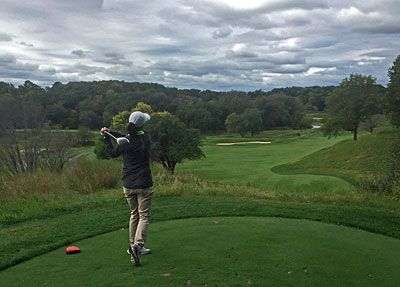
Our last round at Kohler was on the River course at Blackwolf Run. The Straits and Irish course are about 15 minutes away from the main area of the Kohler resort while the River course and the Meadow Valley courses are closer. The River course is a spectacular inland course running around the Sheboygan River. The river is in play on 14 of the 18 holes. The river runs hard by the left side of the first hole and sets the tone for the entire round. The course has two distinct areas. Holes 1-4 are part of the original 18 Dye designed, as are holes 14 though 18. These holes are somewhat flatter, but not lacking in character. Holes 5 through 13 are up and around a significant ridge which brings into play some of the most spectacular views and shots imaginable. Hole 5 is called “Made in Heaven” and this is simply one of the most beautiful and spectacular holes I’ve ever played. 8 is a great par five where the drive is hit off an elevated tee and the hole then turns right to a split fairway allowing a number of strategic options. 9 is a marvelous short par four with all kinds of options off the tee.11 is a very tough par five with bends along the river which guards the entire right side of the hole.
All in all I like the newer holes better, but unfortunately because of the elevation changes and distances between holes the course is really not one you can walk. Despite the difficulty of the course my wife enjoyed the layout both because of the beauty and the fact that Dye, once again, does give an opening to most of the greens. The course could probably use another set of tees slightly forward for less experienced golfers, but this is not a big issue. In addition, the course is almost impossible to walk because of the elevation changes and the distances between holes in the newer portion of the course.Regardless this is a spectacular layout and one of Pete Dye's best efforts.
A word needs to be said about the outstanding service at the Kohler resort. Every employee was friendly and helpful. Our round at the River course was on our anniversary and everyone there knew about it, even the girl at the beverage shack between holes 8 and 12. This is the type of first class service you would expect at a resort of this quality and Kohler consistently delivered.
Erin Hills is about an hour drive from Kohler. It is in an isolated area of the Wisconsin countryside. We stayed in nearby Hartford but there are rooms on the grounds. The clubhouse is magnificent and the food at the clubhouse is first class.
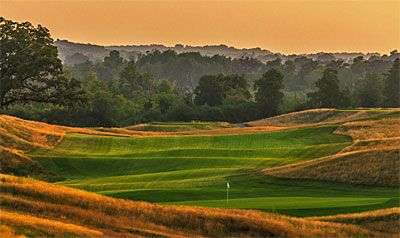
The course is slated to host the 2017 U.S. Open and it certainly has the look and feel of a championship layout. Apparently very little dirt was moved and the result is a very natural feeling and beautiful golf course.

The holes have reasonably generous fairways guarded by well placed bunkers and the holes are defined by acres of thick fescue grass. The routing rolls through some impressive elevation changes. The course reminds me of some of the wild links on the west coast of Ireland such as Enniscrone and Carne. If the ground were firm it would certainly play like a links course but I don’t think the base is firm enough to allow that. Regardless each hole has a wonderful isolated feel and sometimes you feel like there is no one else on the course.
There are a number of great holes. The short second offers a number of strategic options right off the bat. Consistent with the short length of the hole the green is an inverted saucer that demands a precise approach. Birdies are available here but bogey lurks for a lazy tee shot or approach. 4 is a very demanding par four with sharp drop offs front and back on the right side of the green. This is one of the most demanding approaches on the course. The short par three 9th appears easy but is anything but. The green is treacherous and is guarded by immense bunkers. This will be an interesting hole to watch in the U.S. Open. Apparently it played the most difficult hole during the U.S. Amateur despite having a maximum length of 165 yards.

There are a number of nice holes on the back nine starting with the long 10th, an uphill par four which played directly into the wind. 14 is a great risk reward par five with a massive slope on the right side of the green. 15 is a short par four that will probably be a personal favorite since I holed out a 9 iron from 135 yards for an eagle 2! 18 is a massive par five, slightly uphill where each shot most be played carefully and with foresight. A great finish to a great course.
If the USGA doesn’t mess up the golf course and tournament, Erin Hills should be a fitting site for the U.S. Open. If the wind blows scores could go sky high since the fescue rough is absolutely brutal.
Our trip was at the end of September, which was a perfect time to visit. Temperatures were around 60 F. The wind blew harder than usual, probably due to the front which came in from the north and affected the preparation week of the Ryder Cup at Minneapolis. Kohler is an outstanding resort and all the courses we played were of the highest caliber. We had great caddies at all the venues with excellent accommodations and dining. I would encourage golfers of all skill levels to try and make the trek to this area. My wife is a relative beginner but we both had a wonderful time. This was one of my favorite golf trips ever.
Richard Smith
To read my reviews for each course, click on the links below:

2017 US Open The winners and losers at Erin Hills by M. James Ward The 117th US Open marked a first for both Erin Hills, the host site, and the State of Wisconsin. The week produced a range of interesting storylines that showed top tier shotmaking and unexpected hiccups at crucial moments. For the United States Golf Association (USGA) the return to the Midwest for the first time since '03 showed how crucial it is to make sure the championship of American golf is staged at other locations beyond being the domain of the east and west coasts. Here are the winners and losers of last week's event in the Badger State. Losers The world's top three players. Dustin Johnson, Rory McIlroy and Jason Day all failed to make the 36-hole cut. This marked the first time since the world rankings was created in 1986 that all three of the top ranked players headed home earlier than expected. Johnson waited till Tuesday of tournament week to arrive given the birth of his second son the day prior. The missed cut at the US Open marked his second straight missed cut for the world's number one ranked player. McIlroy's indifferent play came from a layoff for several weeks to rehabilitate a tender back. For Day his play was far from being on form with wayward driving and a balky putter. The Aussie needs to revive himself at The Open Championship in a few weeks. Rickie Fowler. Seized the moment with a seven-under-par 65, matching the US Open record of most under par in an opening round. However, the 28-year-old 9th ranked world player was unable to keep pace. Entering the final round just two shots off the lead Fowler had to spend more time playing inventive recovery shots as his earlier steady driving became more circumspect. In the end, Rickie was only able to match par-72 and was simply passed by other players able to demonstrate an extra gear for which Fowler has yet to demonstrate in a major championship's final round. Justin Thomas. Ascended the leaderboard with his stellar 3rd round 63 -- besting the previously mark of 8-under-par for a US Open round set by 1973 US Open champion Johnny Miller during his win at Oakmont. Thomas closed out his Saturday play with a spectacular 3-metal second shot to the closing par-5 and making the short eagle putt. Unfortunately, the three-time PGA Tour winner for '16-'17 was as flat as a pancake in the key final round and faded badly with a closing 75. Like Fowler, Thomas has the talent -- the issue is can he see it through for the full 72-holes in a major championship. Speaking of Johnny Miller. The two-time major champion and lead analyst for NBC-Sports weighed in by downplaying the achievement given Miller's viewpoint that Erin Hills was not in the same category of challenge that Oakmont is where Miller set the then record. The bottom line is that Miller's round is till the gold standard for overall shotmaking prowess given the rigors of Oakmont. What was classless of Miller was failing to show good cheer for what Thomas achieved. Miller's take was more of the curmudgeon who can't see beyond his own two feet. FOX’s coverage certainly improved from its first US Open in '15 at Chambers Bay but lead announcer Joe Buck despite his clear desire to do his best is out of his element when reporting on golf versus his other efforts with Major League Baseball and the National Football League. Hats off to FOX for kayoing original analyst Greg Norman after his first year. Paul Azinger brings a refreshing vigor and is not afraid to be straightforward when situations call for total candor. Course announcer Ken Brown was also quite good. FOX did bring a better technical side with shot-tracer and other additions but the network still needs to raise its approach to be equal to the event it is covering. Having foot solders alongside the players can really add a good deal. Finally, the awards presentation with Curtis Strange interviewing Koepka was amateurish. The USGA needs to follow the script of the R&A to provide for a fitting ending. Winners Brooks Koepka. The new US Open champion, showed immediately in the final round he was ready to play with two straight birdies at the 1st and 2nd holes. His ball striking was peerless given the blustery wind conditions. The 27-year-old missed just one green during the final round and a total of ten for the entire week. His final round five-under-par 67 was aided by solid putts when called upon. Koepka was in the heat of battle and he showed veteran composure and tour de force shotmaking when called upon. The Floridian made two crucial par putts at the 12th and 13th -- the latter coming from 10-feet. At the next three holes Koepka sealed his first major championship with birdies at each hole. Koepka showed much during last year's Ryder Cup Matches -- his wherewithal to win on the biggest of stages was in clear view at Erin Hills. The now 10th ranked player in the world is one of golf's emerging young stars with future majors beckoning. The USGA. After last year's rules debacle that nearly derailed that event the governing body of golf in America needed to resurrect its position as the lead force in administering America's national championship. Going to America's heartland with its marquee event was a roll of the dice that turned out very well. Erin Hills was prepared correctly and the USGA was sensible in carefully calculating the delicate dance between making the course tough but fair. Erin Hills provided a good bit of high quality golf and not the awfully dull and tedious slog type that so many past US Open have produced. The USGA was also blessed by Mother Nature in providing for dry but testing windy conditions for the concluding round. Hideki Matsuyama. Japan's most gifted golfer clearly made a strong move with a six-under-par 66 in the final round. In US Opens posting a score while other players are left with several holes to play can sometimes result in winning the event as the pressure mounts on the finishers. Matsuyama played well to close out '16 and had a fine start in '17 before tailing off in recent outings. There's little question that his golf game has all the ingredients to make him Japan's first ever major golf champion in the very near future. Wisconsin's golf ascension. Going to a new venue and host State was a risky move but by the Open's conclusion it became clear the Badger State has clearly asserted its stature. Erin Hills did a fine job in hosting the US Open. Hats off to course ownership in closing the public course to all play at the end of '16 to ensure top tier playing conditions. With nearby Whistling Straits having hosted three PGA Championships -- the last coming '15 and with the Ryder Cup Matches to be played there in '20 it's clear Wisconsin is smiling "cheese" to all the cameras. With the opening of Sand Valley Golf Club in Nekoosa it's clear Wisconsin is looking to being at the forefront in golf for the foreseeable future. Steve Stricker. The Wisconsin native brought justifiable pride to the home crowd as their favorite son played well with a tie for 16th. Initially, Stricker had asked the USGA to provide him with an exemption into the event. That request was turned down and Stricker's only path to the Championship was through an arduous 36-hole qualified where he succeeded. The affable and self-effacing Stricker has always played golf in manner bespeaking of the sport's most noble traditions. His presence and quality play was a real bonus on all counts. His next mission will be in Captaining the USA squad in September during the President's Cup Matches. Photos courtesy of Paul Hundley Photo\Graphics
‘Panicky’ USGA needs to impress at Erin Hills By Iain Carter BBC golf correspondent The United States Golf Association (USGA) is a governing body under intense scrutiny as it prepares to stage next week's US Open at Erin Hills. There is a growing feeling that players are losing patience with the ways of the USGA. And after damaging controversies at the last two US Opens, former world number one Adam Scott described them as "panicky" and followed Phil Mickelson in piling pressure on the beleaguered organisation. Two years ago at Chambers Bay, the USGA seemed the only observers unwilling to criticise greens so bumpy they were not fit to stage a monthly medal, never mind one of the big four majors. "They were simply the worst most disgraceful surfaces I have ever seen on any tour," Ian Poulter said at the time. Big, bold, vertical - Chambers Bay - Golf course architect Ronald Fream shares his thoughts on the controversial US Open venue Then came last year's ham-fisted handling of the Dustin Johnson rules fiasco that left no one knowing the leader's score throughout most of the final round at Oakmont. It was a farce that, again, portrayed the sport in a poor light. Thankfully Johnson's contentious one stroke penalty, after he was deemed to have caused his ball to move on the fifth green, did not affect the eventual outcome as the current world number one brilliantly closed out his first major title. Asked by American magazine Golfweek if he thought the USGA were feeling the heat, Scott replied: "Absolutely." "They've taken criticism for the last two years, I'm sure they're not liking it. They're going to have to try to run a really good event." This week the USGA have the opportunity to make their final tweaks to the par-72 Wisconsin course, which is just eleven years old and stages its first US Open, starting on 15 June. It is another gamble to hold the championship on such a young course especially so soon after Chambers Bay, a course that opened for business in only 2007. Famed for being the toughest of the majors, ahead of the Masters, Open and PGA Championship, the US Open is usually set up to make level-par a winning score. Narrow fairways, uncompromising rough, rock hard lightning fast greens and relentless length are the stocks in trade of America's national championship. It can make for attritional, one-dimensional golf where the last man standing claims the title. "The ball is in their court; they control it all," Scott added. "Hopefully they get it right this time, just from a playability standpoint. "Let's just have something that's a challenge and interesting, not just playing brutal." The 36-year-old is one of the game's deeper thinkers. "Maybe it's time to do away with the even-par target, just thinking about the bigger picture of the game of golf," said the 2013 Masters champion. "If their major pinnacle event requires courses to be the way they are, it doesn't set a good example for every other bit of golf that they try to promote. Maybe we should get the numbers out of our heads and try a new strategy." It seems the USGA recognise they are under pressure. Their chief executive Mike Davis recently met with the PGA Tour's player advisory council in a bid to improve relations. "Whether it's rules changes or any other decisions they make, I think their process is out," Scott said of the administration which jointly sets golf's rules with the R and A. "I just don't see how they get to some of these decisions. They're hanging onto the rules of golf by a thread, really. That's why they're panicky and they're trying to see what's going on out here on Tour." The USGA was also criticised at last year's Women's US Open for their handling of a penalty imposed on Anna Nordqvist for touching the sand in a bunker during her three hole play-off with eventual champion Brittany Lang. On the final hole, rules officials were out of sequence when they informed the players of the Swede's two-stroke penalty which was incurred on the previous hole and only detected by a high definition television camera. Oblivious to her rules infraction Nordqvist hit her third shot to the last green - then Lang, who was in full possession of the facts, could play a more conservative approach to the final play-off hole to close out victory. To cap it all USGA president Diana Murphy erroneously referred to champion Lang as "Bethany" at the presentation ceremony. Rightly or wrongly, they can expect further criticism for staging this year's Women's US Open at Donald Trump's Bedminster course in New Jersey. Mickelson was withering in his assessment of the USGA at last month's Players Championship. The six times runner up was asked whether a successful men's US Open at Erin Hills would restore the USGA's reputation. "I don't know if doing one thing right is going to fix that," replied the left hander, who is set to miss next week's championship to attend his daughter's high school graduation. Only a delay to first round proceedings through adverse weather would create the time for Mickelson to complete his parental duties and tee it up at the year's second major. The 46-year-old, who has won the three other majors, will probably be nothing more than an interested but distant spectator for this US Open. And like most of the golfing world he will want to see whether the USGA can put on a blemish-free tournament. Their stated aim of a US Open is to thoroughly test each and every part of a player's golf game. Next week all aspects of their organisational competence face an even sterner examination.

Wisconsin - one of America’s best public access destinations By Richard Smith, Knoxville, Tennessee Wisconsin is fast becoming a go-to destination for golfers seeking high quality public access golf courses. The world-renowned resort at Kohler is home to the famous Straits course as well as three other excellent courses. My wife and I visited there three years ago and we were overwhelmed by the service and the quality of the golf. I was also able to play Erin Hills before it hosted the 2017 U.S. Open since it is in the same general area of Wisconsin. After visiting Bandon Dunes last year I was drawn to the latest offering from the Keiser family at Sand Valley. Located in Nekoosa, a remote part of Western Wisconsin, the resort opened to rave reviews and after the opening of Mammoth Dunes, a David McLay Kidd design, I thought it might be worth a trip to check out the new resort. Sand Valley is definitely set in a wilderness. The drive is approximately three and a half hours from both Chicago and Minneapolis and slightly closer from Milwaukee. Wisconsin Rapids and Stevens Point are the two closest small towns with populations around 20,000-25,000 and both are located some 30 to 45 minutes away from the resort. Lawsonia (Links) We decided to fly directly into Chicago and play Lawsonia’s Links course en route to Sand Valley. The Links is a 1930 design by Bill Langford and Ted Moreau. Langford and Moreau began designing courses in 1918 and they were based out of Chicago. They laid out over 200 courses, most of which were in the Midwest section of the United States. Although we don’t have any good information on their influences, after playing Lawsonia I believe they learned a good bit from the magnificent course at Chicago Golf Club. Lawsonia is a delightful golf course that presents an almost perfect combination of challenge and playability. Most of the fairways present generous driving lines but the greens and approach areas are excellent. The holes are routed through lovely rolling hills but there is never a very severe uphill or downhill shot – by the same token there is almost never a completely level lie as well. A number of angled fairway bunkers challenge the player to choose the correct line from the tee. Often a wide fairway proved to be deceiving because the ideal line off the tee offered a much easier shot into the green. The green complexes are defended by deep bunkers and severe slopes and run offs to the sides and back, however, most holes allow a run up approach to one side of the green or the other. The greens themselves have significant slopes and vexing internal contours. The course was in pristine condition and played firm and fast as well. I thought the course was reminiscent of some of the great heathland layouts around London, such as the three ‘Ws” of Woking, West Hill and Worplesdon. There are expansive views from almost every point on the course. From the 1st tee a good portion of the front nine can be seen and from the 11th tee the entire back nine can also be taken in. With so many good holes, it’s difficult to pick out favorites. The 2nd is a dogleg right par four with a blind tee shot over a ridge guided by two bunkers at the crest. The green slopes sharply from back to front and from left to right and a deep left side bunker protects it. #4 is a long uphill par three guarded on all sides by deep bunkers and a sharp fall off to the right of the green. #7 is a downhill par three with probably a 15 to 20 feet drop off the right and behind the green which is divided by a large slope in the middle. We played to a back right pin and when my ball stayed on the top level to the left I had a 50-foot triple breaking putt that I was overjoyed to two putt. Par on the back nine starts 3-5-3-5-3 and I think the par five 13th is the best of the lot. This is a long (585-yard) hole and the third shot is usually played from the bank of a steep hill that makes it difficult to judge the distance and get solid contact. The par four 15th plays to a green slightly hidden around a corner where trees come into play just enough to demand that the tee shot is kept to the left to allow an open shot in. The par five finishing hole plays downhill, allowing the longer hitter to go for the green, especially with a tailwind. The green is protected by a deep slope and bunker left and a large drop off right, but short and right offers an open approach and a chance at birdie. The Links course measures around 6,900 yards from the back tees, but it is enough of a challenge to host the Wisconsin State Amateur championship, which was held two days after we played – the winner was only seven under par for 72 holes. It was a fun but difficult course for my wife – the deep bunkers are a challenge for the expert player and she certainly had her problems in them – however she enjoyed the beauty of the course and the open approaches to many of the greens. I simply loved playing Lawsonia and hole for hole I think it is a better course than the layouts at Kohler (except for the Straits) and a better course than Erin Hills. I think it would be a mistake of the highest order not to play the Links if you are in the area. Sand Valley Sand Valley is about an hour and fifteen minutes from Lawsonia. The lodgings at the resort were fully booked so we stayed our first two nights up the road at Stevens Point before traveling to Sand Valley for the rest of the trip. Sand Valley has two full-length 18-hole courses and a 17-hole par three course. Coore and Crenshaw built Sand Valley in 2017 and David McLay Kidd followed with Mammoth Dunes which opened in 2018 along with The Sandbox, the par three course. The vibe here definitely feels like Bandon except that you are on inland sand-based land versus the oceanside setting of Bandon. The course is walking only with caddies and trolleys available. Both courses here have the open look of the Bandon layouts and everything is set very close together. The 1st tee at Mammoth Dunes is right outside the clubhouse, and The Sandbox is a short walk from there. Sand Valley is a short ride up a hill serviced by a frequent bus shuttle service. The accommodations are all close by the clubhouse. Our room was spacious, well-maintained and we had a nice view of the Sandbox and Mammoth’s 18th green. We played two rounds each at Sand Valley and Mammoth Dunes and had a single round at the Sandbox. The courses are very different and a great complement to each other. Sand Valley has shot up in the rankings since it opened and I think this is well deserved. The sandy terrain has beautiful flow and the holes loop up and around a ridge on the front nine with somewhat flatter but no less interesting land on the back. As the name implies sand is everywhere. There is essentially no maintained rough but a combination of large sandy waste areas and natural grass that provides all the challenge you need. Sand Valley has imposing fairway bunkering making driving intimidating. As you’d expect from a Coore and Crenshaw creation, the green complexes are magnificent. The par four 2nd is a great example of the design features of the course. The drive has a nice open area but deep bunkers surround the landing zone. The second shot plays uphill to a bunker-less green that has steep run offs to the sides and off the back. On the other hand a massive deep bunker to the right protects the short par three 8th. There are fun holes as well, especially the downhill par four 9th, which is driveable for many golfers, but there’s a lake hidden to the right to capture the careless shot. There are also several half par holes such as the 455-yard par four 6th and the 475-yard par five 12th. Eighteen is a nice uphill par five dominated by a long bunker approaching the right of the large boomerang-shaped green. Sand Valley was in great condition and played as fast and firm as any links or heathland course I have ever played. The fairways were tight and the putter could be used from almost anywhere the player felt comfortable pulling it out. Calculating the bounce and roll made this a great challenge and made thinking as much a component of the game as power. The open nature of the land and the rolling terrain really make this course a wonderful walk as well as a great challenge. I have seen old pictures of some of the great heathland courses such as Sunningdale and Swinley Forest before the trees grew in and Sand Valley has the look of some of those classics when they were first built. In comparison to the courses at Bandon, I think Pacific Dunes is the best course of all, but Sand Valley can hold its own with any of the other three Bandon courses. It’s a world-class layout that will probably gain in stature with time. The Sandbox After playing two rounds at Sand Valley we made our way to The Sandbox the next morning. The Sandbox is a 17-hole par three course, also designed by Coore and Crenshaw, and it’s loads of fun. The majority of holes are from 75 to 100 yards long, but two of the holes stretch up to 150 yards and longer. The greens have all sorts of twists and turns and one hole even has a valley splitting the middle of the green from front to back. The bunkers are tight to the green edges and they are no bargain to get up and down from. It took us around two hours to play and the course is very easy to get around. For those who have been to Bandon, The Sandbox is somewhere between The Preserve and Shorty’s par three course at the practice area. I would certainly play The Sandbox on a return trip, but if I were short on time I would skip The Sandbox and play one of the bigger courses again. Mammoth Dunes After playing The Sandbox and having lunch, we headed out to Mammoth Dunes. Mammoth is a wild ride. The fairways are very generous but there are great strategic options off the tee on many of the holes. Early in the round the huge greens are guarded by large mounds, so it’s possible to have a number of blind shots at the pins. In fact, the first time around Mammoth, I had blind shots on five of the first six holes, with my only clear look at the pin on the par three 4th. It turns out that there had been a tournament that morning and the pins had been placed in some diabolical locations. On my second time around the course I didn’t have a blind shot the whole way around. The first six holes work across some rolling terrain, but for me the course really takes off after seven when the visual aspects of the holes open up and the challenges off the tee and into the greens becomes more apparent. There are a number of memorable holes… The short dogleg left uphill 10th is a cracking hole. The tee shot can be played short of or between two large fairway bunkers, or a longer hitter can challenge the green. The putting surface has a significant back to front slope which adds to the challenge. #13 is a stellar par three that’s played over a chasm of sandy wasteland and the green has several large undulations that define several choice pin placements. The back of the green falls off sharply as well so the tee shot has to be played very thoughtfully and precisely. #14 is a driveable par four that allows the player to use a speed slot down the right side to sling the ball to the green, which has a significant back to front slope that causes problems wherever your ball winds up. I also loved the downhill par three 16th hole where a bunker cuts in from the left. The tee shot has to be played to the right front of the green using the slope to work the ball close to any pin placement to the left. #18 is a fun par five that’s guarded by a long waste bunker almost the entire length of the hole’s left side. The angle of the hole begs the longer hitter to go for the green, but layup options are available to the right. It’s cool to finish underneath the patio behind the clubhouse. I was very impressed by Mammoth and the design by David McLay Kidd. The greens were large but the contours were all reasonable and well thought out. This is a big, imaginative design that reminded my in some ways of Mike Strantz’s design at Tobacco Road in North Carolina. I think Mammoth is a better course than Tobacco Road but both courses are fun and have you wanting to come back for more. Plans are in place for Tom Doak to design another course on the Sand Valley property. Sedge Valley will be a sub par 70 course and it sounds to me like this will be Tom’s tribute to Swinley Forest and some of the other great shorter heathland courses. Tom certainly has the ideal canvas to paint a masterpiece here, as the sandy ground is perfect to fashion a course that pays homage to the ground game – I hope Tom and his team do a great job. Once the third course is built Sand Valley is sure to become an even more popular port of call. Sand Valley will certainly enter the conversation for golf destinations as word spreads. I preferred Sand Valley to Mammoth Dunes and I think Sand Valley will be a fixture in the USA Top 100 rankings for years to come. Mammoth is a fine course and probably on the edge of Top 100 status where opinions will probably fall along handicap lines. Players with 10 or less will likely prefer Sand Valley, while higher handicaps will probably go with Mammoth Dunes due to the easier driving lines and more generous approaches. My wife preferred Mammoth and played some nice golf on both rounds, but she enjoyed Sand Valley as well. The resort has built a number of tees that enable players of all abilities to play a length that suits their talent. By modern standards, both courses are not that long (although hidden back tees not on the card are there to lengthen the courses if needed) and each course played even shorter due to the firm conditions. However, just about anyone will enjoy the golfing tests. Comparison I’d like to briefly compare Sand Valley in Wisconsin with Bandon Dunes in Oregon and Streamsong in Florida. Cabot Cliffs is probably also in the conversation, but I haven’t played there yet so I’ll limit my comments to the three I have visited. Bandon is the gold standard by which all golf resorts are measured. Four world-class golf courses and a tremendous par three course on the same property cannot be matched anywhere. The service and amenities at Bandon are tremendous as well. When you enter Bandon you are immersed in a world of golf that you really don’t want to leave. Streamsong Resort has three very good courses but none of the three are quite up to the quality of the Bandon layouts. It's definitely easier to get to since it is reasonably close to Tampa and Orlando and the service/amenities are world-class, just like they are at Bandon. Sand Valley is, like Bandon, set in a somewhat obscure location, but I think the reputation of the resort will grow over the years. The rooms are very nice but the food service has some work to do – I have no doubt the Keiser family will sort things out in no time. I see Bandon as a worldwide destination that will only continue to grow with the planned addition of a fifth championship course. Streamsong will remain a preferred winter destination and will retain popularity due to the relative convenience of travel there. Sand Valley is, for now, mostly a regional destination for golfers from the Midwest. Obviously word about Sand Valley is spreading and after Doak’s new course is built I suspect more golfers will make the trip to Wisconsin to play the closest thing I’ve seen in America to firm heathland-style golf. Richard Smith All photos courtesy of Richard Smith Other related articles by Richard Smith: Bandon Dunes - not only for the guys Is Streamsong Florida’s premier golf resort?

