In addition to Trump's £1bn development, 2 new courses by Paul Lawrie and Jack Nicklaus are planned. Further massive retail and leisure investment are also in the pipleine from local government.
Donland Trump's dream golf resort will spearhead a massive £3 billion investment bonanza in the North-east of Scotland, it was revealed yesterday. Work is expected to begin early next year to transform the Menie estate, on the Aberdeenshire coast, into the American tycoon's £1 billion golf and housing development.
But Aberdeen City and Shire Economic Future (Acsef), the private and public partnership that drives development in the region, has disclosed that, in addition to the ambitious Trump project near Balmedie, a further £2 billion of investment is in the pipeline for an area "the credit crunch forgot".
A total of £600 million in investment is already planned in retail, leisure and commercial developments, with a further £1.4 billion in potential developments expected to be injected into the area's economy.
And, in a further boost for the North-east economy, it was also announced yesterday that Scottish ministers have given the final go-ahead for another major golfing development in the area – two days after giving the green light to the Trump proposals.
They have approved the £115 million golf and housing development being planned by the Muir Group for the estate of the historic Blairs Seminary on the outskirts of Aberdeen.
The championship course at the Blairs site will be designed by Aberdeen's Paul Lawrie, the last British golfer to win a major championship – the Open in 1999. The development also includes a luxury hotel and a residential development of 280 homes.
John Muir, the chairman of the Muir Group, said: "I am thoroughly excited by the vision that can now be implemented in terms of enabling leisure and business tourism through a world-class hotel resort and a signature championship golf course by local golfing hero Paul Lawrie."
Rita Stephen, the Acsef development manager, said: "We are really now putting this area on the map as the Mecca for golf development. And on the back of that, clearly there are lots of opportunities for further tourism development."
A spokeswoman for Acsef explained that in addition to the Trump and Muir Group schemes, the area was also poised for a £40 million development at the Ury Estate, near Stonehaven, which will be the home of a Jack Nicklaus signature golf course and luxury hotel.
Other developments include a new £55 million headquarters for the global energy company the Wood Group plus the £250 million Union Square and £30 million City Wharf developments in Aberdeen. Rupert Lumsden, the laird of the Banchory and Leggart estate, has also announced plans for a £700 million urban village and business hub on the outskirts of Aberdeen.
Ms Stephen: "These new developments represent investment totalling over £600 million. "When coupled with Trump International Golf Links Scotland and other proposals such as Energetica – the proposed 30-mile energy lifestyle corridor – the total could be approaching £3 billion."
She added: "This signals a new era for the region that will secure our long-term vision."
From: Scotsman
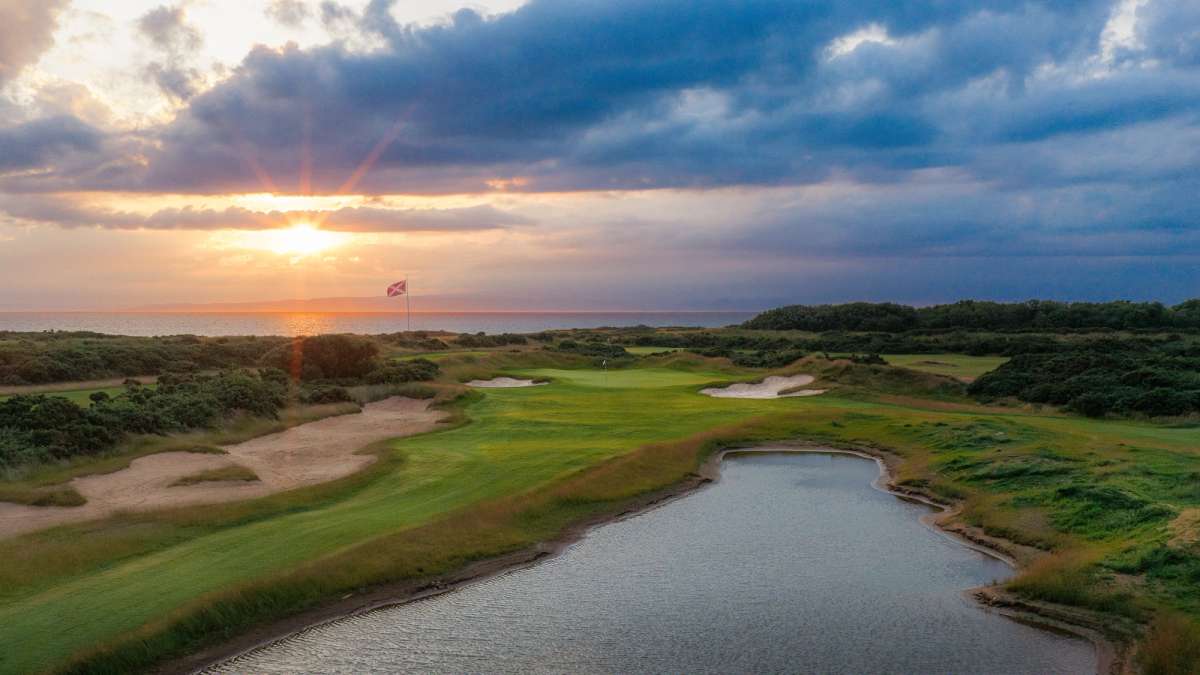
Trump Turnberry has announced the opening of its new 12-hole golf course at Donald Trump’s South Ayrshire resort in Scotland. The par-three course, featuring holes from 70 to 206 yards, is promised to offer “something completely different while maintaining the same commitment to quality”. At £120 for 12 holes, ‘Trump’s Twelve’ is priced at a premium by short-course standards, positioning it as an extension of the Turnberry experience rather than simply an alternative to the resort’s practice facilities. “Trump Turnberry continues to set the standard for world-class golf,” Eric Trump, Executive Vice President of The Trump Organisation said. “The Ailsa and King Robert the Bruce are recognised among the finest championship courses anywhere, and Trump’s Twelve completes an exceptional collection.” Built on land previously occupied by the Arran Course, Trump’s Twelve was designed by Turnberry's in-house team, led by Director of Golf Courses and Estates Allan Patterson. It combines undulating greens, natural wasteland areas and carefully positioned water features, creating a short-course layout for golfers of all abilities. The course’s official opening on August 10 comes after recent enhancements to Turnberry’s Ailsa course and the development of the resort’s PGA-certified Golf Academy and practice facilities. “This new course is another example of our long-term investment in the transformation of Turnberry and our ambition to create unforgettable golfing experiences for every guest who visits the resort,” Trump said. Artificial grass tee-lines ensure every hole has the option of a premium teeing area regardless of the conditions. Turnberry General Manager Nic Oldham said the course is “another exciting addition” to what is believed to be one of the finest golfing experiences anywhere in the world. “Complementing the Ailsa and King Robert the Bruce, this course is every bit as enjoyable for families, Academy guests and experienced players looking to sharpen an important part of their game. It reflects our continued commitment to providing outstanding experiences for every golfer who visits Turnberry." Trump’s Twelve will also serve as an integral part of the Trump Turnberry Golf Academy, providing an ideal environment for beginners taking their first steps into the game, juniors developing their skills and accomplished golfers refining their wedge play, distance control and scoring. "This is a fantastic addition to the academy. Short-game performance is where golfers save shots, and Trump's Twelve gives us an outstanding environment that simply wasn't available before. Whether someone is picking up a club for the first time or preparing for tournament golf, the course allows us to coach every aspect of scoring in realistic playing conditions.” Turnberry Golf Academy Manager Alistair Kyle said. "It will become a key part of our coaching programmes, junior development, family experiences and academy packages while also offering tremendous enjoyment for guests simply looking to play a memorable round."
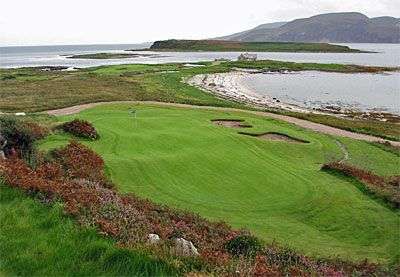
The impressive new 18-hole course takes shape on the Isle of Jura’s Ardfin estate Top 100 Golf Courses previews Scotland’s latest golf course development in the western isles The Inner Hebrides archipelago off the west coast of Scotland consists of thirty-five inhabited and dozens of other uninhabited islands and their combined land mass amounts to around 1,600 square miles. The mountainous, rather bleak and barren Isle of Jura is the fourth largest of these islands, supporting a small population of around two hundred people. Access to the mainland is by a couple of vehicle ferry crossings via Islay or by taking the summer season passenger ferry that runs to Tayvallich, near Lochgilphead, a two-hour car journey from Glasgow. With vast tracts of the island covered in blanket bog, Jura is divided into seven estates. One of these, Ardfin, is located in the south of the island, within one of forty designated National Scenic Areas in Scotland. The estate was acquired in 2010 from the Riley-Smith family, brewers from Tadcaster in Yorkshire, by retired Australian hedge fund manager Greg Coffey and the London-based owner has embarked on a long term redevelopment project to restore the semi-derelict C-listed Jura House to its former glory and construct a top class 18-hole golf course. At the invitation of architect Bob Harrison, I had a look around the course recently in the company of both the designer and estate manager Willie MacDonald who, like his father and grandfather before him, has worked on the Ardfin estate all of his life. Bob is a former lead architect for Greg Norman’s design company and eight of his courses are currently listed within the Top 100 ranking chart for his native Australia, including the ultra-private Ellerston in New South Wales which he built for Kerry Packer at the start of the new millennium. Rather than travel to Jura by boat or plane via Islay, I decided to take the small passenger ferry from the mainland, taking 45 minutes to get to the small port of Craighouse, where the Jura Hotel and Jura Distillery are located within yards of each other. The Irish construction company SOL GOLF is building the new Ardfin course and I got the chance to have a chat on the journey over with greenkeeper Sam Leach, who was heading back to the job after flying into Glasgow from Dublin, having had a few days at home on leave. Within minutes of arriving on the island, I was striding down the 1st fairway with Bob and Willie, who both endorsed Sam’s assertion that building a course on such difficult terrain – much of it peatland that had to be dug out and replaced with soil from elsewhere – hadn’t been easy. As an example, the fescue and bent grass turf for the greens had been specially shipped in from Yorkshire, along with a whole range of other building materials that couldn’t be sourced locally, so organising the transportation logistics had been a major consideration from day one of the project. The course is laid out along the cliffs that line the southern shores of the island, with holes routed down to the water’s edge on the back nine before climbing back up to Jura House at the end of the round. The views across the Sound of Jura towards the Isle of Gigha and the Kintyre peninsula are simply sensational and some might say it’s all too easy to succumb to the seduction of the spectacular surroundings. But what of the course itself and rumours that, just like that other private golfing playground at Ellerston, Ardfin will be something of a tough track? The 1st hole gives a fair indication of what lies ahead, playing gently uphill, with rocky outcrops to the left, a severe drop off down the cliffs on the right and a ditch scything through the fairway in front of the green. There’s little margin for error with either the tee shot or the approach as anything slightly offline will be lost in the dense vegetation skirting the fairway and the green. It’s obvious right from the start that precision, not power, is what’s required here because many of the playing corridors are frighteningly narrow, placing an absolute premium on accurate shot making. The long par three 2nd calls for a heroic tee shot across a bracken-filled chasm to a seemingly distant green but the hole normally plays downwind – unlike the short 10th, which requires a similar all-or-nothing tee shot across the edge of the cliffs, but this time into the prevailing wind. Bob told me more work is still to be carried out to the left side of the 3rd hole, opening up the stream that runs along the edge of the fairway before it cuts behind a really striking, right to left sloping green. After such a demanding start, it’s time to relax a little during the next few comparatively placid holes. The 4th plays uphill then kinks right across a road to a fairway split by a nest of bunkers, so width is not an issue here. The breadth of the fairway isn’t a problem at the next two holes either, played side by side, first uphill then back downhill towards the water. Beautifully reconstructed stone dykes line the perimeter of the large playing field that houses both the 5th and 6th, and they offer a bit of a breather before the rigours of the back nine. The 7th hole lies along the hillside and its fairway had just been seeded so it was the only hole I didn’t get a close look at. The 8th drops down a level towards the shoreline and the architect told me it was one of the most difficult holes to fashion on the course. Part of the hillside had been removed to create a semblance of a driving line from the tee boxes but it’s still a really tight path for tee shots to reach the fairway landing area. From here, a stone wall fronts a gully that runs across the fairway before the hole then veers left and down towards the green – it’s a simply stunning par four that begins a brilliant sequence of holes around the turn. The 9th doglegs left and down, bringing us towards the water’s edge, where the 10th plays as a semi blind “reverse Calamity” short hole and it seems to be all carry to the putting surface – only when you walk towards the green do you discover there’s actually a big bail out area along the edge of the cliff, which is handy for when a strong wind’s blowing directly in your face on the tee. The 11th continues the slow descent towards the restored boathouse down at the Sound and there’s a huge wetland area to carry with the approach shot to a raised green that might, depending upon a high seasonal tide or stormy weather, end up almost entirely surrounded by water. The par three 12th skirts a little sandy beach, moving inland to a wonderfully rippled green nestled at the foot of the rocky escarpment. It’s a hole that looks great from the tee but even better from the cliff top at the back of the green, next to the putting surface on the 16th hole. The 13th continues along the coastline, past an old sheep shearing building that’s still to be restored, to a challengingly shallow, two-tiered green. This hole’s then followed by a terrific Cape hole which hugs the shore as it swings left to another green that’s protected by a really intimidating wetland area in front of the putting surface, just like the 11th. The 15th turns for home and it starts a slow, inexorable climb along the cliffs to the 18th green. Thankfully, there’s a fair degree of width on the closing holes which is probably just as well because the fairways all slope a fair amount from left to right as they head along what appears to be a little ledge cut into the hillside, above the cliff tops. With par fives at both the 16th and 18th, there’s always the chance of bagging a propitious birdie at the end of the round. On the other hand, should a bogey or two prevail, there’s always the consolation of the magnificent vistas to soften the blow of a somewhat disappointing finish. There’s absolutely no doubt in my mind that Ardfin is destined to become a high flying entrant in a future Scottish Top 100 chart, possibly even making an impression on the Great Britain & Ireland Top 100 chart. I had the same feeling about Castle Stuart, Renaissance Club and Machrihanish Dunes when I visited each of them before they officially opened for business and I won’t be in the least surprised to see this course make its mark in a similar fashion. In fact, looking at the way some remotely located new build courses within the English-speaking golf world are being touted for inclusion in forthcoming golf magazine World Top 100 charts, don’t discount Ardfin from making a global impact in the ranking stakes either. Jim McCann Editor Top 100 Golf Courses
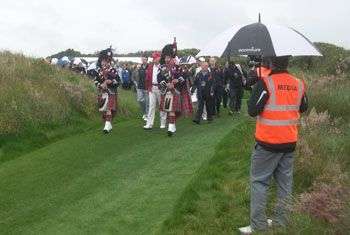
Trump International Golf Links finally arrives After a seven-year gestation period, Trump International Golf Links finally arrives 10th July 2012 The skirl of the bagpipes announced the impending arrival of the owner at the 1st tee for the opening ceremony at the new Trump International Golf Links. Sure enough, looking back down the grass path towards the clubhouse, Donald Trump and architect Martin Hawtree could be seen leading a throng of family, friends and invited guests towards the tee box on hole number one where, amongst the many press members, the Top 100 team were in attendance. Martin Hawtree, whose company celebrate 100 years of golf course design this year, was introduced and he spoke of the privilege it had been to work on such a wonderful piece of property, providing as he put it, the final five per cent of effort to finish a project that Nature had all but completed. Three heavyweights from the professional world of golf were next up to speak at the microphone, led by Colin Montgomerie. Monty called the course a masterpiece that would only mature and get better as the years progress, adding that it made him very proud to be Scottish. Sandy Jones, chief executive of the PGA, followed the former Ryder Cup captain. His opening words of “I love this place” pretty much established the tone for the remainder of his speech. Sandy thinks the Trump course will end up as one of the top three courses in the world… though he’s not sure which courses will fill the number 2 and number 3 slots. George O’Grady, European Tour CEO, then gave the clearest of signals that the Trump course is destined for bigger things by saying the Tour will work with the owner in the future “to bring the right event to the course” – who knows how short lived the Scottish Open’s tenure at Castle Stuart might be? Finally, Donald Trump took time to thank all the people who had been involved in the seven-year process of building the course on the Menie Estate and everyone from architects to construction teams, from Trump employees to Trump family members was given a mention. After the red ribbon was cut to mark the opening of the course, it was time for a snap of the participants in the opening four-ball: (left to right) George O’Grady, Donald Trump, Colin Montgomerie and Sandy Jones. Donald Trump led the way with the first tee shot, followed by Monty then Sandy, before George O’Grady ducked out to allow European Tour commercial director James Finnigan to take his place. As Mr Trump and company set off down the first fairway, we got a chance to have a quick word with Martin Hawtree and Michael O’Leary, managing director of SOL golf construction, who built the course. Both men were obviously very proud of what had been achieved on the Menie site but we wanted to find out what they were up to elsewhere. One of the subjects we raised was related to possible improvements at Ballybunion’s Cashen course, where the architect has been consulting, and Mr Hawtree indicated some work was about to be carried out by SOL at several of the holes. Michael O’Leary also mentioned his company were embarking on an exciting new project in Liege, where the course would take two years to complete. We will, of course, keep a watchful eye on both these new developments. Click the link to view details of Trump International Golf Links Jim McCann Editor www.top100golfcourses.com

