West Virginia, United States
The Greenbrier course suffered major flood damage in June 2016. Some of the course is open, but Phil Mickelson Design has been commissioned to renovate eight original holes and build ten new ones.
Overall rating

4.0
The Greenbrier course suffered major flood damage in June 2016. Some of the course is open, but Phil Mickelson Design has been commissioned to renovate eight original holes and build ten new ones.
The Greenbrier (The Greenbrier)
The latest ranking of the Top 100 Golf Courses in the World serves as the ultimate global golf bucket list. Most members of our World Top 100 Panel are seasoned golfers, each playing 20-30 of these courses annually while travelling extensively over decades to form their opinions on others. We recognise that opinions vary—even among our panel members. Rankings are subjective, and there are undoubtedly 50 or more courses in the UK and USA alone that could easily fit onto this list. Links Golf Pilgrimages The rankings
California, United States
New Jersey, United States
Northern Ireland, United Kingdom
New York, United States
New York, United States
Golf – in the form of a basic 9-hole layout – first made an appearance at the famous Greenbrier spa and hotel in 1910. The Old White was the first 18-hole course to open three years later, followed by the Seth Raynor-designed Greenbrier in 1924. Dick Wilson added another course, now called the Meadows, to the property in 1963. During the construction of this third course, some of the old Greenbrier holes were incorporated into its 18, meaning five new holes were built for the Greenbrier.
The Greenbrier played host to the 1979 Ryder Cup matches between the USA and Europe. Team Captains were Billy Casper (US) and John Jacobs (Europe). Continental European golfers were for the first time allowed to compete in the 23rd Ryder Cup Matches and a final format change was also implemented bringing the total points to 28. Nick Faldo was the European cornerstone finishing 4-1, but the US once again prevailed thanks to a flawless 5-0 performance from Larry Nelson. Unfortunately Seve Ballesteros and Antonio Garrido (the first continental European selections) could only muster a single point from a possible six. USA 17 - Europe 11. The Ryder Cup was played at Royal Lytham & St Annes in 1977 and at Walton Heath in 1981.
The Greenbrier was given a major face-lift by the Jack Nicklaus design company in 1978 as preparation for the series of Ryder Cup matches between USA and Europe the following year. The home side won that match 17-11 and the female equivalent of Team USA also triumphed 13-7 in the Solheim Cup against the European Ladies on the same course fifteen years later.
Jay Morrish and Bob Cupp were project architects for Nicklaus at the time and, although they didn’t alter the course routing, the green complexes were reshaped to essentially remove the pitch and run approach options, installing target golf putting surfaces instead. According to Tom Doak, "Jack Nicklaus obliterated all trace of its origins. The holes where ponds were added seem particularly out of place."
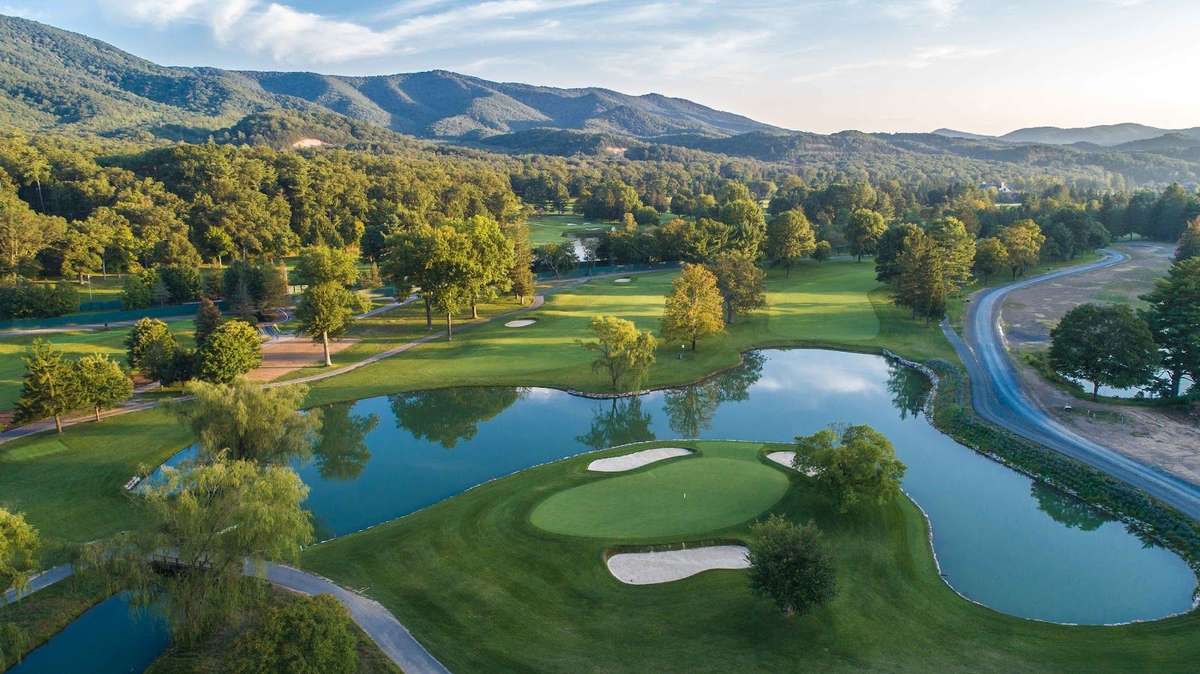
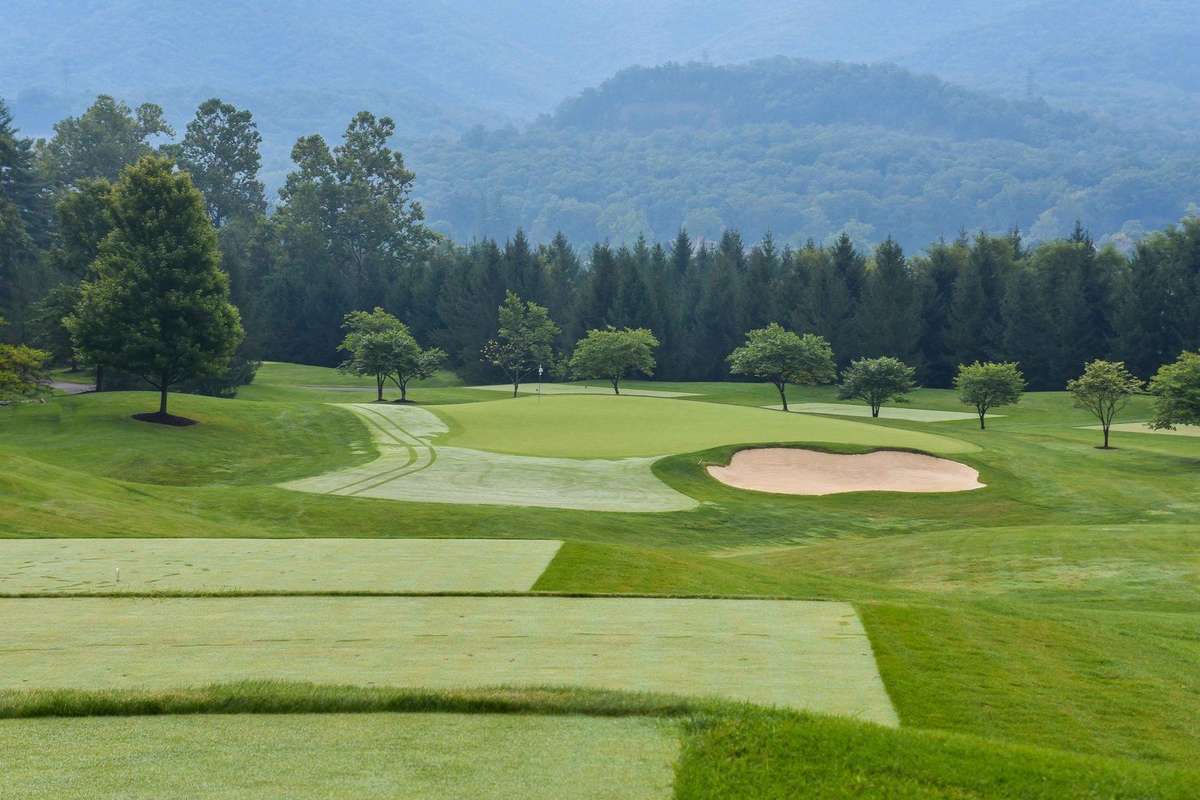
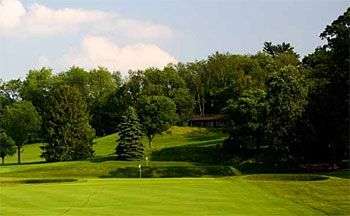
The Greenbrier's fairways are laid out over a gently undulating landscape. The front nine holes of the out-and-back routing are configured in a slightly unconventional manner, featuring three par threes, three par fours and three par fives.
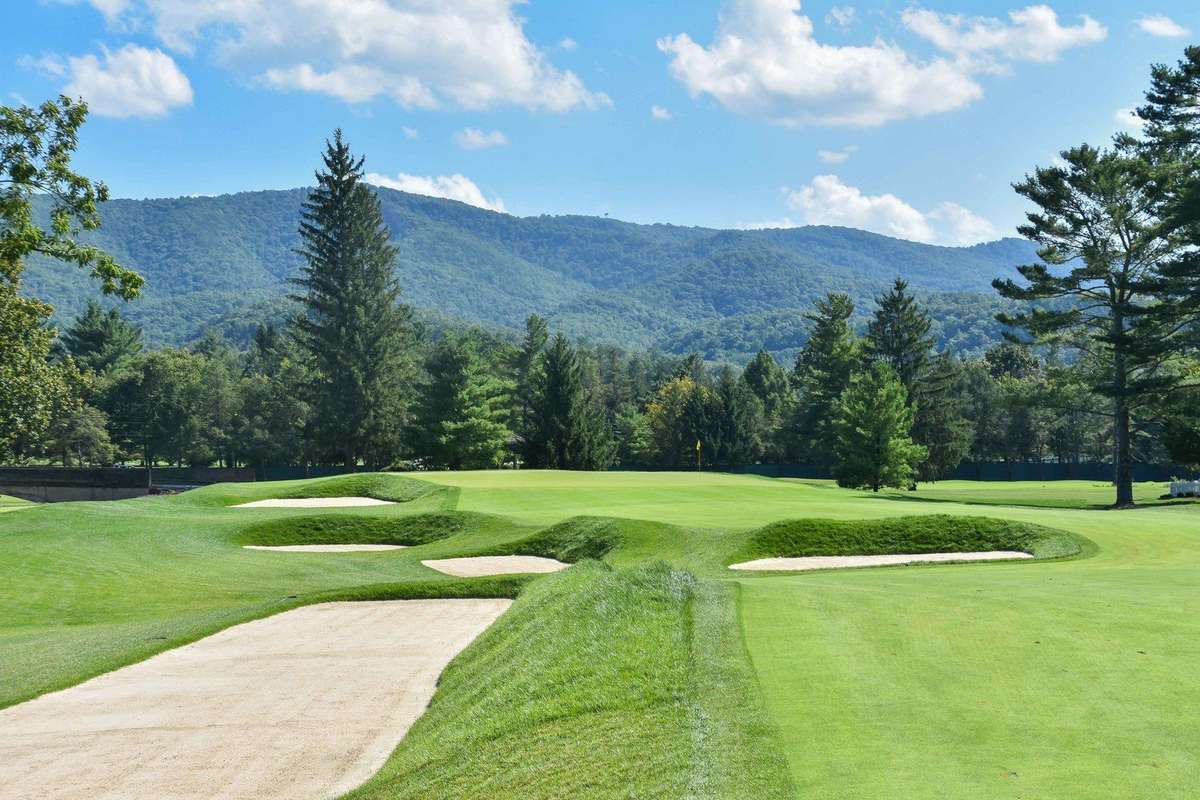
The most difficult of these holes is the 456-yard 6th (“Plateau”) where a very tight fairway doglegs uphill to a long, narrow offset green that sits behind a rather large, intimidating bunker.
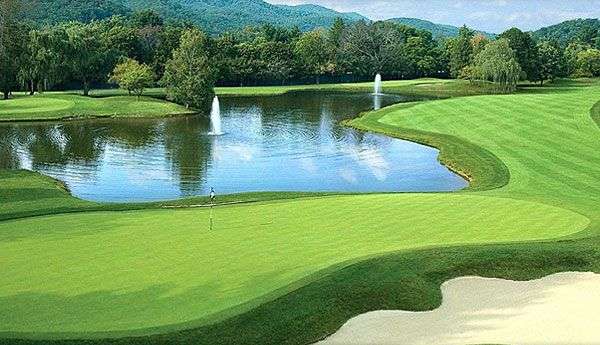
The Greenbrier’s back nine showcased a couple of delightful short par fours. Hole 10 (“Cross Road”) measured only 339 yards from the back tees with a wide creek cut across the fairway about fifty yards short of the pear-shaped putting surface. Four holes later, the even shorter 305-yard 14th (“Sahara”) sported a long bunker down the left of the fairway which then wrapped itself around the left side of the green.
However, the Greenbrier course was one of several at the resort to suffer major damage following the flooding in June 2016. Six former Greenbrier holes (#9 through #14) now form part of the Meadows course (#10 to #15). The Sahara hole on the Meadows layout is now a long uphill par three measuring 220 yards.
Currently, the Greenbrier can be played as a 9-hole or 18-hole course. However, the story is quite complicated, so we’ll let Robert Harris, Vice President of Golf, explain:
“When you elect to play 18 holes, you actually get to play 10 of the 12 that we maintain. Play holes 1 through 7 and arrive at the Snack Stand. Make a U turn and play holes 16-17 (that is your 9-hole course), or skip #17 and play #18 back to the Clubhouse or play #18 as an extra hole.
Otherwise, when completing #17, go to nearby #2 tee, play back to #7 – U turn and play home 16-17-18. We maintain but don’t use former holes #8 and #15. If you play both the Greenbrier and Meadows, you essentially play 16 of the 18 former Greenbrier course holes!”
The current Greenbrier configuration is temporary as Phil Mickelson Design has been commissioned to renovate the layout with works including modifications to eight original holes and the construction of ten new holes, which will be routed through an old forest dissected by streams. The new holes will feature elevation changes of more than 100 feet.
Phil Mickelson, who recently was named The Greenbrier Resort’s PGA Tour Ambassador, said, “I’ve always been a big fan of Seth Raynor’s work. We have a tremendous piece of property that comes with a great history, and we are going to make it great for the future of The Greenbrier Resort and the region.”
As at October 2020, work on the new Greenbrier course is on hold.
Fergal O’Leary takes America on… again Fergal continues his quest to play the Top 100 Golf Courses of the World. His latest adventures were in Pennsylvania, West Virginia, Wisconsin and Illinois Fox Chapel The architect needs no introduction. The names of the holes need no introduction. As Raynor was making his way through Pennsylvania in 1923, the town of Fox Chapel was about to establish itself on the golfing map. With horses traversing the golf course shaping the iconic greens and rolling fairways, the evolution of a masterpiece was underway. As my eyes studied the scorecard on the 1st tee, I could feel my mouth watering as I saw the names of the holes and was about to embark on a trip down memory lane. The testament to Raynor comes to fruition when golfers around the world debate his greatest piece of work, and nobody can ever come to an agreement. The difference between modern day courses and those courses created during the Golden Age is that the grandfathers of architecture created layouts which require shot-making and imagination and barely tip out at 6,500 yards. The older courses were crafted by horse and excessive manual labour which is a far cry from the endless supply of machinery and technology we see today that generates the 7,500-yard courses we have to slog around in modern times. Fox Chapel Golf Club is an example of a golf course where golfers come to celebrate the Redan, the Punchbowl, the Cape, the Alps and who could ever forget the Biarritz (to name but a few). The club restored its bunkers a few years ago and ensured the steep lips were renovated back to original design. Each green is squared off at the front which is an old school characteristic I admired along with the history that echoes around the clubhouse. Breathe it in. Fox Chapel is fun to play and it’s exciting to peer down the adjacent fairways and see the architecture from many angles. The fact that the architect gave each hole a name, illustrates the personal connection that he made with each one. They are uniquely identifiable and collectively unforgettable. Pikewood National The State of West Virginia possesses one of America’s most difficult golf courses. With a slope rating of 147 and a course rating of 75.1 from the member’s tees (I won’t even bother mentioning the metrics from the championship tees), this layout will leave you out of breath. The genius of the property is that world famous architects didn’t create it. It was created by the owners of the land who had travelled the world playing golf and decided to exercise their imagination. With Golf Digest rating the course at #45 in America, I was eager to travel to Morgantown, West Virginia, to see for myself. The names of the holes at Pikewood National Golf Club sparked great curiosity and I subsequently learned that they were influenced by the owners’ friends based on their experiences throughout their respective golfing adventures. You can’t help but smile when playing holes called Hagge’s Knocker, Beaver and Cypress Pint. Exceptional conditioning, a natural routing and an appreciation for world-class design variety continually characterize Pikewood National. The naïve golfer will look at this land and think they are going to be climbing hills all day. You’ll quickly realise that although there are a couple of elevated tee shots, the fairways and topology are mostly flat despite being at altitude. The penal nature of the golf course is its demand for accuracy and finesse, but each green certainly has accessibility ensuring good playability. This golf course will host State or USGA events and is not to be taken lightly. The pride that the owners have for their land is mirrored in the care they take with its upkeep and the never-ending search for improvement for its members. I’m not a proponent of the landscape surrounding a golf course being a reason to give a higher rating, because the architect did not create the mountains, forests or oceans. I shake my head when I hear inexperienced course raters being asked “how did you like the course?” and their immediate response is “the view of the ocean is amazing”. I focus on what the architects created. At Pikewood the holes are developed in a direction that celebrates and leverages the views which are available, so it becomes a natural flow of how the golfing topology becomes one with the vistas. From the 2nd green you can see four different States and the holes take you on a private tour of the region. I highly commend the owners for having the “audacity” to develop Pikewood National as the best is yet to come for this exclusive club. Each hole is by itself and has its own evolving story. On a personal note, I look forward to returning to see the Shamrock shaped plaque on the 17th hole celebrating this Irishman who hit a drive 418 yards down the par five speed-slot. Mrs. O’Leary’s Cow didn’t get in the way of that ball. The hole is called Coupe DeVille, and it’s about to become a little bit more like Ireland after my unforgettable visit. Erin Hills Erin Hills is the second public golf course in Wisconsin to host a major championship. The 2011 US Amateur was, for most people, the club's introduction on the world stage. The announcement of the 2017 US Open further cemented its place in American golf history. Located 35 miles northwest of Milwaukee, the architects uncovered, rather than manufactured, the most impressive holes they could find on the property. The length of the course is barbaric from the black tees (7,823 yards) and even from the blue tees, it takes a foursome five and half hours to get round. So this place isn’t for casual players looking to enjoy the countryside for an afternoon while waiting for a Packers game to commence. The front nine is severe with very long par fives, greens with excessive undulations, a couple of blind tee shots and forced carries. Pulling the correct club as you judge wind and elevation change is paramount. With the exception of the beautiful 9th hole, I personally found the collection of par threes to be somewhat bland. I don’t think anybody will write home about them. The course will only tolerate perfect shots as danger and turmoil is literally waiting with open arms. If you hit a tee shot on the wrong side of a fairway, you could have a blind approach. If you hit an approach shot on the wrong side of a green, you’re looking up to the heavens for mercy. I feel like the course needs a little more design variety in terms of shorter holes and less punishment. I was informed that the undulation in the 3rd green is being softened ahead of the US Open which is clearly a step in the right direction. The yardage book gives advice on each hole, and it portrays the gauntlet nature of everything to avoid. The average golfer hasn’t a hope unless they play from the White tees. Erin Hills is a wonderful test of skill and it’s very rewarding for a scratch player to walk off the course even par. I thoroughly enjoyed my round and scored very well, but could quickly see how different it is from the classic layouts from decades gone by. I understand why it was selected to host the US Open and I pray for their sake that the wind doesn’t blow because the USGA will have their hands full setting up the monstrous layout. When I reflect on my day at Erin Hills, I think somebody should make a copy of the sign on the first tee at Bethpage Black and bring it to Wisconsin. Butler National When it comes to the epitome of a men’s golf club, one doesn’t have to look much further than the club that rests behind the large white-pillared entrance in Oak Brook, IL. The membership represents the nation’s elite and the golf course represents hell on grass. Butler National Golf Club has a reputation for being amongst the most difficult and penal layouts in America which examines every aspect of your game. The demographic of the golfers who play Butler is pretty one-dimensional as this place isn’t for average golfers. You’ll use every club in your bag and you’ll find yourself in awe of the property the whole way around. The bunkering is so impressive that each of them looks like it could jump up and bite you. They have huge muscular lips and weave amongst each other to carve your way through this unforgiving gauntlet. With that said, Tom Fazio was fair in so far as the ball will always roll back to the base of the bunker and give you the ability to get out. With such little play, this course is always in immaculate condition and is an immense privilege to be there. No matter how many times you play at Butler, it will always give you fits. The look of disbelief on golfer’s faces as they peer out in front of them is quiet entertaining. One could not imagine such brutality if their lives depended on it. Aggregate 640+ yard par fives, doglegs around water, doglegs through corridors of tall trees, treacherously tight entrances, rolling terrain crafted by the man above, putting surfaces that will repel anything less than perfection and greens running at 12 that would even make Hitler flinch, that’s Butler National. I have a friend who is a scratch golfer and has played at Butler many times over the years who says “Playing at Butler National feels like you’re slamming your hand in the car door for 4 hours”. The reputation, the challenge and the prestige made me fall in love with this club. It’s the type of layout where you really want to play well and you can sense your level of concentration increasing with every stride. The service inside the clubhouse is world class and the facilities are second to none. You haven’t been in a hot tub until you’ve been in the Butler National hot tub with a cocktail in your hand. You haven’t been to a “men’s bar” until you’ve been to the bar at this place. With no menus in the dining areas, you just have to tell them whatever you want to eat, and trust me they can make it. The gentleman who calls Butler National his home club owns a golf course that is the essence of golfing Mecca. Upon reflection of my latest visit to the Windy City, these 18 holes in Oak Brook achieve greatness in playability, resistance to scoring, design variety and up holding the true traditions of the game. Article written by our US Consultant, Fergal O'Leary, who continues his mission to become the youngest person to play the Top 100 Golf Courses of the World. Images courtesy of Fox Chapel, Pikewood National, Erin Hills and Butler National.
30th July 2008 Financial Corp to Take Over Pete Dye Golf Club Financial problems have prompted the sale of Bridgeport's Pete Dye Golf Club, based in West Virginia. In a letter to the club's members, club President James J. LaRosa, announced the sale to Textron Financial Corporation. The letter says the current economic downturn is forcing the sale. The letter goes on to say that Textron Financial has retained Davis Love Golf Management to serve as the club's new general manager. We contacted the LaRosa family, who did not wish to comment. A representative from Textron has confirmed that it is in talks with the current owners, but had no comment beyond that. According to Textron's website, it is "the largest golf finance company in North America". What the changes mean for the Nationwide Tour stop at the course remain to be seen. The Tour held its biggest stop of the year at the Pete Dye Golf Club earlier this month. The Players Cup was the first tournament in tour history to have a $1 million purse. The current nationwide tour contract with the Pete Dye Golf Club runs through the 2011 season. Executive Tournament Director Tim McNeely says he and the club have not had any substantive conversations yet. He also said ownership of golf courses does change hands and that it does happen on the Nationwide Tour and PGA Tour, so this is not a unique situation. From: State Journal, West Virginia
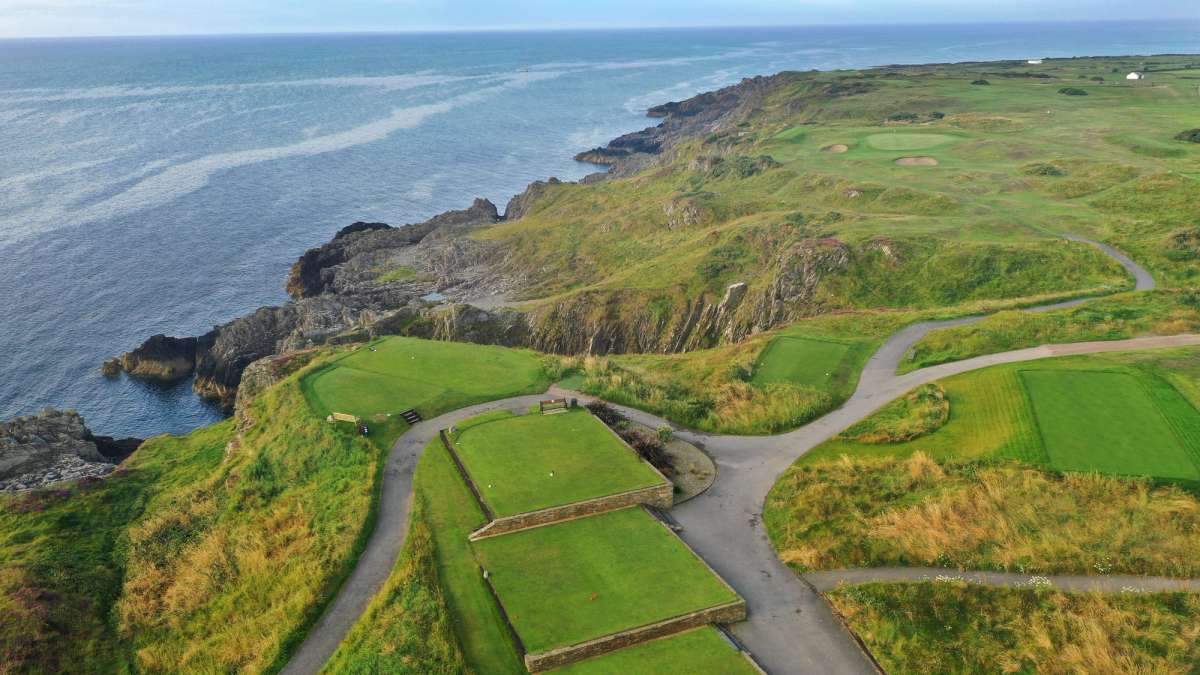
While some of the world's most famous courses command eye-watering green fees, there are often excellent alternatives just a short drive away. From celebrated links venues to championship layouts, we've picked out 10 famous golf courses and their more affordable neighbours, where you can still enjoy a quality round without paying quite so much. Pebble Beach Golf Links vs Pacific Grove Golf Links (California, USA) Pebble Beach Golf Links | World Ranking: 27th | California Ranking: 3rd | Green Fees: US$755 (including mandatory cart fee) Pacific Grove Golf Links | California Ranking: 71st | Green Fees: US$66–89 Few golf courses command the same level of recognition as Pebble Beach Golf Links. Ranked 27th in the world, it has hosted multiple US Opens and is a regular fixture on the PGA Tour, with its spectacular Pacific coastline making it one of the game's most recognisable settings. At US$755 for a visitor round, however, it comes at a considerable price. Just five miles away, Pacific Grove Golf Links offers a much more affordable way to enjoy the same stretch of California coastline. Often nicknamed the 'Poor Man's Pebble Beach', this municipal course has plenty of character of its own, with its history closely connected to its famous neighbour. Chandler Egan, who helped redesign Pebble Beach alongside Alister MacKenzie, laid out Pacific Grove's original nine holes in 1932, before Jack Neville, one of Pebble Beach's original designers, extended it to 18. The front nine winds through gardens and trees, while the back nine opens up towards the Pacific Ocean and Point Pinos Lighthouse. With green fees from US$66, it's a considerably cheaper way to enjoy golf on the Monterey Peninsula. Distance apart: 5 miles Price difference: US$666–689 (88–91% cheaper at Pacific Grove) St Andrews Links – Old Course vs St Andrews Links – Eden Course (Scotland) St Andrews Links (Old) | World Ranking: 7th | Scotland Ranking: 1st | Green Fees: £380 St Andrews Links (Eden) | Scotland Ranking: 62nd | Green Fees: £85 Few golf courses carry the reputation of the Old Course at St Andrews. Ranked seventh in the world, it is the Home of Golf and one of the most recognisable venues in the game, but securing a tee time can be just as challenging as finding the money for its £380 high-season green fee in 2027. A much more affordable option is the Eden Course, just west of the Old Course and ranked 62nd in Scotland. Designed by Harry Colt and opened in 1914, it offers a genuine links experience for a fraction of the price. Its wide fairways provide some room off the tee, but deep bunkers, undulating greens and several challenging par fours ensure there is plenty to think about. At £85 for a high-season round in 2027, the Eden is an appealing way to enjoy the Home of Golf without paying Old Course prices. Distance apart: Approximately 1 mile Price difference: £295 (around 78% cheaper at the Eden) Royal County Down – Championship Course vs Ardglass Golf Club (Northern Ireland) Royal County Down (Championship) | World Ranking: 3rd | Northern Ireland Ranking: 1st | Green Fees: £495 Ardglass Golf Club | Northern Ireland Ranking: 8th | Green Fees: £275 Royal County Down is a bucket-list destination for golfers, ranked third in the world and set against the spectacular backdrop of the Mountains of Mourne. Its Championship course is a formidable links test, with rugged dunes, blind drives and some of the most memorable holes in the game. A visitor round costs £495 in 2027, and tee-time availability is exceptionally limited. Around 11 miles away, Ardglass offers a different but equally memorable experience along the County Down coastline. The opening five holes hug the cliffs above the Irish Sea, with the second a particularly striking par three played across a rocky inlet. The course also has a clubhouse with a rather unusual history: it occupies a 14th-century castle. Ardglass may not have the same global reputation as its famous neighbour, but its dramatic coastal setting and enjoyable links test make it well worth adding to a trip to the area. At £275, it also represents a sizeable saving. Distance apart: Approximately 11 miles (straight-line) Price difference: £220 (44% cheaper at Ardglass) Royal Portrush Golf Club – Dunluce Course vs Castlerock Golf Club – Mussenden Course (Northern Ireland) Royal Portrush Golf Club (Dunluce) | World Ranking: 9th | Northern Ireland Ranking: 2nd | Green Fees: £475 Castlerock Golf Club (Mussenden) | Northern Ireland Ranking: 5th | Green Fees: £250 Royal Portrush is one of the biggest names in Irish golf, ranked ninth in the world and twice the host of The Open Championship, most recently in 2025. The Dunluce Links is a spectacular test, with its dramatic coastal setting and memorable holes, including the famous par-three 16th, Calamity. At £475 for a visitor round, it is also one of the more expensive places to play in Northern Ireland. Around 13 miles along the coast, Castlerock's Mussenden Course offers an excellent alternative for £250. It may live in the shadow of its more famous neighbours, but it is a highly regarded links in its own right, with a strong reputation among golfers who have made the trip to the Causeway Coast. The standout is the fourth, known as Leg O’Mutton, a 200-yard par three with a railway line running alongside one side and a burn guarding the other. Castlerock also has views across the Atlantic towards Donegal and, on a clear day, Scotland. Distance apart: Approximately 13 miles by road Price difference: £225 (47% cheaper at Castlerock) Carnoustie Golf Links – Championship Course vs Panmure Golf Club (Scotland) Carnoustie Golf Links (Championship) | World Ranking: 34th | Scotland Ranking: 5th | Green Fees: £450 Panmure Golf Club | Scotland Ranking: 35th | Green Fees: £195 Carnoustie is one of the most famous and demanding tests in Scottish golf. Ranked fifth in Scotland and 34th in the world, its Championship course has hosted The Open eight times, most recently in 2018, when Francesco Molinari lifted the Claret Jug. A peak-season visitor round in 2027 costs £450. Just a short drive away, Panmure provides a similarly challenging links experience for considerably less. Ranked 35th in Scotland, it has plenty of history of its own, having hosted Open Qualifying and played a part in Ben Hogan's preparation for his 1953 Open Championship victory at Carnoustie. Hogan spent two weeks practising at Panmure before winning at his neighbouring course, and the club still celebrates that connection. The layout features plenty of traditional links character, with heather, hillocks and demanding approach shots. At £195 during the 2026 peak season, it is an appealing option for anyone planning a golf trip to Angus & Dundee. Distance apart: Approximately 5 miles by road Price difference: £255 (57% cheaper at Panmure) Pinehurst No. 2 vs Southern Pines Golf Club (North Carolina, USA) Pinehurst No. 2 | World Ranking: 57th | North Carolina Ranking: 2nd | Green Fees: Not published Southern Pines Golf Club | North Carolina Ranking: 11th | Green Fees: US$225–245 Pinehurst No. 2 is one of American golf's most celebrated courses. Ranked 57th in the world and second in North Carolina, the Donald Ross design has hosted multiple US Opens, most recently in 2024, and will welcome the championship back in 2029. Playing it, however, requires more than simply booking a tee time. Access is reserved for resort guests and members, with a minimum two-night stay required for those booking through the resort. Around five miles away, Southern Pines Golf Club offers a more accessible way to experience the area's golfing heritage. Another Donald Ross design, it opened in 1906 and has retained much of its traditional character, with rolling fairways, sandy waste areas and greens that demand careful approach play. It is ranked 11th in North Carolina and welcomes public play, with visitor fees ranging from US$225 to US$245. It may not carry the same prestige as Pinehurst No. 2, but it is a worthwhile addition to any trip to the Sandhills. Distance apart: Approximately 5 miles Price difference: Not directly comparable – Pinehurst No. 2 requires a resort stay or membership, while Southern Pines has a published visitor green fee. TPC Sawgrass – Stadium Course vs St Johns Golf Club (Florida, USA) TPC Sawgrass (Stadium) | USA Ranking: 66th | Florida Ranking: 2nd | Green Fees: From US$775 St Johns Golf Club | Green Fees: US$41–53.50 TPC Sawgrass is one of the most recognisable venues in American golf. Ranked 66th in the United States and second in Florida, its Stadium Course has hosted THE PLAYERS Championship since 1982 and is best known for the island green 17th. Designed by Pete and Alice Dye, it is a bucket-list round for many golfers, but visitor fees start at US$775 during the September-to-May season. Around 27 miles away, St Johns Golf Club provides a far more affordable alternative. This public, county-owned course in Elkton offers 18 holes of golf for out-of-state visitors at $53.50 in the morning, with afternoon rates dropping to $41. It is a different proposition to the Stadium Course, but the layout has recently benefited from a redesign by Erik Larsen and offers a varied test for golfers of all abilities. For anyone visiting the Jacksonville area, it is a practical option for fitting in a round without paying the premium associated with TPC Sawgrass. Distance apart: Approximately 27 miles by road Price difference: US$721.50–734 (93–95% cheaper at St Johns, comparing TPC's September–May starting rate with St Johns' 2026 out-of-state rates) Royal St George's Golf Club vs Prince's Golf Club – Dunes & Himalayas (England) Royal St George's Golf Club | World Ranking: 19th | England Ranking: 1st | Green Fees: £430 Prince's Golf Club (Dunes & Himalayas) | England Ranking: 32nd | Green Fees: £180–230 Royal St George's is one of the most recognisable names in English golf. Ranked 19th in the world and first in England, the Sandwich links has hosted The Open 15 times, most recently in 2021. Its undulating fairways, towering dunes and famously deep bunkers make it a formidable test, with peak-season visitor fees reaching £430 in 2027. Almost next door, Prince's offers a more affordable way to enjoy links golf on the same stretch of Kent coastline. It hosted The Open in 1932, when Gene Sarazen claimed victory, and remains a highly regarded venue in its own right. The Himalayas nine is particularly varied, with wetland carries, a driveable par four and a double green among its features. Prince's has 27 holes across three nine-hole loops, allowing visitors to combine the Himalayas with either the Dunes or Shore to make an 18-hole round. At £180–230 in 2027, it costs considerably less than its famous neighbour. Distance apart: Approximately 1 mile Price difference: £200–250 (47–58% cheaper at Prince's) Bandon Dunes Golf Resort – Pacific Dunes vs Bandon Crossings (Oregon, USA) Bandon Dunes (Pacific Dunes) | World Ranking: 26th | Oregon Ranking: 1st | Green Fees: US$425 Bandon Crossings | Oregon Ranking: 21st | Green Fees: US$70–96 Pacific Dunes is one of the standout courses at Bandon Dunes Golf Resort, ranked 26th in the world and among the most celebrated public-access layouts in the United States. Tom Doak's design opened in 2001 and makes full use of its rugged Pacific coastline, with several holes playing directly alongside the ocean. It is an unforgettable experience, but a peak-season round for a day guest costs US$425 in 2027. Around 10 miles south, Bandon Crossings offers a much more affordable alternative. Built on an old cattle and sheep ranch, the course was designed by Oregon architect Dan Hixson and takes a different approach to the area's golf, with a heathland-style layout rather than a traditional coastal links. It is not trying to compete directly with the resort's famous courses, but provides an enjoyable and considerably cheaper round, with the added option of taking a cart. Its 2026 standard-time walking rate is US$70, rising to US$96 during daylight-saving time. Distance apart: Approximately 10 miles Price difference: US$329–355 (77–84% cheaper at Bandon Crossings, comparing Pacific Dunes' 2027 peak-season day-guest rate with Bandon Crossings' 2026 walking rates) Royal Melbourne Golf Club – West Course vs Sandy Golf Links (Melbourne, Australia) Royal Melbourne Golf Club (West) | World Ranking: 6th | Australia Ranking: 1st | Green Fees: Not published (Last indicative international visitor rate AU$850) Sandy Golf Links | Australia Ranking: 82nd | Green Fees: AU$70–76 Royal Melbourne's West Course is ranked sixth in the world and first in Australia, and is widely regarded as one of Alister MacKenzie's finest designs. It is a private members' club, although international golfers who belong to a recognised golf club can apply for visitor tee times. The indicative overseas visitor fee is around A$850, although the club does not publish its rates publicly. Less than a mile away, Sandy Golf Links provides an opportunity to experience Melbourne's famous Sandbelt without the same price tag or access restrictions. Formerly known as Sandringham Golf Course, the public facility was extensively redesigned by OCM Golf, the team of Geoff Ogilvy, Mike Cocking and Ashley Mead, and reopened in its current form in 2020. The par-65 layout features firm greens, strategic bunkering and the sandy terrain associated with the region. It is ranked 82nd in Australia and welcomes public bookings, with 18 holes costing A$70 on weekdays and A$76 at weekends. Distance apart: Approximately 1km Price difference: A$774–780 (91–92% cheaper at Sandy, based on Royal Melbourne's indicative A$850 visitor fee) Green fees reflect published high-season visitor rates for 2027 where available. Where 2027 rates have not yet been released, the latest available published rates are provided. Prices and visitor access are subject to change.