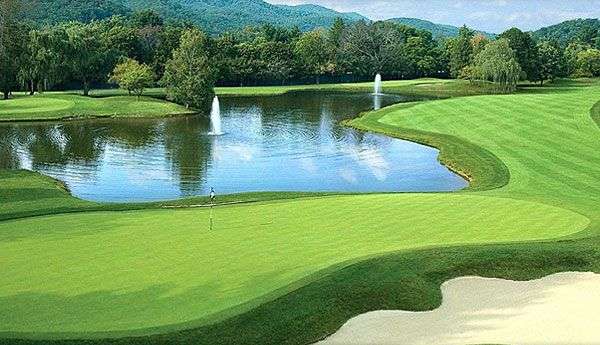
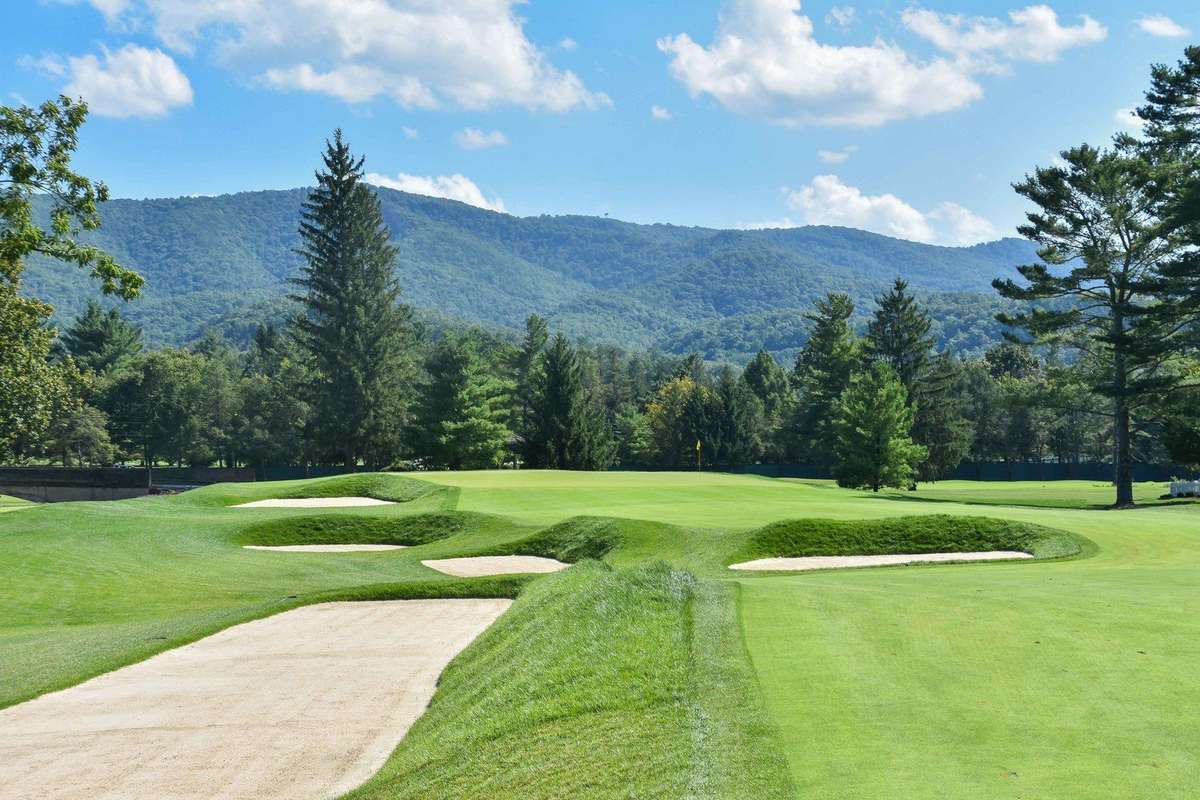
Greenbrier's rejuvenated Meadows course re-opened for play in 2017 with a new design and routing, using six holes from the Greenbrier course.
The Greenbrier (The Meadows)
Greenbrier's rejuvenated Meadows course re-opened for play in 2017 with a new design and routing, using six holes from the Greenbrier course.
Alex Findlay added a basic 9-hole golf course to the wide range of sporting activities at the famous Greenbrier spa and hotel a century ago and this initial layout has developed over the years into a fantastic 54-hole golf complex that has hosted both the Ryder Cup in 1979 and the Solheim Cup in 1994.
The two main 18-hole courses on the property are the Greenbrier and Old White but for golfers who find this pair a little too arduous, the Meadows course is just the job as it’s a less demanding course, perfect for the vacation golfer.
Uniquely, the Meadows course (formerly known as the Lakeside) actually came about as a means of spreading and disguising the spoil from construction of The Greenbrier Hotel’s Cold War Bunker which housed the then secret underground Congressional command shelter.
In 1963, Dick Wilson incorporated some of the Seth Raynor holes from The Greenbrier (now holes 8-10) into what was then called the Lakeside, a par 70 course measuring 6,336 yards. In 1999, Bob Cupp updated the layout, adding over 450 yards to the overall length as he formed the par 71 Meadows course.
Tom Fazio subsequently replaced two holes created by Cupp in 2004 due to new flood control issues when he was constructing the Snead course at the Greenbrier Sporting Club. However after sustaining significant flood damage in 2016, the Meadows course closed for restoration, managed by director of grounds Kelly Shumate and Vice President of Golf Operations Burt Baine. The Meadows reopened in 2017 with a new design and routing, using six holes from the Greenbrier course.
The six former Greenbrier holes (#9 through #14) are now holes #10 through #15 on the Meadows course and the only hole that was significantly modified was the driveable par 4 #14 (Sahara), which is now a tough 220-yard uphill par three. The new par 70 Meadows course measures 6,602 yards from the tips, but five sets of tees make this layout manageable for all levels of golfer providing Greebrier's trademark revetted bunkers are avoided.
The par five 4th hole is the longest of the three par fives on the card and is rated the toughest hole on the Meadows course. It demands accuracy, with Howard’s Creek guarding the left side and out of bounds on the right. The home hole is the second hardest on the scorecard, which requires a forced carry approach over Swan Lake to a well bunkered green.
The latest ranking of the Top 100 Golf Courses in the World serves as the ultimate global golf bucket list. Most members of our World Top 100 Panel are seasoned golfers, each playing 20-30 of these courses annually while travelling extensively over decades to form their opinions on others. We recognise that opinions vary—even among our panel members. Rankings are subjective, and there are undoubtedly 50 or more courses in the UK and USA alone that could easily fit onto this list. Links Golf Pilgrimages The rankings
California, United States
New Jersey, United States
Northern Ireland, United Kingdom
New York, United States
New York, United States

Fergal O’Leary takes America on… again Fergal continues his quest to play the Top 100 Golf Courses of the World. His latest adventures were in Pennsylvania, West Virginia, Wisconsin and Illinois Fox Chapel The architect needs no introduction. The names of the holes need no introduction. As Raynor was making his way through Pennsylvania in 1923, the town of Fox Chapel was about to establish itself on the golfing map. With horses traversing the golf course shaping the iconic greens and rolling fairways, the evolution of a masterpiece was underway. As my eyes studied the scorecard on the 1st tee, I could feel my mouth watering as I saw the names of the holes and was about to embark on a trip down memory lane. The testament to Raynor comes to fruition when golfers around the world debate his greatest piece of work, and nobody can ever come to an agreement. The difference between modern day courses and those courses created during the Golden Age is that the grandfathers of architecture created layouts which require shot-making and imagination and barely tip out at 6,500 yards. The older courses were crafted by horse and excessive manual labour which is a far cry from the endless supply of machinery and technology we see today that generates the 7,500-yard courses we have to slog around in modern times. Fox Chapel Golf Club is an example of a golf course where golfers come to celebrate the Redan, the Punchbowl, the Cape, the Alps and who could ever forget the Biarritz (to name but a few). The club restored its bunkers a few years ago and ensured the steep lips were renovated back to original design. Each green is squared off at the front which is an old school characteristic I admired along with the history that echoes around the clubhouse. Breathe it in. Fox Chapel is fun to play and it’s exciting to peer down the adjacent fairways and see the architecture from many angles. The fact that the architect gave each hole a name, illustrates the personal connection that he made with each one. They are uniquely identifiable and collectively unforgettable. Pikewood National The State of West Virginia possesses one of America’s most difficult golf courses. With a slope rating of 147 and a course rating of 75.1 from the member’s tees (I won’t even bother mentioning the metrics from the championship tees), this layout will leave you out of breath. The genius of the property is that world famous architects didn’t create it. It was created by the owners of the land who had travelled the world playing golf and decided to exercise their imagination. With Golf Digest rating the course at #45 in America, I was eager to travel to Morgantown, West Virginia, to see for myself. The names of the holes at Pikewood National Golf Club sparked great curiosity and I subsequently learned that they were influenced by the owners’ friends based on their experiences throughout their respective golfing adventures. You can’t help but smile when playing holes called Hagge’s Knocker, Beaver and Cypress Pint. Exceptional conditioning, a natural routing and an appreciation for world-class design variety continually characterize Pikewood National. The naïve golfer will look at this land and think they are going to be climbing hills all day. You’ll quickly realise that although there are a couple of elevated tee shots, the fairways and topology are mostly flat despite being at altitude. The penal nature of the golf course is its demand for accuracy and finesse, but each green certainly has accessibility ensuring good playability. This golf course will host State or USGA events and is not to be taken lightly. The pride that the owners have for their land is mirrored in the care they take with its upkeep and the never-ending search for improvement for its members. I’m not a proponent of the landscape surrounding a golf course being a reason to give a higher rating, because the architect did not create the mountains, forests or oceans. I shake my head when I hear inexperienced course raters being asked “how did you like the course?” and their immediate response is “the view of the ocean is amazing”. I focus on what the architects created. At Pikewood the holes are developed in a direction that celebrates and leverages the views which are available, so it becomes a natural flow of how the golfing topology becomes one with the vistas. From the 2nd green you can see four different States and the holes take you on a private tour of the region. I highly commend the owners for having the “audacity” to develop Pikewood National as the best is yet to come for this exclusive club. Each hole is by itself and has its own evolving story. On a personal note, I look forward to returning to see the Shamrock shaped plaque on the 17th hole celebrating this Irishman who hit a drive 418 yards down the par five speed-slot. Mrs. O’Leary’s Cow didn’t get in the way of that ball. The hole is called Coupe DeVille, and it’s about to become a little bit more like Ireland after my unforgettable visit. Erin Hills Erin Hills is the second public golf course in Wisconsin to host a major championship. The 2011 US Amateur was, for most people, the club's introduction on the world stage. The announcement of the 2017 US Open further cemented its place in American golf history. Located 35 miles northwest of Milwaukee, the architects uncovered, rather than manufactured, the most impressive holes they could find on the property. The length of the course is barbaric from the black tees (7,823 yards) and even from the blue tees, it takes a foursome five and half hours to get round. So this place isn’t for casual players looking to enjoy the countryside for an afternoon while waiting for a Packers game to commence. The front nine is severe with very long par fives, greens with excessive undulations, a couple of blind tee shots and forced carries. Pulling the correct club as you judge wind and elevation change is paramount. With the exception of the beautiful 9th hole, I personally found the collection of par threes to be somewhat bland. I don’t think anybody will write home about them. The course will only tolerate perfect shots as danger and turmoil is literally waiting with open arms. If you hit a tee shot on the wrong side of a fairway, you could have a blind approach. If you hit an approach shot on the wrong side of a green, you’re looking up to the heavens for mercy. I feel like the course needs a little more design variety in terms of shorter holes and less punishment. I was informed that the undulation in the 3rd green is being softened ahead of the US Open which is clearly a step in the right direction. The yardage book gives advice on each hole, and it portrays the gauntlet nature of everything to avoid. The average golfer hasn’t a hope unless they play from the White tees. Erin Hills is a wonderful test of skill and it’s very rewarding for a scratch player to walk off the course even par. I thoroughly enjoyed my round and scored very well, but could quickly see how different it is from the classic layouts from decades gone by. I understand why it was selected to host the US Open and I pray for their sake that the wind doesn’t blow because the USGA will have their hands full setting up the monstrous layout. When I reflect on my day at Erin Hills, I think somebody should make a copy of the sign on the first tee at Bethpage Black and bring it to Wisconsin. Butler National When it comes to the epitome of a men’s golf club, one doesn’t have to look much further than the club that rests behind the large white-pillared entrance in Oak Brook, IL. The membership represents the nation’s elite and the golf course represents hell on grass. Butler National Golf Club has a reputation for being amongst the most difficult and penal layouts in America which examines every aspect of your game. The demographic of the golfers who play Butler is pretty one-dimensional as this place isn’t for average golfers. You’ll use every club in your bag and you’ll find yourself in awe of the property the whole way around. The bunkering is so impressive that each of them looks like it could jump up and bite you. They have huge muscular lips and weave amongst each other to carve your way through this unforgiving gauntlet. With that said, Tom Fazio was fair in so far as the ball will always roll back to the base of the bunker and give you the ability to get out. With such little play, this course is always in immaculate condition and is an immense privilege to be there. No matter how many times you play at Butler, it will always give you fits. The look of disbelief on golfer’s faces as they peer out in front of them is quiet entertaining. One could not imagine such brutality if their lives depended on it. Aggregate 640+ yard par fives, doglegs around water, doglegs through corridors of tall trees, treacherously tight entrances, rolling terrain crafted by the man above, putting surfaces that will repel anything less than perfection and greens running at 12 that would even make Hitler flinch, that’s Butler National. I have a friend who is a scratch golfer and has played at Butler many times over the years who says “Playing at Butler National feels like you’re slamming your hand in the car door for 4 hours”. The reputation, the challenge and the prestige made me fall in love with this club. It’s the type of layout where you really want to play well and you can sense your level of concentration increasing with every stride. The service inside the clubhouse is world class and the facilities are second to none. You haven’t been in a hot tub until you’ve been in the Butler National hot tub with a cocktail in your hand. You haven’t been to a “men’s bar” until you’ve been to the bar at this place. With no menus in the dining areas, you just have to tell them whatever you want to eat, and trust me they can make it. The gentleman who calls Butler National his home club owns a golf course that is the essence of golfing Mecca. Upon reflection of my latest visit to the Windy City, these 18 holes in Oak Brook achieve greatness in playability, resistance to scoring, design variety and up holding the true traditions of the game. Article written by our US Consultant, Fergal O'Leary, who continues his mission to become the youngest person to play the Top 100 Golf Courses of the World. Images courtesy of Fox Chapel, Pikewood National, Erin Hills and Butler National.
30th July 2008 Financial Corp to Take Over Pete Dye Golf Club Financial problems have prompted the sale of Bridgeport's Pete Dye Golf Club, based in West Virginia. In a letter to the club's members, club President James J. LaRosa, announced the sale to Textron Financial Corporation. The letter says the current economic downturn is forcing the sale. The letter goes on to say that Textron Financial has retained Davis Love Golf Management to serve as the club's new general manager. We contacted the LaRosa family, who did not wish to comment. A representative from Textron has confirmed that it is in talks with the current owners, but had no comment beyond that. According to Textron's website, it is "the largest golf finance company in North America". What the changes mean for the Nationwide Tour stop at the course remain to be seen. The Tour held its biggest stop of the year at the Pete Dye Golf Club earlier this month. The Players Cup was the first tournament in tour history to have a $1 million purse. The current nationwide tour contract with the Pete Dye Golf Club runs through the 2011 season. Executive Tournament Director Tim McNeely says he and the club have not had any substantive conversations yet. He also said ownership of golf courses does change hands and that it does happen on the Nationwide Tour and PGA Tour, so this is not a unique situation. From: State Journal, West Virginia

A good halfway house can turn a great round of golf into a memorable one. It might be a cold beer on a Scottish links, a burger with a spectacular view or a hot drink to warm you up before the back nine. Whatever is on offer, the best halfway houses give golfers a chance to forget about the scorecard for a few minutes and enjoy the experience. We recently asked the Top100 Golf Courses community to share their favourite halfway houses, uncovering plenty of memorable stops around the world. We've picked five of their recommendations, alongside five more renowned halfway houses that are well worth knowing about. What is a Halfway House? A halfway house is a food and drink stop positioned around the turn of a golf course, usually between the ninth and 10th holes. Some are little more than a hut serving snacks and drinks, while others have become destinations in their own right, offering everything from full meals and cocktails to fires, views and plenty of local character. Five Halfway Houses Chosen by the Top100 Community Sunningdale Golf Club (England) There is a reason the halfway hut at Sunningdale has become one of the most famous refreshment stops in golf. The small Swiss-chalet-style building has been in place since 1903, sitting where the ninth holes of both the Old and New Courses meet their respective 10th holes. But the building itself isn't the main attraction. That would be the sausage sandwich. Sunningdale's legendary hut serves a simple sausage on buttered bread, with other food and refreshments available alongside it. The hut has become such an established part of the experience that the club's own tradition says everybody stops, but does so speedily. It's not fancy, and that's rather the point. After nine holes of heather-lined fairways, a hot sausage sandwich and a cup of tea can feel like exactly what golf ordered. Nairn Golf Club - The Bothy at Nairn (Scotland) The Bothy at Nairn has a history that goes well beyond golf. Built in 1877, the stone building and neighbouring icehouse formed part of the Easter Delnies Fishing Station, one of five salmon fisheries operating along the coast between Nairn and the mouth of the Findhorn. In a good season, the fishery could catch up to 5,000 salmon, with ice collected from local rivers and a specially made pond and stored in the icehouse to keep the catch fresh. The buildings have since been given a new lease of life, with the Bothy converted into a halfway house where golfers can stop for snacks and refreshments at the turn. On a cold day beside the Moray Firth, there's also a fireplace to warm up beside. The historic stone building, Highland setting and views across the course provide plenty of atmosphere. One of our community members put it rather simply: a dram of whisky and a fire are hard to beat. Hard to argue with that. Turnberry Ailsa (Scotland) Turnberry's halfway house is about as far removed from the traditional golf hut as you can get. The Ailsa's ninth hole now finishes beside the famous Turnberry Lighthouse, which doubles as a halfway house for golfers. The lighthouse itself dates back to 1873, while the golf course's dramatic ninth was redesigned as part of the Ailsa's major renovation. Inside, golfers can stop for food and drink before heading to the 10th, but the real attraction is outside. From the lighthouse, there are views across the Firth of Clyde towards the Isle of Arran and Ailsa Craig. It's a halfway stop that feels more like a destination than a quick pit stop. When your halfway house is a historic lighthouse overlooking one of Scotland's most spectacular stretches of coastline, you've got a pretty good excuse to take your time. Ardglass Golf Club (Northern Ireland) At Ardglass, the halfway-house experience is wonderfully straightforward: have a Guinness and enjoy the view. The course's old cottage halfway house at the back of the 7th green has become one of its most memorable features, with golfers able to stop for a pint before continuing their round. A recent visitor described it as a gorgeous cottage with Guinness, while another praised the combination of a Guinness, sausage roll and views over the Irish Sea. It fits Ardglass perfectly. The County Down links is already one of the most dramatic places to play golf in Northern Ireland, with the Irish Sea never far away. Add a pint of Guinness just before the turn and you've got a halfway house that feels distinctly of its surroundings. Sometimes you don't need to reinvent the wheel. Blair Atholl Golf Estate (South Africa) Blair Atholl might have been one of the less obvious names to appear among the community recommendations, but the descriptions made it impossible to leave out. The halfway stop sounds less like a quick break and more like an event. One golfer highlighted the chicken burger, a chef cooking a barbecue beneath the trees and a deck sitting beneath a stream. Another mentioned silver-service high tea. That's quite the halfway-house menu. It's also a good example of why the best stops aren't necessarily the most famous. A halfway house can become memorable because of the food, the setting or simply the feeling that you're being looked after rather than rushed back onto the course. Five More Renowned Halfway Houses St Andrews Links - The Old Course (Scotland) If we're talking about halfway houses, it makes sense to visit the place that has a claim to starting the tradition. In the 19th century, David "Old Da" Anderson sold ginger beer and other refreshments from a cart on the Old Course at St Andrews. It has been described as golf's first refreshment stand. The modern version sits behind the ninth green and keeps the tradition going, albeit with a rather more substantial menu. The pork and haggis sausage roll is a popular choice, while the club's own Tom Morris 1821 Lager provides a suitably Scottish accompaniment. It's difficult to think of a more fitting place for a halfway stop. The Old Course is steeped in golfing history, and even the break between nines has a story of its own. Pine Valley Golf Club (New Jersey, United States) Pine Valley's halfway house is memorable before you've even ordered anything. Rather than a conventional hut, it is built into the base of an old water tower, which golfers encounter around the eighth hole and again near the 12th tee. It's an appropriately unusual feature for one of the world's most unconventional golf courses. The tower doubles as a stop for drinks and snacks, giving golfers a chance to take a breather before continuing around Pine Valley. It even boasts an impressive collection of golf balls from around the world. There aren't many halfway houses that can claim to be built inside a water tower. Quivira Golf Club (Baja California Sur, Mexico) Quivira has taken the halfway-house concept and spread it across the entire round. The Jack Nicklaus-designed course has multiple all-inclusive comfort stations, each offering golfers food and drinks as they make their way around the Cabo San Lucas layout. The most spectacular is The Cliffs, perched almost 300 feet above the Pacific, where golfers can stop for a breakfast burrito and take in the views over the ocean. Then there's The Oasis, the main halfway house near the ninth green. Here, the emphasis is on the food, with freshly prepared Baja cuisine including tacos and tostadas, alongside a full tequila bar. A final stop, Cañada, sits near the 16th tee, while another comfort station beside the oceanfront practice facility offers snacks and cold drinks before golfers even reach the first tee. The food and refreshments are included in the green fee, making Quivira's comfort stations much more than somewhere to grab a quick drink. Tacos, tequila and spectacular Pacific Ocean views make the breaks almost as memorable as the golf. Whistling Rock Country Club (South Korea) At Whistling Rock, there isn't just one halfway house to look forward to. The South Korean club is made up of three nine-hole loops, each with its own themed tea house: Cocoon, Temple and Cloud. The three buildings are each distinctly different. One is a rounded structure between a lake and forest, another is a formal wood-and-glass building, while the Cloud tea house sits high among the trees. The result is a halfway-house experience that feels distinctly different depending on which nine you're playing, with each tea house adding another layer to the Whistling Rock experience. Royal Dornoch Golf Club (Scotland) Royal Dornoch's halfway house is proof that sometimes the best idea is a simple one. The stop sits behind the ninth green of the Championship Course, with views back across the links towards the Dornoch Firth. And then there's the traditional order: hot chocolate with Bailey's Irish Cream, a combination that makes considerably more sense when you're standing on a Scottish links in a North Sea wind. It's a small detail, but one that has become part of the Royal Dornoch experience and exactly the sort of halfway-house tradition golfers remember.