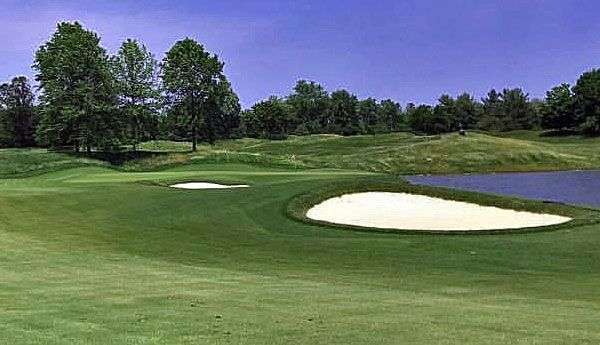
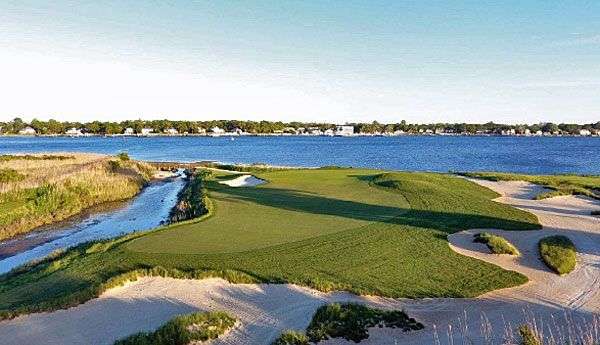
Formed in 1898, Hollywood Golf Club moved to its present location in 1912. The layout has been revamped numerous times since the Scottish professional Isaac Mackie originally laid it out.


Hollywood Golf Club
Formed in 1898, Hollywood Golf Club moved to its present location in 1912. The layout has been revamped numerous times since the Scottish professional Isaac Mackie originally laid it out.
Formed in 1898, Hollywood’s initial 9-hole course lasted only four years before the club moved to another site, where it remained for eleven years before members moved to their current location, next door to Deal Golf and Country Club in New Jersey
A Scottish professional named Isaac Mackie was tasked with creating a new 18-hole course at Deal which opened in 1913, but within a couple of years, Walter J. Travis (three-time US Amateur Champion between 1900 and 1903 and Amateur Champion at Royal St George’s in 1904) would work with Greens Committee chairman Frank B. Barrett to totally revamp the layout.
Travis dispensed with many of Mackie's sand traps and green complexes, combining some holes, removing and adding others. When the beefed-up Hollywood course reopened in 1915, there were no fewer than 220 bunkers incorporated into the design, with no fewer than 57 assigned to the 12th hole alone.
A number of architects have been involved down the years to maintain the integrity of the Travis design. Dick Wilson remodeled the layout in the mid-1950s, then Geoff Cornish carried out additional modifications in the 1980s before Rees Jones completed a renovation in the late 1990s.
In 2013, Hollywood embarked on yet another remedial programme, which included extensive bunker restoration, this time under the tutelage of Tom Doak’s Renaissance Golf Design.
“The great depth of golf in the Met Section is illustrated here,” said Tom Doak in The Confidential Guide to Golf Courses, “Hollywood received scant attention before a recent restoration by Brian Schneider, an avowed fan of Travis’s greens. These are some of the old man’s best: the four-tiered 7th is not as excessive as it sounds, and the lower back-left hole location at the 9th a thing of beauty.”
Who knows, with all these changes completed, we may yet see the Women’s US Amateur Championships (won here in 1921 by Marion Hollins when she defeated Alexa Stirling 5&4 in the final) return one year to the grand old Hollywood Golf Club? After all, the club successfully hosted the 2014 US Senior Women’s Amateur, won by Joan Higgins.
US Mid-Atlantic Division Best in State Rankings 2016 Three states in the Northeast Region are re-ranked in the eighth of nine US divisional updates We continue our Best in State re-ranking process for the United States of America with new listings for courses situated in the Mid-Atlantic division. This eighth and penultimate article in our series of US reappraisals snapshots the very strong golfing states of New Jersey, New York and Pennsylvania. As part of our review strategy, we’re extending our coverage of courses in the USA and this expansion will be reflected across just about every state in the country. For example, in this Mid-Atlantic division, we’re adding forty new tracks across the three states, representing an increase of 30%. New Jersey The top five positions in the Garden State remain exactly as they were when we last updated our standings two years ago, which means Pine Valley is still the number 1 course. After ten years at the top of our World Top 100 chart, this George Crump classic was displaced by Cypress Point as the best golfing layout on the planet when we revised our global listings in November last year. Such a fall from grace is relative, of course. Climbing three spots to number 8 in our new state chart, Hollywood is a Walter Travis Golden Age design that has been worked on by a number of architectural firms down the years, most recently by Tom Doak’s Renaissance Golf Design. Last month, a reviewer describer his playing experience on the course in the following terms: “I could happily be a member here and never get bored of the course… Hollywood plays over sandy ground that provides firm and fast playing conditions. The layout itself feels grand and is routed across a large canvas.” Essex County Country Club makes a prodigious leap up the New Jersey table, rising eleven places to just outside the Top 10 at number 12. Formed in 1887, the club is one of the oldest in the country, moving to its present location in 1916. Seth Raynor and Charles Banks reworked A. W. Tillinghast’s original design a decade later and the course has been modified a number of times since then, most notably by Brian Silva when he upgraded the fairway and greenside bunkers. The highest new entry appears at number 15 and it’s Morris County, another Seth Raynor design that dates back to 1916. Originally listed on the Top 100 website as a GEM, Morris County Golf Club started out in 1894 as a women-only club and had played host to both the Women's and Men's US Amateur championships before the turn of the 19th century. One of our contributors commented as follows: "As soon as I saw the first fairway, I knew I would love the place and I did. That fairway and many others reminded me of the land at Minneapolis GC and White Bear Yacht Club in MN... rolling with huge mounds and nary a flat lie anyplace, wonderfully roly-poly and Humpty Dumpty." Rank/ Click this link to see full details of our 2016 New Jersey Best in State rankings New York The top thirteen courses in the Empire State are all nationally ranked – indeed, all but two of these top tracks are included in our World Top 100 chart – which is a fair indication of the high quality of courses that you’ll find in this part of the country. Shinnecock Hills remains virtually unchallenged at the top of the state chart and this brilliant old William Flynn layout will once again play host to the best golfers in the world at the US Open in 2018 and 2026. Swapping places, A.W. Tillinghast’s West course at Winged Foot drops down one spot to number 4, with Seth Raynor’s fabulous Golden Age design at Fishers Island rising one place to number 3. It’s quite remarkable to think this fabulous old track was largely overlooked by many golf publications in their rankings until recent times. Thankfully, this special seaside track is now getting the recognition it fully deserves. Further down the newly updated New York chart, two near century-old Donald Ross courses make significant upward moves: Whippoorwill (up thirteen to 19) lasted only two years before it was redesigned by Charles Banks in 1930 and Wykagyl (up ten to 23) has been revamped many times since its debut in 1920, with the latest Coore & Crenshaw makeover mainly involving the addition of bunkers and removal of trees. Another big climber is St George’s Golf & Country Club, up nineteen positions to number 25, situated on the north shore of Long Island. Laid out by Devereux Emmet in 1917, the course has undergone a really positive transformation in recent years, thanks in no small part to the restoration skills of Gil Hanse and the application of the architect’s masterplan by Superintendent Adam Jessie, who arrived from Shinnecock Hills a decade ago. Click this link to see full details of our 2016 New York Best in State rankings Pennsylvania The Keystone State listings are headed by the Henry and William Fownes-designed Oakmont course, where this year’s US Open was held. It’s a notoriously tough track but a recent reviewer had this to say about his playing experience: “fairway landing areas are generous… only a few greens – generally on the shortest holes – are completely surrounded by bunkers. So unlike other difficult courses… playing a running approach is quite feasible – or even preferable – in many cases.” There’s not too much movement at the top end of the state rankings, except for a couple of notable Saucon Valley climbers: the 1960s William & David Gordon Weyhill course (up six to number 8) has undergone a recent Fazio Golf restoration whilst the Grace course is another highly regarded co-design by the same father and son architectural team and it hurtles fourteen places up the Pennsylvania standings to number 16. Another significant climber is A. W. Tillinghast’s Wissahickon course at Philadelphia Cricket Club (up seventeen to number 19), which was closed for twelve months in 2013, allowing Keith Foster to carry out an extensive renovation of the layout. The highest newcomer on the chart is Gulph Mills – a Donald Ross design that opened in 1919 – where Gil Hanse has been consulting since the start of the new millennium. Click this link to see full details of our 2016 Pennsylvania Best in State rankings As always, we’re delighted to receive feedback when we carry out a re-ranking exercise so please feel free to tell us what you think about our three revised US Best in State charts. We’d like to think you’ll concur with our published listings but perhaps you have a different view of things. Whatever your thoughts are, please click the “Respond to this article” link at the top or at the bottom of this page to let us know your views. Jim McCann Editor Top 100 Golf Courses

US Junior on tap this summer Baltusrol’s long-term agenda? By M. James Ward Last Thursday’s media rollout for the upcoming US Junior Amateur this summer at Baltusrol Golf Club provided an interesting peak behind the curtain for the historic Garden State club. Baltusrol has been the host location for a remarkable sixteen USGA Championships -- counting this year's Junior event. The club also served as host site (in 2005 and 2016) for the PGA Championship. But the news of the day went beyond the club's hosting of the Junior event for the first time in club history. Club president Rick Shea announced architect Gil Hanse has been brought on board as course consultant. The comments came unprompted from Shea in his welcome remarks to the assembled media and guests. What's interesting is a clear statement of direction for the historic club which had previously relied upon the Jones family -- Robert Trent Jones, Sr. and recently with Rees Jones in updating the two courses -- Lower and Upper respectively. Hanse is the most sought after architect in golf -- given recent various successes including his design of the Rio 2016 Olympic Golf Course and in updating two classic courses slated to host the US Open in the next few years with Winged Foot (West) in 2020 and Los Angeles (North) in 2023. Interestingly, it is Winged Foot that got the nod for the 2020 event over Baltusrol and it's fair to say the NJ-based club sought to replicate the success of the Mamaroneck, NY club in having the Hanse touch involved. Clearly, the leadership at Baltusrol believes something is needed in order to bolster the 36-hole A.W. Tillinghast design. Hosting the Junior event is something Baltusrol is likely doing to curry favor with the USGA since hosting the last event of the Association with the 2000 Amateur. With the last of the seven US Opens played on the Lower in 1993 -- the next opening for America's national championship will not be until 2028. That marks at minimum a span of 35 years from having hosted America's national championship -- the longest in club history. Interestingly, the club had previously had a 13-year period between US Opens when hosting the 1954, 1967, 1980 and 1993 championships. Although not stating at the podium an outright interest in hosting an eighth US Open, the desire of the club to remain a fixture in championship golf is clearly evident. The Junior Amateur will showcase both courses, but it is the Upper which will stage the entire match play portion for the best junior players. Baltusrol is the only club in US Open history where both courses at the same site have hosted the US Open. The Upper has not received overall fan and media attention, but architecturally, many, including this writer, see it as the superior design. The US Open used to be a regular agenda item for Baltusrol. That is no longer the case and the competition among various sites to remain in the favor of the USGA is always subject to change. Witness the favor of Bethpage (Black) early on when hosting the 2002 and 2009 events -- then splitting and aligning with the PGA of America to host the 2019 PGA Championship and 2024 Ryder Cup Matches. The same can be said of Oakland Hills (South) which last hosted the US Open in 1985 but did host the Ryder Cup in 2004 and PGA Championship in 2008. In addition, the Detroit-area club has hosted two US Amateurs since the 1985 championship, thus far the USGA has not indicated if a return for a 7th US Open will happen. Bringing in Hanse is a clear statement Baltusrol is keen to do whatever is needed in order to once again have America's national championship return to New Jersey. There are no guarantees and the payoff will not happen immediately, but the Junior Amateur is anything but "junior" to a club now intent in taking the needed steps to rejoin the conversation at the top of America's golf pecking order. Whether that happens or not will be a work in progress certainly worth watching.

US Women's Open marks ongoing stature Golf in the Garden State by M. James Ward New Jersey is the 46th largest state in area in America – but its reputation in the golf arena clearly exceeds its limited geographical size – both historically and carrying through to the present day. This week's US Women's Open at Trump National Golf Club in Bedminster marks the 7th time the Garden State has served as host of the premier event in women's golf. The event also marks the 61st USGA Championship hosted in New Jersey – only three other states exceed that total – Pennsylvania, California and New York and each is considerably larger in overall size and in total courses. The first USGA Championship held in the state goes back to 1896 when Morris County Golf Club in Convent Station hosted the Women's Amateur. Leading the way in the Garden State is Baltusrol Golf Club. The Springfield-based club’s role in staging major golf championships stretches back to the earliest days of golf in the 20th century. After staging last year's PGA Championship, Baltusrol has hosted 17 national championships, including seven US Opens and two PGAs. Originally designed by A.W. Tillinghast, the formidable Lower course was updated by Montclair resident and world-renowned golf course architect Robert Trent Jones Senior in the early 1950s. RTJ’s work proved so demanding members suggested he play the strengthened par-3 4th hole prior to the 1954 US Open with its daunting water carry. Jones came to Baltusrol and proceeded to hit a 4-iron into the hole. Without skipping a beat he pronounced, "Gentlemen, as you can see, the hole is eminently fair!" NJ is also home to Pine Valley Golf Club – consistently rated among the top 2-3 clubs in the world. Located in the southwestern corner of the state, Pine Valley opened in 1913, the brainchild of hotelier George Crump. Born in Philadelphia in 1871, Crump was an avid golfer and his only design sprung from ideas adapted following his golfing trips to Britain and Europe. Unfortunately, Crump died before the final four remaining holes opened – completed after his death at 46 years of age. The English architect H.S. Colt played a major role in finalizing efforts. The aura of Pine Valley has only grown over time, as the course possesses an array of stellar holes. Renowned designer Tom Fazio has recently modified the layout and he also created a short course, which mirrors the approaches played to holes on the main course. In 1954, Arnold Palmer, in his first visit to Pine Valley, arranged a significant wager to recoup money spent on an engagement ring for his wife Winnie. Palmer fired scores of 67, 69 and 68, securing nearly enough money to pay for the ring. A few years later Jack Nicklaus played the course on his honeymoon, however, new bride Barbara waited in their car since the club was a men’s only bastion. Beyond the likes of Baltusrol (Lower) and Pine Valley, the Garden State has seven courses currently ranked among the Top 100 Golf Courses of the USA. Only two other states (California and New York) placed more. The New Jersey list includes Plainfield Country Club in Edison, Somerset Hills Country Club in Bernardsville, Baltusrol (Upper) in Springfield, Ridgewood Country Club (West & East) in Paramus and Galloway National Golf Club in Galloway. A few Garden State factoids In 1887, Essex County Country Club in West Orange, organized as NJ’s oldest country club, with 36 holes to open shortly thereafter. Bobby Jones played an exhibition on both courses and highlighted the 15th hole on the former private West course (now called Francis Bryne) among the strongest par fours he had ever played. In 1903 the term "birdie" was coined at Atlantic City Country Club in Northfield and shortly thereafter "eagle" was also born. Not far from ACCC the first PGA Championship was played in the state in 1942 at Seaview Country Club in nearby Absecon. A blossoming golf star named Sam Snead earned both his first Wannamaker Trophy and first of seven major titles. Snead bested Jim Turnesa – who was serving the U.S. Army with literally a battalion of fellow GI’s rooting for him from nearby Fort Dix. Sam later mentioned how much he gained from the experience given earlier failures in winning major events. Interestingly, a year prior at the 1941 PGA Championship, a Rumson native, Vic Ghezzi, claimed his first and only major championship. In 1946 Ghezzi would lose the US Open in a playoff, yet his stellar career play garnered him a spot in the PGA Hall of Fame in 1965. Morris County Golf Club, located in Convent Station, started in 1894 and it’s the only club of its kind in the USA organized and managed by women. One of NJ's most important contributors was George Jacobus. Born in Brook Lake the head golf professional at The Ridgewood Country Club in Paramus served as President of the PGA of America from 1932-39. Jacobus rose from the caddie ranks to become the first association president native to America. Ridgewood hosted the 5th Ryder Cup Matches – won by the American side 9-3 and led for the final time by playing Captain Walter Hagen. One of the members of the USA squad (Craig Wood) would later become a member of Ridgewood and add triumphs in 1941 at The Masters and the US Open. Jacobus attended the 1935 Masters and identified a developing player named Byron Nelson. Jacobus hired the Texan as his assistant and during his brief stint won the NJ Open in 1935 and the Met Open one year later before commencing his Hall-of-Fame career. In 1913, Weequahic Park in Newark opened, the oldest publicly owned course in the Garden State, which was coincidentally designed by George Low the Baltusrol club professional at that time. With clubs teetering during The Great Depression, Jacobus convinced PGA leadership in 1935 to hire the talented architect A.W. Tillinghast (the man responsible for NJ courses such as Baltusrol and Ridgewood) to provide no cost consultation services to PGA-member courses to bolster their designs and provide member clubs with a clear reason to keep PGA members on staff when many were let go because of the plunging economy. Tillinghast eventually visited over 400 courses nationwide. The plan was a success. Keeping the PGA of America relevant and having Tillinghast upgrade various courses in serious need of his design talents. Jacobus served Ridgewood for 50 plus years and was elected posthumously to the PGA Hall of Fame in 1965. In 1920 Shady Rest opened as the first African-American golf and country club in the USA. John Shippen, a superb golfer, competed and finished 5th in the 1896 US Open at Shinnecock Hills. The property is now called Scotch Hills Golf Course, owned by Scotch Plains Township and open to all. Another Jersey resident emerged years later as President of the PGA. This time the issues were more internal than external. Leo Fraser, long-time owner of the Atlantic City Country Club, assumed the leadership mantle in 1969-1970. During his term an ugly divorce between players competing in weekly tour events and those representing the bulk of the membership was brewing. Fraser played a key role and the resulting solution meant the creation of the PGA Tour. The two entities continue to this day as separate but affiliated organizations. William Lowell, Sr., a Maplewood dentist, is credited with marketing the first wooden tee in 1921. Growing the game has been a consistent clarion call to present day efforts. In 2012, the New Jersey PGA Section received the Herb Graffis Award from the PGA of America for its exemplary effort in player development. Founded in 1931, the NJPGA was lauded for an initiative called Golf in Schools, starting in 2009 and impacting 95,000 boys and girls at elementary and middle schools throughout the Garden State at 168 schools, the program has been a model for all 41 PGA sections across the country. Funded through the New Jersey Golf Foundation (the charitable arm of the Section) is offered at no cost to school districts. The Champions Tour debuted in 1980 when Atlantic City Country Club hosted the Atlantic City Senior Invitational, won by Texan Don January who earlier claimed the 1967 PGA Championship. Coming up in late September is the bi-annual President’s Cup Matches. Hosted at Liberty National Golf Club located in Jersey City with sensational views of the NYC skyline and Statue of Liberty. The USA squad, captained by Steve Stricker, and the world team minus Europe, captained by Nick Price, will tangle on a design from the late Bob Cupp with input from PGA Tour star and 1992 US Open champion Tom Kike. Liberty National, along with such courses as Plainfield and Ridgewood form the trio of clubs that rotate host roles for the Northern Trust Open (formerly the Barclays) the first leg of the Fed-Ex Cup Playoffs. The Garden State has been ground zero for a good deal of meaningful golf history. This week’s US Women’s Open Championship only adds to that impressive portfolio. New Jersey Best In State Rankings
The latest ranking of the Top 100 Golf Courses in the World serves as the ultimate global golf bucket list. Most members of our World Top 100 Panel are seasoned golfers, each playing 20-30 of these courses annually while travelling extensively over decades to form their opinions on others. We recognise that opinions vary—even among our panel members. Rankings are subjective, and there are undoubtedly 50 or more courses in the UK and USA alone that could easily fit onto this list. Links Golf Pilgrimages The rankings
California, United States
New Jersey, United States
Northern Ireland, United Kingdom
New York, United States
New York, United States