New Jersey, United States
Manasquan River Golf Club boasts 600 yards of river frontage and also lays claim to ownership of the highest land point on the Atlantic Seaboard for more than 1,000 miles between Atlantic Highlands in the north and Florida to the south.
Overall rating

4.5
Manasquan River Golf Club boasts 600 yards of river frontage and also lays claim to ownership of the highest land point on the Atlantic Seaboard for more than 1,000 miles between Atlantic Highlands in the north and Florida to the south.
The latest ranking of the Top 100 Golf Courses in the World serves as the ultimate global golf bucket list. Most members of our World Top 100 Panel are seasoned golfers, each playing 20-30 of these courses annually while travelling extensively over decades to form their opinions on others. We recognise that opinions vary—even among our panel members. Rankings are subjective, and there are undoubtedly 50 or more courses in the UK and USA alone that could easily fit onto this list. Links Golf Pilgrimages The rankings
California, United States
New Jersey, United States
Northern Ireland, United Kingdom
New York, United States
New York, United States
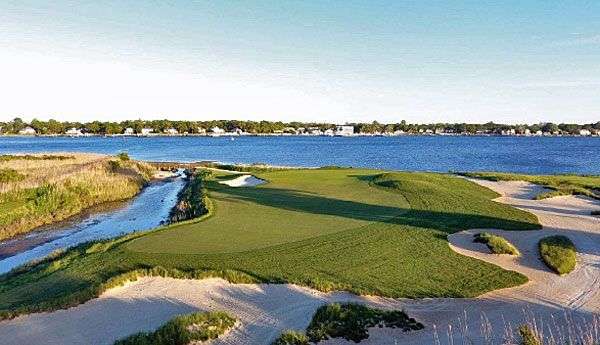
Founded in 1922, Manasquan River Golf Club is located on the northern shore of the Manasquan River, only a few hundred yards from where it empties into the Atlantic Ocean.
The club boasts 600 yards of river frontage and also lays claim to ownership of the highest land point on the Atlantic Seaboard for more than 1,000 miles between Atlantic Highlands in the north and Florida to the south.
A Scotsman named Robert White, who emigrated from St Andrews to study agronomy, laid out the first nine holes for the founding members along the river in 1923. Three years later White routed the second nine through the woodlands on the higher ground to the west of the original course, from where there are compelling, panoramic river views to enjoy.
The original nine, which now comprises holes 1, 2 and 12-18, play across the flat land by the river, while holes 3-11 are set on the high ground further to the west. These contrasting nines give Manasquan River a rather unusual split personality.
In spring 2020, the New Jersey State Golf Association Magazine profiled Manasquan River's 16th hole:
“The 16th hole at Manasquan River Golf Club is a 471-yard par-4 which combines beauty and difficulty to the highest degree. The hole doglegs to the right at approximately 300 yards from the back tee, and a waste area runs along the entire right side. The second shot is played over a small inlet of water which flows from the Manasquan River to a green with an “infinity” backdrop. This adds to the challenge of the approach, as does the presence of the wind. The open coastal setting of the 16th makes the breeze a major factor on this hole, which always plays differently depending on wind direction.”
The club hosted the US Girl’s Junior Championship in 1990 before Ron Prichard renovated the layout. In 2019 Andrew Green completed a course restoration. Andrew commented as follows:
“We rebuilt all the bunkers respecting the Robert White original vision for the golf course. Fairway bunkers were tweaked to best meet the modern game. Greenside bunkers were meant to fit the green shapes and strategies. Some Robert White mounds were installed through the layout to add strategy and interest.”
Additionally, four greens were rebuilt to provide a wider array of hole locations and all other greens were modestly adjusted to reclaim the putting surfaces.
US Mid-Atlantic Division Best in State Rankings 2020 We’re closing in on the conclusion of our Best in State re- ranking process for the USA with this, our penultimate revision for the Mid-Atlantic states of New Jersey, New York and Pennsylvania. In such a high quality golfing division, where twenty-seven of the courses are listed in our US Top 100, we’ve acquired additional local knowledge that now allows us to extend our listings in this northeast region by more than a third to a total of 235 courses. Without further ado, we’re going to dive straight in to our Mid-Atlantic reappraisal, starting with the Garden State of New Jersey, where we’ve added another twenty-five tracks to the fifty that we already featured. New Jersey It’s no surprise whatsoever to discover the course at Pine Valley Golf Club in Clementon stays firmly embedded as the No. 1 layout in New Jersey. It is, after all, second to only Cypress Point at the top of both our national and global Top 100 charts. All eighteen holes of George Crump’s Camden County masterpiece have been in play for just over a hundred years now and they collectively form one of the toughest tracks in all of golf. Pine Valley Golf Club Our Florida correspondent Marc Bender posted these comments four months ago: “there is no course that offers a greater variety of 18 unique and fabulous holes with this level of continuity… the attention to every little architectural detail of the course is unparalleled. The balance of holes, use of the terrain, and the green complexes is incredible. Little difference exists between the least memorable hole and the most memorable hole; that’s how good each and every one of them is.” Ten of the top twelve chart places remain unaltered, so the first real movement of significance occurs with the Highlands course at Hamilton Farm in Gladstone, rising six spots to #18, which is the position it previously held in 2016. A late 1990s Hurdzan/Fry co-design from when those two architects were working in partnership, this layout is complemented by a fantastic 18-hole par three course called The Hickory, offering a really diverse 36-hole experience at the club. Hamilton Farm - Highlands course Also climbing six spots to #26, the course at Arcola Country Club in Paramus is the sum product of three English-born architects – Herbert Haydn Barker, Willard G. Wilkinson and Robert Trent Jones Sr. – who fashioned the fairways over a fifty-year period between 1909 and 1958. Our US Correspondent Fergal O’Leary played at Arcola last year and felt it was “a truly wonderful club that has a lot to be proud of.” Arcola Country Club The first of our new additions arrives at #23 and it’s the course at Manasquan River Golf Club in Brielle, which was originally established back in 1923 when Robert White laid out an initial 9-hole track. Described by our regular contributor M. James Ward as “one of the most underappreciated courses in the Garden State,” this layout hosted the US Girls’ Junior Championship in 1990 and it’s just undergone an extensive restoration exercise by Andrew H. Green. Another place to greatly benefit from a recent restoration is the course at Watchung Valley Golf Club (new at #29) which started out in the late 1920s as a layout planned by Seth Raynor but construction was carried out by Marty O’Loughlin, the Plainfield professional, who oversaw the build after the architect’s untimely death. George Waters has completed a project to polish the Raynor template holes and integrate them seamlessly with the style of the other holes that has evolved over time. Watchung Valley Golf Club Rank/ Click the link to see full details of our latest New Jersey Best in State rankings. New York Such is the strength in depth at the top of the table in New York, the first eighteen courses are all listed in our US Top 100 – and eight of these layouts also occupy positions in our World Top 100 – so with those figures in mind, we’ve decided to expand our state chart to a Top 100, bringing an additional thirty courses under the golfing spotlight in the Empire State. The leading five courses stay exactly as they were after we refreshed the standings two years ago, which means the 18-hole layout at Shinnecock Hills Golf Club in Southampton retains its No. 1 status. Golf has been played here since 1891, the year that Willie Davis set out an initial twelve holes, and the course has been modified a couple of times since then, first by C.B. Macdonald and Seth Raynor during World War I, then by Howard Toomey and William Flynn in the early 1930s. Shinnecock Hills Golf Club All the top amateur tournaments have been played here – including the US Amateur, US Women’s Amateur, US Senior Amateur and the Walker Cup – along with five editions of the US Open, the last of which was hosted two years ago. This prestigious event is due to return to Long Island for the 126th staging of the championship in another six years, when the club’s illustrious layout will once again take centre stage. Three courses make double digit upward moves in the new chart. Rising twelve to #31, the course at Teugega Country Club in Rome is a Donald Ross design dating back to 1921. The club was formed in 1899 and members played on a 9-hole layout next to the Mohawk River until a decision was made by the committee to move from their old waterlogged location five miles north to a new site on the southern shores of Delta Lake. Walter Hatch supervised construction, but Donald Ross made several site visits, even securing his first hole in one at the short par three 7th during a round on the new course. Teugega Country Club Advancing fifteen to #44, the course at Westhampton Country Club in Westhampton Beach is one of Seth Raynor’s earliest solo designs from 1915 which Gil Hanse restored a decade ago now. “A truly wonderful layout with plenty of fun for good measure,” is what Fergal O’Leary said about the course in his review last year. “It’s a shot-maker’s paradise and we walked off the 18th green wanting more.” Westhampton Country Club Up ten places to #50, the course at Metropolis Country Club in White Plains was founded in 1904, with Herbert Strong completing his first ever design here. A.W. Tillinghast remodelled the layout in the late 1920s and it was further altered at different times by Joe Finger and his design partner Ken Dye before Ron Forse carried out a new millennium restoration. Metropolis Country Club M. James Ward thought last year the layout had “clearly improved in terms of strategic interest” with the recent removal of trees. Furthermore, he felt “the visual dynamics are clearly improved and turf quality has clearly benefitted from the added air flow... place Metropolis in another area of the USA where the overall competition is not that keen and the overall standing would likely be more noticeable.” Leading the mass infiltration of newcomers into the New York listings, the course at Nassau Country Club in Glen Cove appears at #49. The club’s initial course was laid out by committee members but Devereux Emmet became the first architect to put his design stamp on the property in 1920. Others, such as Herbert Strong and Seth Raynor, made early changes to the course while Tom Fazio is credited with replacing all the greens eight years ago. Nassau Country Club Writing in his golf travel blog, Paul Rudovsky had this to say about Nassau when he played it a while back (as he chased down every venue to have hosted the US Amateur); “here is a course that never was on a top 100 and probably never will be... but a fun, fun course to play.” Click the link to see full details of our latest New York Best in State rankings. Pennsylvania Like New York, the top five layouts in Pennsylvania remain in the same order, so the course at Oakmont Country Club remains in the No. 1 slot. Located outside Pittsburgh, on the south bank of the Allegheny River, Oakmont’s reckoned to be one of the toughest tracks in American golf. Industrialist Henry Fownes and his son William devised this layout back at the start of the last century and William (who won the US Amateur in 1910) is said to have continued working on it right up until he died in 1950. It’s due to host the US Amateur in August next year, the sixth time the championship has been staged here. Oakmont Country Club Our International Correspondent David Davis commented last year, following his second visit to the club: “the routing is as good as anything on the planet … the bunkering and the greens really steal the show.” Javier Pintos, our Argentina Correspondent, also posted: “all the long holes are downhill and the short ones uphill so there you admire the design and the balance the course has.” There’s very little movement in the upper reaches of the new chart but casting an eye a little lower reveals a few upward motions of note. The course at Longue Vue Club (up five to #24) in Verona is exactly a hundred years old this year, having been designed by Scottish professional Robert White in 1920 then renovated by A. W. Tillinghast fifteen years later. Set two hundred feet above a bend in the Allegheny River, the layout “is certainly among the best in the Keystone State” according to M. James Ward. It’s also due to co-host the US Amateur in 2021. Longue Vue Club The Old course at the Omni Bedford Springs Resort also moves up five rungs on the ladder. Dating back to 1895, the layout had improvements made by A.W. Tillinghast (1912) and Donald Ross (1923) before a new millennium Ron Forse restoration revitalized the set-up, introducing new bunkers and mounds to build on the strategy and variety already inherent on the course. Omni Bedford Springs Old course White Manor Country Club’s 18-hole layout in Malvern (up to #32) reverses the fall from grace it suffered two years ago when it slipped seven places in the listings. The club was established in 1948 at Paxton Hollow but moved sixteen years later to its current location, where William and David Gordon laid out a new course for the members. Bobby Weed then renovated this layout in 2002. White Manor Country Club The progression made by the Militia Hill course at Philadelphia Cricket Club in Plymouth Meeting (up nine to #33) more than makes up for a drop of four places which took place during our 2018 revision exercise. When this Hurdzan/Fry co-design was unveiled in 2002, it meant the club was the only one in the United States to have had a course built in each of the last three centuries as its St. Martins 9-holer emerged in 1895 and its 18-hole Wissahickton layout took shape in 1922. The first of ten new entries in our enlarged Pennsylvania chart debuts at #35 and it’s the course at Llanerch Country Club in Havertown, where the 1958 PGA Championship was first contested as a stroke play event. Originally designed by Alex Findlay in the 1920s, the layout was reconfigured by J.B. McGovern, Donald Ross’s associate, after World War II. Last year, Brian Schneider from Renaissance Golf Design was appointed to carry out a renovation: “To make the golf course as fun, engaging, and visually attractive as possible.” Llanerch Country Club Click the link to see full details of our latest Pennsylvania Best in State rankings. Next up in our final release are the New England states of Connecticut, Maine, Massachusetts, New Hampshire, Rhode Island and Vermont. Jim McCann Editor Top 100 Golf Courses
US Junior on tap this summer Baltusrol’s long-term agenda? By M. James Ward Last Thursday’s media rollout for the upcoming US Junior Amateur this summer at Baltusrol Golf Club provided an interesting peak behind the curtain for the historic Garden State club. Baltusrol has been the host location for a remarkable sixteen USGA Championships -- counting this year's Junior event. The club also served as host site (in 2005 and 2016) for the PGA Championship. But the news of the day went beyond the club's hosting of the Junior event for the first time in club history. Club president Rick Shea announced architect Gil Hanse has been brought on board as course consultant. The comments came unprompted from Shea in his welcome remarks to the assembled media and guests. What's interesting is a clear statement of direction for the historic club which had previously relied upon the Jones family -- Robert Trent Jones, Sr. and recently with Rees Jones in updating the two courses -- Lower and Upper respectively. Hanse is the most sought after architect in golf -- given recent various successes including his design of the Rio 2016 Olympic Golf Course and in updating two classic courses slated to host the US Open in the next few years with Winged Foot (West) in 2020 and Los Angeles (North) in 2023. Interestingly, it is Winged Foot that got the nod for the 2020 event over Baltusrol and it's fair to say the NJ-based club sought to replicate the success of the Mamaroneck, NY club in having the Hanse touch involved. Clearly, the leadership at Baltusrol believes something is needed in order to bolster the 36-hole A.W. Tillinghast design. Hosting the Junior event is something Baltusrol is likely doing to curry favor with the USGA since hosting the last event of the Association with the 2000 Amateur. With the last of the seven US Opens played on the Lower in 1993 -- the next opening for America's national championship will not be until 2028. That marks at minimum a span of 35 years from having hosted America's national championship -- the longest in club history. Interestingly, the club had previously had a 13-year period between US Opens when hosting the 1954, 1967, 1980 and 1993 championships. Although not stating at the podium an outright interest in hosting an eighth US Open, the desire of the club to remain a fixture in championship golf is clearly evident. The Junior Amateur will showcase both courses, but it is the Upper which will stage the entire match play portion for the best junior players. Baltusrol is the only club in US Open history where both courses at the same site have hosted the US Open. The Upper has not received overall fan and media attention, but architecturally, many, including this writer, see it as the superior design. The US Open used to be a regular agenda item for Baltusrol. That is no longer the case and the competition among various sites to remain in the favor of the USGA is always subject to change. Witness the favor of Bethpage (Black) early on when hosting the 2002 and 2009 events -- then splitting and aligning with the PGA of America to host the 2019 PGA Championship and 2024 Ryder Cup Matches. The same can be said of Oakland Hills (South) which last hosted the US Open in 1985 but did host the Ryder Cup in 2004 and PGA Championship in 2008. In addition, the Detroit-area club has hosted two US Amateurs since the 1985 championship, thus far the USGA has not indicated if a return for a 7th US Open will happen. Bringing in Hanse is a clear statement Baltusrol is keen to do whatever is needed in order to once again have America's national championship return to New Jersey. There are no guarantees and the payoff will not happen immediately, but the Junior Amateur is anything but "junior" to a club now intent in taking the needed steps to rejoin the conversation at the top of America's golf pecking order. Whether that happens or not will be a work in progress certainly worth watching.

US Women's Open marks ongoing stature Golf in the Garden State by M. James Ward New Jersey is the 46th largest state in area in America – but its reputation in the golf arena clearly exceeds its limited geographical size – both historically and carrying through to the present day. This week's US Women's Open at Trump National Golf Club in Bedminster marks the 7th time the Garden State has served as host of the premier event in women's golf. The event also marks the 61st USGA Championship hosted in New Jersey – only three other states exceed that total – Pennsylvania, California and New York and each is considerably larger in overall size and in total courses. The first USGA Championship held in the state goes back to 1896 when Morris County Golf Club in Convent Station hosted the Women's Amateur. Leading the way in the Garden State is Baltusrol Golf Club. The Springfield-based club’s role in staging major golf championships stretches back to the earliest days of golf in the 20th century. After staging last year's PGA Championship, Baltusrol has hosted 17 national championships, including seven US Opens and two PGAs. Originally designed by A.W. Tillinghast, the formidable Lower course was updated by Montclair resident and world-renowned golf course architect Robert Trent Jones Senior in the early 1950s. RTJ’s work proved so demanding members suggested he play the strengthened par-3 4th hole prior to the 1954 US Open with its daunting water carry. Jones came to Baltusrol and proceeded to hit a 4-iron into the hole. Without skipping a beat he pronounced, "Gentlemen, as you can see, the hole is eminently fair!" NJ is also home to Pine Valley Golf Club – consistently rated among the top 2-3 clubs in the world. Located in the southwestern corner of the state, Pine Valley opened in 1913, the brainchild of hotelier George Crump. Born in Philadelphia in 1871, Crump was an avid golfer and his only design sprung from ideas adapted following his golfing trips to Britain and Europe. Unfortunately, Crump died before the final four remaining holes opened – completed after his death at 46 years of age. The English architect H.S. Colt played a major role in finalizing efforts. The aura of Pine Valley has only grown over time, as the course possesses an array of stellar holes. Renowned designer Tom Fazio has recently modified the layout and he also created a short course, which mirrors the approaches played to holes on the main course. In 1954, Arnold Palmer, in his first visit to Pine Valley, arranged a significant wager to recoup money spent on an engagement ring for his wife Winnie. Palmer fired scores of 67, 69 and 68, securing nearly enough money to pay for the ring. A few years later Jack Nicklaus played the course on his honeymoon, however, new bride Barbara waited in their car since the club was a men’s only bastion. Beyond the likes of Baltusrol (Lower) and Pine Valley, the Garden State has seven courses currently ranked among the Top 100 Golf Courses of the USA. Only two other states (California and New York) placed more. The New Jersey list includes Plainfield Country Club in Edison, Somerset Hills Country Club in Bernardsville, Baltusrol (Upper) in Springfield, Ridgewood Country Club (West & East) in Paramus and Galloway National Golf Club in Galloway. A few Garden State factoids In 1887, Essex County Country Club in West Orange, organized as NJ’s oldest country club, with 36 holes to open shortly thereafter. Bobby Jones played an exhibition on both courses and highlighted the 15th hole on the former private West course (now called Francis Bryne) among the strongest par fours he had ever played. In 1903 the term "birdie" was coined at Atlantic City Country Club in Northfield and shortly thereafter "eagle" was also born. Not far from ACCC the first PGA Championship was played in the state in 1942 at Seaview Country Club in nearby Absecon. A blossoming golf star named Sam Snead earned both his first Wannamaker Trophy and first of seven major titles. Snead bested Jim Turnesa – who was serving the U.S. Army with literally a battalion of fellow GI’s rooting for him from nearby Fort Dix. Sam later mentioned how much he gained from the experience given earlier failures in winning major events. Interestingly, a year prior at the 1941 PGA Championship, a Rumson native, Vic Ghezzi, claimed his first and only major championship. In 1946 Ghezzi would lose the US Open in a playoff, yet his stellar career play garnered him a spot in the PGA Hall of Fame in 1965. Morris County Golf Club, located in Convent Station, started in 1894 and it’s the only club of its kind in the USA organized and managed by women. One of NJ's most important contributors was George Jacobus. Born in Brook Lake the head golf professional at The Ridgewood Country Club in Paramus served as President of the PGA of America from 1932-39. Jacobus rose from the caddie ranks to become the first association president native to America. Ridgewood hosted the 5th Ryder Cup Matches – won by the American side 9-3 and led for the final time by playing Captain Walter Hagen. One of the members of the USA squad (Craig Wood) would later become a member of Ridgewood and add triumphs in 1941 at The Masters and the US Open. Jacobus attended the 1935 Masters and identified a developing player named Byron Nelson. Jacobus hired the Texan as his assistant and during his brief stint won the NJ Open in 1935 and the Met Open one year later before commencing his Hall-of-Fame career. In 1913, Weequahic Park in Newark opened, the oldest publicly owned course in the Garden State, which was coincidentally designed by George Low the Baltusrol club professional at that time. With clubs teetering during The Great Depression, Jacobus convinced PGA leadership in 1935 to hire the talented architect A.W. Tillinghast (the man responsible for NJ courses such as Baltusrol and Ridgewood) to provide no cost consultation services to PGA-member courses to bolster their designs and provide member clubs with a clear reason to keep PGA members on staff when many were let go because of the plunging economy. Tillinghast eventually visited over 400 courses nationwide. The plan was a success. Keeping the PGA of America relevant and having Tillinghast upgrade various courses in serious need of his design talents. Jacobus served Ridgewood for 50 plus years and was elected posthumously to the PGA Hall of Fame in 1965. In 1920 Shady Rest opened as the first African-American golf and country club in the USA. John Shippen, a superb golfer, competed and finished 5th in the 1896 US Open at Shinnecock Hills. The property is now called Scotch Hills Golf Course, owned by Scotch Plains Township and open to all. Another Jersey resident emerged years later as President of the PGA. This time the issues were more internal than external. Leo Fraser, long-time owner of the Atlantic City Country Club, assumed the leadership mantle in 1969-1970. During his term an ugly divorce between players competing in weekly tour events and those representing the bulk of the membership was brewing. Fraser played a key role and the resulting solution meant the creation of the PGA Tour. The two entities continue to this day as separate but affiliated organizations. William Lowell, Sr., a Maplewood dentist, is credited with marketing the first wooden tee in 1921. Growing the game has been a consistent clarion call to present day efforts. In 2012, the New Jersey PGA Section received the Herb Graffis Award from the PGA of America for its exemplary effort in player development. Founded in 1931, the NJPGA was lauded for an initiative called Golf in Schools, starting in 2009 and impacting 95,000 boys and girls at elementary and middle schools throughout the Garden State at 168 schools, the program has been a model for all 41 PGA sections across the country. Funded through the New Jersey Golf Foundation (the charitable arm of the Section) is offered at no cost to school districts. The Champions Tour debuted in 1980 when Atlantic City Country Club hosted the Atlantic City Senior Invitational, won by Texan Don January who earlier claimed the 1967 PGA Championship. Coming up in late September is the bi-annual President’s Cup Matches. Hosted at Liberty National Golf Club located in Jersey City with sensational views of the NYC skyline and Statue of Liberty. The USA squad, captained by Steve Stricker, and the world team minus Europe, captained by Nick Price, will tangle on a design from the late Bob Cupp with input from PGA Tour star and 1992 US Open champion Tom Kike. Liberty National, along with such courses as Plainfield and Ridgewood form the trio of clubs that rotate host roles for the Northern Trust Open (formerly the Barclays) the first leg of the Fed-Ex Cup Playoffs. The Garden State has been ground zero for a good deal of meaningful golf history. This week’s US Women’s Open Championship only adds to that impressive portfolio. New Jersey Best In State Rankings