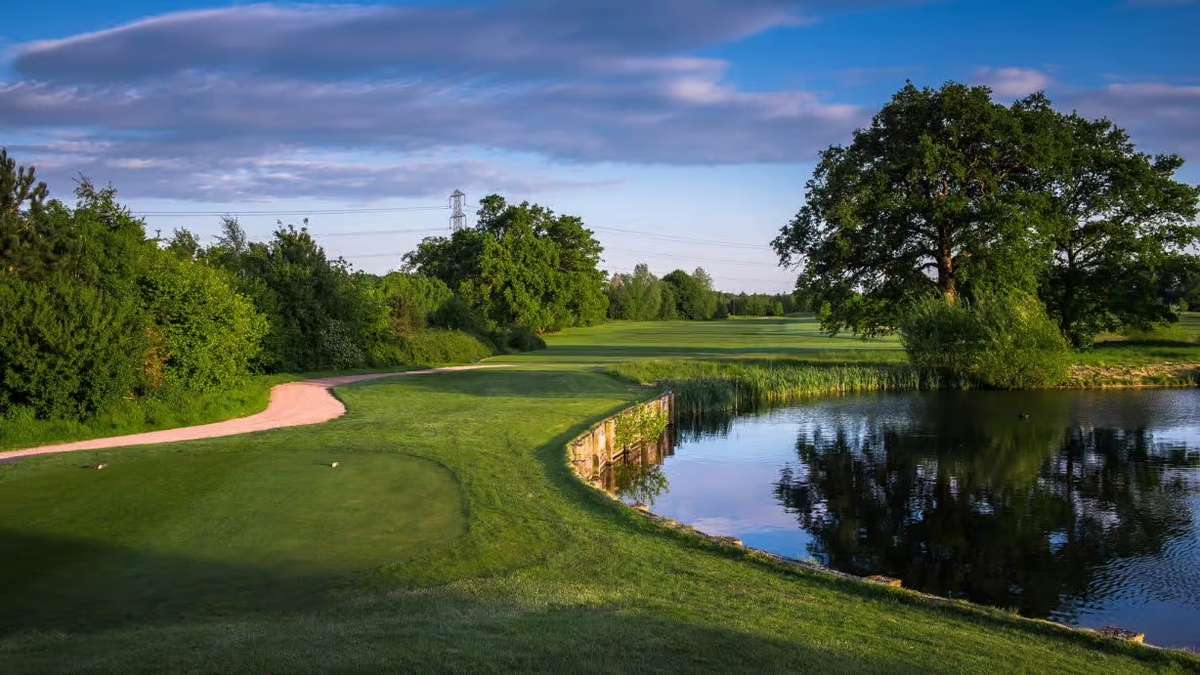
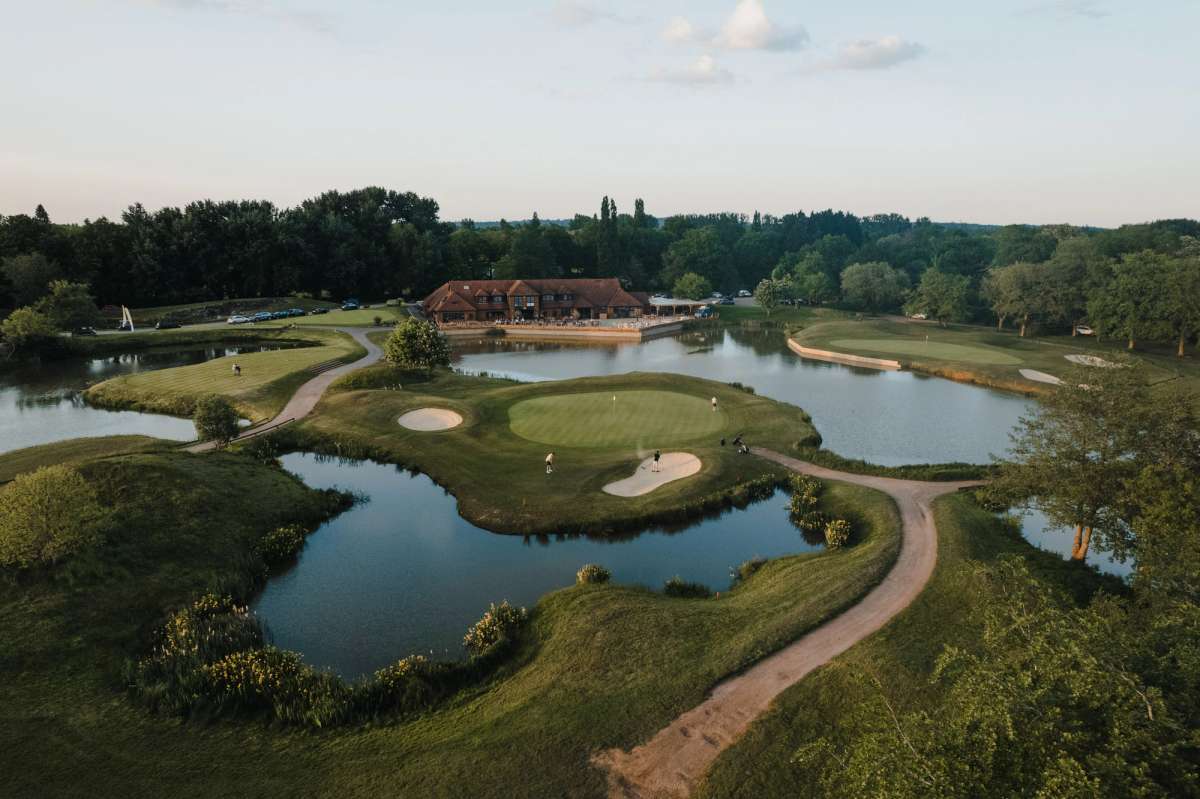
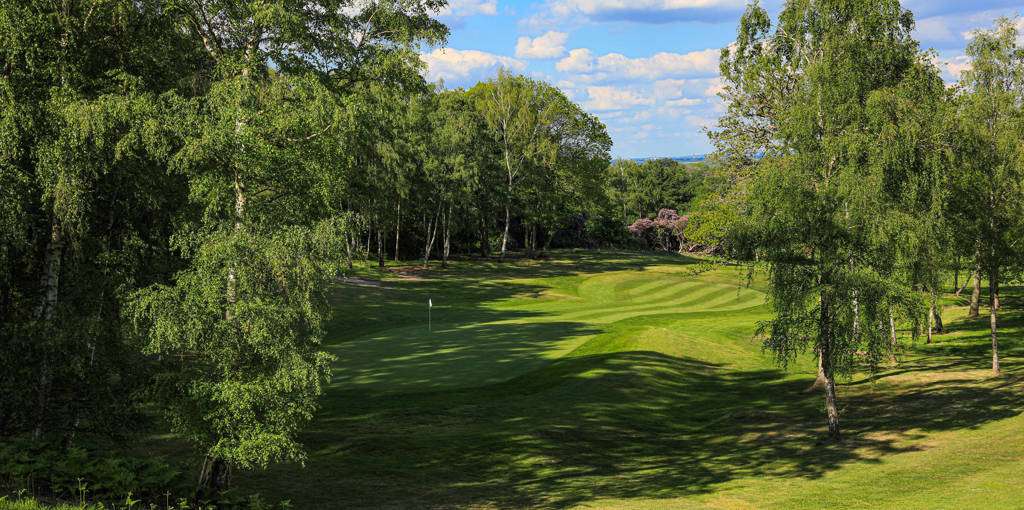
The spectacular golfing panorama from the front of the St George's Hill clubhouse is a view that grabs you and makes your heart pound...


The spectacular golfing panorama from the front of the St George's Hill clubhouse is a view that grabs you and makes your heart pound...
St George's Hill Golf Club (Red & Blue)
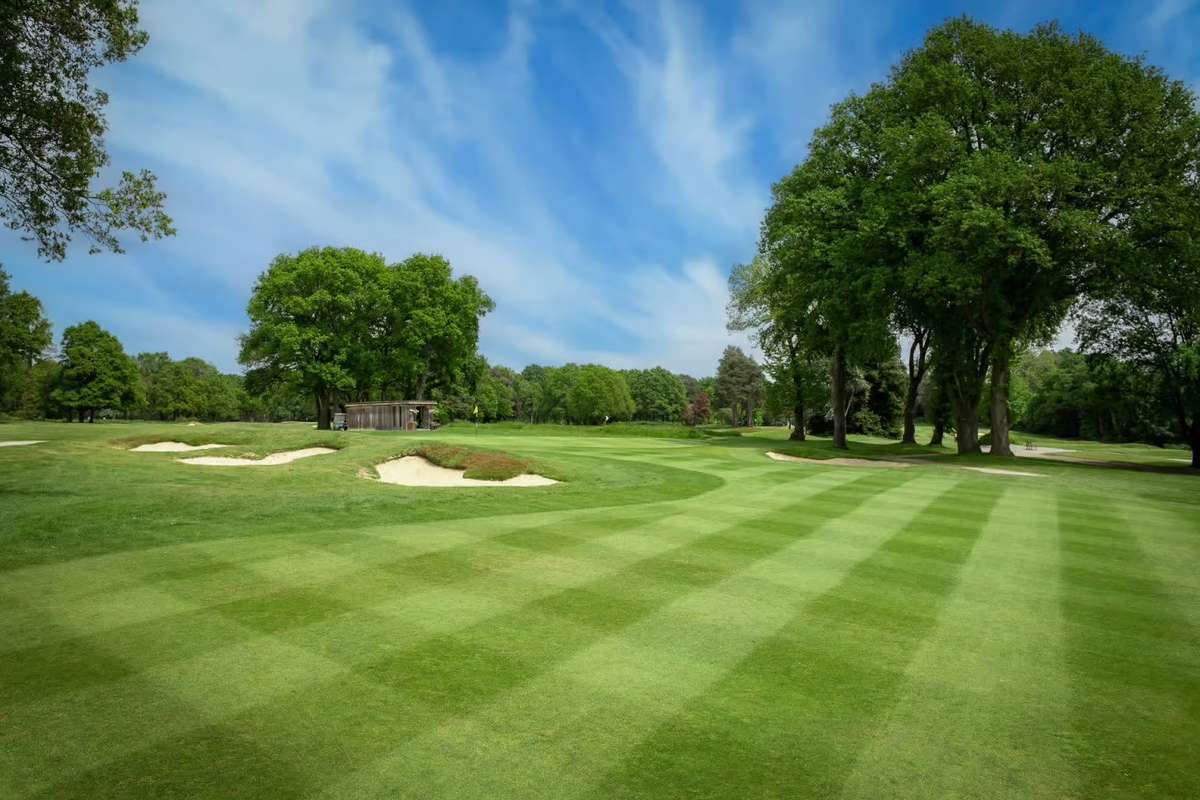
St George’s Hill Golf Club is one of the prettiest of the numerous heathland courses on the Surrey/Berkshire sand belt... it's also one of the best. In 1911, a local builder came up with an original idea to build luxury fairway-side houses and, by chance, Harry Colt was the chosen architect. The course opened for play in 1913 and it is considered (alongside Swinley Forest) to be one of Colt’s greatest designs.
The most notable difference between St George’s Hill and the heathland layouts in this area is the terrain. The land here sweeps and undulates like a rollercoaster and Harry Colt used these dramatic elevation changes superbly in his design.
At this stage, it is worth pointing out that there are three loops of nine holes, called Red, Blue and Green. At one time, St George’s Hill was a 36-hole complex but sadly, no longer. The main course is comprised of the Red nine and the Blue nine, the Green nine is somewhat shorter.
The spectacular panorama from the front of the clubhouse, or the pavilion as it was originally called, totally whets your appetite. It is one of those views that grabs you and makes your heart pound in excited anticipation. You cannot help but want to get out onto the first tee as quickly as possible.
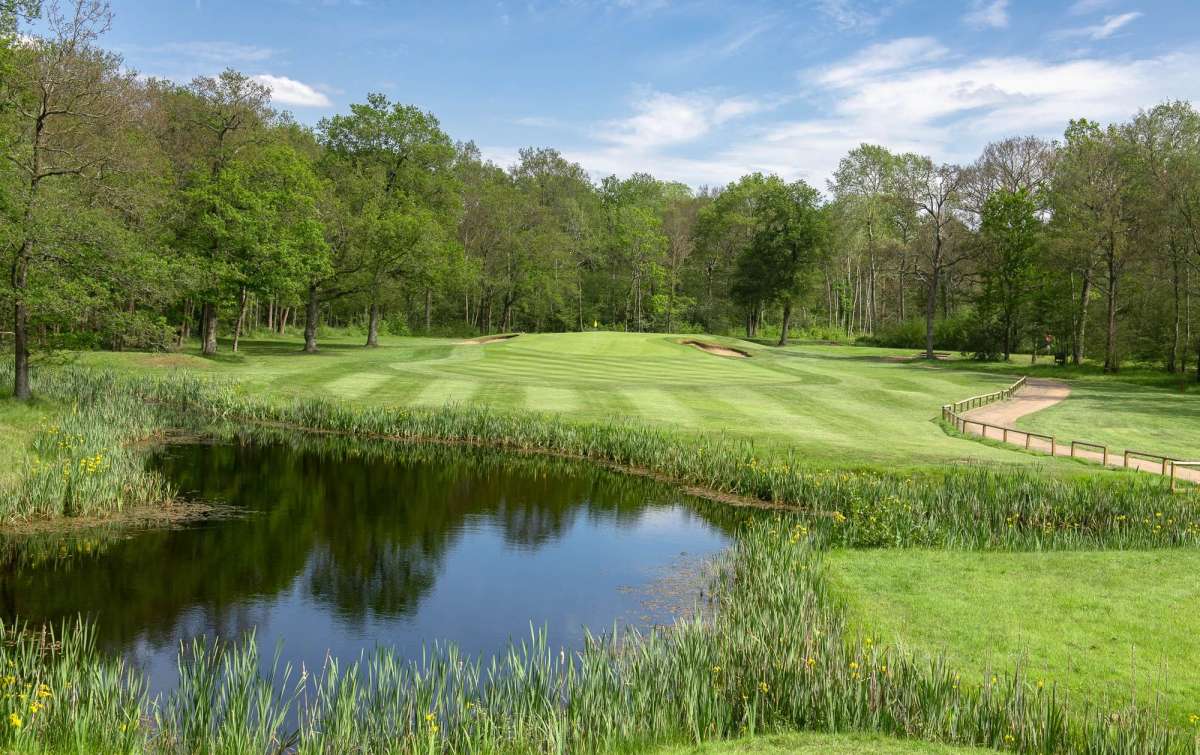
Opening up is a super 384-yard par four played from an elevated tee. A good drive will leave your tee shot at the bottom of a valley, your approach will then need to be struck steeply up the hill to an inviting green that waits patiently at the top. The 2nd hole is even better, a brutal 458-yard par 4, a blind drive over the brow of a hill will leave a tough approach shot from a hanging lie which must carry a stream on its way to a distant raised green. And so it goes on, with many more memorable holes, especially the par threes. In fact there isn’t a single weak hole here at St George’s Hill.
Tim Lobb was engaged by the club to produce a design policy report in 2015, after the architect had rebuilt the practice ground and created a new green for the short par four 6th on the Green nine. The report indicated the club had strayed from its Colt heritage, resulting in Lobb replacing the green on the 1st hole, restoring an original Colt bunker on the left side of the fairway and adding a new bunker on that side closer to the new green. Further bunker work (mainly to enlarge hazards and introduce peripheral heather) has since been carried out on another twelve holes.
In 2023, the Renaissance Golf Design firm, headed by Brian Schneider, was appointed to produce a new masterplan for all twenty-seven holes at the club.
Diamonds of the heather - golfing London’s heathland by Richard Smith I have had a long love affair with golf in Great Britain and Ireland. The recent Open championship at Royal Birkdale rekindled some of my earliest memories of links golf when I was watching Johnny Miller outduel a young Severiano Ballesteros in the 1976 Open at that famous golfing venue. I was fascinated by the completely different style of play that links golf offered and I developed a keen desire to play the game in “the old country”. I have been blessed down the years to have the opportunity to play most of the top links in GB&I, including all thirteen past and present Open venues. However, my experience with the many great inland courses has been limited. I was able to begin to sample the excitement and challenge of heathland golf several years ago when I combined a trip to the great links of Royal St. George’s, Prince's, Royal Cinque Ports and Rye with a trip to the southwest of London. I was able to play both the Old and New Courses at Walton Heath, St. George’s Hill, the Red and Blue courses at The Berkshire, and West Sussex in Pulborough. It was at that time I realized how much I had limited my experience by confining my trips to links courses. I found heathland golf to be a spectacular test. There were many of the challenges of links golf, including fast and firm running fairways and greens, but I loved the strategic brilliance of these courses and their natural beauty as they flowed through the ubiquitous heather and rolling terrain. I was keen for an opportunity to play more of this style of golf. As fate would have it, Ruth, my wonderful wife for over thirty years, rather bravely agreed to take up golf at a relatively late stage in life recently and this has opened up a lot of travel options for us. After some convincing, I got her to agree to accompany me on a tour of some of the great heathland courses. We based our trip out of Woking, which is a charming town about twenty-five miles to the southwest of London city centre. For international travellers, Woking is easily accessible from both Heathrow and Gatwick airports, although Heathrow is somewhat closer. It has a train station with direct access to Waterloo station in London, and is centrally located for a tour of the heathland courses in Surrey and the surrounding region. The town itself has a number of restaurants and shopping opportunities and there is good access to the major roads in the area. We were able to book a one-bedroom apartment through what is becoming one of my favourite services, Air BNB, and our trip began to take shape. For this visit, I was looking to play as many top heathland courses as possible within the space of a week and I was able to use the Top 100 ratings as a guide, as well as renowned golf course architect Tom Doak’s book The Confidential Guide To Golf Courses. Volume 1: Great Brian and Ireland. In addition, I was in contact with Top 100 editor-in-chief Keith Baxter. Between these resources, I was able to arrange our trip and secure tee times at all of the courses I wanted us to play. We left our home in Knoxville, Tennessee on a Friday afternoon and arrived at Heathrow around 10.00 am on the Saturday morning. After collecting our luggage, getting through customs, and picking up our rental car, we headed directly to our first test, the open and expansive course at Hankley Common Golf Club. We were well received at the pro shop and enjoyed a lovely lunch before heading out. Hankley is a fascinating course, set within a large sprawling property that looks like it could handle at least one other full-sized course and maybe more. There’s a feeling of open spaciousness here that is unique among the courses we played. The layout has some significant elevation changes, especially around holes 6 to 8, but overall the terrain is gentle and the course was not difficult to walk, even after jet lag from our overnight flight from the States. The course opens with a demanding par four of 422 yards, with a fairway guarded by bunkers on the right side and heather pinching in from the left. The next few holes loop back to the clubhouse with the 4th green adjacent to the clubhouse. Hole 4 is a great short par four. Two bunkers on the right of the fairway make choosing the correct club off the tee critical as the tee shot needs to hug these bunkers to open up the approach to the green. The green complex is probably the best on the course, with slopes off the front right and back left that demand a precise approach. Two excellent bunkers protect the green as well so that a par is well-earned, even though the hole only measures 327 yards. After hole 5, the course heads up to the high ground I mentioned earlier, and hole 7 is one of several great short holes on the course. The tee shot is played across a valley to a two-tiered green with a false front that adds to the difficulty and front bunkers are positioned to capture any ball that is poorly struck. Among the rest of the holes, the 11th is another excellent par three, measuring 216 yards from the white tees with run off slopes in front of and around the putting surface. Only a superbly struck shot will hold this green. There are a number of fine par fours coming in, including the uphill 14th and the intriguing short par four 15th. The 18th is well known as a tough finishing hole, and I certainly enjoyed getting up and down out of the deep grass hollow in front of the green. The course was playing hard and fast after the dry weather in the UK this year and truly had the feel of an inland links. The greens were beautiful and smooth. It’s a course that emphasizes position and precision rather than power due to the subtle doglegs. I liked Hankley a lot and the course would be a joy to play as a member. I used every club in my bag except my 3-hybrid, which to me is usually the sign of a fine layout. I think if the club added some diagonal cross hazards, as Tom Doak suggests, and also added some contour to a few of the flatter greens, then they would have a world-beater on their hands. As it is, playing Hankley is a lovely experience. Ruth enjoyed the course, especially the openings to the greens which allowed her to begin to experience the challenge of running the ball up to the green rather than flying everything to the hole. From the standard ladies tees there were a number of forced carries over heather that were hard for her to negotiate but a forward set of junior tees was available that she made use of several times. This was a great start to our trip. Sunday gave us a chance to rest and catch up on the time differential from the States while we prepared for our tee time in the afternoon at The Addington. After some hits and misses with our GPS on the road from Woking to Croydon, we finally made it to the clubhouse where we met Top 100 editor Jim McCann, who had flown down from Scotland, and editor-in-chief Keith Baxter, who had driven from his home in Devon to meet up with us. Keith and I had met and played together at Saunton two years ago, but this was the first time I met Jim, a delightful Scot with a wealth of knowledge and insight about golf courses in Great Britain and Ireland. Keith and Jim had played the 9-hole course at Reigate Heath that morning, but they were ready to play when we arrived, despite the unseasonably hot weather that day. The golf course at The Addington Golf Club is interesting, with an incredibly natural layout rolling through some fascinating terrain that architect J. F. Abercromby was able to use to create a unique and testing experience. The course has numerous twists and turns. As is the case with most of the heathland courses, it demands the ability to control your ball flight and direction to have the best chance to score well. There is a predominance of right to left holes and, with the fast running fairways from the dry hot summer, it was a challenge to choose and hit the right line off the tee to keep the ball in play. The course starts with a pretty average short, uphill par three, but quickly gets more difficult at the right doglegged par five 2nd and the long, slightly uphill, 210-yard par three 3rd hole. The first few holes are difficult, but the fun really begins at the short, left doglegged par four 6th. Short and to the right of the green lies what may be the deepest bunker I have ever seen, probably 15 to 20 feet deep. Hitting it in there would be a nightmare. Suffice to say, it’s the only bunker I’ve ever seen that has a bridge over it! Hole 7 is a great short par three, with absolute death to the right as the hole is defended with a steep slope of heather and a deep bunker as well. Hole 9 is a fascinating par four. The uphill tee shot is a layup as the hole veers sharply to the left, with a bunker protecting the left side of the approach to keep the player honest. The second shot is then played over an ocean of bracken to an upturned green defended only by the devilish slopes around it rather than bunkers – a “4” on the card here is a great score. Interest continues to build on the back nine. The 11th is a short par three to an island green surrounded by deep bunkers. The 12th is a unique hole that no modern architect would design. The hole is a short par five, measuring 486 yards from the white tees and plays downhill from the tee. The fairway runs out at 246 yards and there are steps in the middle at that point and a plateau landing area. From the plateau, it is about 210 yards back uphill to a sloped green with heather all along the left side of the hole up to the green. Somehow I was able to hit two hybrids here to reach the green in two and make a birdie but I’m not quite sure how I pulled this off! Hole 13 is probably the “signature hole” at The Addington, a 229-yard par three played over a valley to a green which falls off short and left of the putting surface, with the slope so severe the bunkers will actually save your ball from rolling into further danger. Of course, a bunker to the right removes any thought of a bail out, so it is simply a matter of bashing a 230-yard shot to a 15-yard wide green with no place else to go. Keith made a magnificent par here, nearly holing his chip from just short and left of the green. This a great hole and one of the most difficult par threes I’ve ever played. The remaining holes are all interesting and fun to play. From the 14th and 16th tee the skyline of the City of London is visible, which adds to the excitement of playing this course. I found The Addington to be a unique and fun experience. The course had suffered more than the others we played from the hot and dry conditions of that summer, however the greens and tees were in great shape and the brilliance of the layout was easy to see, especially from hole 6 onwards. Ruth enjoyed the course, but it was a little more difficult for her because of the difficulty of the approach shots. However, she had fewer forced carries over the heather off the tee so driving the ball was a little easier for her. All in all, it was a great experience to play here. Monday brought thirty-six holes with Jim and Keith. Our morning round was played at Worplesdon Golf Club, with the afternoon round at West Hill, as I began my tour of “the three Ws” (with Woking to come on Wednesday). Worplesdon was designed by Addington architect J.F. Abercromby, so I was very interested to see the difference between the two courses. At Worplesdon, the terrain is definitely gentler than The Addington. However, this makes it no less of a challenge and the course is a brilliant example of subtle strategic bunkering and the use of natural terrain to create a fun but challenging course. The course was playing hard and fast, as were all the courses we played, so the full strategic value of the course could be appreciated. Playing golf along the ground gives the architect the opportunity to challenge the golfer to the fullest. On almost every hole at Worplesdon the challenging line off the tee opens up the approach to the green. The greens were all sloped enough to further ask the player to accurately place the ball in the proper position in order to score well. The downhill 3rd exhibits these qualities well. An oblique cross bunker occupies the middle of the fairway, a fair distance off the tee, but the drive is downhill and fairways were running fast so the bunker is certainly in play for longer hitters. More importantly, the second shot plays downhill. The green is guarded by two closely placed bunkers on the right and two on the left. The putting surface is also significantly sloped from right to left so, in order to get the approach close, the drive must be positioned on the left of the fairway and the second shot has to come perilously close to the right bunkers to hold the proper line. This is a brilliant hole even though it is only 387 yards from the white tees. The 5th is another magnificent hole. The right side of this right doglegged hole is covered in heather, enticing the player to bite off as much as he dare. A deep fairway bunker to the left in the landing area complicates matters. Of course, the right side of the fairway opens up the approach to the green, which is not only guarded by the bunkers but by a hollow in the front of the green. This may be the best of many great holes on this course. The short par three 10th plays over a pond and offers a scenic break before crossing a busy road to an excellent stretch of holes. Hole 11 is a nice par five with well-placed bunkers. I was lying short in two about forty yards away. As I was contemplating my approach, Keith played his third up with a putter from fifty yards! Not to be outdone, I pulled out the flat stick and knocked it up to within five feet and made the putt for a birdie, which may have been the highlight of the trip for me. After crossing the road again, the finish is strong. The 16th is a wonderful uphill par three which is guarded by heather-trimmed bunkers and holes 17 and 18 are great strategic par fours along the lines of the holes I mentioned earlier. Worplesdon was a great surprise for me. I was expecting a fine course but this was better than I had imagined. The course offers strategic options on every hole. The greens were beautiful, true and fair. Ruth enjoyed the natural beauty of the course and the ability to run shots up to the greens. It did take her some time to realize that her 100-yard carry off the tee with her 4-hybrid would often turn into a 150-yard shot with the run, but she soon adjusted and enjoyed the challenge. She also cleared the pond on the 10th with her tee shot, which was her favourite shot of the day. The club has a great tradition of supporting women’s golf and we were accorded a fine welcome both before and after the round. Ruth took the afternoon off and caught a cab back to our apartment to watch the tennis at Wimbledon. Keith, Jim and I made our way over to West Hill, where we were joined by Gary, who is an old friend of Keith’s and a member of West Hill Golf Club. The day was quite hot, and I was feeling the heat a bit as we teed off. Although my early play was less than stellar, it was hard not to enjoy a course that was in great condition with the greens running fairly fast and the teeing areas in pristine shape. The course has undergone a massive tree removal project and, to date, over three thousand trees have been eliminated. The tree removal has opened up the course but it has not lessened the challenge due to the heather which tightly guards the fairways. The terrain of West Hill is generally very gentle and rolling although the 1st hole runs a bit downhill while the 18th has a nice uphill slope to it. This is a very pretty, natural course. The greens are subtle but were very hard for me to read. There were no bad holes and many outstanding ones. Hole 3 is a strong par four, doglegging slightly left and protected by a creek which flows obliquely across the fairway some fifty yards short of the green. There are no bunkers around the putting surface but a front to back and right to left slope makes the green hard to hold. The 5th is an interesting par five, with the heather pinching in about 275 yards from the white tees. It’s another forty yards to carry the heather, so the proper tee shot is to drive as close to the heather as possible. The second shot plays downhill, with two bunkers about thirty yards short of the green and two more guarding the front left and back right of the green, which also slopes from front to back. This is a great risk/reward par five. I loved the diagonal bunkers on hole 8, a slightly uphill par four measuring 410 yards. The player can challenge the bunkers or lay back and risk the longer shot in, making it a really strong, strategic hole. On hole 11, care needs to be taken not to run out of fairway while leaving the player a semi-blind uphill second shot. Drivable short par fours are all the rage in modern architecture and the 12th is a great example of this. The hole is only 280 yards long but it’s guarded by multiple deep bunkers and a huge slope in the green ,which is entirely appropriate for a hole of this length. The 18th is a fine finishing hole with a large central bunker about 275 yards off the tee and an uphill second shot to a sloping green. West Hill is a very enjoyable course to play in a beautiful setting. I thought the holes somewhat less strategic than Worplesdon and the greens protected by fewer bunkers than the other courses I had played. Nonetheless, this is a great course to play and loads of fun. I then bid farewell to Keith and Jim, who completed their mad dash of 99 holes in three days with another two rounds the following day at West Surrey and Camberley Heath. Tuesday was a break day for Ruth and I so we took the train into London and enjoyed a delightful day of sightseeing and visiting museums. It was the only day of the trip that it rained, and the added benefit of the weather front that came through was a slight cooling of the temperature, which made the rest of our trip quite pleasant. Refreshed by our day off, we headed to Woking Golf Club on the Wednesday. Woking was initially intended to be a club for lawyers but the club later opened its doors to other professions. Famous golf writer Bernard Darwin was a prominent member of the club for many years. Like many of the other heathland courses, Woking is removing trees to return the course to more of its heathland origins. There are still a large number of trees on the course but they really don’t impinge on play to any degree. Woking is a tough test of golf. The start is unique with a short 277-yard par four that runs downhill for the second half of the hole. I blew a driver about thirty yards over the green and somehow got up and down for a birdie start. The 2nd is a magnificent par three, played across a valley with a really tough left to right sloping green. The fairway bunkers at Woking offer the player both options and challenges, perhaps none better exhibited by the two bunkers in the middle of the 4th fairway. Do you challenge the right side of the fairway, bringing the railway and out of bounds into play, but giving yourself the open route to the green or do you play safe to the left of the bunkers and give up any chance at getting close to a middle or back left pin due to the tough bunker on the left side of the green? Holes 8 and 9 are two of the most challenging back-to-back holes I’ve ever come across. The 8th is a 432-yard par four, played slightly uphill to a green with significant slopes trying to pull your ball into the bunkers. The 9th is even harder, a left doglegged par four of 446 yards with a back to front sloping green. Hole 10 is a short par three where the fall off to the left of the green is so severe that any missed shots on that side will run down the hill into some miserable fescue. Two deep bunkers on the right prevent any bailout on this short hole. There are a number of strong par fours which follow, and then the renowned 14th. This is a right doglegged par five, 541-yards in length from the white tees. The green is quite slanted and the back edge of the putting surface probably sits ten yards from the clubhouse veranda. This certainly puts an element of fear into the approach shot since a skull coming in could put a number of people in danger! I was quite glad to wedge up and take par here. The last four holes are nice, with almost a parkland feel. Ponds guard the par three 16th, as well as the right of the approach to the 18th. There is certainly a severe slope to the home green and we played to a tight left pin on a plateau guarded by a huge tree. I found Woking to be perhaps the most difficult course that we played on the trip as it demands solid shot making and the greens were sloped and difficult for me to read. I really enjoyed the challenge here and I would look forward to taking this course on again. This was a tough course for Ruth as well, with a number of longer carries over heather. We made use of some of the junior tees and she was able to take advantage of this. Unfortunately, we never found the toilet out around the turn and I think Ruth is still mad at me about that! The question always seems to arise, “Which is the best of the three Ws?” I found Woking to be the most challenging, Worplesdon the most fun, and West Hill the prettiest. All were fantastic courses, and I think if you were to obtain a single membership and be able to play all three courses then you would be in heathland heaven. I’m glad I played all three and hope I can return to play them again. I have long wanted to play the famous courses at Sunningdale, and I had actually tried and failed to arrange a round there in the past. This time I was able to secure tee times on both the Old and New courses. I wanted to be well rested so I booked a caddy as well. Ruth was not quite up to playing here, but she agreed to walk with me for the first 18 before returning to Woking. We were met by my caddy, Max, shortly after our arrival and my warm up. Max advised us to head out and start the New course on the 11th at the halfway house to avoid several societies playing in front of us. This turned out to be the first of Max’s many great suggestions during the day as we were able to avoid any number of players and get around both courses in around six hours. I have to say that I have had a number of excellent caddies at clubs throughout Great Britain and Ireland, as well as the USA, but Max was the finest caddy I’ve ever had. Although only 27 years of age, he has caddied professionally and was able to figure out my game after about two holes and take me around both courses without any trouble. Max has a great knowledge of the game and consistently gave me great advice and good reads on the greens. In no small way he helped make this a magical day for me. We started at the 11th tee on the New course and played back around to finish on the 10th green. We took a quick drive back to the clubhouse and were able to jump off at the 1st on the Old course and play it in its normal sequence. I’m going to describe the New Course from the 1st hole forward, however, so you can get the proper feel for the layout. First of all, I think the New course is every bit the equal of the Old. Sunningdale is fortunate to have two outstanding courses designed by different architects that present different and interesting challenges. The New is a bigger, stronger course, while the Old is more subtle but no less challenging. I think any player getting to Sunningdale absolutely has to play both layouts. The New course starts with a hard, uphill par four, measuring more than 450 yards from the white tees. The left of the hole is guarded by out of bounds and a deep bunker defends the left of the green, with a run off slope protecting the right. This is a tough hole to begin the round. The 3rd exemplifies the challenge of the New. The drive calls for a slight fade to follow the contours of the hole while a draw is the proper play into a green that’s guarded by bunkers and run off slopes to the front and back of the putting surface. The 6th is a brilliantly designed short par five. A strong drive makes the hole reachable in two for longer hitters, but the fairway rises steeply to a green with an enormous slope to the front and difficult bunkers to the left and right. The par threes on the New are all outstanding. The 10th is a great downhill hole of about 200 yards, while the 14th and 17th are guarded by steep slopes and bunkers. Almost every hole has some movement so that the player with the ability to work the ball both right and left has a significant advantage here. There are no weak holes on the New course. The par fours all offer different challenges, whether it’s the blind tee shot to the sloping fairway on the 9th or the pond guarding the right of the fairway on the 15th. Hole 18 is a straightforward par five that offers a chance for a finishing birdie and a happy ending to the round. The Old course has hosted any number of major tournaments, including the Senior Open and the Women’s Open championship. Like the New, this is a course that rewards control and excellent ball striking. The Old is a fascinating mix of holes. The course offers several birdie opportunities at holes such as the relatively short par fives at the 1st and 14th, as well as short, drivable, or near-drivable, par fours at holes 3, 9 and 11. However, the short par five 1st is followed by the brutally long par four 2nd – in fact, from the blue tees, none of the par four holes (other than the aforementioned 3, 9 and 11) measure less than 400 yards, and many of them are significantly longer. The par four 5th is a great hole. The downhill tee shot is challenged by two bunkers to the right. Naturally, I drove right into the far bunker. Caddy Max made me take my medicine and pitch out of the bunker (with the lip and the pond just down the fairway there really was no other choice) and I rewarded his strategic advice by wedging it on the green and making par. The long par four 10th is probably the best hole on either course, playing all of 467 yards downhill from the white tees, with two fairway bunkers right and one left, then an uphill approach to a green that tilts markedly from back to front. This is a beautifully scenic and challenging hole. In keeping with the spirit of the New Course, the par threes on the Old are excellent. I especially liked the short uphill 4th and the long 15th, which allowed a draw in from the right to help feed the ball into the green. The finishing three holes at 16, 17 and 18 comprise a string of tough par fours that demand precise driving and accurate second shots to secure par. I can’t imagine there are two better golf courses at a private club in the world. There are two distinct and challenging courses that are beautiful, scenic and fun to play. The club was extremely welcoming. It was a great privilege to play here on a beautiful day with a world-class caddy to lead me around. This day was one of my most memorable experiences on a golf course in my entire life. Thanks to one at all at Sunningdale for such a wonderful day. Friday led us to Swinley Forest Golf Club, for me a golf course that’s shrouded in mystery. I kept wondering how a 6000-yard golf course could be so highly regarded but I knew we were in for something special when I parked and found that my Mercedes sedan rental car looked very pedestrian compared to the luxurious Ferrari I was next to. Originally, Swinley did measure just over 6,000 yards but new tees have been added which extend the course out to almost 6,400 yards. The changes are fairly recent, so much so that a new yardage book is in production and none were available for our use that day. Despite the added yardage, Swinley is still a relatively short course with the modern ball and equipment, but the challenges the course presents are timeless. The first three holes are fairly gentle par fours but the fun begins at the beautiful par three 4th, where the hole runs slightly uphill and is guarded by a fierce bunker to the left. The 5th offers the chance to cut off some distance across the dogleg but the opening to the green is better utilized from the longer, left side of the fairway. Hole 7 is a wonderful uphill par four with the tee shot challenged by diagonal heather mounds. The green cants steeply from back left to front right, presenting a real challenge to get close to the hole. The 8th is a great short par three which shows that swales around greens can offer as much of a challenge as any bunker. The steep fall away slope to the right makes for a difficult approach to secure par. The 10th is a fine left doglegged par four with a gentle decline off the tee then a slight uphill approach to the green. Hole 12 requires a glorious drive across a bank of heather which must be threaded between bunkers on the right and left. The 17th is another great one-shotter, with deep bunkers to the left and a steep slope on the right. Hole 18 is a nice uphill finishing hole with a fairly severe left to right tilting green. Swinley is a course that begs the player to manoeuvre the ball both right and left in order to play it to its fullest advantage. The greens are difficult, but very fair. A shot missed in the wrong position will cause the player no end of vexation. There are so many great approach shots that allow you a safe route in but challenge you to go for the pin. There is something very special here. The club was amazingly gracious and Ruth and I both enjoyed the course and the setting. Ruth enjoyed the course a lot as she had room to hit her drives and the opportunity to run the ball into the green. I think she enjoyed the short game challenges as well, especially her beautiful chip to two feet over the steep slope to the right on the 8th hole! Our last round was played at Hindhead Golf Club, which is situated only a few miles from where we had our first round at Hankley Common, but the courses are as different as night and day. Keith Baxter is a big fan of Hindhead and he arranged our game here. We had the great honour of playing with club Captain Mark Riley and club President Mrs. Ruth Hartley. Mark and Ruth were wonderful hosts and great playing companions and they helped provide a wealth of information about the course. Hindhead is a unique golf course in a glorious setting. The club pedigree includes Sherlock Holmes author, Sir Arthur Conan Doyle, as a founding member and the course requires all of a player’s wiles to negotiate it successfully. Without doubt, it is a tale of two nines. The front nine, beginning at the par five 2nd, plays through two glacial valleys. The first valley is entered from the 2nd tee, with the drive hit seemingly off the end of the earth to the deep valley below. The second shot is then played uphill to a green guarded by a severe slope in front and a massive drop off to the right. Hole 3 is a fine par three that turns down the valley. There are two strong bunkers to the right and another drop off on the left. Any shot missing the green will then make it tough to get up and down. The course continues down the valley on holes 4 and 5 before you walk across a ridge to the 6th and the second valley. Hole 6 is a short, downhill par three that’s guarded by a circle of bunkers on the sides of the green. Hole 8 is an uphill, almost doglegged, par three which plays all of 233 yards from the white tees. The front nine ends with the very difficult uphill par four 9th, which is guarded by a severely canted, back to front green. The inward half begins back on the plateau that the clubhouse and first hole is on. This nine is vintage heathland golf, with gentle downhill holes out to the 12th and then a return up the slope to the 16th. There are a number of fine holes here. I thought hole 12 was fascinating, with a cross hazard of rough and heather threatening the drive and a green guarded by a devilishly sharp drop off in front of the putting surface – it’s probably not a hole that a modern architect would design but great fun, nevertheless. Holes 17 and 18 provide a great finish. The 17th is a tight, left doglegged hole that’s defended on the left by a fall off down to trees and heather and the second shot must be judged correctly to prevent running out the downhill slope of the green. The 18th is defined by the beautiful cross bunkers in the fairway as well as great bunkering around the green. Out of bounds lurks to the right, adding more danger to an already difficult 441-yard par four closing hole. Hindhead was clearly the best conditioned course we played on our trip. I enjoyed the greens, which I would describe as almost Donald Ross-like, with gentle but distinct borrows that were difficult to read. Several times I completely misplayed the slopes and ran fifteen foot putts almost an equal distance past the hole! The course is about two thirds of the way through a massive bunker renovation program to improve both the aesthetics and drainage of the hazards. The bunker improvements look great, as well as making the sand hazards fair and playable. The club isn’t afraid to make improvements which have resulted in several tees being moved and new areas of heather planted. This is a fine golf course that was a joy to play. The valley holes are strong tests and, in a way, remind me of several holes on the somewhat underrated Cascades course at the Homestead Resort in Virginia. The back nine is classic heathland golf. The beautiful setting and challenging golf made this a fantastic end to our trip. Of all the courses we played, Hindhead was the most pleasant surprise and a great way to finish our week-long golfing excursion. After our round, we headed to Heathrow and spent the night at an airport hotel before flying back to the States on the Sunday. I’d been able to play nine rounds, while Ruth played six times. Every round was enjoyable, and we were very fortunate to catch good weather throughout the week. There had been a threat of rain at the beginning of our round at Hindhead but we only caught a few drops before staying dry the entire round. When I thought about the great courses I had played on this trip and the excellent courses that I played on my previous trip to the Surrey sand belt, I can’t think of any other place in the world where so many world-class golf courses lie within such a short radius of a major metropolitan area that is so easy to reach. Besides that, all of these courses are available for play and welcoming to visitors. Heathland golf offers a unique and distinct challenge for golfers of all skill levels. I know that most American golfers relate golf in Great Britain and Ireland to the links golf they see during the Open Championship, and for years I held much the same opinion. This trip confirmed to me that heathland golf matches up with the best inland courses anywhere in the world. These courses are all incredibly natural layouts that are fun to play and pleasing to the eye. They demand skill and strategy, rather than raw power. I imagine some golfers may look at a yardage of 6,000 to 6,500 yards and think that the course must be a walkover, yet all of these courses challenged every aspect of my game. My wife Ruth is a relative beginner, yet she never felt overwhelmed by these excellent courses. Some clubs have built newer forward tees to accommodate learner golfers and we were able to make use of these on several courses. We saw a number of female golfers throughout our visit and all the clubs were open and welcoming to us in every way. I would encourage anyone thinking of making a trip to the UK to consider making a similar tour to find out what heathland golf is all about. Richard Smith Knoxville, Tennessee
Diamonds are the heather - golfing London’s sandy heaths by Richard Smith I have had a long love affair with golf in Great Britain and Ireland. The recent Open championship at Royal Birkdale rekindled some of my earliest memories of links golf when I was watching Johnny Miller outduel a young Severiano Ballesteros in the 1976 Open at that famous golfing venue. I was fascinated by the completely different style of play that links golf offered and I developed a keen desire to play the game in “the old country”. I have been blessed down the years to have the opportunity to play most of the top links in GB&I, including all thirteen past and present Open venues. However, my experience with the many great inland courses has been limited. I was able to begin to sample the excitement and challenge of heathland golf several years ago when I combined a trip to the great links of Royal St. George’s, Princes, Royal Cinque Ports and Rye with a trip to the southwest of London. I was able to play both the Old and New Courses at Walton Heath, St. George’s Hill, the Red and Blue courses at The Berkshire, and West Sussex in Pulborough. It was at that time I realized how much I had limited my experience by confining my trips to links courses. I found heathland golf to be a spectacular challenge. There were many of the challenges of links golf, including fast and firm running fairways and greens, but I loved the strategic brilliance of these courses and their natural beauty as they flowed through the ubiquitous heather and rolling terrain. I was keen for an opportunity to play more of this style of golf. As fate would have it, Ruth, my wonderful wife for over thirty years, rather bravely agreed to take up golf at a relatively late stage in life recently and this has opened up a lot of travel options for us. After some convincing, I got her to agree to accompany me on a tour of some of the great heathland courses. We based our trip out of Woking, which is a charming town about twenty-five miles to the southwest of London city centre. For international travellers, Woking is easily accessible from both Heathrow and Gatwick airports, although Heathrow is somewhat closer. It has a train station with direct access to Waterloo station in London, and is centrally located for a tour of the heathland courses in Surrey and the surrounding region. The town itself has a number of restaurants and shopping opportunities and there is good access to the major roads in the area. We were able to book a one-bedroom apartment through what is becoming one of my favourite services, Air BNB, and our trip began to take shape. For this visit, I was looking to play as many top heathland courses as possible within the space of a week and I was able to use the Top 100 ratings as a guide, as well as renowned golf course architect Tom Doak’s book The Confidential Guide To Golf Courses. Volume 1: Great Brian and Ireland. In addition, I was in contact with Top 100 editor-in-chief Keith Baxter. Between these resources, I was able to arrange our trip and secure tee times at all of the courses I wanted us to play. We left our home in Knoxville, Tennessee on a Friday afternoon and arrived at Heathrow around 10.00 am on the Saturday morning. After collecting our luggage, getting through customs, and picking up our rental car, we headed directly to our first test, the open and expansive course at Hankley Common Golf Club. We were well received at the pro shop and enjoyed a lovely lunch before heading out. Hankley is a fascinating course, set within a large sprawling property that looks like it could handle at least one other full-sized course and maybe more. There’s a feeling of open spaciousness here that is unique among the courses we played. The layout has some significant elevation changes, especially around holes 6 to 8, but overall the terrain is gentle and the course was not difficult to walk, even after jet lag from our overnight flight from the States. The course opens with a demanding par four of 422 yards, with a fairway guarded by bunkers on the right side and heather pinching in from the left. The next few holes loop back to the clubhouse with the 4th green adjacent to the clubhouse. Hole 4 is a great short par four. Two bunkers on the right of the fairway make choosing the correct club off the tee critical as the tee shot needs to hug these bunkers to open up the approach to the green. The green complex is probably the best on the course, with slopes off the front right and back left that demand a precise approach. Two excellent bunkers protect the green as well so that a par is well-earned, even though the hole only measures 327 yards. After hole 5, the course heads up to the high ground I mentioned earlier, and hole 7 is one of several great short holes on the course. The tee shot is played across a valley to a two-tiered green with a false front that adds to the difficulty and front bunkers are positioned to capture any ball that is poorly struck. Among the rest of the holes, the 11th is another excellent par three, measuring 216 yards from the white tees with run off slopes in front of and around the putting surface. Only a superbly struck shot will hold this green. There are a number of fine par fours coming in, including the uphill 14th and the intriguing short par four 15th. The 18th is well known as a tough finishing hole, and I certainly enjoyed getting up and down out of the deep grass hollow in front of the green. The course was playing hard and fast after the dry weather in the UK this year and truly had the feel of an inland links. The greens were beautiful and smooth. It’s a course that emphasizes position and precision rather than power due to the subtle doglegs. I liked Hankley a lot and the course would be a joy to play as a member. I used every club in my bag except my 3-hybrid, which to me is usually the sign of a fine layout. I think if the club added some diagonal cross hazards, as Tom Doak suggests, and also added some contour to a few of the flatter greens, then they would have a world-beater on their hands. As it is, playing Hankley is a lovely experience. Ruth enjoyed the course, especially the openings to the greens which allowed her to begin to experience the challenge of running the ball up to the green rather than flying everything to the hole. From the standard ladies tees there were a number of forced carries over heather that were hard for her to negotiate but a forward set of junior tees was available that she made use of several times. This was a great start to our trip. Sunday gave us a chance to rest and catch up on the time differential from the States while we prepared for our tee time in the afternoon at The Addington. After some hits and misses with our GPS on the road from Woking to Croydon, we finally made it to the clubhouse where we met Top 100 editor Jim McCann, who had flown down from Scotland, and editor-in-chief Keith Baxter, who had driven from his home in Devon to meet up with us. Keith and I had met and played together at Saunton two years ago, but this was the first time I met Jim, a delightful Scot with a wealth of knowledge and insight about golf courses in Great Britain and Ireland. Keith and Jim had played the 9-hole course at Reigate Heath that morning, but they were ready to play when we arrived, despite the unseasonably hot weather that day. The golf course at The Addington Golf Club is interesting, with an incredibly natural layout rolling through some fascinating terrain that architect J. F. Abercromby was able to use to create a unique and testing experience. The course has numerous twists and turns. As is the case with most of the heathland courses, it demands the ability to control your ball flight and direction to have the best chance to score well. There is a predominance of right to left holes and, with the fast running fairways from the dry hot summer, it was a challenge to choose and hit the right line off the tee to keep the ball in play. The course starts with a pretty average short, uphill par three, but quickly gets more difficult at the right doglegged par five 2nd and the long, slightly uphill, 210-yard par three 3rd hole. The first few holes are difficult, but the fun really begins at the short, left doglegged par four 6th. Short and to the right of the green lies what may be the deepest bunker I have ever seen, probably 15 to 20 feet deep. Hitting it in there would be a nightmare. Suffice to say, it’s the only bunker I’ve ever seen that has a bridge over it! Hole 7 is a great short par three, with absolute death to the right as the hole is defended with a steep slope of heather and a deep bunker as well. Hole 9 is a fascinating par four. The uphill tee shot is a layup as the hole veers sharply to the left, with a bunker protecting the left side of the approach to keep the player honest. The second shot is then played over an ocean of bracken to an upturned green defended only by the devilish slopes around it rather than bunkers – a “4” on the card here is a great score. Interest continues to build on the back nine. The 11th is a short par three to an island green surrounded by deep bunkers. The 12th is a unique hole that no modern architect would design. The hole is a short par five, measuring 486 yards from the white tees and plays downhill from the tee. The fairway runs out at 246 yards and there are steps in the middle that point and a plateau landing area. From the plateau, it is about 210 yards back uphill to a sloped green with heather all along the left side of the hole up to the green. Somehow I was able to hit two hybrids here to reach the green in two and make a birdie but I’m not quite sure how I pulled this off! Hole 13 is probably the “signature hole” at The Addington, a 229-yard par three played over a valley to a green which falls off short and left of the putting surface, with the slope so severe the bunkers will actually save your ball from rolling into further danger. Of course, a bunker to the right removes any thought of a bail out, so it is simply a matter of bashing a 230-yard shot to a 15-yard wide green with no place else to go. Keith made a magnificent par here, nearly holing his chip from just short and left of the green. This a great hole and one of the most difficult par threes I’ve ever played. The remaining holes are all interesting and fun to play. From the 14th and 16th tee the skyline of the City of London is visible, which adds to the excitement of playing this course. I found The Addington to be a unique and fun experience. The course had suffered more than the others we played from the hot and dry conditions of that summer, however the greens and tees were in great shape and the brilliance of the layout was easy to see, especially from hole 6 onwards. Ruth enjoyed the course, but it was a little more difficult for her because of the difficulty of the approach shots. However, she had fewer forced carries over the heather off the tee so driving the ball was a little easier for her. All in all, it was a great experience to play here. Monday brought thirty-six holes with Jim and Keith. Our morning round was played at Worplesdon Golf Club, with the afternoon round at West Hill, as I began my tour of “the three Ws” (with Woking to come on Wednesday). Worplesdon was designed by Addington architect J.F. Abercromby, so I was very interested to see the difference between the two courses. At Worplesdon, the terrain is definitely gentler than The Addington. However, this makes it no less of a challenge and the course is a brilliant example of subtle strategic bunkering and the use of natural terrain to create a fun but challenging course. The course was playing hard and fast, as were all the courses we played, so the full strategic value of the course could be appreciated. Playing golf along the ground gives the architect the opportunity to challenge the golfer to the fullest. On almost every hole at Worplesdon the challenging line off the tee opens up the approach to the green. The greens were all sloped enough to further challenge the player to accurately place the ball in the proper position in order to score well. The downhill 3rd exhibits these qualities well. An oblique cross bunker occupies the middle of the fairway, a fair distance off the tee, but the drive is downhill and fairways were running fast so the bunker is certainly in play for longer hitters. More importantly, the second shot plays downhill. The green is guarded by two closely placed bunkers on the right and two on the left. The putting surface is also significantly sloped from right to left so, in order to get the approach close, the drive must be positioned on the left of the fairway and the second shot has to come perilously close to the right bunkers to hold the proper line. This is a brilliant hole even though it is only 387 yards from the white tees. The 5th is another magnificent hole. The right side of this right doglegged hole is covered in heather, challenging the player to bite off as much as he dare. A deep fairway bunker to the left in the landing area complicates matters. Of course, the right side of the fairway opens up the approach to the green, which is not only guarded by the bunkers but by a hollow in the front of the green. This may be the best of many great holes on this course. The short par three 10th plays over a pond and offers a scenic break before crossing a busy road to an excellent stretch of holes. Hole 11 is a nice par five with well-placed bunkers. I was lying short in two about forty yards away. As I was contemplating my approach, Keith played his third up with a putter from fifty yards! Not to be outdone, I pulled out the flat stick and knocked it up to within five feet and made the putt for a birdie, which may have been the highlight of the trip for me. After crossing the road again, the finish is strong. The 16th is a wonderful uphill par three which is guarded by heather-trimmed bunkers and holes 17 and 18 are great strategic par fours along the lines of the holes I mentioned earlier. Worplesdon was a great surprise for me. I was expecting a fine course but this was better than I had imagined. The course offers strategic options on every hole. The greens were beautiful, true and fair. Ruth enjoyed the natural beauty of the course and the ability to run shots up to the greens. It did take her some time to realize that her 100-yard carry off the tee with her 4-hybrid would often turn into a 150-yard shot with the run, but she soon adjusted and enjoyed the challenge. She also cleared the pond on the 10th with her tee shot, which was her favourite shot of the day. The club has a great tradition of supporting women’s golf and we were accorded a fine welcome both before and after the round. Ruth took the afternoon off and caught a cab back to our apartment to watch the tennis at Wimbledon. Keith, Jim and I made our way over to West Hill, where we were joined by Gary, who is an old friend of Keith’s and a member of West Hill Golf Club. The day was quite hot, and I was feeling the heat a bit as we teed off. Although my early play was less than stellar, it was hard not to enjoy a course that was in great condition with the greens running fairly fast and the teeing areas in pristine shape. The course has undergone a massive tree removal project and, to date, over three thousand trees have been eliminated. The tree removal has opened up the course but it has not lessened the challenge due to the heather which tightly guards the fairways. The terrain of West Hill is generally very gentle and rolling although the 1st hole runs a bit downhill while the 18th has a nice uphill slope to it. This is a very pretty, natural course. The greens are subtle but were very hard for me to read. There were no bad holes and many outstanding ones. Hole 3 is a strong par four, doglegging slightly left and protected by a creek which flows obliquely across the fairway some fifty yards short of the green. There are no bunkers around the putting surface but a front to back and right to left slope makes the green hard to hold. The 5th is an interesting par five, with the heather pinching in about 275 yards from the white tees. It’s another forty yards to carry the heather, so the proper tee shot is to drive as close to the heather as possible. The second shot plays downhill, with two bunkers about thirty yards short of the green and two more guarding the front left and back right of the green, which also slopes from front to back. This is a great risk/reward par five. I loved the diagonal bunkers on hole 8, a slightly uphill par four measuring 410 yards. The player can challenge the bunkers or lay back and risk the longer shot in, making it a really strong, strategic hole. On hole 11, care needs to be taken not to run out of fairway while leaving the player a semi-blind uphill second shot. Drivable short par fours are all the rage in modern architecture and the 12th is a great example of this. The hole is only 280 yards long but it’s guarded by multiple deep bunkers and a huge slope in the green ,which is entirely appropriate for a hole of this length. The 18th is a fine finishing hole with a large central bunker about 275 yards off the tee and an uphill second shot to a sloping green. West Hill is a very enjoyable course to play in a beautiful setting. I thought the holes somewhat less strategic than Worplesdon and the greens protected by fewer bunkers than the other courses I had played. Nonetheless, this is a great course to play and loads of fun. I then bid farewell to Keith and Jim, who completed their mad dash of 99 holes in three days with another two rounds the following day at West Surrey and Camberley Heath. Tuesday was a break day for Ruth and I so we took the train into London and enjoyed an enjoyable day of sightseeing and visiting museums. It was the only day of the trip that it rained, and the added benefit of the weather front that came through was a slight cooling of the temperature, which made the rest of our trip quite pleasant. Refreshed by our day off, we headed to Woking Golf Club on the Wednesday. Woking was initially intended to be a club for lawyers but the club later opened its doors to other professions. Famous golf writer Bernard Darwin was a prominent member of the club for many years. Like many of the other heathland courses, Woking is removing trees to return the course to more of its heathland origins. There are still a large number of trees on the course but they really don’t impinge on play to any degree. Woking is a tough test of golf. The start is unique with a short 277-yard par four that runs downhill for the second half of the hole. I blew a driver about thirty yards over the green and somehow got up and down for a birdie start. The 2nd is a magnificent par three, played across a valley with a really tough left to right sloping green. The fairway bunkers at Woking offer the player both options and challenges, perhaps none better exhibited by the two bunkers in the middle of the 4th fairway. Do you challenge the right side of the fairway, bringing the railway and out of bounds into play, but giving yourself the open route to the green or do you play safe to the left of the bunkers and give up any chance at getting close to a middle or back left pin due to the tough bunker on the left side of the green? Holes 8 and 9 are two of the most challenging back-to-back holes I’ve ever come across. The 8th is a 432-yard par four, played slightly uphill to a green with significant slopes trying to pull your ball into the bunkers. The 9th is even harder, a left doglegged par four of 446 yards with a back to front sloping green. Hole 10 is a short par three where the fall off to the left of the green is so severe that any missed shots on that side will run down the hill into some miserable fescue. Two deep bunkers on the right prevent any bailout on this short hole. There are a number of strong par fours which follow, and then the renowned 14th. This is a right doglegged par five, 541-yards in length from the white tees. The green is quite slanted and the back edge of the putting surface probably sits ten yards from the clubhouse veranda. This certainly puts an element of fear into the approach shot since a skull coming in could put a number of people in danger! I was quite glad to wedge up and take par here. The last four holes are nice, with almost a parkland feel. Ponds guard the par three 16th, as well as the right of the approach to the 18th. There is certainly a severe slope to the home green and we played to a tight left pin on a plateau guarded by a huge tree. I found Woking to be perhaps the most difficult course that we played on the trip as it demands solid shot making and the greens were sloped and difficult for me to read. I really enjoyed the challenge here and I would look forward to taking this course on again. This was a tough course for Ruth as well, with a number of longer carries over heather. We made use of some of the junior tees and she was able to take advantage of this. Unfortunately, we never found the toilet out around the turn and I think Ruth is still mad at me about that! The question always seems to arise, “Which is the best of the three Ws?” I found Woking to be the most challenging, Worplesdon the most fun, and West Hill the prettiest. All were fantastic courses, and I think if you were to obtain a single membership and be able to play all three courses then you would be in heathland heaven. I’m glad I played all three and hope I can return to play them again. I have long wanted to play the famous courses at Sunningdale, and I had actually tried and failed to arrange a round there in the past. This time I was able to secure tee times on both the Old and New courses. I wanted to be well rested so I booked a caddy as well. Ruth was not quite up to playing here, but she agreed to walk with me for the first 18 before returning to Woking. We were met by my caddy, Max, shortly after our arrival and my warm up. Max advised us to head out and start the New course on the 11th at the halfway house to avoid several societies playing in front of us. This turned out to be the first of Max’s many great suggestions during the day as we were able to avoid any number of players and get around both courses in around six hours. I have to say that I have had a number of excellent caddies at clubs throughout Great Britain and Ireland, as well as the USA, but Max was the finest caddy I’ve ever had. Although only 27 years of age, he has caddied professionally and was able to figure out my game after about two holes and take me around both courses without any trouble. Max has a great knowledge of the game and consistently gave me great advice and good reads on the greens. In no small way he helped make this a magical day for me. We started at the 11th tee on the New course and played back around to finish on the 10th green. We took a quick drive back to the clubhouse and were able to jump off at the 1st on the Old course and play it in its normal sequence. I’m going to describe the New Course from the 1st hole forward, however, so you can get the proper feel for the layout. First of all, I think the New course is every bit the equal of the Old. Sunningdale is fortunate to have two outstanding courses designed by different architects that present different and interesting challenges. The New is a bigger, stronger course, while the Old is more subtle but no less challenging. I think any player getting to Sunningdale absolutely has to play both layouts. The New course starts with a hard, uphill par four, measuring more than 450 yards from the white tees. The left of the hole is guarded by out of bounds and a deep bunker guards the left of the green, with a run off slope protecting the right. This is a tough hole to begin the round. The 3rd exemplifies the challenge of the New. The drive calls for a slight fade to follow the contours of the hole while a draw is the proper play into a green that’s guarded by bunkers and run off slopes to the front and back of the putting surface. The 6th is a brilliantly designed short par five. A strong drive makes the hole reachable in two for longer hitters, but the fairway rises steeply to a green with an enormous slope to the front and difficult bunkers to the left and right. The par threes on the New are all outstanding. The 10th is a great downhill hole of about 200 yards, while the 14th and 17th are guarded by steep slopes and bunkers. Almost every hole has some movement so that the player with the ability to work the ball both right and left has a significant advantage here. There are no weak holes on the New course. The par fours all offer different challenges, whether it’s the blind tee shot to the sloping fairway on the 9th or the pond guarding the right of the fairway on the 15th. Hole 8 is a straightforward par five that offers a chance for a finishing birdie and a happy ending to the round. The Old course has hosted any number of major tournaments, including the Senior Open and the Women’s Open championship. Like the New, this is a course that rewards control and excellent ball striking. The Old is a fascinating mix of holes. The course offers several birdie opportunities at holes such as the relatively short par fives at the 1st and 14th, as well as short, drivable, or near-drivable, par fours at holes 3, 9 and 11. However, the short par five 1st is followed by the brutally long par four 2nd – in fact, from the blue tees, none of the par four holes (other than the aforementioned 3, 9 and 11) measure less than 400 yards, and many of them are significantly longer. The par four 5th is a great hole. The downhill tee shot is challenged by two bunkers to the right. Naturally, I drove right into the far bunker. Caddy Max made me take my medicine and pitch out of the bunker (with the lip and the pond just down the fairway there really was no other choice) and I rewarded his strategic advice by wedging it on the green and making par. The long par four 10th is probably the best hole on either course, playing all of 467 yards downhill from the white tees, with two fairway bunkers right and one left, then an uphill approach to a green that tilts markedly from back to front. This is a beautifully scenic and challenging hole. In keeping with the spirit of the New Course, the par threes on the Old are excellent. I especially liked the short uphill 4th and the long 15th, which allowed a draw in from the right to help feed the ball into the green. The finishing three holes at 16, 17 and 18 comprise a string of tough par fours that demand precise driving and accurate second shots to secure par. I can’t imagine there are two better golf courses at a private club in the world. There are two distinct and challenging courses that are beautiful, scenic and fun to play. The club was extremely welcoming. It was a great privilege to play here on a beautiful day with a world-class caddy to lead me around. This day was one of my most memorable experiences on a golf course in my entire life. Thanks to one at all at Sunningdale for such a wonderful day. Friday led us to Swinley Forest Golf Club, for me a golf course that’s shrouded in mystery. I kept wondering how a 6000-yard golf course could be so highly regarded but I knew we were in for something special when I parked and found that my Mercedes sedan rental car looked very pedestrian compared to the luxurious Ferrari I was next to. Originally, Swinley did measure just over 6000 yards but new tees have been added which extend the course out to almost 6400 yards. The changes are fairly recent, so much so that a new yardage book is in production and none were available for our use that day. Despite the added yardage, Swinley is still a relatively short course with the modern ball and equipment, but the challenges the course presents are timeless. The first three holes are fairly gentle par fours but the fun begins at the beautiful par three 4th, where the hole runs slightly uphill and is guarded by a fierce bunker to the left. The 5th offers the chance to cut off some distance across the dogleg but the opening to the green is better utilized from the longer, left side of the fairway. Hole 7 is a wonderful uphill par four with the tee shot challenged by diagonal heather mounds. The green cants steeply from back left to front right, presenting a real challenge to get close to the hole. The 8th is a great short par three which shows that swales around greens can offer as much of a challenge as any bunker. The steep fall away slope to the right makes for a difficult approach to secure par. The 10th is a fine left doglegged par four with a gentle decline off the tee then a slight uphill approach to the green. Hole 12 requires a glorious drive across a bank of heather which must be threaded between bunkers on the right and left. The 17th is another great one-shotter, with deep bunkers to the left and a steep slope on the right. Hole 18 is a nice uphill finishing hole with a fairly severe left to right tilting green. Swinley is a course that begs the player to manoeuvre the ball both right and left in order to play it to its fullest advantage. The greens are difficult, but very fair. A shot missed in the wrong position will cause the player no end of vexation. There are so many great approach shots that allow you a safe route in but challenge you to go for the pin. There is something very special here. The club was amazingly gracious and Ruth and I both enjoyed the course and the setting. Ruth enjoyed the course a lot as she had room to hit her drives and the opportunity to run the ball into the green. I think she enjoyed the short game challenges as well, especially her beautiful chip to two feet over the steep slope to the right on the 8th hole! Our last round was played at Hindhead Golf Club, which is situated only a few miles from where we had our first round at Hankley Common, but the courses are as different as night and day. Keith Baxter is a big fan of Hindhead and he arranged our game here. We had the great honour of playing with club Captain Mark Riley and club President Mrs. Ruth Hartley. Mark and Ruth were wonderful hosts and great playing companions and they helped provide a wealth of information about the course. Hindhead is a unique golf course in a glorious setting. The club pedigree includes Sherlock Holmes author, Sir Arthur Conan Doyle, as a founding member and the course requires all of a player’s wiles to negotiate it successfully. Without doubt, it is a tale of two nines. The front nine, beginning at the par five 2nd, plays through two glacial valleys. The first valley is entered from the 2nd tee, with the drive hit seemingly off the end of the earth to the deep valley below. The second shot is then played uphill to a green guarded by a severe slope in front and a massive drop off to the right. Hole 3 is a fine par three that turns down the valley. There are two strong bunkers to the right and another drop off on the left. Any shot missing the green will then make it tough to get up and down. The course continues down the valley on holes 4 and 5 before you walk across a ridge to the 6th and the second valley. Hole 6 is a short, downhill par three that’s guarded by a circle of bunkers on the sides of the green. Hole 8 is an uphill, almost doglegged, par three which plays all of 233 yards from the white tees. The front nine ends with the very difficult uphill par four 9th, which is guarded by a severely canted, back to front green. The inward half begins back on the plateau that the clubhouse and first hole is on. This nine is vintage heathland golf, with gentle downhill holes out to the 12th and then a return up the slope to the 16th. There are a number of fine holes here. I thought hole 12 was fascinating, with a cross hazard of rough and heather threatening the drive and a green guarded by a devilishly sharp drop off in front of the putting surface – it’s probably not a hole that a modern architect would design but great fun, nevertheless. Holes 17 and 18 provide a great finish. The 17th is a tight, left doglegged hole that’s defended on the left by a fall off down to trees and heather and the second shot must be judged correctly to prevent running out the downhill slope of the green. The 18th is defined by the beautiful cross bunkers in the fairway as well as great bunkering around the green. Out of bounds lurks to the right, adding more danger to an already difficult 441-yard par four closing hole. Hindhead was clearly the best conditioned course we played on our trip. I enjoyed the greens, which I would describe as almost Donald Ross-like, with gentle but distinct borrows that were difficult to read. Several times I completely misplayed the slopes and ran fifteen foot putts almost an equal distance past the hole! The course is about two thirds of the way through a massive bunker renovation program to improve both the aesthetics and drainage of the hazards. The bunker improvements look great, as well as making the sand hazards fair and playable. The club isn’t afraid to make improvements which have resulted in several tees being moved and new areas of heather planted. This is a fine golf course that was a joy to play. The valley holes are strong tests and, in a way, remind me of several holes on the somewhat underrated Cascades course at the Homestead Resort in Virginia. The back nine is classic heathland golf. The beautiful setting and challenging golf made this a fantastic end to our trip. Of all the courses we played, Hindhead was the most pleasant surprise and a great way to finish our week-long golfing excursion. After our round, we headed to Heathrow and spent the night at an airport hotel before flying back to the States on the Sunday. I’d been able to play nine rounds, while Ruth played six times. Every round was enjoyable, and we were very fortunate to catch good weather throughout the week. There had been a threat of rain at the beginning of our round at Hindhead but we only caught a few drops before staying dry the entire round. When I thought about the great courses I had played on this trip and the excellent courses that I played on my previous trip to the Surrey sand belt, I can’t think of any other place in the world where so many world-class golf courses lie within such a short radius of a major metropolitan area that is so easy to reach. Besides that, all of these courses are available for play and welcoming to visitors. Heathland golf offers a unique and distinct challenge for golfers of all skill levels. I know that most American golfers relate golf in Great Britain and Ireland to the links golf they see during the Open Championship, and for years I held much the same opinion. This trip confirmed to me that heathland golf matches up with the best inland courses anywhere in the world. These courses are all incredibly natural layouts that are fun to play and pleasing to the eye. They demand skill and strategy, rather than raw power. I imagine some golfers may look at a yardage of 6,000 to 6,500 yards and think that the course must be a walkover, yet all of these courses challenged every aspect of my game. My wife Ruth is a relative beginner, yet she never felt overwhelmed by these excellent courses. Some clubs have built newer forward tees to accommodate learner golfers and we were able to make use of these on several courses. We saw a number of female golfers throughout our visit and all the clubs were open and welcoming to us in every way. I would encourage anyone thinking of making a trip to the UK to consider making a similar tour to find out what heathland golf is all about. Richard Smith Knoxville, Tennessee

South East England - Top 50 Golf Courses 2017 This release for England’s South East is the seventh and final update that will inform our upcoming English Top 100 rankings. The South East region is where you’ll find the nation’s largest swathe of heathland, where there is seemingly an infinite number of classic heathery courses from which to choose. There’s also a trio of Open Championship venues in this region (one current and two former), and it’s the venerable Royal St George’s that heads our inaugural South East Top 50 table. England’s South East region incorporates the counties of Berkshire, Buckinghamshire, Hampshire, Kent, Middlesex, Oxfordshire, Surrey and Sussex. It’s the most densely populated of England’s nine “official” regions where more than eight and a half million people reside. Their golfing needs are served by approximately 475 golf clubs in this region. Selecting the best 10% for our inaugural Top 50 was surprisingly easy because the vast majority are already ranked nationally in our England Top 100. Our new South East regional Top 50 features six World Top 100 ranked courses, twenty-four layouts that are currently ranked in our GB&I hundred, and forty-four that are listed in our current English Top 100. The South East is undeniably the strongest golfing region in England – whichever way you care to analyse it. Underpinning Royal St George’s (#1), the Old course at Sunningdale Golf Club (#2) and its younger sibling the New (#3) are the two premier heathland courses in the country. Many well-travelled golfers believe that Sunningdale is the best 36-hole golf club in the world. Richard Smith, one of our respected reviewers, played here in July: “A day at Sunningdale is a treat to treasure. This is great golf in a beautiful setting on courses oozing with history. This was one of the great golfing days in my life to play the Old and New together.” Swinley Forest (#4) is Harry Colt’s “least bad course” and it’s enjoying a renaissance following the addition of new back tees, which now stretch the layout to around 6,400 yards from the tips. Richard Smith commented as follows: “My first impression after finishing was that this was the hardest 6,400- yard course I had ever played… Swinley is a course that absolutely demands precision and the ability to work the ball in all directions. Every shot needs to be thought and played with a purpose. I think the thing that elevates Swinley to the highest level is a combination of the strategic options available on each shot and the testing greens and approaches.” St George’s Hill (#5) is another outstanding Harry Colt layout which is still vastly underrated by some publications. It has featured in our World Top 100 for a number of years now and its place in that esteemed list is really well deserved. Walton Heath’s Old course (#6) does tend to divide opinion somewhat and its detractors tend to complain about the holes around the turn – which had to be altered to accommodate London’s M25 orbital motorway – but the Old is perhaps the most authentic heathland layout in the South East, where the tangly heather is at its most tenacious. West Sussex (#7) at Pulborough is one of my personal heathland favourites and Bernard Darwin described it as “a little sandy jewel set in the Sussex clay”. It’s considered to be too short by modern standards and maybe it’s one par five away from magnificence, however, along with Rye, it’s one of the toughest par 68s I’ve ever played and holding a score together on the back nine is easier said than done. Talking of brutal homeward nines, few come much tougher than the backside at Royal Cinque Ports (#8) in Deal. Despite its Open pedigree, the rumpled and crumpled links at Sandwich overshadows Deal, but the greensites at Royal Cinque Ports are every bit as good as its more illustrious regal near neighbour. The West course at Wentworth (#9) has been through some tough times in the last decade or so. We did wonder whether lost love would ever return to Virginia Water’s West course – The rise and fall of the troubled Burma Road. We teed it up on the West a couple of weeks ago and the improvements are stark. There is no doubt that the recent multi-million pound revamp, which included creeping bent re-seeding and installation of sub-air greens, has made a marked difference. Retuning the course back to the old Harry Colt design has not only pleased us, but also many of the Tour players – and the work is not yet finished. Further improvements will be undertaken over this coming winter in readiness for next spring’s BMW PGA Championship. Shhh naysayers. Nobody could possibly accuse the Berkshire’s Red course (#10) of being dull. Its exciting 6-6-6 routing keeps you on your toes and there’s only one consecutive pair of holes with the same par values at the back-to-back short par fours (11 and 12) and both these holes are set magnificently on the higher ground. The Old course at Rye (#11) was Harry Colt’s inaugural design where the routing has been altered and improved down the years by several architects, including Tom Simpson and Sir Guy Campbell. Many wonder why Rye is not a permanent feature in the World Top 100, others think – rather like West Sussex – that it’s missing a strong enough mix of holes. Queenwood (#12) is the course that David McLay Kidd built for the club’s small but perfectly formed membership and their very fortunate friends. With probably the best tee to green grooming in England, Queenwood is where many top players hone their game. In the words of Fergal O’Leary: “Expect to feel like a king off the course, and then be challenged like a PGA Tour professional the minute you step on the first tee.” According to Tom Doak, Hankley Common (#13) “provokes mixed emotions; if the strategy ever matched the setting, you could have a world beater.” Undeniably a most enjoyable element of the course is the majesty of the situation, which is quiet and genteel in the classical English mould. Woking (#14) for some is already a world beater and it was here where a few golf mad barristers, with the help of Tom Dunn, created the first experimental heathland layout in 1893. Worplesdon (#15) is perhaps the prettiest of Surrey’s trinity of “Ws” and it was John Abercromby’s inaugural design that dates back to 1908 with the greens and bunkers constructed by Willie Park Junior. Little has changed here after more than 100 years. The East course at Wentworth (#16) was the first course Harry Colt built at Virginia Water. It has remained largely untouched since it was laid out two years before the second unofficial matches between American and British professionals were staged here in 1926, one year prior to the inauguration of the Ryder Cup. Hindhead (#17) has come on in leaps and bounds in the last decade and it’s now one of the premier courses in Surrey thanks to a plethora of subtle modifications and a step change in greenkeeping standards. It’s one of the most memorable courses in the county. West Hill (#18) is the third member of the trio of W’s and it too has improved markedly in the last few years. A massive tree-clearing programme has now completed, creating more width and enabling an already heathery layout to flourish. The Addington (#19) has been underrated for a while now, largely due to tree encroachment which is gradually being addressed. However, there’s no denying the course’s dramatic, tumbling topography that takes golfers on a wild and exciting ride under the watchful gaze of the London city skyline. The Blue course at The Berkshire (#20) is the Red’s understudy. Ed Battye, the founder of Golf Empire, reckons that “the run of holes from the 11th onwards are really what define the Blue… They are all energetic holes and there is more going on over this closing stretch than what has gone before it.” Our first South East Top 50 features courses in the 21-50 range that we’d happily play every week. The undeniable quality and quantity of golf on offer in this region is second to none in the British Isles. It doesn’t make sense to mention every layout here, but we feature each one prominently within our Top 100 web pages. However, we’ll mention a few South East courses that have pleasantly surprised us recently. These have flown under the radar and we think they are worthy of highlighting. Knole Park (#42) has yet to appear within our English Top 100, but that will change very soon. This 1924 John Abercromby design is laid out within an enormous 1,000-acre estate and it’s a thrilling layout which plays firm and fast over an old deer park where fallow deer still roam freely today. We should perhaps pay closer attention to the writings of Bernard Darwin who, in 1925, wrote the following passage in The Golf Courses of Great Britain: [Knole Park] “is still very new, but I think, when it is a little older, few, if any, park courses will be better. Certainly none will be prettier. There are the loveliest holes down winding forest glades, full of romantic possibilities…” Royal Wimbledon (#43) is another club that has perennially missed out on a national ranking position, although in 2008 it did make a brief appearance in our English Top 100. The club really couldn’t care less whether or not their course is ranked, such is their indifference to ratings, however, anyone can play here by following simple protocol. Those that have teed it up at this Harry Colt-touched heathland cum parkland track delight at Colt’s signature par threes. Piltdown (#47) is yet another club in this region that is investing heavily in its primary asset, the golf course. We were very impressed when we played here on two separate occasions recently. Just like its neighbour on the other side of Ashdown Forest, Piltdown is bunkerless, and the absence of sand traps somehow play trickery with distances. It’s a charming course that doesn’t have strong architectural provenance but it’s a solid layout nonetheless. Brokenhurst Manor (#49) is set in the heart of the New Forest and it’s another unsung Harry Colt design which is unusually configured in three returning 6-hole loops. As is often the case with Colt layouts, the stars of the show are the one-shotters which look longer than they actually play, but there are plenty of other solid holes throughout the card. There’s undeniably a heathland look and feel to the entire layout but with a distinct lack of heather which the club is trying to introduce in places. Despite a tree-clearing programme, there’s an opportunity to open the site up further. Farnham (#50) has languished for too long in the lower reaches of our Surrey Best In County rankings. A recent visit to the club proved how important it is to regularly re-play courses. Located in a charming village called The Sands, Farnham is half parkland and half heathland. The course starts and ends on the flatter, parkland ground, and the holes in between are routed across the heathery ground where the land movement is more stirring. Some of these sandy holes would grace any Top 100 heathland course. We played the new and ultra-exclusive David McLay Kidd and Tom Watson co-design at Beaverbrook Golf Club earlier this year and felt it has great potential, but we decided not to list it in our Surrey Best In County rankings this time, largely due to insufficient votes. Finally for those eagle-eyed observers, we’ve extended our Kent Best In County rankings from a Top 25 to a Top 30. We decided there were a number of solid courses in this golf rich county deserving credit. South East England - Top 50 Golf Courses 2017 Rank/ Click the following links to see in detail our latest Best In County rankings for the eight South East England counties: Berkshire Top 15 Golf Courses 2017 Buckinghamshire Top 10 Golf Courses 2017 Hampshire Top 20 Golf Courses 2017 Kent Top 30 Golf Courses 2017 Middlesex Top 10 Golf Courses 2017 Oxfordshire Top 10 Golf Courses 2017 Surrey Top 40 Golf Courses 2017 Sussex Top 20 Golf Courses 2017 Keith Baxter Top 100 Golf Courses
The latest ranking of the Top 100 Golf Courses in the World serves as the ultimate global golf bucket list. Most members of our World Top 100 Panel are seasoned golfers, each playing 20-30 of these courses annually while travelling extensively over decades to form their opinions on others. We recognise that opinions vary—even among our panel members. Rankings are subjective, and there are undoubtedly 50 or more courses in the UK and USA alone that could easily fit onto this list. Links Golf Pilgrimages The rankings
Montana, United States
Nova Scotia, Canada
England, United Kingdom
Zuid-Holland, Netherlands
Wisconsin, United States