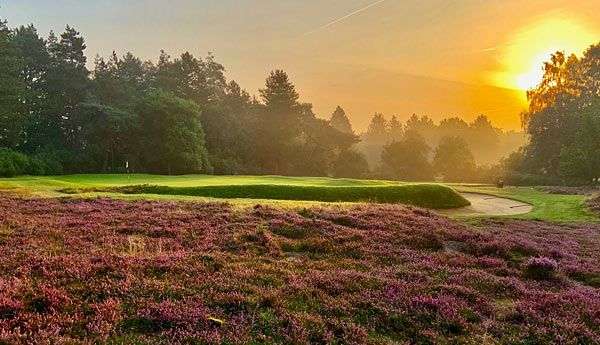
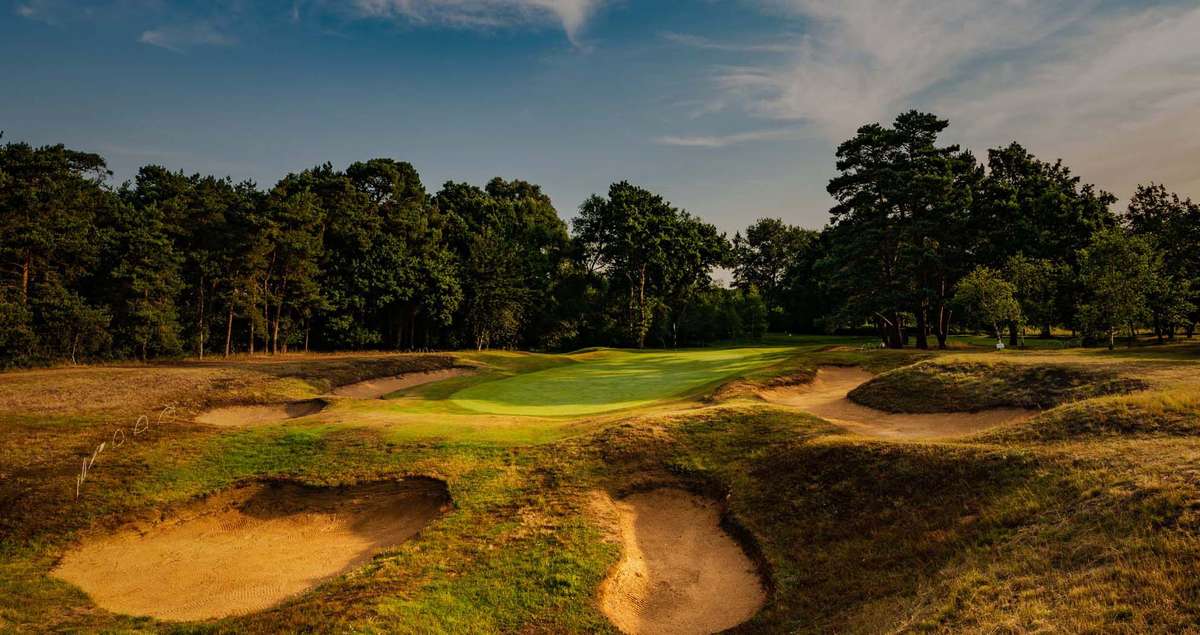
Laid out on sandy soil within the Breckland Forest amongst pine, oak and birch, Thetford Golf Club is not only a wonderful place to play golf but also it’s a serious challenge.
Laid out on sandy soil within the Breckland Forest amongst pine, oak and birch, Thetford Golf Club is not only a wonderful place to play golf but also it’s a serious challenge.
Thetford Golf Club
Thetford Golf Club was founded in 1912 and Charles H. Mayo designed the original 6,000-yard course. James Braid made later changes to the layout and further updates were subsequently implemented by Philip Mackenzie Ross.
“Thetford is situated in the Brecklands, an area of sandy soil, and was once far more heathland in type and more abounding with rabbits than it is today.” Wrote Peter Alliss in The Good Golf Guide. It has large areas of heather, gorse and broom but belts of trees – birch oak and pine – now separate one hole from another and have become strategic features governing the right line for the tee shot on many holes.”
According to the club history: “The course was constructed on an open sandy heath known as Thetford Warren, which as the name suggests, was land used to breed rabbits for their fur and meat. After the First World War the Forestry Commission planted extensive pine trees on the surrounding land now know as Thetford Forest. At the time it was the largest man made forest in the country. From being a heathland course it has gradually become a forest course.”
The construction of a new Thetford bypass resulted in significant changes to the course. Five original holes were lost and five new longer holes were fashioned by Cameron Sinclair and Donald Steel. Today’s layout stretches to more than 6,800 yards from the tips.
“You begin with the challenge of quite a long par three,” continues Peter Alliss, “over a valley to a terraced green. Heather is a feature here, and at many later holes. The 5th is a particularly good par four, with a tee shot played over a wide valley with tree, bunkers and an old chalk pit very much in play. The undulating green is just over the brow of a hill, and falls away to the left.”
Thetford is not as well known as some other East Anglia courses located on the North Sea coast, but it should not be missed if planning a golfing trip to this quiet corner of rural England.
The latest ranking of the Top 100 Golf Courses in the World serves as the ultimate global golf bucket list. Most members of our World Top 100 Panel are seasoned golfers, each playing 20-30 of these courses annually while travelling extensively over decades to form their opinions on others. We recognise that opinions vary—even among our panel members. Rankings are subjective, and there are undoubtedly 50 or more courses in the UK and USA alone that could easily fit onto this list. Links Golf Pilgrimages The rankings
California, United States
New Jersey, United States
Northern Ireland, United Kingdom
New York, United States
New York, United States
Royal Cromer Golf Club, Cromer, Norfolk, England Click any of the large images to return to the main Royal Cromer page All photographs courtesy of Royal Cromer Golf Club 14th hole 18th hole 1st and 18th holes 6th hole 14th tee 1st tee 8th hole to the left 7th hole 16th hole

East England, or East Anglia, is one of the most underappreciated golf destinations in the country. From the wild tidal links of North Norfolk to the Golden Age parkland of the Hertfordshire Chilterns, the region spans a remarkable breadth of golf experience across six counties. The rankings across Bedfordshire, Cambridgeshire, Essex, Hertfordshire, Norfolk and Suffolk span well over 100 courses, ranging from genuine national-calibre venues to thriving county clubs that reward the travelling golfer. See the East of England (East Anglia) Rankings What gives East England its appeal is the sheer variety on offer. Norfolk and Suffolk deliver heathland and links golf in equal measure. Hertfordshire punches well above its weight with an extraordinary concentration of Golden Age architecture. Essex presents some of the best parkland courses within an hour of London. Best Golf Courses at a Glance Norfolk Royal West Norfolk Golf Club holds its position as the county's finest course, as it has done for generations. Designed by Holcombe Ingleby in 1892, this tidal links at Brancaster is one of golf's most singular experiences. The clubhouse becomes an island at high tide, and both the 8th and 9th holes are subject to the sea. Few courses in England are more authentic or more demanding in wind. Hunstanton Golf Club holds second place, and remains the most accessible of Norfolk's elite links. With a history of hosting major amateur events including the Brabazon Trophy and the British Amateur, Hunstanton is not merely a county course but a venue of national standing. James Braid was among those to shape its layout, and Martin Hawtree has overseen recent improvements. Sheringham Golf Club sits third, its clifftop setting on the North Norfolk coast providing views that match almost anything in British golf. Royal Cromer Golf Club follows at fourth, another clifftop course with championship heritage and a loyal following among links purists. Royal Norwich completes the top five. Movement within the Norfolk rankings sees Thetford Golf Club rise to sixth, ahead of King's Lynn Golf Club, which slips one place to seventh. Great Yarmouth & Caister holds eighth, Eaton ninth, and Barnham Broom (Valley) rounds out the Norfolk top ten. Suffolk Suffolk's rankings see notable movement at the top, with Aldeburgh Golf Club (Championship) rising to first. Founded in 1884, Aldeburgh is one of England's oldest heathland courses and carries one of the finest architectural lineages in the region — original layouts by Willie Fernie and John Thompson were refined by Willie Park Junior and J.H. Taylor, then further shaped by Harry Colt and C.H. Alison in the 1920s. Mackenzie & Ebert are currently overseeing a significant programme of improvements. With its deep sleeper-faced bunkers and gorse-lined corridors along the Alde estuary, Aldeburgh is as demanding as it is beautiful. Ipswich Golf Club (Purdis Heath) drops to second from its previous top position. Royal Worlington & Newmarket Golf Club holds third, its nine-hole layout on the Breckland heaths widely regarded as one of the finest short courses in the world. Woodbridge Golf Club (Heath) is fourth. Flempton rises to fifth from seventh, one of Suffolk's notable movers in this cycle. Thorpeness Golf Club drops two places to sixth. Bury St Edmunds holds seventh, while Felixstowe Ferry Golf Club (Martello) drops two to eighth. Stowmarket holds ninth and Bungay & Waveney Valley completes the Suffolk top ten. Hertfordshire Ashridge leads the county, as it consistently has. Designed by Major C.K. Hutchison, Sir Guy Campbell and Colonel S.V. Hotchkin and opened in 1932, with further refinements from Tom Simpson, Ashridge sits within the National Trust's Chiltern Hills estate and is regularly cited by architects including Tom Doak as one of the finest parkland courses in Britain. Henry Cotton was club professional here when he won the 1937 Open at Carnoustie. Few clubs in Hertfordshire can match its combination of architectural pedigree and natural setting. The Grove holds second. Berkhamsted rises one place to third — its unique layout without artificial bunkers, shaped in part by Harry Colt and James Braid, remains one of the more distinctive tests in the south of England. Moor Park (High) drops to fourth. Centurion holds fifth. Cambridgeshire Gog Magog (Old) heads the county, a position it has occupied since the club was established in 1901 on the chalky hills south of Cambridge. Willie Park Junior advised on early bunkering, James Braid later made modifications, and Mackenzie & Ebert have overseen recent bunker restoration work on both courses. Gog Magog (Wandlebury) rises to second, ahead of Saffron Walden Golf Club, which drops from second to third. Links Golf Club – Newmarket holds fourth. The most significant development in Cambridgeshire is the debut of Peterborough Milton at fifth — a new entry that reflects an expanded geographic boundary for this ranking cycle and a broader view of the county's playing landscape. Essex Thorndon Park Golf Club leads Essex, holding the top spot with Orsett Golf Club second and Chelmsford Golf Club third. Chigwell Golf Club holds fourth while Abridge Golf Club rises one place to fifth. Bedfordshire John O'Gaunt Golf Club (John O'Gaunt) leads Bedfordshire, with Dunstable Downs Golf Club second and Aspley Guise & Woburn Sands third. Millbrook Golf Club holds fourth and Bedfordshire (Championship) fifth. All five positions are unchanged from the previous ranking. It is also worth noting that Luton Hoo, previously listed in the county rankings, is now closed for renovations. What the Rankings Tell Us Norfolk's Links Duopoly Royal West Norfolk and Hunstanton represent something rare in English golf — two courses within a few miles of each other that would hold their own in any company on the British Isles. The North Norfolk coast from Brancaster to Hunstanton is as compelling a short stretch of links golf as exists in England, and both clubs maintain strict traditions that preserve the spirit of the game as much as the architecture. Suffolk's Architectural Heritage Aldeburgh's move to the top of the Suffolk rankings is a reflection of the ongoing investment in its Championship Course. The Colt and Alison connection — two of Golden Age architecture's most influential figures — provides a foundation that few English heathland courses can rival. With Mackenzie & Ebert's programme of improvements now well advanced and in play for 2026, Aldeburgh is increasingly recognised beyond East Anglia as a course of genuine national significance. Hertfordshire's Golden Age Density Ashridge, Berkhamsted, Sandy Lodge and Porters Park all carry Golden Age credentials within a relatively compact area of west Hertfordshire. The involvement of Hutchison, Campbell, Hotchkin and Tom Simpson at Ashridge, and Colt and Braid at Berkhamsted, means that golfers exploring this part of the county are playing on ground shaped by the most influential architects of the early twentieth century. Cambridgeshire's Expanding Footprint The arrival of Peterborough Milton in the Cambridgeshire rankings reflects a wider trend across the 2025–2026 cycle, as geographic boundaries are revisited to better represent county-wide depth. The Gog Magog complex south of Cambridge continues to anchor the county, with ongoing restoration work by Mackenzie & Ebert ensuring both the Old and Wandlebury courses maintain their position among the best in the east of England. Planning Your East England Golf Trip The natural starting point for any visit is the North Norfolk coast. Royal West Norfolk at Brancaster and Hunstanton are within a short drive of each other, and a two-day visit combining both — with an afternoon at Sheringham or Royal Cromer on the second day — makes for one of the most rewarding short breaks in English golf. The narrow roads, flint-walled villages and tidal marshland give the experience a character unlike anywhere else in the country. See the East of England (East Anglia) Rankings Suffolk rewards those who venture slightly further. Aldeburgh is a natural anchor for a Suffolk trip, pairing well with the unique nine-hole experience at Royal Worlington & Newmarket, Woodbridge and Thorpeness. Aldeburgh is a good base for accommodation, with the wider coastal landscape of the Suffolk Heritage Coast providing things to see and do for a multi-day stay. Hertfordshire is most naturally combined with a visit to the wider London commuter belt. Ashridge is the centrepiece, but Berkhamsted, Moor Park and Centurion are all within easy reach, making the western Hertfordshire stretch a viable destination for golfers based in London. For golfers looking to cover the whole region, a logical route might run from Hertfordshire northward through Cambridgeshire to the Norfolk coast, before cutting south through Suffolk on the return. Six counties, more than 100 ranked courses, and a range of golf terrain that would satisfy most tastes several times over.

Top 10 Golf Courses in Norfolk 2015 Norfolk Best In County rankings updated Norfolk is best known to many as the flat, low lying county in eastern England where The Broads form a network of navigable, lock-free rivers and canals, providing many with a wide variety of leisure pursuits, from those “messing about on boats” to “twitchers” searching for rare birds among the many acres of wetlands. Sandringham is perhaps the most famous stately home in Norfolk and this 8,000-hectare country retreat is a much loved home of the Royal family. Travel a few miles to the north of Sandringham and you’ll arrive at Hunstanton, where the golf gets rather good. Seven miles to the east of Hunstanton you’ll find Brancaster where the golf is even better. Royal West Norfolk and Hunstanton are jewels in the crown of Norfolk golf and both (while very different links experiences) are not only friendly rivals, but also golfing household names. Keep heading eastwards along the coast and you’ll come to Sheringham Golf Club where there’s a fine cliff edge course that’s often incorrectly labelled as a links. Its next-door neighbour, Royal Cromer, is also perched on the cliffs and these two clubs share a similar rivalry to that of Hunstanton and Brancaster. Norfolk rivalry continues inland at King’s Lynn and Thetford where these two forest courses vie for prominence. As far as ranking positions are concerned, there’s not a lot to choose between these three pairs of very different courses. Brancaster edges Hunstanton, not in terms of playing difficulty, but by quintessential charm. The gap between Sheringham and Cromer has recently narrowed but the former remains marginally ahead in our 2015 Norfolk Best In County rankings. King’s Lynn swaps places with Thetford this time round, but once again the gap was remarkably close and both these courses genuinely deserve wider recognition. Further down the table, Great Yarmouth & Caister stays in 7th spot, while local rivals Eaton and Royal Norwich swap places, with Eaton moving up to 8th position. Things are currently on hold for Royal Norwich as the club is planning to relocate from Hellesdon to Weston Park (which re-enters our Norfolk rankings in position number 10 at the expense of Wensum Valley). The idea is that European Golf Design’s Ross McMurray will refashion the course at Weston Park, which will eventually become the home ground for both clubs. To see our new 2015 Norfolk Top 10, click the link. If you have played golf extensively across any English county and would like to have your say, please contact me (keith@top100golfcourses.com). In the meanwhile a big thank you to everyone who contributed to our Norfolk Best In County ranking process. Keith Baxter Editor-in-Chief Top 100 Golf Courses