
Review of the Month October 2019 – Trump Turnberry (Ailsa)

There are perhaps ten golf courses that are in the discussion of the best golf course in the world: Augusta National, Cypress Point, Pine Valley, Shinnecock Hills, Royal County Down, Royal Portrush, Royal Melbourne West, St Andrews Old, Pebble Beach and Trump Turnberry.
Sure, there are a few others that some might add, perhaps Royal Birkdale, Ballybunion Old, Sand Hills, National Golf Links… but among the people with whom I have played or architects it is those ten that generate the most discussion.
I played Turnberry Ailsa several times before it became Trump Turnberry. It was terrific before and now it is fabulous. The recent redesign substantially strengthened the holes along the water although perhaps one hole was made weaker. The hole made weaker was perhaps my favorite hole before.

The first hole with the added length (50-90 yards) and new location as well as the new green on the first is substantially improved. This used to be a pretty easy hole and now it can be difficult if you do not find the fairway or are not a long hitter.
The third hole remains a long par four with 100 yards separating the pro tee and the member tee. The green has been strengthened by adding a bunker to the left.
The fourth hole remains a very good par 4 playing relatively close to the Firth of Clyde. This begins eight holes along the coast. It is a substantially more difficult hole with trouble in front of the green.
The fifth hole used to be my favorite, a long par 4 of 479 yards from the back tees sweeping slightly to the left while going uphill. Now it is a relatively simple par 5 of 500 yards from the member tee. It is well bunkered getting to the green which is one of the better greens on the golf course with a fair amount of slope.
The sixth hole, a par three heading back at the Firth is a short par three that has been substantially shortened and two of the bunkers on the left side has been removed. It used to play 222-231 yards and now plays 138-171 yards. Overall it is easier.
The 7th hole, a par five at the top of the dune has been lengthened with one bunker being removed that was unnecessary. It feels like the hole is more of a dogleg than before but that might be my imagination. This hole is incredibly fun to play.
The biggest changes to the golf course come now. The 9th used to be a difficult tee shot on this longer par 4 with a semi-blind tee shot and no bunkers. It has been replaced with an incredible par 3 of 190-250 yards over the rocks to a green that tilts right to left and has bunkers to either side. The view here is arguably the best in golf of the rocks, the Firth and the lighthouse. As good as the 9th previously was, this is a significant improvement to the golf course.
The tenth hole was also one of the better holes on the golf course, set along the Firth and a par 4 of 447-457 yards which required a precise tee shot to avoid the two bunkers in the fairway and one bunker right. There was a large bunker in front of the green. Now the hole has an awesome view from any of the seven tee boxes playing as a par five of 496 to 565 yards. It is stunningly beautiful. If I had one criticism of the new hole, it is that without wind it is far too easy for even medium long hitters, who easily reach the green in two with a mid iron as the fairway is very downhill. Long hitters can easily reach the bunkers that cross the fairway as their tee shots can go 400 yards or more due to the speed of the fairway. It does have a smallish green as its defense that you can only miss short, as there is gorse right and out of bounds back and left. Overall it is a more visually perfect hole but not as difficult as before.
I actually own an oil painting of the previous 11th hole, a par 3 of 160-175 yards set against the base of a hill, fronted by two bunkers. The par 3 has been replaced with a new par 3 of 178-215 yards and is much more difficult. Both holes are at the mercy of the wind. I have hit driver here before and never made it to the green such was the wind.
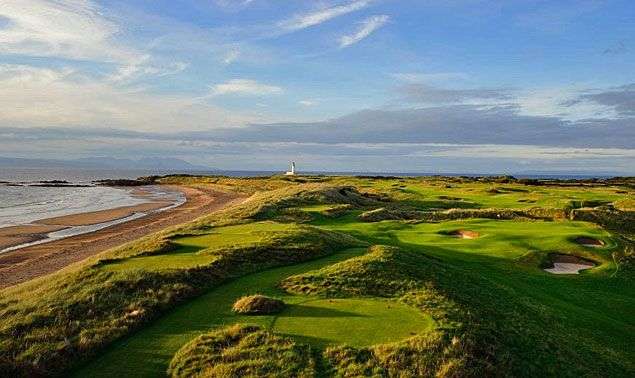
From here on in, the changes are more subtle although there are two big ones left.
The 14th was a longer par 4 and was merely above average. It is now a very strong par five of 500-570 yards playing uphill. You must avoid the large bunkers either side of the fairway on your drive, as you play uphill to the putting surface. This hole has one of the trickiest greens on the course. In fact, playing in from the previous hole begins the stretch of the more difficult greens.
The last major change was changing the 17th from a very good par 5 of 500-560 yards where you felt like you were hitting down into a canyon with the second shot threading through the canyon to a green set well above you. It still has the same canyon feeling as a par 4 of 450-510 yards but only on the tee shot. I find the green to be easier to hit as there used to be four bunkers and now there are only two. The green is tilted more than it looks so a putt can quickly get away from you.
Trump Turnberry Ailsa is an amazing golf course. The views from the clubhouse are excellent. The views from the hotel are even better. It has great food and a comfortable place to eat. It has a very large pro shop and fabulous locker room.
The golf course, however, is the star of the property no matter how excellent the hotel, spa, and clubhouse are (I have stayed there many times). It deserves to be in the discussion of the finest golf course in the world, it is that good. It is arguably the best test of golf for an Open Championship with perhaps only Carnoustie as a worthy discussion. Every time I play here I wish I could play more golf here the next day.
Review of the Month October 2019 selected by Editor-in-Chief, Keith Baxter, and sponsored by TaylorMade – click to read more about Trump Turnberry Ailsa.
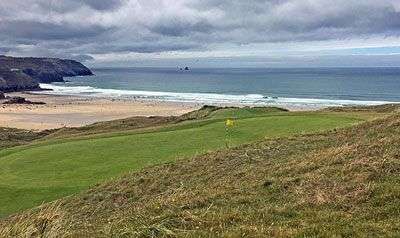
Review of the Month August 2020 – Perranporth "Do you like Marmite?" I was asked the question in the professional’s shop before our debut round on the links at Perranporth which we were warned we would love or hate. Indeed, on our week in Cornwall, almost every golfer we have encountered has warned us of the blind shots and the inevitability of losing several balls. In the pro's shop, I was advised that I would amass no better than mid to late 20 Stableford points even if I was having a good day. Thus, I was rather chipper to have walked off the 18th with 35 and finish with the ball with which I started. This was all the more surprising because the mist which rolled in during our second nine was so thick we could barely see the flag on the par 3 16th and had to take provisional balls off the 17th tee, even though it transpired we had hit straight down the middle. From the opening shot on the 1st hole, down to a green framed by the backdrop of the seaside town which lends the links its name, Perranporth, is a delight. Yes, there are many blind tee shots but straight play is rewarded and the slopes are not as dramatic as many seaside tracks we have played. The hallmark of Perranporth is its scenery – particularly in the front nine when the beach comes into view on most of the holes. I was a particular fan of the 2nd – a par five with two blind shots before a green on the cliff edge. Then there are the many raised greens, including the dramatic ninth and startling 11th. To be honest, I have played on truer greens. These were pretty slow and flatter than most courses we have played on our Top 100 quest. And this isn't a long course – I'm a moderate hitter and regularly found my way to greens in regulation. But it is fun because it encapsulates the ups and downs of links golf. Do I like Marmite? Apparently, I do. Neil White Review of the Month August 2020 selected by Editor-in-Chief, Keith Baxter, and sponsored by TaylorMade – click to read more about Perranporth. Photos courtesy of Neil White.
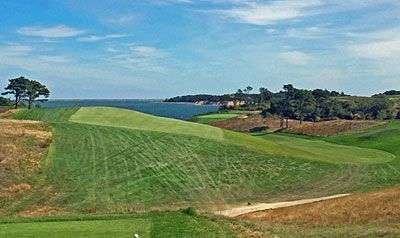
Review of the Month July 2020 – Eastward Ho! Cape Cod was formed by a glacial retreat of ice thousands of years ago, and the resulting extreme land movement left on parts of the Cape, including that which Eastward Ho! sits on, highlights how some rare plots of pure fun golf property can only be found, rather than built. Herbert Fowler took full advantage of the roller coaster land movement when designing the course, where lines of charm are on nearly every par 4 and 5 and one leaves the course feeling that there are a bunch of holes at Eastward Ho! unlike any other one has seen or played before, especially in the U.S. You can disregard the yardages on your scorecard here, as elevation changes, wind, and some fun quirk make this course play more challenging and longer in length than you would think. I cannot imagine anyone trying to build an argument around any single hole here being a “weak” one, but a few favorite ones that continue to linger in memory are 3, 4, 6, 7, 8, 14, 15, and 18. Each one of these holes can be played numerous different ways, and depending on the wind, you might have to play one of 4-5 different clubs for your approach shot on any given day. #3 is one of the best short par 4s I have ever played. Off the tee, you can either play a driver, hybrid, or a 4-6 iron off the tee and potentially end up anywhere from a bump-and-run shot up on to the green to a 150 yard approach. You might have a better view and look at the green from further away and have better odds of finding the fairway if you lay up, but you will have the navigate the wind more and anything right or long of the green is dead. These risk-reward decisions are constant through your round and keep a player thinking. #4 is an outstanding par 3 that is often deceiving in distance due to the wind, as you are right along the water, and due to the hump in front of the green that looks like it is right up against the green but it actually about 30 yards short. Most pin placements will require an uphill putt, making this hole also feel longer than the yardage might indicate. #6 has a fairway unlike any other you have ever seen, with a massive hill carved into it that will repel most balls down and to the right side of the fairway, leaving one with a challenging uphill short iron in to an elevated green that, if you do not hit and hold, you could be left with a delicate short chip/flop shot to a green 15 feet above you. One can play their approach shots from other areas, though there are considerations to this tactic. You can play a slightly shorter tee shot and keep it left, leaving you with a more clear and visible look at the pin but from further out. You can also push your drive to the right in to the #5 fairway and also potentially have a very clean look at the flag with a short iron, though you run the risk of having your ball end up in the rough, making it harder to hold an elevated green upon your approach. Another incredible two shot hole. #7 is a great uphill par 3. The wind will typically help most balls left, and if one misses the green far to the left, they are down the fairway funnel of #6 and have a very uphill second shot to hit to try to find the green and save par. The wind and elevation require choosing the right club and likely striking a pure mid-iron to find the green. #8 is another excellent short par 4 hole where one can take a few different tactics to make par. The further you hit your tee shot, the closer you are to the green, but the flag will be less visible as you get closer as the fairway slumps down before coming back up to a green that is on the same level as the tee. The further you go down the fairway, the more that bunkers on the left that cut into the center of the fairway come into play as well. Longer hitters who choose driver from an elevated tee will find themselves either right in front of a bunker and a blind approach shot, or in the bunker and a blind approach shot. While only a 100-120 yards will remain, one will not feel fully confident of their line here. The right side of the fairway does have a maybe 10 yard wide landing area where you have good visibility of your approach with a wedge, but one needs to thread a needle and also hit it 290 yards or more to find this reward of an approach. Players who lay up and land their ball in the fairway before it dips down into the aforementioned gathering area will have a mid-iron approach shot but will be able to see the flag fully. Anything past the flag will leave a slippery downhill putt. #14 is another superb short par 4. Play your drive up the right side and hope for a slight draw, where you can catch a slope to propel your ball another 30 yards or more for a short wedge in to a green. While your tee shot is not as exposed to the wind, leaving you to feel confident ripping a driver, your approach shot to the green will likely be quite exposed to the wind and may be a downhill shot wedge/short-iron, which keeps the hole exciting and requires one to really think about club selection and the angle you want to take. #15 is a signature hole, and while all of the par 3s at Eastward Ho! are outstanding, this is the best one. The hole runs along the bay and wind is a huge factor. I played this hole twice in the same day and hit 9-iron in the morning and 5-iron from the same tee in the late afternoon. A front pin, especially when windy, is a perfect challenge. Go long, and you have a slick downhill putt. Fall short of the green, and you have a challenging sand shot or chip from the rough with little green to work with to get up and down. The yardage on the scorecard is meaningless on this hole, and a pure shot is required off the tee. #18 is an outstanding finisher and a long par 4. Shot shape off the tee is critical. The fairway shapes right to left, with a huge downhill shoot that longer hitters can catch before heading back uphill for their approach. A shorter drive that stays right will leave a long iron and hard angle to the green, but those who can draw the ball and stay left center of the fairway can get another 40-50 yards of roll and leave them with, depending on the wind, a 7-iron to a 9-iron approach shot in to an elevated green. Eastward Ho! is a perfectly well conditioned and fun course to play, because on any given day, it can play like a completely different course. If you get the opportunity to play here, drop everything and make your way to the Cape. Steven Kennedy Review of the Month July 2020 selected by Editor-in-Chief, Keith Baxter, and sponsored by TaylorMade – click to read more about Eastward Ho!.
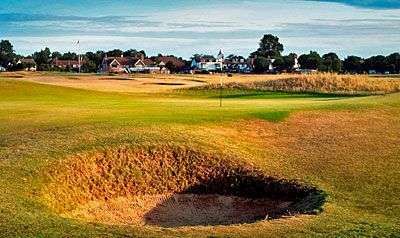
Review of the Month January 2019 – Littlestone (Championship) Littlestone Golf Club is a challenging but enjoyable links course. From a perspective of a ten-year-old golfer, playing from the yellow tees, I think the opening shots off the tee were mostly challenging. The first is a nice par 4 to open with but it gets more and more difficult as you go along for instance the 2nd green is surrounded by two large mounds about 50 yards from the green and there is a burn as well which makes a tough approach to the green. This is a fun course to play but as I played it I noticed that the front nine is easier than the back nine. I thoroughly enjoyed the experience and would 100% recommend people who like links courses to go there. Just one quick thing 16 and 17 are probably two of the hardest holes because 16 is a dog-leg left and has a few hidden bunkers and a tricky green. 17 because it is a very well protected par 3 there are bunkers well placed around the green and some not as close. In summary, I think that Littlestone is a marvellous links course. I think this because it has all the right features for a links and it is nice to play but it also tests your golfing ability. I definitely recommend this golf course. Henry George Bale Review of the Month January 2019 selected by Editor-in-Chief, Keith Baxter and sponsored by TaylorMade – click to read more about Littlestone (Championship).

