The message of great, strategic golf course architecture is clear. The actual words used to describe those golf courses, however, are many. The Architecture Glossary column will examine more precise terms and concepts that one will find when exploring golf course architecture. Hopefully understanding these terms, and why certain architects employed them, will help you to better understand the golf courses you play…and maybe even improve your scores!
Today’s term is ‘Drop-Shot Par Three’.
The average mid-handicapper is more than familiar with occasionally dropping a shot at a par three. In fact, some have dropped a half-dozen shots (and a sleeve of balls) at any given island green. That, however, has almost nothing to do with the concept of a “drop-shot par three.”
Geoffrey Cornish, within his book Classic Golf Hole Design, defined a “drop-shot” as being “from a tee elevated 75 feet or more above the green, an interesting par three may result.” This, however, limits the number of examples that exist. A more broad definition accepted by most is a par three where there is a significant drop from tee to green, which requires clubbing down one or more numbers.
Justifying the existence of such holes doesn’t require much thought, as both reasons are quite simple. The first is that sometimes that terrain at a course requires a quick connection on a severe descent. The second, and more likely reason, is that golfers derive the same thrill from such a dive that riders on a roller coaster do. There is a natural pleasure in hitting a ball out into space and watching it fall farther, farther, and farther still.
Although there are examples of proper drop-shots in the linksland of old (Shiskine Golf and Tennis Club’s No. 4 hole, “The Shelf,” certainly applies), the designers of these courses often avoided such descents. In a land where keeping the ball low and out of the wind is key, a shot that demands contesting the strong breezes is counterintuitive. In less extreme climates, however, these picturesque holes flourished.
Stanley Thompson is as good an architect to consider as any. The Canadian icon was known to walk a property and identify the locations for his par 3 greens first, as he took special pride in crafting memorable, adventurous short holes. Perhaps the most famous par three in his oeuvre is No. 8 at Banff Springs, “The Devil’s Cauldron.” Although the actual “cauldron” is the bowl the green sits within, the real eyecatcher is the translucent pond players must hit across. It plays 192 yards from its tips, but players must consider the altitude as a strategic factor; their usual club from that distance might end up well beyond the putting surface, while clubbing down too much could end up wet.
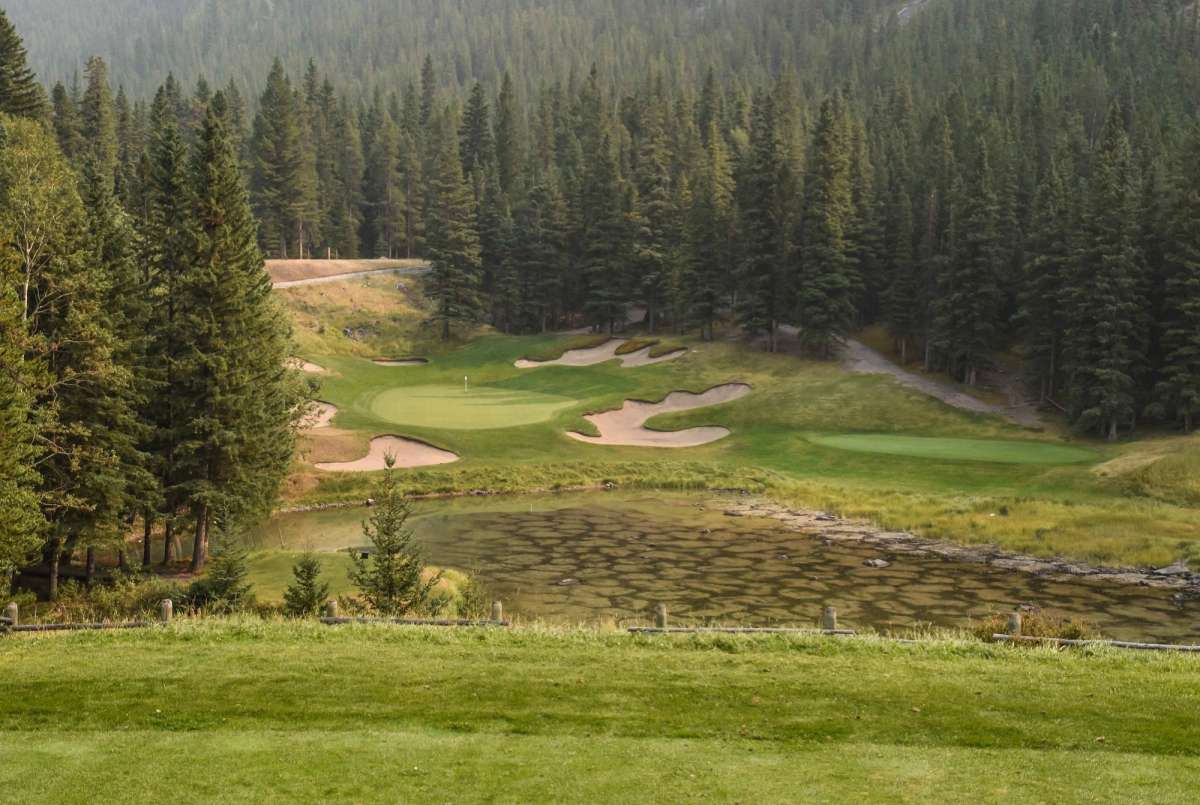
The 'Devil' in 'Devil's Cauldron' is the detail of choosing the proper club to adjust for its drop from tee to green. Photo credit: Patrick Koenig,www.pjkoenig.com
This strategy makes the skilled golfer sweat a bit more than the usual question of wind, as most struggle to calculate how much distance x-feet-of-drop takes off of their distance. Add in the day’s wind, and a drop-shot can quickly become a crapshoot, especially the higher the teebox gets from the green.
This explains why a good number of course analysts dislike the idea of a drop-shot par 3; although there is argument to be made that altitude is a condition that players must gauge to succeed, there are equal numbers who push back on that notion.
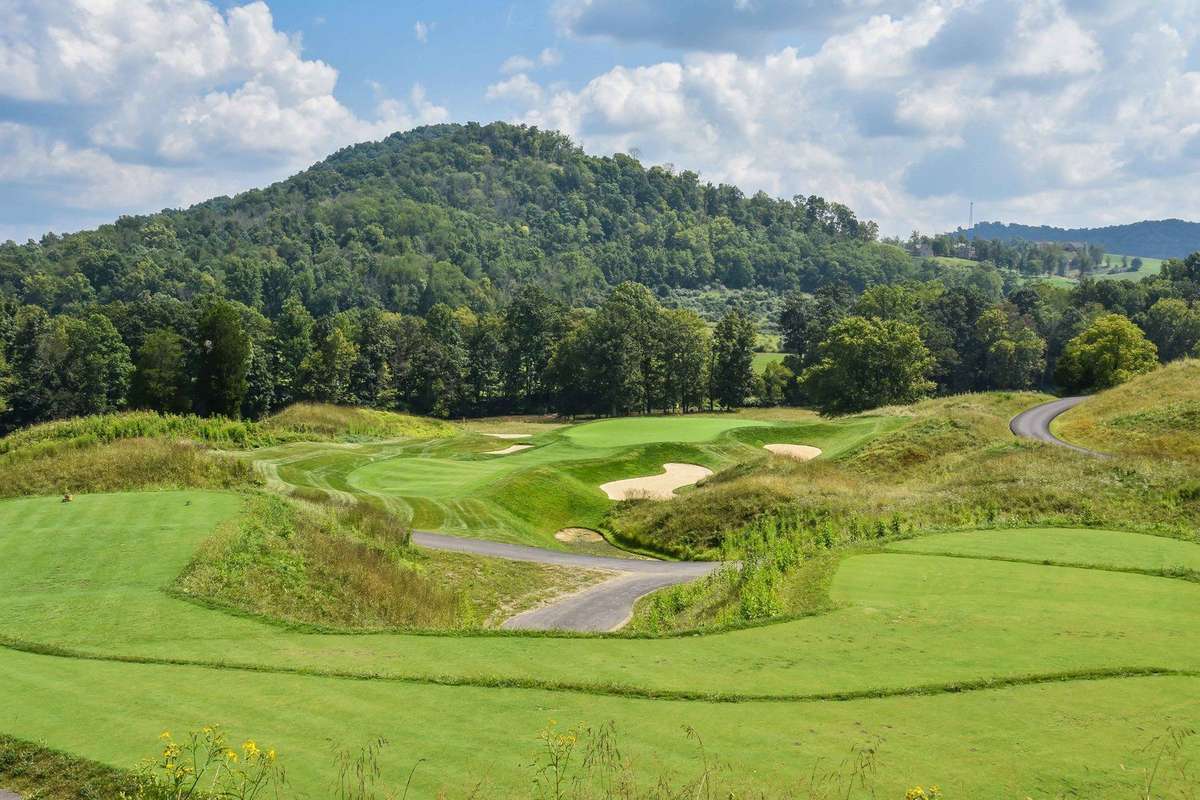
Pete Dye resisted ownership’s push to bring the back tee at Pete Dye Golf Club No. 7 even farther up the hill, as he complained this would be more luck than skill. He also designed the teebox in the shape of a horseshoe, so that different tee placements might offer a different angle to the flag from day-to-day, and keep the shot fresh.
A look down to the green at Pete Dye Golf Club's No. 7. Dye had to resist urges to move the tee box even farther up the hill. Photo credit: Patrick Koenig,www.pjkoenig.com
There’s little doubt that these holes became more and more popular during the age of the “heroic school” of golf course architecture (which Dye certainly helped usher in), where forced carries and adventurous shots occasionally took precedence over strategy. This is not necessarily a criticism of drop-shot par 3s: Once again, there’s a viable argument that measuring one’s shot and choosing clubs wisely is a legitimate skill.
Robert Trent Jones beat Pete Dye to the concept of an island green, and he one-upped Dye in the difficulty of his floating one-shotter as well. No. 16 at Golden Horseshoe’s Gold Course is a definitive statement in heroic-school golf, measuring 170 yards from the back tees and falling down to an island green (this putting surface is sizable but features an array of bunkers as well). You may spend minutes pondering which club to pull.
Several clubs have gone to such extremes that they don’t bother hiding the pure tourist appeal in such an adventurous hole. The third hole at Treetops Resort’s “Threetops” par three course is named “Devil’s Drop” (the devil, appropriately, shows up in many hole names where the golfer must descend a long way) falls 145 feet across 220 yards from tee to green. The resort’s description of the hole sums up how seriously one should take it as a test of golf: “Your guess is as good as mine on club selection. In calm conditions, you can subtract about 50 yards from the back tee yardage…but it’s rarely calm.”
Still too tame for your liking? The most infamous drop-shot par 3, the “Extreme 19th” at Legend Golf & Safari Resort, measures more than 395 yards long. That’s actually shorter than it is tall, free-falling 470 yards. Those who would rather spend £200 on a single golf hole rather than multiple rounds of golf can take a helicopter ride to a teebox built on a nearby mountain before hitting at an Africa-shaped green far, far below. Believe it or not, there have been 14 recorded birdies in the history of the hole.
Where does the line between “great golf hole” and “tourist magnet” start and stop? And does the ounce of luck that comes in measuring up such a shot necessarily mean that it’s not a great golf hole? These arguments have been had among golf course architecture aficionados for generations, and Top100 hopes to keep those arguments going (civilly, of course).
As to their role in championship golf? Those watching the U.S. Open this year will likely notice that No. 12 at The Country Club will probably offer the professionals enough trouble with its relatively small amount of drop…and Pebble Beach’s No. 7 does so annually. That’s likely why the 75-foot falls described by Cornish are not frequently found at the world’s most acclaimed courses.
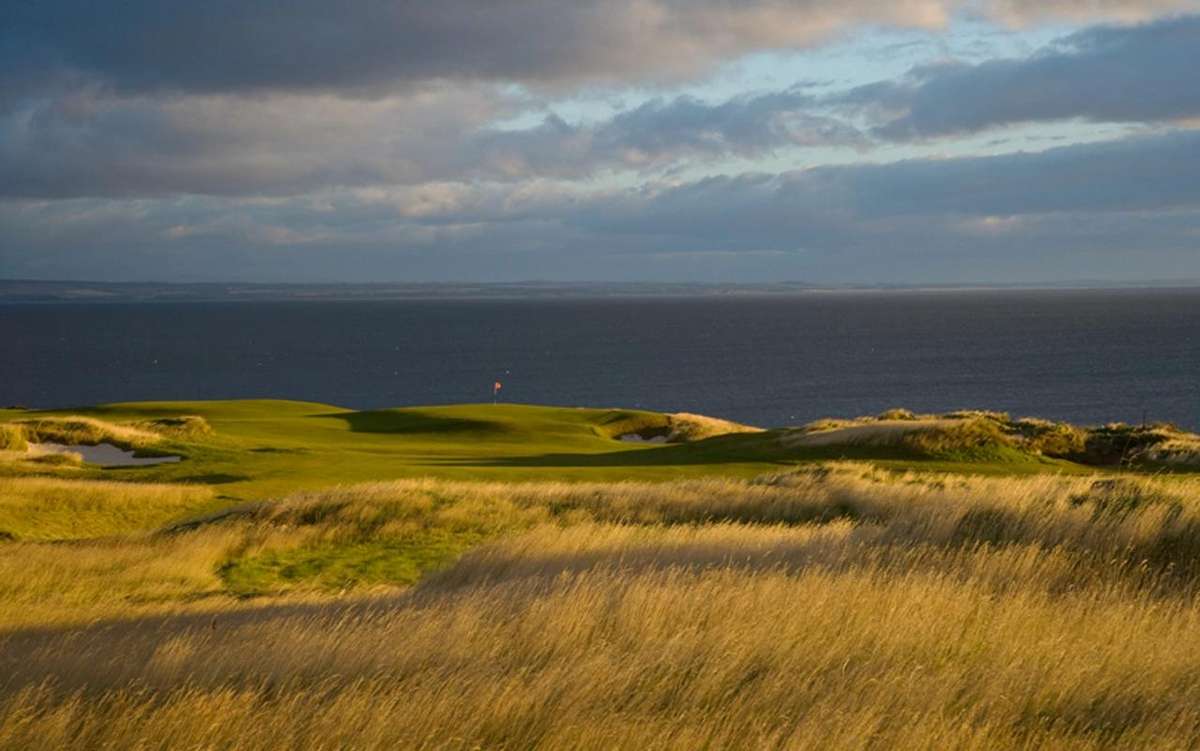
The message of great, strategic golf course architecture is clear. The actual words used to describe those golf courses, however, are many. The Architecture Glossary column will examine more precise terms and concepts that one will find when exploring golf course architecture. Hopefully understanding these terms, and why certain architects employed them, will help you to better understand the golf courses you play…and maybe even improve your scores! Today’s term is ‘Infinity Green’. The game of golf has existed in some form since at least the 15th Century, and the concept of strategic golf course design only began poking its head out in earnest during the mid-19th Century. Many of the terms discussed in these posts still seem somewhat aged, despite being relatively young compared to the game itself. Let’s break the trend and look at an idea that is entirely modern: Infinity greens. The popularity of the infinity green, like the popularity of many things in the modern design scene, can be traced to course development magnate Mike Keiser. He acknowledges, however, that he first learned of the concept from Mark Parsinen, the founder of Kingsbarns and Castle Stuart among other courses. Keiser describes his education on the subject, during a visit to the latter course, within his book The Nature of The Game: “According to his definition, an infinity green didn’t have to create a bold, straight line, as an infinity pool does, in order to count; he included any that had a small segment bleeding into the horizon,” Keiser writes. “To play a round checking them off, while noting how [Parsinen] and Gil Hanse had used them to frame the waters of the Moray Firth and the distant highlands landscape, was a case study in the art of integrating a course into its scenic environment.” One of many infinity greens at Castle Stuart set against the backdrop of the Firth of Moray. (Photo Cred: Larry Lambrecht) This idea — a green where the back of the putting surfaces melds seamlessly into views that stretch for miles — has become popular parlance in design circles, taking its name, as alluded above, from the extravagant “infinity pools” of the Hollywood hills. Keiser is a keen proponent of strategic value in the golf course design, however he is also a businessman. He famously makes suggestions to designers under his employ regarding the wants of “retail golfers,” or those who might not fully appreciate a course from the strategic perspective. The best way to please those golfers, he argues, and indeed amplify the value of a strategically-strong golf course, is to incorporate beautiful scenery. Infinity greens do so by creating a picturesque backdrop while remaining natural in appearance. Keiser was so committed to the idea at Cabot Links that he told designer Rod Whitman he would reward the architect and his wife a trip to Hawaii…if there were 12 infinity greens. Whitman obliged. No. 14 exemplifies how the architect can strategically lay out holes to create such greens. This is the shortest par three at Cabot Links, playing about 100 yards directly toward the Gulf of St. Lawrence. Typically, a downhill tee shot like this does not set up well for an infinity green, however Whitman placed the tee boxes perfectly so that the back of the green blocks views to the rough and beach behind it. Instead, players see ocean all the way, with the added visual stimulation of waves appearing to travel right into the back of the green. Creating infinity greens was a priority for Cabot Cape Breton co-developer Mike Keiser. No. 14 is one of 12 he counts within Rod Whitman's design. (Photo Cred: Cabot Cape Breton Resort) Granted, not all golf courses are blessed with seaside real estate. That doesn’t mean that infinity greens can’t exist. There’s only one feature more boundless than the ocean: the sky. Keiser, as a founding member at Sand Hills Golf Club, may not have realized it when he approached the first green at the inland club, but Bill Coore and Ben Crenshaw had created the same effect. Players will likely be hitting their third shot uphill during this opening par five, with just a front tongue of green obvious from the ground. The flag creates an almost two-dimensional visual, seeming to sit on a hard line drawn across the horizon in front of you. This is part of the challenge, of course; to know and, more importantly, to trust your distance because the green seems to run forever into the Nebraska sky behind it. Coore and Crenshaw provide some help, so that you at least know how wide the green is: A dune to the left and a bunker to the right frame the target. The distance? That’s on you. Infinity greens are primarily an aesthetic benefit of design, to be sure. However examples such as the opener at Sand Hills demonstrate the strategic benefits of these putting surfaces. They are a confidence test, asking players to trust their yardage when looking at a target that confuses the senses. One worthwhile question: Why is the infinity green concept “new”? Why does it seem like developers such as Keiser and Parsinen are the first to implement these jaw-dropping views into their properties? Why didn’t the men who laid out the links of old offer players similar eye candy? If you’re the old codger who insists golf courses built a hundred-plus years ago are inherently better, you need to at least admit that modern technology has made course construction easier. Traditional links courses, for their seaside location, often don’t offer any views of the sea, which is blocked out by the dunes surrounding the fairways. The infamous windy conditions of such locations made exposed green sites more difficult to maintain. Erosion from tidal surges was a challenge as well. Modern architects and developers have the means to create and protect greens such as those seen at Castle Stuart’s No 13. No. 15 "Little Eye" would have been difficult to maintain at the time of the club's creation, but it served as a focal point during the 2023 Open Championship. From the tee, the green melds with the sky. (Photo Cred: Royal Liverpool Golf Club) That said, modern revisionists have considered the concept in recent renovations. The new No. 15 at Royal Liverpool received constant attention throughout the recent Open, as players considered the short shot to a perched putting surface that, like the first at Sand Hills, became one with the sky. One potential difference worth considering here is that, even when clubs are able to maintain such features, the links wind can still make such unprotected shots knee-knockers for professionals and amateurs alike. The jury remains out on whether the concept should be considered successful. No. 11 at the Fishers Island Club is a splendid infinity green...even if Raynor himself didn't call it that. (Photo Cred: P.J. Koenig) Despite its recent surge in popularity, it’s worth wondering whether the idea of the infinity green can truly be considered “new.” The name is certainly new, but a number of Golden Age architects practiced similar techniques frequently within their own catalogs. Donald Ross often incorporated uphill approach shots and framed the green against the sky, intimidating players in the process. Seth Raynor set a number of his fantastic par threes against scenic backgrounds, such as the idyllic Eden hole at Fishers Island, which is backed by the scenic backdrop of a harbor in Long Island Sound. Architects, and especially developers, should always be wary of prioritizing aesthetic elements over strategic ones when creating a new golf course. If those features can add just a smidge of strategic consideration, however, they can explode a course from worth-a-look to world-class.
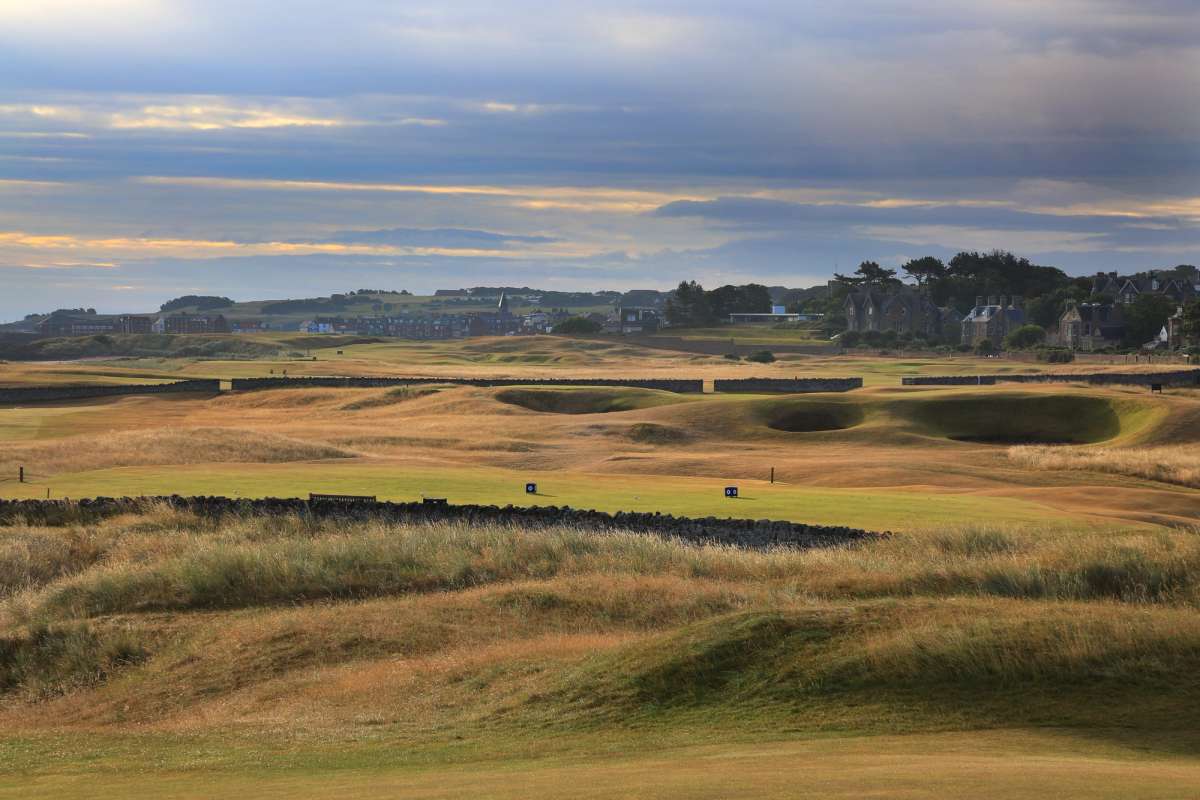
What is a Redan? A Redan is golf's most celebrated template hole—a diagonal par-3 featuring a green angled approximately 45 degrees from right to left with bold slope running toward the back. Named after a Russian fortification encountered during the Crimean War's Siege of Sevastopol, the Redan rewards strategic thinking over brute force. Players who use the green's natural contours, rather than attacking the flag directly, find the most success. First created at North Berwick Golf Club's 15th hole in Scotland, the Redan template has been replicated by legendary architects C.B. Macdonald and Seth Raynor throughout America's Golden Age of golf course architecture. Modern designers continue to build Redans today, proving this 19th-century concept remains as relevant as ever. Quick Reference: Redan Characteristics Origin: North Berwick Golf Club, Hole 15 (1895) Typical Length: 180-230 yards Green Angle: ~45° right-to-left orientation Key Feature: The diagonal approach favours the right side Front Bunker: Deep hazard guarding the direct route Slope: Front portion tilts boldly left Back Shoulder: High right side feeds balls toward pins Named After: Redan fortification at Siege of Sevastopol Popularised By: C.B. Macdonald (early 1900s) The Original: North Berwick's 15th Hole North Berwick Golf Club has several holes that we now call "templates", and it may be responsible for the greatest of them all. C.B. Macdonald—the architect most commonly associated with the template holes concept—referred to the Redan as "the finest one-shot hole in the world." The original Redan (No.15 at the club's West Links in East Lothian) measures 190 yards to a green that turns right-to-left at an angle near 45 degrees when viewed from the tee box. Even more relevant than the degree of turn is the degree of slope, as the front portion of the green slopes boldly toward the left. The back of the green banks generously, however, to escort well-struck shots from the right side of the green to pins on the left. The first of six key pot bunkers sits at the front-left corner of the green, to temper aggressive lines back toward the middle, but too conservative can also lead to trouble; three deep pot bunkers line the right of the green. The only safe miss is long and left, allowing the player to pitch back and putt uphill for a potential par save. Two more bunkers sit at the fore of the green's apron, built into the side of the hill. Although beneficial to the player as reference markers—the ridge that hosts the green rises to the same altitude, possibly impairing the player's view—they can also provide visual intimidation for less confident golfers. Although the yardage might seem quaint for the modern low handicapper, it was a rather lengthy shot back in the day. The combination of slope, relative lack of width, and the inner bunker intends to encourage a shallower draw than the lofty, more direct "dart" preferred by today's pros. The Redan Name Origin The template's name was apparently coined by a serving officer in the Crimean War who likened the hole to the redan fortress he'd encountered at the Siege of Sevastopol. The term refers to triangular outposts that jut out from walls to disrupt attacks. The war veteran returned to North Berwick and found the hole's green uncomfortably similar—both requiring strategic positioning rather than confrontation. Macdonald's Definition of a Redan C.B. Macdonald presented his definition of a Redan in his book Scotland's Gift: Golf: "Take a narrow tableland, tilt it a little from right to left, dig a deep bunker on the front side, approach it diagonally, and you have a Redan." This elegant definition suits two of his most famous renditions, both featured on Long Island and both considered among America's greatest golf courses. Famous Redan Interpretations National Golf Links of America - Hole 4 As is often the case, National Golf Links of America's take (No. 4) has become a showcase for the Redan template. Macdonald ramped up the original's features to do so, expanding the hazard from North Berwick's singular pot bunker to a trench that runs the length of the green. He also created a steeper run from the right of the green down to the left, which can funnel wayward balls back into the front hazard. "This fourth hole at the 'National' is so good a hole that I am not sure that it is not better than the original," wrote Bernard Darwin in The Golf Courses of Great Britain. Piping Rock Club - Redan Perhaps not satisfied with the degree of difficulty at NGLA, Macdonald tweaked the design at the Piping Rock Club further. That iteration is an additional 10 yards in length, and the fronting bunker is both wider and longer, stretching significantly past the end of the green, perhaps to dissuade those aiming for the back-left. The traditional pot bunkers at the back are combined to form a singular trench, mirroring the defence at the front. Swinley Forest - Hole 4 Another Golden Age classic (No. 4 at Swinley Forest) has been credited as one of Harry Colt's finest par-3 designs. The shape and distance (200 yards) obviously fit within the definition of a Redan, and the green also sits upon what Macdonald would call "tableland." The most noticeable difference is the overall gain in elevation, requiring one or two additional clubs. Two bunkers sit at the inner-left, and two rest to the right of the apron. Swinley Forest also merits mention for opening in 1909, the same year that NGLA debuted. Clearly, C.B. Macdonald wasn't the only Golden Age architect in awe of Scotland's great holes. It's likely that Colt and his contemporaries independently created classic examples of template holes before the term was coined. Riviera Country Club - Hole 4 Perhaps the most famous Redan, thanks to its annual PGA Tour appearances, is Riviera Country Club's No. 4 (designed by George Thomas). The hole is well beyond the traditional Redan distance, playing nearly 240 yards compared to the average (180-210 yards). That allows it, however, to play more toward North Berwick's original intent—requiring a long iron or hybrid rather than a mid-iron. Ben Hogan referred to Riviera's 4th as "the greatest Par 3 in the world." 21st Century Redans As perhaps the most revered template, the Redan has newfound popularity in the current era of golf course design. Contemporary architects have embraced the strategic principles while adapting them to modern sites and playing conditions. Pacific Dunes - Hole 17 Tom Doak labelled his effort at Bandon Dunes' Pacific Dunes (No. 17) as the favourite Redan he's built—a big claim from a man who, with Jim Urbina, crafted a Macdonald-inspired 18 at the very same resort with its own Redan (No.12 at Old Macdonald). Playing a traditional distance, the hole at Pacific Dunes embraces the resort's naturalist aesthetic in its front bunker. Although the back hazard is considerably wide of the green, players may become distracted by the backing wall of yellow gorse when in bloom. Sand Valley - Hole 3 Bill Coore and Ben Crenshaw brought the Redan to their own Mike Keiser project. Sand Valley features a lengthy (225 yards) par-3 where the right hump is not actually on the green, but the skirt. Played properly, it will kick onto the green in true Redan fashion. Improperly, and the player will be pitching downhill from the right. Redan Greens on Par 4s and Par 5s It is entirely possible for a par-4 or par-5 to have a Redan green. Several courses, such as Seth Raynor's Blue Mound Golf & Country Club, feature both a par-3 and par-4 rendition. This demonstrates how the Redan concept can be applied to approach shots of varying lengths. Too much of a good thing? Not for Raynor. Learn more about other template holes, including the Biarritz, Alps, Eden, and Short in our comprehensive series. How to Play a Redan Hole Strategic Approach Aim for the high back-right shoulder of the green, allowing the natural slope to feed your ball left and down toward the pin. This is the strategic route that Macdonald intended. Redan Variations Traditional Redans (180-200 yards) Long Redans (220+ yards) Elevated Redans Reverse Redans Firm conditions: Consider running approach from the right Long and left is the only safe miss on a Redan. This position allows an uphill pitch with a makeable par putt. Are They True Redans? Shinnecock Hills - Hole 7 Fans of Golden Age architecture are the staunchest proponents of the Redan... but even they might be willing to admit No. 7 at Shinnecock Hills may not qualify. Indeed, the idea is there but many—including a host of U.S. Open competitors—have reason to argue otherwise. To quote Tom Doak: "I don't think the slope in front of the green allows you to play the bank shot from the right with any high percentage of probability...if you aim for that spot and the ball takes one big bounce, you're over the back right and looking at double bogey." Perhaps by moving the position of the teeboxes, Shinnecock's 7th would provide a more realistic angle of approach, and fully justify the Redan moniker? TPC Sawgrass - Hole 13 Claims that No. 13 at TPC Sawgrass is a modern Redan also require significant consideration. The issue is not so much the water that runs along the left-hand side (a typical Pete Dye diversion), and certainly not the hole's expected right-to-left play. Rather, it's whether the best approach is actually to play it like a Redan. The portion of the green at the front left is unnaturally flat and large enough to hold a well-struck dart. Attempting to arrive at these flags by riding the slope may actually prove more difficult. On the flip side of the coin, the ridge that divides the green flags at the back left receives an occasional ace during The Players Championship when the pros take a Redan route. The difference is the spine, and on which side the flag stands that day. Can it be a Redan one day, and a non-Redan the next? Frequently Asked Questions About Redans What is a Redan hole in golf? A Redan is a par-3 hole with a diagonal green angled approximately 45 degrees, sloping right-to-left. The design encourages golfers to use the green's contours rather than attack directly, rewarding strategic play over the bunker-guarded front approach. Where is the original Redan hole? The original Redan is the 15th hole at North Berwick Golf Club's West Links in East Lothian, Scotland, designed by Ben Sayers around 1895. What makes a true Redan hole? According to C.B. Macdonald: "Take a narrow tableland, tilt it a little from right to left, dig a deep bunker on the front side, approach it diagonally, and you have a Redan." Key features include diagonal orientation, bold tilt and green slopes, strategic bunkering, and a high back-right shoulder. Why is it called a Redan? A Crimean War officer likened the hole to a redan fortress at the Siege of Sevastopol. Redans are triangular fortifications offering flanking defence—similar to how the hole's angle defends against direct assault. What is a Reverse Redan? A Reverse Redan mirrors the traditional design, sloping left-to-right instead of right-to-left. The same strategic principles apply, but in reverse orientation. Who built the most famous Redan holes? C.B. Macdonald and Seth Raynor built numerous Redans across America during the Golden Age. Macdonald's version at National Golf Links of America is considered by many to be superior to the original. How do you play a Redan hole successfully? Aim for the high back-right shoulder and let the slope feed your ball left toward the pin. Avoid the front-left bunker, and remember that long and left is the only safe miss.
D is for Dell (blind par threes) THE ORIGINAL What’s the original blind par three? Considering the many courses that have come and gone among the many rolling dunes of Britain, it’s near impossible to guess. There is one, however, that stands more prominent in the lore of golf, and many have since held it as the standard for blind one-shotters. Interestingly, it’s not among the many rolling dunes of Britain, but rather those of Ireland: The Dell at Lahinch. Lahinch Golf Club Old course 5th hole - image courtesy of Lahinch Golf Club This hole, laid out by Old Tom Morris during 1892, makes its goal obvious (if not the target of one’s tee shot). Granted, a white stone is now placed atop the fronting, 30-foot dune to mark the pin placement for the day, but this was not necessarily always the case. Players launch their ball 155 yards in the general direction, hoping to find it on the two-tiered green (high left and low right) when they arrive at the other side. The worst result will be to end atop or even on the far side of the fronting dune, as the thick cut won’t allow a short ball to follow gravity. True, the player will need extra club to carry the hill, but Old Tom showed his knack for meteorology: The North Atlantic wind results in shots that descend much steeper than they ascend. Despite the debate over the fairness of blind shots, The Dell survived renovations from Alister MacKenzie, the same man who eventually removed Royal St George’s notorious Maiden from the map. There are very few examples to suggest that “Dell” itself is a template, but it does set a standard for holes that wish to be compared to it. OTHER INTERPRETATIONS The Dell may be Old Tom’s most noteworthy instance of a blind par three, but it was far from his first. He first tried the act at Prestwick, nearly 40 years earlier. The famous “Himalayas” hole has a more straightforward green than at Lahinch, simply angled upward from front-to-back. Two factors do make a difference, however: the length (currently 230 yards from the back) and the bunkers. Six pots line the edge of the green, but five of them make the left of the hole the worst miss. Some suggest blind bunkers are an insult to strategic golf, but Morris used the concept several times at Prestwick. In fact, C.B. Macdonald enjoyed the No. 17 “Alps” hole so much that he brought the template home to the National Golf Links of America. If Macdonald — the ultimate strategist — can appreciate it, why shouldn’t we? Prestwick Golf Club 5th hole - image courtesy of Prestwick Golf Club Very soon after Lahinch, Old Tom moved on to Cruden Bay, where No. 15 “Blin’ Dunt” plays exactly like it sounds (we think), 195 yards across the side of a hill where a large green awaits. A friendly slope off the fairway apron will kick shots forward toward the green, but by no means play this hole short. Cruden Bay Golf Club 15th tee box Old Tom was not the only architect to enjoy the occasional blind par three. Laidlaw Purves laid out the since-deceased Maiden hole, and Willie Park Jr. also created a few. Most notable is Shiskine’s “Crows Nest,” an 120-yard shot that seems to travel straight up (and over) to cross a dune that doubles back across the line of approach, before finally settling on a putting surface high above the tee. Players must also combat the breathtaking scenery of the Isle of Arran, with the Firth of Clyde left and a rock bluff rising beyond the green. Shiskine Golf & Tennis Club 10th hole - image courtesy of Shiskine Golf & Tennis Club Unfortunately (or fortunately, depending on your opinion), blind shorts have largely fallen out of favor with modern architects, either because of the potential for injury (not everyone is familiar to listen for a bell) or simply because players don’t like the old-fashioned luck occasionally required at old-fashioned links. A few bold individuals have tried, however. Steve Durkee, upon renovation of the Dorset Field Club, strategically placed the No. 12 tee box to alleviate the safety problem. The player can stand to the left of the box and see the green (and, more importantly, whether anyone is on it). They can then step back to the actual tee area, where the hill on the right now blocks the view to the 145-yard target. Dorset Field Club 12th hole "Goats Loose" - image courtesy of Dorset Field Club One last in-memoriam for an attempt to make a true Dell recreation: At its opening, Erin Hills featured a near-clone of the legendary hole. Cleverly, they left three tee boxes to the right so weaker players could play the green longways, removing the blind element. Better players could challenge its true intent from the leftward tees. Unfortunately, many professional players also dislike the idea of blindness, and the hole was removed as a sacrifice for landing the 2017 U.S. Open. MAYBE...MAYBE NOT We noted there are few details that definitively make The Dell a template hole... so of course we have still found reasons to exclude a few par threes from this list. Willie Park Jr. has another blind par three of almost equal renown to “Crows Nest.” No. 10 at Temple Golf Club plays a whopping 243 yards... so it is helpful the player doesn’t need to cross any significant slope. The blindness is provided by a sunken green, set in a deep hollow. The land slopes down in a punchbowl formation to usher blind shots to the putting surface. Dell-style par threes depend on distance and directional management, without assistance from natural landforms. That the hole is named “Punchbowl” confirms our suspicion that it’s intended to play much more like that template, and less like a Dell. Temple Golf Club 10th hole "Punchbowl" - image courtesy of Temple Golf Club Continuing on this theme, we follow Park to the United States for yet another not-quite “Dell.” The No. 8 hole at Maidstone is one of the most famous on Long Island, yet it plays nothing like its original intent. After Park had left his mark, a storm shifted a dune and made the 150-yard hole blind. Members later elected to bulldoze the dune, but made the odd decision to handle it themselves (we assume these Long Islanders had cash to spare). The remaining wreckage of the dune leaves half the green blind, but more so due to scrub brush than hill. It’s an iconic look, but the visible portion of the green takes it out of contention for “Dell” comparisons. The Maidstone Club 8th hole - image courtesy of Jon Cavalier @LinksGems Using this logic that the entire green must be invisible from the tee, we can rule out greens such as No. 8 at Tom Doak’s Heathland Course at the Legends Resort. Front-left pin placements will be blind due to the sandy rise at the front of the uphill green, but otherwise players will be able to spot the pin on this uphill, 150-yard shot. We don’t doubt at all, however, that Doak is among the most likely architects to propose a blind par three green if an owner gave him a green light.

