
The message of great, strategic golf course architecture is clear. The actual words used to describe those golf courses, however, are many. The Architecture Glossary column will examine more precise terms and concepts that one will find when exploring golf course architecture. Hopefully understanding these terms, and why certain architects employed them, will help you to better understand the golf courses you play…and maybe even improve your scores!
Today’s term is ‘Revetted Bunker’.
The simplest understanding of a “revetted bunker” comes from comparing the iconic hazard style at the links courses of old to modern minimalist masterpieces.
For the latter, consider the large “blown-out” bunker style of Bill Coore and Ben Crenshaw’s Sand Hills Golf Club, designed to look as if they have been there forever, and mankind simply built a golf course around these exposed sand areas. Next, consider the many bunkers at the Old Course of St. Andrews, which appear quite constructed, often circular with steep walls. This bunkering is referred to as “revetted,” a reference to the construction of the walls. More on that in a minute.
The infamous Hell bunker guards the route along No. 14 at the Old Course (Photo Credit: St Andrews Links)
The “new” style of Coore and Crenshaw is in fact the oldest form of creating sand hazards, and indeed even the Open Rota’s gems once hosted similar hazards. Unfortunately for the Scottish course managers of old, “blow-out” was often a literal problem. The linksland’s sandy terrain was constantly influenced by coastal winds. Keeping sand in hazards proved difficult, until the introduction of revetting.
This process involves taking strips of turf — the grass itself and the immediate layer below where the root system takes hold — and stacking them meticulously around the edge of a bunker. The layers of roots bind to create a solid wall of sod, which holds the surrounding soil from collapsing outward, while keeping the sand portion of the trap well below the blowing winds at ground level. A revetted wall often resembles a 14-layer cake, however there are generally many more layers than that. Depending on the height of the bunker, there may be more than 50 layers of turf required to revet.
This term “revetted bunker” can be used interchangeably with “sod-faced bunker.” However, although the wooden sleepers serve the same purpose, they don’t fit the description of “revetted” as understood in golf course architecture.
The origins of the concept may have been for utilitarian purposes only, but the resulting product came with strategic implications. This strategy is most evident in the revetted bunker’s most iconic form: the pot bunker.
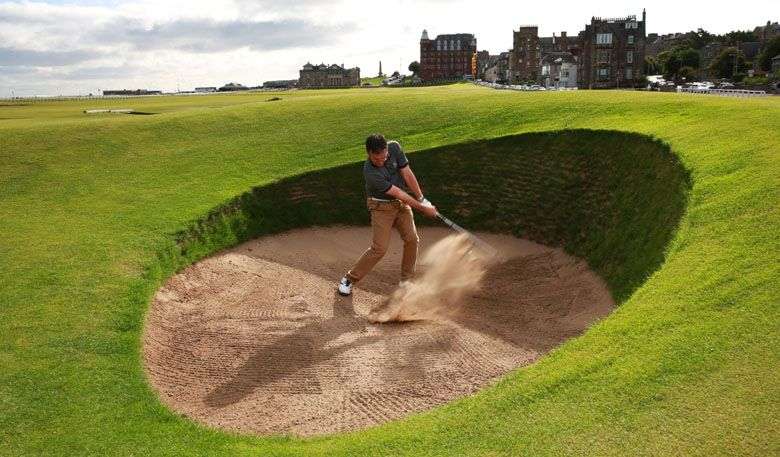
One of the world's most famous pot bunkers guards the left side of the green at the Old Course's No. 17 hole. (Photo Credit: St Andrews Links)
The Open rota is pockmarked with pot bunkers, which have become one of links golf’s most enduring images. Although smaller than the average American parkland-style hazard, the impact on the next shot is considerably more penal. The depth of the trap requires an extreme loft to escape. Although better golfers can sometimes find the green in regulation after finding a standard bunker off the tee, a pot bunker makes such a lengthy shot impossible. And moving forward is a best case scenario! Because the ball often rolls forward into the bunker, it may come to rest near the front of the hazard, requiring a lateral exit because the forward shot is simply too steep.
This emphasis on heavier penalties is, interestingly, a relatively new phenomenon, correlating somewhat with Americans’ fascination for tree-lined fairways. Old photos showing Bobby Jones at St. Andrews indicate that the Road bunker, perhaps the most notorious pot bunker in the world, was not revetted at all. Over time it evolved until the point where the greenside face is nearly five feet deep.
Martin Ebert and Tom Mackenzie wrote about the trend for Golf Course Architecture magazine.
“In the space of about a decade from the mid-1970s, most bunkers on Open courses were revetted, if they were not already, and most other links followed suit,” the architects wrote. “As this approach became adopted widely, the style evolved, with many bunkers becoming deeper and steeper faced. It was like an arms race to see how hard they could become.”

The famous ring bunker at Muirfield's No. 18 green during the process of reconstruction. Note the sod being stacked to form the wall of the hazard. (Photo Credit: Gary Eunsun)
A revetted bunker is hardly required to be a pot. In fact, many of the UK’s most famous monsters are revetted as well. Another St. Andrews example is “Hell,” as well as one of the other most famous hazards in Open history, the ring bunker that guards the final green at Muirfield. Although more shallow than the examples listed above, players must also deal with the infamous mound of grass that runs through the center.

The ring bunker after a successful reconstruction. (Photo Credit: Gary Eunsun)
That trend has carried across the Open Rota and elsewhere, as courses seek to both keep sand safe while maintaining their challenge to the modern golfer. That said, the modern golfer rarely complains when they find a revetted bunker outside of the UK, because the style has become intertwined with what modern golfers associate with classic links. Their employ around the world have been both utilitarian and aesthetic.
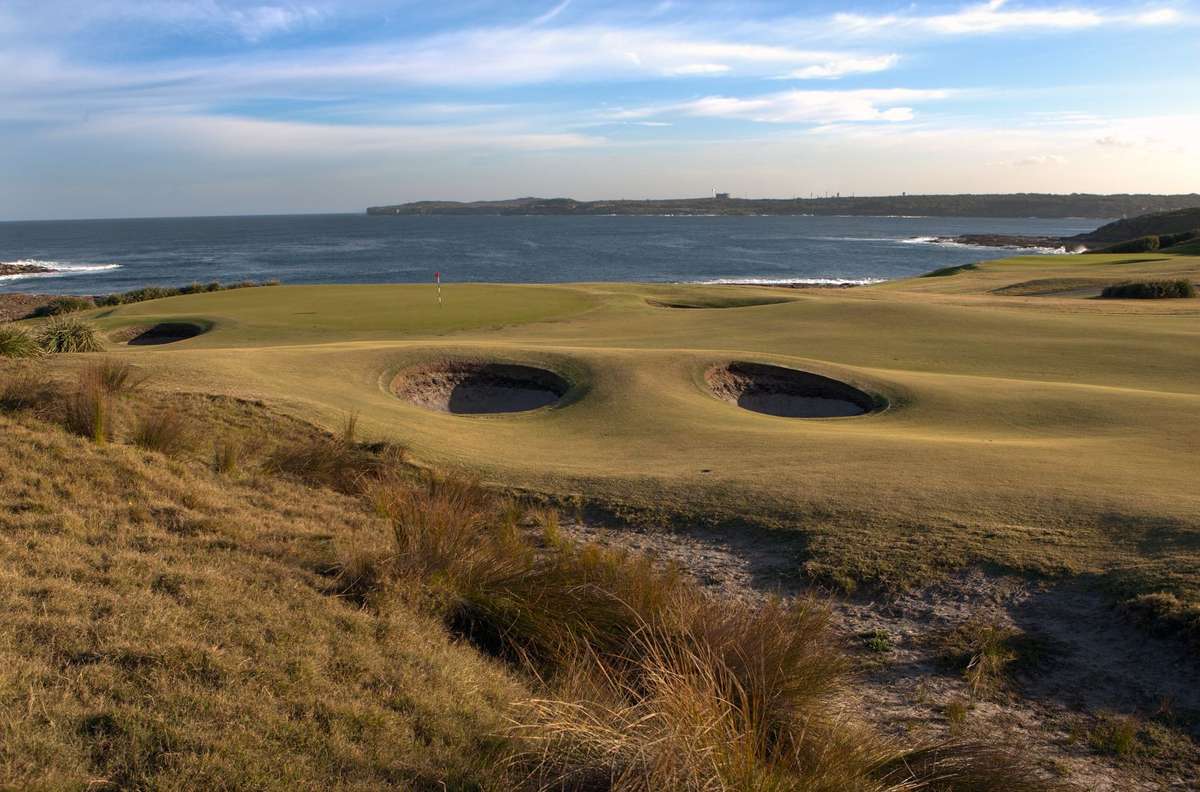
The No. 5 hole at New South Wales features revetted bunkers to defend against winds coming off of the South Pacific. (Photo Credit: New South Wales Golf Club)
One of the most famous sets of revetted bunkers outside of the UK is at New South Wales Golf Club in Sydney. The pots that now dot the route are unlike anything else in Alister MacKenzie’s portfolio. Part of this is because Eric Apperly handled bunker construction after MacKenzie left, but — as at many UK courses — the current slew of revetted bunkers is a relatively new addition. The club used the technique to defend its hazards against the stiff winds off the Tasman Sea.
Absence of a sea has hardly prevented inland courses from introducing revetted bunkers to its property. Michael Hurdzan and Dana Fry went all out at The Pulpit Club’s Paintbrush course, near Toronto, which features 108 revetted hazards.
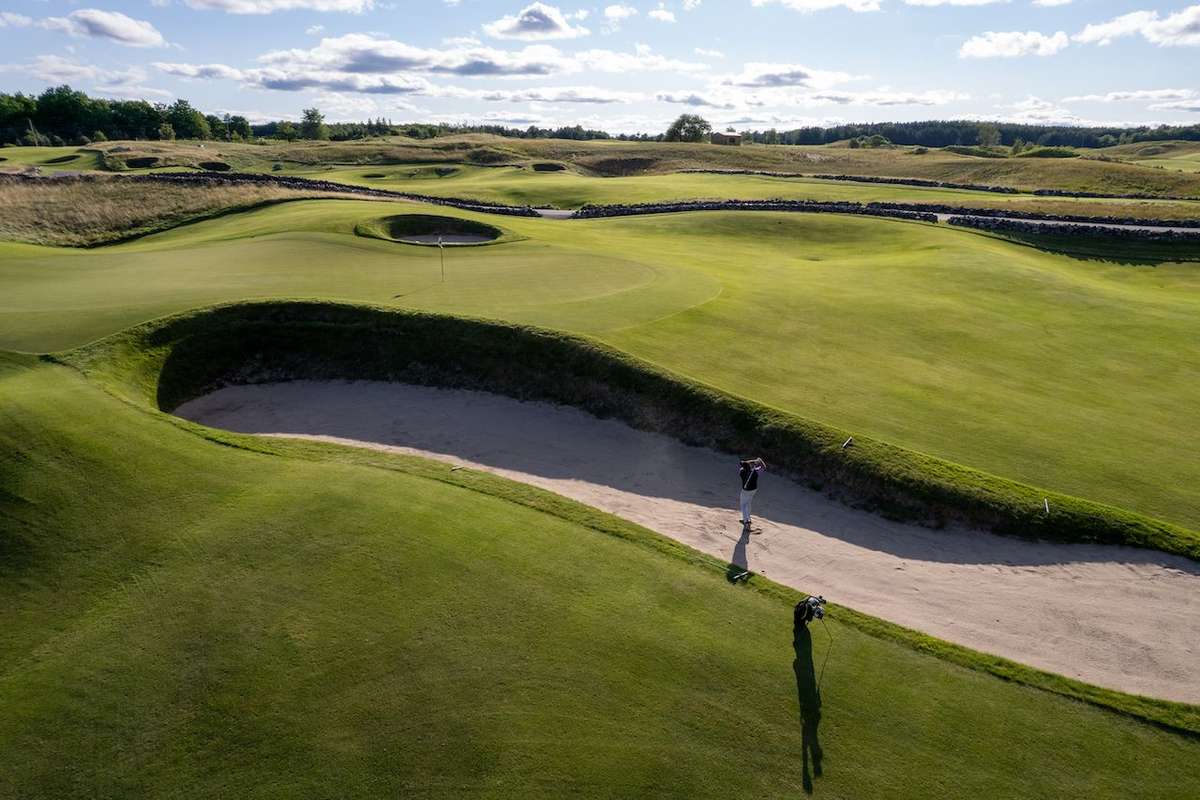
The Paintbrush Course at The Pulpit Club. (Photo Cred: The Pulpit Club)
Why haven’t more courses taken the style up? For one, revetting a bunker requires more labor than the average sand trap (The Paintbrush has rebuilt all of its bunkers three times in the course’s relatively short history). If a parkland course isn’t battling coastal winds, the process is often not worth the club’s time or budget. And, as suggested earlier, revetted hazards are more likely to slow up play. A worthwhile challenge at a championship club, to be sure, but worth destroying the ego of the sand-weak weekend golfer? In many cases, probably not.
In fact, some old world clubs are moving back to the “new” way of crafting bunkers. As part of his celebrated work at Trump Turnberry’s Ailsa course, Ebert returned the course’s revetted bunkers to a more “blown-out,” natural style.
Will we soon see other courses on the Open rotation change their tune and move away from the revetted style? Perhaps in some instances, but increased viewership during the television era has made the revetted bunker an integral part of the links identity for modern players. These hazards will likely endure for years to come.
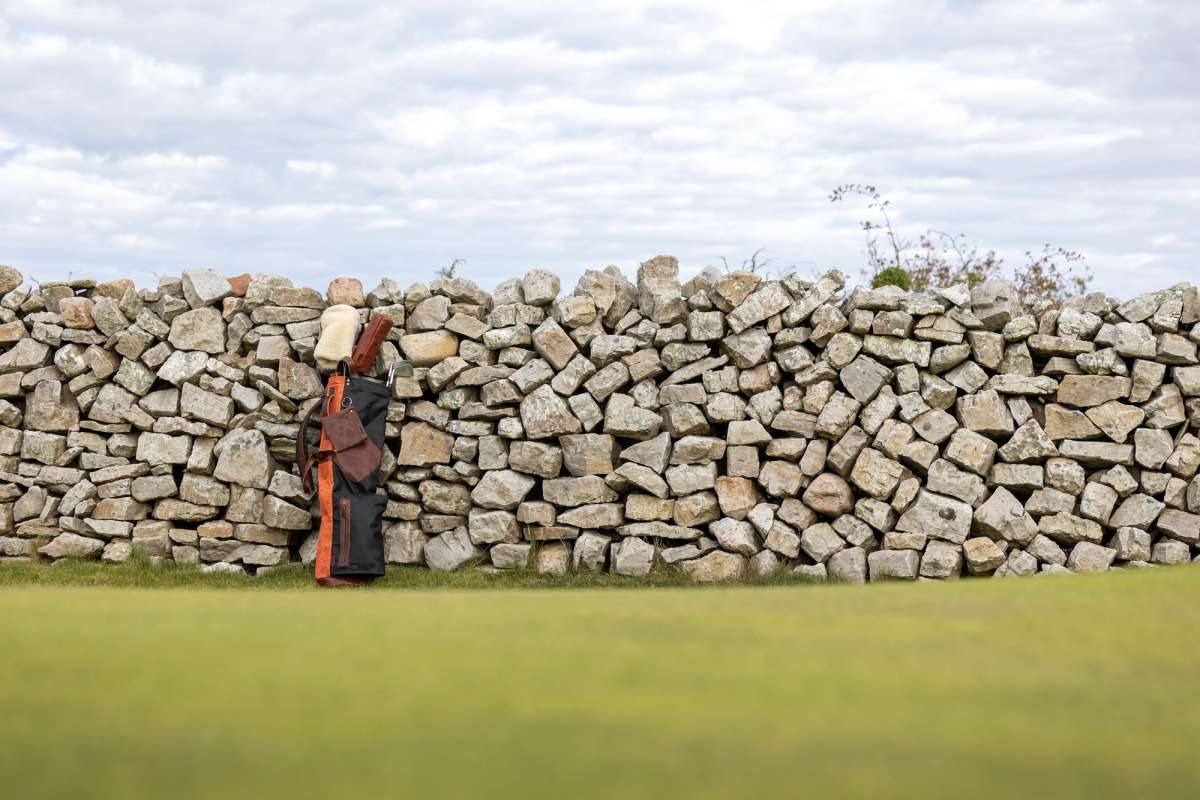
We've curated four exceptional gifts for the discerning golfer—from handcrafted Sunday bags to contemporary art that reimagines golf's greatest holes. Pine Coast Golf Sunday Bags The Sunday bag represents golf at its purest. Pine Coast Golf has elevated this concept with bags handcrafted in a Polish workshop using Italian leather from a fourth-generation Tuscan tannery and waxed canvas from Dundee, Scotland. Founded by Lisette and Johan from a love for golf and commitment to mental health awareness, each bag features brilliant functionality: a skewed pocket that secures valuables naturally, accessible water bottle storage, and strategically centred shoulder loops that balance perfectly over 18 holes. The collection—The Dirty Shirley, The Whitecap, The Pine, The Moss, The Beach, The Sunset and The Orchid—ranges from 3,490 to 4,890 SEK (£260-£370/$350-490) for canvas models. The premium Leather Bag: 9,995 SEK (£750/$995). Personalised embroidery available. Perfect for: Minimalists, walkers, and golfers who value sustainability Why we love it: Handcrafted with purpose, these bags develop a beautiful patina that tells the story of your rounds. Charcoal Golf Art Prints Charcoal Golf bridges fine art and golf course architecture with urban contemporary flair. Artist Mark Rivard brings over 20 years of fine art experience—from skateboard art to founding "Do Rad Things" with Sharpie Markers—to golf's premier landscapes. His top-down hole designs are immediately recognisable yet gritty and unfinished, with geometric patterns and bold colours that push beyond traditional golf art. Each museum-grade giclée print on heavyweight archival stock is hand-signed by the artist. Recent works include Sweetens Cove, Sand Hills, Prairie Dunes, and Bethpage Black's 18th. Custom commissions available. Perfect for: Modern collectors, design enthusiasts, gand olfers who appreciate contemporary art Top100 Members & Subscribers: 15% off with code Top100 at checkout Why we love it: It represents golf culture's evolution—respectful of tradition whilst embracing modern expression. Fyfe Golf Harris Tweed Headcovers Handcrafted in Scotland using authentic Harris Tweed woven in the Outer Hebrides, these headcovers are wearable art. The dark charcoal herringbone pattern features 100% pure new wool that naturally repels water, with plush fleece lining protecting your clubs. Co-founded by Neil Rennie—whose grandparents worked at Aberdeen's famous Grandholm Mill—Fyfe reconnects golf with Scotland's manufacturing heritage. Fabrics come from heritage mills, including Halley Stevensons in Dundee. Carbon-neutral production. Made to order, shipping within 7-14 working days. Available for drivers, fairway woods, and hybrids: £85-95 ($105-122). The newly launched Shooter's Club line really hits the Scottish sporting estate vibe hard. Perfect for: Traditionalists, Scotland lovers, golfers who value heritage craftsmanship Why we love them: They age beautifully, developing character with every round. "Buying better and buying less." Gary Lisbon's "Great Golf Courses of the World" Melbourne-based photographer Gary Lisbon has spent two decades capturing 685 courses across 26 countries. This panoramic coffee table book showcases over 400 images—many never published—from 100+ courses in 20 countries. Playing off a mid-single-figure handicap at Royal Melbourne, Lisbon brings a golfer's eye to his dawn photography. Journey from Norway's Lofoten Links to the British Isles, Australia's Melbourne Sandbelt to New Zealand's clifftop masterpieces, and continental gems like Valderrama and Morfontaine. Over 95% of featured courses are accessible to travelling golfers. 1991 Open Champion Ian Baker-Finch feels it is "undoubtedly the best collection of golf course images from around the world." $135 with worldwide shipping. 18-month desktop calendar: $25. Perfect for: Dreamers, trip planners, course architecture enthusiasts Why we love it: Trip-planning material disguised as art—a worldwide golfing journey from your living room. Mymo Golf Personalised Prints Every round has a story. Mymo transforms those memories into watercolour-style prints featuring any hole from any course worldwide. Founded by Chris Pyatt after his first hole-in-one, Mymo creates personalised aerial prints capturing every detail. Choose your course and hole, add a custom message, and receive a digital proof within 48 hours. Printed on premium matte paper (189 g/m²) with water-based inks. Available in Medium (12 × 16") or Large (16.5 × 23.3"), framed or unframed. Course Map collection features all 18 holes with space for player names and dates—perfect for commemorating trips. You can also capture your three favourite holes on one print. Partnership with Arccos integrates shot-tracking data. Orders typically take 7 days. First-time customers: 10% off. Perfect for: Commemorating holes-in-one, bucket-list rounds, cand elebrating achievements Why we love it: Turns memories into masterpieces worthy of display rather than hidden in your golf bag. Editor's Choice Smathers & Branson Needlepoint Belt Founded by college roommates in 2004, Smathers & Branson now employs over 2,000 artisans creating 100% hand-stitched needlepoint using French cotton thread, full-grain Italian leather, and solid brass buckles. Arrives in a handmade wooden gift box. $185. Pro tip: add 2-3 inches to your pant size. Editor's Note: "The St Andrews Scene belt is my personal favourite. The detail is extraordinary—a daily reminder of golf's spiritual home." Vessel Skyline PrimeX Backpacka For travelling golfers, the right backpack is essential. Vessel features crosshatch embossed synthetic leather—durable, weather-resistant, easy to clean. Padded laptop compartment (15" MacBook Pro), velour-lined valuables pocket, internal water bottle sleeves, hidden top pocket, trolley sleeve, compression-moulded neoprene back panel. Once you have one you'll wonder how you travelled without it. Available in Black, Maroon, Navy: $195. Editor's Note: "A lifesaver on 50+ flights. Transitions seamlessly from airport to office to course." Gift Pairing Ideas Heritage Collection: Pine Coast Sunday bag + Fyfe headcovers for European craftsmanship Art Lovers: Charcoal Golf print + Lisbon's book contrasting contemporary and classical Travel Package: Vessel backpack + Smathers & Branson belt for the well-travelled golfer Memory Makers: Mymo personalised print + Lisbon's book with a promise to book a featured course Scottish Links Experience: Fyfe headcovers + Smathers & Branson St Andrews belt Why We Selected These Gifts Each product celebrates craftsmanship, sustainability, and artistic vision whilst supporting small businesses with genuine purpose. From Scottish workshops to Polish leather artisans, from contemporary artists to master photographers, these gifts honour the game and inspire golfers to play with intention. And don't forget about Top 100 swag at shop.top100golfcourses.com
Q & A with Bill Coore Interview with M. James Ward SOUTHAMPTON, NY. The tandem of Ben Crenshaw and Bill Coore are among the world's finest golf course creators. The duo have reshaped -- no pun intended -- by re-emphasizing classical golf architecture with some of the finest modern designs including the likes of Sand Hills in Nebraska, Friar's Head on Long Island, NY, Bandon Trails in Oregon, Sand Valley in Wisconsin and among others Streamsong (Red) in Florida, as well as major restoration work with the likes of Pinehurst #2 leading the way, and as course consultants to this year's US Open site – Shinnecock Hills. Among their upcoming newest layouts is Ozarks National in Branson, Missouri opening later this year. In sum, the twosome continues to bring to life golf architecture that embodies designs working in total concert with their native sites. Backgrounder Like his partner Ben Crenshaw, Bill Coore was exposed to traditional golf architecture during his formative years. A native North Carolinian, Coore played much of his early golf at the Donald Ross courses of Pinehurst and the Perry Maxwell designed Old Town Club in Winston-Salem. A 1968 graduate of Wake Forest University, Coore began his professional design and construction career in 1972 with the firm of Pete Dye and Associates. Under Dye’s guidance, Coore was introduced to the elements of creative design and physical construction. It was also Dye that first introduced Coore to the written classics of golf architecture – the same books that Crenshaw was then collecting and studying. The information within these books was to later form the foundation for the Coore and Crenshaw partnership. During the succeeding ten years, Coore was involved in the design, construction and maintenance of golf courses in Florida, North Carolina, Virginia, Canada, and Texas. Coore formed his own design company in 1982. Thereafter, he completed courses at Rockport Country Club in Rockport, Texas (featured in the 1986 issue of the USGA Golf Journal) and Golf du Medoc in Bordeaux, France – named one of the ten best courses in France and one of the top fifty courses in Europe. Bill Coore and his wife, Sue, reside in Scottsdale, Arizona. Ben and yourself have been consultants at Shinnecock Hills, what’s your take on the course’s best hole? COORE: In my opinion, there is no best hole at Shinnecock Hills and fortunately there is no worst hole or even less good holes. There is a collection of 18 distinctive, extremely high quality holes that fit seamlessly together. What’s the most underrated hole? COORE: The first hole may be the most underrated because of its position in the round, and it's not one of the course’s most difficult holes, yet it is a marvelous introduction to what is about to be experienced. The view from the first tee located so near the iconic clubhouse, the angle of the fairway to the tee shot, the bunkering, the contouring of the green, its surrounds and the precision demanded of the shots played to the green combine to make it one of the most attractive and interesting holes on the course. Shinnecock is considered to be one of the most impressive courses in the world. Why is that? COORE: The most impressive overall feature of the course is the amazingly interesting way in which the holes lay on the natural landforms and are oriented in such a way that holes play toward all major points on the compass, therefore assuring that during a round the almost always present winds will be encountered at every possible angle. I'm not sure I can think of another course about which that can be said. Golfers have their own respective bucket list of courses to see/play. What’s yours? COORE: Amazingly enough, during my travels, I have yet to see Muirfield in Scotland, so that would certainly be on my bucket list. What’s the hardest thing about being a golf architect? COORE: If you’re successful in the business, saying "no" to a given project. In so many ways you do wish to say "yes" but if you don't feel as if you can really attain the goals set by the ownership it's best not to go forward. What’s the tipping point in making that decision? COORE: Ben and I have been good naturedly kidded about taking forever to make a decision. When we first started we knew we had to run the operation as a business but we also wanted it to be fun too. Truthfully, when we first started we wondered if anyone would hire us. When making a decision we're going to study the site. We're going to listen to what the ownership wants. We're also going to be candid to ourselves -- can we accomplish the goals being set? Sometimes a given site requires extreme alterations and we may not be the appropriate fit to do what is being sought. What’s the most satisfying aspect for Ben and yourself? COORE: The early stages are the most rewarding, discovering the natural attributes and spending time with the ownership on the property. The whole discovery process shows whether the site plays to our design strengths. Can we accomplish the goals set by ownership in tandem with our skills? It's tough when you like an owner personally and professionally and really want to see things move forward to make that dream a reality, but there are times when you don't see how we can make that happen. What have you learned from when you first started creating courses to what you do today? COORE: When you're a young designer there's a temptation to show what you can do. You often try to do too much. It's understandable to happen -- particularly early in a career. It's tempting not to have much restraint. We've believed that if we could mange our impulses we'd be better off. We try to establish the concept and the goals collectively with the guys we work with to allow that process to evolve and come to life. If something happens in the field – even by mistake – that seems to be a better end result then our team is free to move in a better manner. If you allow the process to happen and don't get hung up on some preconceived concept so many wonderful things can in fact happen. What’s harder to do, a completely new course or one being restored? COORE: A restored course by far. You have to first decide what are you going to restore it to. This happened during our time at Pinehurst #2. The course had gone through various looks over the years and when we got involved that question needed answering. Are you going to go back to its earliest days by using aerial photography? Or is there some interim period of time? So one needs to ask restore it to when and what. When Ben and yourself walk onto a property for the first time, what generally do you both discuss? COORE: The very first day can prompt some general impressions of the potential a given site has to offer. We will assess if the site plays to our strengths. Does it have interesting natural features? Is it adaptable to golf if it doesn't need major alterations? What are the most interesting features and whether we can work with that site? Can we do it justice? Clearly, when talking with the ownership, you get some guidance on what the goals are to be. From what you have mentioned, you spend plenty of time listening to others. How important is that in getting the final assessment on whether you will be involved? COORE: It's an absolute priority.

Fergal Makes History Fergal O’Leary becomes the youngest man in history to play the World’s Top 100 Golf Courses AUGUST 2015, South Africa – This summer, Dublin-native Fergal O’Leary will prove the catch-phrase ‘luck of the Irish’ and become the youngest man in history to play the World’s Top 100 Golf Courses. The 32-year old will conclude his quest at the Durban Country Club in South Africa this August. Born and raised in Dublin, Ireland, O’Leary grew up in the backyard of one of the world’s greatest links, Portmarnock Golf Club. Rapidly becoming a talented and passionate golfer, he began to play competitive club level golf at the age of twelve. He took a summer job as a caddy, at a comparable course in the United States, the reputable ‘The Country Club’ in Brookline, Massachusetts. Being privy to such elite clubs and courses sparked a strong aspiration to continue identifying and playing the unique, high caliber greens – majority of which are private clubs. Using his relationships gained as a caddy and his ‘scratch’ handicap, he requested invitations for the opportunity to play on the courses. In 2007, US-based O’Leary set a long-term goal to play on the country’s top 50 clubs including Cypress Point, Sand Hills, Shinnecock Hills, Augusta National and Ballyneal, where he shot an impressive 66. Maintaining a full-time job as an IT Risk Assurance Professional, where he was required to travel on a regular basis, O’Leary devoted all of his downtime including weekends and holidays to visit the individual courses. Many of the courses were in clusters and he was able to play several in one weekend. The momentum continued and in September 2011, 28-year old Fergal played the original course at Sutton Bay, a course that no longer exists, to complete the Top 100 courses in the United States. He became the youngest person, as well as, the first Irishman to accomplish this in history. O’Leary is constantly inspired by the words of David Forgan from 1899, “Golf is a science, the study of a lifetime, in which you may exhaust yourself but never your subject. It is a contest, a duel, a calling for skill, courage, strategy and self-control. It is a test of temper, a trial of honour, and a revealer of character. It means going into God’s out-of-doors, getting close to nature and fresh air. It includes companionship with friends, opportunities for courtesy, kindness and generosity to an opponent.” To date, twenty-six people have played a World Top 100 list, twenty-one of whom are still alive today. Not one of these successors has derived from Ireland. Traveling to countries including the United Kingdom, Spain, France, Portugal, China, Australia and New Zealand, O’Leary’s dream to complete this challenge as both the first Irish man, as well as, the youngest man in history will be reached this summer. O’Leary resides in Boston, Massachusetts and holds the title of Golf Magazine’s Top 100 panelist, Golf Digest’s panelist and the US correspondent for Top 100 Golf Courses of the World in the United Kingdom. For all press inquiries: Elizabeth Tuke, Elizabeth@elizabethtuke.com

