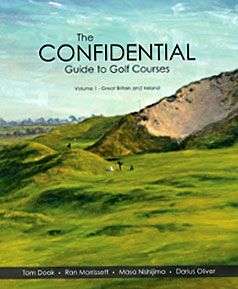
The Confidential Guide revealed
Tom Doak’s updated “Confidential Guide” book: a Scottish perspective
The updated version of Tom Doak’s cult golf book “The Confidential Guide to Golf Courses” will be released in five volumes, the first of which has just been published. For those who don’t know, earlier editions of The Confidential Guide – where Doak reviews and marks courses on a scale of 0 to 10 – change hands for substantial amounts of money amongst acolytes of the minimalist designer.
Along with Ran Morrissett (founder of the Golf Club Atlas website), Darius Oliver (writer and publisher of the Planet Golf books) and Masa Nishijima (long-time international consultant at Top 100 Golf Courses and author of Analysis of a Golf Course), Doak now aims to rate and critique more than 2,000 golf courses around the world, the first 289 of which, in Great Britain and Ireland, appear in Volume 1.
There’s quite a bit to digest in this particular volume, so we thought it might be worth having an initial look at the book from a more specific Caledonian perspective, leaving an examination of the other countries for future articles.
The original Confidential Guide first appeared in 1988, when 53 of the layouts assessed by Tom Doak were located in Scotland. The new revised edition of the book almost doubles the number of courses that lie to the north of the border with England, adding all the top courses that have opened for business in the last quarter of a century, with three glaring exceptions.
Most prominent of these is Spey Valley in Aviemore, an exuberant Dave Thomas-designed layout that sits comfortably in the top half of our Scottish Top 100 chart. The exclusion of the other two courses is even more puzzling because the Fidraand Dirleton courses at Archerfield Links – currently number 32 and 39 in our Tartan Top 100 – are located immediately adjacent to Tom Doak’s only Scottish design at Renaissance Club in East Lothian, which is ranked above both its near neighbours at number 27 in Scotland. Cynics might speculate the absence of both Archerfield courses from the book is understandable due to commercial rivalry – we’d like to believe it was simply an oversight.
Actually, there are a number of other noteworthy courses that are also missing, three of them on the west coast at Glasgow (Gailes), Kilmarnock (Barassie) and Irvine (all of which have been used in the past as Final Open Qualifying venues) and the expansive parkland layout of Downfield in Dundee. The reason given in the book for leaving out Downfield (a former Scottish Open venue) was that it couldn’t be found after driving around for half an hour in search of it. A rather lame excuse surely?
In fairness, to counterbalance any controversy over leaving out (inadvertently or otherwise) those leading Scottish courses, the book does make reference to a raft of lesser layouts, such as Braid Hills, Peebles and Strathpeffer Spa. Also, dare I mention it, there’s even appraisals of other little-known courses, such as Braemar, Cullen and Dunaverty. Furthermore, several wee 9-holers – Carradale, Killin and Rosehearty amongst them – are also considered, so full credit to the authors for this depth of coverage.
As it’s perfectly entitled to, the new volume reappraises the “Doak scale” ratings that were originally given to more than a dozen Tartan tracks, with most of these layouts marked up one point from 3 to 4, 4 to 5 or 5 to 6. Nevertheless, eyebrows will be raised at three courses – Lundin, St Andrews (Jubilee) and Dunbar – which have jumped up 2 points from a 3 (“about the level of the average golf course in the world”) to a 5 (“well above the average golf course, but probably about the average among courses covered by this book”). If those ranking alterations are surprising, the three point jump of Shiskinefrom a humdrum Doak scale-2 (“a mediocre golf course with little or no architectural interest”) to a more than respectable 5 (where although “it’s certainly not everybody’s cup of tea… Shiskine is not to be missed”) might well have some people wondering if Arran was under a blanket of fog when the course was first visited.
Eighteen of the courses in the book have been selected for special attention, forming what’s been termed “The Gourmet’s Choice,” and five of these favourite tracks – all links layouts – are located north of Hadrian’s Wall: St Andrew’s (Old), Prestwick, North Berwick (West), Royal Dornoch (Championship) and, rather surprisingly, Askernish. These courses are described as “places that stir our souls, and will reward the visitor with something out of the ordinary”. Simply put, the authors think that they’re “courses we would take a good friend to play”.
An eclectic 18-hole course for GB & I has also been assembled in the new Confidential Guide, with eight of the holes fashioned from Scottish links courses. The more predictable of these – No. 1 (“Battery”) at Machrihanish (Championship), No. 8 (“Postage Stamp”) on Royal Troon (Old), No.14 (“Foxy”) at Royal Dornoch (Championship) and No. 17 (“Alps”) on Prestwick – are joined by the par four 2nd on St Andrews (Old), the par five 6th at Carnoustie (Championship), the par three 13th at Muirfield and the par three 15th at North Berwick (West).
Individual holes on a number of courses attract criticism from the authors – the “uncomfortably American” 18th at Skibo Castle – Carnegie Club and the “ridiculous uphill par-3” 3rd at Gullane No.2 are two that spring to mind – but the most damning narrative is reserved for all 18 holes on the St Andrews (Castle) course, controversially awarded a score of 0 (“a course so contrived and unnatural that it may poison your mind”), where the considered opinion is that “trying to one-up Kingsbarns turned out to be a formula for excess”. Unnecessarily harsh words indeed for a modern layout that currently resides at number 22 in our national rankings for Scotland, only one position behind its illustrious stablemate St Andrews (New). Then again, it’s very fashionable amongst many in the golfing architectural fraternity these days to lambast just about anything the St Andrews Links Trust does.
Despite the gap of "local" European knowledge, the authors have, overall, performed a reasonable job from a Scottish golf course perspective. Ralph Thompson and the other golfing islanders on South Uist will no doubt be delighted to have their Askernish course lauded so loudly in the book. However, I'm doubtful that architects David J. Russell and David McLay Kidd will be overwhelmed.
Jim McCann
Editor
Top 100 Golf Courses of the World

Golf in the Heather and Gorse Author David Worley’s Guide to the Inland Courses of Scotland and England David Worley’s new book Golf in the Heather and Gorse is a follow up to his two previous titles, Journey through the Links and Another Journey through the Links, where the author wrote extensively about his playing experiences at virtually every links course in the United Kingdom and Ireland. This time around, he concentrates on the non-links layouts of Scotland and England, visiting seventy-seven of the finest parkland, moorland and heathland courses in both countries. Most of these top tracks are located far from the coastline on either side of Hadrian’s Wall but the journey begins by the seaside in East Lothian at The Glen, which “occupies a spectacular piece of cliff-top land”. It’s not the only coastal layout to feature in the book as Worley plays four of the seven courses on the Isle of Arran and he also tees it up at Carlyon Bay in Cornwall – where “the golf course runs along the coastal cliffs” – for his penultimate round of golf. In Scotland, there’s a good mix of courses, with older established tracks such as the Kings’s and Queen’s at Gleneagles rubbing shoulders with modern layouts like The Carrick at Loch Lomond and Spey Valley in Aviemore. Boat of Garten (“fun to play but not a place for wild hitters”) and Ladybank (“challenging without being too difficult”) are amongst a number of second tier courses that also receive well deserved recognition. It’s good to see the book feature less well known Caledonian tracks like Strathpeffer Spa (a “beautiful Highland gem”) and the lovely 9-holer at Carradale (“an enjoyable little sporty course”), though excluding both Letham Grange (Old) and Lanark is a definite oversight. Furthermore, to not include at least one of the marvellous Renfrewshire moorland tracks at East Renfrewshire, Ranfurly Castle or Kilmacolm can only be regarded as another slip-up. After tackling thirty-three courses in Scotland, the author travels south of the border to continue his inland quest. Starting with Alister McKenzie’s Alwoodley in Yorkshire then progressing through to James Braid’s redesign at Berkhamsted in Hertfordshire, his golfing exploits along the spine of England in the chapter “From Leeds to London” only serves to whet the appetite for what follows on the heathland layouts to the south of the capital. The unrelenting quality of the golfing fayre in this region is simply stunning, stretching from Swinley Forest in Berkshire, through the Old and New courses at Sunningdale in Surrey to West Sussex in the county of Sussex. And with a lavish array of photographs to accompany the text, the reader is offered a uniquely personal and intimate insight into what’s it like to play these wonderful layouts, which is ideal for golfers planning a visit or just reliving similar playing experiences they’ve already had. The 44-course English portion of the tour tapers off nicely as the author plays the last of the big hitting layouts then moves along the World Heritage Jurassic Coast and into Cornwall, where he concludes his inland golf trail at Tehidy Park, an inauspicious parkland track located north of Camborne. David Worley’s travels are not quite the golfing equivalent of an epic John o’ Groats to Land’s End trek but they’re not that far wide of the mark. In the foreword, the respected 5-time Open Champion Peter Thomson calls the book “a precious document that shows off Britain’s treasures of the game of golf” and that’s a sentiment which Top 100 Golf Courses wholeheartedly endorses. Golf in the Heather and Gorse can be purchased via Amazon. Click the preceding link or the book cover image for full details. Jim McCann Editor Top 100 Golf Courses
Scotland's national championship returns to East Lothian for another spectacular week of links golf, where the world's elite battle for glory just days before The Open Championship. The Genesis Scottish Open has evolved into one of the sport's must-attend events, combining championship pedigree with Scotland's incomparable golfing heritage. Tournament Overview – Why This Event Matters The Genesis Scottish Open represents the perfect confluence of tradition and modern excellence. Since becoming a co-sanctioned PGA Tour and DP World Tour event in 2022, the tournament attracts the strongest fields outside major championships, with eight of the world's top-10 players regularly competing. The £6.5 million ($9 million/€8.5 million) purse reflects the tournament's elevated status, with the champion claiming approximately £1.1 million ($1.59 million/€1.5 million). The event's timing creates unique drama as players fine-tune their links skills just days before golf's oldest major. From 1987 onwards, the Scottish Open has provided crucial qualifying spots for The Open, with the top three finishers not already qualified earning their place in the championship. This dual purpose elevates tension as players balance tournament ambitions with Open preparation. The 2026 edition unfolds July 9-12 at The Renaissance Club, marking the eighth consecutive year the East Lothian venue has hosted Scotland's national championship. The co-sanctioned status means results count on both the DP World Tour Rankings and FedExCup. Tournament History & Heritage The Scottish Open began in 1972 when Neil Coles defeated Brian Huggett in a playoff at Downfield Golf Club in Dundee. The inaugural championship offered £10,000 in prize money with a £2,000 first prize. After just two editions, including a 1973 St Andrews playing won by Graham Marsh, the tournament disappeared when television coverage couldn't be secured for 1974. The event returned in 1986 as Bell's Scottish Open at Haggs Castle, effectively replacing the Glasgow Open. The tournament moved to Gleneagles in 1987, establishing its week-before-The-Open slot that remains crucial to its identity today. The tournament's modern era began with another shift in 1997. The Loch Lomond World Invitational moved to the week before The Open, taking over the Scottish Open's traditional slot. In 2001, organisers resolved this by retroactively designating all Loch Lomond events as Scottish Opens, creating the unusual situation of two "Scottish Opens" in 1996. From 2001 to 2010, the tournament flourished at Loch Lomond under Barclays sponsorship, though concerns emerged that the parkland course disadvantaged European Tour players compared to PGA Tour rivals who practiced on links courses before The Open. The championship embarked on a nomadic phase, visiting Castle Stuart (2011-13, 2016), Royal Aberdeen (2014), Gullane (2015, 2018), and Dundonald Links (2017). The tournament found its permanent home at The Renaissance Club beginning in 2019, scheduled to host through 2026. The transformative moment arrived in 2022 when the Scottish Open became the first tournament co-sanctioned by both the PGA Tour and DP World Tour, with Genesis Motor assuming title sponsorship. This historic alliance created the strongest non-major fields in professional golf. Recent Champions Ian Woosnam claimed three titles between 1987 and 1992, the most in tournament history. Colin Montgomerie's 1999 victory marked the last Scottish triumph until Robert MacIntyre's emotional 2024 win. MacIntyre sank a lengthy birdie putt on the final hole to defeat Adam Scott by one stroke, becoming the first Scottish winner in 25 years. Recent champions include Austrian Bernd Wiesberger (2019), England's Aaron Rai (2020), Australia's Min Woo Lee (2021), America's Xander Schauffele (2022), and Northern Ireland's Rory McIlroy (2023). All six Renaissance Club champions hail from different countries. Notably, Schauffele remains the only American winner since the event moved to North Berwick in 2019. Championship Courses The Renaissance Club The Renaissance Club represents a fascinating chapter in modern golf architecture. The course emerged when the Sarvadi family from Texas encountered an associate in Pinehurst who inquired whether they'd be interested in building a course in Scotland. Tom Doak designed the course, though he initially hesitated. The property sits between Muirfield and North Berwick, two of his favourite Scottish courses. The original site lacked the dramatic topography of his celebrated designs at Pacific Dunes, Cape Kidnappers, and Barnbougle. What convinced Doak was understanding that Scottish golfers would judge the course solely on playability and strategic interest rather than visual drama. The property featured an unusual characteristic for a Scottish links – 300 acres of pine and sycamore trees planted by Britain's Forestry Commission after World War II. Construction required clearing over 8,000 tonnes of wood, revealing pure sand beneath. Doak strategically retained some trees, creating definition whilst maintaining the character. A land swap with neighbouring Muirfield proved transformative. The Renaissance Club owned woodland adjacent to Muirfield's eighth green, whilst Muirfield controlled the dramatic coastal dunes to the north. The clubs negotiated an exchange, with Muirfield repositioning its ninth tee for the 2013 Open Championship, whilst The Renaissance Club gained permission to extend into spectacular coastal dunes. The resulting stretch of holes 10-13 creates the course's most dramatic sequence. Since hosting the Scottish Open, the course has undergone continuous refinement, with player consultant Padraig Harrington working alongside Doak to enhance the championship test. The layout features an unusual configuration for par-70 courses: ten par-4s, five par-3s, and three par-5s. The course demands precision and length, with six of the ten par-4s stretching beyond 465 yards. Firm, fast fescue fairways require control off the tee, whilst massive, undulating greens challenge even the world's best. Weather dictates scoring dramatically – winning scores have ranged from 18-under in calm conditions to 7-under when coastal winds gust above 20 mph. The course measures 7,303 yards from the championship tees. What Doak created isn't an American course transplanted to Scotland, but rather a respectful tribute to Scottish links golf designed by Americans. Historic Venues: The Tournament's Nomadic Heritage Downfield Golf Club, Dundee (1972) – The birthplace of the modern Scottish Open hosted the inaugural championship, though it never returned to the rota. Old Course at St Andrews (1973) – Graham Marsh claimed a dominant six-stroke victory in the tournament's only appearance at golf's most sacred venue. Gleneagles (1987-1994) – The King's Course hosted the tournament for eight consecutive years, establishing the event's modern identity with extensive BBC coverage. Carnoustie (1995-1996) – The championship moved here for two years without a title sponsor, struggling financially during this period. Loch Lomond (1996-2010) – The parkland gem hosted fifteen editions. The course's beauty attracted top-60 world ranking players, though critics argued parkland golf poorly prepared players for The Open's links challenges. Castle Stuart Golf Links (2011-2013, 2016) – The modern links near Inverness provided spectacular coastal golf. The 2011 edition was reduced to 54 holes due to flooding from heavy rain. Disappointing 2016 attendance figures (declining to just 41,809) suggested the remote Highland location challenged commercial viability. Royal Aberdeen (2014) – The ancient links hosted a single edition. Gullane Golf Club (2015, 2018) – The East Lothian venue's No. 1 course hosted twice, foreshadowing the tournament's return to the region. Dundonald Links, Ayrshire (2017) – The inaugural Rolex Series edition, with prize money jumping to $7 million. The Renaissance Club (2019-2026) – The East Lothian venue has hosted since 2019, scheduled to remain through 2026. The American-owned private club initially faced resistance from Scottish authorities concerned about public access. The Sarvadis made accommodations allowing more British and Scottish golfers to play, securing tournament hosting rights. Championship Experience: Tournament Week Tournament week combines world-class golf with Scottish hospitality. The 2026 edition promises spectacular fields as players make final preparations for The Open Championship at Royal Birkdale. Expect eight or more of the world's top-10 players. General admission tickets provide roaming access across the course. The par-3 17th hole, with its coastal setting and elevated tee, creates natural amphitheatre viewing. The par-5 16th hole's risk-reward dynamics often produce tournament-defining moments. Premium hospitality experiences elevate the week significantly. The Green on 18 provides outstanding views of the finishing hole from a greenside terrace with all-inclusive food and beverage service. Corporate hospitality packages typically include guaranteed seating, premium dining, and appearances by golf personalities. The tournament's atmosphere reflects Scotland's passionate golf culture. Robert MacIntyre's 2024 victory created emotional scenes rarely witnessed in professional golf, with thousands of fans erupting when his final putt dropped. Scottish crowds welcome all players whilst maintaining particular fondness for underdogs and anyone displaying traditional golf values. Edinburgh's proximity transforms tournament attendance into cultural adventures. Visitors experience world-class golf during the day before returning to Edinburgh for evening dining and entertainment. Many structure trips around morning golf viewing, afternoon Edinburgh exploration, and evening tournament returns. East Lothian benefits from a notable microclimate, receiving significantly less rainfall than surrounding regions. July typically provides excellent conditions, though Scottish weather remains famously unpredictable. Pack waterproofs and layers regardless of forecasts. The Renaissance Club sits approximately 33 kilometres east of Edinburgh, easily accessible by car with ample free parking. Public transport includes trains to North Berwick followed by short taxi rides or tournament shuttle services. Golf Nearby During Tournament Week East Lothian's extraordinary concentration of championship courses transforms Scottish Open week into golf's ultimate playground. The region referenced in the Edinburgh & East Lothian Golf Travel Guide provides unmatched variety within remarkably compact geography. Premier Championship Venues Muirfield – Scotland's premier championship venue sits adjacent to The Renaissance Club. The famous two-concentric-circles routing ensures golfers face different wind directions on every hole, creating unmatched strategic complexity. Booking requires two to three years' advance planning. Green fees approximate £340 (€400/$450). The course demands caddies and proper introductions. North Berwick Golf Club – The region's number-two course ranks amongst Scotland's most beloved venues, renowned for quirky character and stunning clifftop holes. The famous Redan hole has inspired copies worldwide. Green fees approximate £200-250 (€235-295/$275-325) depending on season, with advance booking essential. Gullane Golf Club – Championship golf across three distinct courses. Gullane No. 1 hosts major qualifying events and offers stern links examination. No. 1 commands approximately £180-200 (€210-235/$245-275), whilst Nos. 2 and 3 provide outstanding value around £60-100 (€70-120/$80-135). Dunbar Golf Club – Outstanding value for championship-quality links. Green fees approximate £80-100 (€95-120/$110-135), making it accessible for multiple rounds during tournament week. Hidden Gems and Alternative Options Luffness New Golf Club – This former Open qualifying venue offers pay-and-play access with championship-level golf. Perfect for afternoon rounds or spontaneous golf. Green fees range £70-90 (€85-105/$95-120). Gullane No. 3 – Outstanding value within the championship venue category. Often overlooked, favouring the famous No. 1 course, it delivers excellent greens and stunning views. At approximately £45-60 (€55-70/$60-80), it provides a championship-venue experience at municipal pricing. The Glen Golf Club – North Berwick's hidden gem. The nine-hole course commands approximately £30-40 (€35-50/$40-55) and provides charming golf with spectacular coastal views, perfect for late-afternoon rounds. Musselburgh Links Old Course – Extraordinary historical significance as one of golf's original venues, hosting The Open Championship six times in the 19th century. The nine-hole course allows visitors to experience golf history, particularly enjoyable with traditional hickory clubs. At approximately £20-25 (€25-30/$25-35), it offers incomparable value. Archerfield Links – The modern resort features two championship courses (Dirleton and Fidra) designed by DJ Russell. Green fees around £150-200 (€175-235/$200-275) including excellent practice facilities. Kilspindie Golf Club – Traditional nine-hole links adjacent to Aberlady Bay provides charming golf in pastoral setting. Approximately £25-35 (€30-40/$30-45) for 18 holes. The region's compact geography means nowhere sits more than 30 minutes from The Renaissance Club, enabling seamless transitions between playing and watching championship golf. East Lothian's Culinary Scene East Lothian's dining landscape now matches its golfing excellence with culinary sophistication whilst maintaining traditional Scottish hospitality. Fine Dining and Gastropubs The Bonnie Badger in Gullane stands as the region's culinary flagship. The Tom Kitchin gastropub delivers Michelin-quality food in relaxed atmosphere perfectly suited to golf groups. Locally sourced ingredients showcase Scotland's exceptional produce, whilst the extensive whisky collection provides proper education in Scotland's national spirit. The restaurant welcomes golf attire. Mains range £18-32 (€21-38/$25-42). Booking essential, particularly during tournament week. The New Mallard in Gullane provides excellent dining in comfortable hotel setting. The restaurant focuses on Scottish ingredients prepared with modern techniques. The bar welcomes golfers for casual dining and post-round drinks. Nether Abbey Hotel in North Berwick combines comfortable accommodation with quality dining. The restaurant emphasizes Scottish seafood, with daily fresh catches featured prominently. Traditional Scottish Fare Fish and chips remain exceptional throughout the region, with local establishments serving fresh catches from nearby waters. Traditional Scottish breakfasts provide perfect preparation for tournament viewing or morning golf rounds. Black pudding, haggis, and tattie scones may challenge unfamiliar palates initially, though most visitors quickly develop appreciation. Clubhouse Dining Championship courses throughout East Lothian maintain excellent dining facilities. Muirfield's lunch service forms part of the premium experience, whilst The Renaissance Club provides modern clubhouse dining with views over the links. Traditional venues like North Berwick maintain classic clubhouse atmosphere with hearty Scottish fare. Post-Round Drinks The 19th hole culture thrives throughout East Lothian. The Golf Inn in Gullane and The Auld Hoose in North Berwick exemplify this welcoming tradition. Explore Beyond Golf East Lothian and nearby Edinburgh provide exceptional variety for non-golfing partners or rest-day activities. Edinburgh Cultural Attractions Scotland's capital sits just 45 minutes from The Renaissance Club. Edinburgh Castle dominates the skyline, providing Scottish history spanning over 1,000 years. The Royal Mile connects the castle to Holyrood Palace, lined with historic buildings, museums, shops, and restaurants. The National Museum of Scotland offers free admission to world-class collections spanning science, technology, natural history, and Scottish heritage. Edinburgh's August festival season creates unprecedented cultural opportunities, with thousands of performances across all genres. Though not concurrent with the July tournament, many visitors extend trips to experience both golf and festivals. Golf Heritage Sites Bruntsfield Links provides free access to golf's original home. The adjacent Golf Tavern claims status as golf's first clubhouse, serving refreshments to golfers since 1456. Leith Links features historical markers commemorating early golf development. Natural Beauty and Coastal Attractions The John Muir Way provides 215 kilometres of walking paths showcasing dramatic coastal scenery. Tantallon Castle perches on clifftops overlooking Bass Rock, creating spectacular photographs. Dirleton Castle combines medieval ruins with championship gardens. Bass Rock, visible from several golf courses, hosts one of the world's largest Northern gannet colonies. Boat trips from North Berwick provide close encounters with over 150,000 seabirds. Whisky Experiences Glenkinchie Distillery near Pencaitland offers Lowland whisky tours showcasing the lighter, more delicate style distinct from Highland and Islay expressions. Edinburgh hosts numerous whisky bars, with The Scotch Whisky Experience providing educational tastings for beginners through to connoisseurs. Family Activities Edinburgh Zoo delights children with giant pandas, penguins, and extensive animal collections. Dynamic Earth combines science education with entertainment, exploring Earth's geological history through interactive exhibits. Scottish Seabird Centre in North Berwick provides family-friendly wildlife observation with remote cameras on Bass Rock. Frequently Asked Questions When should I book accommodation for the 2026 Scottish Open? Book accommodation immediately upon dates being confirmed. Hotels in North Berwick, Gullane, and Edinburgh fill rapidly once the tournament schedule is released, typically 9-12 months ahead. Edinburgh accommodation provides excellent alternatives with easy access via train or car. Consider staying in Edinburgh if combining tournament attendance with cultural activities, or base in Gullane for central access to East Lothian's golf courses. What's the best way to get tickets for the Genesis Scottish Open? General admission tickets typically go on sale 6-9 months before the tournament through the official DP World Tour website. Season tickets covering Wednesday pro-am through Sunday's final round offer the best value. Premium hospitality packages provide elevated experiences with guaranteed seating, inclusive dining, and enhanced amenities. Tickets sold out ahead of recent editions, so early purchase is essential. Prices typically range £25-75 (€30-90/$35-100) per day. Can I play The Renaissance Club during tournament week? The Renaissance Club is a private members' club with limited public access. During tournament week, the course closes for setup, competition, and recovery. Visitors seeking Renaissance Club golf should explore the "One Time Experience" package offered periodically, though availability remains extremely limited. Focus instead on the region's numerous other championship venues – Muirfield, North Berwick, Gullane, and Dunbar all provide comparable quality. What are the best nearby courses for visitors during Scottish Open week? North Berwick Golf Club offers the perfect combination of quality, character, and proximity. Gullane's three courses provide options for all budgets. Dunbar presents outstanding championship links at accessible pricing. For spontaneous rounds, Luffness New accepts pay-and-play bookings. The Glen provides charming nine-hole golf perfect for evening rounds. Budget-conscious visitors should explore Gullane No. 3 and Kilspindie, both delivering authentic links golf under £60 (€70/$80). Book all courses well in advance during tournament week. Plan Your Scottish Open Experience The Genesis Scottish Open represents golf at its finest – world-class players battling on championship links in golf's spiritual homeland just days before The Open. The tournament's elevation to co-sanctioned status ensures fields rivalling major championships, whilst Scotland's warm hospitality and East Lothian's golfing riches create experiences extending far beyond tournament attendance. Start planning by securing accommodation and tournament tickets well in advance. Edinburgh provides excellent basing options for combining golf with culture, whilst Gullane and North Berwick offer an intimate village atmosphere. Research East Lothian's championship courses and book tee times as early as possible – Muirfield requires 2-3 years advance booking, whilst venues like North Berwick and Gullane typically need several months for summer dates. Transportation planning proves crucial. Rental cars provide maximum flexibility. Edinburgh Airport sits approximately one hour from The Renaissance Club, with straightforward access via the A1 coastal route. Train services connect Edinburgh to North Berwick in 20 minutes. Weather preparation cannot be overstated. Pack quality waterproofs, wind protection, layers, and sun protection. July typically delivers excellent conditions, though Scottish weather's unpredictability means experiencing four seasons in one day remains entirely possible. Equipment considerations include proper golf attire for any rounds booked. Championship courses offer caddie programmes. Muirfield strongly recommends caddies, whilst The Renaissance Club requires shared caddies for unaccompanied visitors. Carry handicap certificates for courses requiring formal introductions. Balance spectating with playing. Consider morning golf followed by afternoon tournament attendance, or reverse based on tee time availability. The compact geography enables seamless transitions. Build rest days into ambitious schedules for Edinburgh cultural exploration or coastal walks. Dining reservations merit advance attention, particularly at premier establishments like The Bonnie Badger. Tournament week sees restaurants fully booked. Embrace Scotland's pub culture for casual dining, where excellent food and warm welcome await without reservations. Budget appropriately. Tournament tickets, championship green fees, quality accommodation, and dining create significant expense. However, the region offers remarkable value opportunities. Combining premium courses like North Berwick with excellent value venues like The Glen or Luffness New maintains high quality whilst controlling costs. Explore the comprehensive course information and booking resources at Top100GolfCourses.com, where detailed reviews, ratings, and practical information help optimise East Lothian golf planning. The Genesis Scottish Open 2026 promises unforgettable golf in an unparalleled setting. Scotland's national championship has achieved remarkable heights, now attracting the sport's biggest stars whilst maintaining its authentic Scottish character. Combined with East Lothian's extraordinary concentration of championship courses, Edinburgh's cultural riches, and Scotland's legendary hospitality, the tournament week offers total immersion in the sport's heritage at its spiritual home.
Top 100 Golf Courses of Britain & Ireland 2014 Our latest Britain & Ireland Top 100 ranking list is unveiled 16th December 2013 We are thrilled to announce our latest 2014 Britain & Ireland Top 100 rankings. We’ve actually whittled our shortlist down this time round because it was taking far too long to research more than 500 courses, the majority of which were never serious contenders for this stellar chart. The top of the table has hardly changed at all and the top six remain in exactly the same positions as 2012. In total, nine courses in our Top 20 remain in the same spots as last time – this is in complete contrast to 2012 when no fewer than seventeen courses in the Top 20 moved position. The skirl of bagpipes at the unveiling of Trump International Golf Links back in July 2012 is now a dim and distant wail. We featured this high profile course on the Top 100 website soon after it opened, but inevitably our biggest challenge focused on where to rank this new kid on the block alongside two favourite classics: Royal Aberdeen (Balgownie) and Cruden Bay. I’ve already gone on record and expressed my utter surprise at a UK golf magazine that claims “definitive rankings by the people who know”. In a moment of excitement they decided to rank Trump’s new Scottish debutant at position eight in their 2012 Britain & Ireland chart – the highest new entry in the magazine’s Top 100 history. Where they ranked the course does not concern me, the fact they ranked it two months before it opened for play caused my eyebrows to involuntarily raise. Anyway, eighteen months later I can tell you that Trump Golf Links is also our highest new entry, straight in at 31st. It is possible that if the playing surfaces at Trump Golf Links firm up, it could be the highest climber in our 2016 rankings. The Carnegie Club at Skibo Castle narrowly missed out in 2012, so we’re pleased to welcome another Scottish links to our 2014 Britain & Ireland chart. Straight in at 61st, Skibo now offers limited tee times on special request. Hats off to Tom Mackenzie (Mackenzie & Ebert) and David Thomson (Skibo’s Director of Golf) who turned this course around. According to one reviewer: “The shift from 2006 to 2008 and then to the current day is dramatic. Where as in 2005 (when I first visited) Skibo was a magnificent Highland hospitality experience with an interesting golf course as a sideshow, the course now stands up in its own right.” There’s a third and final Scottish new entry, straight in at 84th, and you won’t be surprised to hear it’s another links. We first played The Renaissance Club in April 2008, shortly after it opened and our Editor and Scottish Correspondent, Jim McCann, commented: “Doak’s understated touch is a real joy to behold and it raises the bar of golfing excellence along this [East Lothian] coastline yet another notch higher.” There’s a happy return to our 2014 Britain & Ireland Top 100 for Remedy Oak and Moortown, but it gives me great pleasure to announce one more brand new entry, this time from the Emerald Isle. Please raise a glass of Guinness and let’s hear it for Ballyliffin’s Old course. Many golfers believe that Ballyliffin is Ireland’s premier 36-hole complex. The wonderful Glashedy course is knocking on a Top 50 place in Britain & Ireland and with the Old course debuting at position 100, who would argue? According to one reviewer: “Out of the two superb courses at Ballyliffin this [the Old] just nudges it for me. There’s something about the more traditional linksy feel with its numerous bumps and hollows that bring a smile to the face on every hole.” In general terms, Scottish courses fared well in our new rankings, with Duke's St Andrews climbing nine. However, English courses found the going rather more challenging. Irish courses held firm but Welsh courses dropped back a little, compounded by Celtic Manor’s Twenty Ten dropping off the list. A few English courses however made significant upward moves, including Alwoodley (up 12), Hankley Common (up 17) and Broadstone (up 10). The Marquess and Duke’s courses at Woburn both go up nine places. In Ireland the dramatic Old Head may divide opinion but its upward move of thirteen places is, in my humble view, deserved. Lough Erne in the north also makes a positive upward move of nine places. We always welcome feedback, so please feel free to let us know what you think of our latest 2014 Britain & Ireland Top 100. We won’t claim to be “definitive” but we do like to think that we’re the most “informed” and considered golf course rankings in the business. If you’ve played any of our featured courses, we’d love to know what you think, so why not post a course review or two? Keith Baxter Editor-in-Chief www.top100golfcourses.com Click to explore in detail our new 2014 Britain & Ireland Top 100 For those interested, the six courses that made way for the new are: Trevose (Championship), Chart Hills, Celtic Manor (Twenty Ten), Lindrick, Panmure and New Zealand.

